1992 Rewind: Ablett Masterclass Delivers Cats Win

In the 25th anniversary of West Coast’s first premiership, recount the round-by-round story of the Eagles historic 1992 season.


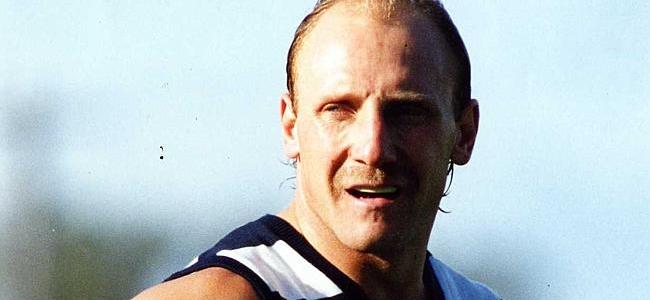
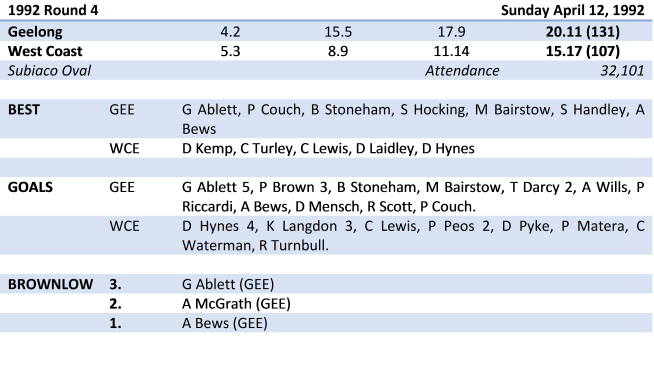
The Cats came to Perth and made away with the four points for the first time on the back of an Ablett-inspired performance.

Already revered in the competition as one of the superstars in the game, the Eagles crowd were treated to one of the finest individual displays in recent times.

Playing his 150th game, Ablett tallied 36 disposals, eight marks and booted five goals as Geelong recorded a 24 point victory. Ablett was purely unstoppable as the Eagles match committee spent the majority of the game trying to find a match-up to quell his influence.

Guy McKenna had had the wood in recent times, but came into the game under an injury cloud and struggled to contain the star Cat. Ablett rotated between the midfield and half-forward and spent time opposed to a range of players. Chris Mainwaring, Craig Turley, Dean Laidley and John Worsfold all tried in vain to halt Ablett but to no avail.

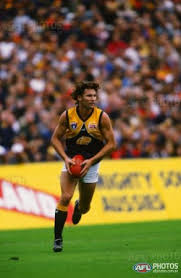
While Ablett was the clear standout in the match, he had good support from fellow midfielders Paul Couch (26 disposals) and Mark Bairstow (22). Dean Kemp was once again the best for West Coast with 24 possessions, while Craig Turley and Chris Lewis both collected 23 with Lewis also about to boot two goals.

West Coast finished the game ahead in most of the key statistics, even finishing with more scoring shots, but an 11-goal quarter from the Cats proved to be the difference. In a fast start, the Eagles led by 7 points at the first change with five goals to four, before the visitors went rampant in the second term. The Cats had nearly 100 points on the board by half time, and stormed to a 38 point lead on the back of Ablett’s brilliance.

Cats coach Malcolm Blight was full of praise for Ablett as Geelong were able to level the ledger. “Gary, along with a lot of other good players, obviously was terrific. He’s enjoying his footy – I think that’s the key to him and most players.

“That terrific second quarter obviously set the game up for us.”

With temperatures soaring beyond 30 degrees on the sunny April afternoon, the Eagles were always going to struggle to overcome the deficit, and whilst they had the better of the game in the second half, the final margin of 24 points was as close as they could get.

The Eagles stuck with the same side that defeated the Saints a week earlier, with Peter Sumich and Brett Heady still unavailable through injury. Sumich had served his two week suspension to start the season and was set to return but an ankle injury suffered during the week at training left the full-forward on the sidelines. Heady was touch-and-go for the Geelong game, but ultimately was given one more week to recover from his hamstring injury a fortnight earlier against the Swans.

The Cats had opened their season with losses to the Hawthorn and Melbourne, but registered their first win of the season the previous week with a 126 point thumping of the hapless Tigers. Geelong still made two changes with Andrew Wills coming into the side, along with first-gamer Peter Riccardi. The Cats prime mover, Garry Hocking, was initially brought into the line-up after missing the Richmond win due to a hip complaint, but was a late withdrawal following a freak accident where a bin broke his ankle. His misfortune paved the way for Riccardi to make his AFL debut.

Bill Brownless and Damian Bourke were also left out of the Cats side, despite Bourke being best on ground for the VFL side the week before. Geelong coach Malcolm Blight opted for the mobile duo of Steven Handley and Barry Stoneham in the ruck, and the move paid dividends.

The Geelong combination proved too strong for Paul Harding and when the floodgates opened in the second term, the Eagles defence were helpless. Barry Stoneham in particular proved too strong both up forward and provided the strong target that West Coast were missing at the other end.

The Eagles forward line was barely functional, although their cause wasn’t helped by an underperforming midfield who crumbled under the Cats pressure. Chris Mainwaring and Peter Matera were both below their best on the wings while Dwayne Lamb also lacked impact through the middle of the ground.

David Hynes moved to full-forward after half-time and booted four second half goals, but Daniel Metropolis and Paul Peos both struggled to have an influence after being match-winners in Round 3. For Metropolis it was a giant fall from grace – after booting four goals in the opening quarter in his debut, Cats defender Steven Hocking clamped down on the rookie restricting him to just three kicks for the game.

While disappointed with his side’s performance Malthouse opted to look forward, with the Eagles set for a crucial month in their premiership aspirations. The Eagles were due to travel for their next three games, to the Gold Coast, Melbourne and Tasmania, and while the opposition were sides they would normally expect to beat, Brisbane, Richmond and Fitzroy had all shown good form in the early weeks of the season.

The Eagles were then to host the Bulldogs, who had started the season in fine form winning three of their first four games. “That month of football will probably determine where we finish – it’s as simple as that.”
199204WCEGEE

1992 Rewind: Metropolis Six Sinks Saints

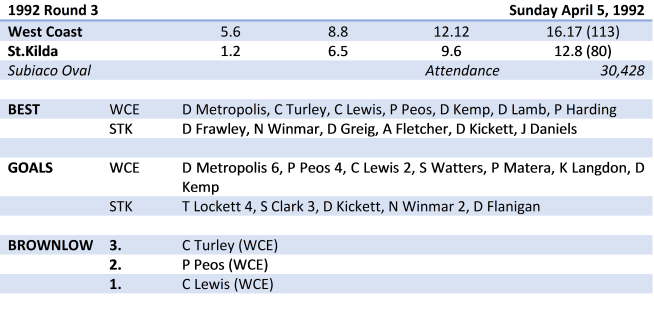
Rookie Daniel Metropolis made a stunning AFL debut to lead West Coast to their first win of the season over St.Kilda. The Eagles first selection from the 1991 National Draft kicked six goals, including four in the opening term, as the Eagles secured a 33 point win.

Shocked by a three-point loss to the lowly Swans in Round 2, the Eagles made a raft of forced and unforced changes. With Peter Sumich still suspended and Brett Heady sidelined during the week, Karl Langdon and Paul Peos were brought in along with Metropolis to improve the forward line firepower, while Paul Harding made his club debut, replacing Dean Irving who was severely outpointed against the Swans.

Harding’s omission against the Swans was a surprise and his impact was instant as the Eagles midfield took full control of the stoppages. John Worsfold was a surprise starter in the centre square but it gave the Eagles a harder edge for the contest than they had against the Swans, winning the centre clearances 7-1 in the opening term.

While Malthouse had been willing to throw his side around in response to the poor performance the week before, the biggest shock came from the opposition when they selected Dale Kickett for his Saints debut. Kickett had been drafted by the Saints in the off-season, but had opted to stay in Western Australia to continue his career with Claremont.

The Saints though included him in their side to tackle West Coast, despite the fact Kickett hadn’t even stepped inside Moorabbin, let alone met any of his new teammates. Kickett ultimately played against the Eagles, who had delisted him after just one season at the end of 1990. Kickett was one of the Saints best with 21 disposals and two goals, but his return to AFL football paled in comparison to the arrival of Metropolis.

Metropolis had put his name forward for selection after a nine-goal haul in a practice match against Sydney in the pre-season, but no-one at the ground including Saints coach Ken Shelden or defender Craig Davenport could have anticipated his blazing start.

Metropolis booted his first goal 40 seconds into the game after a strong mark on the lead at the edge of the 50m arc. Before the quarter was done, the rookie had booted three more, with his first four kicks in the AFL all resulting in majors. Paul Peos had booted the Eagles fifth for the term, and West Coast had stormed to a 28 point quarter-time lead.

Questioned after the previous week’s loss, the match committee selections were all working in the Eagles favour. Andrew Lockyer returned to the line up to mind Saints superstar forward Tony Lockett and Dwayne Lamb finished as one of the leading ball-winners for the Eagles with 25. Lockett had booted ten goals in the opening two weeks of the season, and while he finished this game with four, his influence in the forward line was minimal.

Glen Jakovich contained Stewart Loewe, and with ruck Paul Harding dropping back to fill the space, St.Kilda struggled to score with their two main avenues well held. At the other end, Metropolis booted his fifth early in the 2nd quarter, as historians started making comparisons to Essendon great John Coleman’s debut bag of 12.

Ken Sheldon finally made the change, moving Jayson Daniels onto Metropolis and switching Davenport onto Peos. Metropolis could only manage one more goal for the afternoon, but Peos stepped up during the second half, with the unlikely duo combining for 10 goals.

Sheldon’s moves stemmed the Eagles charge after quarter time, but many of the Eagles midfielders were winning the battle against their Saints opponents. Chris Lewis was displaying his best 1990 form despite the close checking tag of Stephen Newport, Craig Turley was finding plenty of the ball after a disappointing showing against Sydney and Dean Kemp was also prolific through the centre.

The Saints though managed to stay within reaching distance of West Coast, mainly on the back of the individual performances of Nicky Winmar across half-forward, and the miserly defence of Danny Frawley who was shutting down Karl Langdon.

Winmar, in his 100th game, finished with two goals from 18 disposals and provided the highlight of the day for St.Kilda with a spectactular aerial mark over Chris Waterman.

The Saints had held West Coast after quarter time, and when they booted the opening goal of the final term, the margin was just 18 points. The Eagles finally broke the Saints defensive resistance with four quick goals, two of which were kicked by Chris Lewis after Mick Malthouse moved him to full forward.

The win levelled the Eagles season to 1-1 and snuck them back inside the top six ahead of a visit from the Cats.

199203WCESTK

1992 Rewind: Eagles Swan Dive

It took 14 weeks of the 1991 season for West Coast to fall to their first defeat, but only two hours into 1992, coach Michael Malthouse’s pre-match warnings had rung true with a shock three point loss to lowly Sydney.

The Grand Finalists of 1991 were expected to start their season with a straight-forward win against one of the predicted strugglers of 1992, but the Swans showed far greater commitment for the contest and thoroughly deserved their victory.

The game, played on a sodden SCG ground that had been inundated with rain, saw multiple lead changes throughout the second half, but late in the final term West Coast held a 10 point lead which looked enough to earn victory.

However, Warren McKenzie and David Strooper both goaled to get the home side across the line, in Gary Buckenara’s first game as coach of the Swans.

The loss capped off an indifferent summer for West Coast, who had entered the season as premiership favourites, but endured a number of setbacks to key players in the lead up to their opening game.

With the Cricket World Cup dominating many of the football grounds around Australia, only four games were held in the opening round, meaning most teams started the year with a bye. This included West Coast and Sydney who kicked off their season in Round 2.

Despite the extra week, nearly half of the Eagles’ 1991 Grand Final side was missing through a combination of injury, suspension and poor form. Peter Sumich copped the wrath from the tribunal after he was cited by video for striking Mark Neeld in the Eagles second round Fosters Cup defeat to Geelong. He would be ruled out of the team’s opening two weeks along with Ashley McIntosh and Michael Brennan who were both sidelined with injury.

It had been an epidemic at the club for most of the summer. Peter Matera (ankle), Craig Turley (ankle) and John Worsfold (groin) were selected for the Sydney clash, but all had missed a large portion of the pre-season.

Despite the injury concerns, Malthouse still made a statement at the selection table, omitting several high-profile players who had underperformed in the pre-season. Karl Langdon, David Hart, Dwayne Lamb and Peter Wilson all paid the price and were sent back to the WAFL to earn their spots with the senior side.

As a result of so many players missing, a fresh bevy of young players were included. Jason Ball made his AFL debut, and Trent Nichols played his first game after crossing over from Richmond. Youngsters Mitchell White and Ryan Turnbull were also included, playing in just their 3rd and 10th game respectively. Dean Laidley was basically a new face as he made his return to AFL football after almost two years out following a knee reconstruction in 1990.

Despite taking a depleted side across to Sydney, West Coast were still expected to take care of the Swans who had battled their own turbulent off-season. Coach Col Kinnear had been given the boot after three uninspiring seasons, but the Swans would remain without a coach for the majority of the pre-season. Eventually, Gary Buckenara was handed the reins… mostly because there was no one else willing to take on the most unenviable task in football.

Then, marquee midfielder Greg Williams demanded a trade from the Swans, which ultimately saw him land at Carlton. Following his departure, an AFL investigation uncovered that the Swans had breached the salary cap with undisclosed payments made to Williams by one of their sponsors. Williams would be suspended for the first six games of his new club’s season, while the Swans were slapped with a $50,000 fine.

Further controversy surrounded the trade itself that was eventually a three-way deal between Sydney, Carlton and Fitzroy. The Blues agreed to sending Simon Minton-Connell to the Swans as part of the trade, but Minton-Connell wasn’t initially too keen. Eventually he relented and accepted his move to Sydney, as did former Fitzroy forward Darren Kappler.

Both players made their club debuts against the Eagles with vastly different outcomes. Minton-Connell lasted barely 10 minutes before going down with a knee injury, while Kappler would finish as one of Sydney’s best players.

A tight first quarter had Sydney with a slight edge before a six goal term to West Coast gave them the lead at the main change. The Eagles’ best quarter of the day was ignited by Matera’s inclusion into the midfield. Initially starting on the bench, an injury to Troy Ugle forced a reshuffle with Dean Kemp moved to a back pocket and Matera onto the ground.

The Swans were able to close the game down after half time and turn the contest into a dour affair, negating the Eagles runners on the small confines of the SCG.

While the Swans were the better side for most of the day, the Eagles could still consider themselves unlucky that they didn’t claim the four points. Brett Heady, by far the Eagles most productive forward on the afternoon, hit the post on three separate occasions during the second half, while a bizarre umpiring decision in the opening term also had ramifications on the final result.

Troy Ugle was pushed as he cleared the ball out of defence, and as the umpire blew the whistle, Eagles players were expecting to receive a free kick where the play had been. Instead, Guy McKenna was penalised and found himself on report for striking first-gamer David Strooper, who duly kicked the goal from the unusual situation. The error was realised once the game was completed and the charge against McKenna was withdrawn before it reached the tribunal.

But it did nothing to change the result, which left an incredulous Malthouse fuming.

Malthouse had warned his charges of over-confidence leading into the regular season, following two comfortable wins in practice matches played in Perth. The Eagles had defeated Footscray by 87 points and followed that up with a 137 point romp against Sydney, with neither side bringing across strong opposition. Rookie Daniel Metropolis had been the star in the Swans thrashing booting nine goals.

There were also questions over some decisions by the match committee with the non-selection of new recruit Paul Harding the most puzzling.

Stephen Lawrence had dominated the Eagles in the 1991 Grand Final, highlighting a lack of ruck talent on the Eagles list. The acquisition of a ready-made ruckman was high on the off-season priority list, with the Eagles trading in West Australian Paul Harding from St.Kilda.

However, with the Eagles opting for Dean Irving and debutant Jason Ball ahead of Harding, the same problems were shown up against the Swans. Mature age ruckman Brad Tunbridge dominated the stoppages in a best on ground display and provided the Swan midfielders with first use of the ball. Barry Mitchell, David Murphy and debutant Andrew McGovern all benefitted combining for 77 possessions, with McGovern also chipping in with two goals.

Dean Kemp was the leading ball-winner for West Coast with 28, while Matera and Chris Waterman – in his 50th game – collected 26. For West Coast, there were too few winners on the day, and too many players underdone which left Malthouse promising changes for the Eagles first home game against the Saints the next week.


1992 Round 2    

Sunday March 29, 1992

Sydney

4.3

7.6 11.10

14.14 (98)

West Coast

3.3

9.5 11.8

14.11 (95)

Sydney Cricket Ground
                                                                     Attendance                      9,325
 
BEST SYD B Tunbridge, B Mitchell, L Higgins, D Lewis, A McGovern, M Bayes, B Doolan
WCE B Heady, P Matera, C Waterman, D Kemp, D Hynes
 
GOALS SYD D Strooper 4, C Nettlebeck 3, A McGovern 2, B Mitchell, J Love, S Minton-Connell, J Lawson, W McKenzie
WCE B Heady, D Hynes 3, C Mainwaring, C Turley 2, T Nichols, P Matera, D Pyke, R Turnbull
BROWNLOW 3. B Tunbridge (SYD)
  2. L Higgins (SYD)
  1. P Matera (WCE)