
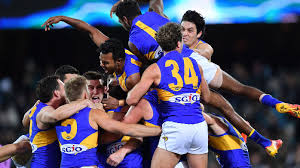
For the seventh consecutive season, the AFL Grand Final will feature a Victorian-based side against an ‘interstate’ side and the collective desire to keep the premiership cup in Victoria has once again been raised.
In a recent piece, with little relevant basis or historical understanding of the game, it was declared that all Victorians should set aside their ‘Collingwoodaphobe’ and barrack against West Coast for the pride of the state and of the game itself.
Here is why Victorians should actually embrace the Eagles and hope they can take away their fourth premiership.
You Actually Wouldn’t Hear From West Coast Fans
Unlike Collingwood fans who primarily reside in Victoria, being on the other side of the country means that Victorians won’t have to deal with who won the flag on a day to day basis. Instead Eagles’ fans will be far more occupied reminding the Dockers supporters who they work with, go to school with or live down the street from that West Coast have a fourth flag while the cupboard at Fremantle remains bare.
A West Coast premiership means Victorians can feel safe in that they won’t have to walk down Smith Street and be reminded by the black and white army that they are premiers once again. In fact, such is the Victorian ignorance of everything west of the border, that many football fans will quickly forget that West Coast even claimed the 2018 flag and will only hear the reigning premiers tag on the odd occasion we venture to the MCG next season, which will most likely be twice, tops!
West Coast Helped Victorian Clubs Stay Alive
It is a bit of a stretch to claim that West Coast should be despised for being an ‘expansion club’, when the real reason the club was formed was to inject much needed funds into an ailing competition. The majority of the 12 clubs during the 1980’s were on the brink of extinction. Fitzroy met their demise in 1996, but before that they, along with Footscray, Melbourne, North Melbourne, Richmond and even the beloved Hawthorn faced serious financial despair.
Unlike the introduction of Gold Coast and GWS Giants, where the AFL hopes to expand the competition into non-AFL strongholds, West Coast were established on the back of a strong history of state football in Western Australia. State of Origin matches through the 1970s and 1980s between the Vics and Sandgropers were some of the greatest games in living memory and only fuelled new rivalries at club level which first saved, then grew the game.
Bringing West Coast into the competition was the logical move to nationalise the game – not expand it – and the $4 million licence fee that the club were expected to stump up to join the league from 1987 went a fair way into padding up the coffers of the struggling Victorian sides.
A Couple Of Bad Years Is Not A ‘Questionable History’
The Eagles’ 2006 premiership has long been derided by opposition fans as tainted due to the drug culture that engulfed the club, tarnishing the reputation of many involved with West Coast at the time and creating a downward spiral for a number of premiership players including Ben Cousins, Daniel Chick and Chad Fletcher.
While no official positive tests or penalties were recorded, the internal and AFL investigations that took place led to changes in the fabric of the club and instigated many of the testing parameters that exist in the AFL environment today. A heightened focus in restoring the off-field culture brought about three years of on-field pain culminating in the clubs only wooden spoon in 2010
The West Coast Eagles of today are a far different brand from that of the mid-2000s with only Trevor Nisbett – who could survive an A-bomb, such is his ability to avoid culpability – a key figure who remains with the club. The fact is, the drug culture argument is no longer relevant.
Instead, if you were to judge a club by their off-field activities, the Collingwood rap sheet is far worse in recent years. Josh Thomas, who will take his place on Grand Final day, and Lachie Keeffe were both suspended for two years for testing positive to an illicit substance during the 2015 off-season, while Sam Murray is facing a potential four year ban for testing positive to an illicit substance on match-day earlier this season.
These incidents bookended the famous, or infamous, headline from the Herald Sun on the eve of the 2017 season reporting up to 11 Collingwood players were being investigated by ASADA for performance enhancing substances.
But as Bill Belichick once said, to live in the past is to die in the present and sport has proven across many decades to be the great forgiver. Tiger Woods is currently riding a wave of support in his building return in golf, South Africa were welcomed back into the world of cricket and the Russian soccer team and their people were celebrated at the World Cup, 18 months after the majority of their athletes were banned from the Rio Olympics. Muhammed Ali was the most hated person in America after being stripped of his boxing licence for being a draft dodger but is now celebrated as THE greatest of all time.
A few years of misconduct shouldn’t necessarily equate to a ‘questionable history’ and the Eagle players and administration of today shouldn’t be tarnished with the brush of those who did wrong in a previous generation.
West Coast Beat Richmond Too
Collingwood should be rightly applauded for their magnificent win over the Tigers in last week’s preliminary final, ending their run at back-to-back flags. However, the Magpies weren’t the only team to defeat Richmond this season. The Eagles accounted for Richmond in Round 9 to the tune of 46 points, knocking the Tigers out of top spot.
So if defeating Richmond is a reason to support a team, then the Eagles should also be considered in the argument. But not only did they defeat the Tigers, they also defeated Collingwood – twice! West Coast have long been questioned over their ability to win at the MCG, but ran out victors in the only home and away meeting between the two sides. The Eagles then followed up with a 16 point win in the opening week of the finals on the back of a final quarter surge.
If being anti-Richmond is a reason to support a team, then being anti-Collingwood should be just as compelling and the Eagles have three wins in 2018 over the two teams combined.
The Nathan Buckley Story Isn’t That Convincing
The narrative behind Collingwood claiming the 2018 flag is completion of a lengthy career with Collingwood for their coach Nathan Buckley. Twice as a player Buckley played on the grandest stage only to see his side go down in consecutive Grand Finals to Brisbane. While the former Collingwood captain claimed numerous individual awards – Rising Star, Brownlow, Norm Smith and multiple Copeland Trophies – the ultimate team prize proved elusive.
But things could have turned out so much differently for Buckley if he hadn’t reneged on a prior agreement to join North Melbourne. First drafted by the Brisbane Bears in 1993, Buckley agreed to spend one year in Queensland before joining the Kangaroos in 1994. However that all fell apart ahead of the next season with Buckley then choosing to join the Magpies. After a finals appearance in 1994, the Magpies would be irrelevant for a number of years, while North Melbourne would win two flags from three Grand Final appearances during the 1990’s and the Brisbane Lions would claim a historic three-peat in the early 2000’s. Ultimately, Buckley chose the third of two good options.
Further, Buckley was a key pillar in the poorly carried out succession plan, which saw Mick Malthouse outed after a 12 year stint that delivered one flag from four grand final appearances. The club had reached the pinnacle of the game a year earlier and had just lost the 2011 decider to Geelong when Buckley took over a squad that was seemingly set for a period of domination. Instead, the division between Malthouse and Buckley drained the squad and the Magpies slipped quickly into the bottom half of the ladder, where they have stayed for much of this decade. So is he really that great?
Conversely, Adam Simpson assumed the role of head coach at the Eagles following the departure of club legend John Worsfold, who had mentally burnt out of the role. Simpson guided the squad to a surprise Grand Final appearance in 2015 and once again has his side in the season decider despite many predicting the demise of both the coach and the club in 2018. Simpson may not have been at the club as Buckely has at Collingwood, but his commitment and connection with West Coast is second to none.
Both teams have had challenges this season and should be praised for reaching the final game of the year and Adam Simpson could rightfully claim to be as deserving to be standing on the premiership dais come the end of the game, as Nathan Buckley is.
Victorians may feel a sense of responsibility to support the Magpies and keep the premiership cup ‘home’ but unless you’re a diehard Collingwood fan, backing West Coast is surely the logical option.

 sportsphrase.blog