
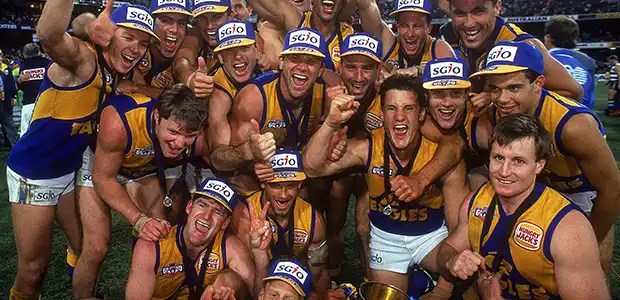
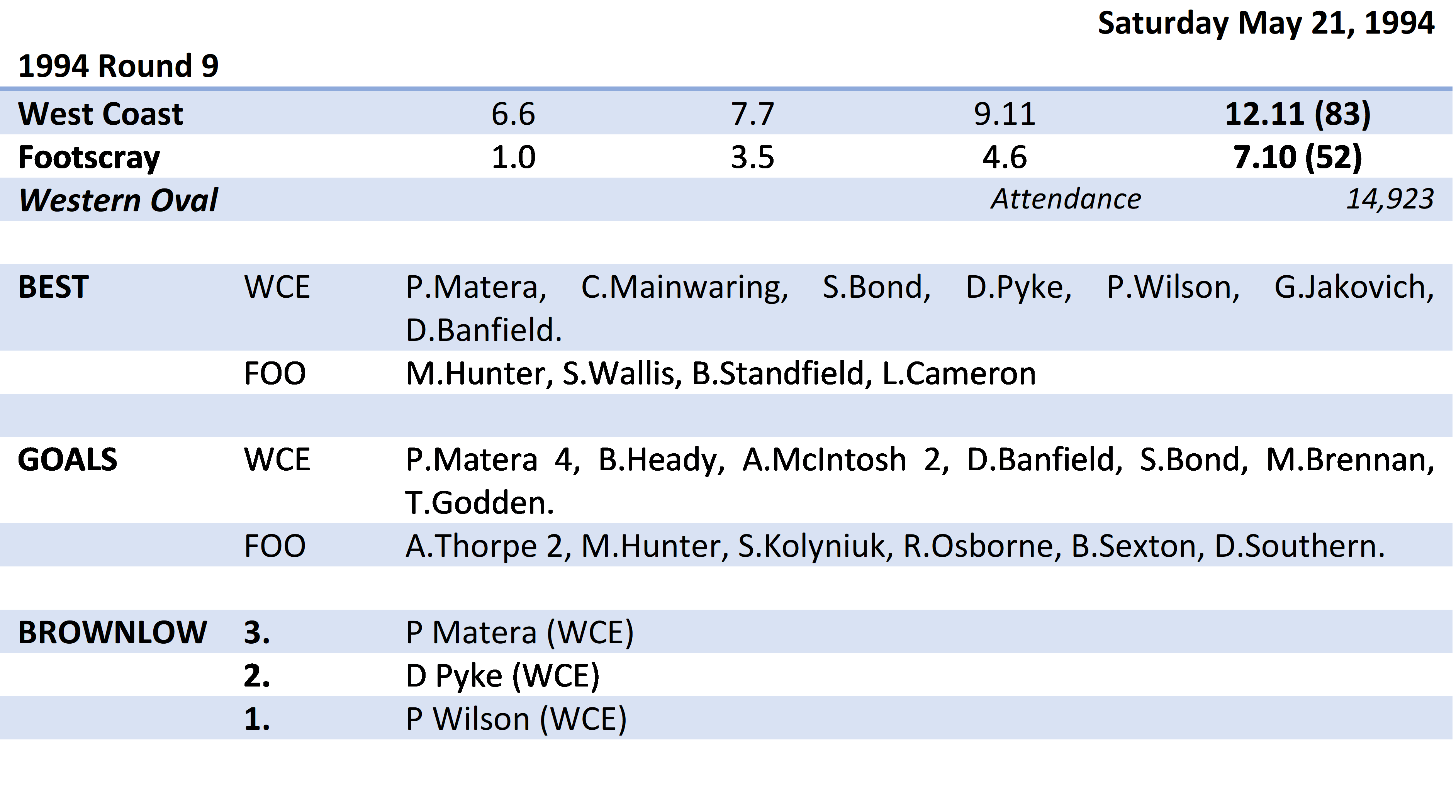
West Coast moved to outright premiership favouritism when they negotiated tricky conditions at the Western Oval to defeat Footscray by 31 points.
After a quiet month, Peter Matera returned to his best form with four goals from 19 disposals in a best on ground display. The dashing wingman was the standout in an even team performance, where forwards were efficient with their chances and the defence were as imperious as they had been all season.
The Eagles were moved to $2.50 favourites, ahead of Geelong ($4.50), North Melbourne and Essendon ($6), Adelaide and early season bolter Melbourne ($10), following their sixth win of the season at a ground that had been their undoing in the previous two seasons.
The Eagles had suffered demoralising defeats in their previous two visits to the ground, managing just three goals in their premiership year of 1992 and then falling to a 42 point defeat in the penultimate round of 1993 which ultimately cost West Coast a top two finish.
Ironically, the Bulldogs had done West Coast a favour the week before when they scraped home by three points against the Demons, allowing the Eagles to leapfrog Melbourne into top spot on the ladder, despite having the bye.
The win over Melbourne was the Bulldogs’ third in succession after earlier victories over Brisbane and Adelaide at Football Park, to have them knocking on the top eight. It had been a vast improvement in form after a tumultuous start to the season.
Terry Wheeler had been sacked just two weeks into the season with a narrow round 1 win over perennial strugglers Richmond and then an 88-point shellacking at the hands of Geelong enough for Footscray powerbrokers to orchestrate a change. Hawthorn premiership coach Alan Joyce was swiftly appointed to the role and after two further losses, the Bulldogs had found their rhythm.
They would have been confident going into the game against West Coast, particularly when persistent rain during the week turned the Western Oval into a quagmire. The rain dissipated by bouncedown, but both teams had to handle a howling gale favouring the Princes Highway end.
The conditions were enough to put off the Eagles who played it cautiously with a couple of their stars. Peter Sumich had initially been named after going down with a hamstring injury three weeks earlier, but he was a late withdrawal, replaced by Jason Ball who had been dropped for the full-forward. Dean Kemp was the other change, sidelined with a knee injury picked up late in the win over Carlton. Tony Godden was his replacement.
The Bulldogs made just the one change, with former Eagle Robbie West dropped in favour of rookie Craig Ellis.
Ultimately, the key moment of the game came before a ball had been bounced. Eagles captain John Worsfold called correctly at the toss and had no hesitation in pointing his team the same direction as the wind.
Michael Brennan and Ashley McIntosh both started forward as West Coast looked to maximise their advantage with long kicks to marking targets. Midway through the quarter the Bulldogs were holding their ground but a four goal burst – the last of which was a bomb from Matera on the wing that carried nearly 80m on the wind – saw the Eagles take a six goal lead into the first break.
Despite the deficit, Bulldogs coach Alan Joyce remained positive his side was still in the game ahead of their first use of the wind. That had all changed at the half, following a defensive masterclass from West Coast.
Brennan and McIntosh were switched from the forward line to defence – a pattern they would continue through the third and fourth quarters – with the Eagles turning the game into a rolling maul of stoppages to eat away the time Footscray had with the wind.
The Bulldogs could manage just two goals with the wind, while Matera bagged his second of the match to keep West Coast in front by 26 at the main break. The Bulldogs closed within 22 but goals to Brett Heady and McIntosh late in the third quarter and then a brace to Matera straight after three-quarter time stretched the Eagles lead to an unassailable 47 points and the game was run and done.
The first term proved the difference by the end of the game, but Malthouse praised his side’s ability to adapt to the conditions and a tough opponent.
“It’s one of the remaining grounds where you do really get affected by the conditions and you have to adjust very quickly.”
Both sides adopted defensive tactics working against the wind, with Doug Hawkins used as a spare player behind the ball when the Eagles looked to attack. With Chris Mainwaring working the defensive wing on the ground, that freed up space for Matera to run and carry, with neither Mark Hunter or Steven Kretiuk able to dull his influence.

As hard as the Bulldogs worked against the wind, they failed to captialise when they had the advantage, with the Eagles defence again strong against their opponent. Glen Jakovich completely shut out Chris Grant, while Richard Osborne, Ben Sexton and Ilija Grgic all lacked impact in the tough conditions. Alan Thorpe was their only multiple goal scorer, with West Coast able to shut down many of their forays forward.
“We were able to play on their home ground in their conditions and hold them out, which is a very good sign.”
“We talked about not panicking and that’s what happened during the third quarter. There were times when we looked at the scoreboard and thought we haven’t scored… but we stuck to it and it fell our way in the end.”
The win kept the Eagles atop the ladder, equal on points with North Melbourne who scored a 33 point win over Collingwood, despite being without Wayne Carey. The Demons slipped to a third straight loss when they coughed up a 23 point three-quarter time lead against the bottom-placed Swans at the MCG, to sit one game behind, as did Hawthorn and Geelong who recorded thumping victories over Adelaide and Richmond, respectively.
Footscray were left in a bottleneck of teams scrambling for spots in the lower half of the top eight, with four wins and four losses from their opening eight games.
Alan Joyce, though, was in no doubt as to who the frontrunners of the competition were. “The boys have now seen what the benchmark is in the competition and the level they have to attain.”

 sportsphrase.blog