1990 Rewind: Eagles Storm Home

Captain’s Call Pays Off

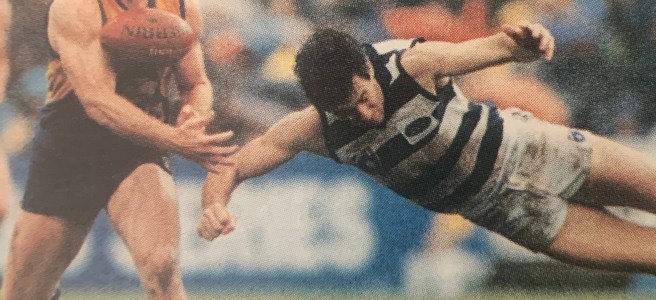
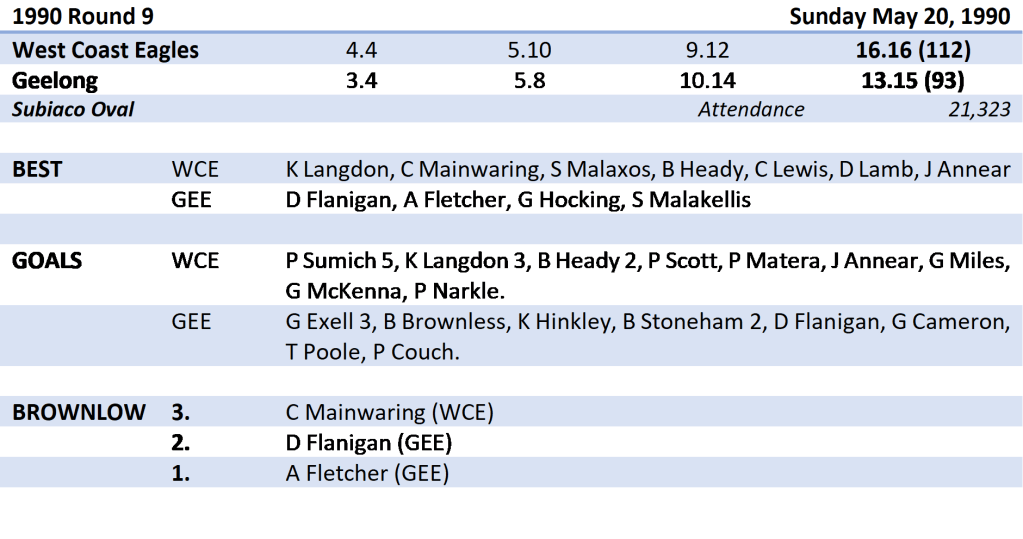
West Coast rode the wind – and the tide – with a seven goal final quarter that sealed a 19 point win in a rollercoaster game of momentum played in driving rain.

In one of the games of the season, the lead changed hands 12 times, and were level three times during the final quarter, before the Eagles were able to come out on top.

Recalled midfielder John Annear stood up in a desperate final quarter as he, Steve Malaxos and Chris Lewis inspired the Eagles to the gutsy win.

Annear was the only change for the Eagles, replacing Tony Begovich who had made his debut the week before against the Bears.

The Cats made three changes coming into the match, as they looked to arrest an embarrassing slide that had seen them drop games against cellar dwellers Richmond and Sydney.

David Cameron, Tim Darcy and Bruce Lindner were all dropped, with Ray Sterrett, Neville Bruns and Dwayne Russell all brought into the line-up. Geelong coach Malcolm Blight was conscious of the wide expanses of Subiaco Oval bringing in players renowned for speed to match the equally pacy Eagles.

The Cats though were still without match winner Gary Ablett, who had been unavailable since having surgery to repair knee cartilage heading into Round 6. Ablett had carried the injury since the Cats night series match against the Kangaroos, although that hadn’t stopped his proficiency in front of goal, booting 24 goals in his first four games of the season before being sidelined.

The first decisive moment of the match, came before the match, when Eagles captain Steve Malaxos won the toss but chose to kick into the gale that was sweeping towards the Subiaco end. West Coast then bounced out of the gates, kicking the opening three goals into the wind and holding onto a six point advantage at the first break.

However, the Cats were just as effective into the wind, restricting the Eagles to just one major although West Coast also had themselves to blame with six behinds for the term. The Eagles led by just two points at the main break, and were down a man after Peter Wilson limped off with a hamstring injury.

The second half then became a battle for momentum.

The Cats were far more effective with their second use of the wind, booting five goals for the term to open up an eight-point lead with a quarter to play. Adrian Fletcher had been kept quiet by Malaxos through the first half, but broke free in the third term with 12 disposals as he, Paul Couch (eight disposals) and Neville Bruns (six) took control through the middle.

Geelong ruckman Darren Flanigan provided the service for his midfielders at the ruck, overwhelming Phil Scott, and later Stevan Jackson. Flanigan finished with 39 hit-outs for the game as Geelong held an ascendancy at the stoppages.

However, the Eagles did enough to hang in the contest, mostly through the work of Chris Mainwaring on the wing and Karl Langdon up forward. Mainwaring was one of the Eagles’ best in the first half with 16 disposals and continued his fine work after half-time picking up nine disposals for the term.

Langdon had started the game on the bench alongside John Annear, but he burst into the game after half-time with three of the Eagles four goals for the quarter.

And as the rain dissipated before the start of the final term, Malaxos’ decision at the coin toss became vindicated. Chris Lewis and Phil Narkle provided the class in the final term, along with several desperate acts from Annear to get West Coast over the line. Annear also bobbed up for a vital goal at the start of the quarter and proved an astute inclusion given the conditions.
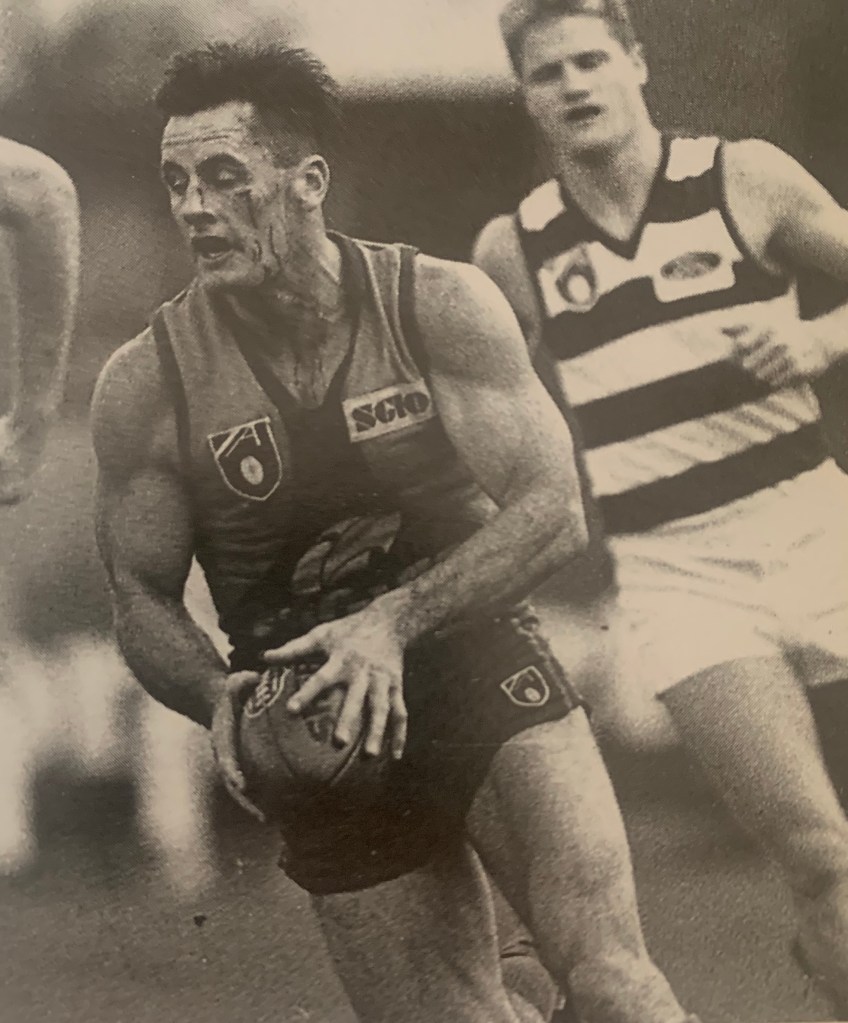
A bloodied John Annear was instrumental in the final quarter surge

After the game, a beaming Malthouse declared his side had answered another one of the Melbourne media criticisms. “We played tough footy in ordinary conditions and that’s what footy is all about – tough and relentless.”

“I would like to keep the dry tracks in Perth but we won’t be disappointed going to Melbourne in the rain.”

Malthouse, though, admitted his side were lucky with the gamble at the toss. “It was raining and we were fortunate to come home with the wind and without the rain.”

Mainwaring finished with 30 disposals for the match, while Chris Lewis and Stephen Malaxos were the next best with 23. Peter Sumich continued his strong form for the season, booting 5.4, stepping up with multiple goals in the final term as West Coast surged.

Geelong coach Malcolm Blight praised his side’s effort and intensity but shared disappointment with some of the ball use. “That touch of class at the end is not working for us.”

Barry Stoneham provided a focal target up forward and Garry Hocking was one of the best for the Cats, but they had too few contributors across the day.

“We’ve been having a dip over the past three weeks and we have lost three games by small amounts,” Blight said.

The third-straight defeat left the Cats with a tough task ahead through the second half of the season, sitting two games and hefty percentage behind the fifth-placed Magpies. However, Blight refused to concede the finals’ hopes of last year’s Grand Finalists were over.

“It’s mission impossible when you’re two games out with one game to go.”

The win saw the Eagles draw level with the Melbourne at the top of the ladder, although they remained in second spot behind the Demons on percentage. Melbourne suffered their second loss of the season when they were easily brushed aside by a Hawthorn side who were keen to atone for their humiliating loss to Carlton a week earlier.

The Hawks moved up to fourth, in place of St Kilda, who dropped out of the top five when they fell to Essendon at Windy Hill. In the battle of 3rd and 4th, the Lockett-less Saints pushed the Bombers all the way, but came up 11 points short.

Collingwood forced their way back into the top five for the first time in a month, when they thrashed North Melbourne by 80 points at Victoria Park. Gavin Brown and Peter Daicos each booted seven goals as the Magpies slammed on 11 final quarter goals to secure an important percentage-boosting win.

The Magpies moved a game clear of the Saints, who were joined by Carlton and Footscray on the edge of the finals’ spots, after they recorded easy victories over Fitzroy and Brisbane.

While the Eagles could feel satisfied with a hard-earned four points and equal-top spot on the ladder, they were less than thrilled with the AFL judiciary, who returned a no-result over their investigations involving Annear and Hocking. The pair clashed twice in a fiery last quarter, with Annear requiring two sets of stitches to repair cuts on his face.

But with Channel 7 unable to supply footage of the incidents from the match, the AFL determined there was insufficient evidence to move forward. Eagles general manager Brian Cook conceded the club wouldn’t lodge an official complaint over the incidents.
1990 Rewind: Eagles Bounce Back Against Bears

Eagles Get Four Points But Miss Percentage Booster

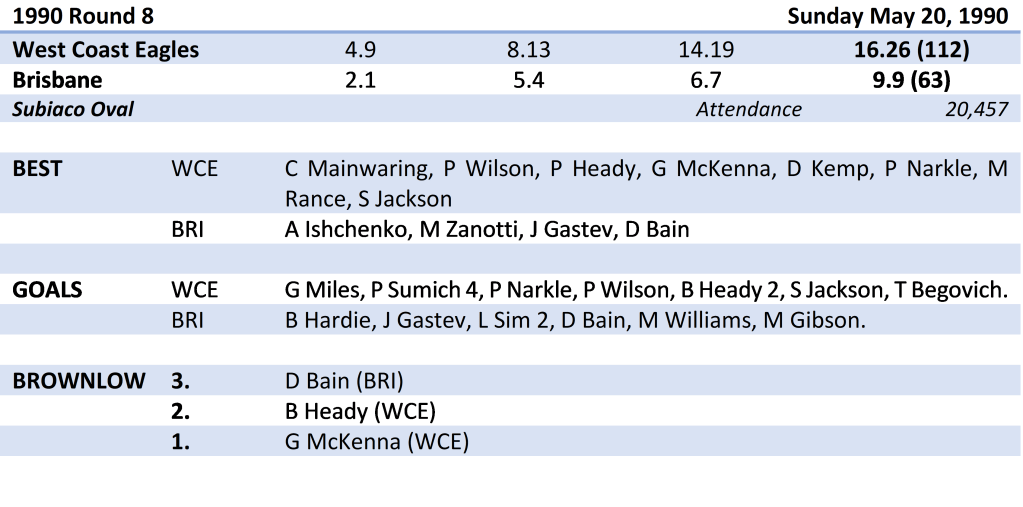
West Coast returned to winning ways when they comfortably accounted for the Brisbane Bears at Subiaco Oval. In a performance that warranted a triple-digit winning margin, poor kicking on goal meant the Eagles had to settle for a 59 point victory.

Peter Sumich booted four goals, as did Geoff Miles who was thrown forward in the second half. With such a complete performance, many Eagles stood out, but the performance that would have most delighted the West Coast match committee was that of Phil Narkle, who returned for his first senior match in over two and a half years.

Narkle – a member of the Eagles inaugural squad of 1987 – was delisted at the end of 1988 after injuries restricted the gifted wingman to just nine games in two seasons. Returning to the WAFL, Narkle managed some games with Swan Districts late in the 1989 season, with the Eagles throwing a lifeline ahead of the 1990 season, with their final selection at the pre-season draft.

Narkle’s last appearance for the Eagles had been the 130 shellacking against Sydney in Round 16 of the 1987 season.

Narkle shone in his first game back, picking up 22 disposals and booting 2.3 playing mostly from the forward pocket. Malthouse, in particular, was delighted by Narkle’s showing.

“I was tickled pink with Phil’s game, especially as he was a bundle of nerves beforehand,” a ‘rapt’ Malthouse said after the game.

“His pace and genuine crumbing ability gave us something that we lacked.”

Narkle was one of four inclusions for the Eagles, who swung the axe after their poor display against the Demons the previous week.

Chris Mainwaring earned an instant reprieve after being dropped to East Fremantle the week before, responding as one of the best players for West Coast. Scott Watters and Tony Begovich were the others brought in, with Craig Turley, Andrew Lockyer and Todd Breman dropped. Dean Laidley was finished for season 1990 having undergone a knee reconstruction during the week.

Begovich debuted for the Eagles after being selected at the 1989 National Draft, but his selection capped off a rampant rise. Begovich initially rejected the Eagles offer to join the club, choosing instead to remain with WAFL club Claremont, alongside fellow draftee Peter Mann.

However, a change of heart in the new year saw Begovich join his new Eagle teammates and a strong start to the WAFL season garnered his first senior AFL game. While he spent most of his first match on the bench, Begovich still managed to have an impact booting his first goal.

The need for Begovich was limited as West Coast controlled the contest from the get go.

The Eagles registered 13 scoring shots in the first term and the game could have been done at the first change if not for an inaccurate return of 4.9.

Chris Mainwaring slotted back on a wing and gave plenty of drive, as did rookie Peter Matera who produced a more rounded effort in his 3rd AFL game. Fellow rookie Brett Heady provided class through the midfield and at half forward, while Peter Wilson was industrious around the ground.

The Bears had arrived in Perth off the back of their second win of the season, by eight points over Sydney, with forward Cameron O’Brien the difference in the win with seven goals. However, he was completely blanketed up forward by Michael Brennan. Murray Rance was similarly effective on Bears captain Roger Merrett.

Guy McKenna provided the drive from the backline and with Karl Langdon and Stevan Jackson up forward, along with Sumich and later Geoff Miles, there was too much class across the ground for the Bears to contain.

The Eagles added another four goals in the second term, and put the foot down after half time with six majors to take their lead out to 60 points with a quarter to play. However 2.7 in the final quarter cost the Eagles a chance at a significant percentage boost.

Remarkably, the Eagles booted 8.13 in each half, to finish with one of their most inaccurate displays in the clubs history, a final score of 16.26, from 42 scoring shots.

Mainwaring, McKenna and Wilson all tallied 26 disposals to be the leading ball winners for the Eagles, with rookies Dean Kemp (22 disposals) and Brett Heady (21 disposals, two goals) also impressive. The only concern for West Coast was full forward Peter Sumich limping off midway through the third term.

Bears coach Norm Dare admitted his side were ‘just not tough enough’ in the contest with the result undoing much of the good work they had showed the week before.

Ironically for the Bears, their best players were also Eagles. Mark Zanotti, John Gastev and Alex Ishchenko had all been a part of the Eagles’ inaugural squad, but had worked their way east to the Bears in subsequent seasons.

Zanotti was the leading possession getter for the Bears with 25 from defence, while Gastev offered an avenue to goal with 18 touches and two goals. Ishchenko was the Bears’ best on the day, completely monstering Phil Scott in the ruck and getting the better of his former teammate around the ground.

Ishchenko finished with 18 disposals and 10 marks, while also having 25 hit-outs in the ruck, compared to just nine for Scott.

While happy with the win, Malthouse bemoaned the missed opportunities on goal. “We worked hard to set up goals rather than kick them.”

And despite the win lifting the Eagles back up to second spot on the ladder, a game clear of the chasing pack, Malthouse acknowledged the win would mean nothing if they lost to the Cats the following week.

“We have to defeat Geelong next week,” Malthouse declared. “That will put us three games up on them.”

“In the wash-up, after 22 rounds they (Geelong) will be vying as we will be, for a place in the five.”

It was déjà vu for the Cats when inaccurate kicking cost them what should have been a straight forward win against a side at the bottom of the ladder. A week on from their shock defeat to Richmond at Kardinia Park, the Cats booted 13.20 in their nine point loss to the Swans at the SCG, who had started the round in equal bottom.

The consecutive defeats had robbed the 1989 Grand Finalists the chance to sit comfortably inside the top five, instead languishing in eighth position, a game and percentage out of the top five. Carlton pushed past the Cats into seventh when they won their third straight match, thrashing the Hawks.

The Blues led from the outset and slammed their advantage home in the final term with an eight goal quarter securing a 67 point win. The Hawks would be the big losers of the round, dropping from 2nd on the ladder to 5th.

Essendon and St Kilda each climbed a spot with narrow wins over Footscray and North Melbourne, respectively, while the Magpies remained stayed in touch with the top five with a ten goal final term turning a 17 point three-quarter time deficit into a 45 point win over Fitzroy. The Demons remained the pacesetters at the top of the ladder with an easy win over the Tigers.

MCG Demons Return

Melbourne Claim Points in Top-of-the-Table Fizzer

A week can be a long time in football.

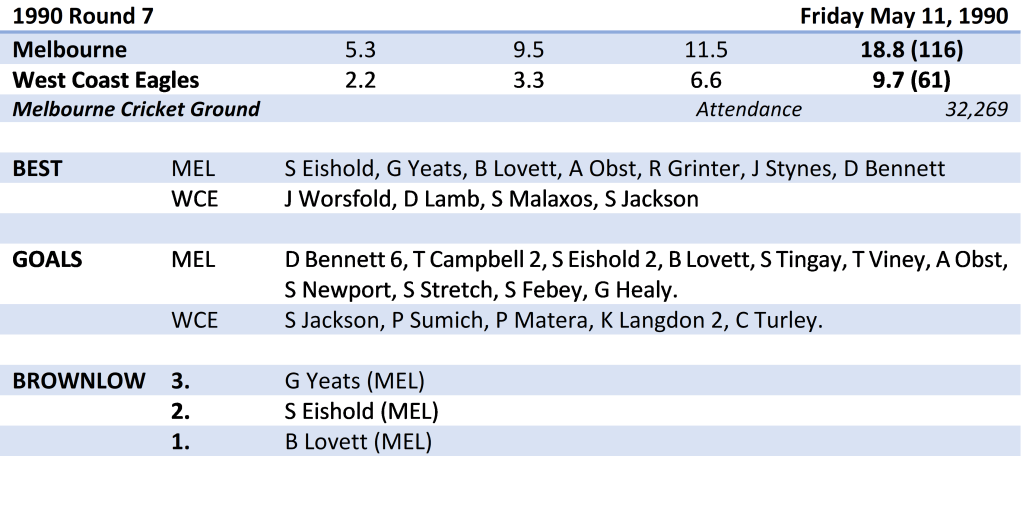
Seven days on from their breakthrough first win at the MCG, the Eagles horror record at the ground was once again at the forefront when they were humbled by the Demons to the tune of 55 points.

The Eagles and Demons headed into their round seven meeting occupying the top two spots on the ladder, with 5-1 records, but the top-of-the-table clash proved a non-event as Melbourne ran away with the game in the first half.

The Demons opened up a three goal break at the first change and were never seriously troubled, finishing with a seven goal final quarter to blow out the margin, and regain their spot at the top of the table.

And there was plenty of insult to injury.

Inaugural Eagle Darren Bennett – who was let go by the club after just one season – did the damage up forward for Melbourne, booting six goals, while West Coast were also left reeling after Dean Laidley was carted off the ground in the second quarter with a knee injury that would rule the half-back flanker out for the rest of the season.

Laidley would be one of three players who would fall victim to a serious knee injury at the MCG in Round 7. North Melbourne pair Brenton Harris (playing in the reserves) and Darren Steele both went down the following day, as criticism over the state of the MCG playing surface grew.

Both Melbourne and West Coast had aired concerns over before the match, with the Eagles declaring they were lucky not to incur any injuries the week before against Richmond. Demons coach John Northey was particularly vocal about the dangers, but AFL communications manager Tony Peek played down the comments.

“We will be keeping a close watch on the situation”, Peek said.

Peek would come to rue those words, with three serious injuries in less than 24 hours. Footscray and North Melbourne joined the chorus of voices demanding action over the state of the ground, with recent attempts to fill holes in the ground with sand failing to deliver any improvement.

Following the Eagles’ defeat, Malthouse wouldn’t be drawn on the playing field, but expressed disappointment over losing Laidley. “It did not look good.”

Malthouse also delivered a blunt analysis of his team’s showing.

“We made far too many mistakes.”

“I thought we could do better and it was a learning curve for all concerned”, Malthouse continued. “We will make adjustments and be a better side.”

The Eagles made two changes coming into the match, with Troy Ugle and wingman Chris Mainwaring both dropped. Mainwaring had struggled in his two games since returning from a back injury, but was still a surprise omission, marking the first time in his 63-game career he had lost his position.

First-year player Peter Matera was chosen for his second game to replace Mainwaring, with Geoff Miles the other inclusion. Miles had failed to play so far this season as he recovered from a hamstring injury, named at full back.

The Demons also made two changes, as they battled somewhat of an injury crisis. Already without Steven Clark and Trevor Spencer for the season, Melbourne lost defender Sean Wight the week before with a knee injury suffered while playing for the reserves and veteran Alan Johnson was unable to prove his fitness in his effort to come back from a calf injury.

The Demons also lost Brian Wilson to a broken cheekbone during the loss to Sydney the week before, with Wilson ruled out, along with Jay Viney who was dropped. Rod Grinter and Glenn Lovett were the two inclusions.

The Eagles started brightly enough with goals to Peter Sumich and Stevan Jackson early in the first quarter, after Simon Eishold opened the scoring. But the Eagles soon became their own worst enemy as Melbourne capitalised on a number of errors in defence.

Michael Brennan twice turned over the ball coming out of defence, leading to Demon goals before Greg Healy led the race back to goal to toe-poke from the square after Murray Rance couldn’t mark at centre half back.

The Demons added a fifth to take their lead out to 19 points at quarter time. The Eagles’ ball use didn’t improve in the second quarter as Melbourne doubled their advantage to 38 at the major break. Dean Laidley had come off the ground after his knee crumpled beneath him, with West Coast leaving plenty to do for an unlikely victory.

The Eagles for their part responded at the start of the second half, booting the first three goals, as they closed to within 17 points. But they were left to rue several other missed opportunities and some poor kicking into their forward line.

“We could have got closer and it may have been a different story in the final term”, Malthouse said.

Having worn everything the Eagles could muster, the Demons responded with two late goal to take their lead out to 29 at the final change, and when Melbourne booted the first three goals of the final quarter, the game was all but won.

While Bennett was the major contributor on the scoreboard, the Demons had an impressive spread of goal kickers with 11 players registering majors. In contrast, the Eagles had just five goal kickers as they constantly broke down going forward.

Dashing Melbourne defender Graeme Yeats provided plenty of rebound from the backline, picking off a number of errant passes, while Rod Grinter was impenetrable in the back half.  

The Eagles decision to only run with one recognised ruckman against Demon pair Jim Stynes and Steven O’Dwyer also proved costly as the Melbourne midfield were regularly gifted first use of the ball from stoppages. Phil Scott managed just five hit-outs for the match, compared to the combined tally of 23 of his direct opponents.

Andrew Obst and Simon Eishold were influential early, finishing with 21 and 15 disposals respectively, while Brett Lovett led the Demons with 26 touches through the middle. Stephen Newport (23 dipsosals), Steven Stretch (21) and Stephen Tingay (20) all gave the Demons plenty of drive, as West Coast often had to build their attacks from defence.

Dwayne Lamb was the sole winner for West Coast in the middle, collecting 20 kicks and 13 handballs. Stephen Malaxos picked up 26 touches and John Worsfold had 28 in a performance that drew praise from Malthouse after the game.

“He was outstanding, considering we only decided to play him five minutes before the game because of a nagging (leg) injury.”

John Worsfold was one of the few winners for West Coast

The result saw Melbourne reclaim top spot, a game ahead of Hawthorn and West Coast, who had fallen to third. However, a number of surprise results over the weekend meant the Eagles maintained a game advantage over the chasing pack.

Essendon were beaten by an improving Carlton, by 20 points, while St Kilda suffered a shock 18 point loss to the bottom-placed Fitzroy, despite seven goals to spearhead Tony Lockett. Despite the losses, the Saints and Bombers both held their spots in the top five, after Geelong blew a golden opportunity to move into the finals positions.

Hosting the second-last Tigers at Kardinia Park, the Cats booted a horrid 9.28 in a 14 point defeat, giving Richmond just their second win of the season. Collingwood were also left outside the top five when they fell to the Hawks in one of the rollercoaster games of the season. The Magpies trailed by five goals at half time, only to hold a 10 point lead at three-quarter time, before falling short by two points.

Following back-to-back games at the MCG, the Eagles were set for a fortnight at home against Brisbane and Geelong, but Malthouse was quick to dismiss the suggestion that the Eagles were happy relying on their perceived home ground advantage to bank the wins they needed for finals.

“We will end up on our backsides if we think [we are guaranteed those games]”, Malthouse warned.

“There are seven or eight sides vying for the top five and it might take at least 14 wins to make the finals.”

History Makers of the West

Eagles Record W.A. First As Victorian Paranoia Sweeps In

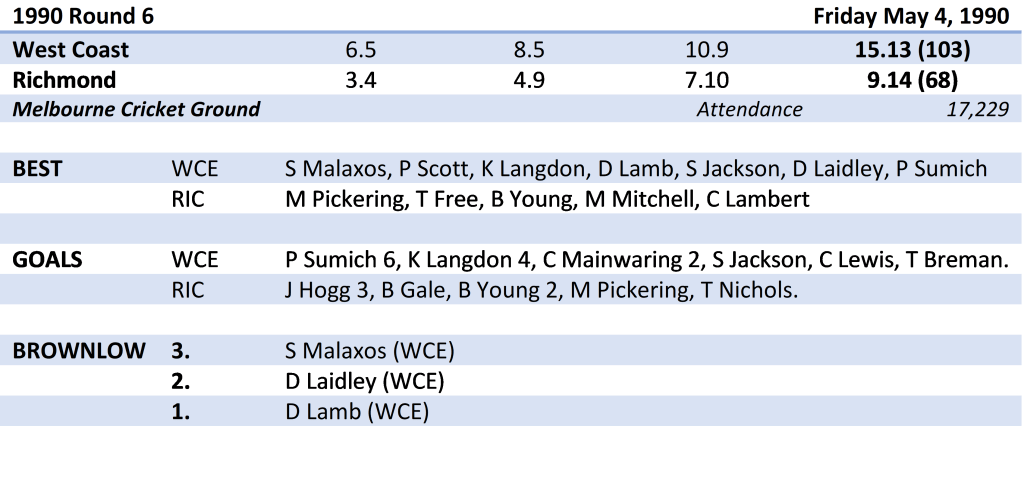
It took until their fourth season in the AFL, but the Eagles finally broke their MCG duck when they recorded a 35 point win over the Tigers on the Friday night opener in round six.

The Eagles had failed to win on their previous six visits to the Home of Football, but a quick start and steamrolling finish ensured their first successful outing.

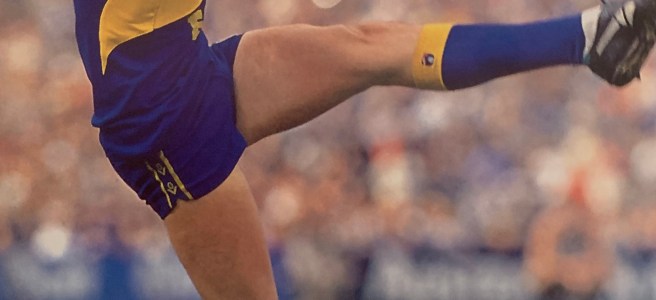
Karl Langdon was responsible for the early spark, booting four first half goals, while Peter Sumich kicked six for the match to take his tally for the season to 28. Sumich could have had a day out, if not for poor kicking on goal, kicking 6.5 from his 14 kicks and seven marks.

The win was also a milestone for West Australian football, with West Coast becoming the first representative team from WA to win at the ground.

Coach Mick Malthouse showed rare emotion after the game, applauding his players as they ventured off the field. The gravity of the result was not lost on Malthouse, who believed his side had overcome a significant hurdle, having long been criticised over their lack of success in Victoria.

“It was media pressure that said we couldn’t win in Melbourne, particularly at the MCG,” Malthouse said.

“We reversed that by telling ourselves that we could, and we did.”

Both teams made two changes for the game, welcoming back important players from injury.

Chris Lewis returned at the Eagles after gaining much need match fitness at Claremont. Lewis had been dogged by hamstring issues through the pre-season and first couple of rounds, but after a fortnight in the WAFL, resumed his place in the Eagles side.

Lewis was joined by Andrew Lockyer who replaced David O’Connell who had struggled to have an influence in the win over Sydney. Scott Watters was the other omission to the team that entered the clash on a three game winning streak.

Richmond rushed back captain Dale Weightman and forward Michael Pickering at the expense of Sean Bowden and ruckman Mark Lee, who had a hamstring strain. Weightman had managed less than a quarter in two months of football with an ongoing achilles problem, but with the Tigers sitting second last, selectors were keen to get to their captain into the league side.

The Eagles got the early break, with a six goal opening quarter establishing a 19 point quarter time lead.

Langdon had been under the microscope after a poor showing against the Swans, where he was well beaten by Neil Cordy. However, the blond-haired enigma responded superbly, providing a strong target up forward and combining well with fellow big man Stevan Jackson.

Both players tallied eight disposals and three marks in the first term, with Peter Sumich also hitting the scoreboard early.

The game then became a dour struggle over the next two quarters as Richmond did their best to hang tight with West Coast. Four goals to each side had the margin dangling at 17 points at the final change and Malthouse admitted he was concerned for his team, who were backing up from playing the previous Sunday.

“At three-quarter time I was worried because we’d only had a five day break from the (Sydney) game.”

Malthouse, though, would not have been concerned for long. The Eagles piled on the first five goals of the final quarter in a finish that Malthouse described as ‘terrific’.

“The win could not have been any better,” Malthouse raved, “and I got a better idea of my players tonight than from any other game this season.”

“It was a combination of fitness and mental toughness.”

If the history-making win wasn’t enough to celebrate, the weekend only got better for West Coast, who found themselves at the top of the ladder, after Melbourne suffered an upset loss to Sydney.

The Demons had been undefeated after five rounds, and were expected to make little work of the Swans, how hadn’t won since the opening week and had a number of key players on the sidelines.

However Melbourne were made to pay for poor kicking in front of goal (12.21) as the Swans came from behind to sneak home by five points.

With Hawthorn and Collingwood also dropping their matches, the Eagles and Demons were both a game clear in the top two. But with West Coast now occupying top spot, predictions of an Eagle premiership heightened as Victorian paranoia set in.

Many scribes suggested that the Eagles already had the 1990 flag in their keeping and were set to dominate the competition for many years. Malthouse, though, downplayed the call and was more keen to focus on the Eagles fifth win of the season.

Eagles captain Steve Malaxos led the way with 25 disposals and had plenty of support through the middle from Dwayne Lamb (21 disposals) and Peter Wilson (20), who was playing his first game against his former club.

Phil Scott took advantage of the absent Mark Lee, having the better of the ageing David Cloke in the ruck and around the ground. Scott often dropped behind the play, particularly through the middle part of the game as Richmond worked their way into the contest. The ruckman finished the game with 19 possessions and nine marks.

Dean Laidley provided the run off half back and Stevan Jackson complimented Langdon’s performance to collect 17 disposals, six marks and a goal.

Tony Free and Michael Pickering finished as the leading ball winners for Richmond with 24 each, with Craig Lambert the next best with 21 disposals. Full forward Jeff Hogg booted three goals, despite struggling with a hamstring injury that had lingered from the previous match against Fitzroy.

The barnstorming final quarter was even more impressive by the Eagles, who had lost Chris Mainwaring and Murray Rance by early in the final term. Mainwaring had been one of the key midfielders early in the game as West Coast set up their advantage, and then stood up again either side of three-quarter time as Richmond threatened to take the lead.

The Tigers had closed to within 11 points late in the third term before Mainwaring stepped up to kick a vital goal before three-quarter time to stretch the Eagles advantage back to 17. Mainwaring then repeated the dose at the start of the final quarter to kickstart the five-goal run that ultimately decided the contest.

The Tigers fightback coincided with a heightened physicality in the game, which saw umpires struggle to contain several spotfires during the third quarter. A number of players were also involved in a melee following a late hit on Dean Kemp from Tony Free. Free would later cop a two game ban for striking Kemp in the head.

AFL Investigator Max Croxford was also called in to review an incident at quarter time that saw Richmond defender Brian Leys run 80m to confront Eagle Chris Lewis who was huddled with teammates. Croxford ruled no further action on the incident.

With a 5-1 record after six games, the Eagles toughest test loomed – a Friday night top-of-the-table clash against the Demons.

Sumich Eight Eclipses Swans

Eagles Climbing After Third Straight Win

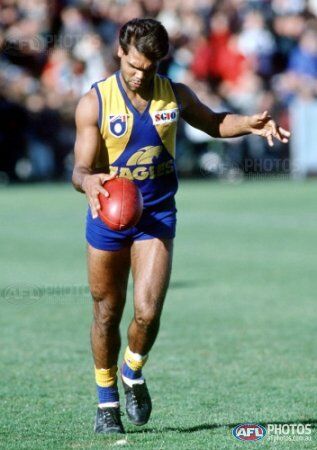
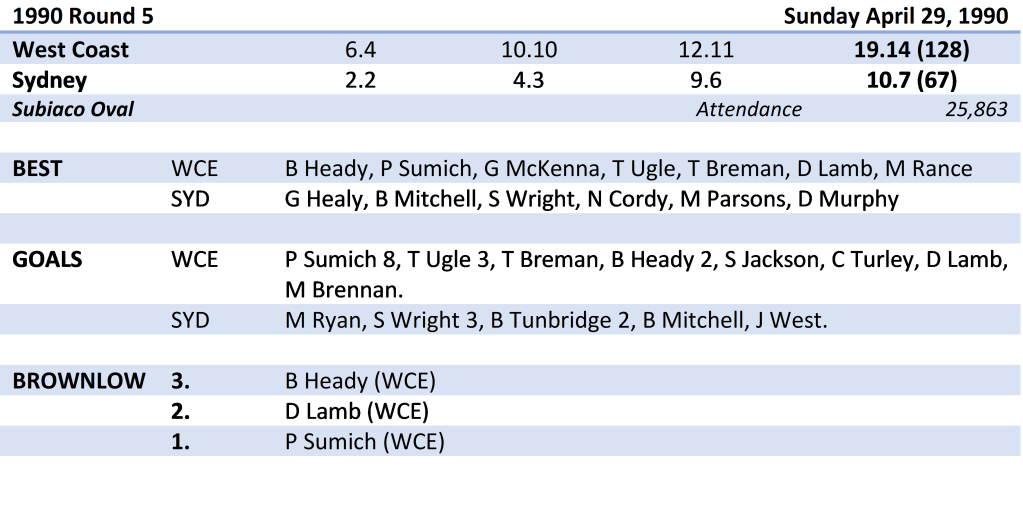
Eight goals from Peter Sumich helped West Coast to a commanding 61 point win over Sydney at Subiaco Oval. The Eagles recorded their third straight win to take their season record to 4-1, rising to third on the ladder.

The Eagles were sandwiched between the Hawks and Magpies, with all three teams on four wins, while the Demons remained the competition benchmark with their fifth win from five games after demolishing the Bears.

Sumich’s haul of eight came in two bursts during the game, mirroring the performance of West Coast through the match.

The Swans arrived in Perth without a win since round 1 and had lost key midfielder Greg Williams to a broken thumb the week before in their defeat to St Kilda. Sydney kept pace with the Eagles early in the game, before three goals to Sumich in time-on helped the Eagles build a 26 point lead at the first change.

West Coast remained in control of the game during the second term as they extended their lead to 43, before the Swans mounted a comeback after half-time. Sydney ruckman Michael Parsons took hold of the ruck combining with rover Gerard Healy to drive the visitors back within touching distance.

Healy had been well contained by Dwayne Lamb in the first half, but racked up 11 disposals in the third quarter as Sydney took over in the centre square. Healy had strong support from fellow midfielders Steven Wright (nine disposals) and Barry Mitchell (eight disposals) as the Swans slammed on five goals for the quarter to reduce the deficit to just 23 points at the final change.

Sumich had failed to add to his goal tally since quarter time, but another four goal burst in six minutes to start the final quarter snuffed out Sydney’s comeback effort. Three of those goals were set up by second-gamer Brett Heady, who was one of the Eagles’ best with 21 disposals and two goals.

Sumich kicked a fifth late goal for the quarter late in the term, finishing with a career-best eight for the match, equalling his effort against the Bulldogs in round five the year before.

Troy Ugle provided the perfect foil for Sumich up forward with three goals from 22 disposals and eight marks, while Peter Wilson (22 disposals) and Guy McKenna (21) were major ball winners for the Eagles. McKenna’s performance was even more striking considering the defender was forced off the ground during the third term with food poisoning.

Troy Ugle was a focal point up forward with three goals

McKenna’s departure from the game coincided with the Sydney’s strongest period of the game, as they converted centre square ascendancy into scores. But, unlike West Coast, the Swans didn’t have a reliable target in their forward arc, with Murray Rance a major roadblock in defence. Rance finished with 21 disposals and seven marks and had the better of a number of Swans opponents who were tried in the key forward position.

Malthouse again praised his defensive unit, admitting that it wasn’t his side’s best performance. John Worsfold stepped into McKenna’s role after he departed the field, while Dean Laidley was strong off the other half back flank.

For Sydney, Gerard Healy finished with 29 touches in his battle against Dwayne Lamb, while Barry Mitchell racked up 28 touches, although was less effective through the centre with Steve Malaxos for company. Neil Cordy tried hard in defence and Stevie Wright had 22 disposals to go with his three goals.

With the final quarter still fresh in his mind, Sydney coach Col Kinnear expressed disappointment in his sides’ ‘very soft’ finish. “As a realist, you can’t think of finals’, Kinnear said.

Mick Malthouse though was happy to take the four points from the underwhelming performance, as West Coast consolidated their position in the top five.