1990 Rewind: Lewis Magic Lifts West Coast

Eagles Get Necessary Win In Penultimate Round

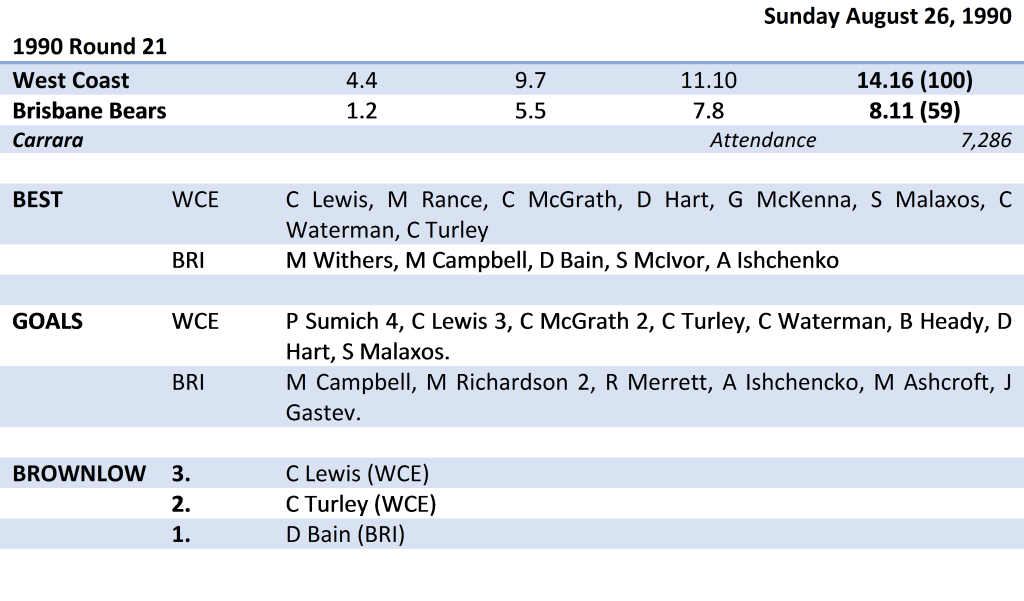
In a game that failed to reach great heights, West Coast got the four points against the Brisbane Bears to keep their hold on third place, with just one regular-season game left.

The Eagles were solid, rather than spectacular in the win, opening up a 20 point lead at the first change before going on to a 41 point result in front of just 7,286 fans at Carrara.

And while those that did come to the ground would have seen the match play out as expected between a team vying for the double chance and another team near the foot of the ladder, they were treated to one of the great individual performances of the year.

Chris Lewis had endured a frustrating start to the season when a hamstring injury and then an ankle problem restricted the midfielder/forward to just one quarter in the opening five games.

A fortnight with WAFL club Claremont built some match fitness before Lewis returned to the Eagles side, hitting his stride in the second half of the season. In ten matches from round 11, Lewis averaged 23 disposals per game and booted 15 goals as West Coast consolidated their spot in the top five.

Against the Bears in Round 21, Lewis put in a career best performance.

Running through the midfield, Lewis collected 28 kicks, 10 handballs, seven marks and booted three goals in a clear best on ground display. The Bears had no answer to the masterful showing from Lewis, who displayed his skills both in the stoppage and out in space and had a hand in creating a number of scoring opportunities.

The Eagles made a host of changes to the side that played the Bears, following their loss to the Demons a week earlier. Dwayne Lamb was forced out with a broken arm and Peter Melesso commenced his five-week suspension for stomping. The casualties from the defeat were Troy Ugle, Tony Begovich and Geoff Miles.

Into the West Coast line up were John Worsfold, who returned from serving a two week ban, Craig McGrath who was a late withdrawal the week before, as well as Scott Watters, Dean Turner and Murray Rance who forced his way into the side after six weeks in the WAFL.

The Bears made just two changes with Chris O’Sullivan and Brad Rowe replacing dropped pair Ray Windsor and Shaun Hart.

Laurie Keene made the trip with the Eagles squad as the travelling emergency, with Malthouse remaining cagey over whether the ruckman would make his return from injury. Keene had been sidelined since the second match of 1989 and even Bears coach Norm Dare predicted pre-match that Keene would be included in the Eagles side.

“I can’t believe Keene would come all this way and not play.”

Keene wasn’t a late inclusion with Malthouse giving the pairing of Dean Irving and Phil Scott a chance to bounce back from the beating they copped against Jim Stynes the week before.

And while both lowered their colours to ex-Eagle Alex Ishchenko, it mattered little as Lewis led the strong showing from the West Coast midfield. David Hart and Stephen Malaxos complemented the silky skills of Lewis with the inside grunt, while Craig Turley and Chris Mainwaring provided the linking run on the wings.

Up forward, Peter Sumich booted four goals, taking his total to 73 for the season, equalling the club record set by Ross Glendinning in 1988. However, Sumich would finish the afternoon on the bench. In only his second game back from missing a month with a hamstring, Sumich once again felt a twinge with the Eagles medical staff taking no chances on their spearhead.
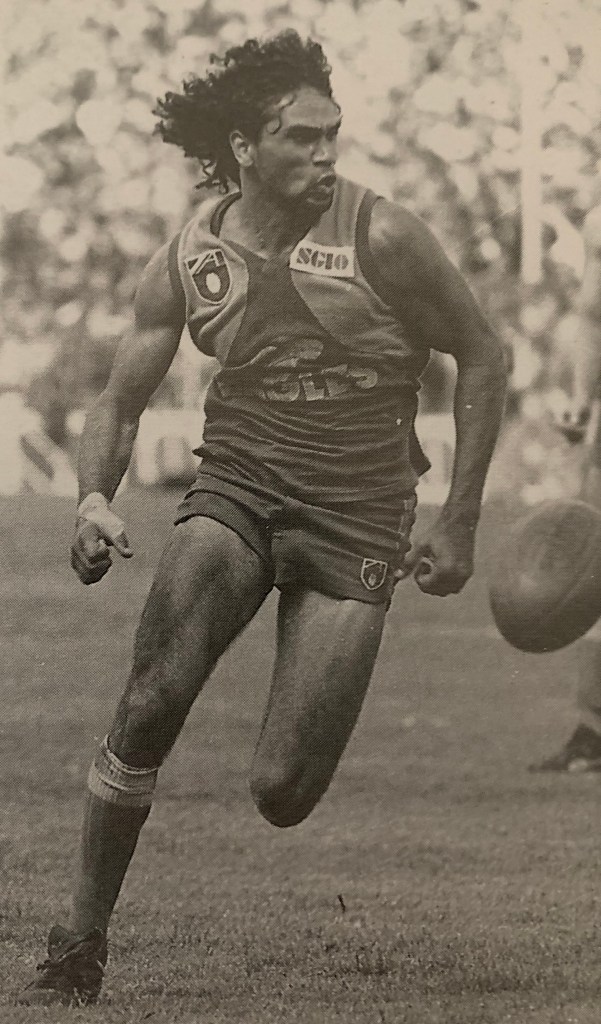
Chris Lewis was sublime for the Eagles against Brisbane

For Malthouse, the defensive effort was the most pleasing aspect, having conceded 100 points in each of the previous two games.

“The idea was to restrict their scoring, which is something we’ve not done in the last two weeks. The Bears only got eight goals – that’s exactly the result we wanted.”

“They had some good runners but we were able to shut them down and we broke through their defence enough times to kick a winning score.”

Pleased with the performance of his defence, Malthouse had special praise for the returning Rance who restricted Bears full-forward Roger Merrett to just nine disposals and a goal.

“It was just about his (Rance) best game this year. Not because of how many kicks he got, but because of who he was playing on and the way he handled himself under pressure.” Malthouse went on to say it was the best game Rance had played at the club.

Rance himself tallied 15 disposals and seven marks to finish as one of the best for West Coast. David Hart relished not having a tag for the match to gather 31 disposals through the middle, while Steve Malaxos picked up 29 touches.

Guy McKenna had 25 disposals off half back, while Craig McGrath provided the perfect foil for Sumich in the forward line with 21 touches, nine marks and 2.3. Chris Waterman – who held his spot after being a late inclusion the week before – was also one of the Eagles’ best with 19 possessions, nine marks and a goal.

Mark Withers was the leading disposal winner for the Bears with 27, while David Bain and Scott McIvor each picked up 26 touches. With the Bears’ key forwards well held by the tight West Coast defence, only Michael Richardson and Matthew Campbell finished as multiple goal scorers with two each.

Bears coach Norm Dare admitted he was flat after the match believing many of his players already had their eye on the end of the season. The Bears were relegated to last on the ladder and were set for the wooden spoon, after Sydney stunned the Cats by two points at Kardinia Park.

The win kept West Coast in third, with all of the finals incumbents registering wins in the penultimate round of the regular season. Essendon stayed top, despite being jumped by Footscray. The Bulldogs opened up a four goal lead at the first change, but the Bombers had hit the front by half-time, before rolling away to a 24 point win.

That kept the Bombers a win ahead at the top of the ladder, with Collingwood putting in the most impressive performance from the top five, thrashing Fitzroy by 86 points. The Demons and Hawks kept their own double chance hopes alive with efficient wins over Richmond and Carlton.

Melbourne broke free of the Tigers with a five goal second quarter, to run out steady 36 point winners, while Jason Dunstall kicked six goals for the Hawks in their 31 point win over the Blues.

While West Coast mostly tailored through their win against the Bears, the performance wasn’t a concern for Eagles coach Mick Malthouse, pointing out the eight hour trip from Perth to the Gold Coast was an acceptable factor.

The air strike that had debilitated much of the national travel system meant West Coast had to make stops in Adelaide and then Sydney, before eventually reaching their destination in Queensland. Conditions at the ground were also tough with hot, blustery winds greeting the teams at Carrara.

“Fatigue was a big factor. It’s a long journey, it’s a big ground and we haven’t played in that sort of heat for a long time.”

“A win, is a win, is a win – and that’s all it was.”
1990 Rewind: Eagles Fail Demons Challenge… Again

Final Five Set, But Double Chance Remains Up For Grabs

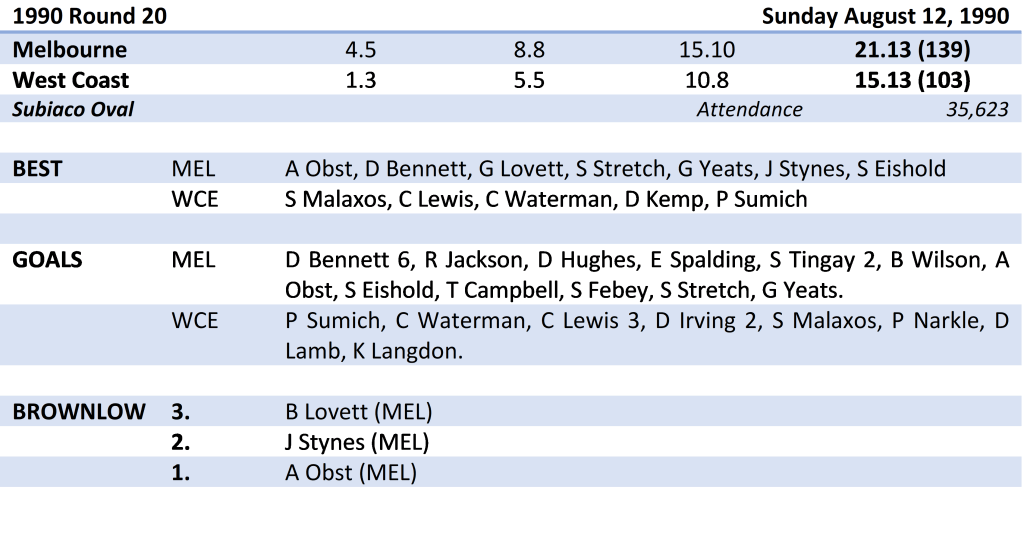
West Coast missed out on securing the double chance in the finals when they lost to Melbourne in a heated encounter in front of a packed house at Subiaco Oval.

The Demons ended the Eagles’ 15-game winning streak at home – stretching back to round 11, 1989 – with a comprehensive 36 point win.

A win would have pushed the Eagles two games clear of the fourth-placed Demons, with two rounds to play, but the race to finish in the top three and secure the double chance in the opening week of the finals was set to be decided over the final two weeks of the home and away season.

Further compounding the loss, West Coast could have climbed to equal top of the ladder after Essendon and Collingwood both suffered defeats 24 hours earlier.

The Bombers, minus a host of stars from their last gasp win over Collingwood the week before, fell to arch-rivals Carlton by 20 points, with Blues captain Stephen Kernahan booting seven goals. The win kept Carlton’s slim finals hopes alive, but the satisfaction of victory was quickly extinguished when news filtered through of Hawthorn’s stunning win over the Magpies at Waverley Park.

Jason Dunstall kicked 11 goals as Hawthorn romped to an 83 point win, virtually assuring the Hawks of a ninth-straight finals appearance. North Melbourne’s defeat of Footscray left the Kangaroos, Blues and Bulldogs all two wins and a hefty chunk of percentage behind the fifth-placed Hawks, essentially setting the participants for the 1990 AFL finals.

Nearly 36,000 fans piled into Subiaco for the blockbuster clash between two of the form teams of the competition. West Coast had won their previous five matches, while the Demons had rediscovered their early-season form to claim four wins on the trot.

The Eagles made two changes when teams were announced, with full-forward Peter Sumich returning after three weeks out with a hamstring injury. Phil Narkle was the other inclusion, with Peter Wilson sidelined with a broken jaw and Don Pyke dropped after just one game in the seniors.

Melbourne also made two changes, with John Howat and Brent Heaver both dropped and Garry Lyon and Steven Febey coming into the line-up. The Eagles were then forced into a third change when forward Craig McGrath withdrew ahead of the bounce, allowing Chris Waterman to make his first appearance of the season.

Waterman had endured a frustrating season on the sidelines after fracturing his ankle in a pre-season match, but had worked his way back into contention for AFL selection after strong form with Subiaco.

Demons coach John Northey had made the trip to Perth the week before to watch West Coast tackle the Tigers and his side followed the lead set by Richmond by approaching the game with physical intent.

Melbourne’s ferocity at the ball – and the man – saw them jump the home side with full-forward Darren Bennett finishing off the midfield ascendancy.

Jim Stynes took immediate control in the ruck against Dean Irving as Melbourne repeatedly sent the ball forward in the early exchanges. The Demons wasted their early chances, starting the match with three behinds, but Bennett soon gave them reward on the scoreboard.

Bennett booted the first four goals of the game, forcing Mick Malthouse to frantically shift around his under-siege defence. With Sumich back in the Eagles goal square, Peter Melesso started at full-back, but he lasted barely ten minutes before Michael Brennan replaced him on the last line.

Melesso was swapped to centre half back on Earl Spalding, Guy McKenna went to Garry Lyon and Steve Malaxos was sent to the back pocket.

Trailing 4.5 to nil, the Eagles worked themselves into the game late in the term, with Peter Sumich booting their only goal for the term.

Melbourne then started the second term as they did the first, with Bennett adding a fifth goal and Ricky Jackson crumbing from the top of the goal square to stretch the Demons lead out to six goals. Andrew Obst was dominant out of the middle of the ground off the back of Jim Stynes’ work in the ruck, while Steven Stretch and Graeme Yeats gave the Demons plenty of drive on the expanses of Subiaco.

But a late hit on Rod Grinter by Chris Mainwaring seemed to spark the home side into action.

The Eagles booted four goals heading into time on to reduce the margin down to 11 points. Troy Ugle came off the bench, as he has done on many occasions through the year, to have a hand in several chances and Dean Irving switched from the ruck to centre half forward where he took several strong marks and kicked the first of the goals to start the Eagles run.

Against the momentum of the game, Melbourne added two late majors. Andrew Obst set up Earl Spalding to run into an open goal, before Ricky Jackson finished off a chain of handballs from the next centre bounce to give the Demons an important break of 21 points at the main break.

The third term would prove to be one of the most exhilarating and controversial quarters of the year.

After being well held during the first half by McKenna, Garry Lyon was switched to the half back line, with Tony Campbell sent forward. Campbell kicked the opening goal of the quarter, but Karl Langdon responded after Jim Stynes failed to adequately clear the Demons defence.

Campbell then went to defence in a direct swap with full-back Danny Hughes who was struggling to contain Peter Sumich, despite the Eagles’ full-forward failing to maximise his chances on goal. The change had immediate effect with Hughes marking strongly in front of goal and converting.

Goals to Yeats and Stephen Tingay followed with Melbourne’s lead reaching 40 points.

The Eagles kept pressing with Waterman goalling twice, but for all of West Coast’s effort, the Demons were able to find a response. Seven goals to five in favour of Melbourne had them head to the final break with a 32 point advantage with the two teams as tensions between the clubs flared.

In the final seconds of the quarter, Jim Stynes’ swinging attempt to kick the ball of the ground only managed to connect with Dwayne Lamb’s arm, forcing the midfielder off with a suspected broken forearm. Chris Lewis was able to goal from the resultant free kick and at the next centre bounce, the Eagles players made their thoughts known when Stynes was collected at the ruck tap.

The animosity continued beyond the three quarter time siren between the players as a secondary melee broke out, while Demons coach John Northey and Eagles trainer Ian Monck also clashed as the pair were making their way to the respective huddles.

Dwayne Lamb finished with a broken arm after a stray kick from Jim Stynes

Any chance of a West Coast fightback in the final quarter was snuffed out early when Andrew Obst and Stephen Tingay kicked the opening two majors to all but end the contest. The midfield pair finished with 19 and 17 disposals, respectively, to be two of the best for Melbourne.

Jim Stynes was the architect, overwhelming both Irving and Phil Scott in the ruck and providing the Demons midfield with first use out of the stoppages. Simon Eishold was the leading ball winner for the Demons playing through the middle and across half forward with 26 possessions, while Brian Wilson was the next best with 24.

David Hart was initially assigned to Wilson, but couldn’t curb his work out of the middle, with Tony Begovich given the task after half time. Bennett finished with six goals for the afternoon, but his four-goal burst to start the match would provide the buffer Melbourne held for much of the afternoon.

Steve Malaxos was the leading possession winner in the game with 32, while midfielders Dean Kemp and Chris Lewis each collected 26. Lewis also booted three goals, as did Chris Waterman and Peter Sumich, who had a mixed afternoon.

Sumich almost summed up the Eagles’ afternoon in the final term when in the space of a minute, the full-forward fluffed two set shots. The first failed to make the distance from gettable range, while his second attempt only managed to go as far as the man on the mark.

The Eagles spearhead finished with 3.5 in his return match, but it could have been a double-digit haul if he made the most of all of his chances.

The fallout from the match continued in the days after.

Emerging Eagles utility Peter Melesso copped a five week suspension after being reported on trial-by-video for ‘assaulting Earl Spalding with his boot’ shortly before half time.

Footage showed Melesso stepping on Spalding as the centre half forward was on the ground, with Melesso arguing the contact was accidental. However the tribunal found Melesso guilty, leading chief executive Brian Cook to call the ‘whole AFL tribunal and video system frustrating’.

To further incense the Eagles, no action was taken on Stynes despite his swinging foot potentially costing Dwayne Lamb the rest of the season with a broken arm. Both club and player considered legal action over the incident, but ultimately chose not to, settling on a request to the AFL to re-define the law around kicking in danger.

Monck and Northey would both receive written warnings from the AFL over their stoush at three quarter time.

With the opportunity lost to cement the double chance, the Eagles now had to secure their place in the top three by getting wins on the road in the final two weeks against Brisbane and Geelong.

1990 Rewind: 2nd Spot Opens Up For West Coast

Eagles Survive Tiger Scare

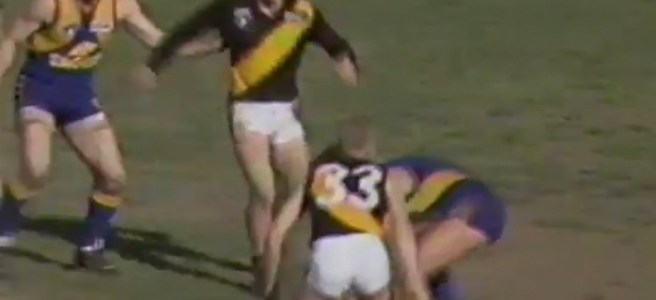
Richmond got the early jump, but it still wasn’t enough to prevent West Coast from romping to a 45 point win at Subiaco.

The Tigers booted seven goals in the opening quarter to open up a four goal lead at quarter time, but the Eagles took control in the final three terms to close in on second spot.

The lowly Tigers weren’t expected to present much of a challenge to the finals-bound Eagles, who were priced as short as $1.06 during the week, but they got the better of the early match-ups to stun the home team and fans to get an early break.

Michael Mitchell was electric in the first quarter, while Stuart Maxfield had the better of Chris Mainwaring on the wing and Matthew Knights provided the drive out of the centre.

The Eagles were also uncharacteristically clumsy in defence as Richmond pounced on a number of errors from the West Coast backmen.

At quarter time, Eagles coach Mick Malthouse moved the magnets and found the right balance, with West Coast booting 7.6 for the quarter and orchestrating a 38 point turnaround.

David Hart moved from Trent Nichols to Mitchell, Brett Heady went to half-forward and Dean Kemp shifted into the middle.

Heady was one of two inclusions for West Coast, who lost vice-captain John Worsfold during the week to suspension. Worsfold was slapped with a two week ban for striking Sydney midfielder Greg Williams. Dean Turner was the other change, omitted in favour of Don Pyke, who was recalled for just his fourth game of the season.

Leading by 14 points at the break, Richmond closed the margin to just six with the first two goals of the term but the Eagles booted five of the next eight goals into the breeze to hold the lead going into the last quarter.

Troy Ugle came off the bench after half-time, to boot three of the Eagles’ five for the third term. The Eagles then ran away with the game in the last term, with their second use of the breeze.

West Coast registered 16 scoring shots for the term and their inaccurate effort of 7.9 prevented the margin from being higher. The Tigers, for all their effort at the start of the game, fell off the pace as Eagle players did as they pleased in the final quarter.

Twice Guy McKenna drifted forward to boot goals, finishing as one of the best players for West Coast after a jittery opening quarter. Defenders Geoff Miles and Phil Scott also drifted forward to hit the scoreboard as the last quarter descended into one-way traffic.

Chris Mainwaring was another to finish as one of the Eagles’ best after lowering his colours early in the game to Maxfield. Malthouse persisted with Mainwaring on the wing, and the Eagle had a hand in many of the Eagles’ scoring opportunities.

Stephen Malaxos again finished as the Eagles’ prime possession winner, tallying 27 through the middle, as did Kemp. Craig Turley picked up 24 disposals, while David Hart was able to gather 22 and kick three goals, while also putting the clamps on Mitchell in the final three terms.

Hart was one of four players to finish with three goals for West Coast, who were still without spearhead Peter Sumich and had a goalless performance from Craig McGrath up forward.

Hart, Ugle, Heady and Karl Langdon all booted three goals, while Chris Lewis could have had a day out but could only return an inaccurate 2.4. The Eagles spread the load of the scoreboard, with 12 Eagles kicking majors.

Dean Kemp was one of the best for West Coast

Jeff Hogg booted four majors for the Tigers, while Matthew Knights chipped in with three goals to go with 22 touches as his side’s standout player. With Dale Weightman copping a four week ban during the week for a late hit on Fitzroy midfielder Paul Broderick, Craig Lambert stepped into the vacant centreman role picking up a team high 26 disposals.

The major disappointment for West Coast was the likely season-ending injury to half-forward Peter Wilson. Wilson suffered a double fracture in his jaw after he was crashed into by former teammate Richard Nixon during the third quarter, prompting Malthouse to question the incident with the field umpires during the three-quarter time break.

After the match, Malthouse expressed happiness over the win, but admitted that his side needed to show a lot more improvement.

“We have a fair way to go to be the side we all want to be.”

“The true test is against the top sides. They are the ones that expose the team’s old mannerisms.”

Interestingly, Richmond coach Kevin Bartlett agreed with Malthouse’s summation that West Coast had plenty to improve on. “I didn’t think the Eagles played well at all. If we could have bolstered our side with some of our injured players, we could have made it a lot tougher.”

The Eagles remained third on the ladder following the win, but joined the Magpies on points, after Collingwood fell to Essendon in a top-of-the-table clash.

Such was the anticipation for the match, in what was strongly predicted as the Grand Final preview, the AFL broadcast the game live on television into Victoria – the first time a match had been shown live against the gate, excluding Grand Finals, since 1970.

And the match didn’t disappoint, as Essendon withstood a late Magpie fightback and a debilitating injury list to hold on for a six point victory. The Bombers broke out to a six goal lead by early in the second term and still held a 28 point lead with a quarter to play.

But the Bombers had just 15 fit players through the final term as Collingwood booted four goals to close in on the lead. Neither side could find the goals in the final ten minutes of the game, as Collingwood relentlessly attacked and Essendon resiliently defended.

James Manson had two simple chances late in the game to put the Magpies in front, but butchered both opportunities, allowing Essendon to hold on at the final siren. The result meant Essendon held onto their spot at the top of the ladder, but were now a game clear of the Magpies and Eagles.

Melbourne continued their push for the double chance when they coasted to a 67 point win over Sydney. Ricky Jackson and Darren Bennett combined for 11 majors as the Demons primed themselves ahead of a trip to Perth to take on West Coast in a crucial game for both sides.

The Hawks rounded out the top five with an impressive 36 point win over St Kilda, which all but snuffed out the Saints’ finals chances. A nine-goal second term proved the difference in the game, with Jason Dunstall booting five goals for the victors and Tony Lockett four in the battle of the heavyweight forwards.

Footscray appeared to be the last team fighting for a finals spot after North Melbourne defeated Carlton by 34 points. The Kangaroos kicked six goals to nil in the opening term and maintained their lead through the remainder of the match, leaving both clubs sitting two games behind Hawthorn with four matches to play.

The Bulldogs leapt up to sixth, one win behind the Hawks, when they got the job done against Fitzroy, winning by 35 points. In the other match in the round, Brisbane climbed off the bottom of the ladder when they thrashed a pathetic Geelong by eleven goals. Roger Merrett booted eight goals for the Bears, with the result relegating the Swans to the foot of the table.

1990 Rewind: Eagles Squeeze Past Swans

Eagles Below Best, But Still Grab The Points

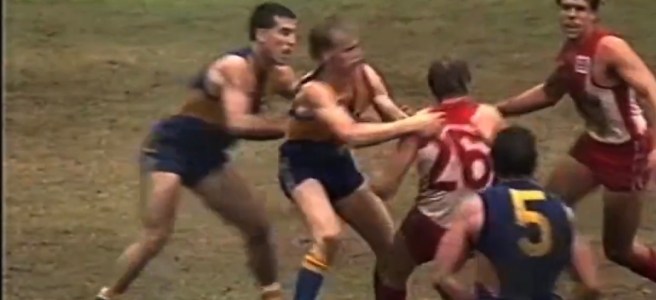
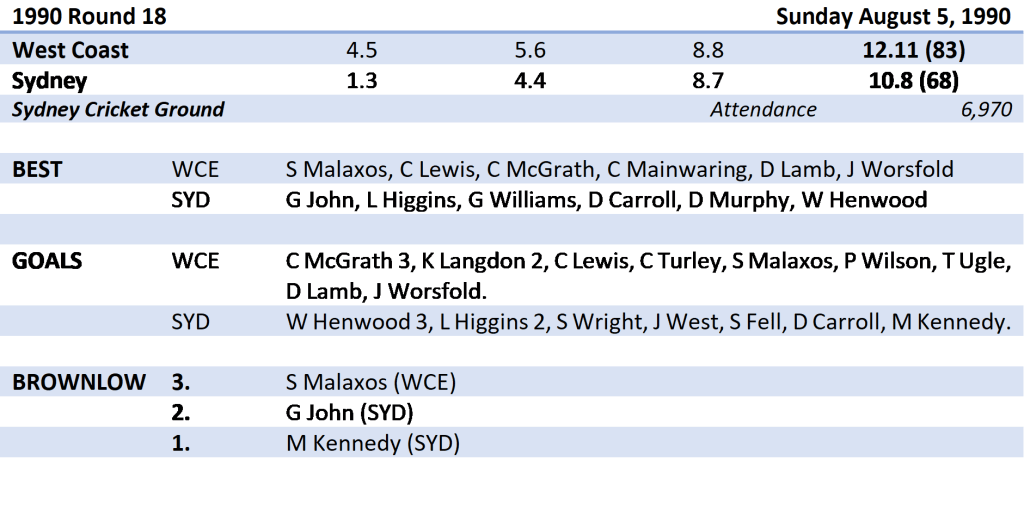
West Coast put in a sub-par performance against the Swans, but still came away with an important 15 point win that kept them in touch with the top two.

The Eagles led by just a point at three-quarter time, but four goals to two in the final term was enough to secure a fourth straight win and leave them just one game behind ladder-leading duo Essendon and Collingwood.

Twice, West Coast pushed their lead beyond twenty points, only to be reeled in by an inexperienced Swans outfit.

Following their 75 point thrashing by the Saints the week before, Sydney turned over a quarter of their side for the clash with West Coast.

Paul Kelly, Matthew Ryan, Troy Luff, Matt Lloyd and Mark Eustice were all dropped, as Sydney brought in a number of youngsters. Craig Nettlebeck and Chris O’Dwyer were both selected for their AFL debuts, while Darren Denneman was picked for just his fifth game of football. Robert Teal was selected for his first game of the season after battling injury for much of the year, with veteran Rod Carter also returning.

The Swans were then dealt a further blow when Darren McAsey was rubbed out for two weeks after being charged for striking on trial-by-video. McAsey received the two week ban after teams were initially submitted during the week, with his place taken by small forward Shane Fell.

The Eagles on the other hand were far more settled making just the one change, with Karl Langdon replacing out of form forward Stevan Jackson. Peter Melesso remained at full forward with Peter Sumich still out injured.

Both teams slugged it out in the early stages, before a burst from West Coast just before quarter time allowed them to hold a 20 point lead at the first change. Undeterred, Sydney plugged away through the second term with goals to Leon Higgins, Shane Fell and Steven Wright to close within two points before a late Craig Turley goal saw West Coast head to half time with an eight point lead.

West Coast opened the third term with the first three goals to reach a game high 26 point lead and looked set to ease to a comfortable victory. But Sydney again wrested control in the game. The Swans booted the last four goals of the quarter to reduce the margin to just a solitary behind with a quarter to play.

Eagles coach Mick Malthouse didn’t hide his displeasure at three quarter time, demanding an improved performance in the final quarter. West Coast responded, led by Chris Lewis and Chris Mainwaring, to claim a 15 point win and hold their spot in third place.

While happy with the win, Malthouse acknowledged his side were far from their best.

“We won it playing poor football, but I’m just happy to get out of this bloody joint with a win.”

“That was our flattest game of the year.”

Sydney coach Col Kinnear was equally disappointed after the match, believing his side had missed out on a golden chance to claim just their fourth win of the season.

“At the 15-minute mark of the final quarter, I don’t think we believed we could win. When we wanted a lift from some of the senior players, it wasn’t coming,” a dejected Kinnear said.

Indeed many of the Swans’ best players came from their younger crew.

Six-gamer Gareth John was arguably best on ground for the Swans, as he had the better of Dean Irving in the ruck. John picked up 24 touches and seven marks, to go with 14 hit-outs, and was virtually another midfielder for the Swans.

Leon Higgins tallied 22 touches and booted two goals, while in defence Craig Nettlebeck stood tall in his debut game, blanketing Eagles forward Karl Langdon. Langdon managed just five disposals for the game, although he did manage to goal twice.

“The kids were terrific. I am bitterly disappointed for them,” Kinnear said.

Dwayne Lamb was one of the best for West Coast in his match up against Greg Williams

The Eagles, on the other hand, had a far greater spread and key players stood up when it mattered.

Captain Steve Malaxos again led from the front, finishing with a game high 31 disposals and a goal, while Dwayne Lamb was effective for the Eagles, while attempting to minimise the damage inflicted by Swans centreman Greg Williams.

Williams still finished with 30 disposals, but was not as dominant as he has shown in 1990, with Lamb able to match him with 25 possessions and a goal. Chris Mainwaring (24 disposals) and Chris Lewis (23) both had important touches in the final term as West Coast again built ascendancy in the match.

Up forward Craig McGrath kicked three goals from 16 disposals and with Langdon and Jackson both largely ineffective, remained the one constant focal point for the Eagles.

The result allowed the Eagles to hold onto third spot as pressure for the double chance continued to come from the Demons and Hawks below them.

“It was more a battle of survival and we are delighted to come away with a win at this time of the year when we are fighting for our top-three position.”

While the Eagles had worked their way through a lethargic performance to still claim the four points, Malthouse reminded the rest of the competition that his side were still expecting to be a force come September.

“A good side wins those sorts of games and we are a good side.”

The one downside from the match was the two game suspension handed down to vice-captain John Worsfold. Worsfold had been cited for striking Williams, with the tribunal rubbing Worsfold out of the Eagles’ next two matches against Richmond and Melbourne.

The Eagles remained hot on the heels of Essendon and Collingwood who both recorded victories. The Bombers scraped past Geelong, booting six goals in the final term to overturn a 27 point three-quarter time deficit. Gary Ablett booted eight goals for the Cats, but it would be another disappointing result for the 1989 runner-ups.

Collingwood made far lighter work of their opponent, thrashing a toothless Saints team by 68 points. The Magpies showed they were on early, registering 12 scoring shots in the opening term, but only managing an inaccurate 3.9 for their effort. Collingwood controlled the game throughout, delivering the Saints their worst loss of the season.

Hawthorn and Melbourne also won, meaning the top five held their positions at the completion of the round. The Hawks defeated the Kangaroos by 18 points in the Friday night opener, while the Demons held off Brisbane to win by 13 points, despite only kicking one goal in the second half.

In the other crucial match-up of the round, sixth-placed Footscray hosted the eighth-placed Carlton at the Western Oval, with both sides harbouring hopes of sneaking into the top five. At quarter time, the home fans would have had September action firmly in their minds, as the Bulldogs led by 26 points having held the Blues scoreless.

But Carlton managed to flip the script in the final three quarters, booting 15 goals to five to run out easy 29 point winners. Simon Minton-Connell proved the difference between the two sides, kicking eight goals, with Footscray unable to find a reliable target up forward.

The win saw the Blues join the Bulldogs on 10 wins, taking over sixth place on percentage, but the Hawks benefitted most of the result to move one game clear of the pair in the final spot for finals action.