

Sumich Shoots Wide On Siren
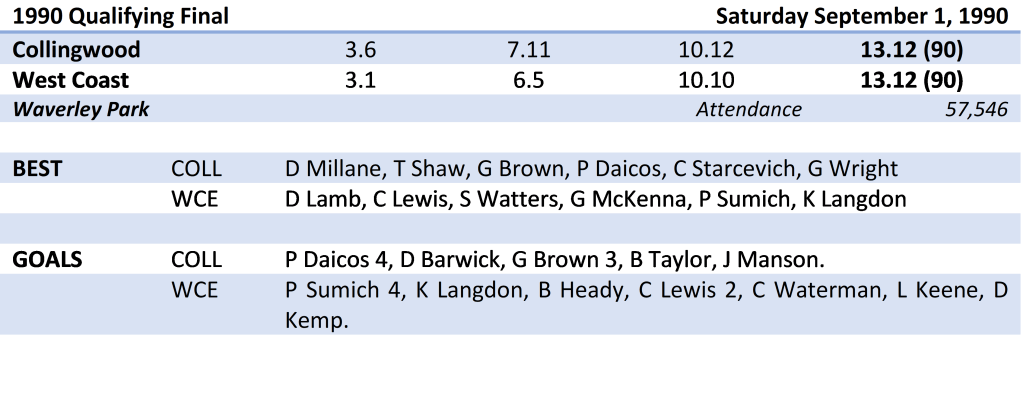
West Coast and Collingwood opened the 1990 finals series with a dramatic draw in the Qualifying Final, flipping the entire finals series on its head.
Peter Sumich had the chance to win the game in the dying seconds, but his missed set shot from close range in the left forward pocket, left the two teams matched on 13.12 (90) as the final siren rang.
The result – the first draw in a final since the 1977 Grand Final – was set to throw the finals series into disarray, with the Eagles and Magpies due to return to Waverley Park the following weekend to determine who would progress to the first semi-final to tackle the Bombers.
Melbourne were awaiting the loser of the replayed match, after they knocked reigning premiers Hawthorn out of the premiership race with a nine-point win in front of nearly 75,000 fans at the MCG.
The Demons now also had the added benefit of a week off ahead of the second semi-final after winning through the elimination final. Conversely, Essendon – who had earned the week off in the first week of the finals for finishing top at the end of the home-and-away season – were now facing a second straight week off, complicating their preparations for their first final.
Essendon coach Kevin Sheedy dismissed suggestions the protracted series would work against the Bombers, despite the prospect of over three weeks between their final round match against the Saints and the first semi-final. “We have played 22 home and away games this year, four Fosters Cup games and eight practice matches. I don’t think we need to worry about fitness.”
While the AFL were estimating an additional $800,000 would be generated from the extra match to be played, they were also forced to busily reschedule many of the planned events over the coming month. The Grand Final was now set to be played a week later on October 6, however the date for the Brownlow medal wasn’t expected to change.
The Magpies were heavy favourites heading into the match, off the back of their two largest wins of the season in the final two rounds. The Magpies took in an unchanged side from the win over North Melbourne, despite a couple of key injury concerns.
Darren Millane stayed in the side despite fracturing a thumb against the Kangaroos, as did ruckman James Manson who trained lightly leading up to the match due to an ongoing groin issue. The Magpies also had Denis Banks and Shane Kerrison available to return from injury, although neither was recalled for the clash against the Eagles.
Full-forward Brian Taylor also kept his spot, despite an indifferent two seasons at the club. Taylor had managed just one game in the back half of 1989 due to a knee injury (coincidentally against the Eagles) and had featured in just five further matches in 1990, returning to the side in round 21 against Fitzroy.
The Eagles made just one change with Dean Irving returning after being dropped for the final round match against Geelong. Controversially, fellow ruckman Phil Scott was the one to make way after playing all 22 games during the home-and-away season.
For Mick Malthouse, it was a heart-wrenching decision. “This was the toughest decision I have made in seven years of coaching.”
“Phil accepted the decision like the professional sportsman that he is.”
Craig Turley also held his place despite concerns over a groin problem. West Coast were considered outsiders – namely by the Victorian media – with ten players playing in their first final. The Eagles were also playing only their third game ever in club history at Waverley Park; their other two appearances had both resulted in losses.
Steve Malaxos won the toss and sent his side the way of the breeze in the opening term, but the more experienced Magpies were able to settle first. Taylor had an early chance in the game, hitting the post with his first shot, before sending his second effort on goal out of bounds on the full.
His presence on the game forced an early positional change in the match, with Murray Rance and Michael Brennan swapping. The larger Rance headed to the goal square to match on Taylor, with Brennan shifting to centre half back on Craig Starcevich.
Dean Irving was stationed as a loose man in defence as Collingwood continued to push the ball forward, but while West Coast were able to limit the damage on the scoreboard early, the Magpies’ opposing ruckman Damien Monkhorst was allowed to dictate play and provide the link playing loose through the middle of the ground.
Monkhorst would be involved in the chain that delivered Collingwood the opening goal of the game. Chris Mainwaring was caught holding the ball across half forward, by opponent Mick McGuane, with Collingwood able to transition quickly to the other end of the ground.
Graeme Wright received the handpass from Monkhorst through the centre square, and kicked inside forward 50, looking for Taylor. However, Peter Daicos was able to read the spoil from Rance and after a handpass exchange with Starcevich, Daicos found some space to slot the important first major.
Gavin Brown added a second after being held by Guy McKenna in a marking contest, before West Coast worked their way into the game. Laurie Keene wobbled through the Eagles’ first on the run, before Brett Heady made it two goals in succession.
Brown added a second for the quarter, and third for the match for the Magpies, but his effort was cancelled out by Peter Sumich from long range leaving West Coast five points behind at the first change.
Mick McGuane was the clear standout at quarter time, picking up 16 disposals on the wing for the term opposed to Chris Mainwaring. His red hot start continued into the second term when an early shot on goal cannoned into the post. The Magpies managed several more efforts without success, before Sumich swung the game back in favour of West Coast.
Sumich goaled twice from long range to draw the Eagles level, before Karl Langdon sent through his own long bomb from beyond the arc to put West Coast in front.
However, that only seemed to spark the Magpies into gear.
Brian Taylor was dragged to the bench and the more mobile Craig Starcevich became the prime target up forward. Peter Daicos continued to present a threat, as did Gavin Brown who was now operating out of the goal square.
The Magpies booted the final three goals of the term to open up a 12 point lead at the main break. Collingwood were also guilty of wasting their chances on goal, having had seven more scoring shots for the half than West Coast.
Both coaches made moves to start the second half, as they looked for the all-important edge in the match. Ron McKeown replaced Craig Kelly at full back on Peter Sumich and Worsfold took Daicos in the Eagles defensive half.
And as the match grew in intensity, so did the sublime skills of its participants.
Dean Kemp drew the Eagles within a kick with a pinpoint goal from the pocket, before Daicos responded with a 40 metre snap. Peter Sumich add his fourth of the match, again from long range, and Chris Waterman kicked truly after being found on his own in the forward pocket, to see the Eagles reach parity.
West Coast were now in control of the game, led by Dwayne Lamb who gathered 12 possessions for the quarter, and Scott Watters, who had nine. James Manson put the Magpies back in front against the run of play after a sloppy turnover in defence, but the Eagles continued to generate opportunities.
Brett Heady, Chris Mainwaring and Dwayne Lamb all missed before Chris Lewis typified the class of the game, with a truly outrageous goal to put the Eagles back in front.
Ron McKeown was captured in defence by Kemp, with the ball spilling towards the boundary line where Lewis was able to swoop, gather, brush off the tackling attempt from Scott Russell before snapping through an incredible goal on his non-preferred foot in amongst a nest of Magpies.
Further adding to the difficulty of Lewis’ effort, Lewis had also lost his footing during the play, stranded on his knees before being able to lift back to his feet and kick an important goal for the Eagles.
Lewis had been instrumental in the second quarter in keeping West Coast in touch with Collingwood as they built an early advantage and now, as the match closed in on three-quarter time, the Eagles were the ones with all of the momentum.

Heady would miss a chance after some clever play by Lewis at half forward, where he was able to pluck the ball away just as Collingwood were set to clear from defence, before Heady and Sumich would then clash competing for the same mark. Dwayne Lamb would also miss a chance to get a shot on goal after fumbling at the top of the goal square.
A swift chain of passes from defence ended with Doug Barwick kicking truly to give Collingwood an unlikely two point lead, against the run of play, with a quarter to play.
The two point deficit became a ten point lead for West Coast early in the final quarter after Heady and Lewis each booted majors in quick succession. The Eagles runners – the likes of Watters, Lamb, Chris Mainwaring and Guy McKenna – had controlled the tempo of the game since half-time and the Magpies were struggling to keep pace.
Mick McGuane had faded out of the game after his blistering first quarter and found himself on the pine, while James Manson had been sent from attack to defence to quell Karl Langdon who had been in everything during the third term.
Trailing, Leigh Matthews reinstated Brian Taylor to the field after spending the second and third terms on the bench and the move paid immediate dividends. Taylor was able to claim a diving mark in front of Murray Rance, and goal, to reduce the Eagles lead to four points.
A few minutes later, Taylor added a second after Rance caught him high in a marking contest, and Collingwood had worked their way back into the lead.
The Magpies appeared to have done away with the Eagles challenge when Peter Daicos extended their lead with an effort that managed to top Lewis’ freakish effort in the previous term.
The Eagles attempt to exit their defensive 50m arc came unstuck when Guy McKenna missed John Worsfold with a pass, after a strong mark in the Magpies’ goal square. Gavin Brown was able to win the loose ball back near the boundary line, feeding a handpass up the line to Darren Millane, who instantly handpassed over his shoulder to Daicos deep in the forward pocket.
With the outside of his right boot, from the wrong pocket, Daicos magically worked the ball to land at the feet of the goal umpire and extend the Magpies’ lead out to eight points with just five minutes remaining.
West Coast though continued to push.
A desperate effort from Steve Malaxos across half forward prevented Collingwood from clearing out of defence, with Langdon able to snap truly from a boundary throw-in. Waterman dragged a shot on goal from deep in the pocket, reducing Collingwood’s lead to a solitary point before the final last play that had the game in the balance.
Chris Mainwaring twice failed to find an Eagles target in the forward half before Darren Millane attempted to clear out of defence. However, Eagles runner Rob Wiley inadvertently kept the ball in the Eagles forward line when he got in the way of Millane’s handpass resulting in a boundary throw in.
Langdon won the ball from Keene at the restart with his attempt on goal floating across the face into the opposite pocket where Sumich was able to mark over his shoulder. His final kick would become instantly folklore.

All up, the lead changed eight times during the match, and while the teams may not have been separated at the completion of four quarters, the same couldn’t be said for the attitude of the two coaches.
While Leigh Matthews was relieved to have a second chance at the second chance, his counterpart in Malthouse was left ruing the missed opportunity.
“We didn’t make the most of the opportunities. When the game was there to be won, we didn’t grab it.”
Malthouse expressed frustration that West Coast couldn’t take advantage of the lead they built during the final quarter and run out to win the game. “I feel bitterly disappointed. We didn’t achieve what we came here to achieve.”
The Eagles coach was also unwilling to accept much of the post-match praise from the Victorian media, who joined in with Matthews’ assessment that the Eagles were stronger contenders for the flag than many scribes had suggested.
“They were always going to play better than the public perception of them – that almost inevitably is the case,” Matthews said.
“It was never going to be easy. We didn’t think we played well, but we live to fight another day and that’s the way we are looking at it.”
The Collingwood coach refused to admit they were fortunate to make it out with a draw, but said they were ‘thankful’ to get another crack. “With a draw you tend to be disappointed because you haven’t won – until you tell yourself you haven’t lost either.”
“We feel quite positive about having another chance.”
The ramifications of the draw would lead the AFL to change how drawn matches were decided, with the Commission voting to introduce two five-minute periods of extra time for all finals, other than the Grand Final.
For now though, West Coast and Collingwood had a week to prepare to do it all again and Malthouse had one message for those who had decided to jump on the Eagles bandwagon.
“Do us a favour and write us off,” Malthouse declared.
“Maybe they (the media) have underestimated the fierceness and willingness to contest. We showed today what we are capable of doing.”
“As far as I’m concerned it’s half time in the match. It’s a 14-day game.”

 sportsphrase.blog