
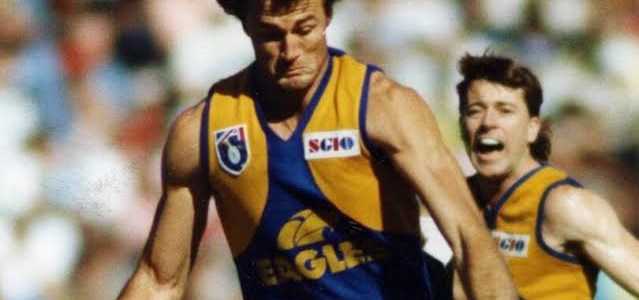
West Coast Hold Third With Final Quarter Fightback
As the clock ticked into time-on of the third quarter at Kardinia Park, the Eagles’ double chance hopes looked shot.
A goal to Trevor Poole had extended Geelong’s lead out to 31 points over a sluggish West Coast side that had been unable to match the Cats throughout the afternoon. Elsewhere, results were not favouring the Eagles.
With the Magpies thrashing North Melbourne and the Demons holding a handy advantage heading towards three quarter time over the Hawks, West Coast were poised to drop to fourth to face reigning premiers Hawthorn in an elimination final in the first week of the finals.
But the Eagles of 1990 have developed the steely resolve of their back-pocket coach and by game’s end, West Coast were celebrating another incredible win in the clubs short history.
Goals to Craig McGrath, Peter Sumich and Chris Waterman in the final six minutes leading into three-quarter time reduced the margin to 18 points, to give West Coast hope and put the stutters into the Cats and their fans.
Then Brett Heady – who had been well beaten by Geelong’s best player on the afternoon, Ken Hinkley – bobbed up to kick two quick goals to start the final term when Hinkley was forced off the ground with injury.
Karl Langdon also added a brace of goals in the final term as West Coast steamrolled the home side five goals to one, securing a seven point victory.
And it was a returning big man who seemed to be the catalyst for the Eagles comeback.
Laurie Keene hadn’t been seen at AFL level since Round 2 1989 as he battled knee and lower leg complaints but was named after stringing together a number of games with Subiaco. Keene had travelled with the squad to Brisbane the week before and was promoted to the senior side after Mick Malthouse lost patience with the ruck pairing of Phil Scott and Dean Irving.
Scott held his place but Irving was omitted from the team that defeated Brisbane, along with Phil Narkle and Dean Turner. Joining Keene into the team were Paul Peos, who was selected for his first match since suffering a knee injury in round 3, and Dwayne Lamb who made a surprise return just two weeks after breaking his forearm.
Lamb took to the field with an arm brace and was assigned the job of minding Cats centreman Paul Couch. Scott started in the ruck, with Keene forward and John Worsfold was matched on dangerous Cats forward Gary Ablett.
Geelong had endured a horror season, with just eight wins for the season and would have been excused for having their minds on Mad Monday, rather than the clash with the Eagles. But it was Geelong who started the game like there was something on the line.
Stoneham controlled the ruck, allowing the likes of Neville Bruns and Garry Hocking to drive Geelong forward where Ablett was all over Worsfold. The Geelong forward had six shots on goal in the first quarter alone, but was wasteful with 2.3 and one that sailed out of bounds.
The Cats had only a four point lead at quarter time to show for their early dominance, but they were able to grow their lead over the next two terms with Ken Hinkley controlling the play at half back and the Malekellis brothers joining Hocking and Bruns in winning plenty of the ball through the middle.
Malthouse persisted with Worsfold on Ablett and Lamb had the better of his duel with Couch, but many other Eagles struggled to work their way into the game. Steve Malaxos, David Hart, Dean Kemp and Craig Turley had limited impact in the game, while up forward Peter Sumich was well held by novice Cats defender Mark Neeld.
Sumich had limped off with a hamstring concern the week before against the Bears, but played against Geelong with Malthouse adamant during the week that there was nothing wrong with the Eagle spearhead.
It took the move of Keene into the ruck to swing the match.
Keene took over from Phil Scott in the ruck midway through the third term and his influence at the stoppages was immediate. Chris Lewis and Scott Watters were able to gain an upper hand at the clearances and the Eagles started to generate meaningful forward entries.
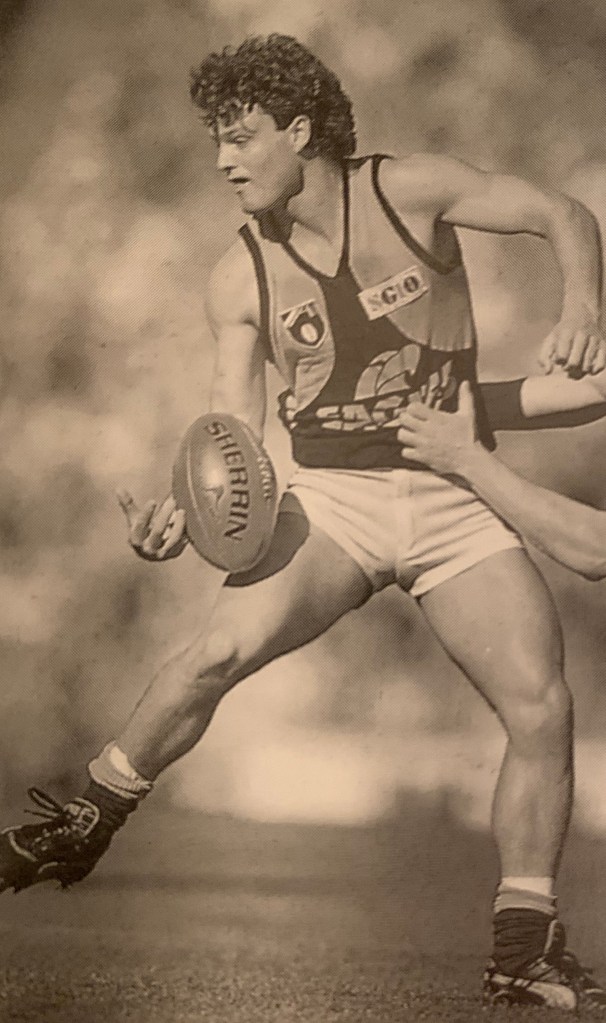
The Eagles would finish with eight of the last ten goals in the match, confirming third spot – the position they had held on the ladder since round 14 – and were set for the clubs’ second ever final against Collingwood.
The win to West Coast said as much as the loss did about Geelong.
For the second week in a row, the Cats had lost at home late in the game after giving up a decisive lead. The Cats had capitulated on multiple occasions during the season and this match was the fifth time instance where Geelong had lost despite having more scoring shots.
For Geelong, the writing on the wall for season 1990 may have been in the humiliating 115 point round one loss to Hawthorn, in the Grand Final replay.
Cats coach Malcolm Blight was pointed in his criticism of the football club. “I’m starting to think that if a side gets close to us, history shows they can beat us.”
“That’s going to be the biggest thing for the Geelong Football Club to overcome.”
The return of Keene also added a new element to the West Coast side, with Blight stating ‘he gave the Eagles a look they haven’t had all year’.
Chris Lewis was again one of the best for West Coast with 20 touches and two goals, while Dwayne Lamb marked his remarkable return with a team high 26 disposals. Lamb also nullified the influence of Paul Couch, with Blight dragging his Brownlow medallist from the ground during the third term.
Scott Watters recorded his highest possession count for the season with 23 and had appeared to time his claim for a senior spot to perfection, having returned to the league side the week before against Brisbane.
Chris Mainwaring worked his way into the game with 24 disposals and Paul Peos also produced a strong showing in his return from injury with 22 touches on the wing.
Neville Bruns was a four-quarter performer for the Cats with 24 kicks and 11 handpasses and Ken Hinkley was the Cats’ best before he hobbled off early in the final term, having accumulated 30 disposals and nine marks.
Garry Hocking picked up 24 touches, Barry Stoneham collected 20 disposals and nine marks in his battle with Phil Scott and then Keene in the ruck, while Gary Ablett was the prime forward in the match, booting 6.5 from 15 disposals.
All spots were up for grabs heading into the final round, but with West Coast overcoming the Cats, there were no changes to the final make-up of the top five.
Essendon secured the minor premiership with a 35 point win over the Saints, who were once again without Tony Lockett. The Bombers trailed at half-time, but a seven-goal final term got the Bombers the win. The match was most notable for the appearance of all four Daniher brothers in the same team; the first time a quartet of brothers played together in the same team.
Collingwood did it easy over North Melbourne, coasting to an 89 point win to finish second on the ladder. With the result determined by half-time, most of the interest surrounded whether Kangaroos full forward and Coleman medal incumbent John Longmire could reach 100 goals for the season.
Longmire had started the match with 96 goals for the season, but his accuracy in front of goal deserted him, returning an inaccurate 2.8 to fall two goals short of the ton.
Melbourne and Hawthorn stayed in fourth and fifth with the Demons holding to a 12 point win, upsetting Hawks captain Michael Tuck’s record-breaking 404th AFL game. The Demons led by 39 points at three-quarter time, but had to withstand a fightback from the Hawks in the final term. The result meant that the two teams were set to play again the following week in the elimination final.
Eagles coach Mick Malthouse acknowledged the achievement of rebounding from a poor 1989 season to reaching finals in 1990, but declared his side would have much to improve on ahead of the Magpies.
Malthouse was also confident that Keene had put the ongoing injury issues of the past 18 months behind him, and could be an important cog in West Coast’s finals campaign.


 sportsphrase.blog