
West Coast recorded their third win on the trot when they easily accounted for Fitzroy at the WACA.
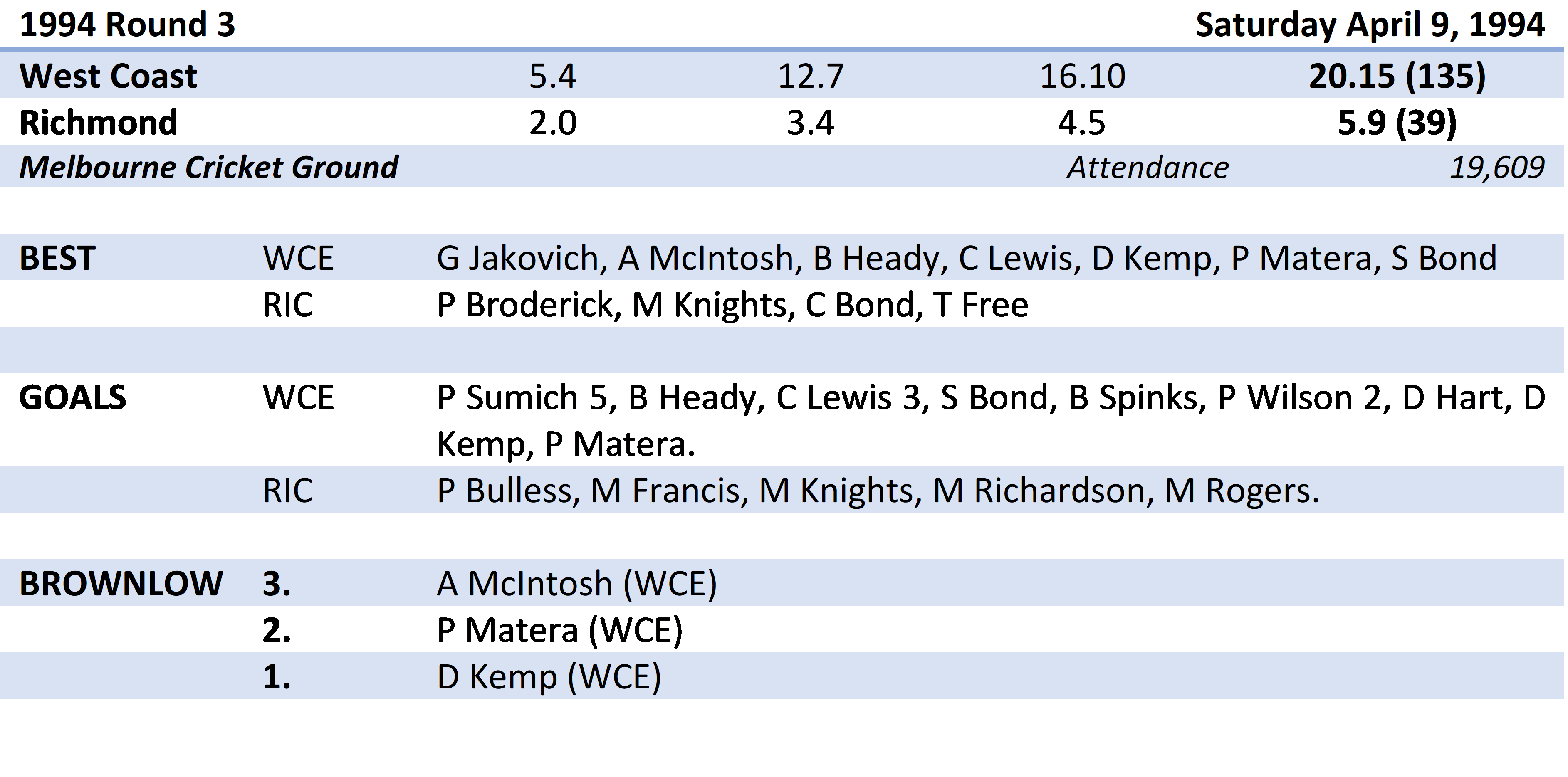
Peter Matera was at this devastating best, finishing with 31 disposals and two goals, while Brett Heady and Peter Sumich combined for seven goals up forward. After an enterprising first quarter from both sides, the Lions could manage just four more goals with the Eagles romping to a 76 point win.
The victory ended a recent poor run for the Eagles against the Lions over the previous three seasons, despite the two sides spending much of that time at opposite ends of the ladder.
The wooden-spoon Lions toppled the ladder-leading Eagles in the final round of 1991, before repeating the dose with an upset 20 point win in Hobart in 1992. The Lions then made it three wins from four games when they shocked the reigning premiers by 18 points at the WACA in their only meeting of 1993.
Early on, it seemed as though the Lions were set to cause more troubles when they booted the first two goals in the opening three minutes. The Lions started with an unorthodox four-man forward line as they looked to run-and-gun from defence on the pacy WACA ground.
Paul Roos was used through the middle and had eight first quarter possessions, as did Fitzroy centreman Brad Boyd. However, the Eagles worked their way into the game and a three-goal burst right before quarter time had the home team in front by 12 points at the first change.
After an enterprising six goal to four opening term, the Eagles defence clicked into gear with the Lions restricted to just four more goals for the game. Paul Roos was soon deployed back into defence, but could do little to stop the West Coast forward line, who mustered 39 scoring shots on goal.
Brett Heady was giving David Johnston the run around, kicking three consecutive goals in the second term as West Coast piled on 5.7 to just three points. The Eagles held a commanding 50 point lead at the main break, before coasting through the second half.
The centre line of Matera, Dean Kemp and Chris Mainwaring all had plenty of the ball, while the Eagles defence clicked into gear after quarter time. The Lions could manage just 4.5 in the last three quarters, with two of those coming virtually on the final siren.
The Eagles win also ended a three game losing streak at the WACA. West Coast had won 14 straight games at the venue before dropping all three matches in 1993, to Fitzroy, Melbourne and Geelong.
It was a disappointing night for the Lions who had come to Perth with a point to prove. There had been much discussion about the future of the Lions, in particular coach Robert Shaw, who was reported to be high on the Fremantle Dockers wish list as their inaugural coach. Shaw had refused to comment on potentially becoming the Dockers coach for their first season in 1995, saying that he was firmly committed to the Lions.
However, the contrast between the two clubs was stark, with some at Fitzroy expecting the club to fold as part of the Dockers’ entry to the competition. Prior to the announcement of the Dockers a few months earlier, there had been suggestions that the club would be forced to relocate to WA and become the state’s second club, however Fitzroy president Dyson Hore-Lacy had been adamant that the club would never entertain such an idea and would continue to fight for their own survival.
Fitzroy had also expressed anger, over what they believed was a deliberate shun by the AFL over Paul Roos’ 250th game the week before. The milestone hadn’t been acknowledged by either the league or the official AFL record with Roos himself playing down the incident, despite the club being privately incensed about the matter.
But Fitzroy were ultimately outclassed, leading Shaw to declare that the Eagles had re-discovered their irrepressible 1991 form.
“They applied pressure to us that probably no other club has been able to do for many years. They are back to the team of 1991. I think they’ve reached that level again. Maybe they’re stronger and their tackling is better.”
Malthouse was delighted with the win, with West Coast again showing great form up forward. While Peter Sumich was held to three goals by young full-back Simon Hawking, Brett Heady had re-discovered his best touch to boot four, and Brett Spinks and Shane Bond again showed great form despite their inexperience.
Spinks played his best game in his short career, with 14 kicks and 10 marks from centre half forward. His effort earned him a rising star nomination and his early season had form had kept Karl Langdon out of the Eagles line up, despite the premiership player finishing his three game suspension from the pre-season competition.
Shane Bond booted two goals from 18 possessions and Peter Wilson had 24 disposals operating between half forward and the midfield. Despite losing Michael Brennan before the game with a hamstring strain and Chris Lewis to a wrist injury after half-time, little had gone wrong for West Coast, with Malthouse emphasising a need to bank wins early in the season.
“It’s very difficult to come home sometimes and try to catch up”, he said. “Geelong tried it last year and were very effective till in the end their percentage was below ours.”
“We don’t want that happening to us this year.”
“I’m not sure how many games it’ll take to get into the eight. It might take 10 or 11 wins (from 22 games) but I don’t want to find out in round 21 or 22 that we need two wins to get there,” Malthouse warned.
With three wins from four games, the Eagles remained in fourth spot, courtesy of the AFL’s controversial match-ratio system. With positioning of teams based on the numbers of wins based as a percentage against the number of games they had played, instead of points and percentage, West Coast sat behind Melbourne and Collingwood, despite having the same number of wins and a better percentage.
Because those two teams had already sat a bye in the opening four rounds, they occupied 2nd and 3rd spots with three wins from three games. The Kangaroos sat in top spot, also with three wins from three games.
While the Eagles had a comfortable win on the field, off the field they had to deal with another battle with another Lions group. Subiaco had expressed their dismay over the problems they faced with fringe Eagles players in their squad.
Subiaco had 13 Eagles-listed players in their squad, with coach Tony Solin blaming their poor start to the WAFL season on the disruptive issue of only having Eagles players train at the club once a week. The likes of Karl Langdon, Daniel Metropolis, Jarrad Schofield (who ended up being a late inclusion for the Fitzroy game, replacing Brennan), Tony Godden and Matt Connell had all played with Subiaco, with the Eagles strong start, but the club believed being forced to play Eagles’ players had compromised their team selection.
West Coast players had also admitted confusion over the differing styles of play between Malthouse’s defensive set-up, versus the game plan that Solin had hoped to implement with Subiaco.
Subiaco said that moving some of the players to rival WAFL clubs wasn’t an option, and under the agreements between the WAFL and West Coast Eagles, they were unable to drop players to the Subiaco reserves side. Daniel Metropolis and Jason Heatley were two players that had had little impact in their opening games with Subiaco.
The Eagles and Subiaco met ahead of the Friday night clash with Fitzroy to reach a compromise, with Solin hoping that West Coast players would be more accommodating in attending Subiaco training and team bonding sessions.

 sportsphrase.blog