1994 Rewind: Eagles Bounce Back Against Roos

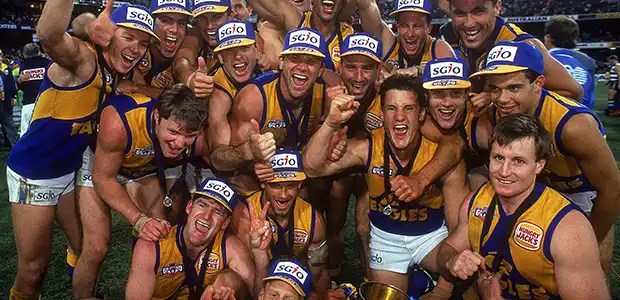
Wayne Carey may have won the battle, but the Eagles won the war as they righted the shock defeat to Hawthorn the week before with an impressive 37-point win over premiership rivals North Melbourne.

Carey was a lone force for the Kangaroos, eclipsing opponent Glen Jakovich in the hotly-anticipated duel. The North Melbourne skipper racked up 21 disposals, 15 marks (out of the 45 marks North Melbourne managed as an entire team) and booted 5.3. However, it mattered little as West Coast put in their most accomplished performance of the season.

Both teams entered the clash keen to atone for poor defeats the week before. The Kangaroos suffered their first loss of the season when they fell to Geelong by 15 points, while the Eagles had been humiliated by 71 points at home to lowly Hawthorn.

The Eagles responded to the loss by making four changes, although two of them were forced through injury. Paul Harding had escaped serious concerns over a knee injury suffered against the Hawks but was still not considered fit enough to take on the Kangaroos, while Peter Matera was also left at home, still dealing with the after effects of a broken nose and concussion from the Hawks game.

Jarrad Schofield and Craig Turley were both dropped, with the latter failing to recapture his best form in his first five games back from retirement. Dwayne Lamb, David Hynes and Tony Godden were all selected for their first games of 1994, while Chris Waterman came back into the team after three weeks exiled at East Fremantle.

North Melbourne weren’t without their injury concerns either heading into the game, with both Corey McKernan and Peter Mann unavailable for selection. Glenn Archer did make the cut, despite injuring a hamstring at state-of-origin training the week before, while Anthony Rock also played in spite of a back complaint.

Along with Archer, Stuart Anderson was selected for his AFL debut, while journeyman Gareth John was picked for his first game with the Kangaroos after swapping over from the Swans. It is the Kangaroo ruckman’s first senior game of football since 1991 with injuries curtailing the end of his time with Sydney. Ian Fairley, Jason Daniltchenko and Brett Allison were all omitted.

The Kangaroos started strongly with Carey having immediate impact. The North Melbourne captain took an early mark and kicked truly before hitting the post with a second shot on goal moments later. Peter Sumich kicked a brace in quick time, after two strong marks opposed to Mick Martyn, before Carey had a third shot on goal, his second miss of the term.
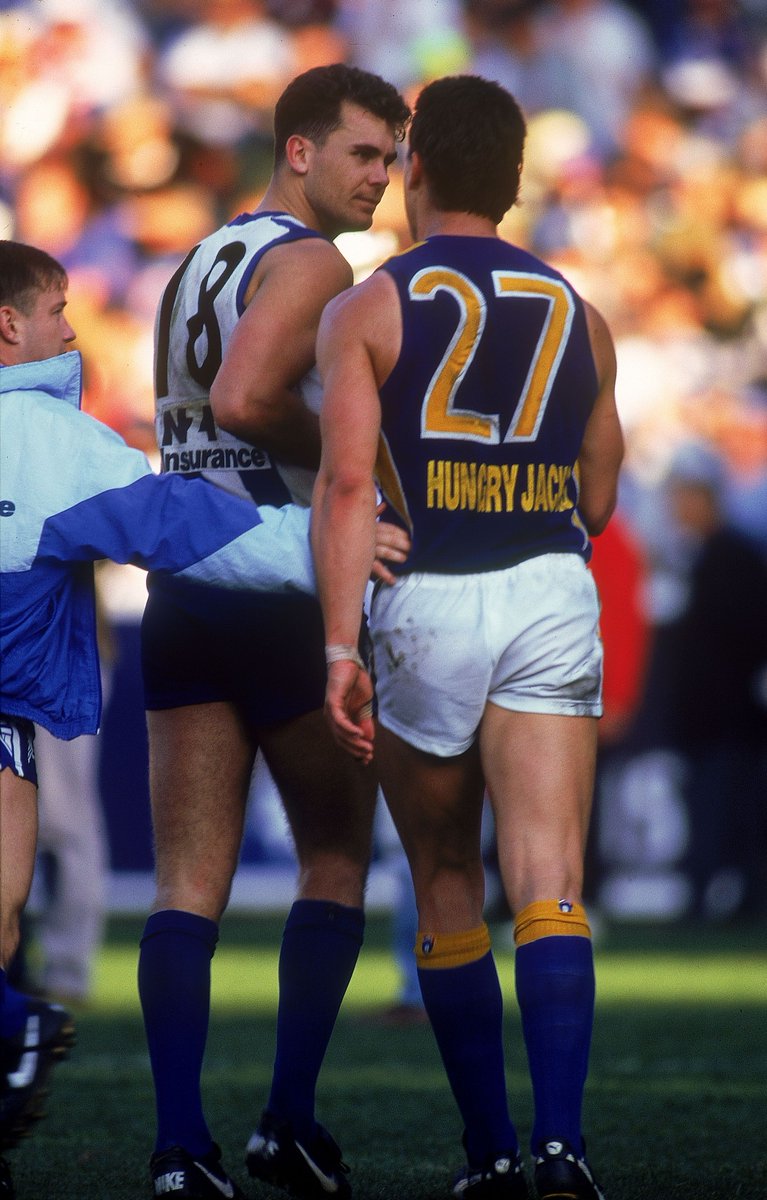
The early missed chances from Carey would prove costly as West Coast’s running game troubled the Kangaroos. Chris Mainwaring and Guy McKenna – who was moved up the field as Matera’s replacement on the wing – were providing plenty of drive, as was Dean Kemp who was being used across half-back. Mainwaring racked up nine first quarter possessions opposed to Stuart Anderson, while McKenna was giving former teammate Trent Nichols a bath.

McKenna was involved in setting up the Eagles third goal through Ashley McIntosh – who had started forward alongside Sumich and Brett Spinks – before kicking the Eagles’ fourth with a long range shot on the run.

Adam McAdam came off the bench for the Kangaroos to provide some run and immediately found Mark Roberts for the Kangaroo’s second goal but the Eagles responded almost immediately through Don Pyke. McKenna then had this third goal involvement of the term when he found Brett Spinks on the run to put West Coast 20 points clear.

Carey did his best to keep the Kangaroos in the contest, booting consecutive goals. The first came from a free kick given away by Michael Brennan off the ball, before he then out-marked Jakovich to kick his third for the term. Don Pyke kicked his second goal late in the quarter to take the Eagles lead back out to 14 points.

The Eagles kicked seven straight for the first term and their impeccable goal kicking continued into the second quarter. The Eagles had ten goals on the board before their first blemish when Ashley McIntosh hit the post. Before that, McIntosh had kicked two successive goals to open the term, as he proved too fast and too agile for John Blakey. Wayne Carey added a fourth goal (out of North’s five), before a cleverly crumbed goal to Chris Lewis saw West Coast’s lead stretch out to 26 points.

The Eagles running game was too much for the Kangaroos, recording three times as many handballs, as they continually swarmed forward in waves from half-back. With the game starting to get out of hand, Denis Pagan swung a number of changes.

Mark Roberts was switched to defence to curtail McIntosh, John Blakey was moved forward, Glenn Archer went to half-back and Dean Laidley pushed onto the wing against Mainwaring. Gareth John was introduced into the ruck off the bench, while Adam McAdam returned to the field and was stationed at full forward.

But the changes did little to stop the Eagles momentum. Brett Spinks goaled from the boundary line, and David Hart roamed forward to goal from 50m, after some good forward pressure from Shane Bond. After being so accurate through the first quarter and a half, the Eagles’ radar went missing as they butchered a host of other chances late in the term, with a John Longmire goal after the half-time siren reducing their lead to 31.

It was more of the same for West Coast after the main break, with the Eagles booting the opening four goals of the term as their lead pushed towards ten goals.

Brett Spinks marked in a heavy pack in the goal square to open the scoring, with Mainwaring kicking truly when he received a 50m penalty against Laidley. David Hart had his second running goal, when a scrappy kick out of the Eagles defensive fifty evaded a number of players, releasing Hart from the centre circle to the top of the West Coast 50. Brett Heady had his first of the afternoon when he scouted the back of a marking contest to snap truly on his opposite foot.

The Eagles had winners all over the ground, with even Carey’s influence waning as the ball stayed locked in the Eagles forward half. While Pagan was busily moving the magnets to stop the tide, the Eagles were perfectly quelling the Kangaroo’s prime movers.

Wayne Schwass managed just one kick in the first half opposed to Drew Banfield, while Anthony Rock had Dwayne Lamb for company and had been barely sighted. Don Pyke was given the role on Anthony Stevens, but Stevens was soon moved to the wing to be Mainwaring’s third opponent for the day.

Two late goals to Glenn Archer and Trent Nichols before the three quarter time siren stopped the Eagles run, but the visitors still headed for home with a 46 point lead.

That lead stretched beyond ten goals with David Hynes and Chris Lewis both kicking majors, before the Kangaroos kicked the last four goals in the game, as the heat dissipated out of the contest.

Apart from Carey, there were few notable performances from the Kangaroos. Glenn Archer tallied 20 disposals to go with his third quarter goal, while Mark Roberts had 19 possessions and two goals rotating between the forward line and defence and Ross Smith was the best in the midfield with 16 disposals.

For Malthouse, the performance was a good response to the previous week’s thrashing. “Hawthorn were very good last week and we needed to be this week. Everyone that is in top sports knows that you’ve got to have the right attitude.”

After a blistering start, Chris Mainwaring finished with 25 touches, with Anthony Stevens restricting his output through the second half. Guy McKenna picked up 21 disposals, 7 marks and a goal, David Hart finished with 22, while Dean Kemp was the highest ball winner with 27 playing out of defence.

Brett Spinks and Ashley McIntosh each kicked three goals, with ten players hitting the scoreboard. “He (Spinks) has given us a new dimension. He’s a very capable player who will only get better… he’s a good grab and he kicks the ball out of sight.”

The result lifted the Eagles to 2nd on the ladder, behind only the undefeated Demons, but the win came at a cost. Peter Sumich limped off during the third term with a hamstring injury that was expected to sideline the spearhead until at least after the Eagles bye in Round 8.
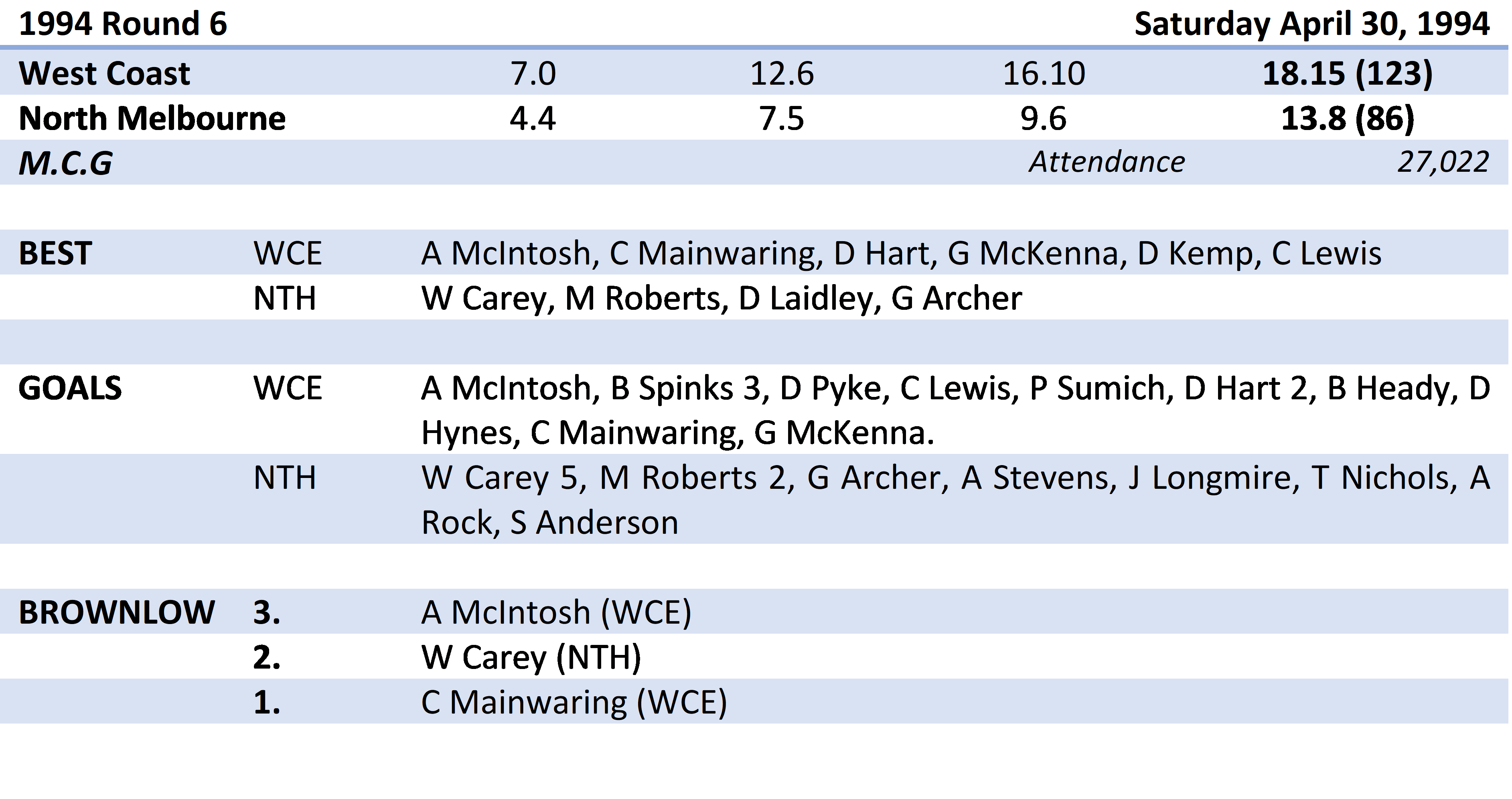
1994 Rewind: Malthouse Warnings Fail to Fire

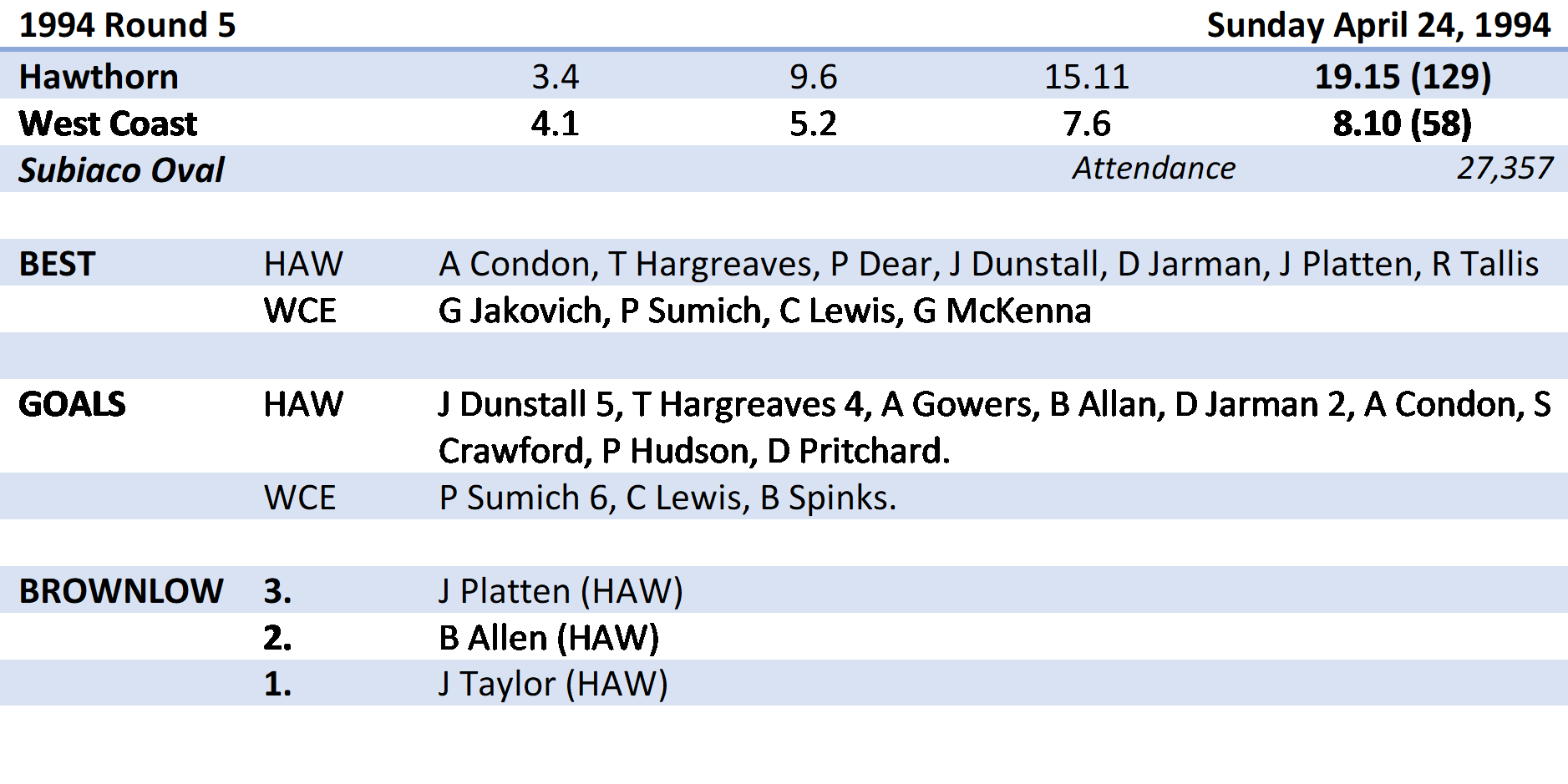
The Eagles failed to heed the pre-match warnings of their coach when they crashed to an embarrassing 71 point loss at home to the bottom-of-the-ladder Hawks.

West Coast recorded their lowest ever score at Subiaco Oval, while also suffering the worst ever loss at home as Hawthorn ran riot after quarter time. The Hawks booted 16 goals to four as West Coast failed to put up a fight against a physical Hawthorn outfit.

The Hawks were noticeably physical towards the Eagles players and the disputed contest, with Peter Matera an early casualty. Matera was collected by Hawks ruckman Paul Dear following the opening bounce and played no further part in the game as he dealt with concussion.

The Eagles appeared unwilling to match the Hawk’s desire leaving Malthouse to question his side’s attitude leading into the game. Hawthorn had been given virtually no chance of upsetting West Coast at home, following a string of horror losses.

A round two defeat to Melbourne by 54 points had been followed by thumpings from North Melbourne (127 points) and Carlton (87 points), had left the 1980’s powerhouse mired to the bottom of the table and coach Peter Knights under extreme scrutiny.

However, the depleted Hawks were buoyed by the return from injury of spearhead Jason Dunstall and full-back Chris Langford to make their ‘spine’ far stronger. Dunstall and Langford were two of four changes with Jason Taylor brought into the team to shore up the Hawks defence, while Tim Hargreaves came in for his AFL debut. Nick Holland, Mark Bunn, Glenn Nugent and Darren Baxter all made way.

The Eagles made just one change to the team that was on a three-game winning streak, with Michael Brennan returning after being a late withdrawal the week before against Fitzroy. His replacement against the Lions, Jarrad Schofield, held his spot, with Matt Clape the player to go out of the side.

Despite being overwhelming favourites going into the clash, Eagles coach Mick Malthouse cautioned his players over complacency in taking on the Hawks. Malthouse even went as far as making his players sit down and watch the replay of the Perth Wildcats game from a few days earlier, when they were humbled at home by the last-placed North Melbourne Giants.

And early on it seemed as though Malthouse’s warnings had gotten through to his players when the Eagles opened with the first three goals against Hawthorn. Despite losing Peter Matera at the opening bounce when Hawthorn ruckman Paul Dear crashed into him, the Eagles were completely dominant as Peter Sumich gave Langford a torrid return start.

Sumich had all of the Eagles’ first three goals but the game soon shifted as Hawthorn’s midfield got on top. Tim Hargreaves kicked the Hawk’s first with his first kick in AFL football with the Hawks booting the next three to take the lead heading into quarter time. Sumich restored the Eagles’ advantage with his fourth for the term, as West Coast headed into the first break with a three point advantage.

But Hawthorn’s midfield continued on their dominance, as they repeatedly won the ball from stoppages. Ben Allen and John Platten had the ball on the string in the centre, while Andrew Gowers provided plenty of run on the wing opposed to Chris Mainwaring, who was sporting a large padding on his thigh from the outset.

The Hawks booted the first six goals for the term, with Dunstall and Gowers each kicking two, before Brett Spinks responded late in the term for West Coast, reducing the deficit to 28 points at half-time. Any thoughts of a second half comeback though were quickly snuffed out at the start of the third term.

Jason Dunstall marked a scrambled kick forward from John Platten out of the first centre bounce to kick his third goal for the game, and then Ben Allen goaled moments later to stretch the Hawks lead out to 40 points after just a minute and a half of play.

Hawthorn would boot another six goals for the term to push the difference beyond 10 goals, before Chris Lewis broke the run with his first major and then Peter Sumich kicked his fifth after the three quarter time siren. A four goal to one term in favour of the visitors completed the rout.

Remarkably, Sumich would also goal after the final siren, bringing his tally for the game to six, with three of his goals kicked after the close of quarters. Sumich kicked goals after the siren for the first, third and fourth quarters in one of the more bizarre outings for a forward.

Following the defeat, Malthouse was in no doubt about what triggered the shock result. “I reckon our attitude before the game was that it was going to be a stroll in the park. We paid dearly for thinking that it would just happen because we are playing at Subiaco Oval.”

“I’ve said for the last five or six years that you can’t play around with form. You can’t drop your workload. You can’t drop your attitude.”

Sumich was one of the few winners for West Coast, kicking six of the team’s eight goals. The rest of the forward line was non-existent as many of the Eagles lowered their colours against their Hawthorn opponents.

Ray Jencke shut out Brett Heady, 2nd gamer Mark Graham had the better of Spinks, while young defender Paul Cooper contained Chris Lewis. Shane Bond was virtually non-existent as he was outpointed by Andrew Collins. The Eagles midfield were obliterated by their hungrier Hawks opponents, with Dear getting on top of both Turnbull and Harding in the ruck, before Harding was stretchered off in the final term with a knee injury.

Glen Jakovich and Guy McKenna stood strong in the face of a Hawthorn avalanche, but the visitors had too many winners on the ground. Jason Dunstall finished with five majors, while Hargreaves kicked four in his first game.

Anthony Condon had 30 disposals and a goal to lead the Hawks ball-winners, while Darren Jarman was next best with 25 touches and two goals. Jakovich was the leading possession getter for West Coast (with 25) in a clear indication of where the ball spent most of the afternoon. Guy McKenna had 20 and Chris Mainwaring 19, although he was soundly beaten by Gowers.

For Peter Knights, the win was huge weight off the shoulders after three weeks under the microscope. “We had to stand up and be counted and I think the guys deserve the credit because they did just that.”

Despite the loss, the Eagles remained in fourth place as a number of contenders around them also suffered defeats in a round of upsets. The Kangaroos (first), the Magpies (third) and the Crows (fifth) all lost with Melbourne moving to the top of the ladder as the last undefeated side.

1994 Rewind: Eagles Bury Lions, Hoodoos

West Coast recorded their third win on the trot when they easily accounted for Fitzroy at the WACA.

Peter Matera was at this devastating best, finishing with 31 disposals and two goals, while Brett Heady and Peter Sumich combined for seven goals up forward. After an enterprising first quarter from both sides, the Lions could manage just four more goals with the Eagles romping to a 76 point win.

The victory ended a recent poor run for the Eagles against the Lions over the previous three seasons, despite the two sides spending much of that time at opposite ends of the ladder.

The wooden-spoon Lions toppled the ladder-leading Eagles in the final round of 1991, before repeating the dose with an upset 20 point win in Hobart in 1992. The Lions then made it three wins from four games when they shocked the reigning premiers by 18 points at the WACA in their only meeting of 1993.

Early on, it seemed as though the Lions were set to cause more troubles when they booted the first two goals in the opening three minutes. The Lions started with an unorthodox four-man forward line as they looked to run-and-gun from defence on the pacy WACA ground.

Paul Roos was used through the middle and had eight first quarter possessions, as did Fitzroy centreman Brad Boyd. However, the Eagles worked their way into the game and a three-goal burst right before quarter time had the home team in front by 12 points at the first change.

After an enterprising six goal to four opening term, the Eagles defence clicked into gear with the Lions restricted to just four more goals for the game. Paul Roos was soon deployed back into defence, but could do little to stop the West Coast forward line, who mustered 39 scoring shots on goal.

Brett Heady was giving David Johnston the run around, kicking three consecutive goals in the second term as West Coast piled on 5.7 to just three points. The Eagles held a commanding 50 point lead at the main break, before coasting through the second half.

The centre line of Matera, Dean Kemp and Chris Mainwaring all had plenty of the ball, while the Eagles defence clicked into gear after quarter time. The Lions could manage just 4.5 in the last three quarters, with two of those coming virtually on the final siren.

The Eagles win also ended a three game losing streak at the WACA. West Coast had won 14 straight games at the venue before dropping all three matches in 1993, to Fitzroy, Melbourne and Geelong.

It was a disappointing night for the Lions who had come to Perth with a point to prove. There had been much discussion about the future of the Lions, in particular coach Robert Shaw, who was reported to be high on the Fremantle Dockers wish list as their inaugural coach. Shaw had refused to comment on potentially becoming the Dockers coach for their first season in 1995, saying that he was firmly committed to the Lions.

However, the contrast between the two clubs was stark, with some at Fitzroy expecting the club to fold as part of the Dockers’ entry to the competition. Prior to the announcement of the Dockers a few months earlier, there had been suggestions that the club would be forced to relocate to WA and become the state’s second club, however Fitzroy president Dyson Hore-Lacy had been adamant that the club would never entertain such an idea and would continue to fight for their own survival.

Fitzroy had also expressed anger, over what they believed was a deliberate shun by the AFL over Paul Roos’ 250th game the week before. The milestone hadn’t been acknowledged by either the league or the official AFL record with Roos himself playing down the incident, despite the club being privately incensed about the matter.

But Fitzroy were ultimately outclassed, leading Shaw to declare that the Eagles had re-discovered their irrepressible 1991 form.

“They applied pressure to us that probably no other club has been able to do for many years. They are back to the team of 1991. I think they’ve reached that level again. Maybe they’re stronger and their tackling is better.”

Malthouse was delighted with the win, with West Coast again showing great form up forward. While Peter Sumich was held to three goals by young full-back Simon Hawking, Brett Heady had re-discovered his best touch to boot four, and Brett Spinks and Shane Bond again showed great form despite their inexperience.

Spinks played his best game in his short career, with 14 kicks and 10 marks from centre half forward. His effort earned him a rising star nomination and his early season had form had kept Karl Langdon out of the Eagles line up, despite the premiership player finishing his three game suspension from the pre-season competition.

Shane Bond booted two goals from 18 possessions and Peter Wilson had 24 disposals operating between half forward and the midfield. Despite losing Michael Brennan before the game with a hamstring strain and Chris Lewis to a wrist injury after half-time, little had gone wrong for West Coast, with Malthouse emphasising a need to bank wins early in the season.

“It’s very difficult to come home sometimes and try to catch up”, he said. “Geelong tried it last year and were very effective till in the end their percentage was below ours.”

“We don’t want that happening to us this year.”

“I’m not sure how many games it’ll take to get into the eight. It might take 10 or 11 wins (from 22 games) but I don’t want to find out in round 21 or 22 that we need two wins to get there,” Malthouse warned.

With three wins from four games, the Eagles remained in fourth spot, courtesy of the AFL’s controversial match-ratio system. With positioning of teams based on the numbers of wins based as a percentage against the number of games they had played, instead of points and percentage, West Coast sat behind Melbourne and Collingwood, despite having the same number of wins and a better percentage.

Because those two teams had already sat a bye in the opening four rounds, they occupied 2nd and 3rd spots with three wins from three games. The Kangaroos sat in top spot, also with three wins from three games.

While the Eagles had a comfortable win on the field, off the field they had to deal with another battle with another Lions group. Subiaco had expressed their dismay over the problems they faced with fringe Eagles players in their squad.

Subiaco had 13 Eagles-listed players in their squad, with coach Tony Solin blaming their poor start to the WAFL season on the disruptive issue of only having Eagles players train at the club once a week. The likes of Karl Langdon, Daniel Metropolis, Jarrad Schofield (who ended up being a late inclusion for the Fitzroy game, replacing Brennan), Tony Godden and Matt Connell had all played with Subiaco, with the Eagles strong start, but the club believed being forced to play Eagles’ players had compromised their team selection.

West Coast players had also admitted confusion over the differing styles of play between Malthouse’s defensive set-up, versus the game plan that Solin had hoped to implement with Subiaco.

Subiaco said that moving some of the players to rival WAFL clubs wasn’t an option, and under the agreements between the WAFL and West Coast Eagles, they were unable to drop players to the Subiaco reserves side. Daniel Metropolis and Jason Heatley were two players that had had little impact in their opening games with Subiaco.

The Eagles and Subiaco met ahead of the Friday night clash with Fitzroy to reach a compromise, with Solin hoping that West Coast players would be more accommodating in attending Subiaco training and team bonding sessions.

1994 Rewind: Eagles Tame Tigers

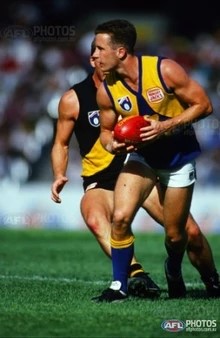
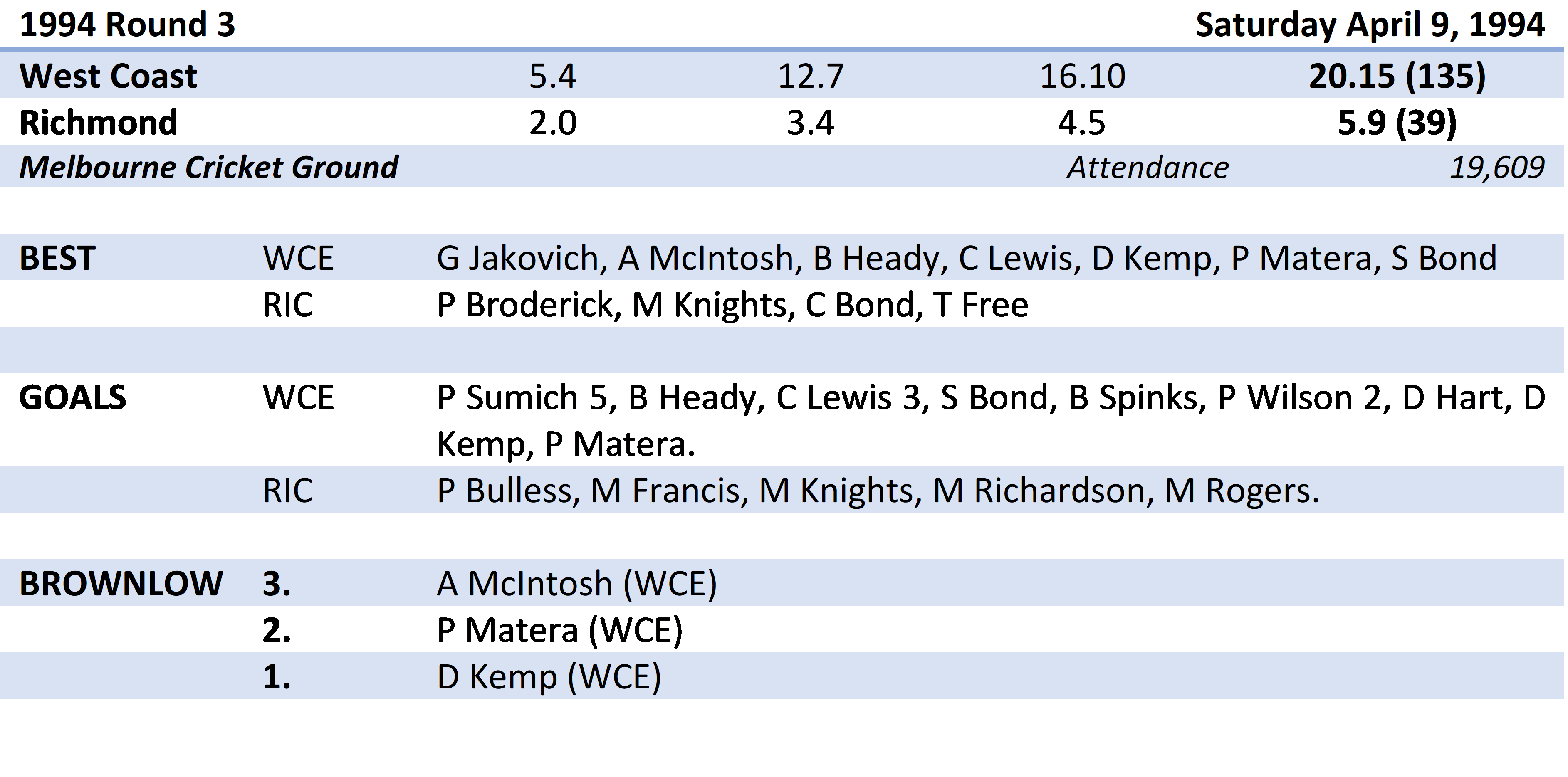
West Coast delivered their most complete performance of 1994 when they dismissed a hapless Richmond by 96 points at the MCG. The legitimacy of the Eagles as premiership contenders had been questioned after inconsistent showings in the first two rounds, but the comprehensive win stamped the Eagles as one of the teams to beat.

After a lean few years, the Tigers had started the season positively, breaking an 11 game losing streak with a thumping 62 point win over Brisbane in Round 2, after losing narrowly against the Bulldogs in Round 1. Young forward Matthew Richardson had been the star for the Tigers in the opening fortnight, booting 15 goals across the two games to lead the Coleman Medal.

However, the Eagles defence reigned supreme with Ashley McIntosh too strong for Richardson and Glen Jakovich dominating his duel with Brendan Gale. McIntosh stymied his third opponent in as many weeks, holding Richardson to just one goal – the same that Paul Salmon and Tony Modra had managed in previous weeks.

Guy McKenna and David Hart were just as stingy, with the West Coast backline holding the Tigers to their lowest ever score against the Eagles. At the other end, the Eagles cashed in on the midfield work of Dean Kemp and Peter Matera, with Peter Sumich (five goals), Chris Lewis (three) and Brett Heady (three) all hitting the scoreboard.

Even youngsters Shane Bond and Brett Spinks chimed in with two apiece, with Matlhouse saying the addition of the two rookies made the Eagles forward line ‘better equipped’. “One is 18 and the other one is 20. When we get them both firing, they will be terrific.”

“Seventeen of our twenty goals came from our forwards. I guess there was pressure on them today to perform and it was one of our better games, but we have to be careful not to get too carried away with the win.”

But while Malthouse heaped praise over his revitalised forward structure, he was less complimentary to the football media who had criticised the Eagles start to the season. “I think it’s a mistake to judge any side on its practice match form.”

Pre-match the Tigers had talked up their chances against West Coast, but they were never in the hunt against a more seasoned Eagles outfit. West Coast pounced on regular Richmond turnovers in the first half, with a seven goal burst in 13 minutes during the second quarter ending the contest.

“It was very disappointing, we expected a lot more. But we just came up against a solid, experienced team and we didn’t handle them at all well. They just gave us a lesson in football”, a subdued John Northey said.

The Tigers cause wasn’t helped with the loss of Paul Bulless and Matthew Francis during the game, while a host of other player came into the game under a cloud. Chris Bond passed a late fitness test to be one of the Tigers better players, but ruckman Greg Dear – who copped a heavy knock in the win over Brisbane the week before – was no match for the duo of Ryan Turnbull and Paul Harding.

Their ruck dominance translated into a possession spree for many of the Eagles midfielder, with Don Pyke (32 disposals), Dean Kemp (25) and Chris Mainwaring (22) all prominent. Peter Matera won his battle on the wing opposed to Wayne Campbell and Drew Banfield had the measure of Matthew Francis before he went off injured.

Don Pyke led the Eagles with 32 disposals

The win lifted the Eagles up to fourth on the ladder with Malthouse declaring that the current Eagles line-up were far better than the 1993 version.    

“We’re slowly coming along… we haven’t rushed anything this year. The disappointment this year is we were in a position to win our first round and we didn’t win it. We could be three-zip.”

1994 Round 2: Heady Heroics Save Eagles

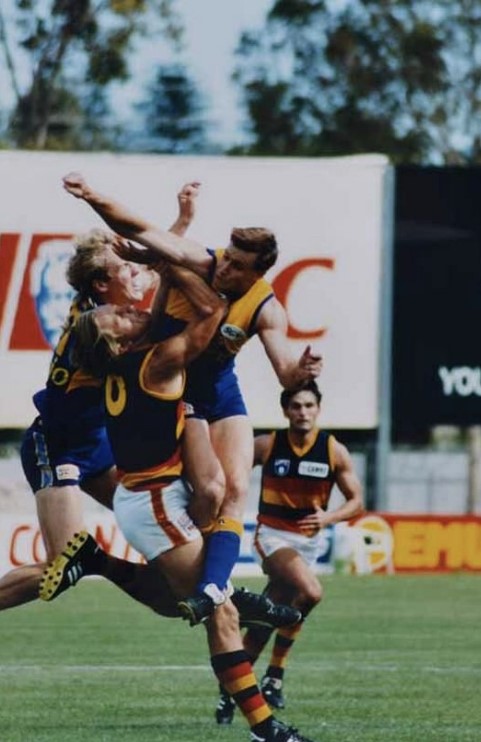
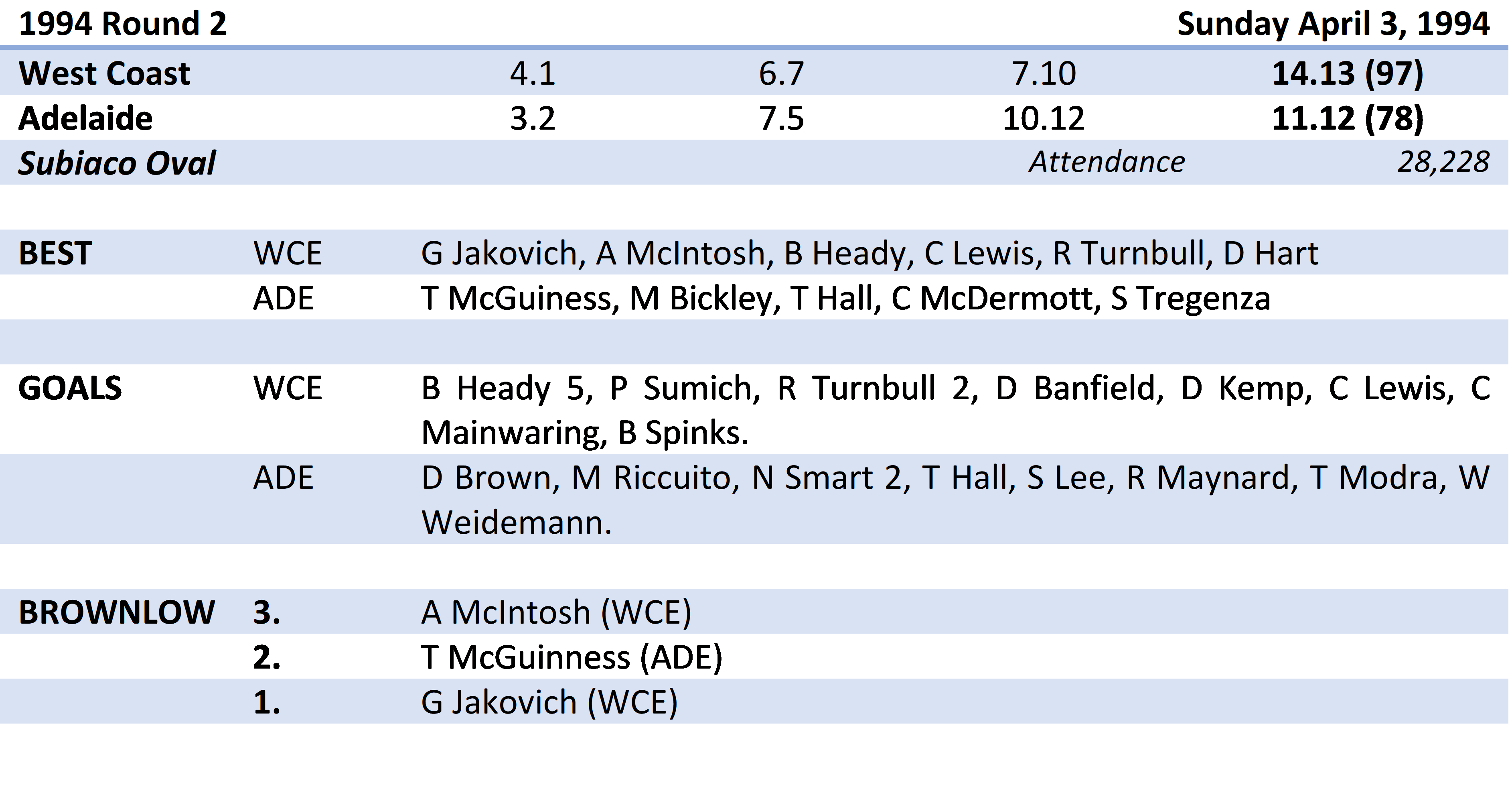
With a quarter to play against Adelaide, the Eagles were staring at a 0-2 start to season 1994 as they sat 20 points behind the 1993 preliminary finalists. 30 minutes later the Eagles had restored parity to their season with a seven goal to one final term, on the back of an inspired Brett Heady.

Heady booted four last quarter goals – to finish with a match haul of five – after a week spent bed-ridden. Heady had kept his illness secret from the club, much to the chagrin of coach Mick Malthouse, but proved to be the saviour in the final quarter surge.

“He (Heady) didn’t tell me before the game,” Malthouse confirmed. “In the end it was just a matter of getting him across the line.”

Heady was barely sighted in the opening three quarters, tallying just three possessions in between large stints on the bench. However, he exploded in the final term, gathering 10 kicks and three marks as West Coast rode home on a favourable breeze.

After a dire first three quarters, where the defensive nature of the home team had seen the game stagnate for large portions, the Eagles burst the game open with Heady capitalising on a centre square dominance.

Chris Lewis was moved into the middle after lacking any influence across half-forward, while Ryan Turnbull got on top of Shaun Rehn in the ruck, after he replaced Paul Harding who limped off during the third term with a hip injury.  

But it was another moment in the third quarter that proved the turning point in the game.

At the 15 minute mark, Adelaide full-forward Tony Modra charged out on a lead, only to be met by West Coast captain John Worsfold running back the other way. The star full-forward – who had booted a Round 1 AFL record 13 goals the week before in the Crows demolition of Carlton – staggered off the ground, enraging Crows coach Graham Cornes.

Worsfold cannons into Modra, sending the star Adelaide forward off

Cornes pointedly abused Worsfold at the three quarter time break, with Malthouse suggesting the tirade may have sparked his players to the final quarter comeback. “I don’t know exactly what took place – you’ll have to find out from Graham Cornes.”

“The inference was that John thought what was said to him was uncalled for. Under those circumstances obviously he was going to be cranked up. I suppose he would have sparked a few of the other players up.”

The Eagles final quarter was a stark improvement on the rest of the game, which had been a tactical battle for much of the afternoon. The Eagles held a slender lead at the first change, before the Crows worked their way in front at the main break.

West Coast were able to restrict the Crows running game for much of the first half, leading to long periods of stagnated play from both sides, but the visitors took hold in the third quarter. Tony McGuinness marshalled the centre square and Simon Tregenza got the better of Peter Matera on the wing, as Adelaide controlled the ball inside their forward half.

However, they could only manage an inaccurate 3.7 for the term, and their system fell away once Modra left the field.

A deflated Cornes wouldn’t be drawn on the controversy surrounding his interaction with Worsfold, instead choosing to lament his sides’ inability to hold onto their lead.

“It’s a four-quarter game and 20 points is never a match-winning lead, particularly against a team playing at home and coming home with a slight breeze.”

Tony McGuiness was one of the few Adelaide players who performed all day, finishing with 27 disposals, while Mark Bickley shaded fellow centreman Dean Kemp in racking up 30. Paul Rouvray restricted Sumich to just two goals while Rodney Maynard – who was a late inclusion for Greg Anderson – was serviceable with 17 disposals and a goal.

However, the Crows forwards were well beaten by another strong defensive performance from West Coast. Ashley McIntosh held Modra to just one goal before he went off injured, while Glen Jakovich completely shut out Nigel Smart at centre half forward. David Hart made it two scalps in as many weeks when he kept Matthew Liptak goalless, while Guy McKenna shaded Tony Hall in an intriguing contest.

Jakovich would finish as the Eagles’ highest possession winner (20, along with 14 marks) indicating how much the Eagles built their play from half-back, while Dean Kemp (19) and Peter Matera (17) the next best for West Coast.

The Eagles sat with nine other teams who had split their opening two games, but with fixtures to come against Richmond, Fitzroy and Hawthorn, they sat perfectly to stake an early claim for a top four spot.

1994 Round 1: Bombers Pip Eagles Again

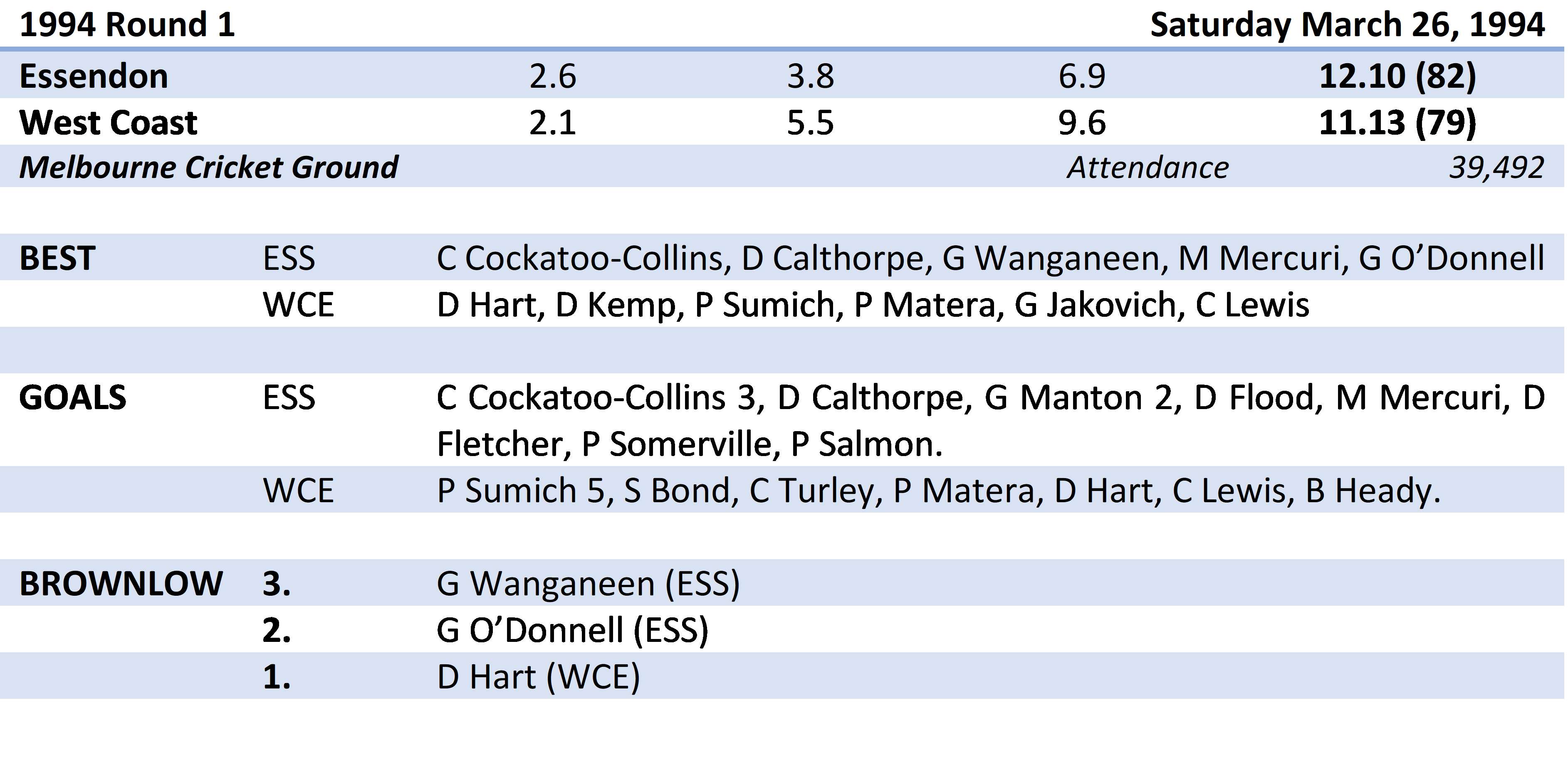
It was a case of history repeating for the Eagles when they fell short in their 1994 season opener against reigning premiers Essendon. In an almost identical finish to the classic round 16 meeting of 1993, Paul Salmon bobbed up to kick the winning goal after a poor day.

The Essendon forward was included despite an injury-interrupted pre-season but struggled to have an influence, both up forward and when thrown into the ruck. But with under two minutes remaining, Salmon clutched onto a mark in the goal square, despite the best efforts of Ashley McIntosh, to deliver the four points to the Bombers.

Played in oppressive 30-degree heat, the Bombers fought back from a 33 point deficit during the third term to start their premiership defence with a narrow three point win against the side many predicted pre-season to be premiership favourites.

The win was even more meritorious for the reigning premiers, given the eight players missing from their 1993 premiership triumph over Carlton. Norm Smith medallist Michael Long was expected to miss the year with a knee injury, captain Mark Thompson was out with a calf injury and midfielder Joe Misiti missed through illness. Stephen Alessio had been controversially suspended for five weeks for stomping on the back of Hawthorn rover John Platten during the Fosters Cup, while Sean Denham, Dean Wallis, Paul Hills and Chris Daniher were also all unavailable.

As well as Paul Salmon, veteran Tim Watson played despite limited preparations, while the Bombers had also had to deal with the fallout of Derek Kickett who walked out on the club after playing every game in 1993, only to be dropped for the Grand Final.

Conversely, the Eagles’ build-up to the 1994 season had been mostly seamless, with the club looking to bounce back from a disappointing 1993 campaign. Following the announcement of a second team from WA – the Fremantle Dockers – joining the competition from 1995, the Eagles hierarchy spent much of the summer locking away potential Fremantle targets Peter Sumich and Peter Matera to long-term contracts. The club also welcomed back Brownlow runner-up Craig Turley over the summer, after he had announced his retirement early in the 1993 season.

Turley was instantly recalled to the Eagles line-up for the opening game, alongside draftees Brett Spinks and Shane Bond who both made their debuts in a new-look forward line. Peter Sumich took his place at full-forward, despite doubts over a hamstring strain, but Chris Mainwaring was unable to recover from his own hamstring problem and was left out of the side.

With so many premiership stars missing, the Bombers also had a host of new players, including former Eagle Dale Kickett. Kickett had returned to WAFL ranks in 1993 after just one year with the Eagles, but was picked up by the Bombers after a breakout season at Claremont. Ben Doolan also made his club debut after switching across from the Swans, while Che Cockatoo-Collins and Robert Stevenson were selected for their AFL debuts.

And it would be Cockatoo-Collins who would ignite the Bombers early in the game and again in the third quarter fightback. The first gamer had the opening goal of the game as Essendon dominated much of the early exchanges and could have finished the quarter with three, if not for poor finishing. The dynamic forward was proving too elusive for McKenna, who was moved onto Kickett, with Worsfold given the task of minding the youngster.

At the other end, the Eagles were made to make the most of the few chances they had. Shane Bond had the daunting challenge of lining up in the forward pocket opposed to reigning Brownlow medallist Gavin Wanganeen, but goaled with his first kick in league football to get the Eagles going. Shortly after, Craig Turley marked his return to football with a running goal, to have the Eagles within touching distance of the Bombers at the first change.

In the second quarter the match swung West Coast’s favour on the back of Peter Matera and Peter Sumich. Sumich had been wayward early, registering behinds with his first three shots on goal, but put the Eagles in front with a brace in a matter of minutes. The second – a remarkable snap goal from the boundary on the wrong side for a left footer – was matched by Matera on the brink of half-time, who kicked a long-range snap from the other pocket, to have West Coast in front by nine points at the major break.

Sumich’s purple patch continued into the second half as the Eagles took charge. The Eagles booted the opening four goals for the term – three to Sumich – to build a commanding 33 point advantage. Dean Kemp and Peter Matera were winning plenty of the ball through the centre, Spinks was providing a strong target at half-forward and the defence was miserly.

Glen Jakovich was proving too strong for Glenn Manton and James Hird at centre half back, while Darren Bewick and Dale Kickett and were non-existent opposed to David Hart and Guy McKenna. Salmon couldn’t take a trick, dropping marks and fumbling balls, even managing to prevent a certain Michael Symons goal from going through on the goal line.

Brett Spinks made an impression in his first game

In a bid to resurrect his side, Essendon coach Kevin Sheedy threw the magnets around. David Flood replaced Dustin Fletcher at full-back on Sumich, Fletcher moved into the forward line, Salmon went into the ruck, Hird was placed behind the ball and David Calthorpe went into the middle. The response was almost immediate, with the spark coming from Cockatoo-Collins.

The small forward cleverly kept a long ball into Essendon’s forward line in play, and from deep in the pocket, curled home a miraculous goal. Cockatoo-Collins’ second major of the afternoon with under five minutes remaining in the quarter broke a run of seven unanswered goals from West Coast, and there was still time for the Bombers to make further inroads into the Eagles lead.

Mark Mercuri and Dustin Fletcher both goaled to make it three in as many minutes for the Bombers and reduce the Eagles lead to 15 at three-quarter time. In a blink, the Bombers had the lead when they opened the final term with another three goal burst. Glenn Manton broke free to kick two either side of a David Calthorpe major, to set up a thrilling finish between the premiers of the two previous seasons.

Chris Lewis hit the post to register the Eagles’ first score in over a quarter before West Coast grabbed back the lead with a long running goal from defender David Hart. The Eagles peppered the goals but couldn’t find a major, with Sumich, Matera and Lewis (twice) all missing. Lewis was causing havoc for the Bombers defence in the final term, but couldn’t capitalise on the scoreboard.

The string of behinds had crept the Eagles lead up to eight, but the Bombers were back within two when Cockatoo-Collins kicked his third goal. Essendon then had the lead when Peter Matera remonstrated with Mark Harvey, who collected the Eagles wingman at the next centre bounce, gifting a 50m penalty to Peter Somerville who kicked the simple goal.

Brett Heady was another who got busy in the final term. The half-forward spent most of the day on the bench but he restored the Eagles lead with six minutes to go after a strong contested mark on Wanganeen. Ultimately, Paul Salmon would be the difference at the final siren with his only goal for the afternoon. Twice in the dying seconds the Eagles pumped long balls deep into the forward line, but James Hird was on hand to take the saving mark on the final siren and ensure a thrilling win to the Bombers.

Despite another last-gasp win against the Eagles, there were no jacket-waving histrionics from Sheedy who acknowledged his side had made the most of their last quarter opportunities. The Bombers booted 6.1 to 2.7 in the final term, with the Eagles hitting the post on three occasions.

David Hart was the Eagles’ best with a game-high 31 disposals, whilst also quelling the influence of Darren Bewick, who managed just 13 disposals and a point. Dean Kemp collected 31 in the midfield, while Peter Matera finished with 25. Peter Sumich finished with 5.4, as the Eagles only multiple goal scorer, but had his influence nullified after being matched by Flood.

Cockatoo-Collins was the leading goal scorer for Essendon with three from 21 possessions, while Calthorpe and Manton finished with two apiece. Mark Mercuri led the ball winners for the Bombers with 28, while Gavin Wanganeen had 25 out of defence and centreman Gary O’Donnell finished with 24.

For Mick Malthouse, his 100th game as coach of West Coast produced a disappointing result, as he was left to ponder the Eagles preparation for the game. “I don’t know whether we had a hard enough lead-up. We struck a side that had played three hard games to win a [pre-season] premiership. I don’t know whether it was for us or against us being fresh.”

“I don’t think we had the game under control. A game goes for 120 minutes.”

Building The Premiers

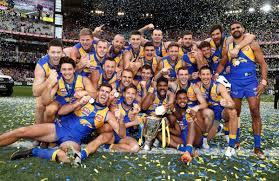
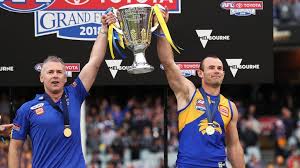
The trade period has ended for 2018 and the focus of 18 clubs now turns to this month’s draft as 17 clubs look to emulate the achievement of West Coast in 2019. The Eagles claimed their fourth flag – against pre-season odds – building a squad through a variety of trade and draft choices. How did West Coast bring their premiership side together? Here are five crucial trade and draft decisions that shaped the 2018 premiers.


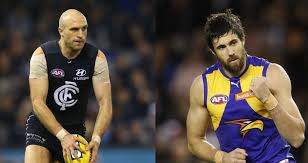
The Chris Judd Trade

One of the most famous trades in modern AFL history brought two players to the Eagles who would play a part in the Eagles’ premiership success in their 11th season with the club. After being bundled out in straights sets in the 2007 finals series, the Eagles were rocked by confirmation from their club captain that he would return home to Victoria.

Captain of the 2006 premiership side, Judd was also a Brownlow medallist, a Norm Smith medallist and multiple best and fairest winner in six seasons with West Coast. The hottest property in the game, Judd commanded a big trade in return and after canvassing several clubs, Judd and West Coast believed that Carlton had the best to offer.

The Eagles were after the West Australian born forward taken two drafts earlier at number 4 and despite Carlton’s resistance (and also initially the player), Josh Kennedy was traded to West Coast in exchange for Judd. Also part of the deal were two of Carlton’s early draft picks, numbers 3 and 20 overall. While Tony Notte delivered little success with pick 20, Chris Masten arrived with the Eagles’ first selection and was an important link-man in 2018. With Kennedy, after years of debate, the Eagles have come out on top with that trade, Kennedy now the greatest goal kicker in the clubs history, and booting three important goals in the 2018 decider.

judd kennedy


Daniel McConnell Heads to the Kangaroos

Daniel McConnell had just a brief stint at West Coast, but his departure indirectly led to the Eagles’ selecting their 2018 premiership captain. McConnell had been an early draft pick in the 2003 National Draft, but after two games in two years, McConnell decided he wanted to head back to his native Victoria.

The Kangaroos were keen on the midfielder and stumped up two early draft picks in the 2005 National Draft to gain his services. North Melbourne gave West Coast picks 13 and 29, with the Eagles handing pick 18 back the other way along with McConnell. Having improved their initial position five spots in the draft, the Eagles settled on the strongly built Shannon Hurn from Central Districts. The Eagles would select forward Ben McKinley with pick 29, but he would find his way back to North Melbourne despite a promising 2008 season.

North for their part would trade pick 18 to the Hawks in exchange for Jonothan Hay, but the Eagles would be the big winners out of the trade in selecting their future captain. Hurn is set to play game 250 early in 2019 and will be etched in West Coast history in lifting the 2018 cup.

shannon hurn

Dale Thomas defects to Carlton

It has already circulated on social media, but Dale Thomas’ decision to leave Collingwood and join arch rival Carlton indirectly led to Dom Sheed – who would prove to be the match-winner in the Grand Final – finding his way to the Eagles. At the end of 2013, Thomas made the call to leave the Magpies and re-unite with former coach Mick Malthouse who had joined the Blues.

Thomas’ decision to leave Collingwood as a free agent resulted in the Magpies receiving a compensation pick through the middle of the first round – number 11 overall. The Eagles entered the 2013 trade period with pick 6 after a disastrous season had seen them fall to 13th on the ladder and signal the end of John Worsfold’s 12 year tenure at the club.

West Coast were set from the outset on taking Dom Sheed who hailed from Subiaco with pick 6 but were also in discussions with the Lions about securing Elliot Yeo, who after two seasons in Brisbane, had requested a move back home. The Lions wanted nothing less than the Eagles’ 2nd round selection (number 28 overall), but West Coast weren’t as keen as being without a pick in the second round.

Enter a pick swap with the Magpies who were desperate to hold two picks inside the top ten at the draft. West Coast and Collingwood negotiated a trade that would see the Eagles give away picks 6 and 44 in exchange for picks 11, 31 and 49 from the Magpies. Despite dropping five places, the Eagles were confident they would still land Sheed.

Collingwood had picks 6 and 10 and no doubt there would have been a side-agreement that they stay away from Sheed. North Melbourne had pick 8, but were already locked into recruiting father-son option Luke McDonald, leaving just Brisbane at pick 7 and Melbourne at pick 9 to bypass Sheed. The Lions and Demons took James Aish and Christian Salem, respectively, and Sheed was snapped up with pick 11.

The other two picks that West Coast received would prove to be busts, with the Eagles picking up small forward Malcolm Karpany at 31 and midfielder Dylan Main at 49, but a separate and much more convoluted pick swap with Collingwood helped West Coast land Tom Barrass with pick 43.

When Josh Fraser was selected by the Gold Coast Suns as part of their inaugural list at the end of 2010, the Magpies received a third round compensation pick which could be used over any of the following five drafts (2011-2014). The Magpies traded this pick with West Coast for their third round selection in the 2010 Draft, with West Coast sitting on this pick until the 2013 trade period. Having traded out pick 44 as part of the draft swap above, the Eagles got back into the third round by swapping the compensation pick they received from Collingwood to the Suns, in exchange for pick 43, which West Coast used on Barrass.

dom sheed


Two Defenders for a Forward

Andrew McDougall arrived at the Eagles at the end of 2000, as the great white hope in the forward line for the next decade. Peter Sumich had retired in 1997 and Fraser Gehrig had departed for the Saints as part of the trade period, leaving big holes up front. Fast forward to the end of 2006 and the promise that McDougall showed ahead of being selected with the fifth pick of the 2000 draft had not materialised, with both club and player keen on changing things up.

McDougall had played just 38 games in six seasons but found a new suitor in the Western Bulldogs who were keen on taking a punt on the former first rounder. The Eagles and Bulldogs engineered a multiple-round pick swap to get McDougall to the Bulldogs, resulting in West Coast receiving picks 29 and 50 in exchange for picks 34, 66 and McDougall. The Bulldogs would get just five games out of McDougall for their investment, but for the Eagles, the picks would deliver two stalwarts of the club.

Eric Mackenzie would be taken with pick 29, playing 147 games before retiring at the end of 2018, his last few years at the club cruelled by injury. Pick 50 would be used to select Will Schofield, with the veteran defender one of the Eagles’ best in their 2018 premiership. Schofield would play a near-perfect role, stepping into the shoes of Brad Sheppard after being unlucky to be left out earlier in the finals series. Schofield would curtail De Goey’s influence up forward and be the lockdown defender needed in the back half.

will schofield

Bargain Saints

Two Saints found their way to the Eagles during the 2012 trade period in contrasting manners. Jamie Cripps had spent two years with St Kilda for a modest return, but was keen on making his way back to WA. The Eagles recent draft picks for high half forwards had not come to fruition, with the likes of Ryan Neates, Gerrick Weedon and Andrew Strijk all delisted at the end of the season.

The Saints weren’t rapt on letting Cripps go and were initially hesitant with the offer from West Coast, who had already given away their first round selection (number 18) to Collingwood in a trade for Sharrod Wellingham. With new franchise GWS given bulk early draft picks, the Eagles’ next selection was number 40, which the Saints would eventually accept as part of a trade.

West Coast had received pick 43 from the Bulldogs for Koby Stevens, so both picks were packaged and sent to the Saints, with West Coast then receiving pick 45 in return, along with Cripps. Having given away their first two selections, the Eagles entered the draft in the third round, selecting midfielder Brant Colledge with pick 45 and then small defender Adam Carter with their ladder-allocated draft pick at 59.

The Eagles then had pick 60 to use, which they received as compensation for the departure of Quinten Lynch. Lynch had taken up a two year offer from the Magpies, following ten seasons with the Eagles, which resulted in an extra third round pick for West Coast. At pick 60, the Eagles chose Mark Hutchings, who had previously been on the Saints rookie list in 2011.

Hutchings only lasted one season with St Kilda, without playing a game, before returning to the WAFL, where he finished 2nd in the Sandover Medal. That was enough for West Coast to pick up the midfielder, with Hutchings evolving his game into being a solid run-with player. Hutchings would play vital role in the 2018 decider, clamping the influence of Steele Sidebottom, restring the Brownlow runner-up to just 14 disposals.

jamie cripps mark hutchings


And the rest?

1 Liam Ryan. The small forward would be picked up with the Eagles’ third selection in the 2017 draft after Geelong thwarted the Eagles’ initial intention of selecting Tim Kelly with their pick.

2 Mark LeCras. Selected with pick 37 in the 2004 National Draft, a selection the Eagles received from Collingwood in exchange for Chad Morrison.

8 Jack Redden. Traded to the West Coast from Brisbane, with the Lions receiving the Eagles’ first round selection in the 2015 draft, which would be number 17 overall. Redden arrived at the club as an inside mid, but found his role changed with the presence of Matt Priddis and then Sam Mitchell. Following the pair’s retirement, Redden showed his worth, claiming the joint Player of the Finals award with Dom Sheed.

13 Luke Shuey. The Norm Smith medallist would arrive to the club courtesy of a compensation pick. Following a disastrous 2008 season which reaped just four wins, both the Eagles and Demons received an extra pick at the end of the first round. Melbourne selected Sam Blease with pick 17; the Eagles got far greater return in picking Shuey with pick 18.

14 Liam Duggan. The Eagles first selection in the 2014 draft, selected at number 11 overall, allocated to West Coast for finishing ninth in 2014.

18 Daniel Venables. Another first round selection for West Coast, coming at pick 13 in the 2016 National Draft. Venables was considered a surprise selection ahead of local product Sam Powell-Pepper, but repaid the Eagles in 2018 after an injury-riddled first season.

19 Nathan Vardy. A trade more through necessity with first choice ruckmen Nic Naitanui and Scott Lycett expected to miss the 2017 season. Vardy came cheaply from the Cats; the Eagles offloaded pick 72 in the deal, a pick they had earlier received from the Hawks as part of the Sam Mitchell trade.

20 Jeremy McGovern. One of the bargain finds in Eagles history, with the defender coming with pick 44 in the 2010 rookie draft. McGovern would take some time to push through to the senior side, with a couple of close calls in between, but is now the premier defender in the competition after three consecutive All-Australian selections.

23 Lewis Jetta. A direct trade with the Sydney Swans for ruckman Callum Sinclair following the 2015 Grand Final defeat. The Eagles identified a lack of pace, and hoped Jetta’s line breaking and ball use would take the club the extra step in 2016. A little slow to get going, Jetta was worth the price in the finals series.

27 Jack Darling. Another compensation pick, with the Eagles receiving an end of first round selection for winning less than five games in 2010. Remarkably, Darling slid all the way to pick 26 despite being touted as a potential top five selection for much of his draft year.

28 Tom Cole. Drafted by the club in the 2015 National Draft, as one of two Eagles’ picks in the second round. The Eagles had given away their first pick for Jack Redden, but received an extra pick in the second round following the surprise decision by Matt Rosa to leave the club. Rosa headed to the Gold Coast for pick 36; the Eagles selected Tom Cole.

29 Scott Lycett. Part of the triumvirate of star players that were selected in the 2010 National Draft, Lycett came to the club with the Eagles’ third pick, number 29 overall. The 2010 Draft would see the Eagles also bring in Andrew Gaff and Jack Darling.

44 Willie Rioli. Used with one of the picks that changed hands between the Eagles and Hawks in the Sam Mitchell deal, Rioli was an astute choice selected with the Eagles’ third round selection – number 52 overall – in the 2016 draft.

Why Victorians Should Back West Coast

For the seventh consecutive season, the AFL Grand Final will feature a Victorian-based side against an ‘interstate’ side and the collective desire to keep the premiership cup in Victoria has once again been raised.

In a recent piece, with little relevant basis or historical understanding of the game, it was declared that all Victorians should set aside their ‘Collingwoodaphobe’ and barrack against West Coast for the pride of the state and of the game itself.

Here is why Victorians should actually embrace the Eagles and hope they can take away their fourth premiership.


You Actually Wouldn’t Hear From West Coast Fans

Unlike Collingwood fans who primarily reside in Victoria, being on the other side of the country means that Victorians won’t have to deal with who won the flag on a day to day basis. Instead Eagles’ fans will be far more occupied reminding the Dockers supporters who they work with, go to school with or live down the street from that West Coast have a fourth flag while the cupboard at Fremantle remains bare.

A West Coast premiership means Victorians can feel safe in that they won’t have to walk down Smith Street and be reminded by the black and white army that they are premiers once again. In fact, such is the Victorian ignorance of everything west of the border, that many football fans will quickly forget that West Coast even claimed the 2018 flag and will only hear the reigning premiers tag on the odd occasion we venture to the MCG next season, which will most likely be twice, tops!


West Coast Helped Victorian Clubs Stay Alive

It is a bit of a stretch to claim that West Coast should be despised for being an ‘expansion club’, when the real reason the club was formed was to inject much needed funds into an ailing competition. The majority of the 12 clubs during the 1980’s were on the brink of extinction. Fitzroy met their demise in 1996, but before that they, along with Footscray, Melbourne, North Melbourne, Richmond and even the beloved Hawthorn faced serious financial despair.

Unlike the introduction of Gold Coast and GWS Giants, where the AFL hopes to expand the competition into non-AFL strongholds, West Coast were established on the back of a strong history of state football in Western Australia. State of Origin matches through the 1970s and 1980s between the Vics and Sandgropers were some of the greatest games in living memory and only fuelled new rivalries at club level which first saved, then grew the game.

Bringing West Coast into the competition was the logical move to nationalise the game – not expand it – and the $4 million licence fee that the club were expected to stump up to join the league from 1987 went a fair way into padding up the coffers of the struggling Victorian sides.


A Couple Of Bad Years Is Not A ‘Questionable History’

The Eagles’ 2006 premiership has long been derided by opposition fans as tainted due to the drug culture that engulfed the club, tarnishing the reputation of many involved with West Coast at the time and creating a downward spiral for a number of premiership players including Ben Cousins, Daniel Chick and Chad Fletcher.

While no official positive tests or penalties were recorded, the internal and AFL investigations that took place led to changes in the fabric of the club and instigated many of the testing parameters that exist in the AFL environment today. A heightened focus in restoring the off-field culture brought about three years of on-field pain culminating in the clubs only wooden spoon in 2010

The West Coast Eagles of today are a far different brand from that of the mid-2000s with only Trevor Nisbett – who could survive an A-bomb, such is his ability to avoid culpability – a key figure who remains with the club. The fact is, the drug culture argument is no longer relevant.

Instead, if you were to judge a club by their off-field activities, the Collingwood rap sheet is far worse in recent years. Josh Thomas, who will take his place on Grand Final day, and Lachie Keeffe were both suspended for two years for testing positive to an illicit substance during the 2015 off-season, while Sam Murray is facing a potential four year ban for testing positive to an illicit substance on match-day earlier this season.

These incidents bookended the famous, or infamous, headline from the Herald Sun on the eve of the 2017 season reporting up to 11 Collingwood players were being investigated by ASADA for performance enhancing substances.

But as Bill Belichick once said, to live in the past is to die in the present and sport has proven across many decades to be the great forgiver. Tiger Woods is currently riding a wave of support in his building return in golf, South Africa were welcomed back into the world of cricket and the Russian soccer team and their people were celebrated at the World Cup, 18 months after the majority of their athletes were banned from the Rio Olympics. Muhammed Ali was the most hated person in America after being stripped of his boxing licence for being a draft dodger but is now celebrated as THE greatest of all time.

A few years of misconduct shouldn’t necessarily equate to a ‘questionable history’ and the Eagle players and administration of today shouldn’t be tarnished with the brush of those who did wrong in a previous generation.


West Coast Beat Richmond Too

Collingwood should be rightly applauded for their magnificent win over the Tigers in last week’s preliminary final, ending their run at back-to-back flags. However, the Magpies weren’t the only team to defeat Richmond this season. The Eagles accounted for Richmond in Round 9 to the tune of 46 points, knocking the Tigers out of top spot.

So if defeating Richmond is a reason to support a team, then the Eagles should also be considered in the argument. But not only did they defeat the Tigers, they also defeated Collingwood – twice! West Coast have long been questioned over their ability to win at the MCG, but ran out victors in the only home and away meeting between the two sides. The Eagles then followed up with a 16 point win in the opening week of the finals on the back of a final quarter surge.

If being anti-Richmond is a reason to support a team, then being anti-Collingwood should be just as compelling and the Eagles have three wins in 2018 over the two teams combined.


The Nathan Buckley Story Isn’t That Convincing

The narrative behind Collingwood claiming the 2018 flag is completion of a lengthy career with Collingwood for their coach Nathan Buckley. Twice as a player Buckley played on the grandest stage only to see his side go down in consecutive Grand Finals to Brisbane. While the former Collingwood captain claimed numerous individual awards – Rising Star, Brownlow, Norm Smith and multiple Copeland Trophies – the ultimate team prize proved elusive.

But things could have turned out so much differently for Buckley if he hadn’t reneged on a prior agreement to join North Melbourne. First drafted by the Brisbane Bears in 1993, Buckley agreed to spend one year in Queensland before joining the Kangaroos in 1994. However that all fell apart ahead of the next season with Buckley then choosing to join the Magpies. After a finals appearance in 1994, the Magpies would be irrelevant for a number of years, while North Melbourne would win two flags from three Grand Final appearances during the 1990’s and the Brisbane Lions would claim a historic three-peat in the early 2000’s. Ultimately, Buckley chose the third of two good options.

Further, Buckley was a key pillar in the poorly carried out succession plan, which saw Mick Malthouse outed after a 12 year stint that delivered one flag from four grand final appearances. The club had reached the pinnacle of the game a year earlier and had just lost the 2011 decider to Geelong when Buckley took over a squad that was seemingly set for a period of domination. Instead, the division between Malthouse and Buckley drained the squad and the Magpies slipped quickly into the bottom half of the ladder, where they have stayed for much of this decade. So is he really that great?

Conversely, Adam Simpson assumed the role of head coach at the Eagles following the departure of club legend John Worsfold, who had mentally burnt out of the role. Simpson guided the squad to a surprise Grand Final appearance in 2015 and once again has his side in the season decider despite many predicting the demise of both the coach and the club in 2018. Simpson may not have been at the club as Buckely has at Collingwood, but his commitment and connection with West Coast is second to none.

Both teams have had challenges this season and should be praised for reaching the final game of the year and Adam Simpson could rightfully claim to be as deserving to be standing on the premiership dais come the end of the game, as Nathan Buckley is.

Victorians may feel a sense of responsibility to support the Magpies and keep the premiership cup ‘home’ but unless you’re a diehard Collingwood fan, backing West Coast is surely the logical option.

1992 Rewind: Ablett Masterclass Delivers Cats Win

In the 25th anniversary of West Coast’s first premiership, recount the round-by-round story of the Eagles historic 1992 season.


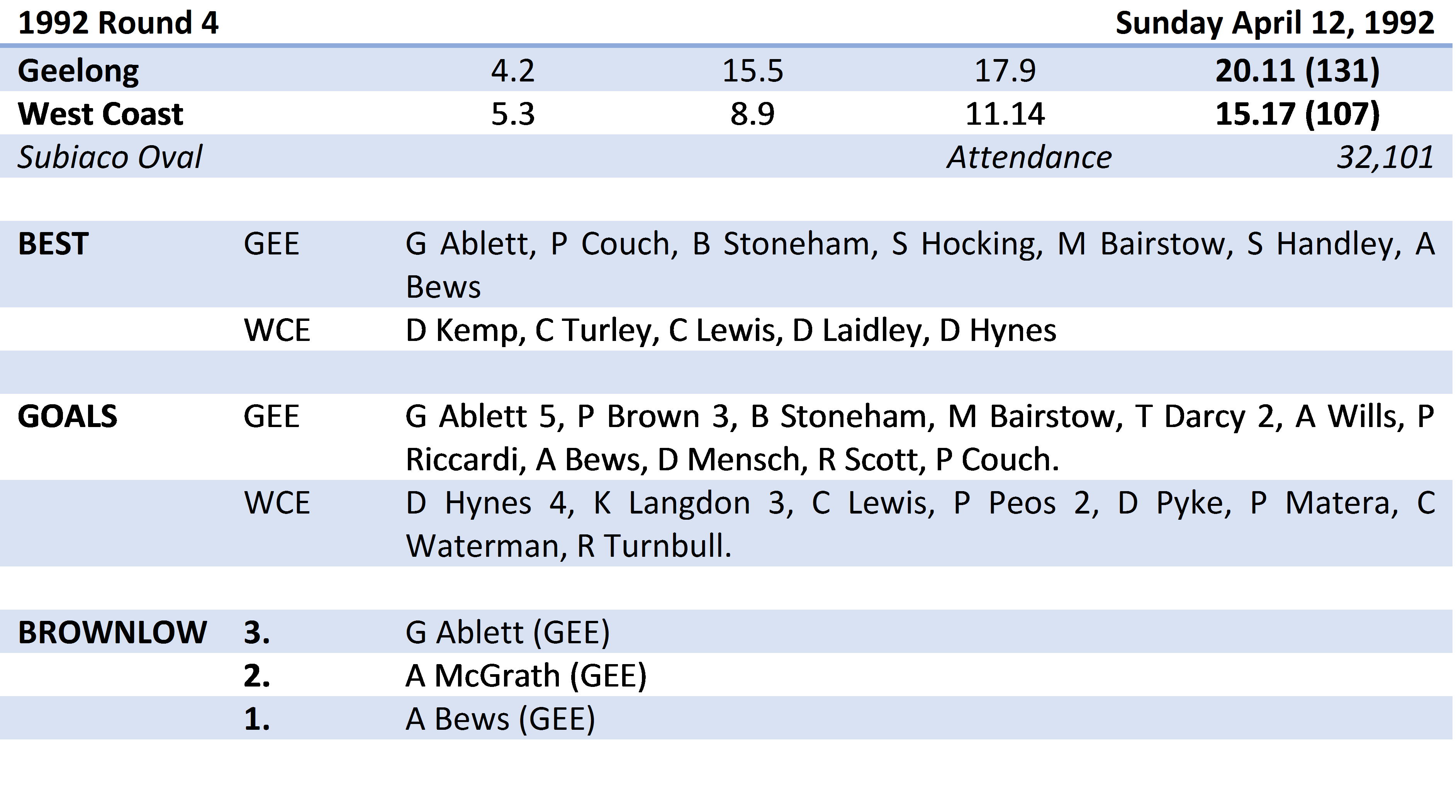
The Cats came to Perth and made away with the four points for the first time on the back of an Ablett-inspired performance.

Already revered in the competition as one of the superstars in the game, the Eagles crowd were treated to one of the finest individual displays in recent times.

Playing his 150th game, Ablett tallied 36 disposals, eight marks and booted five goals as Geelong recorded a 24 point victory. Ablett was purely unstoppable as the Eagles match committee spent the majority of the game trying to find a match-up to quell his influence.

Guy McKenna had had the wood in recent times, but came into the game under an injury cloud and struggled to contain the star Cat. Ablett rotated between the midfield and half-forward and spent time opposed to a range of players. Chris Mainwaring, Craig Turley, Dean Laidley and John Worsfold all tried in vain to halt Ablett but to no avail.

While Ablett was the clear standout in the match, he had good support from fellow midfielders Paul Couch (26 disposals) and Mark Bairstow (22). Dean Kemp was once again the best for West Coast with 24 possessions, while Craig Turley and Chris Lewis both collected 23 with Lewis also about to boot two goals.

West Coast finished the game ahead in most of the key statistics, even finishing with more scoring shots, but an 11-goal quarter from the Cats proved to be the difference. In a fast start, the Eagles led by 7 points at the first change with five goals to four, before the visitors went rampant in the second term. The Cats had nearly 100 points on the board by half time, and stormed to a 38 point lead on the back of Ablett’s brilliance.

Cats coach Malcolm Blight was full of praise for Ablett as Geelong were able to level the ledger. “Gary, along with a lot of other good players, obviously was terrific. He’s enjoying his footy – I think that’s the key to him and most players.

“That terrific second quarter obviously set the game up for us.”

With temperatures soaring beyond 30 degrees on the sunny April afternoon, the Eagles were always going to struggle to overcome the deficit, and whilst they had the better of the game in the second half, the final margin of 24 points was as close as they could get.

The Eagles stuck with the same side that defeated the Saints a week earlier, with Peter Sumich and Brett Heady still unavailable through injury. Sumich had served his two week suspension to start the season and was set to return but an ankle injury suffered during the week at training left the full-forward on the sidelines. Heady was touch-and-go for the Geelong game, but ultimately was given one more week to recover from his hamstring injury a fortnight earlier against the Swans.

The Cats had opened their season with losses to the Hawthorn and Melbourne, but registered their first win of the season the previous week with a 126 point thumping of the hapless Tigers. Geelong still made two changes with Andrew Wills coming into the side, along with first-gamer Peter Riccardi. The Cats prime mover, Garry Hocking, was initially brought into the line-up after missing the Richmond win due to a hip complaint, but was a late withdrawal following a freak accident where a bin broke his ankle. His misfortune paved the way for Riccardi to make his AFL debut.

Bill Brownless and Damian Bourke were also left out of the Cats side, despite Bourke being best on ground for the VFL side the week before. Geelong coach Malcolm Blight opted for the mobile duo of Steven Handley and Barry Stoneham in the ruck, and the move paid dividends.

The Geelong combination proved too strong for Paul Harding and when the floodgates opened in the second term, the Eagles defence were helpless. Barry Stoneham in particular proved too strong both up forward and provided the strong target that West Coast were missing at the other end.

The Eagles forward line was barely functional, although their cause wasn’t helped by an underperforming midfield who crumbled under the Cats pressure. Chris Mainwaring and Peter Matera were both below their best on the wings while Dwayne Lamb also lacked impact through the middle of the ground.

David Hynes moved to full-forward after half-time and booted four second half goals, but Daniel Metropolis and Paul Peos both struggled to have an influence after being match-winners in Round 3. For Metropolis it was a giant fall from grace – after booting four goals in the opening quarter in his debut, Cats defender Steven Hocking clamped down on the rookie restricting him to just three kicks for the game.

While disappointed with his side’s performance Malthouse opted to look forward, with the Eagles set for a crucial month in their premiership aspirations. The Eagles were due to travel for their next three games, to the Gold Coast, Melbourne and Tasmania, and while the opposition were sides they would normally expect to beat, Brisbane, Richmond and Fitzroy had all shown good form in the early weeks of the season.

The Eagles were then to host the Bulldogs, who had started the season in fine form winning three of their first four games. “That month of football will probably determine where we finish – it’s as simple as that.”

199204WCEGEE

1992 Rewind: Metropolis Six Sinks Saints

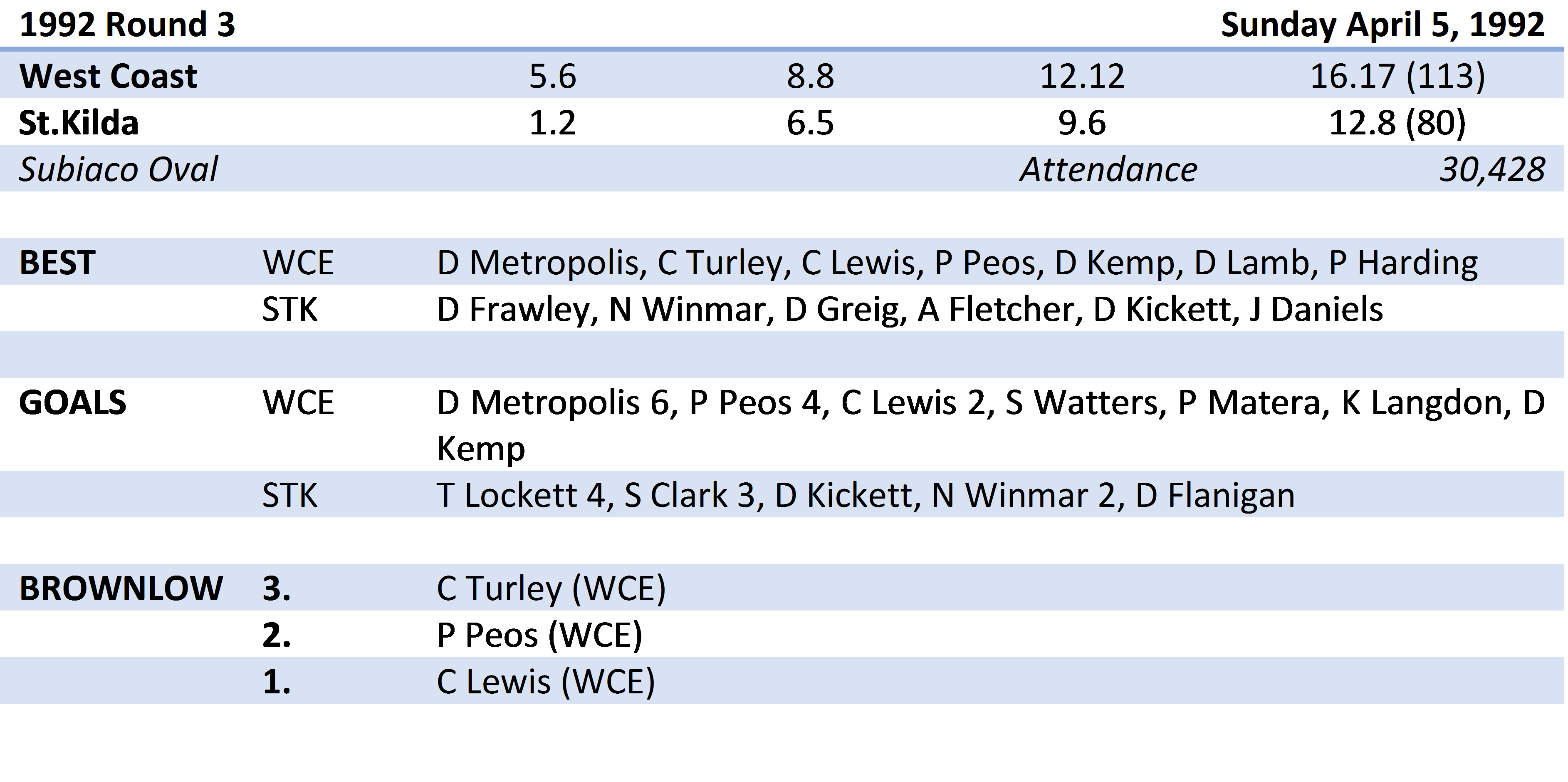
Rookie Daniel Metropolis made a stunning AFL debut to lead West Coast to their first win of the season over St.Kilda. The Eagles first selection from the 1991 National Draft kicked six goals, including four in the opening term, as the Eagles secured a 33 point win.

Shocked by a three-point loss to the lowly Swans in Round 2, the Eagles made a raft of forced and unforced changes. With Peter Sumich still suspended and Brett Heady sidelined during the week, Karl Langdon and Paul Peos were brought in along with Metropolis to improve the forward line firepower, while Paul Harding made his club debut, replacing Dean Irving who was severely outpointed against the Swans.

Harding’s omission against the Swans was a surprise and his impact was instant as the Eagles midfield took full control of the stoppages. John Worsfold was a surprise starter in the centre square but it gave the Eagles a harder edge for the contest than they had against the Swans, winning the centre clearances 7-1 in the opening term.

While Malthouse had been willing to throw his side around in response to the poor performance the week before, the biggest shock came from the opposition when they selected Dale Kickett for his Saints debut. Kickett had been drafted by the Saints in the off-season, but had opted to stay in Western Australia to continue his career with Claremont.

The Saints though included him in their side to tackle West Coast, despite the fact Kickett hadn’t even stepped inside Moorabbin, let alone met any of his new teammates. Kickett ultimately played against the Eagles, who had delisted him after just one season at the end of 1990. Kickett was one of the Saints best with 21 disposals and two goals, but his return to AFL football paled in comparison to the arrival of Metropolis.

Metropolis had put his name forward for selection after a nine-goal haul in a practice match against Sydney in the pre-season, but no-one at the ground including Saints coach Ken Shelden or defender Craig Davenport could have anticipated his blazing start.

Metropolis booted his first goal 40 seconds into the game after a strong mark on the lead at the edge of the 50m arc. Before the quarter was done, the rookie had booted three more, with his first four kicks in the AFL all resulting in majors. Paul Peos had booted the Eagles fifth for the term, and West Coast had stormed to a 28 point quarter-time lead.

Questioned after the previous week’s loss, the match committee selections were all working in the Eagles favour. Andrew Lockyer returned to the line up to mind Saints superstar forward Tony Lockett and Dwayne Lamb finished as one of the leading ball-winners for the Eagles with 25. Lockett had booted ten goals in the opening two weeks of the season, and while he finished this game with four, his influence in the forward line was minimal.

Glen Jakovich contained Stewart Loewe, and with ruck Paul Harding dropping back to fill the space, St.Kilda struggled to score with their two main avenues well held. At the other end, Metropolis booted his fifth early in the 2nd quarter, as historians started making comparisons to Essendon great John Coleman’s debut bag of 12.

Ken Sheldon finally made the change, moving Jayson Daniels onto Metropolis and switching Davenport onto Peos. Metropolis could only manage one more goal for the afternoon, but Peos stepped up during the second half, with the unlikely duo combining for 10 goals.

Sheldon’s moves stemmed the Eagles charge after quarter time, but many of the Eagles midfielders were winning the battle against their Saints opponents. Chris Lewis was displaying his best 1990 form despite the close checking tag of Stephen Newport, Craig Turley was finding plenty of the ball after a disappointing showing against Sydney and Dean Kemp was also prolific through the centre.

The Saints though managed to stay within reaching distance of West Coast, mainly on the back of the individual performances of Nicky Winmar across half-forward, and the miserly defence of Danny Frawley who was shutting down Karl Langdon.

Winmar, in his 100th game, finished with two goals from 18 disposals and provided the highlight of the day for St.Kilda with a spectactular aerial mark over Chris Waterman.

The Saints had held West Coast after quarter time, and when they booted the opening goal of the final term, the margin was just 18 points. The Eagles finally broke the Saints defensive resistance with four quick goals, two of which were kicked by Chris Lewis after Mick Malthouse moved him to full forward.

The win levelled the Eagles season to 1-1 and snuck them back inside the top six ahead of a visit from the Cats.

199203WCESTK