
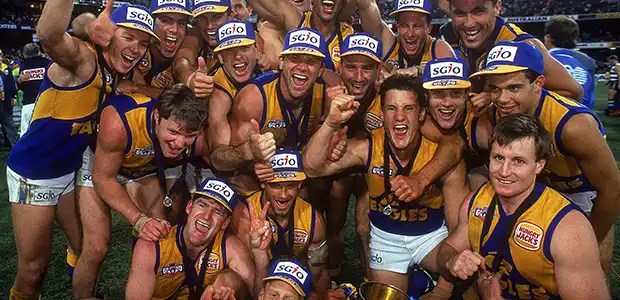
Dwayne Lamb made club history when he became the first player to play 150 games in the Eagles 26 point win over lowly Sydney at the WACA.
Already the first player to reach 50 and 100 games, Lamb had slowed up in his attempt to notch game 150. Lamb had managed just one appearance in the back end of the 1993 season, and was then overlooked for the opening five games of 1994.
However, the veteran was brought back into the Eagles line-up following the debacle against Hawthorn, stringing together the four games required to earn life membership with the club.
The Eagles were expected to brush aside the 14th placed Swans but Sydney proved to be stronger competition than anticipated. A week after upsetting the Demons at the MCG, Sydney threatened to repeat the dose when they held a 19 point lead closing in on half-time.
David Hynes kicked truly on the half-time siren to reduce the deficit to a goal at the main break before the Eagles clicked into gear in the third term. The home team booted six goals in 10 minutes to separate the two sides, eventually running out 26 point winners.
While happy with the four points, Eagles coach Mick Malthouse was more interested in praising the opposition than discussing his own team. “Four points is four points. It’s so easy to say we were terrible, but the basic thing from football’s point of view is that the Swans were terrific.”
“It’s important to acknowledge that the Swans played football almost as good enough to win the game. We played one good quarter of football”, Malthouse said.
With Dwayne Lamb given the honour of starting on the ground in his milestone game, David Hart spent most of the first half on the bench, but his introduction just before half-time helped get the game on the Eagles’ terms.
Hart booted two goals and had a hand in several others as West Coast went on their third-quarter run, as well as curbing the influence of Jamie Lawson, who had been dynamic for the Swans in the first half. Lawson had 12 first-half possessions and along with Peter Filandia and Dale Lewis, thrived on the ruck dominance of Gavin Rose.
Rose was too strong in the hit-outs opposed to the Eagles trio of Jason Ball, David Hynes and Ryan Turnbull and it was no coincidence that the Eagles six goal run came when he was given a breather on the bench.
Sydney coach Ron Barrassi was proud of his side’s effort, but expressed disappointment in the third-quarter lapse. “I guess we’ll have a good look at that third quarter and see where we came unstuck.”
“It’s hard to contain a side for four quarters, let alone a top four side.”
Despite the mostly unimpressive performance, the win saw West Coast move a game clear at the top of the ladder, courtesy of Brisbane’s upset win over North Melbourne. The Bears trailed by five goals at quarter time, but steamrolled their way home to record a 27 point win over the Kangaroos at the GABBA.
Melbourne ended their losing run with a comfortable win over the Saints to join North Melbourne on six wins, while six teams – Geelong, Collingwood, Carlton, Hawthorn, Essendon and Adelaide – sat a further game back on five wins, as the top eight started to take shape.
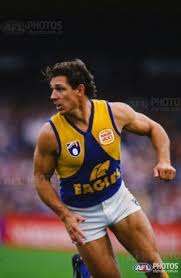
While there was plenty to celebrate for West Coast, the win came at a cost. Peter Sumich and Brett Heady both sat out the second half due to hamstring injuries and Chris Lewis was nursing a knee problem at game’s end.
Sumich’s latest injury occurred in his first game after damaging his hamstring in the round six win over North Melbourne. Recalled at the expense of young forward Brett Spinks, the spearhead failed to last a half, limping off late in the second quarter with Heady following him off the ground a minute later.
Malthouse was forced to defend the selection of Sumich, with the full-forward facing another spell on the sidelines. “Any medical people in the country would have allowed him to play – he was half an inch off playing last week.”
“With another week’s training you can’t blame anyone. The simple fact is that he probably has a weakness in that area.”
With Sumich and Heady both sitting on the bench, the Eagles were forced into a re-shuffle of their forward line after half-time. Ashley McIntosh was moved to the Eagles goal square, after failing to get a hold of Simon Minton-Connell in defence at the start of the game. The Sydney full-forward had four shots early in the opening term, kicking 1.3 (including a poster), with Michael Brennan shifted to the last line.
Minton-Connell finished with 3.4 for the match to be the Swans’ most productive forward, but the Eagles defence were again superb, particularly in the first half when Sydney’s midfield had control. Guy McKenna provided plenty of dash off half-back collecting 29 possesions, while Worsfold restricted enigmatic forward Derek Kickett to just three disposals, before he was ultimately benched in the third quarter.
Dermott Brereton was another Swan who spent several stints on the bench, when he was well beaten by Glen Jakovich at centre-half forward. Brereton had made his first Swans appearance the week before, his club debut delayed due to a seven week suspension for stomping on Hawk Raydon Tallis in a pre-season practice match.
However, Brereton struggled in his second game, managing just five disposals while also giving away two 50m penalties on a poor night.
Along with Jamie Lawson, Peter Filandia (22 disposals) and Robert Neill (22) gave the Swans drive out of the middle, with Ed Consadine and Andrew Dunkley holding their ends in defence. However, the Eagles midfield stamped their authority in the third quarter.
Peter Wilson and Don Pyke both lifted after half-time as did Chris Waterman who enjoyed the rare chance to spend four quarters on the ground. Shane Bond was productive, finishing with 22 possessions to be the second highest ball-winner for West Coast, behind McKenna.
Leading up to the game, Barassi had identified the two wingmen as the Eagles’ greatest weapons and duly slapped tags on both of them. Jayson Daniels was given the run-with role on Peter Matera, while Daryn Cresswell was stationed on the other wing to stop Chris Mainwaring.
While Mainwaring was well held by Cresswell, Matera got the early break on his opponent with seven kicks in the first quarter. Matera was one of the few four-quarter performers for West Coast finishing 18 possessions and 1.3.
Post-match, much of the attention was on Mainwaring and his future at the club. The Fremantle Dockers were compiling their priority list of uncontracted players for their inaugural 1995 squad and had made no secret that Mainwaring was their number one priority.
Fremantle were expected to table a substantial offer to the East Fremantle product in excess of what West Coast had presented, as well as offering Mainwaring the opportunity of being the club’s first captain. Mainwaring, to this point, had been non-committal over his future at West Coast with chief executive Brian Cook declaring the ‘ball was in his court’.
The Eagles had been wary of the Dockers poaching their stars, signing the likes of Peter Sumich, Peter Matera and John Worsfold to long-term deals earlier in the season.
As part of the AFL’s establishment rules, the Dockers were entitled to select 12 players who were uncontracted at opposition clubs. As well as Mainwaring, several Eagles were yet to sign contracts for 1995 including Michael Brennan, David Hynes, Brendan Krummel, Jason Ball and Damien Hampson.
While confident that they would be able to hold onto most, if not all, of their uncontracted players, West Coast were adamant that they would keep an eye on Fremantle to ensure they followed the correct protocols in signing new players.
“We did have some misgivings about some of the methods they were using a month or two ago with some part-time staff. Since then we have contracted most of our players… they have got no excuses to talk to our players.”

 sportsphrase.blog