1990 Rewind: Malthouse Begins

Off-Season of Change Brings Winning Start

The 1990 season promised a new beginning.

The AFL was officially born with league headquarters re-branding from the VFL to recognise that the competition was now national, with clubs located in Victoria, New South Wales, Queensland and Western Australia.

The West Coast Eagles had also undergone significant changes since a disappointing 1989 campaign.

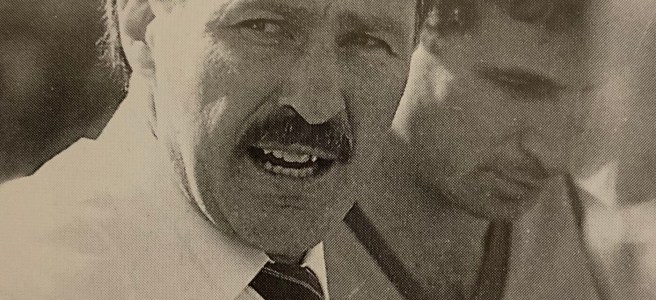
John Todd was replaced as coach after two seasons, with Victorian Michael Malthouse taking over the reins following six seasons at Footscray. The Bulldogs had only made the finals once during Malthouse’s tenure as coach, falling agonisingly short of a Grand Final appearance in 1985 in Malthouse’s second year.

The Bulldogs had remained competitive since, hovering just outside the final five, before crashing to second-last in Malthouse’s final year in charge, as the club battled football extinction. The Bulldogs would exist in their own right for season 1990 – saved from merging with Fitzroy – but Malthouse sought a new challenge across the Nullabor.

The transition between Todd and Malthouse hadn’t been a smooth one; news of Malthouse’s appointment had been leaked before Todd was formally told he would not be offered a new contract, with the Eagles hierarchy scrambling together a press conference on the afternoon of October 3, 1989 to present Malthouse as the clubs third coach.

Malthouse would not be the only key change for the Eagles heading into 1990.

Brian Cook was appointed CEO, after two years with the WAFC, and Trevor Nisbett was appointed football manager. On-field, Stephen Malaxos was named captain with John Worsfold vice-captain and the club was able to establish Subiaco Oval as its permanent training base, having operated out of a number of different locations across their first three seasons.

Leading up to the clubs opening game against Collingwood, the signs were positive the Eagles could return to finals action.

The Eagles lost narrowly to Essendon in their Fosters cup opening game, but were given a reprieve in the competition after Brisbane failed to travel down for the pre-season competition. West Coast played the Bears’ opponent in North Melbourne, and narrowly lost again. The Eagles lost both games by three points, with poor kicking for goal to blame in both defeats.

West Coast then hosted the previous seasons Grand Finalists in practice matches to round out the pre-season. Both were resounding victories. The Eagles thrashed the Cats by 89 points and then followed up that performance with a 12 goal win over the Hawks.

West Coast named a fresh squad to tackle the Magpies, who were one of the premiership favourites heading into the season. Collingwood had made the finals the previous two seasons under Leigh Matthews, but had been bundled straight out in both years. With a number of key recruits over the off-season, many believed the Magpies were ready to take the next step.

The Eagles named four players for their AFL debut. Peter Matera – the Eagles first selection at the 1989 draft – Dean Kemp, Dean Irving and Brad Gwilliam were all selected for their first matches, while Peter Wilson was also picked for his first game with the club, having switched across from Richmond.

John Worsfold was left to lead the club, after new captain Steve Malaxos was forced to miss the game with a broken foot. Malaxos had suffered the injury, stepping on a picket at his home, missing the start of the season.

The Magpies named new recruits Tony Francis and Scott Russell, who had both joined the club from the SANFL, but prized addition Paul Hawke and defender Michael Christian were both unavailable due to hamstring injuries.

The two sides had met in the final round of the 1989 season, with Collingwood easy 49 point winners.

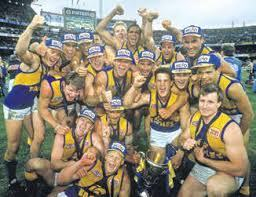
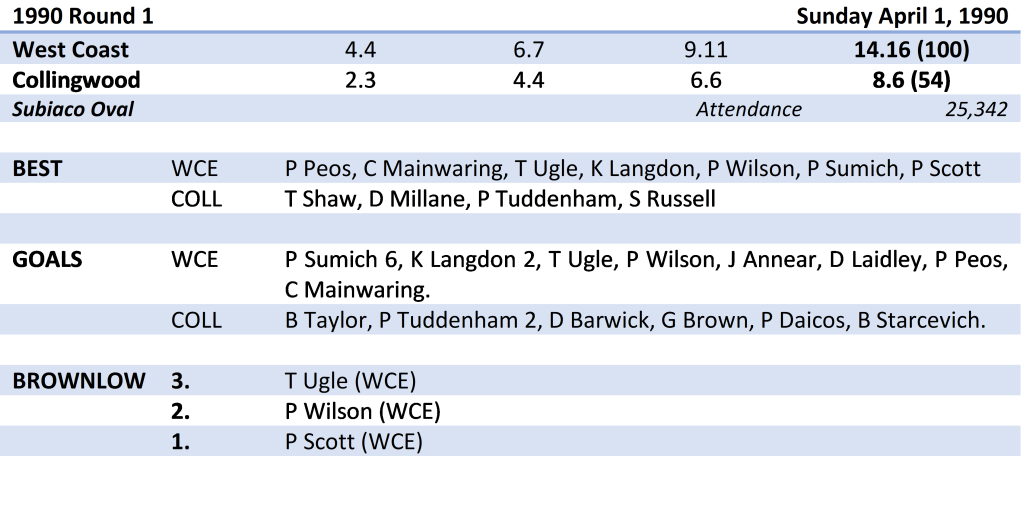
But in a clear sign of how much the Eagles had progressed in one summer, West Coast extended their lead in every quarter to run away with a 46 point win.

In a bruising encounter that had plenty of moments of spite between the two sides, it was an all-in brawl midway through the third quarter that set the course of the final outcome. Collingwood first-gamer Tony Francis lashed out at Eagles defender Murray Rance as the two tumbled over the boundary line, sparking an altercation that involved most players from both sides.

Play was held up for several minutes as the umpires tried to separate the players and when the two teams did get back to playing football, it was the Eagles who settled quicker. The Eagles booted the next three goals to stretch their lead out to 34 points, and while Collingwood responded with the last two goals in the term, a five goal to two last quarter sealed an impressive win for the home side.

Peter Sumich starred up forward with six goals, but it was the improved defensive attitude that pleased new coach Mick Malthouse most. Collingwood could manage just eight goals for the afternoon, with Michael Brennan shutting out full forward Brian Taylor and Murray Rance the better of Craig Starcevich.
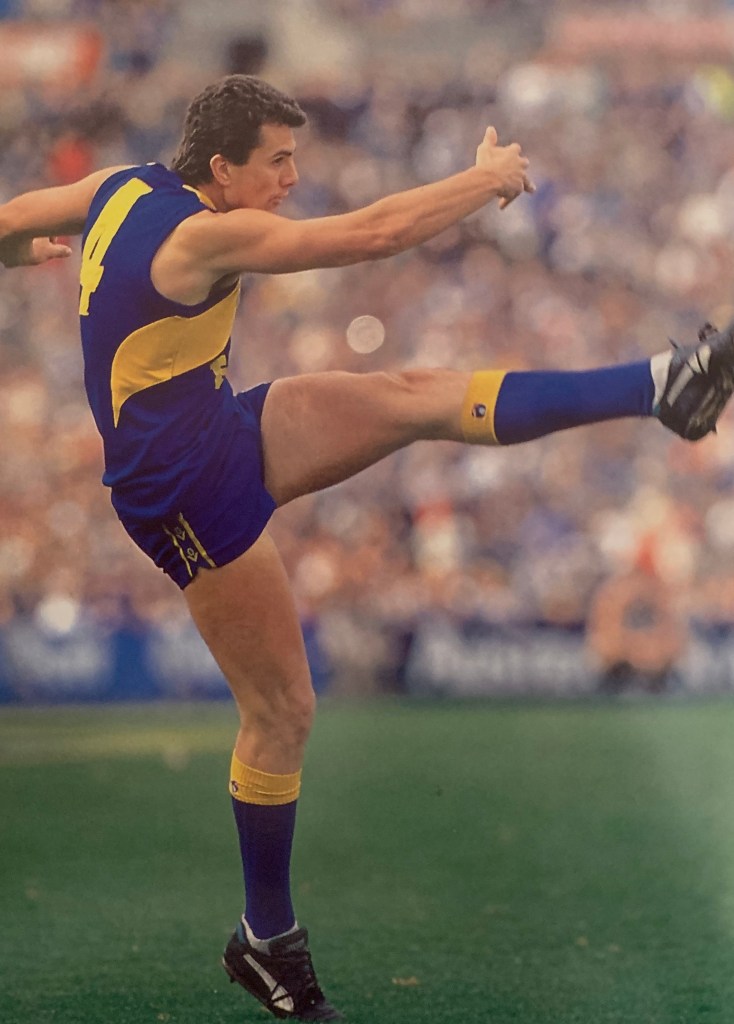
Sumich led the way up forward with six goals

Dean Laidley had the better of Jamie Turner, while John Annear found a new role in defence, marked with the task of minding Gavin Brown.

The Magpies struggled throughout the day with the man-on-man structure that Malthouse implemented, as well as the intense pressure around the ball.

“They (the players) didn’t talk about how much they’d won by or who kicked the goals. The first thing they said when they came in was the tackling was terrific”, an excited Malthouse proclaimed after the match.

“They acknowledged each other and it’s important that they think that’s one criterion of success, either at Subiaco Oval or Melbourne.”

Troy Ugle was stationed in the back pocket for the Eagles and provided plenty of dash through the first half, before being forced off the ground when he was caught under the pack of the melee, injuring an arm in the process. However, he returned to the field in the forward line for the final quarter, booting a goal and setting up two others in a best-afield display.

First-gamer Dean Irving combined well with Phil Scott in the ruck with the duo proving too strong for Collingwood pair Damien Monkhorst and James Manson at the stoppages. The Eagles midfield benefitted from this advantage with Paul Peos the leading ball-winner with 25 disposals and Chris Mainwaring next-best with 22.

Dean Kemp had 20 touches on the wing to get the better of Graeme Wright and Dwayne Lamb restricted Peter Daicos to just six kicks and a goal.

After having his colours lowered by Paul Tuddenham in the first quarter, acting captain John Worsfold was released into the middle, where he finished with 19 disposals and gave plenty of drive along with Karl Langdon, who collected 21 touches and booted two goals roaming between half forward and the centre.

For Collingwood, only captain Tony Shaw (24 disposals), newcomer Scott Russell (22) and Darren Millane (21) showed they were capable of matching the fierceness that West Coast brought to the contest.

It only got worse for the Magpies, with Francis later suspended for six games for kicking Rance. In his tribunal hearing, Francis remarked that he had been provoked when he felt Rance brush his groin area, and while he admitted responding with a kicking action, believed that he had missed Rance. The Eagles defender supported the claim by Francis that he didn’t make any contact, but that didn’t stop tribunal chairman Neil Busse rubbing the Collingwood midfielder out until round 8.

The Eagles themselves weren’t immune from the tribunal, with runner Rob Wiley charged for his involvement in the melee. Wiley was sanctioned and fined $1000.

While the result proved an awakening to the rest of the competition, Malthouse remained calm, saying there was plenty for his side to work on.

“If you come away from round one with a win, and plenty of work to do, that’s good.”
1994 Rewind: Finals Secured But Too Soon For Malthouse

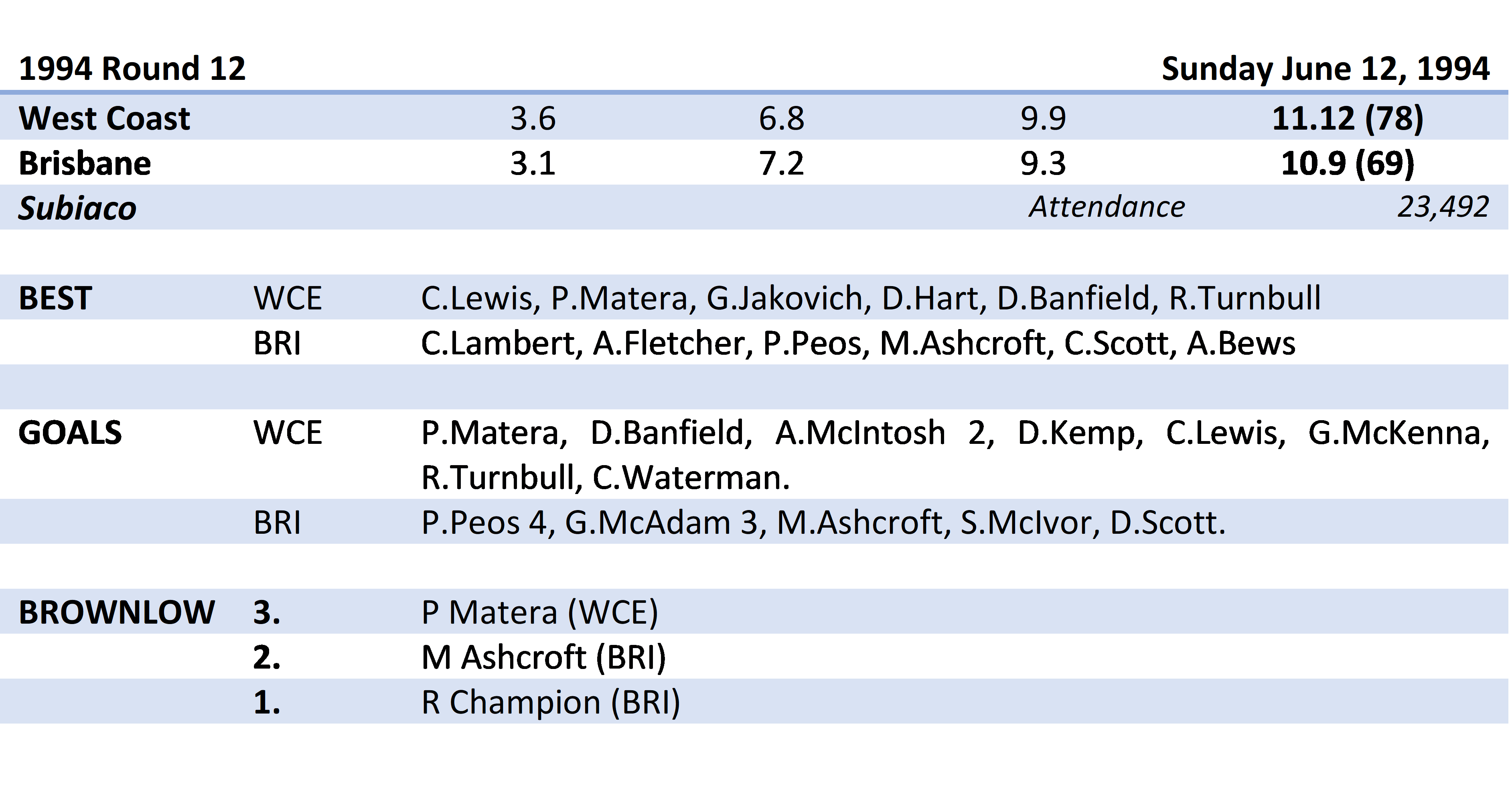
The Eagles were unimpressive but still made it six wins in a row when they held off a plucky Brisbane at Subiaco Oval.

The Bears arrived in Perth off wins against finals fancies North Melbourne and Geelong and threatened to topple the ladder-leading Eagles for much of the afternoon. However, the Bears butchered their chances in the final term meaning the Eagles are still yet to lose to Brisbane – a draw in 1992 the closest the Bears have gotten.

The Eagles 9-2 record after 11 games kept them a game clear at the top of the ladder and virtually assured them of a fifth straight finals appearance, although Eagles coach Mick Malthouse wasn’t exactly celebrating.

Post-match, an agitated Malthouse resumed his criticism from before the season about the newly implemented top eight. Malthouse had derided a system that ‘rewarded’ more than half the of the teams in the competition with a finals spot and also suggested that the larger finals system had eliminated the late season drama of teams competing for finals.

Malthouse said that the season had developed a clear division of the top teams and the bottom teams at the halfway mark and that the finals make up had already been decided, killing any interest in the second half of the year.

“I think its ridiculous. In the past two seasons we have gone to round 22 or 24, we’ve gone to the final siren in many instances to find out who would make the top six. Now, in round 12 we have got real division.”

Malthouse said that only Adelaide – who were in ninth position – were capable of pushing into the top eight out of the sides sitting in the bottom half.

“That’s the unfortunate thing about the final eight,” Malthouse continued. “You can get all the Victorian sides in that you like, but it doesn’t solve the problem of having a competition that’s fierce right to the end.”

Malthouse though wasn’t done after expressing his views on the top eight.

The Eagles had been put on notice by the AFL during the week after they had exploited a loophole which allowed Dean Kemp to be a late inclusion to the team that played Melbourne a week before, despite not being named in the squad of 24 submitted to the AFL on the Thursday night.

Under AFL rules, clubs were allowed to add an extra player to their emergency list the following day if they were playing on Sunday, with Kemp added as the 25th player in the Eagles squad. Kemp was subsequently included in the final side the morning of the clash with Melbourne, replacing Brett Heady who was never expected to play after straining a hamstring a week earlier.

As such, the AFL announced they would revoke the rule from Round 13, expressing their disappointment that West Coast had blatantly benefitted from the situation. For Malthouse, the whole scenario seemed unwarranted, simply stating that they were entitled to ‘use it to their advantage’. “While the rule is there, you use it.”

“We took the opportunity to take Dean Kemp across and he filled the role of the player (Heady) who pulled out of the side late.”

The Eagles clearly weren’t bothered by the AFL’s stance, as they made a further two late changes for their clash with Brisbane.

Brett Heady was named to return from a hamstring injury, but failed to come up on game day allowing Jarrad Schofield to reclaim his place after he was omitted for Heady. The other late change was Peter Wilson, who had been surprisingly named after Malthouse had ruled the half-forward out earlier in the week with a hamstring injury suffered against the Demons.

Wilson had his place taken by Matt Clape, who returned to the West Coast side for his first game since round 4. Brett Spinks was another who spent much of the week under an injury cloud, but he recovered enough from an ankle concern to take his place.

Michael Brennan plays game 150

The Bears were dealt a double blow for their trip west with captain Roger Merrett unavailable due to a thigh complaint and Matthew Kennedy ruled out with a fractured cheekbone. Merrett, in particular, was a bad loss for the Bears. The veteran had booted five goals and two goals in the previous two weeks as Brisbane recorded consecutive upset wins.

Scott McIvor was named for his 100th game at full forward in place of Merrett, with Fabian Francis the other inclusion.

The Eagles had the better of the early chances, but wasteful kicking at goal kept the Bears in the game at quarter-time with the visitors then dictating the play after the first change.

Adrian Fletcher and Craig Lambert led the Brisbane midfield who had the better of their Eagle counterparts. Dean Kemp struggled in his second game back from a knee injury and Chris Mainwaring found himself on the pine with Chris Scott getting the better of their duel.

Paul Peos then changed the game with three goals in 13 minutes. The former Eagle was proving a handful for several of his ex-teammates, with John Worsfold and then Guy McKenna both unable to contain the half-forward. Michael Brennan – who was playing game 150 – became his third opponent but the Bears had taken a seven point lead following Peos’ purple patch.

At the other end, West Coast were sorely missing Sumich, Heady and Wilson. Malthouse had a constant rotation of players through his front half, as he searched for an effective combination. David Hynes, Ashley McIntosh and Karl Langdon all started the game in the forward 50 but failed to have an impact, with Hynes well beaten by Martin Leslie and Darryl White getting the better of McIntosh.

A goal to Chris Waterman right before half-time levelled the scores at 44 apiece with West Coast then taking charge again in the third quarter. The Waterman goal started a run of four for the Eagles, with Peter Matera (twice) and Ryan Turnbull kicking majors to have the hosts ahead by 17 points.

Still, the Bears wouldn’t go away.

Brisbane booted the last two goals in the term to reduce the Eagles lead to six at three-quarter time, making it anyone’s game to win.

It would be the Eagles who would find the goals when it mattered in the final term. Guy McKenna was shifted to the forward line at the start of the last quarter, with the move paying immediate dividends. McKenna goaled just three minutes into the term to take the Eagles lead out to 12 points.

The Bears continued to pepper the goals, but couldn’t hit the major target. Peos and Alastair Lynch both missed from close range and then Troy Clarke slammed his rushed shot on goal into the post. The game was then decided heading into time-on with the Eagles pouncing on a Scott McIvor turnover. McIvor’s errant disposal was swooped on by the Eagles at half-back and a quick movement up the ground finished with McIntosh kicking an easy goal on the run to put the Eagles out to a three goal lead and end the contest.

A late goal to Brisbane reduced the final margin, but they paid for their missed chances earlier in the quarter. The Bears booted 1.6 for the term and Robert Walls was left to rue the opportunities. “We had our chances. Whoever won today could say they were a bit fortunate.”

“We weren’t able to close it and to their credit they bottled it up and did all the things that an experienced and good team should do in the final minutes.”

Malthouse though was blunt in his assessment of the performance. “We were ordinary in certain passages of the game… a lot of them are very disappointed in their performance today and are not buoyed at all by the fact that we got over the line.”

In further sour news, the Eagles lost Don Pyke and John Worsfold during the second half to injury. Pyke was forced off the ground with a shoulder injury early in the third quarter, while Worsfold played for nearly a quarter with an arm complaint, before then sitting out the last term.

Asked why Worsfold spent so long on the ground despite being clearly hampered, Malthouse said he did all he could get to his captain off. “Have you ever had front teeth extracted? That’s how hard it was to get him to leave the ground.”