1990 Rewind: Lewis Magic Lifts West Coast

Eagles Get Necessary Win In Penultimate Round

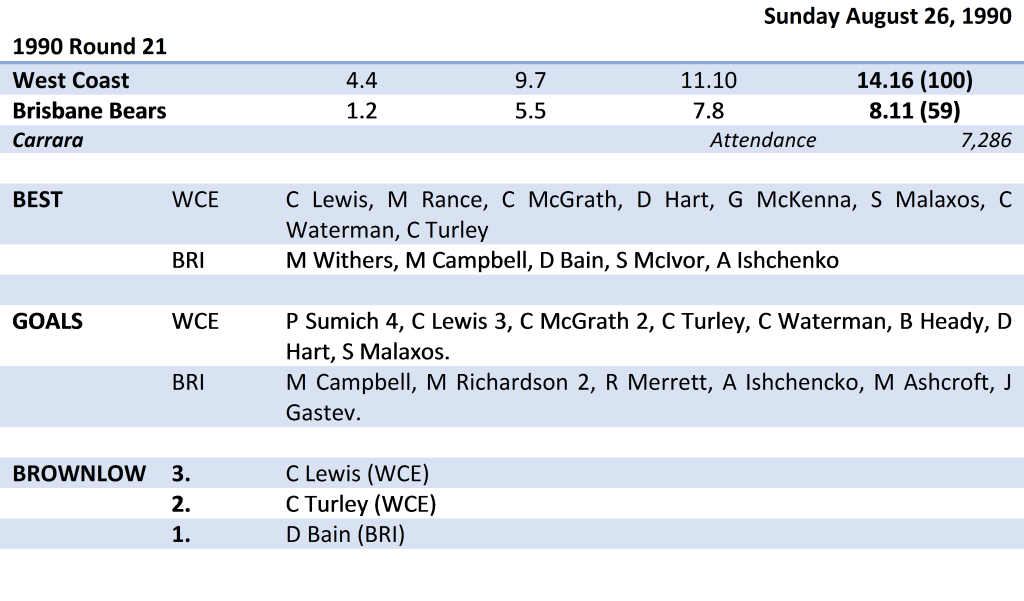
In a game that failed to reach great heights, West Coast got the four points against the Brisbane Bears to keep their hold on third place, with just one regular-season game left.

The Eagles were solid, rather than spectacular in the win, opening up a 20 point lead at the first change before going on to a 41 point result in front of just 7,286 fans at Carrara.

And while those that did come to the ground would have seen the match play out as expected between a team vying for the double chance and another team near the foot of the ladder, they were treated to one of the great individual performances of the year.

Chris Lewis had endured a frustrating start to the season when a hamstring injury and then an ankle problem restricted the midfielder/forward to just one quarter in the opening five games.

A fortnight with WAFL club Claremont built some match fitness before Lewis returned to the Eagles side, hitting his stride in the second half of the season. In ten matches from round 11, Lewis averaged 23 disposals per game and booted 15 goals as West Coast consolidated their spot in the top five.

Against the Bears in Round 21, Lewis put in a career best performance.

Running through the midfield, Lewis collected 28 kicks, 10 handballs, seven marks and booted three goals in a clear best on ground display. The Bears had no answer to the masterful showing from Lewis, who displayed his skills both in the stoppage and out in space and had a hand in creating a number of scoring opportunities.

The Eagles made a host of changes to the side that played the Bears, following their loss to the Demons a week earlier. Dwayne Lamb was forced out with a broken arm and Peter Melesso commenced his five-week suspension for stomping. The casualties from the defeat were Troy Ugle, Tony Begovich and Geoff Miles.

Into the West Coast line up were John Worsfold, who returned from serving a two week ban, Craig McGrath who was a late withdrawal the week before, as well as Scott Watters, Dean Turner and Murray Rance who forced his way into the side after six weeks in the WAFL.

The Bears made just two changes with Chris O’Sullivan and Brad Rowe replacing dropped pair Ray Windsor and Shaun Hart.

Laurie Keene made the trip with the Eagles squad as the travelling emergency, with Malthouse remaining cagey over whether the ruckman would make his return from injury. Keene had been sidelined since the second match of 1989 and even Bears coach Norm Dare predicted pre-match that Keene would be included in the Eagles side.

“I can’t believe Keene would come all this way and not play.”

Keene wasn’t a late inclusion with Malthouse giving the pairing of Dean Irving and Phil Scott a chance to bounce back from the beating they copped against Jim Stynes the week before.

And while both lowered their colours to ex-Eagle Alex Ishchenko, it mattered little as Lewis led the strong showing from the West Coast midfield. David Hart and Stephen Malaxos complemented the silky skills of Lewis with the inside grunt, while Craig Turley and Chris Mainwaring provided the linking run on the wings.

Up forward, Peter Sumich booted four goals, taking his total to 73 for the season, equalling the club record set by Ross Glendinning in 1988. However, Sumich would finish the afternoon on the bench. In only his second game back from missing a month with a hamstring, Sumich once again felt a twinge with the Eagles medical staff taking no chances on their spearhead.
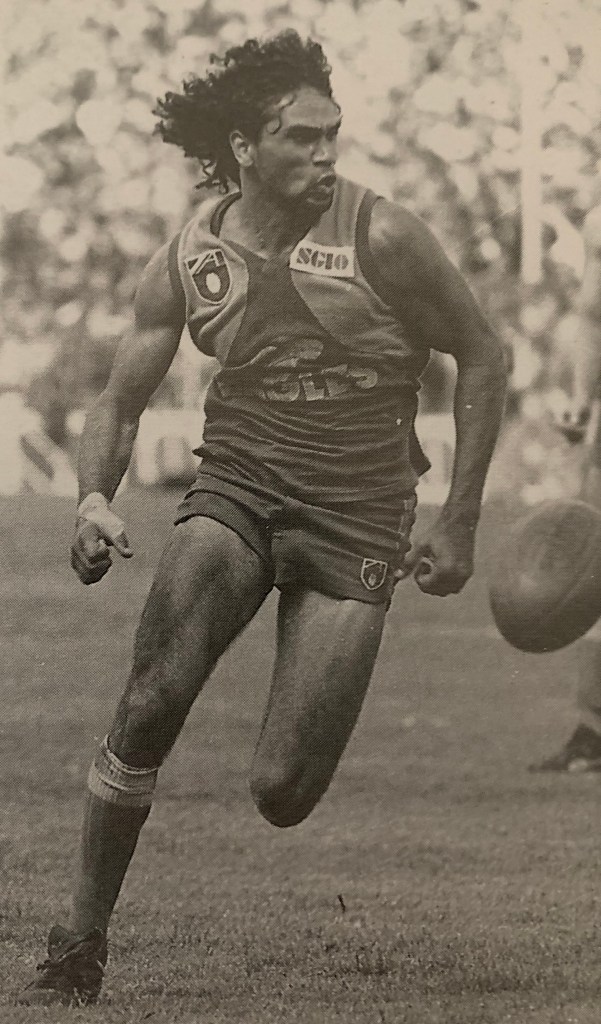
Chris Lewis was sublime for the Eagles against Brisbane

For Malthouse, the defensive effort was the most pleasing aspect, having conceded 100 points in each of the previous two games.

“The idea was to restrict their scoring, which is something we’ve not done in the last two weeks. The Bears only got eight goals – that’s exactly the result we wanted.”

“They had some good runners but we were able to shut them down and we broke through their defence enough times to kick a winning score.”

Pleased with the performance of his defence, Malthouse had special praise for the returning Rance who restricted Bears full-forward Roger Merrett to just nine disposals and a goal.

“It was just about his (Rance) best game this year. Not because of how many kicks he got, but because of who he was playing on and the way he handled himself under pressure.” Malthouse went on to say it was the best game Rance had played at the club.

Rance himself tallied 15 disposals and seven marks to finish as one of the best for West Coast. David Hart relished not having a tag for the match to gather 31 disposals through the middle, while Steve Malaxos picked up 29 touches.

Guy McKenna had 25 disposals off half back, while Craig McGrath provided the perfect foil for Sumich in the forward line with 21 touches, nine marks and 2.3. Chris Waterman – who held his spot after being a late inclusion the week before – was also one of the Eagles’ best with 19 possessions, nine marks and a goal.

Mark Withers was the leading disposal winner for the Bears with 27, while David Bain and Scott McIvor each picked up 26 touches. With the Bears’ key forwards well held by the tight West Coast defence, only Michael Richardson and Matthew Campbell finished as multiple goal scorers with two each.

Bears coach Norm Dare admitted he was flat after the match believing many of his players already had their eye on the end of the season. The Bears were relegated to last on the ladder and were set for the wooden spoon, after Sydney stunned the Cats by two points at Kardinia Park.

The win kept West Coast in third, with all of the finals incumbents registering wins in the penultimate round of the regular season. Essendon stayed top, despite being jumped by Footscray. The Bulldogs opened up a four goal lead at the first change, but the Bombers had hit the front by half-time, before rolling away to a 24 point win.

That kept the Bombers a win ahead at the top of the ladder, with Collingwood putting in the most impressive performance from the top five, thrashing Fitzroy by 86 points. The Demons and Hawks kept their own double chance hopes alive with efficient wins over Richmond and Carlton.

Melbourne broke free of the Tigers with a five goal second quarter, to run out steady 36 point winners, while Jason Dunstall kicked six goals for the Hawks in their 31 point win over the Blues.

While West Coast mostly tailored through their win against the Bears, the performance wasn’t a concern for Eagles coach Mick Malthouse, pointing out the eight hour trip from Perth to the Gold Coast was an acceptable factor.

The air strike that had debilitated much of the national travel system meant West Coast had to make stops in Adelaide and then Sydney, before eventually reaching their destination in Queensland. Conditions at the ground were also tough with hot, blustery winds greeting the teams at Carrara.

“Fatigue was a big factor. It’s a long journey, it’s a big ground and we haven’t played in that sort of heat for a long time.”

“A win, is a win, is a win – and that’s all it was.”
1990 Rewind: Eagles Bounce Back Against Bears

Eagles Get Four Points But Miss Percentage Booster

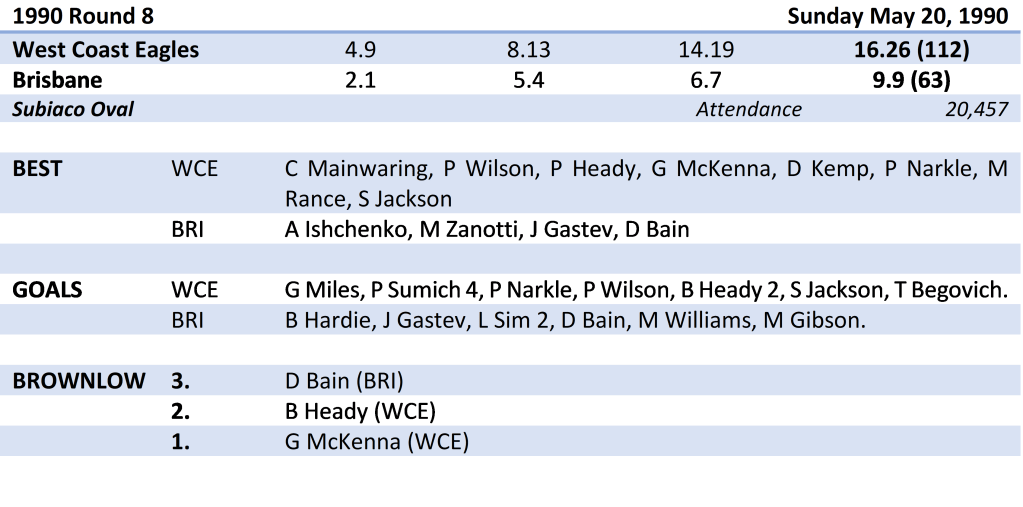
West Coast returned to winning ways when they comfortably accounted for the Brisbane Bears at Subiaco Oval. In a performance that warranted a triple-digit winning margin, poor kicking on goal meant the Eagles had to settle for a 59 point victory.

Peter Sumich booted four goals, as did Geoff Miles who was thrown forward in the second half. With such a complete performance, many Eagles stood out, but the performance that would have most delighted the West Coast match committee was that of Phil Narkle, who returned for his first senior match in over two and a half years.

Narkle – a member of the Eagles inaugural squad of 1987 – was delisted at the end of 1988 after injuries restricted the gifted wingman to just nine games in two seasons. Returning to the WAFL, Narkle managed some games with Swan Districts late in the 1989 season, with the Eagles throwing a lifeline ahead of the 1990 season, with their final selection at the pre-season draft.

Narkle’s last appearance for the Eagles had been the 130 shellacking against Sydney in Round 16 of the 1987 season.

Narkle shone in his first game back, picking up 22 disposals and booting 2.3 playing mostly from the forward pocket. Malthouse, in particular, was delighted by Narkle’s showing.

“I was tickled pink with Phil’s game, especially as he was a bundle of nerves beforehand,” a ‘rapt’ Malthouse said after the game.

“His pace and genuine crumbing ability gave us something that we lacked.”

Narkle was one of four inclusions for the Eagles, who swung the axe after their poor display against the Demons the previous week.

Chris Mainwaring earned an instant reprieve after being dropped to East Fremantle the week before, responding as one of the best players for West Coast. Scott Watters and Tony Begovich were the others brought in, with Craig Turley, Andrew Lockyer and Todd Breman dropped. Dean Laidley was finished for season 1990 having undergone a knee reconstruction during the week.

Begovich debuted for the Eagles after being selected at the 1989 National Draft, but his selection capped off a rampant rise. Begovich initially rejected the Eagles offer to join the club, choosing instead to remain with WAFL club Claremont, alongside fellow draftee Peter Mann.

However, a change of heart in the new year saw Begovich join his new Eagle teammates and a strong start to the WAFL season garnered his first senior AFL game. While he spent most of his first match on the bench, Begovich still managed to have an impact booting his first goal.

The need for Begovich was limited as West Coast controlled the contest from the get go.

The Eagles registered 13 scoring shots in the first term and the game could have been done at the first change if not for an inaccurate return of 4.9.

Chris Mainwaring slotted back on a wing and gave plenty of drive, as did rookie Peter Matera who produced a more rounded effort in his 3rd AFL game. Fellow rookie Brett Heady provided class through the midfield and at half forward, while Peter Wilson was industrious around the ground.

The Bears had arrived in Perth off the back of their second win of the season, by eight points over Sydney, with forward Cameron O’Brien the difference in the win with seven goals. However, he was completely blanketed up forward by Michael Brennan. Murray Rance was similarly effective on Bears captain Roger Merrett.

Guy McKenna provided the drive from the backline and with Karl Langdon and Stevan Jackson up forward, along with Sumich and later Geoff Miles, there was too much class across the ground for the Bears to contain.

The Eagles added another four goals in the second term, and put the foot down after half time with six majors to take their lead out to 60 points with a quarter to play. However 2.7 in the final quarter cost the Eagles a chance at a significant percentage boost.

Remarkably, the Eagles booted 8.13 in each half, to finish with one of their most inaccurate displays in the clubs history, a final score of 16.26, from 42 scoring shots.

Mainwaring, McKenna and Wilson all tallied 26 disposals to be the leading ball winners for the Eagles, with rookies Dean Kemp (22 disposals) and Brett Heady (21 disposals, two goals) also impressive. The only concern for West Coast was full forward Peter Sumich limping off midway through the third term.

Bears coach Norm Dare admitted his side were ‘just not tough enough’ in the contest with the result undoing much of the good work they had showed the week before.

Ironically for the Bears, their best players were also Eagles. Mark Zanotti, John Gastev and Alex Ishchenko had all been a part of the Eagles’ inaugural squad, but had worked their way east to the Bears in subsequent seasons.

Zanotti was the leading possession getter for the Bears with 25 from defence, while Gastev offered an avenue to goal with 18 touches and two goals. Ishchenko was the Bears’ best on the day, completely monstering Phil Scott in the ruck and getting the better of his former teammate around the ground.

Ishchenko finished with 18 disposals and 10 marks, while also having 25 hit-outs in the ruck, compared to just nine for Scott.

While happy with the win, Malthouse bemoaned the missed opportunities on goal. “We worked hard to set up goals rather than kick them.”

And despite the win lifting the Eagles back up to second spot on the ladder, a game clear of the chasing pack, Malthouse acknowledged the win would mean nothing if they lost to the Cats the following week.

“We have to defeat Geelong next week,” Malthouse declared. “That will put us three games up on them.”

“In the wash-up, after 22 rounds they (Geelong) will be vying as we will be, for a place in the five.”

It was déjà vu for the Cats when inaccurate kicking cost them what should have been a straight forward win against a side at the bottom of the ladder. A week on from their shock defeat to Richmond at Kardinia Park, the Cats booted 13.20 in their nine point loss to the Swans at the SCG, who had started the round in equal bottom.

The consecutive defeats had robbed the 1989 Grand Finalists the chance to sit comfortably inside the top five, instead languishing in eighth position, a game and percentage out of the top five. Carlton pushed past the Cats into seventh when they won their third straight match, thrashing the Hawks.

The Blues led from the outset and slammed their advantage home in the final term with an eight goal quarter securing a 67 point win. The Hawks would be the big losers of the round, dropping from 2nd on the ladder to 5th.

Essendon and St Kilda each climbed a spot with narrow wins over Footscray and North Melbourne, respectively, while the Magpies remained stayed in touch with the top five with a ten goal final term turning a 17 point three-quarter time deficit into a 45 point win over Fitzroy. The Demons remained the pacesetters at the top of the ladder with an easy win over the Tigers.