1990 Rewind: Eagles Exorcise Demons

Historic First Finals Win For West Coast

West Coast set up a meeting with Essendon in the preliminary final after defeating Melbourne by five goals in the semi final.

Mick Malthouse’s drastic changes at the selection table paid off, as West Coast overcame a poor recent record against Melbourne to produce the clubs first ever win in a final.

One of those selections – Chris Waterman – produced a career best outing booting six goals across half forward.

Waterman was one of six changes for West Coast, with Eagles coach Mick Malthouse ruthlessly axing a quarter of the side that was demolished by Collingwood the week before in the Qualifying Final replay.

The most controversial omission was captain Steve Malaxos, who lost his place after a period of indifferent form. Malaxos had spent much of the previous two games against Collingwood on the bench, with Malthouse later saying the Eagles needed greater leg speed and running power on the wide expanses of Waverley Park.

Joining Malaxos out of the side were ruckman Dean Irving, who had been well beaten in both Collingwood matches, Troy Ugle, Craig McGrath, Murray Rance with a fractured jaw and Peter Wilson who would be a late withdrawal ahead of the game with a hamstring strain.

Phil Scott returned to the Eagles line-up, after being dropped on the eve of the finals, to partner Laurie Keene in the ruck, while Scott Watters returned after missing the replay with a knee injury. Stevan Jackson replaced McGrath up forward after ten goals with South Fremantle in the previous fortnight, while Waterman and Tony Begovich were added for their ability to run and spread.

When Wilson pulled out ahead of the game, Andrew Lockyer was called up, slotting into defence in place of the missing Rance. Guy McKenna had been in doubt after breaking a nose late in the loss to the Magpies, but held his spot, as did Mainwaring whose knee was becoming a week by week proposition.

Stevan Jackson returned to the Eagles side to be one of their best

Melbourne made no change when teams were announced but were soon to have their own late drama. Captain Garry Lyon was pulled from the side on the morning of the game after he suffered a corked thigh colliding with teammate Steven O’Dwyer the day before at training. Todd Viney was called up to the side.

Despite being without Lyon and midfielders Brian Wilson and Alan Johnson, the Demons were still hot favourites to progress to the preliminary final.

It took just 90 seconds for West Coast to show they weren’t going to just whimper away.

Kicking into the wind, the Eagles had two goals on the board – both to Chris Mainwaring – before Melbourne had even worked out their direct match-ups.

As well as bringing in a host of new players, Malthouse also moved his side around as he sought to catch the Demons off guard. Mainwaring started at half forward and his quick brace forced a shuffle of the Melbourne defence with Steven Stretch moved from the wing to replace Matthew Febey.

John Worsfold also started forward, as did Chris Lewis as the Eagles looked to avoid an early tag. Lewis still had Stephen Newport for company, but was influential early as West Coast established an important 13 point lead at quarter time.

Andrew Obst had been instrumental in Melbourne’s win over the Eagles in Perth several weeks earlier and Malthouse wasn’t keen on letting the midfielder run unattended again. Guy McKenna shifted into the midfield in a run-with role, holding Obst to just 12 disposals for the game.

Laurie Keene led the ruck, with Phil Scott taking the resting ruckman in the back pocket, while Andrew Lockyer had first crack at Darren Bennett.

The Demons tried to repeat the physical approach that had seen them defeat West Coast twice during the regular season, but the Eagles kept their focus on the ball.

The 13 point advantage exploded to 45 points by the main break, with the Eagles booting six goals to none with the wind, and the match was as good as done.

Melbourne outscored the Eagles in the second half, but West Coast were never in danger of giving up their spot in the Grand Final playoff.

West Coast would have to get past Essendon if they were to make their first ever Grand Final, after the Bombers were comprehensively beaten by Collingwood in the other semi-final.

Kevin Sheedy denied the Bombers would be affected by the additional layoff because of the drawn Qualifying Final leading into the match, but they appeared sluggish going on to lose by 63 points. The Magpies led by 12 points at half time, but ten goals to two after half time saw Collingwood qualify for their first premiership decider in nine years.

While West Coast could feel satisfied with the history-making first ever finals win in the clubs history, there were concerns to come out of the five goal win.

Scott Watters had arguably been the Eagles’ best player in the first half, but spent the entire second half on the bench with a groin complaint. Guy McKenna suffered a suspected broken arm after clashing with Earl Spalding in the dying minutes of the game and three Eagles wound up on report from separate incidents in the game.

Chris Lewis was placed on report for charging Graeme Yeats and Stevan Jackson was reported for striking Jim Stynes. Both players would get off at the tribunal during the week, but Dwayne Lamb wasn’t so fortunate.

The Eagles tagger was also charged for reporting Stynes, copping a one week ban. Lamb, and many of the other Eagles, were still seeking retribution from the last match between the two sides which saw Stynes break Lamb’s arm with an attempted soccer off the ground.

The Eagles gave it to Stynes, every chance they could, and it appeared to work as Keene controlled the stoppages and provided plenty of attacking run off Stynes around the ground.

The move appeared to work with Melbourne unable to get any direction or structure on the field with their captain missing and their ruckman ineffective.

At the feet of Keene, Craig Turley, Dean Kemp and David Hart had plenty of the ball as they overwhelmed their Demons counterparts. For the second week in a row Turley was one of the best for West Coast, revelling in the centreman role in the absence of Malaxos.

Turley finished with 26 disposals, one behind Mainwaring who had a team high 27 possessions to go with his two goals at the start of the match. Hart, Kemp and Brett Heady all tallied 21 while Keene himself finished with 23 touches, four marks and ten hit-outs.

Scott Watters was one of the best for West Coast but finished on the bench injured

Up forward, the change in dynamic did wonders with West Coast kicking their highest score since round 19. Waterman was the surprise packet with six goals from 17 disposals and nine marks, while Peter Sumich booted four and Stevan Jackson three, the trio combining for 13 of the Eagles’ 19 goals.

Sumich and Jackson also each booted five behinds, with Jackson also gathering 21 disposals and five marks – highlighting the dominance of the Eagles’ tall forwards.

The Demons had few players who shone, with Simon Eishold and Greg Healy the leading ball winners with 20 disposals. Stephen Newport gathered 16 disposals and seven marks after starting in a tagging role on Chris Lewis. Newport was then replaced by Glenn Lovett, but Lewis had the better of both players as his blistering second half of the season continued.

Rod Grinter booted four last quarter goals when he was shifted forward, with Ricky Jackson, Graeme Yeats and Darren Bennett each kicking two.

Demons coach John Northey called his side’s performance ‘pathetic’, with Melbourne unable to live up to their favouritism billing heading into the match. “In finals football, you have to find something extra all the time, and our players weren’t prepared to do it.”

Northey believed that the underdog status had worked in the Eagles’ favour, after two testing weeks against the Magpies.

“When everyone is kicking us in the guts, we have something to prove, but as soon as we become favourites in something, we have always faltered, and not just once, it has happened many, many times,” expressed a frustrated Northey.

 For Mick Malthouse, the performance was justification for their season and followed his earlier comments the week before that West Coast would bounce back. “I think a lot of people underestimated the fighting spirit of this group.”

“We didn’t make the finals series for the sake of making the finals series.”

Malthouse also believed the first ever finals win would be a great fillip for his side as they continued their push for a maiden flag.

“It (a finals win) is fantastic for the players… this year we have won in Sydney for the first time, the MCG for the first time. These are all little hurdles all along that are being looked at by the players.”

The Eagles coach also denied it was a risk making the mass number of changes ahead of the game, with many of the inclusions having a strong say in the final result.

“If it hadn’t come off, I suppose it may have been the biggest gamble of my coaching career,” Malthouse wryly admitted.

1990 Rewind: Not Done Yet

Malthouse Declares Eagles Will Bounce Back From Replay Thrashing

Eagles coach Mick Malthouse boldly declared his side’s season wouldn’t end in the following weeks semi-final, after succumbing to Collingwood in the qualifying final replay.

West Coast were blown out of the game in the opening term and apart from a ten minute period late in the third quarter, never appeared likely to work their way back into the game.

After the match, Malthouse refused to concede the Eagles would struggle to get past Melbourne in the semi-final, despite needing to return to Waverley Park for a fourth straight week. The Demons had enjoyed the luxury of the week off as West Coast and Collingwood did battle for a second consecutive week.

“The players have a history of character and we have rebounded before. I am confident of beating Melbourne.”

The Eagles though were sluggish as the travel back and forth from Perth appeared to have taken its toll.

West Coast made two changes from the drawn match, with Chris Waterman dropped and Scott Watters unable to take his place after failing a fitness test on the morning of the match. Peter Wilson was recalled from a fractured cheekbone suffered against the Tigers in Round 19, with Troy Ugle the late inclusion for Watters.

Despite concerns over an ongoing knee injury, Chris Mainwaring held his spot on the wing. Steve Malaxos was another who held his spot despite growing speculation over his position in the side.

Collingwood also made two changes with forwards Craig Starcevich and Brian Taylor both dropped. Despite Leigh Matthews’ claims during the week that the Magpies would need a more fleet-footed side, like-for-like players Michael Christian and Denis Banks were the players selected in their place.

Taylor, in particular, could feel aggrieved for his omission after his crucial last quarter involvement saw him kick two goals as the Magpies salvaged a draw. After being left out of the side, the burly full forward announced he would retire at seasons end.

West Coast lined up much like they had the week before, but Leigh Matthews threw his Magpies’ side around to unhinge many of the Eagles’ match ups. James Manson was preferred in the ruck ahead of Damien Monkhorst, regular defender Gavin Crosisca played across half forward and Mick McGuane was recast as a tagger on Chris Lewis.

The Magpies also went small up forward with Gavin Brown and Peter Daicos operating out of the goal square, dragging running defender Guy McKenna to the last line.

Steve Malaxos started in the middle opposed to Collingwood captain Tony Shaw while David Hart also started in the middle with the task of running with Tony Francis.

The match started fiercely when Peter Sumich opened the scoring. Paul Peos’ shot on goal faded towards the goal line with the full forward able to mark over two Collingwood defenders. From the tight angle, Sumich ran around and kicked the Eagles’ first major, but was felled after snapping the goal by Magpie Michael Christian.

Christian was reported for his late hit as a melee involving 20 players broke out in the Eagles forward line. Spotfires continued to erupt around the ground, but it would be Collingwood who would settle into the game better.

The Magpies booted eight of the next nine goals in the quarter, opening up a six goal lead.

And it was the work of Manson in the ruck, who did much of the damage. The lanky ruckman had the better of Dean Irving at the tap, but also exposed the Eagles ruckman around the ground.

With Collingwood benefitting from the breeze in the opening quarter, Irving stationed himself in the Eagles defence. However, Manson enjoyed the freedom through the centre of the ground, running forward to boot two goals in the term, while also having a hand in many of the Magpies other scoring chains.

Gavin Brown and Tony Francis also kicked two majors for the quarter as Collingwood swiftly moved the ball around the ground. Peter Daicos and Darren Millane also hit the scoreboard, with Peter Sumich adding a second goal for West Coast.

The Eagles started strongly in the second term, taking control at the stoppages in the centre square. Laurie Keene took over in the ruck as the Eagles claimed the first four centre clearances. Karl Langdon opened the scoring before Mick McGuane answered after taking a strong mark as he is crunched by John Worsfold and David Hart.

Laurie Keene responded for West Coast, but Collingwood finished the term stronger. Craig Kelly had been shifted forward after starting in defence on Craig McGrath, kicking truly after out-marking Michael Brennan and Brett Heady. Peter Daicos added a second and Gavin Crosisca finished off an impressive first half with a goal that saw Collingwood’s lead reach 49 points at the major break.

Matthews continued to shuffle his players around, preventing West Coast to find a rhythm in the game. Kelly went back to defence in the third term, as did Denis Banks and Shane Morwood, with Matthews dictating the match ups in the battle of the coaches box.

For West Coast, too many players struggled to get into the game. Chris Lewis was blanketed by McGuane, with Malthouse moving the dynamic midfielder into the forward line in a bid to shake the tag. Peter Wilson struggled to handle the pace of the final in his first game in six weeks and the Eagles forward line was virtually non-existent.

Craig Turley was one of the few good players for West Coast

Little much changed to start the third term, with Daicos and Brown each booting their third goals of the match to stretch the Magpies’ lead to a game high 60 points. But with Collingwood coasting to victory, West Coast roared back into the contest.

Ron McKeown, who had had the better of Sumich, limped off with a corked thigh which unsettled the Magpie backline. Michael Christian had been resolute across half back, mainly playing loose in defence, but was forced to mind Sumich.

The Eagles slammed on five goals in eight minutes to put the pro-Collingwood crowd on edge.

Trailing by 30 points with a quarter to play, Peter Sumich had a golden opportunity in the opening seconds of the final term to continue the Eagles momentum.

But as had been the case the week before, Sumich failed to capitalise. Leading new opponent Shane Morwood back to the goal square, Sumich valiantly flailed his left leg at an awkwardly bouncing ball, failing to make even the slightest contact that would have brought West Coast within 24 points.

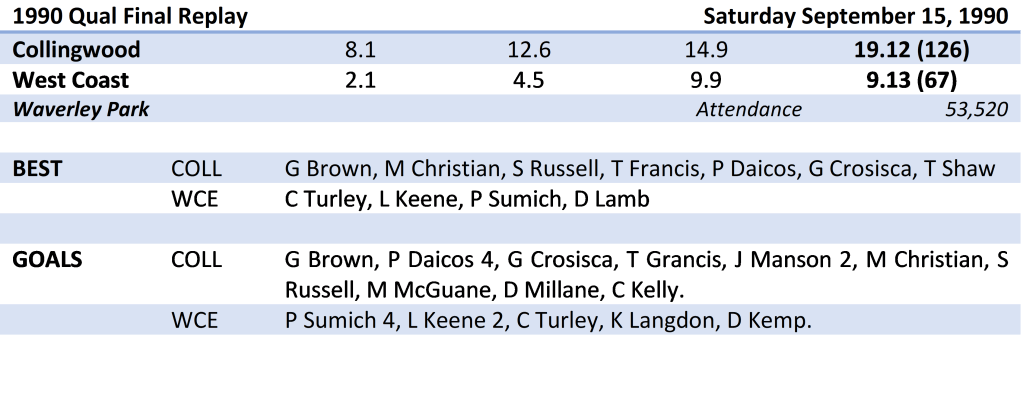
Instead, Gavin Brown marked a torpedo effort from Peter Daicos at the top of the goal square to steady the Magpies. Collingwood booted the only five goals of the last quarter to run out comfortable 59 point winners – ultimately a fair margin between the two teams on the day.

The result marked the Magpies first finals win since 1984 and the first victory in a final for coach Leigh Matthews. “Most definitely a relief. We’re playing for a Grand Final spot whereas we could have been playing for survival,” a happy Matthews said after the game.

Conversely, a despondent Malthouse reflected on the missed opportunity of the week before.

“Last week was there to be won – I’m a realist.”

“A lot of our players didn’t reach the level they did last week, but it’s been a magnificent experience so far for the players. We always looked second to the ball… and that is a state of mind.”

While acknowledging that his players looked tired, the Eagles coach maintained faith that his side would bounce back against the Demons.

“They (finals) don’t stay the same, they don’t decrease, they always get tougher, week in, week out, and these players have now experienced the intensity of two in a row.”

The difference between the two sides proved to be the spread of contributors as Collingwood had a greater share of the workload. Michael Christian finished as the leading ball winner for the Magpies with 24 disposals and eight marks, while midfielder Scott Russell and wingman Graeme Wright were the next best with 23.

All up, Collingwood had ten players hit the scoreboard with Daicos and Brown the best of those with four each.

Tony Shaw had the better of Steve Malaxos in their individual duel, as did Tony Francis opposed to David Hart. Denis Banks kept Karl Langdon to just ten disposals and a goal and Mick Gayfer provided plenty of run alongside Christian at half back.

For West Coast, only a handful could match the output of the week before. Craig Turley was arguably the Eagles’ best collecting 22 disposals and kicking a goal and winning his contest with Doug Barwick. Laurie Keene was influential when he replaced Dean Irving in the ruck with 21 disposals, 12 hit-outs and two goals. Keene and Sumich (four goals) were the only multiple goal scorers for West Coast.

Dwayne Lamb finished with 26 touches to lead the disposal getters for West Coast, but couldn’t quell the impact of Scott Russell for the Magpies, while Lewis toiled through the game to pick up 20 touches playing between half forward and the midfield.

The double chance had turned into a triple chance, but West Coast now found their season on the line with the Demons waiting.

1990 Rewind: Finals Chaos As Eagles, Magpies Draw

Sumich Shoots Wide On Siren

West Coast and Collingwood opened the 1990 finals series with a dramatic draw in the Qualifying Final, flipping the entire finals series on its head.

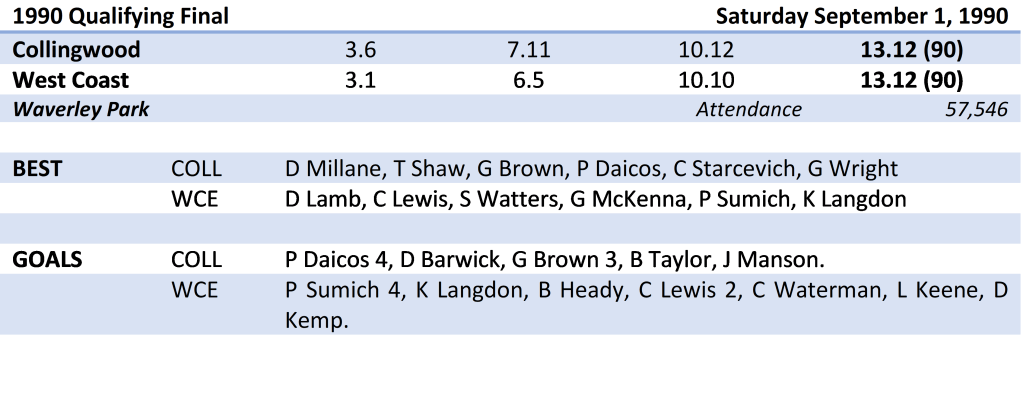
Peter Sumich had the chance to win the game in the dying seconds, but his missed set shot from close range in the left forward pocket, left the two teams matched on 13.12 (90) as the final siren rang.

The result – the first draw in a final since the 1977 Grand Final – was set to throw the finals series into disarray, with the Eagles and Magpies due to return to Waverley Park the following weekend to determine who would progress to the first semi-final to tackle the Bombers.

Melbourne were awaiting the loser of the replayed match, after they knocked reigning premiers Hawthorn out of the premiership race with a nine-point win in front of nearly 75,000 fans at the MCG.

The Demons now also had the added benefit of a week off ahead of the second semi-final after winning through the elimination final. Conversely, Essendon – who had earned the week off in the first week of the finals for finishing top at the end of the home-and-away season – were now facing a second straight week off, complicating their preparations for their first final.

Essendon coach Kevin Sheedy dismissed suggestions the protracted series would work against the Bombers, despite the prospect of over three weeks between their final round match against the Saints and the first semi-final. “We have played 22 home and away games this year, four Fosters Cup games and eight practice matches. I don’t think we need to worry about fitness.”

While the AFL were estimating an additional $800,000 would be generated from the extra match to be played, they were also forced to busily reschedule many of the planned events over the coming month. The Grand Final was now set to be played a week later on October 6, however the date for the Brownlow medal wasn’t expected to change.

The Magpies were heavy favourites heading into the match, off the back of their two largest wins of the season in the final two rounds. The Magpies took in an unchanged side from the win over North Melbourne, despite a couple of key injury concerns. 

Darren Millane stayed in the side despite fracturing a thumb against the Kangaroos, as did ruckman James Manson who trained lightly leading up to the match due to an ongoing groin issue. The Magpies also had Denis Banks and Shane Kerrison available to return from injury, although neither was recalled for the clash against the Eagles.

Full-forward Brian Taylor also kept his spot, despite an indifferent two seasons at the club. Taylor had managed just one game in the back half of 1989 due to a knee injury (coincidentally against the Eagles) and had featured in just five further matches in 1990, returning to the side in round 21 against Fitzroy.

The Eagles made just one change with Dean Irving returning after being dropped for the final round match against Geelong. Controversially, fellow ruckman Phil Scott was the one to make way after playing all 22 games during the home-and-away season.

For Mick Malthouse, it was a heart-wrenching decision. “This was the toughest decision I have made in seven years of coaching.”

“Phil accepted the decision like the professional sportsman that he is.”

Craig Turley also held his place despite concerns over a groin problem. West Coast were considered outsiders – namely by the Victorian media – with ten players playing in their first final. The Eagles were also playing only their third game ever in club history at Waverley Park; their other two appearances had both resulted in losses.

Steve Malaxos won the toss and sent his side the way of the breeze in the opening term, but the more experienced Magpies were able to settle first. Taylor had an early chance in the game, hitting the post with his first shot, before sending his second effort on goal out of bounds on the full.

His presence on the game forced an early positional change in the match, with Murray Rance and Michael Brennan swapping. The larger Rance headed to the goal square to match on Taylor, with Brennan shifting to centre half back on Craig Starcevich.

Dean Irving was stationed as a loose man in defence as Collingwood continued to push the ball forward, but while West Coast were able to limit the damage on the scoreboard early, the Magpies’ opposing ruckman Damien Monkhorst was allowed to dictate play and provide the link playing loose through the middle of the ground.

Monkhorst would be involved in the chain that delivered Collingwood the opening goal of the game. Chris Mainwaring was caught holding the ball across half forward, by opponent Mick McGuane, with Collingwood able to transition quickly to the other end of the ground.

Graeme Wright received the handpass from Monkhorst through the centre square, and kicked inside forward 50, looking for Taylor. However, Peter Daicos was able to read the spoil from Rance and after a handpass exchange with Starcevich, Daicos found some space to slot the important first major.

Gavin Brown added a second after being held by Guy McKenna in a marking contest, before West Coast worked their way into the game. Laurie Keene wobbled through the Eagles’ first on the run, before Brett Heady made it two goals in succession.

Brown added a second for the quarter, and third for the match for the Magpies, but his effort was cancelled out by Peter Sumich from long range leaving West Coast five points behind at the first change.

Mick McGuane was the clear standout at quarter time, picking up 16 disposals on the wing for the term opposed to Chris Mainwaring. His red hot start continued into the second term when an early shot on goal cannoned into the post. The Magpies managed several more efforts without success, before Sumich swung the game back in favour of West Coast.

Sumich goaled twice from long range to draw the Eagles level, before Karl Langdon sent through his own long bomb from beyond the arc to put West Coast in front.

However, that only seemed to spark the Magpies into gear.

Brian Taylor was dragged to the bench and the more mobile Craig Starcevich became the prime target up forward. Peter Daicos continued to present a threat, as did Gavin Brown who was now operating out of the goal square.

The Magpies booted the final three goals of the term to open up a 12 point lead at the main break. Collingwood were also guilty of wasting their chances on goal, having had seven more scoring shots for the half than West Coast.

Both coaches made moves to start the second half, as they looked for the all-important edge in the match. Ron McKeown replaced Craig Kelly at full back on Peter Sumich and Worsfold took Daicos in the Eagles defensive half.

And as the match grew in intensity, so did the sublime skills of its participants.

Dean Kemp drew the Eagles within a kick with a pinpoint goal from the pocket, before Daicos responded with a 40 metre snap. Peter Sumich add his fourth of the match, again from long range, and Chris Waterman kicked truly after being found on his own in the forward pocket, to see the Eagles reach parity.

West Coast were now in control of the game, led by Dwayne Lamb who gathered 12 possessions for the quarter, and Scott Watters, who had nine. James Manson put the Magpies back in front against the run of play after a sloppy turnover in defence, but the Eagles continued to generate opportunities.

Brett Heady, Chris Mainwaring and Dwayne Lamb all missed before Chris Lewis typified the class of the game, with a truly outrageous goal to put the Eagles back in front.

Ron McKeown was captured in defence by Kemp, with the ball spilling towards the boundary line where Lewis was able to swoop, gather, brush off the tackling attempt from Scott Russell before snapping through an incredible goal on his non-preferred foot in amongst a nest of Magpies.

Further adding to the difficulty of Lewis’ effort, Lewis had also lost his footing during the play, stranded on his knees before being able to lift back to his feet and kick an important goal for the Eagles.

Lewis had been instrumental in the second quarter in keeping West Coast in touch with Collingwood as they built an early advantage and now, as the match closed in on three-quarter time, the Eagles were the ones with all of the momentum.

Chris Lewis continued his excellent form from the second half of the season in the drawn final

Heady would miss a chance after some clever play by Lewis at half forward, where he was able to pluck the ball away just as Collingwood were set to clear from defence, before Heady and Sumich would then clash competing for the same mark. Dwayne Lamb would also miss a chance to get a shot on goal after fumbling at the top of the goal square.

A swift chain of passes from defence ended with Doug Barwick kicking truly to give Collingwood an unlikely two point lead, against the run of play, with a quarter to play.

The two point deficit became a ten point lead for West Coast early in the final quarter after Heady and Lewis each booted majors in quick succession. The Eagles runners – the likes of Watters, Lamb, Chris Mainwaring and Guy McKenna – had controlled the tempo of the game since half-time and the Magpies were struggling to keep pace.

Mick McGuane had faded out of the game after his blistering first quarter and found himself on the pine, while James Manson had been sent from attack to defence to quell Karl Langdon who had been in everything during the third term.

Trailing, Leigh Matthews reinstated Brian Taylor to the field after spending the second and third terms on the bench and the move paid immediate dividends. Taylor was able to claim a diving mark in front of Murray Rance, and goal, to reduce the Eagles lead to four points.

A few minutes later, Taylor added a second after Rance caught him high in a marking contest, and Collingwood had worked their way back into the lead.

The Magpies appeared to have done away with the Eagles challenge when Peter Daicos extended their lead with an effort that managed to top Lewis’ freakish effort in the previous term.

The Eagles attempt to exit their defensive 50m arc came unstuck when Guy McKenna missed John Worsfold with a pass, after a strong mark in the Magpies’ goal square. Gavin Brown was able to win the loose ball back near the boundary line, feeding a handpass up the line to Darren Millane, who instantly handpassed over his shoulder to Daicos deep in the forward pocket.

With the outside of his right boot, from the wrong pocket, Daicos magically worked the ball to land at the feet of the goal umpire and extend the Magpies’ lead out to eight points with just five minutes remaining.

West Coast though continued to push.

A desperate effort from Steve Malaxos across half forward prevented Collingwood from clearing out of defence, with Langdon able to snap truly from a boundary throw-in. Waterman dragged a shot on goal from deep in the pocket, reducing Collingwood’s lead to a solitary point before the final last play that had the game in the balance.

Chris Mainwaring twice failed to find an Eagles target in the forward half before Darren Millane attempted to clear out of defence. However, Eagles runner Rob Wiley inadvertently kept the ball in the Eagles forward line when he got in the way of Millane’s handpass resulting in a boundary throw in.

Langdon won the ball from Keene at the restart with his attempt on goal floating across the face into the opposite pocket where Sumich was able to mark over his shoulder. His final kick would become instantly folklore.

Peter Sumich laments his late miss

All up, the lead changed eight times during the match, and while the teams may not have been separated at the completion of four quarters, the same couldn’t be said for the attitude of the two coaches.

While Leigh Matthews was relieved to have a second chance at the second chance, his counterpart in Malthouse was left ruing the missed opportunity.

“We didn’t make the most of the opportunities. When the game was there to be won, we didn’t grab it.”

Malthouse expressed frustration that West Coast couldn’t take advantage of the lead they built during the final quarter and run out to win the game. “I feel bitterly disappointed. We didn’t achieve what we came here to achieve.”

The Eagles coach was also unwilling to accept much of the post-match praise from the Victorian media, who joined in with Matthews’ assessment that the Eagles were stronger contenders for the flag than many scribes had suggested.

“They were always going to play better than the public perception of them – that almost inevitably is the case,” Matthews said.

“It was never going to be easy. We didn’t think we played well, but we live to fight another day and that’s the way we are looking at it.”

The Collingwood coach refused to admit they were fortunate to make it out with a draw, but said they were ‘thankful’ to get another crack. “With a draw you tend to be disappointed because you haven’t won – until you tell yourself you haven’t lost either.”

“We feel quite positive about having another chance.”

The ramifications of the draw would lead the AFL to change how drawn matches were decided, with the Commission voting to introduce two five-minute periods of extra time for all finals, other than the Grand Final.

For now though, West Coast and Collingwood had a week to prepare to do it all again and Malthouse had one message for those who had decided to jump on the Eagles bandwagon.

“Do us a favour and write us off,” Malthouse declared.

“Maybe they (the media) have underestimated the fierceness and willingness to contest. We showed today what we are capable of doing.”

“As far as I’m concerned it’s half time in the match. It’s a 14-day game.”

1990 Rewind: Lewis Magic Lifts West Coast

Eagles Get Necessary Win In Penultimate Round

In a game that failed to reach great heights, West Coast got the four points against the Brisbane Bears to keep their hold on third place, with just one regular-season game left.

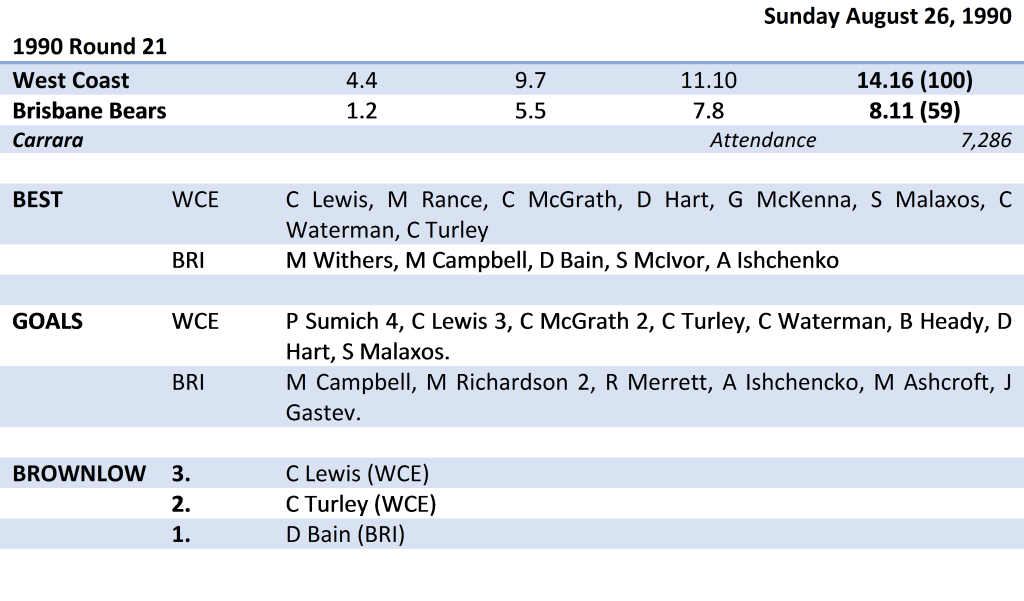
The Eagles were solid, rather than spectacular in the win, opening up a 20 point lead at the first change before going on to a 41 point result in front of just 7,286 fans at Carrara.

And while those that did come to the ground would have seen the match play out as expected between a team vying for the double chance and another team near the foot of the ladder, they were treated to one of the great individual performances of the year.

Chris Lewis had endured a frustrating start to the season when a hamstring injury and then an ankle problem restricted the midfielder/forward to just one quarter in the opening five games.

A fortnight with WAFL club Claremont built some match fitness before Lewis returned to the Eagles side, hitting his stride in the second half of the season. In ten matches from round 11, Lewis averaged 23 disposals per game and booted 15 goals as West Coast consolidated their spot in the top five.

Against the Bears in Round 21, Lewis put in a career best performance.

Running through the midfield, Lewis collected 28 kicks, 10 handballs, seven marks and booted three goals in a clear best on ground display. The Bears had no answer to the masterful showing from Lewis, who displayed his skills both in the stoppage and out in space and had a hand in creating a number of scoring opportunities.

The Eagles made a host of changes to the side that played the Bears, following their loss to the Demons a week earlier. Dwayne Lamb was forced out with a broken arm and Peter Melesso commenced his five-week suspension for stomping. The casualties from the defeat were Troy Ugle, Tony Begovich and Geoff Miles.

Into the West Coast line up were John Worsfold, who returned from serving a two week ban, Craig McGrath who was a late withdrawal the week before, as well as Scott Watters, Dean Turner and Murray Rance who forced his way into the side after six weeks in the WAFL.

The Bears made just two changes with Chris O’Sullivan and Brad Rowe replacing dropped pair Ray Windsor and Shaun Hart.

Laurie Keene made the trip with the Eagles squad as the travelling emergency, with Malthouse remaining cagey over whether the ruckman would make his return from injury. Keene had been sidelined since the second match of 1989 and even Bears coach Norm Dare predicted pre-match that Keene would be included in the Eagles side.

“I can’t believe Keene would come all this way and not play.”

Keene wasn’t a late inclusion with Malthouse giving the pairing of Dean Irving and Phil Scott a chance to bounce back from the beating they copped against Jim Stynes the week before.

And while both lowered their colours to ex-Eagle Alex Ishchenko, it mattered little as Lewis led the strong showing from the West Coast midfield. David Hart and Stephen Malaxos complemented the silky skills of Lewis with the inside grunt, while Craig Turley and Chris Mainwaring provided the linking run on the wings.

Up forward, Peter Sumich booted four goals, taking his total to 73 for the season, equalling the club record set by Ross Glendinning in 1988. However, Sumich would finish the afternoon on the bench. In only his second game back from missing a month with a hamstring, Sumich once again felt a twinge with the Eagles medical staff taking no chances on their spearhead.

Chris Lewis was sublime for the Eagles against Brisbane

For Malthouse, the defensive effort was the most pleasing aspect, having conceded 100 points in each of the previous two games.

“The idea was to restrict their scoring, which is something we’ve not done in the last two weeks. The Bears only got eight goals – that’s exactly the result we wanted.”

“They had some good runners but we were able to shut them down and we broke through their defence enough times to kick a winning score.”

Pleased with the performance of his defence, Malthouse had special praise for the returning Rance who restricted Bears full-forward Roger Merrett to just nine disposals and a goal.

“It was just about his (Rance) best game this year. Not because of how many kicks he got, but because of who he was playing on and the way he handled himself under pressure.” Malthouse went on to say it was the best game Rance had played at the club.

Rance himself tallied 15 disposals and seven marks to finish as one of the best for West Coast. David Hart relished not having a tag for the match to gather 31 disposals through the middle, while Steve Malaxos picked up 29 touches.

Guy McKenna had 25 disposals off half back, while Craig McGrath provided the perfect foil for Sumich in the forward line with 21 touches, nine marks and 2.3. Chris Waterman – who held his spot after being a late inclusion the week before – was also one of the Eagles’ best with 19 possessions, nine marks and a goal.

Mark Withers was the leading disposal winner for the Bears with 27, while David Bain and Scott McIvor each picked up 26 touches. With the Bears’ key forwards well held by the tight West Coast defence, only Michael Richardson and Matthew Campbell finished as multiple goal scorers with two each.

Bears coach Norm Dare admitted he was flat after the match believing many of his players already had their eye on the end of the season. The Bears were relegated to last on the ladder and were set for the wooden spoon, after Sydney stunned the Cats by two points at Kardinia Park.

The win kept West Coast in third, with all of the finals incumbents registering wins in the penultimate round of the regular season. Essendon stayed top, despite being jumped by Footscray. The Bulldogs opened up a four goal lead at the first change, but the Bombers had hit the front by half-time, before rolling away to a 24 point win.

That kept the Bombers a win ahead at the top of the ladder, with Collingwood putting in the most impressive performance from the top five, thrashing Fitzroy by 86 points. The Demons and Hawks kept their own double chance hopes alive with efficient wins over Richmond and Carlton.

Melbourne broke free of the Tigers with a five goal second quarter, to run out steady 36 point winners, while Jason Dunstall kicked six goals for the Hawks in their 31 point win over the Blues.

While West Coast mostly tailored through their win against the Bears, the performance wasn’t a concern for Eagles coach Mick Malthouse, pointing out the eight hour trip from Perth to the Gold Coast was an acceptable factor.

The air strike that had debilitated much of the national travel system meant West Coast had to make stops in Adelaide and then Sydney, before eventually reaching their destination in Queensland. Conditions at the ground were also tough with hot, blustery winds greeting the teams at Carrara.

“Fatigue was a big factor. It’s a long journey, it’s a big ground and we haven’t played in that sort of heat for a long time.”

“A win, is a win, is a win – and that’s all it was.”

1994 Rewind: Lewis Shines in Top of the Table Fizzer

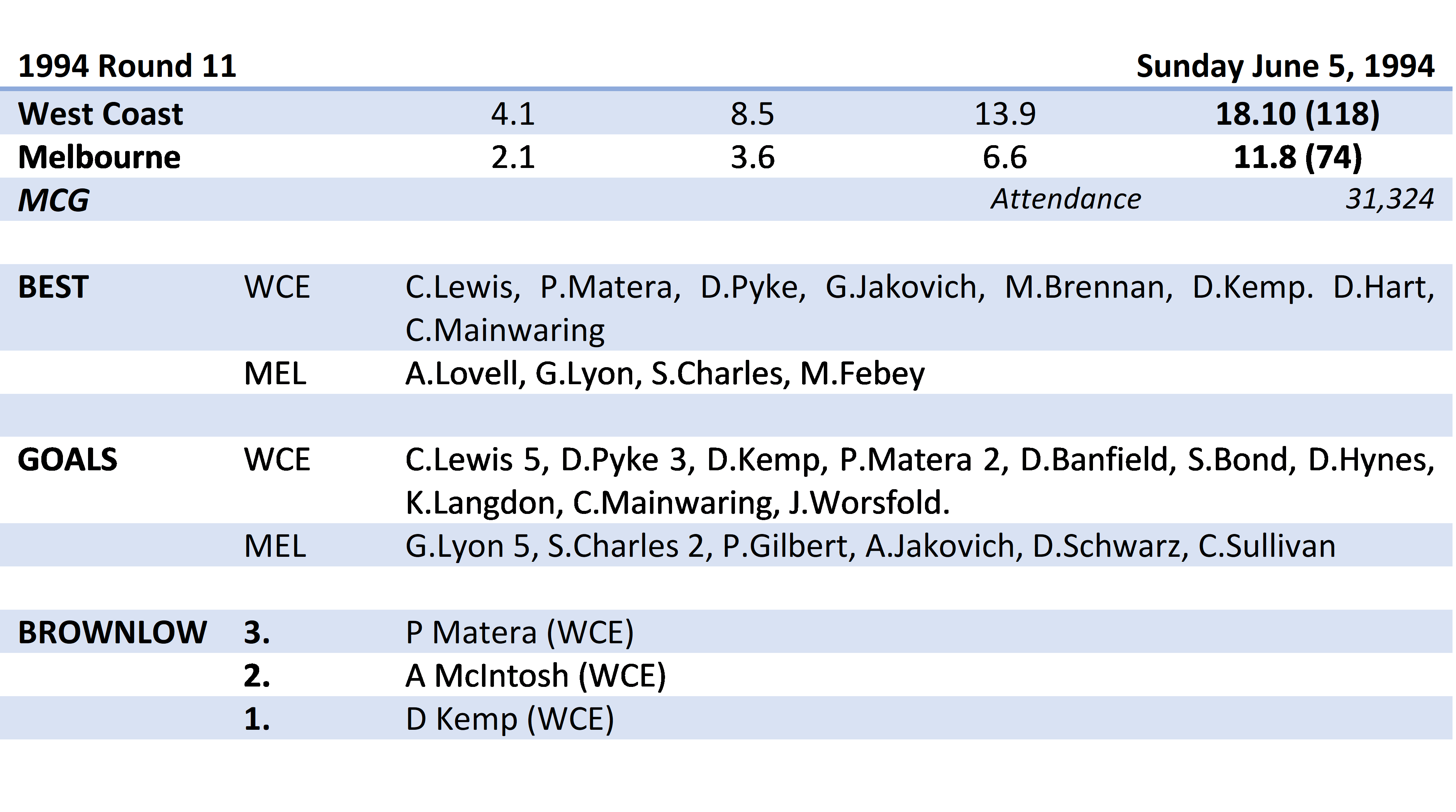
The Eagles turned a potentially intriguing top-of-the-table clash with Melbourne into a one-sided masterclass when they were too strong for Melbourne at the MCG.

The Eagles and Demons were sitting in first and second spot coming into the clash, but the strong performances of West Coast players, coupled with an excellent coaching effort, prevented the Demons from ever being a realistic chance.

The win was the Eagles’ fifth in a row, while the Demons had slumped to their fourth loss in five games, after starting the season with five straight wins.

Chris Lewis was the star for West Coast in a performance that Mick Malthouse described as the ‘best he has played in several years.”

Stationed permanently in the forward line – and operating mostly out of the goal square – Lewis was the class between the two sides, finishing with five goals (from nine scoring shots) and having a hand in several others.

With Peter Sumich once again sidelined with a hamstring injury, the Eagles were forced to experiment with their forward set up. Ashley McIntosh was swung back to the forward line, alongside Lewis, while there was also an element of the old and the new brought back into the team.

Rookie Brett Spinks returned to the forward line after being a shock omission the week before, while Karl Langdon was named for just his second game since the 1992 premiership. Injuries had restricted the blonde firebrand to just one game in 1993, with suspension then delaying his start to the 1994 season.

Langdon copped a three week ban for tripping Mark Bickley during the Fosters Cup and was then forced to bide his time at Subiaco until a spot opened up at West Coast. Langdon and Spinks were joined by half-forward Tony Evans who was playing his first game since injuring a foot in the round one loss to Essendon and second-year midfielder Jarrad Schofield.

Out of the side with Sumich, were omitted trio Jason Ball, Tony Godden and Dwayne Lamb, the latter having celebrated his milestone 150th game the week before.

After naming their initial side, there was still plenty of intrigue over the Eagles’ final team. Under recently revised AFL rules, clubs playing on Sundays were allowed to add an extra emergency player to their squad on the Friday, with West Coast curiously adding Dean Kemp to the squad, the midfielder having not played since injuring a knee in the round 7 win over Carlton.

Kemp would ultimately be a late inclusion ahead of the first bounce replacing Brett Heady. Heady had limped off the ground with a hamstring injury the previous game and was a surprise selection on the half-forward flank.  

While the Eagles played games over their playing 21, the Demons were having their own player issues. Steven Febey and Todd Viney were both named in the Melbourne line-up, despite looking incredibly proppy during the week, before Jim Stynes created a stir when he limped off the training track 24 hours before bouncedown.

Stynes appeared to roll an ankle but made it out to the field, in what was his 158th consecutive appearance. While Stynes, Febey and Viney all took their place, Jeff Hilton wasn’t as fortunate after he was another casualty at training. Hilton strained a calf and was one of two changes along with Kevin Dyson who was left out of the side despite a 24-possession, two goal effort against St Kilda the week before. Sean Charles and Glenn Molloy were the two players to come in.

After plenty of activity leading into the game, the match itself turned into a one-sided affair quickly. The Eagles ruck duo of David Hynes and Ryan Turnbull overwhelmed Stynes and the Eagles midfield capitalised on the ruck advantage.

Kemp, Don Pyke and Drew Banfield were all busy early, as the Eagles kicked four goals to two in the first quarter. Melbourne were unable to get their hands on the ball, as West Coast controlled possession and often outnumbered their opponents at the stoppages and around the ground.

With a weight of possession forward of centre, Lewis was given plenty of opportunity to show his wares. Lewis proved too elusive for Sean Wight and Graeme Yeats, finishing with his best haul in a game since round 6, 1988.

Malthouse was glowing in his praise of Lewis after the match and had a simple reasoning for his impressive outing. “He enjoys his footy now. People who enjoy their football play with that sort of enthusiasm.”

Lewis’ creativity up forward brought others into the game, with many of the Eagles’ smaller players hitting the scoreboard. Ashley McIntosh provided a solid target up forward but could manage just three behinds from 18 possessions and nine marks, but Brett Spinks and Karl Langdon both failed to have any influence.

Spinks went possession-less, registering just five hit-outs, while Langdon fared slightly better with one goal from four touches and two marks. Don Pyke and Dean Kemp combined for five goals as they alternated through the centre and half-forward, while Peter Matera kicked two goals from the wing.

Malthouse was happy with the ‘good even performance’ despite the quiet games from his tall forwards, commenting that he was happy Langdon ‘got through a game without getting injured or reported’.

Glen Jakovich was strong at half-back, getting the better of David Schwarz with 29 disposals and six marks. Don Pyke had 29 possessions through the middle to go with his three goals, while Chris Mainwaring was rampant on the wing on his way to 27 disposals, six marks and a goal.

The Demons on the other hand had few winners. Garry Lyon finished with five goals from the half-forward flank in his battle with 100-gamer Chris Waterman and Andy Lovell and Matthew Febey tried hard with 26 and 20 disposals, respectively.

Allan Jakovich – who was the difference the last time the two teams met, with six goals in an upset Melbourne victory – was well beaten by Michael Brennan, managing just six disposals before he was dragged in the third quarter and replaced by Phil Gilbert.

After the game, Melbourne coach Neil Balme was in no doubt as to where the Eagles sat in the competition. “Before the game I rated them very highly – and I probably rate them even higher now.”

While Neil Balme was declaring the Eagles the team to beat, Malthouse was looking to deflect attention elsewhere. He declared the reigning premiers, Essendon, as the benchmark of the season, despite West Coast sitting a game and 18 percent clear of 2nd placed North Melbourne.

“Essendon are the best side contrary to what Kevin (Sheedy) would like everyone to believe. They won the premiership last year and they’re going along in very much the same way.”

The Bombers were sitting seventh with six wins, but equal on points with Melbourne who held onto third place on percentage, despite the humbling defeat to West Coast. Carlton, Hawthorn and Collingwood filled the positions in between after all recording comfortable wins.

With eight wins from their opening ten games, the Eagles were one win better off than at the same time in 1993. The Eagles had recorded wins over North Melbourne and Melbourne at the MCG, as well as thumping Carlton at home. Still, Malthouse was cautious over the Eagles’ standing.

“If you gave me 8-2 at the beginning of the year I’d take it… we don’t judge where we’re going to be. We just like to be competitive and better than what we were last year,” Malthouse said.

“We’re steady at the moment. Nothing over the top. We’re steady.”