Eagles Firm For Finals

Second Quarter Burst Delivers Important Away Win

Seven unanswered second-quarter goals and a number of other favourable results all but ensured the Eagles would return to finals action for the first time in four seasons.

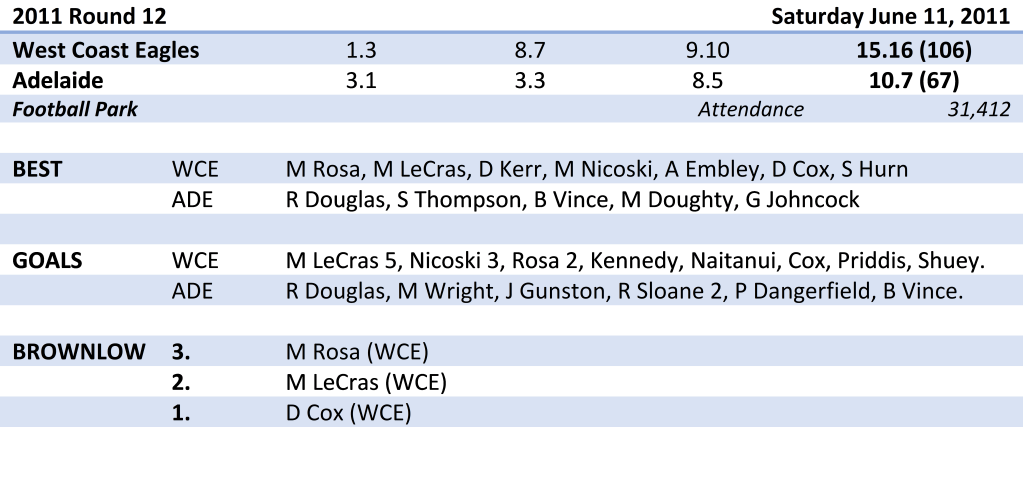
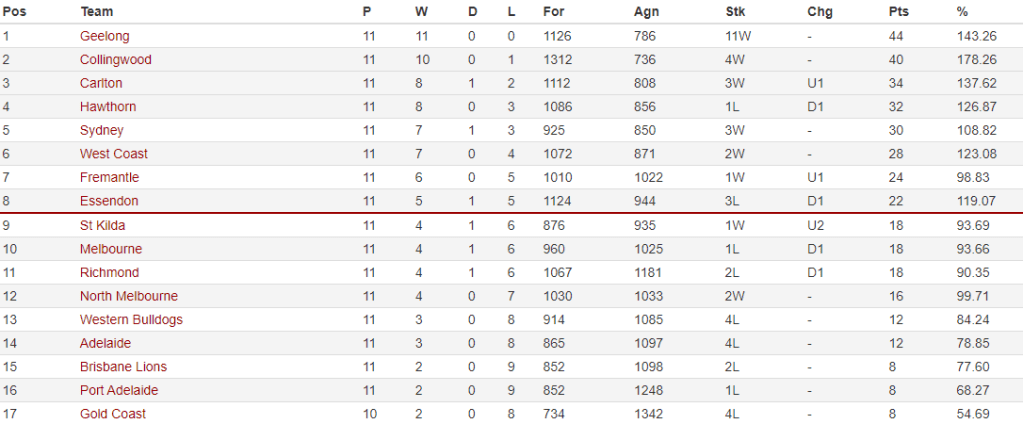
West Coast scored a 39 point win over Adelaide at Football Park and found themselves safely inside the top eight by two and a half games at the halfway mark of the season as several of the outsiders dropped important results.

Melbourne were thrashed by Collingwood to the tune of 88 points in their Queens Birthday clash while Richmond fell to a narrow ten point loss to the Swans in Sydney to harm their chances of reaching finals.

The Eagles sat sixth after 11 matches, just one game out of the top four after Hawthorn lost another narrow match to Geelong. The Hawks led by three goals at three-quarter time, but were held scoreless in the final stanza as the Cats maintained their unbeaten start to the year. Geelong booted three goals to claim the lead nine minutes into the final quarter, before the match became an engrossing battle, with the Cats recording the last four scores of the game (all behinds) to run out five point winners.

That result saw Hawthorn drop to fourth on the ladder, with Carlton leapfrogging the Hawks after the comfortably accounted for the Lions by ten goals. Fremantle reversed recent form to record an impressive 34 point win over Essendon, with the two sides swapping position in 7th and 8th on the ladder. The Dockers win was set up in the first quarter when they opened the match with a six goal to one term.

The Crows and Eagles had built a strong rivalry during the mid-2000’s, with the Eagles twice thwarting Adelaide’s flag hopes with preliminary final wins in 2005 and 2006. As West Coast dropped to the foot of the ladder, the Crows continued to be a finals challenger but in 2011 the roles had reversed.

Adelaide had won just three games for the season and were in rebuild mode, while the Eagles had surged back towards finals contention. Such had been the Crows’ performances this season, that questions had risen over the future of senior coach Neil Craig.

The commentary over Craig’s future led to Worsfold to back in his counterpart ahead of the match, having been the focus of speculation the year before. The Eagles coach questioned why many were quick to dismiss veteran coaches during bad spells, suggesting that Craig and Rodney Eade both had the capability to turn their clubs’ fortunes around in future years.

West Coast made three changes for the trip to South Australia, recalling Brad Ebert after he was banished to the WAFL a week earlier. Ebert responded with a best on ground performance for Peel to earn his spot back, with Daniel Kerr and Sam Butler both overcoming injuries to make the trip.

Brad Sheppard, Tom Swift and Andrew Strijk were the three to lose their place.

The Crows made two changes, dropping Ricky Henderson and Brad Moran in favour of Andy Otten and Shaun McKernan.

Adelaide had first use of a strong breeze, opening up a ten point lead at the first change, before West Coast maximised the wind advantage in the second term.

West Coast slammed on seven goals while the Crows managed just two behinds as the ball lived in the Eagles forward half. Mark LeCras add two majors for the term to go with the Eagles only goal of the first term to have three at the half.

Adelaide made better use of the breeze in the third term as they worked their back on the scoreboard. When Richard Douglas added a brace of goals within 77 seconds, the home side trailed by just nine points.

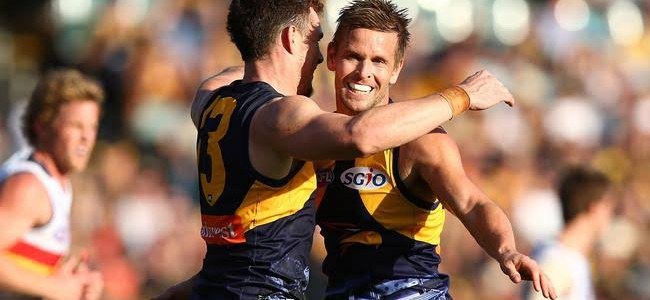
Mark Nicoski then put the match out of reach with the opening two goals of the final term as the Eagles eased away for their seventh win of the season. LeCras contributed the final two goals of the game to take his match haul to five, with Nicoski (three) and Matt Rosa (two) the other multiple goal scorers for West Coast.

In his 101st game, Rosa was best on ground, with 31 disposals, nine marks and seven inside-50s on the wing to go with his two goals. Andrew Embley (29 disposals) and Daniel Kerr (25) were proficient while Scott Selwood and Patrick McGinnity did the jobs on Scott Thompson and Richard Douglas.

The Eagles ruck pairing of Dean Cox and Nic Naitanui again controlled the tap knocks with the Eagles winning the count by 19 and subsequently the clearances by 10.

For Adelaide, running defender Graham Johncock was their leading ball winner with 26 and ten rebound 50’s, with Scott Thompson also collecting 26 disposals. Michael Doughty nullified the influence of Matt Priddis in the middle while Matthew Wright and Bernie Vince bobbed up throughout the game, but the greater spread of the Eagles ensured they would get the points.
1994 Rewind: Eagles Fall Short Against Crows

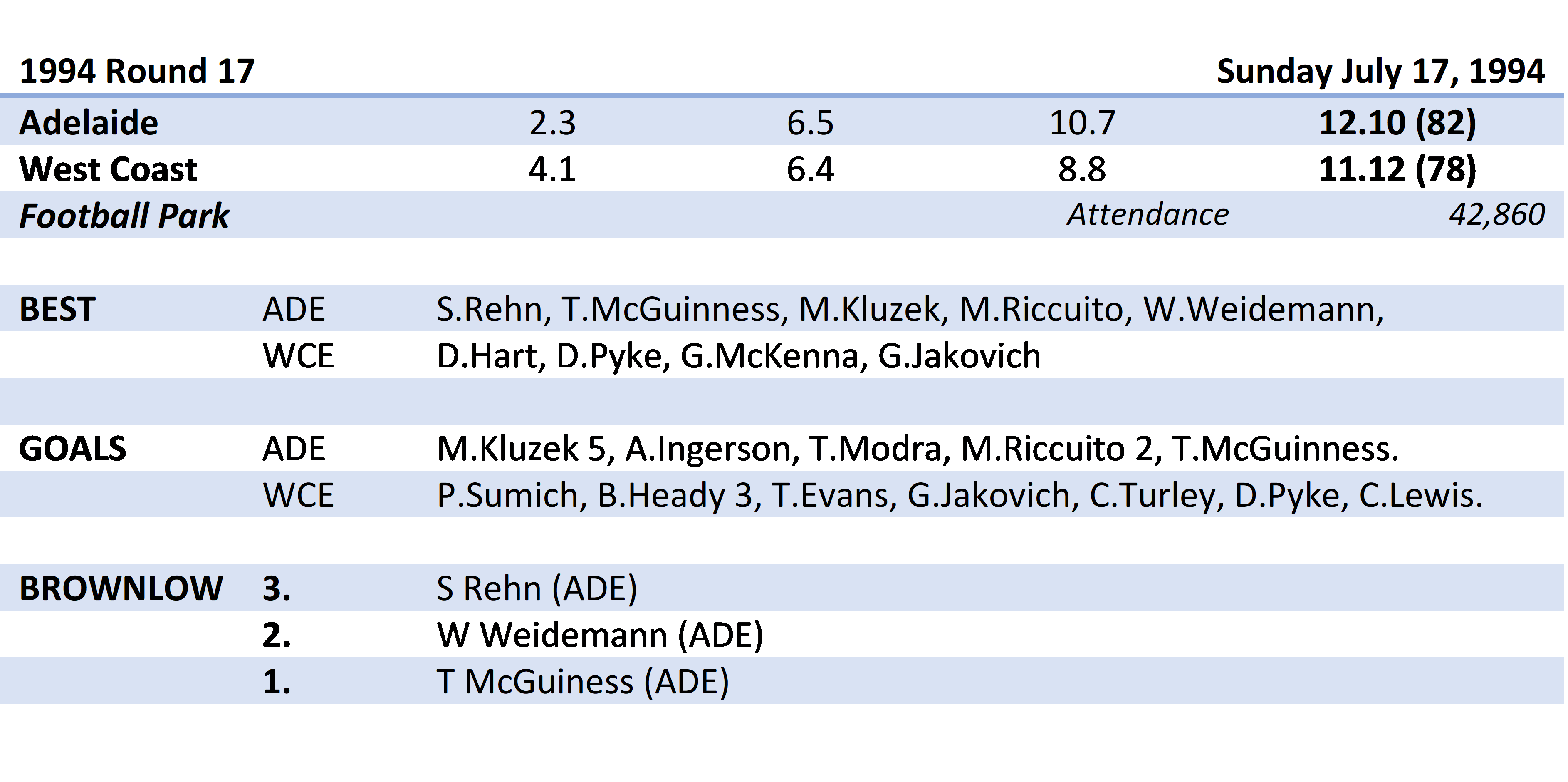
Adelaide kept their flagging finals hopes alive, while the Eagles’ grip on top spot loosened slightly, after the Crows defeated West Coast by four points at Football Park.

Peter Matera had a chance to win the game with only seconds remaining in the game, but his running shot from deep in the pocket missed narrowly, resulting in the Eagles’ fourth defeat of the season.

For the second time in five weeks, a third-gamer proved to be the Eagles undoing. Matthew Kluzek gave Chris Waterman the run-around after coming onto the ground during the second quarter when Nigel Smart limped off with a hamstring strain. The small forward booted five of the Crows 12 goals and proved a constant threat as part of a pacy Adelaide forward line.

The loss saw Carlton join West Coast at the top of the ladder after the Blues beat Collingwood in a blockbuster clash at the MCG. Carlton’s 43 point win saw them jump up to 12 wins from 16 games, level with West Coast, although the Eagles remained top on percentage. 

North Melbourne climbed back up to third when they easily accounted for St Kilda, passing the Hawks who fell to Melbourne. Like Adelaide, the Demons were able to stay in finals contention with the 38 point victory, while Footscray moved back into the top eight – at the expense of Geelong – with a 28 point win over the Cats.

Richmond climbed up to fifth on the ladder, on the back of their sixth straight win, when they defeated the Bears at the GABBA and Essendon moved to sixth on the ladder after they thrashed Fitzroy. The Magpies dropped from fourth to seventh after their loss to Carlton.

Leading into the game, the Eagles were almost unbackable favourites with the two clubs tracking different paths in 1994. While West Coast had sat at the top of the table for much of the year, the Crows had fallen well short of expectation after their preliminary final appearance in 1993.

West Coast made just one change, with Brett Spinks coming back into the line-up after being a late withdrawal the week before. Tony Godden was the player to make way. The Crows though made three changes in response to the ten goal thumping from Carlton the week before.

Andrew Jarman was ruled out with a groin injury, while Rodney Maynard and Martin McKinnon were dropped. However, McKinnon would get a reprieve before the first bounce when Simon Tregenza was ruled out with illness. Wayne Weidemann, Nick Pesch and Jonathan Ross were all brought into the Adelaide line-up.

The Eagles would have their own pre-match drama when Guy McKenna undertook a fitness test ahead of the game, after injuring an ankle at training the day before. The half-back flanker passed and was able to take his place.

The Crows got the early running with the opening two goals in the game, but things started to go awry for the home side.

Jonathan Ross dislocated a kneecap inside the first 30 seconds of the game, with West Coast taking charge of the game, mostly through the efforts of Don Pyke. The midfielder tallied 10 possessions (including a goal) and had strong support from Peter Wilson and Guy McKenna.

The Eagles finished with the final four goals of the quarter to take a 12 point lead into the first break. Tony Modra got the Crows on the board early in the second term, but Peter Sumich quickly responded. Adelaide’s injuries woes only worsened when Nigel Smart was forced out of the game, leaving the Crows with just one player left on the bench halfway through the second term.

With the Eagles holding sway, Adelaide coach Graham Cornes swung the board around and the momentum of the game changed. Chris McDermott was moved to the uncustomary role of half-back while Mark Bickley was moved into the middle onto Pyke.

Tony McGuinness broke free of the tag from Drew Banfield to provide some drive out of the middle, while Kluzek similarly got free to boot two second quarter goals. Adelaide stole a one point lead at the main break and then continued on in the third term on the back of Shaun Rehn’s dominance in the ruck.

Rehn completely outpointed Ryan Turnbull and Jason Ball in the ruck and around the ground as the Eagles struggled to win the ball at the stoppages. With Dean Kemp well held by Wayne Weidemann and Pyke and Mainwaring both having little impact after strong starts, the Eagles forward line were getting no supply.

Matt Kluzek booted a further two goals for the term as Adelaide kicked four goals to two to stretch out their lead to 11 points.

With much of his side ineffective, it was Mick Malthouse’s turn to throw the magnets around. Glen Jakovich went forward, with Ashley McIntosh moved onto Modra after Michael Brennan went off injured. Guy McKenna went to a half forward flank and Peter Matera went into the centre with Malthouse sending Kemp to McGuinness in an attempt to break the Weidemann tag.

When Kluzek slotted his fifth goal at the five minute mark of the final term, Adelaide led by four goals and the game seemed done.

The Eagles, though, roared back into the contest after Jakovich kicked a long bomb. Brett Heady and Tony Evans followed with goals and the Eagles had dragged themselves back within a goal of the home side.

But as West Coast sought a winner, they could find only behinds. Guy McKenna, David Hart and Peter Sumich all missed shots on goal, before Matera’s final chance seconds before the final siren sounded for an Adelaide win.

A relieved Cornes hailed his side’s victory in the face of a growing injury list. Cornes had been under immense pressure in recent weeks, with speculation he was likely to be out of a job if Adelaide failed to make finals, but for the moment the Crows coach was happy to just to get some self-belief back at the club.

“Coaching the Crows is like riding a roller coaster when we win the crowd go overboard and when we lose they can be very unforgiving. The emotional highs and lows are unbelievable,” Cornes said.

The Crows had been well served by veterans Chris McDermott and Tony McGuinness who finished with 33 and 32 disposals respectively, while younger midfidlers Mark Bickley and Mark Riccuito were also influential.

Riccuito chimed in with two goals, along with Modra and Anthony Ingerson as multiple goalscorers behind Kluzek. Shaun Rehn was a clear best on ground with 21 disposals, 10 marks and 31 hit-outs.

David Hart finished as the leading ballwinner for West Coast with 25, while Pyke, Mainwaring and Wilson all tallied 21. Peter Sumich and Brett Heady each booted three goals, but West Coast lacked any genuine winners up forward.

A circumspect Malthouse admitted that it would have been the ‘steal of the season’ if West Coast had gotten over the line, in what was his 250th game as coach across both Footscray and the Eagles.

“We were out-muscled, out-played and beaten badly by a very talented football side. To be undermanned and then lose a couple of players and still win… they’re going to be a real threat.”

“They were terrific, they were far too good for us,” Malthouse declared.

Reflecting on his milestone, Malthouse acknowledged the journey his coaching career had taken.

“… I suppose reaching 250 (games) makes you think you’ve been around a fair while. There have been ups and downs and probably more downs than ups, but it has been great to be involved.”