2011 Rewind: Eagles Cruise Past Crows

Simple Tune-Up For West Coast as Magpies Await

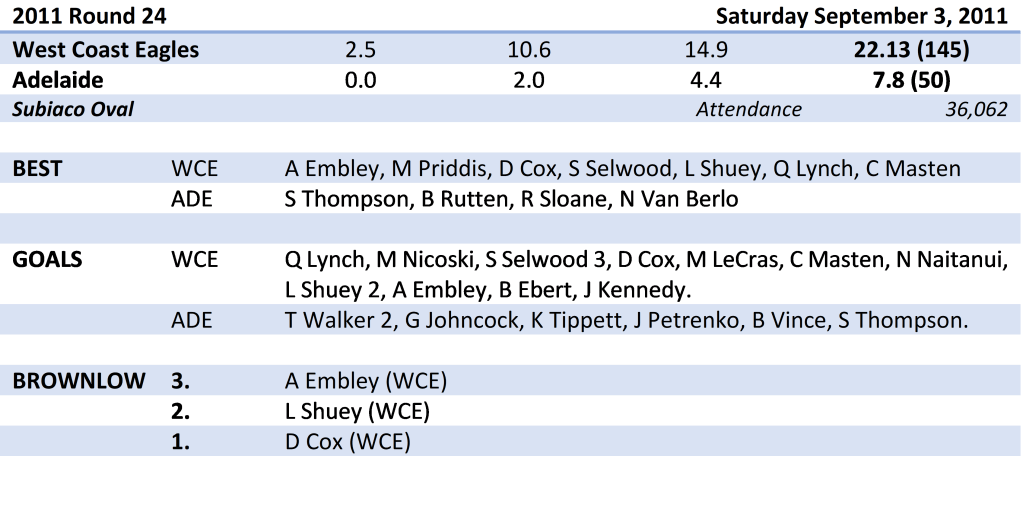
The Eagles wrapped up their 2011 home-and-away campaign with an effortless 95 point win over an uninterested Crows outfit, as they shifted their focus to finals action.

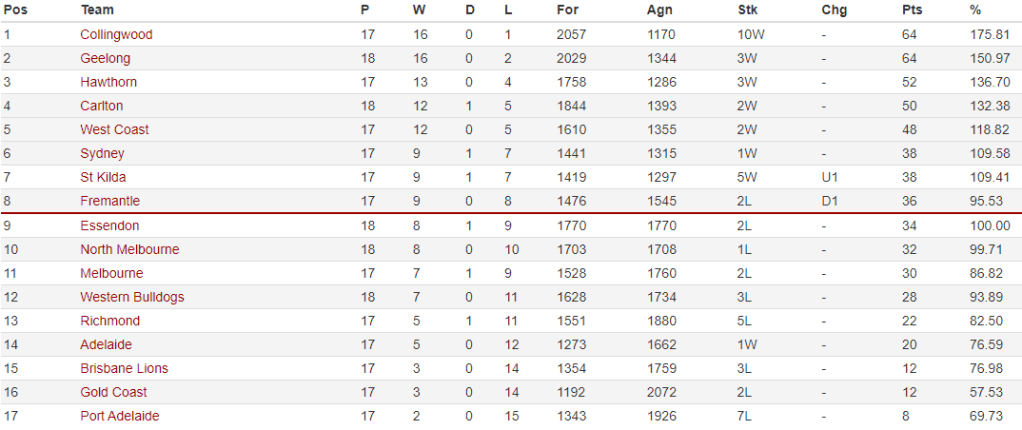
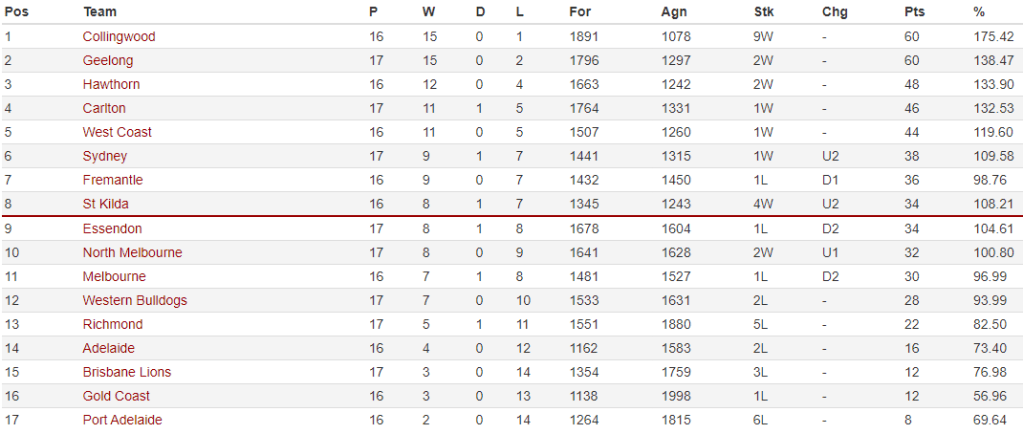
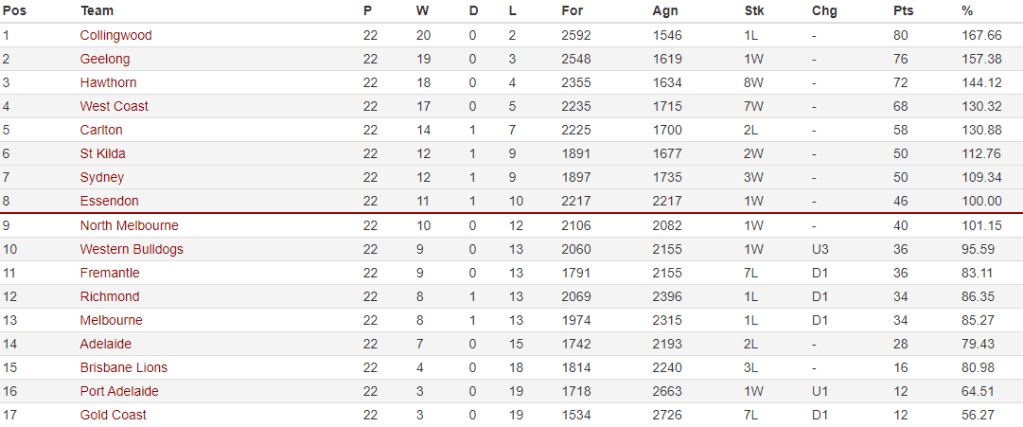
The win was West Coast’s 17th of the season – equalling their record from the grand final and premiership seasons of 2005 and 2006. However, while they had finished in the top two in each of those years to secure multiple home finals, a 17-5 return was only good enough for fourth position in what finished as a lopsided ladder.

The Magpies claimed the minor premiership and were the Eagles’ next opponents, but the reigning premiers suddenly looked vulnerable after being humbled by Geelong by 96 points. The top-of-the-table clash soon became a fizzer as the Cats steamrolled Collingwood, highlighted by a ten goal second quarter.

The defeat was just Collingwood’s second of the season – both of which had come against Geelong – but the invincibility that had surrounded the Magpies for much of the year was starting to wear off as injury and off-field issues affected the back end of Collingwood’s season.

While the Eagles were expected to start as distant outsiders in the qualifying final, the Eagles were as well positioned as they could expect to be. There were no late complications ahead of the finals series as Adelaide offered little competition.

Jack Darling returned after two weeks sidelined with injury, with Sam Butler the other inclusion in a somewhat controversial selection. With defender Will Schofield expected to miss just the one week after fracturing a cheekbone against the Lions, it had been anticipated that premiership players Brett Jones would earn a game ahead of his likely retirement at seasons end.

However, Worsfold opted against the sentiment bringing Butler back into the side after recovering from a groin strain. Ashton Hams was the other change, losing his place to Darling.

The Crows made a host of changes for their final game of the season with Jack Gunston (shoulder), Andy Otten (concussion) and Brodie Martin (groin) all out with injury. Aiden Reilly was dropped with Ian Callinan, Richard Tambling, Ricky Henderson and Michael Doughty all brought into the side.

The signs were early that the Crows wouldn’t be able to match West Coast and they set about minimising the damage.

For a quarter it worked as West Coast bombarded their forward 50 arc for little reward. Brad Ebert and Mark Nicoski both kicked majors, but the home side were mostly frustrated as the Crows bunkered down.

On the flip side, the Crows were no chance of scoring as they looked to just exit out of their back half, but the Eagles backline just sat back and racked up the possessions as Adelaide players continually kicked the ball to them. Butler had 12 disposals for the term in his return game, Adam Selwood had 11 and Beau Waters 7.

Leading by 17 points at the first change, Nic Naitanui goaled inside the first minute of the second term as West Coast broke the Adelaide shackles. Kurt Tippett registered the first Adelaide score a few minutes later, but West Coast finished with seven of the last eight goals in the term to break the game apart and head into the major break with a nine goal advantage.

The second half was purely going through the motions, but another eight goals in the final term ensured West Coast would finish the regular season in emphatic fashion. Chris Masten added a second goal late in the game to take the Eagles lead into triple figures, but Adelaide avoided a 100 plus point loss in Mark Bickley’s final game as caretaker coach thanks to a late Taylor Walker goal.

West Coast posted 22 goals for the match, but pleasingly their strong offensive performance came despite a quiet showing from full forward Josh Kennedy. Kennedy managed just one goal from eight disposals and one mark as he was well held by Ben Rutten.

Instead eight Eagles managed multiple goals in the game, with Quinten Lynch, Scott Selwood and Mark Nicoski leading the way with three each.

After being restricted to just a handful of possessions the week before by Brisbane tagger Andrew Raines, Andrew Embley bounced back with a strong performance on the wing. Embley was the Eagles’ best with 33 disposals and eight inside 50s providing plenty of run on the outside. Inside the contest, Matt Priddis did much of the heavy work with 12 clearances from 23 possessions, while also laying 13 tackles.

Adam Selwood (28 disposals), Chris Masten (27, 7 clearances & 2 goals), Luke Shuey (25, 2 goals) and Quinten Lynch (22 & 7 marks) were all proficient as the Eagles dominated in most areas. West Coast recorded 23 more inside 50s in the game (59-36), controlled the clearances (60-43) and even with the huge margin still managed to lay more tackles than their opposition (79-65).

The Crows offered little, with Scott Thompson flying a lone flag in the middle of the ground. Thompson finished as the leading ball winner on the ground with 40 disposals and a goal with minor support from Nathan Van Berlo and Rory Sloane.

The only disappointment for the Eagles was a hamstring injury to Ashley Smith that saw the running defender subbed out during the second term with Andrew Gaff coming on. It was the sixth time this season that Gaff had started the game with the green vest.

Smith was set to be the only ill bill of health for West Coast, with Daniel Kerr, Matt Rosa and Schofield all set to be available for the first final against Collingwood.

While the Geelong-Collingwood result sent a shockwave through the competition, the rest of the fixtures essentially went as expected. Hawthorn held onto third place despite being pushed to the edge by lowly Gold Coast. The Hawks made 10 changes for the match as they openly focused on their first final against Geelong, and the reinforcements did what they needed to do in a nine point win.

The only finals match up that wasn’t know heading into the final round centred around sixth and seventh. While St Kilda and Sydney knew they were playing each other, the Swans could still pass the Saints and claim a home final, if the Saints couldn’t claim a win against the fifth placed Blues.

Sydney did what they needed to do, easily defeating Brisbane, but the Saints ensured the final would be played in Victoria, when they came from behind to beat Carlton by 20 points. The Blues led by 11 points at half time and extended their lead to 18 early in the third quarter when Zach Touhy goaled. However the Saints booted seven of the next eight goals to hold their position of sixth.

The Bombers rounded out the top eight, safe in the knowledge they would make the finals despite having a bye in the final round. Essendon were set for a blockbuster first week match up against Carlton, who similarly, were sure of completing the season in fifth.

The only other interest in the round came at the foot of the ladder where Port Adelaide were able to escape the wooden spoon with a dramatic eight point win over Melbourne. The Suns were relegated to last on the ladder in their debut season, with the Power recording their third win of the season in a historic match at the home of the SACA.

Following extended negotiations between the SANFL and SA Cricket Association, the Power were able to secure the first game played at the Adelaide Oval for premiership points in the AFL competition, marking the occasion with an entertaining eight point win over the Demons in front of nearly 30,000 fans – the largest non-Showdown home crowd they had had in over 18 months.

But for West Coast, attention now turned to September action for the first time since 2007 and they were set to play the team they last played in a final in Collingwood. With a double chance and a guaranteed home final in either the second or third week of the finals, the Eagles were riding the wave of momentum and the public sentiment towards a fairytale finish.
2011 Rewind: Eagles Continue Demon Misery

McGinnity Charge Overshadows Melbourne Win

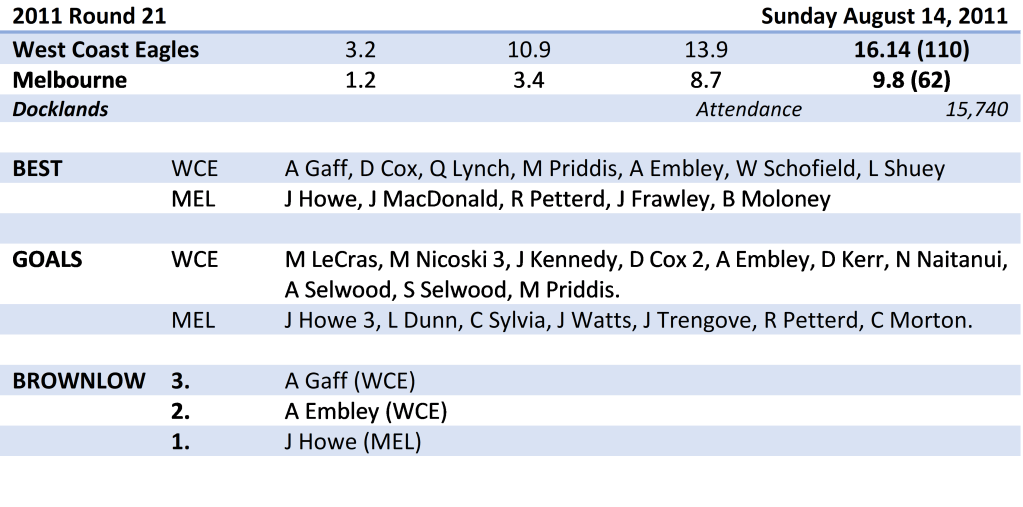
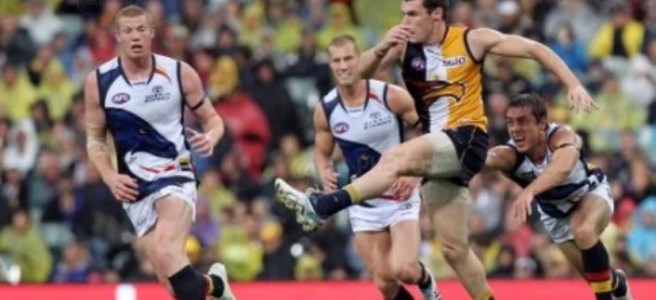
West Coast continued to stalk the Blues and the Hawks in the top four, with a comfortable 48 point win over Melbourne at Docklands.

The Eagles recorded their fifth away win of the season – one more than they had managed home and away in 2010 – off the back of a seven goal second quarter that put the dysfunctional Demons out of the game by the major break.

Despite being still mathematically in the hunt for finals, the Demons had endured a horror three-week period that had seen them fall to 54, 186 and 76 point defeats, part ways with senior coach Dean Bailey, before enduring renewed backlash over their previous season performances when Bailey suggested following his sacking that the club had tanked for priority draft picks.

After making a host of changes at selection during the week, the Demons then lost Brad Green on the morning of the game. Green joined Jake Gysberts and James Strauss as casualties, while young ruckman Max Gawn and midfielder Matthew Bate were dropped. Into the Melbourne side came Colin Sylvia, Sam Blease, Cale Morton and Mark Jamar.

Like Melbourne, the Eagles also went into the game without their skipper with Darren Glass spared the trip east due to soreness. Matt Rosa was sidelined with a knee injury, while Chris Masten was a surprise omission despite coming on as the injury substitute for Rosa the previous week, tallying 12 disposals in little over a quarter.

Instead the Eagles recalled Ashton Hams for just his second game of the season, with Eric Mackenzie and Josh Kennedy obvious inclusions returning from injury. With vice-captain Beau Waters still not considered ready for senior action, Dean Cox was instilled as captain despite being under an injury cloud for much of the week.

Cox was hampered by a knock to his hip early in the Eagles last game against Richmond and failed to train in the lead up to the clash with Melbourne. However, West Coast coach John Worsfold said they wouldn’t follow the lead of Geelong and Collingwood and rest players ahead of the finals.

Despite starting as outsiders, the Demons started the game with much more purpose than the visitors. Jeremy Howe kicked the opening goal after ten minutes, but for the Demons that would be their only scoreboard joy until time-on of the second term.

In that time, the Eagles had slammed on eight majors with Howe ending the run with his and his side’s second goal. Mark LeCras and Mark Nicoski each added two goals during the run as the Eagles midfield were all over their counterparts.

Andrew Gaff continued his impressive late season form with 10 disposals in the second term, and 15 for the half, with Luke Shuey and Andrew Embley each tallying eight disposals for the second quarter. As good as West Coast were for the quarter, the Demons were equally bad.

The exuberance they showed in the early stages of the game were long gone, with senior players in particular guilty of giving up possession either through poor use of the ball or ill discipline. Nearly half of their kicks in the first half were either ineffective or clangers, with the Eagles capitalising.

Leading by 47 points at half time, the Eagles continued their recent trend of dropping off in the third term to allow the Demons to close within five goals with a quarter to play. Worsfold referenced the Bermuda Triangle post-match when discussing the drop off immediately after half time, but the Demons followed the lead of the Bulldogs a fortnight earlier.

The Demons opted for a man-on-man style in the third quarter and looked to maintain possession and deny the Eagles ball. Melbourne recorded 47 more disposals for the quarter with Brent Moloney (12 disposals) and Sam Blease (10) proficient. Colin Sylvia managed just four touches in the first half, but sparked the Demons mini-revival with nine disposals and a goal in the third term.

However, that would be Melbourne’s best shot for the day.

West Coast muted their momentum in the final term and after a 15 minute stalemate where neither team could find the big openings, stand in captain Dean Cox kicked the vital goal that snuffed out any chance of a Demon comeback.

The Eagles added three goals to one to essentially restore their half time lead, with Josh Kennedy and Dean Cox for a second time, hitting the scoreboard.

Worsfold was expectedly pleased with the result, but again refused to entertain the discussion around the clubs return to finals. “We don’t talk about it (finals), we’re focused on improving the way we’re playing. We had patches today that were pretty average and we want to keep improving.”

“I’m sure they (the players) might be striving for (finals) but… we play a very good team this week, so that’s our immediate focus,” Worsfold said.

“In three or four weeks we’ll know what the ladder looks like. There’s still plenty of football to be played, a lot of games.”

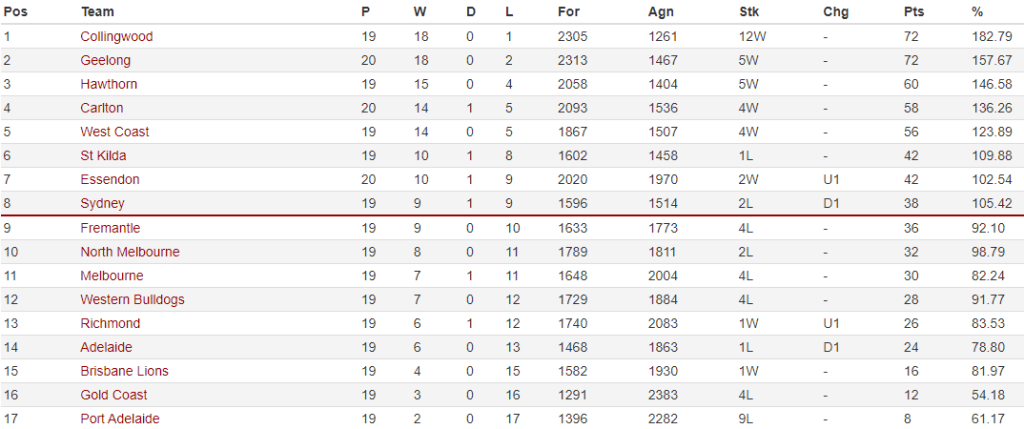
While Worsfold remained deadpan about the Eagles positioning at the end of the season, the Eagles continued to firm for a top four finish. West Coast remained two points behind the Blues, with a game in hand, and weren’t expected to drop their final three games against Essendon, Brisbane and Adelaide.

As had been the case the previous three rounds, the top five sides all won with the gap building between them and the rest of the competition. The Eagles were three and a half games clear of St Kilda in fifth spot with another string of one-sided results.

AFL Chief Executive Andrew Demetriou denied that the competition lacked competitiveness, but a second consecutive thrashing of Port Adelaide must have had those at AFL House worried. A week after copping a 138 point pasting at the hands of Collingwood, the Power were comprehensively whacked by Hawthorn to the tune of 165 points.

The Hawks fell three points short of notching 200 points scored, with Lance Franklin (eight) and Cyril Rioli (six) contributing 14 goals between them. Brisbane recorded a ten goal win over new rivals Gold Coast in a battle of the cellar-dwellers while Essendon accounted for the Bulldogs by 49 points.

The two leading sides were both forced into strong battles with their opposition, but like they had most weeks, still found a way to come out on top. The Magpies ended the Saints’ six game winning streak with a 19 point win. In the highly anticipated clash between last year’s grand finalists, Collingwood got the early jump in the opening term and maintained their lead throughout.

Geelong were given a scare by lowly Adelaide who threatened to steal the game late. After Adelaide controlled the game early, the Cats got separation with six of the seven goals heading into half time. Early in the final term, Geelong led by four goals, but the Crows kept coming. Adelaide closed within a kick as the game entered time-on, but the Cats steadied for an 11 point win.

Richmond threw a spanner in the works for Sydney when they produced an upset 43 point win at the MCG. The result saw the Swans drop to the edge of the top eight, but they were able to maintain their position courtesy of the Dockers’ 30 point defeat to Carlton and the Kangaroos serving their second bye.

The defeat made it 12 losses in a row for the Demons at Docklands and while their season was petering out to a nondescript end, there was still plenty to be gained according to stand in coach Todd Viney. Viney believed the Eagles’ 2011 season gave many other clubs hope that their fortunes could be turned around quickly.

“It’s a great story that you modify your game plan, you keep tinkering with it, you keep persisting, you keep positive and you can turn things around,” Viney enthused.

“It’s amazing, their turnaround. They are fighting for a top four spot.”

While Worsfold refused to acknowledge finals, he did believe that the Eagles had earned back the respect of many within the AFL competition after three years of poor off-field and on-field performances. “I would expect so. I suppose it depends on whether you are talking about respect from opposition teams or the footballing public. I’m sure its happened.”

Gaff finished with 33 disposals to lead the Eagles, ahead of Matt Priddis (26, 11 tackles) and Andrew Embley (25, five inside 50s). Dean Cox stood tall through the second half to collect 17 disposals along with 21 hit-outs, seven clearances and two goals.

Mark LeCras and Mark Nicoski each booted three majors, while for just the second time, Adam and Scott Selwood each contributed goals in the same game. It would be the second quirky record for Adam on the day after he and Troy earlier moved up to equal fourth on the list of games to be played by twins. The pair had now combined for 227 games total (Adam 152, Troy 75) to join Ryan and Nathan Lonie.

The post-script to the fine win was a one week ban handed down to Patrick McGinnity following an unsavoury incident on half-time. McGinnity was referred directly to the tribunal for violating the AFL’s respect and responsibility policy for comments direct towards Demon player Ricky Petterd.

McGinnity was overheard telling Petterd that he would ‘rape his mother’ after Petterd had earlier threatened to kill him during a brawl at the half-time break involving a host of players. An investigation was launched after an umpires report following the game with several officials hearing the comment.

AFL CEO Andrew Demetriou condemned the comments, labelling them ‘totally disgusting’ while operations boss Adrian Anderson applauded Petterd for reporting the incident. His praise came in direct contrast with McGinnity’s player manager David Sierakowski, who believed the exchange should have remained on the football field and not been brought to public light.

McGinnity would later release a statement apologising for his actions, accepting the one match ban plus a $2,500 fine. Eagles chief executive Trevor Nisbett was also critical of McGinnity’s actions saying the club expected better from their players and that his words did ‘not reflect the values of our football club.’

Cox: From Unlucky Villain to Dependable Hero

Eagles Outlast Another Comeback Attempt

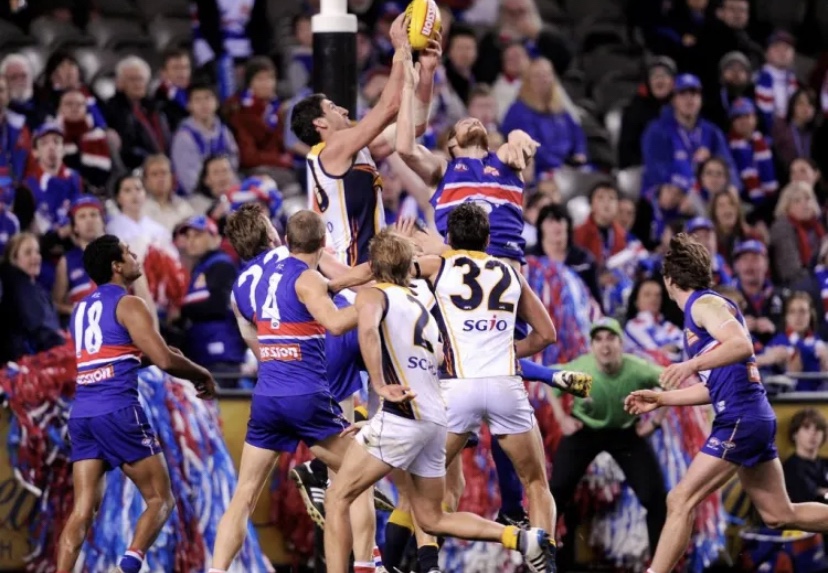
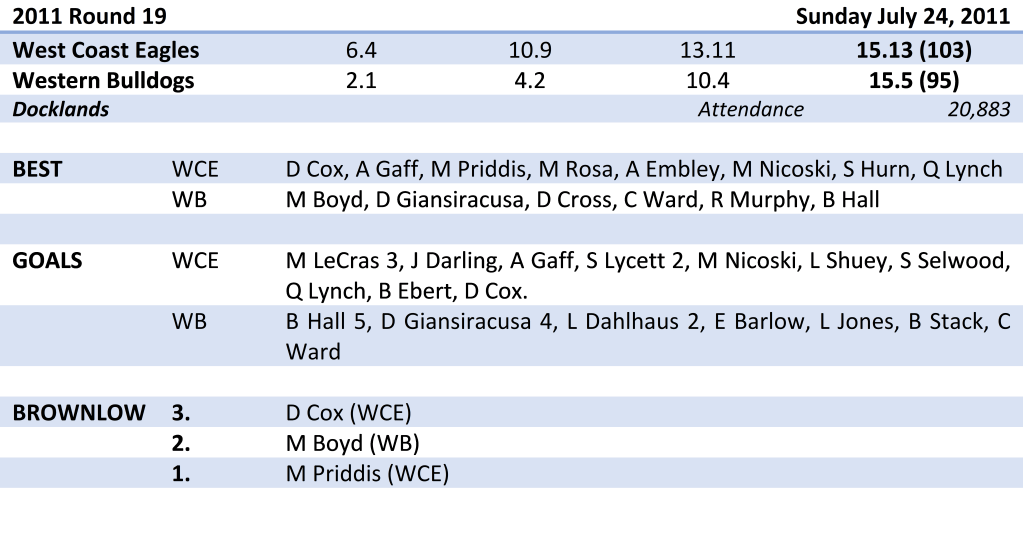
A week after claiming a derby win over Fremantle by the barest of one-point margins, the Eagles again snuck past the line when they recovered from a remarkable Bulldogs comeback to record an eight point victory at Docklands.

The Eagles led by 43 points at half-time and extended their lead to 50 by the ten minute mark of the third quarter, before the Bulldogs piled on 11 of the next 13 goals to take the lead heading into time-on in the final quarter.

Facing a potentially humiliating defeat, West Coast were able to settle and kick the final two goals of the match, with Dean Cox booting the sealer with just a minute to play.

Cox shortened his Brownlow odds with a comprehensive best on ground display that saw the Eagles ruckman control the ruck to set up the Eagles lead in the early part of the game, before taking important marks at either end of the ground with the result on the line.

His performance would have gone some way to easing the burden of guilt he would have felt going into the game after playing the villain in a bizarre accident during the week.

The Eagles’ selection plans were thrown asunder after full-forward Josh Kennedy was forced to withdraw from the game due to an eye injury courtesy of a stray tennis ball. Kennedy suffered bleeding behind the eye which was set to rule him out for a fortnight, with Cox later acknowledging he had been responsible for the incident.

Kennedy had booted a personal best ten goals in the previous meeting between the two sides earlier in the year when West Coast made their biggest statement of the season with a 123 point thrashing of the Bulldogs.

Kennedy’s unavailability was compounded with the omission of Nic Naitanui who was rested. Naitanui had carried a shoulder injury for much of the year, with the Eagles believing the week off would be beneficial ahead of a finals campaign.

That opened the door for the Eagles’ third selection of the 2010 draft, Scott Lycett, to make his debut. The young ruckman was selected with the 29th pick of the National draft and completed the highly touted triumvirate of players that were seen to be the future of the Eagles. Tom Swift joined Lycett as the other inclusion for West Coast.

The Bulldogs, on the other hand, moved nearly a third of their side as they looked for the combination that could keep their season alive. After reaching the preliminary final of the previous three years, the Bulldogs had fallen off the pace in 2011, sitting a game and a half outside the top eight with five matches to play.

Dylan Addison, Lukas Markovic, Jarrod Grant and Lindsay Gilbee were all dropped after the defeat to Sydney, while the Bulldogs also lost Adam Cooney, Shaun Higgins and Nathan Djerrkura to injury.

Robert Murphy returned from injury and Justin Sherman was recalled after serving a four game suspension for racially abusing young Gold Coast player Joel Wilkinson. Ed Barlow, Jordan Roughead, Brennan Stack, James Mulligan and Ryan Hargrave were the other players brought in before Jayden Schofield became inclusion number eight when Dale Morris was forced to withdraw before the opening bounce with a groin strain.

Lycett started in the goal square for the Eagles and he couldn’t have asked for a better start to his AFL career, kicking a goal with his first kick after just 47 seconds.

Twenty minutes later, the Eagles had six goals on the board and had opened up a 33 point lead. A late Daniel Giansiracusa major cut the Eagles lead to 27 at the first break, which was short of what West Coast deserved. Such was the dominance around the ground in the opening stanza, the Eagles finished the quarter with 52 more disposals, 12 more contested possessions, eight more marks, 27 more handball receives and six more inside 50s.

Five of the Eagles’ six goals for the term came from direct from the stoppage as Cox was superior.

West Coast continued on with their momentum after quarter time with Scott Lycett bagging a second goal in his debut. Andrew Gaff, Dean Cox and Matt Rosa all had 16 disposals in the first half, while Matthew Boyd and Daniel Cross were doing the best they could for the Bulldogs with 14 and 10 disposals, respectively, in the second term.

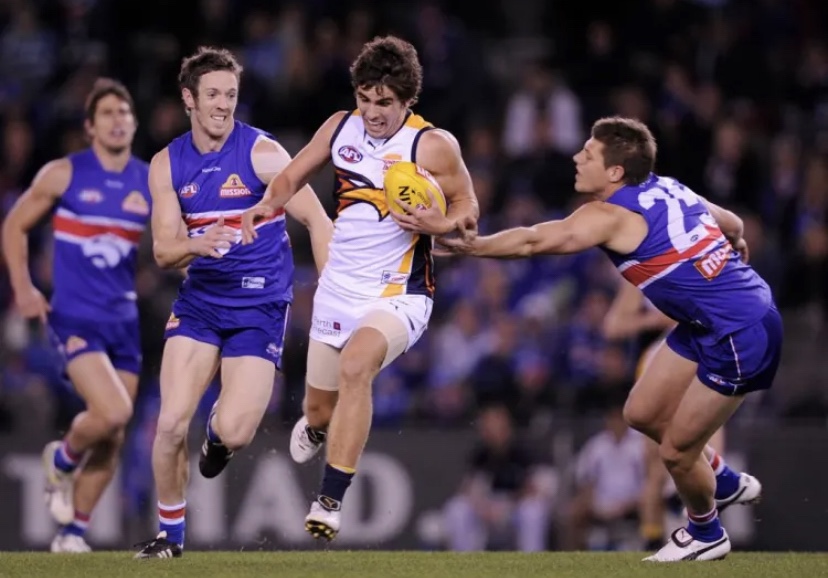
Andrew Gaff led the Eagles through the game with 31 disposals and two goals

Luke Shuey opened the scoring in the third term with the Eagles’ 11th goal and at 50 points up, the game appeared to be in the Eagles control.

But with their season clinging to life support, the Bulldogs found something through their experienced leaders as Barry Hall asserted himself up forward. Hall booted the first two goals of an amazing run that saw the game completely flip on its head.

For the first two and a half quarters, the Bulldogs had tried to match the Eagles forward press with counter attack that repeatedly came unstuck. Midway through the third term, Eade instructed his men to go man-on-man, and the bigger bodies of the Bulldogs started to bully the younger Eagles.

Matthew Boyd, Daniel Cross, Callan Ward and Daniel Giansiracusa all got busy at the stoppages as the Bulldogs had all of the forward play and conjured up goal after goal. The Bulldogs restricted the Eagle lead to 19 points before Mark LeCras bobbed up on the brink of three-quarter time to give the Eagles some space.

It would prove only a moment of respite as the Bulldogs continued on their way at the start of the final term. Barry Hall added two more goals, either side of a Callan Ward major to have the Bulldogs within a kick. Giansiracusa then booted his third goal of the game to bring the Bulldogs level and then after eight tense minutes, his fourth put the Bulldogs in front for the first time in the game.

For all their efforts in the game, the Eagles looked done but they mustered up some final heroic moments, led by their star ruckman.

Cox took back control in the ruck and with the Bulldogs continuing to press, he placed himself behind the ball to stall the Bulldogs momentum. Jack Darling belied his 17 games of experience to deliver a clutch goal and bring West Coast back to parity, with behinds to Andrew Embley and Mark LeCras inching the Eagles back ahead.

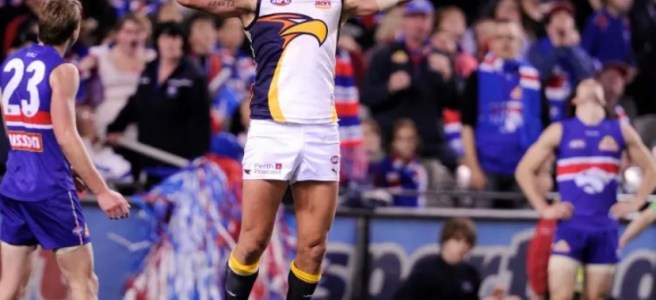
With the game now on the line, Cox had the final say in the game taking a strong pack mark at the top of the Eagles goal square to ice the game.

The Eagles ruckman finished with 27 disposals, 13 marks, 37 hit-outs, 11 contested possessions, four clearances and the sealing goal in a clear best on ground performance. Six of Cox’ 13 marks were contested – just one less than the Bulldogs managed as an entire team.

Dean Cox takes a towering mark in the goal square to seal the game for West Coast

Andrew Gaff and Matt Priddis were the leading ball winners for the Eagles with 31 each, with Gaff adding nine inside 50s and two goals, while Priddis produced nine clearances to go with 14 tackles. Matt Rosa continued his strong first half to end with 30 possessions, while Mark LeCras was the best forward up front with three majors.

Matthew Boyd was a presence all day for the Bulldogs to pick up 40 disposals, with 11 clearances. Robert Murphy was the next best with 26 disposals and then Giansiracusa with 22 and four goals. Barry Hall kicked five goals as he got a handle of Glass and Mackenzie up forward.

Eagles coach John Worsfold was obviously relieved to come away with the win after the Eagles gave up a large margin. “Well, we were pretty pleased to win, we came here to try and win the game. So that was our number one focus.”

Worsfold acknowledged that his side struggled to adapt with the change in style from the Bulldogs, who he said ‘tackled harder and were prepared to get in and win the loose ball’. But Worsfold also praised his team for being able to respond when they fell behind.

“That’s another part of showing where they’re at and even getting behind and making sure they just kept grinding away and doing enough to grab the win.”

The defeat all but ended the Bulldogs’ finals hopes as they fell two games and percentage behind the Dockers who were occupying eighth spot. While the Bulldogs were no longer considered contenders, the race for the top eight was still very much on after Fremantle were thrashed by Hawthorn at home. The Dockers gave up the first eight goals in the game and were never likely from that point on.

The Hawks maintained their hold of third sport, ahead of Carlton who had to do things the hard way in their come-from-behind win over North Melbourne. The Eagles win kept them in the hunt in the top four, but ultimately confirmed the race for the double chance would be a race in five as they skipped two and a half games clear of Sydney in sixth place, who had the bye.

St Kilda’s late season resurgence continued with a 20 point win over an inaccurate Gold Coast as the teams vying for finals all stumbled.

As well as North Melbourne and the Bulldogs, Essendon were thrashed by Collingwood in a rollercoaster match. After the two teams traded the first eight goals, the Bombers booted the next five either side of quarter time to lead by 30 points early in the second term.

However, Collingwood then orchestrated a remarkable 104-point turnaround with 21 of the final 26 goals in the game to run out 74 point winners. But even that performance wasn’t the most outstanding of the weekend.

Geelong fell just four points short of the greatest winning margin in VFL/AFL history as they destroyed Melbourne by 186 points at Kardinia Park. The Cats had established a 114 point lead by half time, “easing off” in the second half as they sauntered their way to the heavy win.

Steve Johnson booted seven goals from 34 disposals, Tom Hawkins kicked five, Joel Selwood tallied 43 disposals and 15 Geelong players picked up 20 touches or more as the Cats racked up 510 for the match – 230 more than the Demons.

The fallout from the game would continue in the days to follow with Melbourne coach Dean Bailey becoming the second senior coach this season to be given the axe.

Eagles Taken To The Line

Centremetres in it as Eagles Survive Late Docker Comeback

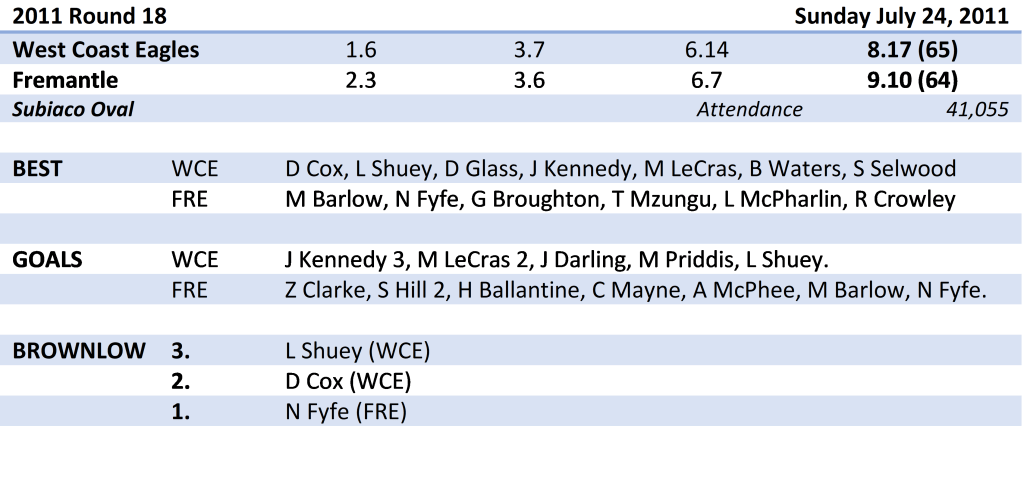
West Coast held on for a one point victory in one of the most gripping Western derbies seen between the Eagles and Dockers.

Fremantle goalsneak Hayden Ballantine had the chance to steal the unlikeliest of wins for the Dockers after the siren, with his long range effort from the boundary unable to clear the hoard of players positioned on the Fremantle goal line.

The result had important top eight implications for both teams, with the fine line in finish and margin keeping the Eagles in control of their top four destiny, while leaving the Dockers at the mercy of the chasing teams looking to force their way into September qualifications.

A win to Fremantle would have seen them join level with the Eagles on ten wins, but instead West Coast were able to open up a two game break on their closest rivals and keep the pressure on Carlton and Hawthorn for the double chance.

The frenzied finish belied the match and much of the build up as the two clubs remained cagey over their line ups.

Nic Naitanui and Jack Darling both failed to train during the week suggesting they could miss, while the Dockers were surprisingly touting the prospect of ruckman Aaron Sandilands returning despite a recurrence of a toe injury just three weeks earlier.

Mark Harvey then lit a fuse at the customary joint pre-match press conference between the two coaches when he declared the Dockers wouldn’t be caught out by West Coast as they had in the previous meeting earlier in the season.

Harvey suggested the Eagles had been ‘leaked intelligence’ before the match, which West Coast won by 33 points despite losing Daniel Kerr and Andrew Embley in the hour before the match. Further pressed, Harvey intimated the Eagles had gained information on personnel and planning which had aided them in claiming the win. Harvey was defiant in that the Eagles wouldn’t be able to rely on such assistance this time around.

A bemused John Worsfold added nothing to the accusations, other than to say he wasn’t aware of any leak. “I am not sure where all of that has come from.”

Much of the speculation during the week over line-ups ultimately came to nothing with both Jack Darling and Nic Naitanui picked for West Coast and Aaron Sandilands failing to come up. Daniel Kerr would miss a second straight week officially due to soreness with the Eagles taking precaution over their veteran midfielder.

Patrick McGinnity was the one change from the defeat to St Kilda the week before, replacing Koby Stevens. The Dockers made two changes, with Roger Hayden ruled out after breaking his leg against the Swans the week before, while 2008 rising star winner Rhys Palmer was dropped as doubt swirled around his future at the club.

Palmer had yet to sign a new contract with the Dockers with the expectation he would join the incumbent 18th AFL side, Greater Western Sydney at the end of the season. Nick Suban and Ryan Crowley were the two inclusions for the Dockers.

Although West Coast started the match as strong favourites, the Dockers held sway through the first half.

The Eagles had been expected to hold a considerable advantage in the ruck with Cox and Naitanui over Jon Griffin and Zac Clarke, and while that was the case in the ruck knocks, the Dockers through Matthew Pavlich and Michael Barlow ensured they would match West Coast in the clearances.

The first half was a tight affair that provided little in the way of space or clean skills. Stephen Hill had a rare chance to run and carry when he bounced his way from half back through the middle of Subiaco Oval to kick the game’s opener.

Michael Barlow added a second for Fremantle to give them an early break, with Jack Darling adding the only other goal for the quarter following a crunching tackle by Darren Glass on the wing on Ballantine.

Two goals in four minutes early in the second quarter to Matt Priddis and Josh Kennedy put West Coast in front for the first time, but couldn’t muster much more in their forward half as Fremantle spent the quarter edging closer.

The Dockers managed one goal for the term, with Zac Clarke marched close to goal after Nic Naitanui initially infringed the ruckman in a marking contest and then failed to adequately hand the ball back in time.

The evenness in the game showed on the scoreboard with the Eagles holding a slender one point lead at the main break, but West Coast would exert their mark on the game from the third quarter. The Eagles had 10 scoring shots to just four, but inaccuracy prevented them from wrapping the game up.

West Coast booted 3.7 for the term but handed the Dockers simple goals with a turnover that ended with Adam McPhee and another 50m penalty to Zac Clarke for his second of the match. However, the Dockers were dealt a blow when Jon Griffin limped off with a knee injury, leaving Clarke to hold up the ruck against the Eagles pairing.

Dean Cox took full advantage en route to being awarded the Glendinning medal. Cox would finish with 42 hit-outs for the match, 27 of which came after half time as he fed the likes of Luke Shuey (26 disposals, eight clearances) and Matt Rosa (21 disposals, five clearances).

Zac Clarke was left to lead the ruck for Fremantle after Jon Griffin went down

The Eagles worked their way to a seven point lead at the final change with late goals to Kennedy and LeCras and the game looked as good as done by midway through the final term when Kennedy added a third and Luke Shuey out-pointed Barlow in the goal square to stretch the Eagles advantage to 22 points.

Fremantle appeared out of shots through the last quarter as the Eagles controlled the forward half possession and their lead should have been far greater. Cox and Kennedy both missed sitters in front of goal, LeCras kicked into the man on the mark and Kennedy sent another chance out on the full.

A dour contest seemed set to reach its anticipated conclusion before Fremantle sparked into life in the final minutes through the efforts of second-year midfielder Nat Fyfe.

Fyfe got on the end of an Eagles turnover on the wing to carry the ball to the Dockers forward 50 before launching a shot on goal that drifted wide but landed with teammate Stephen Hill to kick his second of the match.

A minute later, with the Eagles looking to play conservatively and run down the clock, Fyfe won a contested ball to set Chris Mayne into space, with the half forward running the ball all the way to the goal line to draw the Dockers back within nine points.

Fyfe then added a third successive goal when Darren Glass gave away the Eagles’ third 50m penalty for the afternoon. Suddenly, in no time, the Dockers had closed to within a couple of points and had all of the momentum.

West Coast, seeming comfortable for much of the quarter, were now in desperation mode as Fremantle continued to press forward. Mayne was denied a pack mark that had correctly been adjudged to come off multiple hands, before Luke McPharlin was unlucky not to receive a free kick for high contact at the top of the goal square.

The ensuing scramble in the goal square ended with Priddis rushing a behind to reduce the margin to two points and give West Coast possession with a minute to play. Alex Silvagni won the ball back on the wing, but his kick to half forward missed the target, allowing Quinten Lynch to gather and kick for space onto the opposite wing.

Fremantle had one final thrust forward as the clock counted down to zero. A long kick from Tendai Mzungu was unable to be marked by Barlow and as the ball bobbled around a pack of players, Rosa sought refuge towards the boundary line.

However, the umpire called deliberate and the final play of an absorbing contest rested with Hayden Ballantine after the siren.

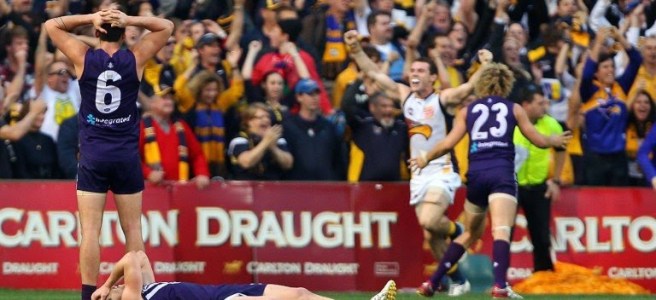
Taking possession at the apex of the boundary line and the 50m arc, the kick seemed beyond the small forward, but Ballantine flushed the kick as well as he possibly could have. For the mostly Fremantle crowd, and the kicker himself, the ball seemed to have enough but the ecstasy of celebration quickly dropped to agony and despair as the kick faded late to fall into the mass of players and only register a behind – leaving the Eagles one point victors.

The after-the-siren drama saw rare emotion from Worsfold, who ran onto the field after the final score was confirmed to celebrate with his players. But, while happy with the four points, the Eagles coach reflected on poor errors and discipline that could easily have given up the result.

“We got the win but it was real hard work, real hard work.”

Three of Fremantle’s nine goals came directly from 50m penalties, while Worsfold also bemoaned the ease of some of the other scores they conceded. “Heaps to learn from it and to know we have got to get a bit better again.”

Fremantle coach Mark Harvey praised the resilience of his side, for pushing towards the end, although he admitted he held little hope for Ballantine to come through with the winner from beyond 50m.

“My immediate thought was that it was going to be hard to kick a goal from that far out. I was expecting he might try a torpedo. He nearly got there anyway but it doesn’t come down to that kick. It comes down to prior events.”

Harvey admitted his side allowed the Eagles to control possession too much through the second half, with West Coast tallying 110 marks for the game. “We probably allowed them to kick the ball around too much at times, especially down back.”

“It was a credit to our blokes to come off the trip we had last week and kick the last three goals.”

“I would like to think that we never know when the end is near.”

Cox tallied 22 disposals and a number of important marks in the final term as part of his medal-winning performance, although Shuey arguably was the Eagles’ best with his showing in the midfield. With both Matt Priddis and Andrew Embley well held by Crowley and Mzungu, Shuey picked up the slack around the stoppages, along with Scott Selwood, who won his battle with Matthew Pavlich, and Matt Rosa.

Luke Shuey was one of the best for the Eagles with Priddis and Embley subdued

Mark LeCras picked up 22 touches and booted two goals, both of which came in the third term. LeCras was largely contained by Garrick Ibbotson, but broke free in the second half with 14 disposals and a brace of majors. Beau Waters was inspirational with 23 touches and a courageous effort in the third quarter when he backpeddled into oncoming traffic to mark deep in defence as Mayne crashed into the back of him.

Josh Kennedy finished with 3.4 for the match, while in defence Darren Glass and Adam Selwood were resolute. Glass limited the impact of Chris Mayne while Selwood had the job on Ballantine. Matt de Boer was assigned the defensive forward role on half back Shannon Hurn, but Hurn was still able to collect 17 disposals and six rebound 50s as the Eagles defensive group held firm throughout the day.

Michael Barlow and Greg Broughton were the leading ball winners for Fremantle with 26 each with Barlow the Docker’s most consistent performer on the day, just three weeks after returning from a horror broken leg. Luke McPharlin won his duel with Jack Darling to have 20 disposals and seven marks and Fyfe lifted in the final term with eight disposals to finish with 19 touches and five inside-50s.

Importantly for West Coast, their pursuit of the top four remained on track, despite the strong wins of Carlton and Hawthorn over the weekend. The Blues smashed Essendon by 74 points with Eddie Betts booting eight goals and the Hawks had the better of Melbourne to the tune of nine goals.

As good as those wins for Carlton and Hawthorn were, the defeats for Essendon and Melbourne could not have been more demoralising. The Bombers tumbled out of the eight as a result with St Kilda taking their place courtesy of a 103 point thrashing of Adelaide that would see the end of Neil Craig as senior coach of the Crows.

Remarkably, the Saints had started the round 11 percent behind Essendon, but the two results orchestrated a 15 percent turnaround between the two sides that allowed St Kilda to move into eighth spot. Fremantle held seventh, while the Swans remained sixth with a comfortable 39 point win over the Bulldogs.

However, they remained six points behind West Coast, who also had a game in hand, to leave the fight for the double chance down to a race in five. Collingwood and Geelong continued on their merry way at the top of the ladder with the Magpies and Cats recording easy wins over Gold Coast and Richmond.

Eagles Get The Cream

West Coast Withstand Cats Comeback

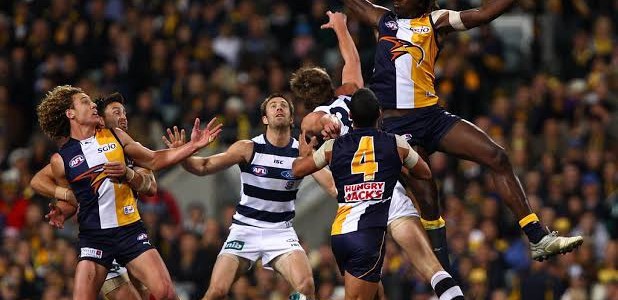
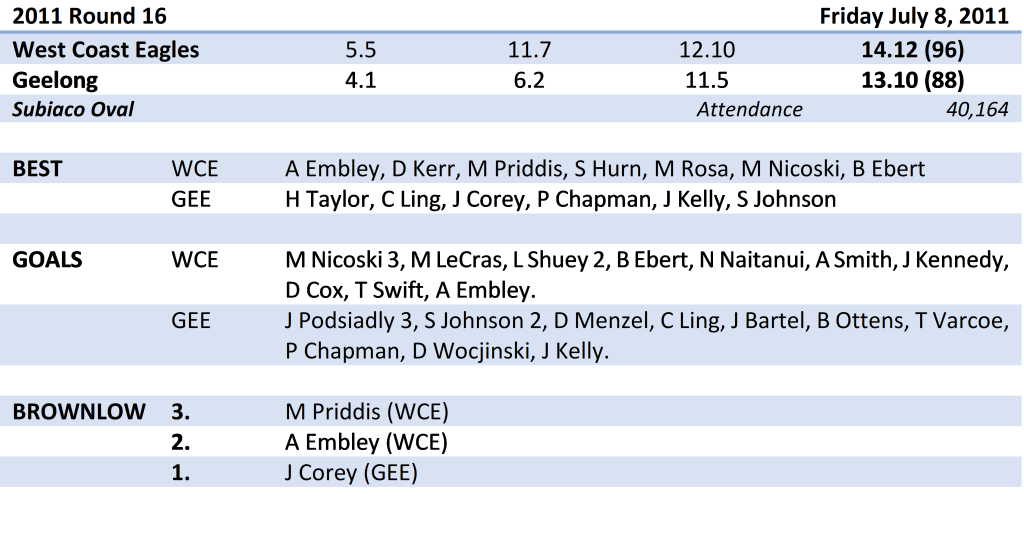
Thirty scintillating minutes either side of quarter time and some desperate final quarter defence saw West Coast get home by eight points over ladder-leaders Geelong in one of the games of the 2011 season.

Over 40,000 people packed Subiaco Oval on the Friday night to see the Eagles score their second straight win over a top-four side and continue their push to break into the double chance position.

The Eagles remained fifth following the win, but after serving their second bye the week before, now sat within four points of the Blues and Hawks, with an extra game up their sleeve.

Geelong arrived in Perth as the competition’s benchmark after first-year coach Chris Scott had guided his side to 13 wins from his first 13 games in charge – a VFL/AFL record – but had had their unbeaten streak ended the week before with a surprise four point loss to Essendon.

Scott talked up the Eagles in the lead up, declaring the trip to WA as the biggest challenge in the competition and the Cats could have been accused of having an eye on the Eagles ahead of their match with Essendon.

The Cats made the left-field decision to send several players to WA the week before, with Travis Varcoe and Joel Corey – who were both rested against Essendon – along with suspended midfielder Joel Selwood spending the week training with South Fremantle.

West Coast had their own tribunal issues ahead of the match with Quinten Lynch copping two one week suspensions for separate incidents involving Marc Murphy in the Eagles win over Carlton a fortnight earlier.

While Lynch would plead guilty to a striking charge, confirming his ineligibility for the Geelong match, the Eagles successfully challenged the grading of a rough conduct, reducing the level from high to medium which meant Lynch would serve just the one match suspension.

Lynch was joined by Sam Butler on the sidelines after the defender strained a quad in the final training session of the week. Patrick McGinnity and Koby Stevens were the two inclusions for West Coast, with Stevens making his first appearance of the season.

Geelong made three changes, with Varcoe and Corey returning, along with Taylor Hunt. The Cats were clear in their match selection as they chose a number of mid-sized runners to come into the side in place of tall forwards Mitch Brown and Tom Gillies. Andrew Mackie was the third exclusion for Geelong due to soreness.

Dean Cox started in the ruck for West Coast, but had partner Nic Naitanui beside him at the opening bounce with John Worsfold throwing the Fijian into the centre square alongside Daniel Kerr and Matt Priddis.

The Eagles brought the early intensity with a number of forward entries that had the Geelong defence scrambling. However, for all of the home side’s endeavour, the class of the Cats stood out as they capitalised on the rebound.

Geelong booted four of the first five goals in the game – including their first three from just four forward 50 entries – with James Podsiadly bobbing up for two of them.

West Coast on the other hand were blowing their chances, with Mark Nicoski (twice) and Naitanui both missing simple shots in front of goal.

With five minutes left in the quarter Geelong led 4.1 to 1.3 but West Coast finished the quarter with a flurry of majors to get reward for their dominance. And it was the two players who had been guilty in front of goal earlier in the term who sparked what would be an unanswered nine goal run.

Naitanui would be the fortunate recipient of an overturned free kick in the forward pocket after Jack Darling had sprayed a set shot out on the full. With Geelong set to take possession, Steve Johnson took unkindly to the attention he was receiving from Adam Selwood off the ball, gifting the ball back to the Eagles, where Naitanui snapped truly from the behind post.

Josh Kennedy eked through the Eagles’ third goal after a scramble near the goal square before Mark Nicoski produced a moment of magic.

Collecting the ball on the bounce near the boundary line and cornered by two Geelong defenders, Nicoski fashioned a checkside effort as he was falling backwards that purely defied his two earlier misses from dead in front. That put West Coast in front with Mark LeCras extending the Eagles lead to ten points at the first change in the dying seconds.

The final major told the tale of the first term.

The longer the quarter went, the less sure and composed the Cats defence appeared in the face of the Eagles forward pressure. With the seconds ticking down, Travis Varcoe had possession and looked to exit the ball from the defensive arc. Varcoe overshot his handpass which went directly to Mark LeCras, who then cut a swathe through two defenders and caressed the ball home for the Eagles’ fifth goal from the 50m line.

West Coast had enjoyed 77% of the play in their forward half and led the inside 50 count 18-8 with many of their early matchups were working in their advantage.

Adam Selwood was minding the enigmatic Steve Johnson, brother Scott was doing a similar job on Bartel and Darren Glass had kept the dangerous Daniel Menzel to just two disposals. Brad Ebert had been deployed as a defensive forward on Matthew Scarlett, with the intent of dragging the Cats full back out of the play.

If West Coast had been guilty of not maximising the glut of forward entries in the first quarter, there was no such issue in the second term as the Eagles piled on five goals in 17 minutes to stun the Cats. From sixteen points down entering time-on of the first term, West Coast had advanced to a 40 point lead entering time-on of the second.

Mark Nicoski was dynamic for West Coast up forward with three goals

Bartel eventually ended the Eagles run, but when Brad Ebert rolled home his first major just before half time after another poor turnover in defence by Geelong, this time by Taylor Hunt, West Coast had secured a 35 point lead at the main break.

The Eagles midfield were in complete control from the first half, with Andrew Embley (20 disposals, three clearances), Daniel Kerr (15 disposals, four clearances) and Matt Priddis (14 disposals, four clearances) all prominent.

For Geelong, only Cameron Ling with 18 disposals for the half showed resistance.

The Cats though weren’t the top side in the competition by accident and they proved as such in the early stages of the third quarter when they slammed on four goals in nine minutes to cut the Eagles lead back to 10 points.

Dean Cox provided a steadier but David Wocjinski reduced the margin once again heading into three-quarter time as the match started to take on a different look than earlier in the piece.

Where West Coast had virtually monopolised forward half possession and hunted the Cats when they attempted to control the ball, it was now Geelong that was generating multiple forward 50 entries with the Eagles trying to hold off their momentum.

The first goal of the final term was crucial to both sides, and it would be West Coast who would get the vital strike. With a ball up in their goal square, James Kelly took possession and looked to switch the ball towards the Chris Mainwaring wing. But the ball had barely travelled a metre off his boot before being intercepted by Mark Nicoski, who cleanly took the ball and drilled his third goal of the night.

Geelong continued to press but the first quarter efficiency had all but disappeared as they butchered a spate of chances in front of goal. Paul Chapman, Wocjinski, Steve Johnson and Steven Motlop all missed gettable shots and they were made to pay when Andrew Embley sealed the match on a breakaway move.

Having endured repeat forward entries, Darren Glass was able to mark a Podsiadly entry into the forward line and switch the play as West Coast found a way around the Geelong defence. Josh Kennedy was able to mark at half forward and spotted Embley alone in the forward pocket.

Having taken the mark, Embley inadvertently took a step forward – enough for the umpire to wave play on as Scarlett and Taylor came bearing down on the Eagles wingman. Corralled towards the boundary line and on the wrong side for a right footer, Embley ducked and baulked the pair before swinging home the sealer.

The Cats finished with the final two majors to keep fans on edge, but West Coast had done enough to keep Geelong at bay and record their 10th win of the season.

A pleased John Worsfold commended the maturity of his side as Geelong mounted their comeback. “I think holding on to win with Geelong throwing everything at us in the second half to get back into the game… and the composure the boys showed through the last quarter. I thought that was great…”

“Beating Carlton was fairly important for us because we had some pretty closes losses against some of the other teams that… were going pretty well. It was reward for effort, I think, because we had pushed those teams and lost close games.”

“In the last two weeks we have pushed good teams and won.”

Chris Scott lamented his side’s poor second quarter, which ultimately cost them the game despite the strong second half performance. The Cats recorded 34 inside 50s after half-time, to just 13 for the Eagles and ended up winning the count 52-43 for the match, but had left themselves too much to do.

“Our first half was really bad, theirs was really good. We just didn’t do enough to stop the momentum. They kicked nine straight at one stage.”

“We left ourselves with too much to do, but our gusy are pretty tough and have great character. Even our young players are showing that they play the Geelong way when the chips are down and the disappointing thing is we just didn’t do enough.”

Joel Corey, Corey Enright and Paul Chapman all lifted their rate in the second half with rookie ruckman Nathan Vardy getting a handle of the stoppages. Cameron Ling finished as the leading ball winner with 30 disposals, while Chapman collected 13 touches in the final term to finish the match with 29. Joel Corey tallied 28 possessions and Harry Taylor had 23 disposals and nine marks opposed to Darling in defence.

Andrew Embley was outstanding for West Coast for four quarters, picking up 32 touches on top of kicking the sealing goal. Matt Priddis did much of the grunt work in the middle, while Shannon Hurn and Daniel Kerr each picked up 24 touches. Brad Ebert quelled the influence of Matthew Scarlett and chimed in for 20 disposals and a goal and Matt Rosa was important in the last quarter.

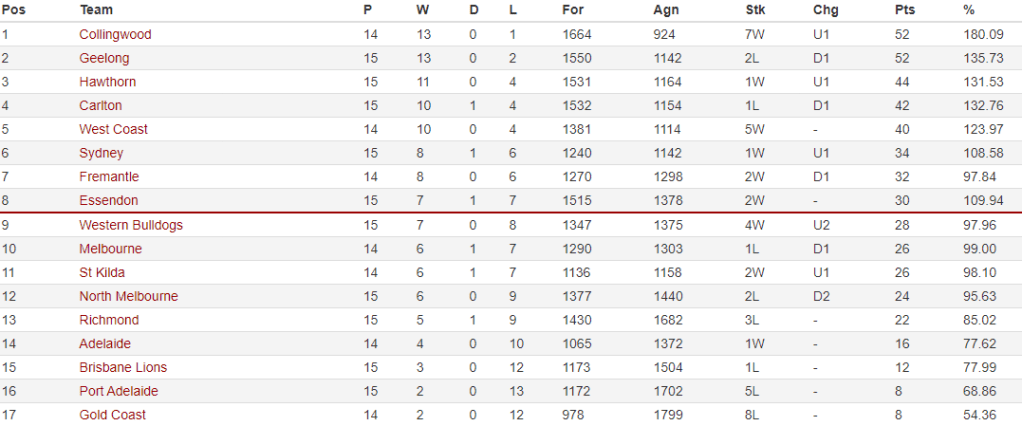
The Cats lost more than the four points on the evening, as they were usurped from top position following a second successive defeat. Collingwood overtook the Cats with a superior percentage after they demolished North Melbourne by 117 points.

Carlton’s surprise 27 point defeat to the Bulldogs, which had the Bulldogs on the edge of the top eight, now had the Blues prime for the picking in fourth spot. West Coast had the prize of the double chance firmly in their grasp but the ever-straight Worsfold continued to preach the evolution of his squad.

“Our goals have always been about continual improvement.”

“It has come pretty quickly in terms of this year, but we are still a long way short of where we want to be”, Worsfold said.

“But we are prepared to do the hard work it is going to take.”

JK’s Big Day Out

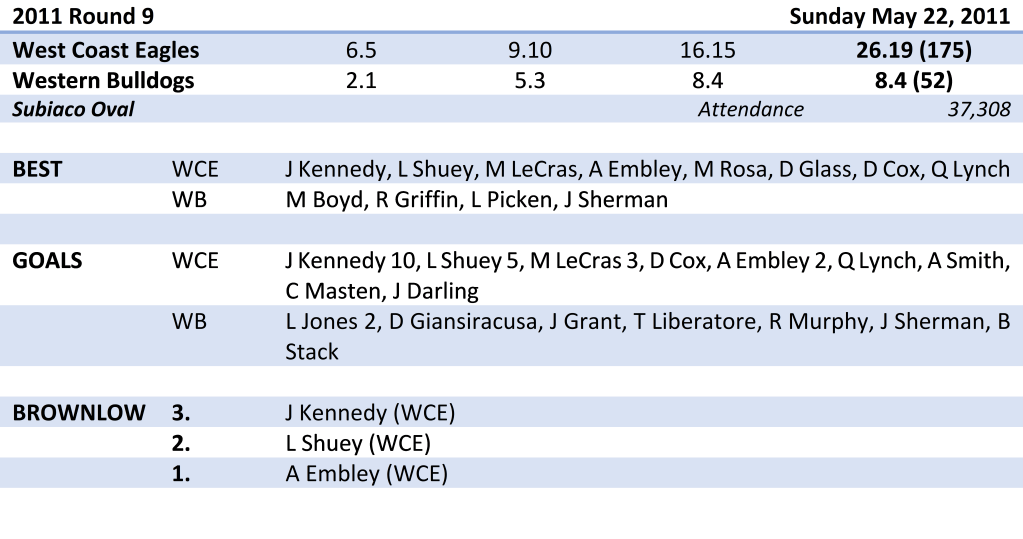
Kennedy Bags 10 as Eagles Deliver Bulldog Belting

When Chris Judd declared that he would head home to Victoria at the end of the 2007 season, the premiership captain was adamant West Coast would be fairly compensated for his departure.

Following a tender process involving four clubs, the Blues ultimately came up with the package that earned the services of Judd, exchanging the number 3 and 20 draft selections, as well as emerging West Australian forward Josh Kennedy.

Kennedy had booted 11 goals in 22 games across two seasons at the Blues, and while Carlton were reluctant to let the key forward go, the opportunity to bring Judd to the club was too great to refuse.

Judd was instantly instilled as captain, guided the Blues to finals appearances in 2009 and 2010 and claimed the club champion award in his first three years at the club as well as winning the 2010 Brownlow.

For West Coast, Josh Kennedy was always going to be a longer-term project.

And in his 53rd game with the club, the Eagles saw exactly what Kennedy could produce when he booted a career best 10 goals in a 123 point thumping of the Western Bulldogs.

Kennedy got the better of four opponents on the day, kicking 10.3 from 21 disposals and 15 marks as the Eagles orchestrated a remarkable 183 point turnaround from their last meeting with the Bulldogs. That game, in Round 13 of 2010, saw ‘Dogs come to Perth and claim an easy 60 point win.

However, the side that had reached the penultimate weekend of the season in each of the previous three seasons appeared a shell on this trip to Perth, outplayed from the opening bounce.

The Bulldogs were without several important players, including Brian Lake and Barry Hall (who was named an emergency as he returned from injury), while Adam Cooney was forced out with a knee injury and Dylan Addison injured an ankle at training. However, Shaun Higgins, Easton Wood and Tom Williams could all be recalled.

West Coast made just the two changes, bringing in Andrew Embley and Daniel Kerr who had been late withdrawals the week before. Their two replacements for the Derby in Brad Sheppard and Andrew Gaff made way.

Kennedy’s big day started in the opening minute when Matt Rosa and Scott Selwood combined to win the first stoppage, before sliding the ball to Luke Shuey who found Kennedy. Kennedy would have a further three goals by quarter time and added a fifth, 56 seconds into the second term.

By this point the Eagles had opened up a five goal lead, although the visitors were able to manage the halt the damage to half time. Remarkably, when Jarrad Grant and Daniel Giansiracusa goaled midway through the third term, the margin was just 22 points between the sides, but the Eagles rammed home their clear advantage in the game with the next seven goals.

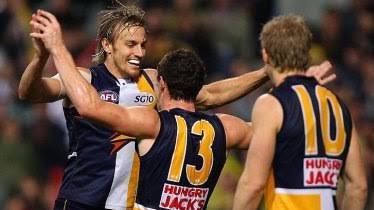
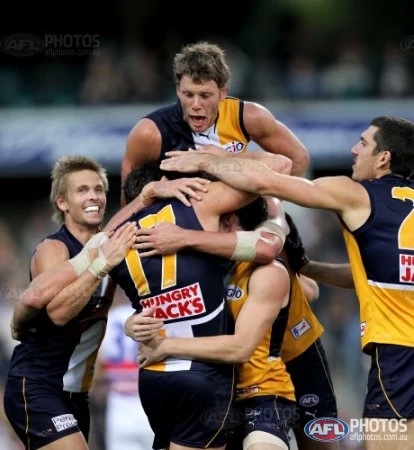
Eagles teammates celebrate with Kennedy after he kicks his tenth goal

The game was as good as done by three-quarter time with West Coast leading by 59 points, before the Eagles went another level.

West Coast stepped into savage mode.

The last term became a procession as the Eagles slammed on 10.4 to nothing to come away with a 20 goal victory, having kicked 17 of the last 18 goals in the match. After four goals in the first quarter, Kennedy added two in each of the 2nd, 3rd and 4th terms, with teammates mobbing the key forward when he became just the fourth Eagle in club history to reach double digits.

Kennedy would be the standout from the result, but there wasn’t a poor Eagle in the house.

Scott Selwood and Daniel Kerr provided the grunt in the middle, Andrew Embley and Matt Rosa gave the outside run and Luke Shuey provided the cream through the centre and the perfect foil up forward, booting five goals from 27 disposals.

With the Eagle talls dominating, Mark LeCras spent more time through the middle, gathering 29 disposals and booting three goals. Darren Glass held the defence, blanketing Jarrad Grant with Ashley Smith and Shannon Hurn proficient in exiting the ball out of the Bulldogs forward 50 on the few times they got that far up the ground.

Nic Naitanui and Dean Cox were superior over Ben Hudson and Will Minson, Quinten Lynch and Jack Darling roamed up and down the ground to send the ball inside 50 on ten occasions and Adam Selwood kept the reins on Daniel Cross.

All aspects of the game pointed to a shellacking.

West Coast finished the game with 121 more disposals, 35 more marks, won the clearances 48-37, recorded 34 more inside-50s and had a staggering 33 more scoring shots (45-12). The Eagles also took 27 marks inside their forward 50, with the combination of Kennedy, Darling, Lynch and Cox proving too much for the undersized Bulldog defence.

The 123 point margin was the third largest win in the clubs history and was also their highest score since 2006.

While teammates and fans were celebrating the massive win, coach John Worsfold was quick to stifle expectations declaring the upcoming round 10 match against Collingwood ‘the real measuring kick’.

“I told them after the game you get four points for the win. You get a lot of pats on the backs – well above what four points deserves.”

“They deserve the accolades that come but it doesn’t give you anything other than one win. I wanted to see them maintain the effort they put in last week and they did that.”

Worsfold was also full of praise for Kennedy following his career-best day. “It reinforces the faith in the ability that we all know he (Kennedy) does have. It is good reward because he works as hard as anyone.”

“It wasn’t ideal losing Chris Judd but… we were more than pleased with the outcome of that trade.”

While Worsfold was playing down the expectations of his side, Bulldogs coach Rodney Eade declared West Coast were premiership contenders, following what he described as the ‘worst loss his career’. The magnitude of the defeat – the fourth worst in the history of the Bulldogs, and their largest defeat since 1996 – followed in the coming days, with president David Smorgon issuing an open letter to members apologising for the performance.

Smorgon was also forced to deny Eade’s tenure as coach was under threat, despite the veteran coach being out of contract at the end of the season. “With 14 rounds to play, I want to reiterate that we will continue to support and encourage Rodney Eade and the match committee to make whatever changes they feel necessary to ensure we again start playing consistent footy every week and every quarter.”

Any other day LeCras’ 29 disposal, three goal game would have been best on ground honours

The big victory saw the Eagles move up one place to sixth on the ladder, with the biggest gain in the percentage column, rising from 112.6 to 131. The Eagles moved past the Swans who were thrashed at home by Hawthorn to the tune of 46 points. That saw the Hawks climb up to third after Essendon and Carlton both suffered defeats in the round.

The Bombers were 16 point losers to the Tigers, with Richmond joining the Swans on four and a half wins on the outskirts of the top eight. Carlton went down to the top of the table Cats by just two points in one of the games of the season.

The Blues jumped out of the blocks early, twice leading by 20 points during the first half, before a late rally before half-time saw the top four aspirants level at the major break. Geelong edged away during the third term, before Carlton strung four of five goals either side of three-quarter time to take back the lead.

The Cats then settled through Steve Johnson and James Podsiadly, but the Blues had chances late in the game to steal the win, with Jarrad Waite and Robert Warnock missing shots on goal. The Bombers and Blues were now just half a game in front of the Eagles.

The Dockers joined the Eagles on five wins when they easily accounted for Port Adelaide, who slumped to the bottom of the ladder after Brisbane broke through for their first win of the season over North Melbourne. The Demons hopes of making finals took a hit when they fell to a 20 point defeat against the Saints, who had started the season horribly after playing in the previous two grand finals. St Kilda had recorded just two wins and a draw in their first eight games.

Next up for West Coast was arguably their biggest challenge of the year – a trip to the MCG to tackle the all-conquering Magpies.

Eagles End Derby Drought

Shock Late Withdrawals Fail to Rock West Coast

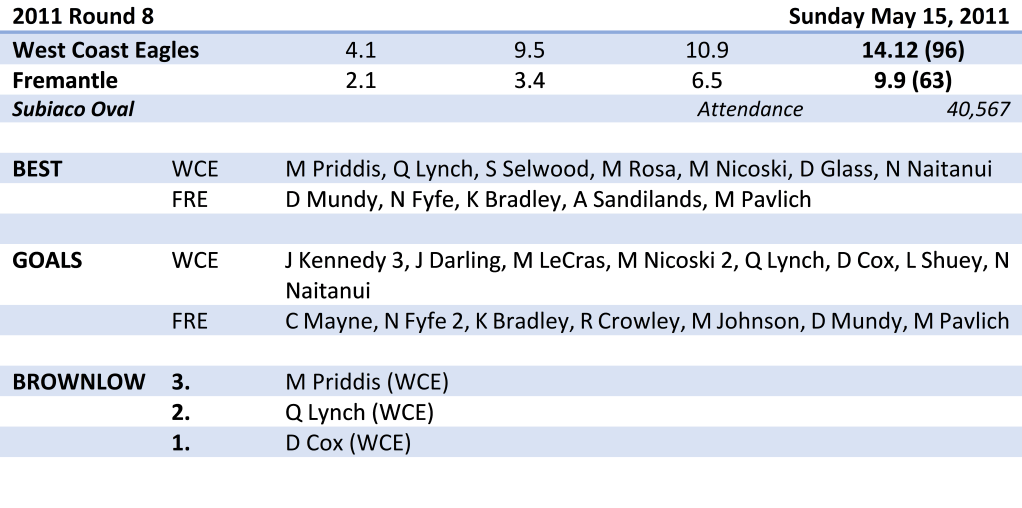
West Coast ended a seven game losing streak against their cross-town rivals when they broke through for a 33 point win over the Dockers.

Despite losing key midfielders Daniel Kerr and Andrew Embley in the hour before bouncedown, West Coast managed to win the battle in the centre and implement their forward press to make it four wins from their first seven matches – equal to the number of wins they managed for the entire 2010 season.

Matt Priddis stepped up in the absence of Kerr and Embley to dominate the stoppages and claim his first Ross Glendinning medal. Priddis was a unanimous choice for the award, with 27 disposals (17 contested), six clearances and five tackles.

Priddis, in particular, was instrumental at winning the ball in the contest and feeding out possession to the outside runners in the likes of Matt Rosa, Chris Masten and Luke Shuey. The Eagles forward line functioned far better than their counterparts, with the three-pronged attack of Kennedy, Darling and Lynch proving too much for the Docker defence.

Lynch also rotated through the ruck as West Coast used the burly forward along with Nic Naitanui and Dean Cox to counter the impact of Fremantle beanpole Aaron Sandilands. Sandilands still got the better in the hit-outs (45-39) and picked up 14 disposals to go with five clearances to be one of Fremantle’s better players on the day, but West Coast would have a better spread of contributors in the match.

The 33rd Western Derby promised to be the most even contest in several seasons with West Coast showing improvement after three seasons at the bottom of the ladder. Certainly, hopes were raised amongst both sets of fans, with the match declared a sell out over a week before the match. However, the Eagles’ chances of ending their losing run against Fremantle took a major hit as the clubs prepared for the start of the match.

First, Andrew Embley pulled out after deciding his questionable hamstring wasn’t worth the risk. Then, with the sides completing their customary warm-up, Daniel Kerr strained an adductor and was deemed unable to take his place. Brad Sheppard and Andrew Gaff were called up as the late replacements, with Gaff donning the substitute vest and Chris Masten, who had already been added to the side for his first game since injuring a knee in the opening round, was elevated into the starting 21.

Fremantle had their own late drama with small forward Hayden Ballentine officially ruled out. Ballantine had not been expected to play due to injury, but was surprisingly named when teams were released during the week with the Dockers refusing to admit there had been an issue. Jayden Pitt was brought in as his replacement, starting as the Fremantle sub.

Despite the disrupted preparations, West Coast showed no signs of being rattled. They started the stronger of the two sides with Josh Kennedy taking a strong pack mark to boot the Eagles’ first goal, with Darling following shortly after.

Quinten Lynch and Mark Nicoski also kicked first-quarter goals as West Coast took a two-goal lead into the second term, where West Coast’s ascendancy around the ground would lead to its biggest impact on the scoreboard.

Fremantle became the latest casualty to the Eagles forward press, as West Coast locked the ball in their forward half. The Docker defence failed to handle the pressure from the Eagles forwards, who capitalised in booting five goals for the term to take a commanding 37-point lead into half time.

The Dockers got the match on a more even keel through the second half, twice closing withing 20 points, but the Eagles were able to hold their advantage to run out 33 point winners.

Josh Kennedy finished with three goals to get the better of Luke McPharlin, with Jack Darling, Mark LeCras and Mark Nicoski each finishing with a brace. Scott Selwood joined Priddis with the in-and-under work, finishing with 21 disposals and nine tackles while Matt Rosa picked up 24 disposals on the wing in a run-with role on Stephen Hill.

John Worsfold was impressed with his side’s ability to focus on the task at hand, despite the late disruptions. “It was a credit the players just got on with business.”

“The way that Gaff prepared, the way that Sheppard prepared. And also Masten who expected to be the sub and having to come on and play longer game time. Those players just got on with the job.”

“They are only young players who showed great maturity.”

While many of the plaudits were for the midfield and forward groups, the Eagles defence were also solid, with Darren Glass leading the way. Glass held Jack Anthony to just five disposals and a behind in his Dockers debut, with Sam Butler and Ashley Smith providing the rebound from the back half.

While Anthony’s first game since crossing over from Collingwood was underwhelming, he wasn’t alone with many of the key Fremantle players struggling. Matthew Pavlich was closely watched by Adam Selwood, and while he still found the ball 22 times, he lacked presence in the match.

Adam McPhee, Paul Duffield, Clancee Pearce and Greg Broughton were all below their best, with Mark Harvey admitting his side couldn’t handle the pressure brought on the Eagles.

“We appear to not have enough class at the moment in our side and we are putting ourselves under pressure with our disposal.”

Matt Priddis was the unanimous choice for the Ross Glendinning Medal

The result saw West Coast move back into the top eight, past the Dockers into 7th spot. The Eagles were able to climb several rungs with Melbourne and Richmond, who sat above them heading into the round, both suffering surprise defeats to lower placed sides.

The Tigers lost to the Bulldogs in a 43-goal shootout, while Melbourne fell to North Melbourne by 41 points after being outscored 12 goals to four in the second half. Many of the remainder games went as expected as the top half of the ladder began to take shape.

Essendon ran away to a six goal win over Brisbane after an even first half, Hawthorn claimed a five goal win over the Saints after also being even at the major break while Sydney thrashed Port Adelaide by ten goals.

The match of the round, however, was the opening game of the weekend that saw the undefeated pair of Collingwood and Geelong meet at the MCG. In a fiercely fought match, the inaccurate Cats came from behind to get over the top of the Magpies by three points.

Geelong registered 11 scoring shots in the opening term but could only manage 2.9, to hold a 14 point lead at the first change. Collingwood then took control with six of the next nine goals to head into the final term with a five point advantage. Andrew Krakouer kicked the first major in the final quarter to stretch the Magpies lead out to 11 and the reigning premiers appeared to have done enough.

However, three goals in seven minutes to the Cats flipped the match, with Geelong holding on due to some late controversy. Scott Pendlebury appeared to have slid home the winner for Collingwood in the final two minutes after taking advantage from a free kick, but the umpires pulled the ball back up the ground and the chance was lost.

For Eagles fans, the win over Fremantle had them dreaming of a return to finals actions after three seasons watching on in September. While Worsfold was happy with the result, bragging rights weren’t high on the agenda.

“It’s not about the derby. It’s where we want to get to as a team. We’re working hard to improve… and we’ve taken some steps. There are a lot of steps still to take. And the derby was another step on the way.”

“The big picture is to develop this side to be the absolute best it can be. It’s going to take a little while longer.”

2011 Rewind: Eagles Strike Down Power

Eagles Make It Two On The Trot

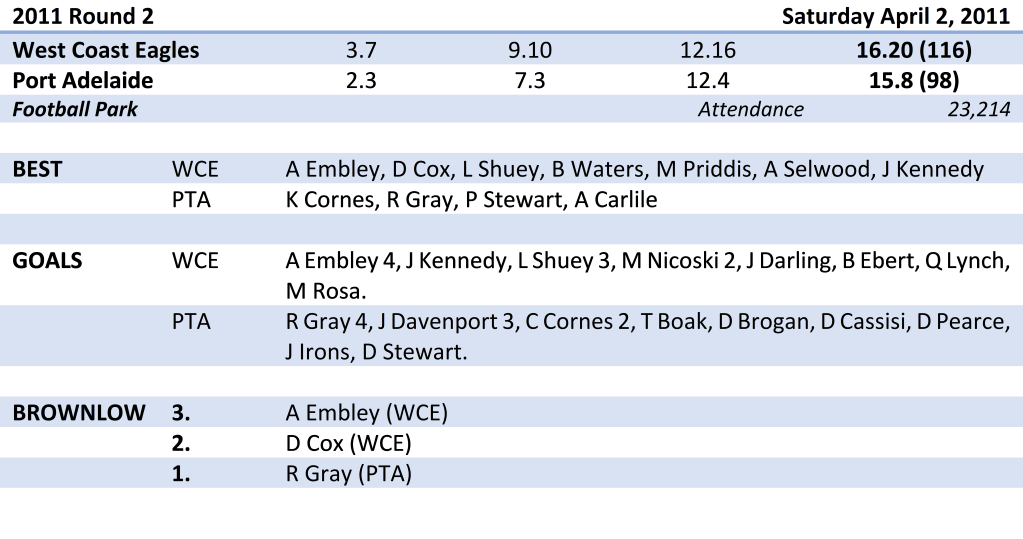
West Coast made it consecutive wins to start the 2011 season when they secured an 18 point win over Port Adelaide at Football Park.

The inaccurate Eagles edged their way to a three goal leading during the first half and maintained their advantage for most of the second half, holding out the home side after they twice closed within a goal during the final term.

Andrew Embley booted four goals to go with 32 disposals in a best afield display, while Josh Kennedy and Luke Shuey each kicked three. Kennedy had the better of Jackson Trengove early to boot his three goals by half time, while Embley and Shuey combined for the Eagles’ last six goals as West Coast became the first team since Collingwood in 2000 to win their first two games after claiming the wooden spoon the year before.

However, it was mixed fortunes for two of the Eagles most injury-prone players.

Daniel Kerr returned for his first game in nearly a year and picked up where he left off, gathering 25 disposals through the middle. Beau Waters, though, was set for a stint on the sidelines after injuring an elbow in one of the plays of the day.

With the Power closing in on the Eagles lead during the third term, and with the run of the play through the middle of the ground, Waters was able to tackle David Rodan, recover to smother a kick off the boot of Jaspar Pittard, before taking possession and finding Andrew Embley free at half forward to roll home a steadying goal.

The Eagles vice-captain missed the entire 2009 campaign after surgery on his left elbow, with the latest injury to his right. While West Coast were optimistic after the match, Waters would remain unavailable to the back end of the season.

Kerr was one of three changes for the Eagles, with Nic Naitanui and Patrick McGinnity both recalled after being late withdrawals the week before. Chris Masten and Mark LeCras were both sidelined with injury, with small forward Ashton Hams dropped.

Port Adelaide made just the one change after they were thrashed by reigning premiers Collingwood in the opening round. Veteran Chad Cornes came into the side in place of injured full forward Jay Schulz.

As they had done the week before, West Coast started strongly, but inaccuracy prevented the visitors from establishing a larger lead. Josh Kennedy and Quinten Lynch kicked truly early in the second term to stretch the Eagles lead to 22 points before Port Adelaide got their foot into the game.

Chad Cornes swung forward to kick the Power’s first for the term, with Robbie Gray kicking a brace to bring the Power back within five points. The Eagles then got on another run with Kennedy booting his third to send the Eagles out to a four goal advantage.

Gray added a third for the term to reduce the Eagles lead to 19 at the main break.

Mark Nicoski kicked from long range inside the opening minute of the second half to stretch the lead to 25, before the Power’s sub stamped his mark on the game. Jason Davenport was injected into the game during the half-time break in place of Dom Cassisi, booting three goals for the quarter as Port Adelaide refused to give up on their chase of the Eagles lead.

Three goals in a row – two to Davenport – had the home side back within nine points, before Waters’ inspirational play through the middle of the ground led to Embley and then Shuey, giving the Eagles breathing space.

Again Port Adelaide came, with Davenport adding his third and Chad Cornes kicking truly.

The Eagles had managed 12 more scoring shots in the first three quarters, but that only equated to a 12 point lead. Travis Boak – who had been well held by Adam Selwood – found the major opening to get the Power within a goal but Luke Shuey was able to answer.

And for each of the Power’s challenges in the final term, the Eagles were able to find the answer with Embley’s fourth in the dying seconds the icing on a fine win.

Daniel Kerr was one of the best for West Coast in his return game

Eagles coach John Worsfold was pleased with the win, but the victory was the least of what West Coast deserved having controlled large periods of the match. The Eagles finished with 60 more disposals, 18 more contested possessions and 13 more scoring shots.

Worsfold was also content with the return of Kerr through the midfield. “…he (Kerr) was always going to be a certain starter when he was fit enough to be in the side.”

“His attitude about getting back to wanting to play his best footy is great.”

Dean Cox again dominated in the ruck, combining with Naitanui to get the better of Port Adelaide ruckman Dean Brogan. The pair notched 53 hit-outs to Brogan’s 13, although the Eagles weren’t able to translate the hit-out advantage in the stoppages, losing the clearances 33-40.

But with Mitch Brown keeping Justin Westhoff quiet, and the other Port talls unable to exert any influence in the forward half, West Coast were able to set up much of their scoring opportunities with transition football from the back half.

Matt Priddis collected 29 disposals through the centre, while Shuey’s 27 disposal, three-goal effort earned a rising star nomination.

The Eagles’ first win over Port Adelaide at the Adelaide Oval in nine attempts, since 1998, left them as one of just five teams with two wins from the opening two games of the season.

For Worsfold, the result was an important step as the Eagles continued to build from the bottom. “Obviously for us they’re all important wins.”

“So to come to Port and beat Port here, which has been pretty tough for us since Port’s existence, for this group specifically it’s a very good win for them, but for the club overall to beat Port here has taken a bit of time.”

“We came over here saying we still wanted to win. Just that belief within the group, I think, is a bit stronger.”