2011 Rewind: Eagles Crack Top Four

Second Half Surge Lifts Eagles Into Double Chance

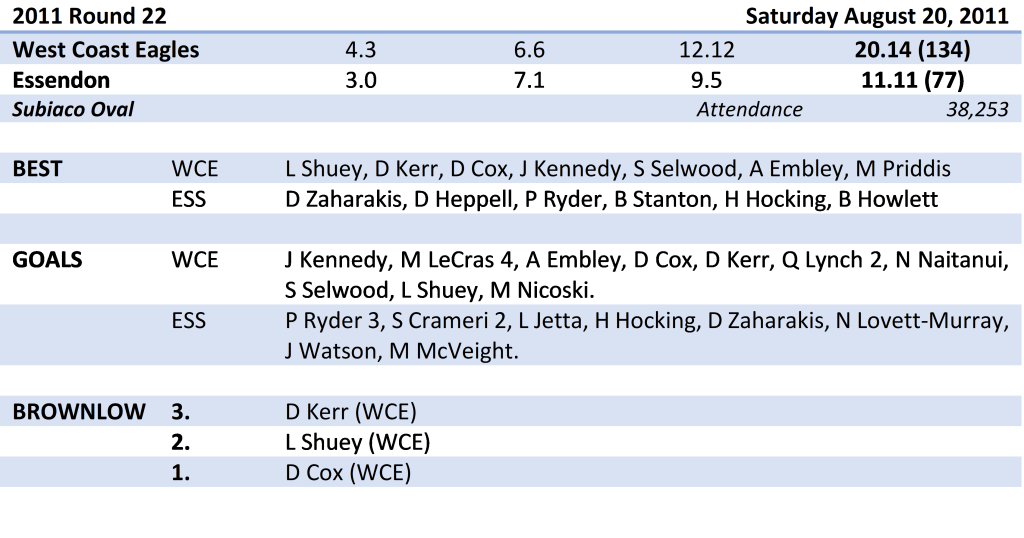
West Coast finally cracked their way into the top four and prime position for the double chance come finals after careering away to a 57 point win over the Bombers.

The Eagles trailed by a point at half time, but fourteen goals after half time ensured West Coast would claim their 15th win of the season and replace Carlton in the top four. The Blues lost their place after losing by two goals in an enthralling clash with the Hawks in the round opener.

West Coast welcomed back their captain and vice-captain in Darren Glass and Beau Waters, with defender Mitch Brown unlucky to lose his place and Patrick McGinnity serving a one match ban for breaching the AFL’s respect and responsibility policy.

The McGinnity investigation was the focus for much of the week, but John Worsfold denied it would be a distraction for the club. Worsfold endorsed the vilification code and declared McGinnity had learned from the incident. “Paddy understands very clearly what he did wrong and… he is remorseful.”

The Bombers arrived in Perth having won four of their past six games and looking to consolidate their spot in the top eight, but the make up of their side failed to take shape until late in the week.

Dustin Fletcher was initially left out of the side, but returned when Tayte Pears failed a fitness test. Michael Hurley was ruled out with soreness and Ricky Dyson was dropped, with Nathan Lovett-Murray, David Myers and Tom Bellchambers the three inclusions.

Bellchambers was called into the side, joining Paddy Ryder and David Hille meaning James Hird had three ruckmen at their disposal to counter the influence of Nic Naitanui and Dean Cox.  

Ultimately, Hird’s decision would backfire.

Cox would finish as one of the best for West Coast as the Eagles overran the Bombers through the second half. Jack Darling was a late withdrawal ahead of the game (missing his first game of his debut season), with Chris Masten brought in as his replacement and having the additional runner in the game appeared to work in the Eagles favour.

West Coast held the edge from the start of the game, but some costly mistakes kept the Bombers in the hunt during the first term. Paddy Ryder scored the Bombers’ first two goals, the second coming from an interchange infringement against Dean Cox. After Quinten Lynch kicked the Eagles second goal, Cox entered the field of play ahead of time, gifting the Bombers a free kick and a 50m penalty resulting in a simple goal.

The Eagles registered seven scoring shots to just three, but only held a nine point lead with Essendon making the most of their few opportunities. The Eagles extended their lead to 16 midway through the second term before the Bombers got on a roll that saw them lead at the major break.

Essendon kicked four of the final five goals in the term with Stewart Crameri’s second putting the Bombers in front by a point at half time. The Essendon midfield were able to get a handle of the game late in the term with Brent Stanton, Jobe Watson, David Myers and Jake Melksham all gathering nine disposals for the term.

However any thoughts Essendon had of continuing their momentum at the resumption after half time was quickly extinguished as the West Coast press generated repeat inside 50 entries and shots on goal.

The Eagles recorded the first six scoring shots of the term and while they could only manage a return of 2.4, it was enough to stamp their authority in the game. Jobe Watson and Leroy Jetta bucked the trend to add two majors for the Bombers to draw them back within a point, but it would be the last punch thrown by the visitors – at least on the scoreboard.

The game had several flashpoints during the term after Jobe Watson was collected by Beau Waters. The pair came together across the Essendon half forward line, with the Essendon captain aided to the bench and the Eagle reported. Nathan Lovett-Murray then took it upon himself to throw his weight around but that only worked in West Coast’s favour as they finished with the final four goals in the term.

It only got worse for the Bombers as the Eagles slammed on eight goals in the final quarter to blow out the margin, while the accuracy that kept them in the game in the first half deserted them when they needed it most, finishing the game with six behinds. Along with Watson, Andrew Welsh was forced out of the game early, while Stewart Crameri’s season was in doubt after dislocating a shoulder late in the game.

For West Coast, Daniel Kerr and Luke Shuey were the keys after half time, with Shuey belying his 26 games of experience. Shuey tallied 23 disposals, with 11 clearances, 7 inside 50s and a goal as he went head to head against Essendon midfielder Dyson Heppell.

The pair were the two standouts for the rising star award, with Heppell just as impressive for the Bombers with 26 disposals.

Matt Priddis matched Shuey’s effort around the stoppages with 10 clearances to go with 27 disposals, while Kerr was next best for the Eagles with 25. Scott Selwood had 23 disposals and eight tackles, while up forward Josh Kennedy and Mark LeCras each booted four goals.

Brent Stanton and David Zaharakis led the Bombers with 27 possessions each, while Heath Hocking battled it out with 20 touches and 12 tackles. Paddy Ryder finished with three goals and Crameri two, to be the Bombers only multiple goal scorers in the game.

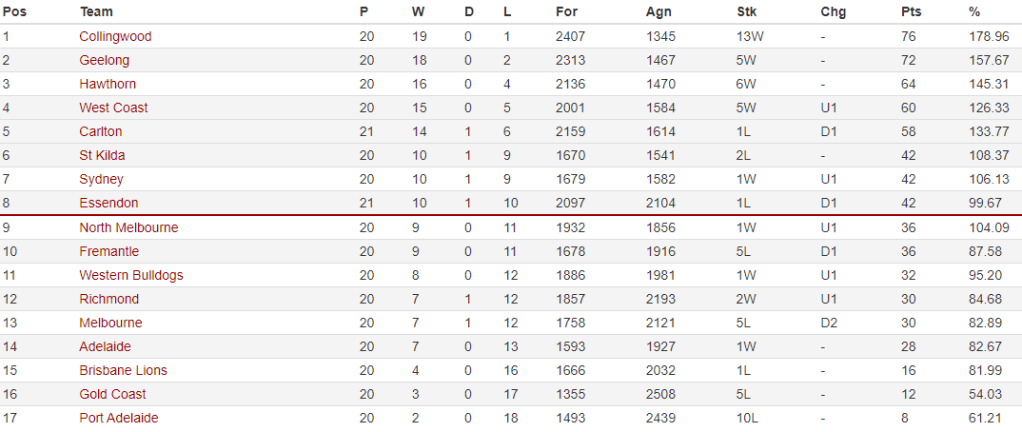
Despite the loss, Essendon held their spot in the eight as a number of other results went their way. Fremantle’s season continued to unravel when they were on the end of a 98 point thrashing by North Melbourne. The Kangaroos jumped the Dockers into ninth spot, but were six points behind the Bombers with two games to play.

Melbourne were officially out of the running for finals when they fell short against the Tigers by seven points, while the Bulldogs’ finals hopes were quashed despite a ten goal win over Port Adelaide. Barry Hall booted six goals for the Bulldogs, but his former side ensured they wouldn’t reach September action when they overcame horrible accuracy in front of goal and a three-quarter time deficit to defeat the Saints by 15 points.

The Swans did everything they could to throw the game away, trailing by seven points at the final change even though they had had eight more scoring shots. Four goals to one in the final term saw the Swans home, moving past the Bombers into seventh position.

Collingwood moved a game clear of the Cats at the top of the ladder with a three goal win over Brisbane. Geelong had the bye, but the two sides had sewn up the top two, with a final round meeting set to be the intriguing point of the season.

While the Eagles were now in the prime position to finish in the top four, Worsfold refused to buy into the finals discussion, which was expected to see West Coast tackle reigning premiers Collingwood in the opening week.

“It feels like we have two big games to go and fourth in Round 22 doesn’t mean anything. Round 24 is where we want to make sure we are in a good position. Nothing is ever a given. You have got to go out and earn it.”

Worsfold praised his side for handling the heat of the contest and earning a ‘solid win’ against a finals contender. “I thought a really good intense game in that first half, a lot of heat and obviously to come out and run out the game in the second half was very, very pleasing,” Worsfold said.

“We knew that they were a good inside stoppage team. There was some strong bodies in there, so there was a specific challenge for some of the players, especially in the third quarter and they performed really well.”

The Eagles were shaping nicely for a finals tilt and were given a further boost when Waters was cleared of his hit on Watson, with the tribunal deeming the action wasn’t a bump and the contact accidental.
1990 Rewind: Exhausted Eagles Bow Out

Travel Load Catches Up With Young Eagles

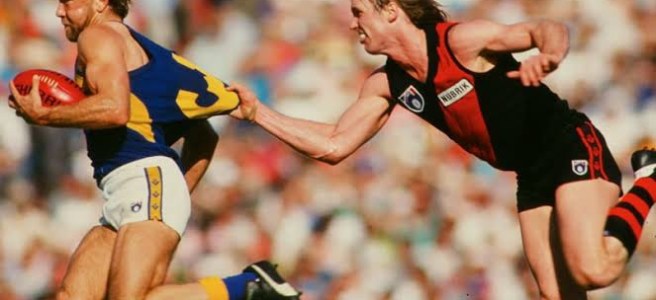
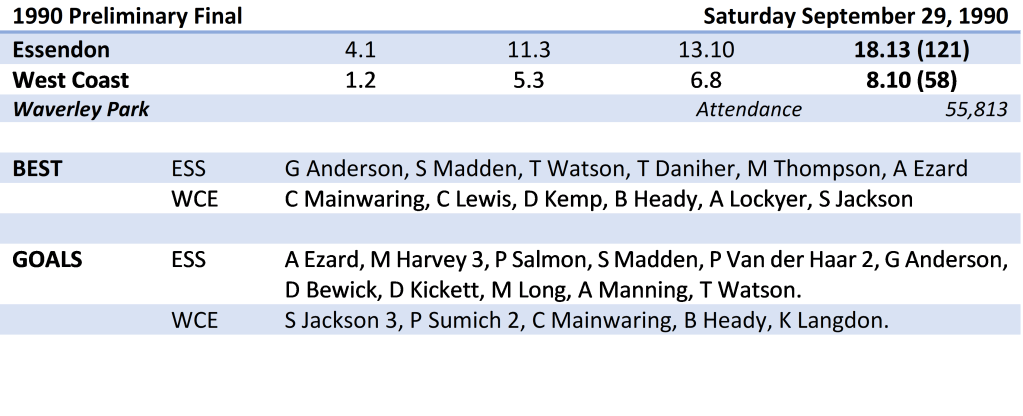
West Coast’s 1990 campaign fizzled out to a 63 point defeat against Essendon in the Preliminary Final, with the Bombers progressing to face Collingwood in the Grand Final.

Four consecutive matches at Waverley Park, and six interstate trips in a row, finally caught up with the young Eagles line-up, as they battled injury, illness and air strikes in the lead up to the match.

The Eagles were again forced to compromise their travel plans amid the ongoing national air strikes that had plagued much of their travelling over the previous six weeks.

West Coast ventured to Melbourne on a chartered flight, sharing the trip with the Perth Wildcats and Melbourne Tigers who were in the middle of their NBL Grand Final series. The trip required several stops along the way, and saw the three teams land in Melbourne on the Thursday – a day earlier than the Eagles’ usual schedule.

There were also concerns at the selection table.

Dwayne Lamb was unavailable, courtesy of a one week ban from the AFL tribunal, while nuggety midfielder Scott Watters was ruled out with a groin complaint.

Chris Mainwaring was struggling with a knee issue, Guy McKenna was racing the clock after injuring his arm late against the Demons and Laurie Keene was managing a groin injury. Craig Turley – who had been the Eagles best player over the prior fortnight – hadn’t trained all week due to the flu.

All four would take their place, but only Mainwaring would be a serviceable contributor.

Peter Melesso and Dean Turner were the two replacements for Lamb and Watters, with the selection of Turner somewhat of a surprise. Turner earned selection ahead of captain Steve Malaxos, who was left out of the side for a second week, as well as Don Pyke and Phil Narkle who had both been favoured to be included in the side.

Melesso was named after serving a five match suspension, but would then be a late withdrawal. Melesso took part in the warm-up ahead of the match, before being replaced by Todd Breman.

West Coast started the brighter of the two sides, but despite controlling possession struggled to find a way past half forward. Simon Madden, who had been heavily criticised during the week after a poor showing against the Magpies in the semi-final, was dominant both in the ruck and as the spare man in defence clogging up the space of the Eagle forwards.

Madden tallied 10 disposals and five marks for the term, as well as booting Essendon’s fourth goal of after a strong mark over Phil Scott in the goal square. The Eagles had just one major for the quarter; a solo effort from Mainwaring when he intercepted a defensive kick in the Eagles forward 50m area, before kicking truly on the run.

Stevan Jackson was busy early and finished with three goals

The quarter time deficit of 17 points was soon 43 as Essendon made West Coast pay for some sloppy play. Craig Turley started the rot when he dropped a simple mark in the middle of the ground, allowing the Bombers to regain possession with Darren Bewick finishing off a chain of play.

Alan Ezard then capitalised after the Eagles turned the ball over at half back before Simon Madden was able to boot his second of the match when John Worsfold was unable to handle the ball in defence.

Gary O’Donnell missed a golden opportunity, hitting the post running into an open goal, before Essendon caught a lucky break to boot their fourth major of the quarter. A scrappy kick forward by Derek Kickett eluded Phil Scott as he led Paul Salmon to the ball, allowing the Bomber full forward to hand off to Mark Harvey for a simple finish.

At this point, nothing was going right for West Coast.

Guy McKenna had copped a heavy hit that left him with a bloodied nose to along with the arm injury he was carrying, while Chris Mainwaring and Mark Harvey were involved in a brutal head clash that left both players on the ground for several minutes.

Finally, the Eagles found their second goal of the match. While they had been outplayed in most areas on the ground, the one spot they were winning was the centre clearances, even with Laurie Keene restricted.

Some good work out of the middle ended with Brett Heady steering through a second goal on his left foot from half forward, with the Eagles able to boot three more to give them an outside chance of victory.

However, a horrible handpass by Todd Breman deep in the Eagles defence gifted Ezard his second major of the quarter and the Bombers held a six goal lead at the main break.

Things only got harder straight after the restart when Karl Langdon was carted off after being knocked out cold in an accidental clash with Terry Daniher. Langdon attempted a diving mark, running back with the flight of the ball, with Daniher’s hip collecting Langdon in the head. With Keene also done for the day, the Eagles were without a bench, with a half to play and six goals behind.

Still, they refused to give up the fight. West Coast were the better side for much of the third term, with the play almost completely in their forward line. Essendon couldn’t find a way out of defence as West Coast continually pumped the ball into their forward 50, but they couldn’t make it count on the scoreboard.

Peter Sumich kicked the Eagles first goal, but then missed two more set shots, before Stevan Jackson hit the post from close range, and then Tony Begovich missed from directly in front after receiving a 50m penalty.

Mainwaring had a chance that failed to score, as did Michael Brennan, whose long range shot was marked on the line by Ezard. Sumich had a third chance that sailed out of bounds and for all their dominance, the Eagles had posted just 1.5 for the quarter.

Dean Turner then best exemplified the Eagles’ frustration when he cannoned into Ezard, well after the Bomber forward had taken a running shot on goal. Ezard’s effort missed, but the umpire awarded a second shot following Turner’s indiscretion, with Ezard able to boot his third goal and all but finish West Coast’s resistance in the match.

The Bombers added a further five goals in the final quarter to run out easy, albeit unconvincing, winners.

Malthouse admitted the heavy travel load had caught up with his side, but had nothing but praise, despite bowing out in penultimate week of the season.

“We looked and acted tired.”

“But I think the spirit was there to generate as much play as possible… it all caught up with them,” Malthouse said.

“The players showed enormous courage and fortitude… at no stage in six weeks of criss-crossing Australia was their a complaint. There was no sign of weakness during a severe test of the team’s character and competitiveness.”

Essendon coach Kevin Sheedy was happy enough with the performance, confident his side would bounce back from the thrashing by Collingwood the week before. “We were switched on early, and the players worked hard to get 18 wins this year and they did not want to let that slip.”

“I feel that will make us 10 percent better next week.”

Greg Anderson and Chris Mainwaring were both their respective sides’ best players, despite being opposed to each other on the wing for much of the afternoon. Anderson finished with 25 touches and booted 1.3, while Mainwaring had 19 disposals and booted a goal.

Terry Daniher and Mark Thompson also finished with 25 touches to lead the way at Essendon, while Tim Watson picked up 22 disposals and booted a goal. Simon Madden was another standout during the game with 21 possessions, 12 marks, 10 hitouts and two goals.

Alan Ezard and Mark Harvey each booted three goals.

At West Coast, Chris Lewis finished as the leading ball winner with 22 in his battle with Mark Thompson. Thompson was influential in the opening term, but Lewis had the better of the match-up over the remainder of the match despite Thompson still finding plenty of the ball. Lewis had been sublime through the second half of the season, with his consistent showing culminating in winning the club best and fairest, as well as being named in the All-Australian side (along with John Worsfold).

Chris Mainwaring was one of the Eagles’ best despite barely being able to see by games end

Dean Kemp picked up 21 touches and Brett Heady 20, as the two finished their impressive debut seasons with strong performances. Stevan Jackson offered plenty in the forward line with three goals from 14 disposals and six marks, while Peter Sumich would rue a wasteful day, finishing with 2.5.

Andrew Lockyer won his battle at centre half back on Paul Van der Haar, keeping the veteran Bomber to just nine disposals and two late goals. Craig Turley (17 disposals) and Guy McKenna (16) toiled hard despite their operating below their capacity.

The Eagles coach was openly proud of his side’s season, but the gains made in season 1990 were best summed up by opposing coach Kevin Sheedy. The Bombers coach – a former teammate of Malthouse’s at Richmond – praised Malthouse, saying he had added professionalism to the four year old club, while also lauding WA’s ‘sensational’ year.

Sheedy said playing four finals in a row was the equivalent of two finals series’ worth of experience, which would be ‘invaluable’.

“After physically and mentally going through it, the standard for West Coast has been set.”

The Eagles for their part had risen from a bit-part team out in the west, to one of premier clubs in the revamped competition in just one season. The addition of Malthouse had been an immediate success – and the board knew as much.

Days before Christmas, the Eagles announced that Malthouse had signed a three year extension to his initial contract, keeping him at the club until the end of 1994.

The ’90s had begun – as had the first Eagles dynasty.  

1990 Rewind: Big Fish Sinks Eagles

Eagles Drop To The Edge of Finals as Forwards Misfire

It was a tale of the full forwards as West Coast dropped a second consecutive game to leave their finals aspirations sitting on the brink at the halfway mark of the season.

Windy Hill lived up to its name as the Eagles struggled to handle the swirling breeze that encased the ground with a forward line function that was virtually non-existent.

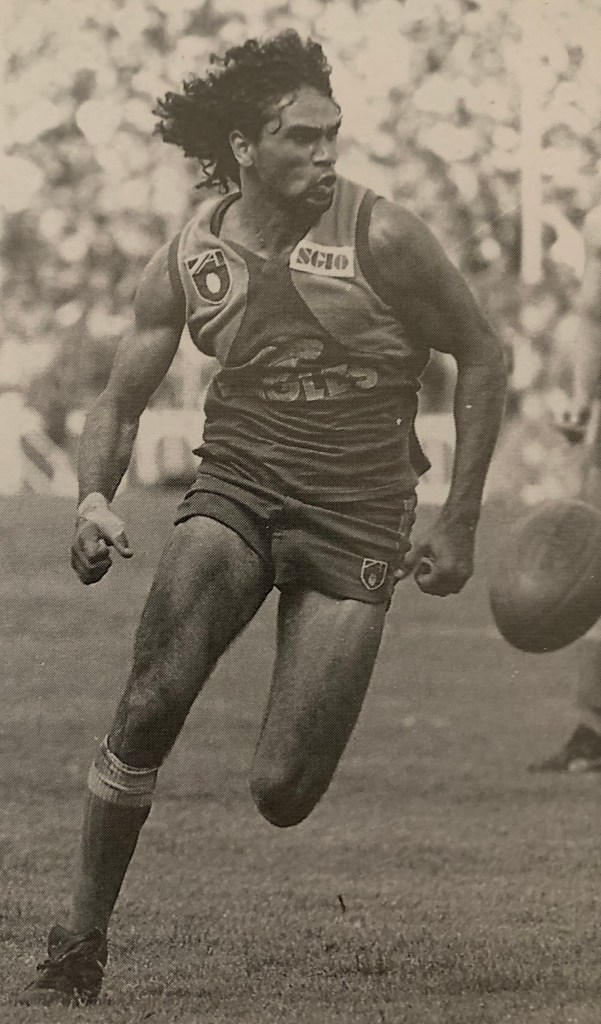
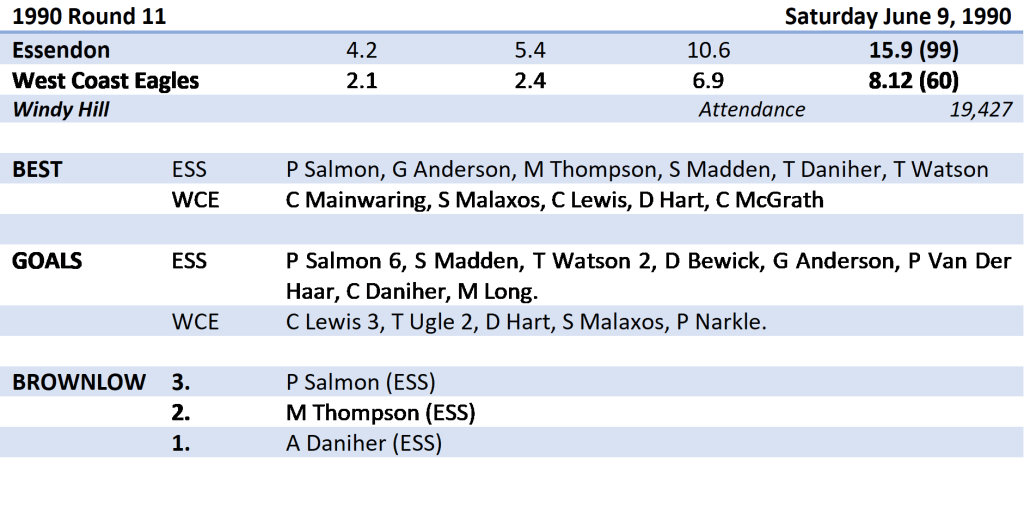
The Eagles were unable to contain Essendon full-forward Paul Salmon, who booted six goals from 20 disposals and 14 marks alternating between the forward line and in the ruck, while Peter Sumich was held goalless by Anthony Daniher.

In fact, not only did Sumich fail to register a goal, the Eagles spearhead failed to register a possession, despite spending all bar three minutes on the ground.

Stevan Jackson was another who struggled up forward, managing just a kick and a handpass in the opening half, before spending the entire second half on the bench.

The 39 point defeat left the Eagles precariously placed in fifth position, as a host of teams pressed their claims for a spot in the top five.

The disappointment of the previous weeks effort against North Melbourne lingered through the week, as coach Michael Malthouse took his team to task.

A brutal two and a half hour training session on the Monday was followed by a tackling session led by rugby league coach Russ Devonshire with Malthouse keen on igniting aggression towards the opposition.

The Eagles were then savage at match committee, dropping seven players for the clash with the Bombers. Peter Matera, Dean Turner, Geoff Miles, John Annear, Scott Watters, Dean Kemp and Don Pyke all lost their spots, with the Eagles inclusion centred around height to battle the plethora of talls at Essendon.

Craig McGrath was selected for his club debut after being picked up in the pre-season draft, following six seasons with Fitzroy. Dean Irving was also recalled for his first game since round 3, to partner Phil Scott in the ruck against Essendon pair Simon Madden and Paul Salmon. Geelong and North Melbourne had both exposed the Eagles in the ruck in recent weeks, with Phil Scott going it alone.

Peter Wilson, Dwayne Lamb and John Worsfold all returned after missing the loss to the Kangaroos through injury, while Craig Turley and David Hart were also welcomed back to the side. Troy Ugle held his place up forward after being a late replacement for Worsfold the week before.

Essendon were forced to make four changes, due to a raft of players left unavailable after their 90 point win over Sydney. Derek Kickett, Billy Duckworth and Ian McMillan were all out injured, while Andrew Manning copped a two week suspension.

Into the Bombers line up came defender Chris Daniher and midfielders Adrian Burns, Tony Antrobus and Ed Consadine. Kevin Walsh pressed his claims to return from a knee injury, but failed to recover in time.

In tricky conditions, the first half was a tightly fought affair.

Paul Salmon made his first imprint on the game with three goals in the opening quarter as Essendon opened up a 13 point quarter time lead. The two teams then managed just one goal between them as the game developed into a fierce lockdown.

Trailing by 18 points at the main break, the Eagles started the third quarter brightly, but ill-discipline undid much of the early good work in the term as Essendon were handed a string of easy goals.

The Eagles gave away three 50m penalties in the quarter, all of which directly resulted in goals for the home side. Greg Anderson kicked a goal from the first penalty, with Salmon then the recipient of the next two as he booted another three goals in the term to take his match haul to six.

Two goals late in the term to Troy Ugle kept the Eagles within 21 points at the final change, but a five goal to two last quarter sealed the win for the Bombers and consolidated their position at the top of the ladder.

Chris Lewis was the exception up forward for the misfiring Eagles, booting three goals

After the match, Mick Malthouse was blunt about his non-firing forward line.

“When we get the ball as often as we did and don’t score as often as our opposition – that is our breakdown.”

The Eagles matched the Bombers in total disposals and managed nine more forward 50 entries (64-55), yet registered four less scoring shots.

“At no stage did our forward line click”, Malthouse continued.

Malthouse was also forthright in his assessment of the umpires, questioning the legitimacy of the 50 metre penalties awarded against his side in the crucial third quarter.

“One was soft,” an exasperated Malthouse declared, “and I could almost argue about (the other) two of them.”

“I get sick and tired of trying to justify how good or bad the umpires are. It’s time (national director) Bill Deller… have a good look at the situation.”

Chris Lewis was the best forward for the Eagles on the day, finishing with three goals from 20 disposals across half forward. Lewis also proved he had paid attention during the week, laying eight tackles in the match.

Chris Mainwaring had 26 disposals on the wing and Stephen Malaxos was again industrious in the centre with 24 disposals and a goal. Dwayne Lamb and David Hart both had successful returns with 21 and 20 possessions, respectively.

Craig McGrath also impressed in his first game as an Eagle, collecting 21 disposals and six marks, showcasing his wares at both ends of the ground.

However, the Eagles had no answer for Salmon, who was arguably the difference between the two sides. Dean Irving was tasked with the role of tagging Salmon around the ground, but appeared out of his depth and the Eagles backline were again exposed for height against the taller forwards in the competition.

Simon Madden booted two goals while resting forward, with Salmon’s haul of six coming a week after John Longmire booted eight goals for the Kangaroos.

Greg Anderson finished as the leading possession winner for the Bombers with 26, while Terry Daniher was the next best with 24 touches and 11 marks. Tim Watson also booted a brace of goals from 22 disposals and Mark Thompson finished with 23 and eight marks through the middle.

The result moved Essendon a game clear of the Eagles, and they were joined by the Magpies and Demons. Collingwood recorded a routine win over the bottom-placed Bears at Carrara, while Melbourne survived an incredible Carlton comeback to fall over the line.

The Demons streaked away to a 56 point lead midway through the third term, off the back of a five goal performance from debutant Brent Heaver. However, the Blues stepped into gear to kick the final five goals of the term and reduce the Demons advantage to 21 at the final change. Carlton continued to surge with Stephen Kernahan leading the charge in the final term, but a poor return of 3.6 left them six points short.

Hawthorn also moved ahead of the Eagles when they had little trouble defeating the Swans, despite being without Jason Dunstall. John Platten booted five to be the surprise leading goal scorer for the Hawks, who returned to the top five in place of St Kilda.

The Saints lost their place in the five with a narrow eight point defeat to the Cats. In a high-tempo clash, Geelong worked their way to a 25 point advantage at the final change, before second-year Saint Robert Harvey dragged his side back into the contest. Harvey booted four goals in the final quarter to bring St Kilda within touching distance of the lead, but Stewart Loewe and Tim Pekin missed simple chances late in the game, which ultimately proved costly.

The result meant that St Kilda and Geelong both sat one game behind West Coast, as did Footscray who did what they had to in a 14 point win over Richmond. The Eagles’ hopes of finals now rested on a crunch home game against the 4th-placed Hawks the following week.

While the 39 point defeat wasn’t the desired outcome, the Eagles could find some solace in this performance compared to the previous season. In the corresponding fixture of 1989, West Coast conjured up just one goal for the afternoon in a 160 point shellacking – a 20 goal improvement on their last visit to Windy Hill!

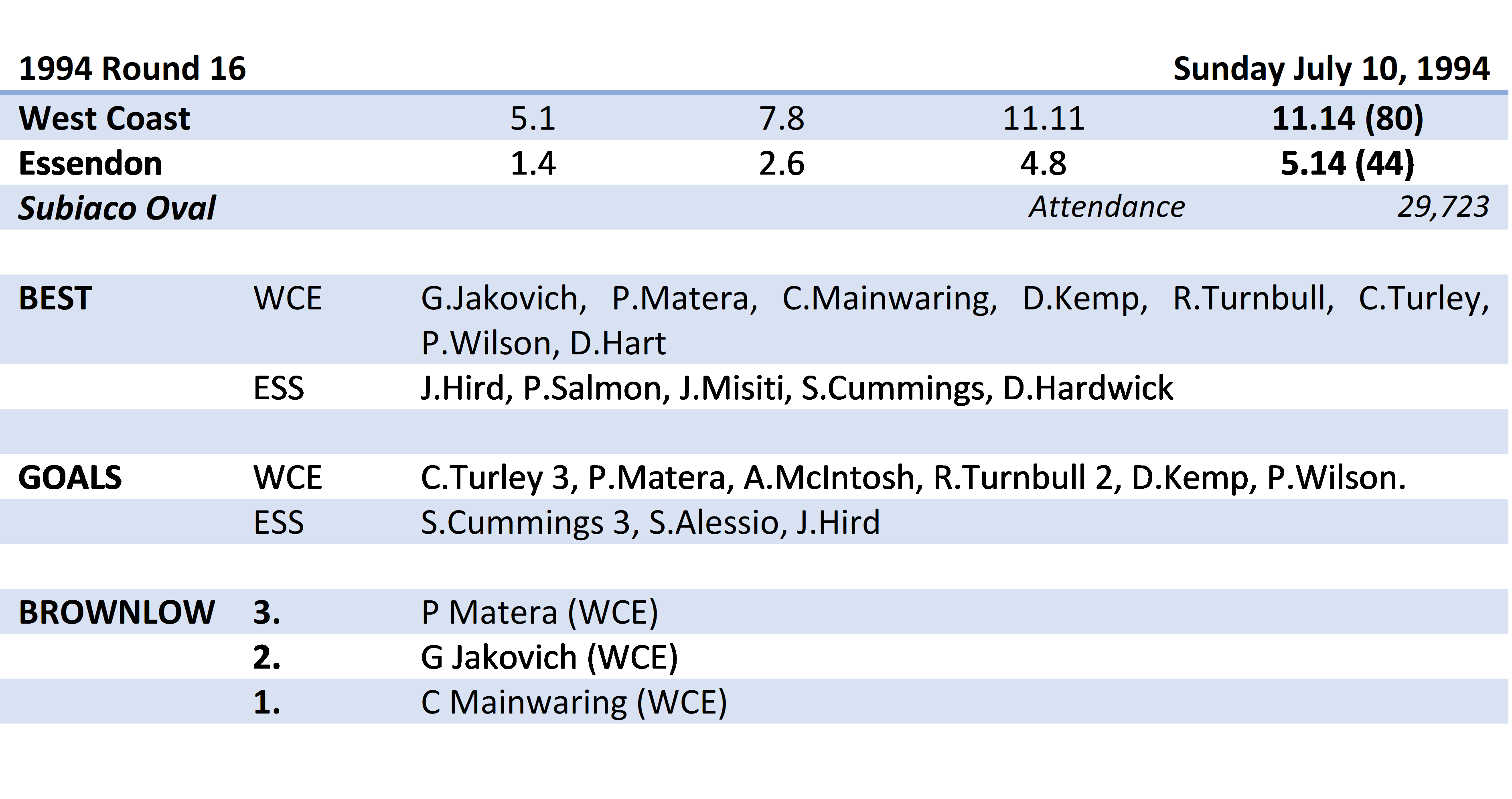
1994 Rewind: Scarves & Swamps

West Coast retained their premiership favouritism and Eagles fans got to exact their revenge but the biggest talking point after West Coast’s 36 point win over Essendon was the dilapidated surface of Subiaco Oval.

With Perth in the midst of an uncharacteristic wet spell, Subiaco Oval resembled more of a muddy swamp than its customary fast-track, drawing the ire of Eagles coach Mick Malthouse.

The Eagles coach seemed more interested in savaging the state of the surface than discussing his side’s committed win over the reigning premiers. With one side of the stadium torn down ahead of the building of the new southern stand, Malthouse was sceptical over whether there had been appropriate care towards maintenance of the playing arena, with drainage around the ground, virtually non-existent.

Malthouse extended his criticism towards the WAFC in the hope that improvements would be made before the end of the season.

And when the Eagles coach did talk about his side’s performance, he remained stoically understated.

The game appeared done at quarter time with the Eagles jumping the Bombers booting five goals to one. Any chance of Essendon staging a comeback was extinguished at the start of the second term when driving rain descended the game into a quagmire.

By three-quarter time, West Coast had extended their lead to 45 points, before the two teams combined for 1.9 in the last quarter, with the two teams out on their legs in the heavy conditions.

The win kept West Coast at the top of the ladder a game ahead of the Blues, with Malthouse acknowledging that a win over the 1993 premiers gave a good indication of where the Eagles sat. “I believed if you want to assess yourself you have to do it against the previous year’s premiership side. Last year everyone wanted to have a crack at us to see where they sat.”

“I think after the halfway mark if you are on top, you should really aspire to stay there. It is tough enough to get there and its going to be tough to stay there”, Malthouse said.

More pleasing for Malthouse was the successful return of Peter Sumich, who made it through four quarters, despite having little impact. Sumich was held scoreless from three kicks but there was relief after the game that the full-forward had managed to get through his first full game in over three months. “Peter did everything we wanted from him today,” Malthouse said.

Sumich was one of two inclusions, with Eagles captain John Worsfold finally making it to his 150th game after missing two of the previous three games. Sumich replaced David Hynes at full forward, while Shane Bond was the other exclusion through injury. Brett Spinks became the third out for the Eagles on game day, after being under an injury cloud all week, with Tony Godden coming in for his first game since Round 10.

The Bombers dropped Glenn Kilpatrick and Robert Stevenson, while their hero from the Round 1 win over West Coast, Che Cockatoo-Collins, couldn’t be considered after he dislocated a finger. Captain Mark Thompson was then a fourth change for the Bombers, when he was withdrawn on the morning of the game through illness.

David Grenvold replaced Thompson, with Anthony Daniher, Lachlan Ross and Russell Williams the other inclusions. The Bombers had been hopeful of bringing back a number of premiership stars for the trip West, but the likes of Mark Mercuri (groin), Dean Wallis (achilles), Rick Olarenshaw (back) and David Flood (hamstring) remained sidelined.

Dustin Fletcher, Michael Long and Mark Harvey were three more premiership players missing from the Essendon line-up, a fact that Malthouse was willing to present. “Essendon had three or four key players out of the side so we don’t want to get carried away with the victory.”

The make-up of the Bombers side would not have mattered to Eagles fans, who got their right of reply to Kevin Sheedy’s antics 12 months earlier. In the corresponding game of 1993, Sheedy emerged from the coaches box waving his jacket above his head after Paul Salmon had snatched a two point win over the Eagles in the final minute of the game.

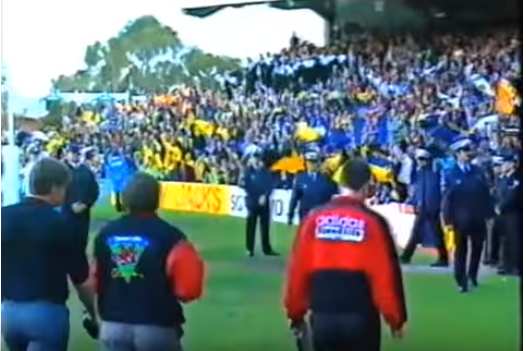
The Eagles had lost the two meetings since that game – the semi final of 1993 and then the opening round of 1994, both of which had been played in Melbourne – but as Kevin Sheedy walked the muddy boundary line towards the Bombers race, he was met with the mass celebration of scarves and jackets twirling above the heads of the jubliant Eagles crowd. The Essendon coach could do no more, than acknowledge the gesture with a wry smile and a nod of the head.

The Essendon coach is met with flying scarves after the Eagles 36 point win

If Sumich lasting 100 minutes was one feel good factor from the day, the other pleasing performance for the Eagles match committee would have been that of Craig Turley. After returning to the club following his retirement during the 1993 season, Turley’s form had been rather indifferent as he struggled to recapture the form that made him one of the premier midfielders of the preceding two seasons.

But against the Bombers, Turley bobbed up with three crucial goals from 12 disposals across half-forward as he appeared to revel in the tough, slippery conditions. Turley was also handed the task of stopping Essendon playmaker Gary O’Donnell, with the stand-in captain restricted to just 11 possessions, and a couple of stints on the bench.

The Eagles wingmen were again the standouts, with Chris Mainwaring leading the way with 27 disposals, while Peter Matera finished with 24 touches and five shots on goal, booting 2.3. Mainwaring benefitted from being matched against Darren Bewick, who had been moved to a wing to avoid the tag of David Hart. Bewick had enough of the ball (finishing with 18 possessions) but was nowhere near as damaging as the blonde Eagle, who continually linked the ball from defence to the forward line.

Glen Jakovich was again the rock in defence, picking up 22 disposals in his absorbing battles with James Hird. Hird often drifted up to the wing, but Jakovich remained in the Eagles defensive 50, often setting up as the Eagles seventh defender. Steven Alessio was sent to centre half forward to create a match-up with Jakovich, but Jason Ball was sent to defence, allowing Jakovich to pick off Essendon’s forward entries, many off Hird himself.

Ryan Turnbull also enjoyed plenty of freedom around the ground and had an important influence on the contest, particularly early in the game. With Paul Salmon often dropping a kick a behind the play after contesting the ruck, Turnbull positioned himself through the middle of the ground, drifting forward twice in the opening term to boot goals.

Peter Wilson picked up 22 disposals around the ground and Dean Kemp had 20 through the centre, although he lowered his colours slightly to Joe Misiti who finished with 25 disposals.

James Hird was the next best for Essendon, after Misiti, with 24 disposals and seven marks, while Sean Denham had 21. Gavin Wanganeed was switched forward after half-time and gathered 19 disposals, but the Bombers lacked few options forward of centre. Third-gamer Scott Cummings was the only winner in the Essendon forward line, booting three of the Bombers’ five goals for the game.

Sheedy was left to lament a poor attitude from his side in the opening quarter, which ultimately decided the game. “We were very undisciplined in the first quarter. It cost us dearly.”

One such incident involved Gary O’Donnell choosing to wrestle with Eagles captain John Worsfold, rather than contest a loose ball, which allowed Turley to stroll in and boot one of his three goals.  

While declaring that ‘the Eagles were looking pretty good’, Sheedy admitted that his side would have a battle to make finals, after they dropped to seventh on the ladder, amongst a strong group of teams vying for the lower spots in the top eight.

Richmond climbed to sixth on the ladder when they recorded a narrow three point win over Footscray, in what was a virtual eight-point clash. The Bulldogs dropped out of the top eight as a result, replaced by Geelong who, off the back of 10 goals from Gary Ablett, defeated Melbourne by 30 points.

At the pointy end of the table, Carlton and Hawthorn both recorded ten goal wins over Adelaide and St Kilda, respectively, to maintain their chase of West Coast. Collingwood moved into the top four after they beat Fitzroy by 49 points at the Western Oval, moving past North Melbourne who had the bye.