Eagles Get The Cream

West Coast Withstand Cats Comeback

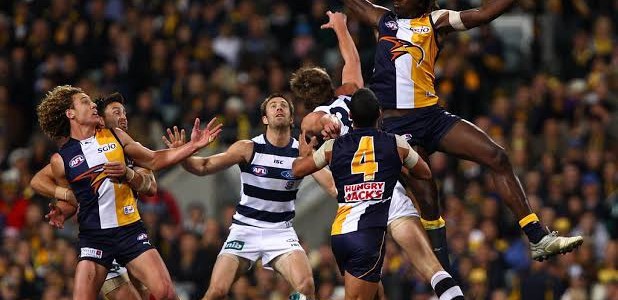
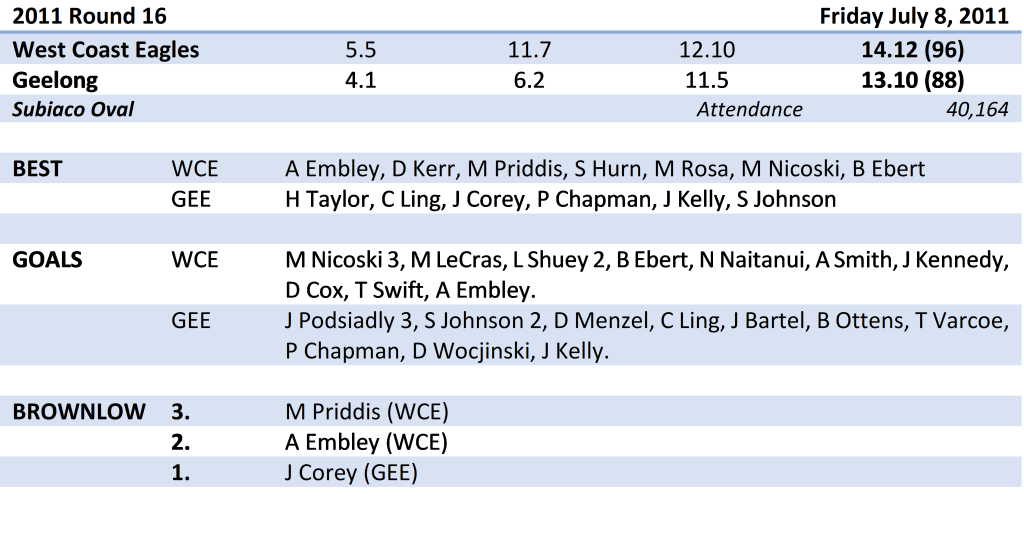
Thirty scintillating minutes either side of quarter time and some desperate final quarter defence saw West Coast get home by eight points over ladder-leaders Geelong in one of the games of the 2011 season.

Over 40,000 people packed Subiaco Oval on the Friday night to see the Eagles score their second straight win over a top-four side and continue their push to break into the double chance position.

The Eagles remained fifth following the win, but after serving their second bye the week before, now sat within four points of the Blues and Hawks, with an extra game up their sleeve.

Geelong arrived in Perth as the competition’s benchmark after first-year coach Chris Scott had guided his side to 13 wins from his first 13 games in charge – a VFL/AFL record – but had had their unbeaten streak ended the week before with a surprise four point loss to Essendon.

Scott talked up the Eagles in the lead up, declaring the trip to WA as the biggest challenge in the competition and the Cats could have been accused of having an eye on the Eagles ahead of their match with Essendon.

The Cats made the left-field decision to send several players to WA the week before, with Travis Varcoe and Joel Corey – who were both rested against Essendon – along with suspended midfielder Joel Selwood spending the week training with South Fremantle.

West Coast had their own tribunal issues ahead of the match with Quinten Lynch copping two one week suspensions for separate incidents involving Marc Murphy in the Eagles win over Carlton a fortnight earlier.

While Lynch would plead guilty to a striking charge, confirming his ineligibility for the Geelong match, the Eagles successfully challenged the grading of a rough conduct, reducing the level from high to medium which meant Lynch would serve just the one match suspension.

Lynch was joined by Sam Butler on the sidelines after the defender strained a quad in the final training session of the week. Patrick McGinnity and Koby Stevens were the two inclusions for West Coast, with Stevens making his first appearance of the season.

Geelong made three changes, with Varcoe and Corey returning, along with Taylor Hunt. The Cats were clear in their match selection as they chose a number of mid-sized runners to come into the side in place of tall forwards Mitch Brown and Tom Gillies. Andrew Mackie was the third exclusion for Geelong due to soreness.

Dean Cox started in the ruck for West Coast, but had partner Nic Naitanui beside him at the opening bounce with John Worsfold throwing the Fijian into the centre square alongside Daniel Kerr and Matt Priddis.

The Eagles brought the early intensity with a number of forward entries that had the Geelong defence scrambling. However, for all of the home side’s endeavour, the class of the Cats stood out as they capitalised on the rebound.

Geelong booted four of the first five goals in the game – including their first three from just four forward 50 entries – with James Podsiadly bobbing up for two of them.

West Coast on the other hand were blowing their chances, with Mark Nicoski (twice) and Naitanui both missing simple shots in front of goal.

With five minutes left in the quarter Geelong led 4.1 to 1.3 but West Coast finished the quarter with a flurry of majors to get reward for their dominance. And it was the two players who had been guilty in front of goal earlier in the term who sparked what would be an unanswered nine goal run.

Naitanui would be the fortunate recipient of an overturned free kick in the forward pocket after Jack Darling had sprayed a set shot out on the full. With Geelong set to take possession, Steve Johnson took unkindly to the attention he was receiving from Adam Selwood off the ball, gifting the ball back to the Eagles, where Naitanui snapped truly from the behind post.

Josh Kennedy eked through the Eagles’ third goal after a scramble near the goal square before Mark Nicoski produced a moment of magic.

Collecting the ball on the bounce near the boundary line and cornered by two Geelong defenders, Nicoski fashioned a checkside effort as he was falling backwards that purely defied his two earlier misses from dead in front. That put West Coast in front with Mark LeCras extending the Eagles lead to ten points at the first change in the dying seconds.

The final major told the tale of the first term.

The longer the quarter went, the less sure and composed the Cats defence appeared in the face of the Eagles forward pressure. With the seconds ticking down, Travis Varcoe had possession and looked to exit the ball from the defensive arc. Varcoe overshot his handpass which went directly to Mark LeCras, who then cut a swathe through two defenders and caressed the ball home for the Eagles’ fifth goal from the 50m line.

West Coast had enjoyed 77% of the play in their forward half and led the inside 50 count 18-8 with many of their early matchups were working in their advantage.

Adam Selwood was minding the enigmatic Steve Johnson, brother Scott was doing a similar job on Bartel and Darren Glass had kept the dangerous Daniel Menzel to just two disposals. Brad Ebert had been deployed as a defensive forward on Matthew Scarlett, with the intent of dragging the Cats full back out of the play.

If West Coast had been guilty of not maximising the glut of forward entries in the first quarter, there was no such issue in the second term as the Eagles piled on five goals in 17 minutes to stun the Cats. From sixteen points down entering time-on of the first term, West Coast had advanced to a 40 point lead entering time-on of the second.
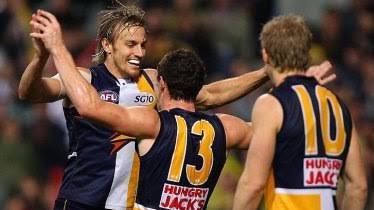
Mark Nicoski was dynamic for West Coast up forward with three goals

Bartel eventually ended the Eagles run, but when Brad Ebert rolled home his first major just before half time after another poor turnover in defence by Geelong, this time by Taylor Hunt, West Coast had secured a 35 point lead at the main break.

The Eagles midfield were in complete control from the first half, with Andrew Embley (20 disposals, three clearances), Daniel Kerr (15 disposals, four clearances) and Matt Priddis (14 disposals, four clearances) all prominent.

For Geelong, only Cameron Ling with 18 disposals for the half showed resistance.

The Cats though weren’t the top side in the competition by accident and they proved as such in the early stages of the third quarter when they slammed on four goals in nine minutes to cut the Eagles lead back to 10 points.

Dean Cox provided a steadier but David Wocjinski reduced the margin once again heading into three-quarter time as the match started to take on a different look than earlier in the piece.

Where West Coast had virtually monopolised forward half possession and hunted the Cats when they attempted to control the ball, it was now Geelong that was generating multiple forward 50 entries with the Eagles trying to hold off their momentum.

The first goal of the final term was crucial to both sides, and it would be West Coast who would get the vital strike. With a ball up in their goal square, James Kelly took possession and looked to switch the ball towards the Chris Mainwaring wing. But the ball had barely travelled a metre off his boot before being intercepted by Mark Nicoski, who cleanly took the ball and drilled his third goal of the night.

Geelong continued to press but the first quarter efficiency had all but disappeared as they butchered a spate of chances in front of goal. Paul Chapman, Wocjinski, Steve Johnson and Steven Motlop all missed gettable shots and they were made to pay when Andrew Embley sealed the match on a breakaway move.

Having endured repeat forward entries, Darren Glass was able to mark a Podsiadly entry into the forward line and switch the play as West Coast found a way around the Geelong defence. Josh Kennedy was able to mark at half forward and spotted Embley alone in the forward pocket.

Having taken the mark, Embley inadvertently took a step forward – enough for the umpire to wave play on as Scarlett and Taylor came bearing down on the Eagles wingman. Corralled towards the boundary line and on the wrong side for a right footer, Embley ducked and baulked the pair before swinging home the sealer.

The Cats finished with the final two majors to keep fans on edge, but West Coast had done enough to keep Geelong at bay and record their 10th win of the season.

A pleased John Worsfold commended the maturity of his side as Geelong mounted their comeback. “I think holding on to win with Geelong throwing everything at us in the second half to get back into the game… and the composure the boys showed through the last quarter. I thought that was great…”

“Beating Carlton was fairly important for us because we had some pretty closes losses against some of the other teams that… were going pretty well. It was reward for effort, I think, because we had pushed those teams and lost close games.”

“In the last two weeks we have pushed good teams and won.”

Chris Scott lamented his side’s poor second quarter, which ultimately cost them the game despite the strong second half performance. The Cats recorded 34 inside 50s after half-time, to just 13 for the Eagles and ended up winning the count 52-43 for the match, but had left themselves too much to do.

“Our first half was really bad, theirs was really good. We just didn’t do enough to stop the momentum. They kicked nine straight at one stage.”

“We left ourselves with too much to do, but our gusy are pretty tough and have great character. Even our young players are showing that they play the Geelong way when the chips are down and the disappointing thing is we just didn’t do enough.”

Joel Corey, Corey Enright and Paul Chapman all lifted their rate in the second half with rookie ruckman Nathan Vardy getting a handle of the stoppages. Cameron Ling finished as the leading ball winner with 30 disposals, while Chapman collected 13 touches in the final term to finish the match with 29. Joel Corey tallied 28 possessions and Harry Taylor had 23 disposals and nine marks opposed to Darling in defence.

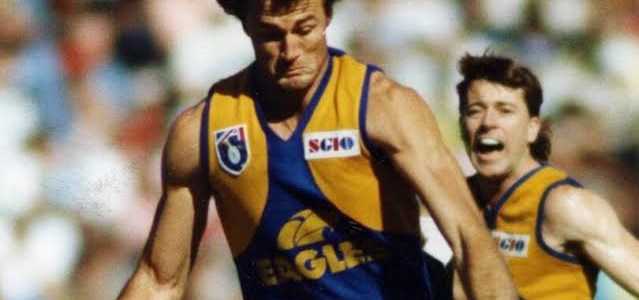
Andrew Embley was outstanding for West Coast for four quarters, picking up 32 touches on top of kicking the sealing goal. Matt Priddis did much of the grunt work in the middle, while Shannon Hurn and Daniel Kerr each picked up 24 touches. Brad Ebert quelled the influence of Matthew Scarlett and chimed in for 20 disposals and a goal and Matt Rosa was important in the last quarter.

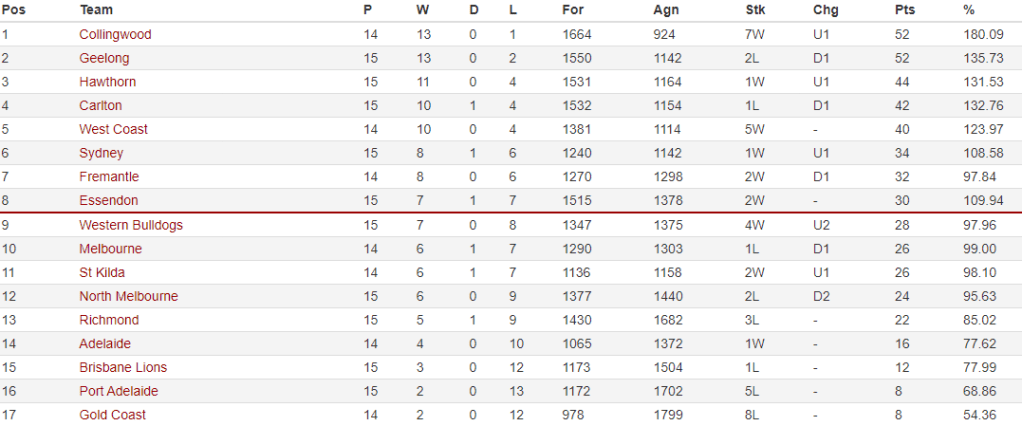
The Cats lost more than the four points on the evening, as they were usurped from top position following a second successive defeat. Collingwood overtook the Cats with a superior percentage after they demolished North Melbourne by 117 points.

Carlton’s surprise 27 point defeat to the Bulldogs, which had the Bulldogs on the edge of the top eight, now had the Blues prime for the picking in fourth spot. West Coast had the prize of the double chance firmly in their grasp but the ever-straight Worsfold continued to preach the evolution of his squad.

“Our goals have always been about continual improvement.”

“It has come pretty quickly in terms of this year, but we are still a long way short of where we want to be”, Worsfold said.

“But we are prepared to do the hard work it is going to take.”
1990 Rewind: Eagles Lock In Double Chance

West Coast Hold Third With Final Quarter Fightback

As the clock ticked into time-on of the third quarter at Kardinia Park, the Eagles’ double chance hopes looked shot.

A goal to Trevor Poole had extended Geelong’s lead out to 31 points over a sluggish West Coast side that had been unable to match the Cats throughout the afternoon. Elsewhere, results were not favouring the Eagles.

With the Magpies thrashing North Melbourne and the Demons holding a handy advantage heading towards three quarter time over the Hawks, West Coast were poised to drop to fourth to face reigning premiers Hawthorn in an elimination final in the first week of the finals.

But the Eagles of 1990 have developed the steely resolve of their back-pocket coach and by game’s end, West Coast were celebrating another incredible win in the clubs short history.

Goals to Craig McGrath, Peter Sumich and Chris Waterman in the final six minutes leading into three-quarter time reduced the margin to 18 points, to give West Coast hope and put the stutters into the Cats and their fans.

Then Brett Heady – who had been well beaten by Geelong’s best player on the afternoon, Ken Hinkley – bobbed up to kick two quick goals to start the final term when Hinkley was forced off the ground with injury.

Karl Langdon also added a brace of goals in the final term as West Coast steamrolled the home side five goals to one, securing a seven point victory.

And it was a returning big man who seemed to be the catalyst for the Eagles comeback.

Laurie Keene hadn’t been seen at AFL level since Round 2 1989 as he battled knee and lower leg complaints but was named after stringing together a number of games with Subiaco. Keene had travelled with the squad to Brisbane the week before and was promoted to the senior side after Mick Malthouse lost patience with the ruck pairing of Phil Scott and Dean Irving.

Scott held his place but Irving was omitted from the team that defeated Brisbane, along with Phil Narkle and Dean Turner. Joining Keene into the team were Paul Peos, who was selected for his first match since suffering a knee injury in round 3, and Dwayne Lamb who made a surprise return just two weeks after breaking his forearm.

Lamb took to the field with an arm brace and was assigned the job of minding Cats centreman Paul Couch. Scott started in the ruck, with Keene forward and John Worsfold was matched on dangerous Cats forward Gary Ablett.

Geelong had endured a horror season, with just eight wins for the season and would have been excused for having their minds on Mad Monday, rather than the clash with the Eagles. But it was Geelong who started the game like there was something on the line.

Stoneham controlled the ruck, allowing the likes of Neville Bruns and Garry Hocking to drive Geelong forward where Ablett was all over Worsfold. The Geelong forward had six shots on goal in the first quarter alone, but was wasteful with 2.3 and one that sailed out of bounds.

The Cats had only a four point lead at quarter time to show for their early dominance, but they were able to grow their lead over the next two terms with Ken Hinkley controlling the play at half back and the Malekellis brothers joining Hocking and Bruns in winning plenty of the ball through the middle.

Malthouse persisted with Worsfold on Ablett and Lamb had the better of his duel with Couch, but many other Eagles struggled to work their way into the game. Steve Malaxos, David Hart, Dean Kemp and Craig Turley had limited impact in the game, while up forward Peter Sumich was well held by novice Cats defender Mark Neeld.

Sumich had limped off with a hamstring concern the week before against the Bears, but played against Geelong with Malthouse adamant during the week that there was nothing wrong with the Eagle spearhead.

It took the move of Keene into the ruck to swing the match.

Keene took over from Phil Scott in the ruck midway through the third term and his influence at the stoppages was immediate. Chris Lewis and Scott Watters were able to gain an upper hand at the clearances and the Eagles started to generate meaningful forward entries.

Scott Watters produced his best game of the season against the Cats

The Eagles would finish with eight of the last ten goals in the match, confirming third spot – the position they had held on the ladder since round 14 – and were set for the clubs’ second ever final against Collingwood.

The win to West Coast said as much as the loss did about Geelong.

For the second week in a row, the Cats had lost at home late in the game after giving up a decisive lead. The Cats had capitulated on multiple occasions during the season and this match was the fifth time instance where Geelong had lost despite having more scoring shots.

For Geelong, the writing on the wall for season 1990 may have been in the humiliating 115 point round one loss to Hawthorn, in the Grand Final replay.

Cats coach Malcolm Blight was pointed in his criticism of the football club. “I’m starting to think that if a side gets close to us, history shows they can beat us.”

“That’s going to be the biggest thing for the Geelong Football Club to overcome.”

The return of Keene also added a new element to the West Coast side, with Blight stating ‘he gave the Eagles a look they haven’t had all year’.

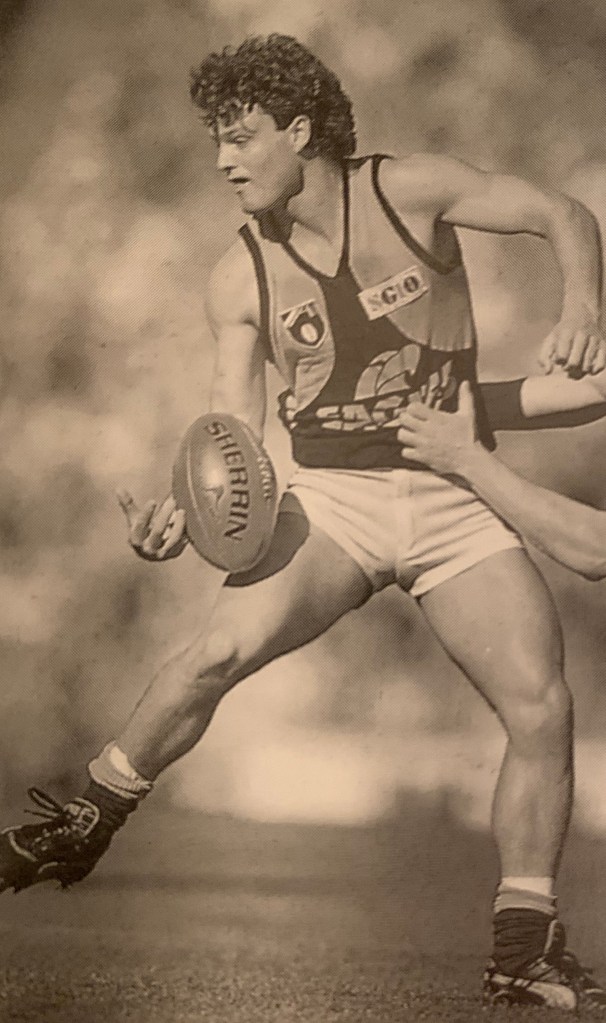
Chris Lewis was again one of the best for West Coast with 20 touches and two goals, while Dwayne Lamb marked his remarkable return with a team high 26 disposals. Lamb also nullified the influence of Paul Couch, with Blight dragging his Brownlow medallist from the ground during the third term.

Scott Watters recorded his highest possession count for the season with 23 and had appeared to time his claim for a senior spot to perfection, having returned to the league side the week before against Brisbane.

Chris Mainwaring worked his way into the game with 24 disposals and Paul Peos also produced a strong showing in his return from injury with 22 touches on the wing.

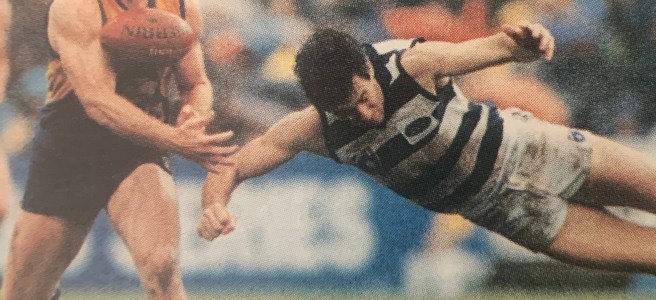
Neville Bruns was a four-quarter performer for the Cats with 24 kicks and 11 handpasses and Ken Hinkley was the Cats’ best before he hobbled off early in the final term, having accumulated 30 disposals and nine marks.

Garry Hocking picked up 24 touches, Barry Stoneham collected 20 disposals and nine marks in his battle with Phil Scott and then Keene in the ruck, while Gary Ablett was the prime forward in the match, booting 6.5 from 15 disposals.

All spots were up for grabs heading into the final round, but with West Coast overcoming the Cats, there were no changes to the final make-up of the top five.

Essendon secured the minor premiership with a 35 point win over the Saints, who were once again without Tony Lockett. The Bombers trailed at half-time, but a seven-goal final term got the Bombers the win. The match was most notable for the appearance of all four Daniher brothers in the same team; the first time a quartet of brothers played together in the same team.

Collingwood did it easy over North Melbourne, coasting to an 89 point win to finish second on the ladder. With the result determined by half-time, most of the interest surrounded whether Kangaroos full forward and Coleman medal incumbent John Longmire could reach 100 goals for the season.

Longmire had started the match with 96 goals for the season, but his accuracy in front of goal deserted him, returning an inaccurate 2.8 to fall two goals short of the ton.

Melbourne and Hawthorn stayed in fourth and fifth with the Demons holding to a 12 point win, upsetting Hawks captain Michael Tuck’s record-breaking 404th AFL game. The Demons led by 39 points at three-quarter time, but had to withstand a fightback from the Hawks in the final term. The result meant that the two teams were set to play again the following week in the elimination final.

Eagles coach Mick Malthouse acknowledged the achievement of rebounding from a poor 1989 season to reaching finals in 1990, but declared his side would have much to improve on ahead of the Magpies.

Malthouse was also confident that Keene had put the ongoing injury issues of the past 18 months behind him, and could be an important cog in West Coast’s finals campaign.

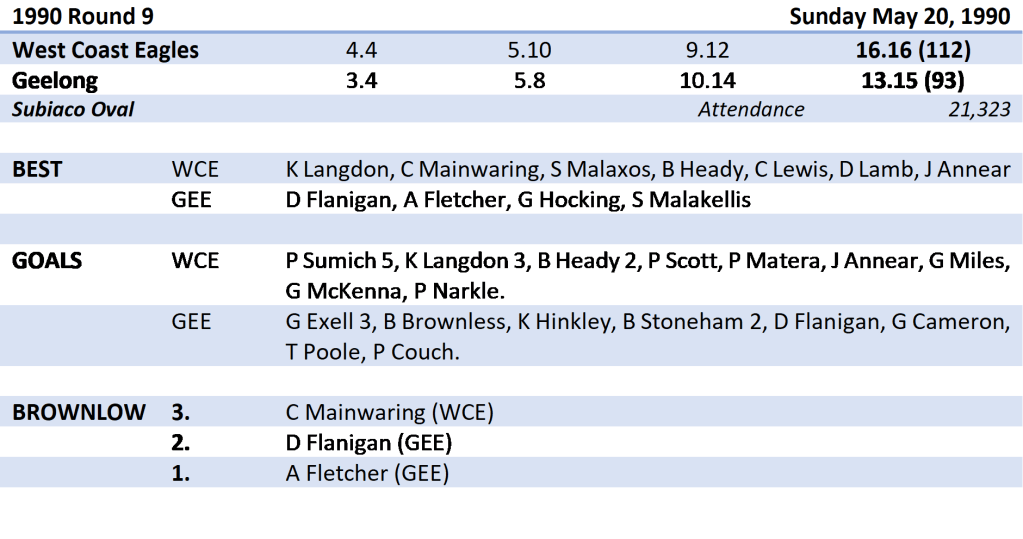
1990 Rewind: Eagles Storm Home

Captain’s Call Pays Off

West Coast rode the wind – and the tide – with a seven goal final quarter that sealed a 19 point win in a rollercoaster game of momentum played in driving rain.

In one of the games of the season, the lead changed hands 12 times, and were level three times during the final quarter, before the Eagles were able to come out on top.

Recalled midfielder John Annear stood up in a desperate final quarter as he, Steve Malaxos and Chris Lewis inspired the Eagles to the gutsy win.

Annear was the only change for the Eagles, replacing Tony Begovich who had made his debut the week before against the Bears.

The Cats made three changes coming into the match, as they looked to arrest an embarrassing slide that had seen them drop games against cellar dwellers Richmond and Sydney.

David Cameron, Tim Darcy and Bruce Lindner were all dropped, with Ray Sterrett, Neville Bruns and Dwayne Russell all brought into the line-up. Geelong coach Malcolm Blight was conscious of the wide expanses of Subiaco Oval bringing in players renowned for speed to match the equally pacy Eagles.

The Cats though were still without match winner Gary Ablett, who had been unavailable since having surgery to repair knee cartilage heading into Round 6. Ablett had carried the injury since the Cats night series match against the Kangaroos, although that hadn’t stopped his proficiency in front of goal, booting 24 goals in his first four games of the season before being sidelined.

The first decisive moment of the match, came before the match, when Eagles captain Steve Malaxos won the toss but chose to kick into the gale that was sweeping towards the Subiaco end. West Coast then bounced out of the gates, kicking the opening three goals into the wind and holding onto a six point advantage at the first break.

However, the Cats were just as effective into the wind, restricting the Eagles to just one major although West Coast also had themselves to blame with six behinds for the term. The Eagles led by just two points at the main break, and were down a man after Peter Wilson limped off with a hamstring injury.

The second half then became a battle for momentum.

The Cats were far more effective with their second use of the wind, booting five goals for the term to open up an eight-point lead with a quarter to play. Adrian Fletcher had been kept quiet by Malaxos through the first half, but broke free in the third term with 12 disposals as he, Paul Couch (eight disposals) and Neville Bruns (six) took control through the middle.

Geelong ruckman Darren Flanigan provided the service for his midfielders at the ruck, overwhelming Phil Scott, and later Stevan Jackson. Flanigan finished with 39 hit-outs for the game as Geelong held an ascendancy at the stoppages.

However, the Eagles did enough to hang in the contest, mostly through the work of Chris Mainwaring on the wing and Karl Langdon up forward. Mainwaring was one of the Eagles’ best in the first half with 16 disposals and continued his fine work after half-time picking up nine disposals for the term.

Langdon had started the game on the bench alongside John Annear, but he burst into the game after half-time with three of the Eagles four goals for the quarter.

And as the rain dissipated before the start of the final term, Malaxos’ decision at the coin toss became vindicated. Chris Lewis and Phil Narkle provided the class in the final term, along with several desperate acts from Annear to get West Coast over the line. Annear also bobbed up for a vital goal at the start of the quarter and proved an astute inclusion given the conditions.

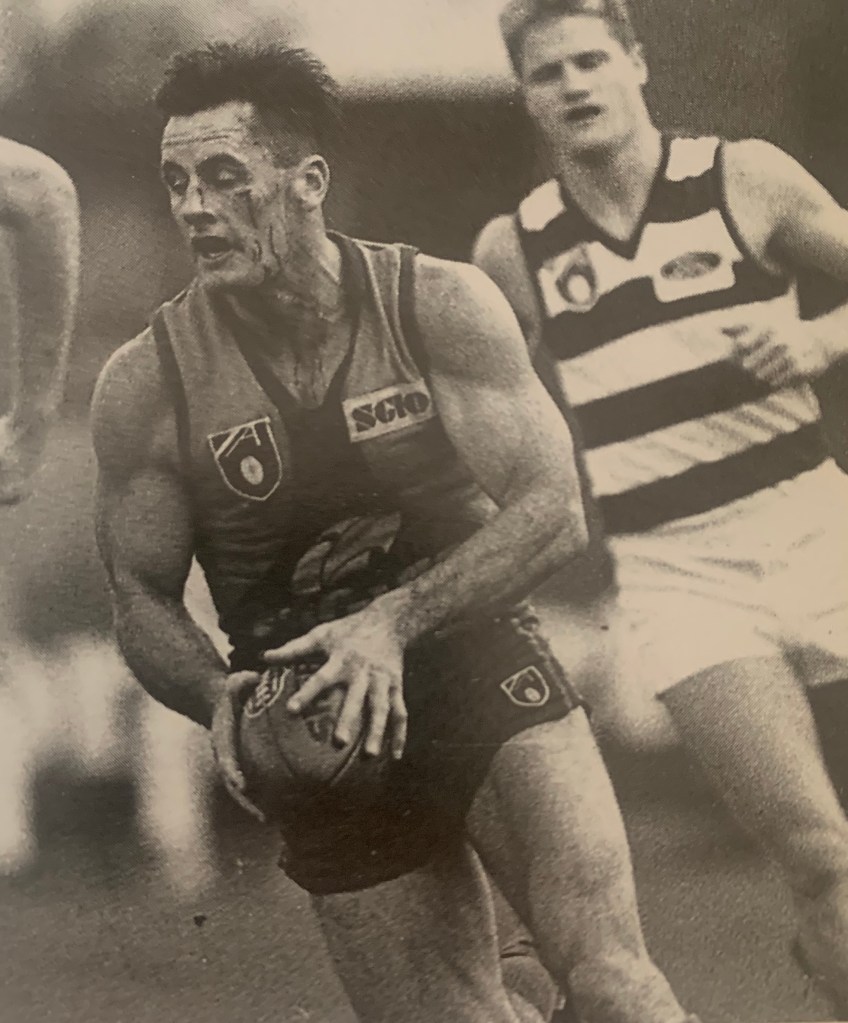
A bloodied John Annear was instrumental in the final quarter surge

After the game, a beaming Malthouse declared his side had answered another one of the Melbourne media criticisms. “We played tough footy in ordinary conditions and that’s what footy is all about – tough and relentless.”

“I would like to keep the dry tracks in Perth but we won’t be disappointed going to Melbourne in the rain.”

Malthouse, though, admitted his side were lucky with the gamble at the toss. “It was raining and we were fortunate to come home with the wind and without the rain.”

Mainwaring finished with 30 disposals for the match, while Chris Lewis and Stephen Malaxos were the next best with 23. Peter Sumich continued his strong form for the season, booting 5.4, stepping up with multiple goals in the final term as West Coast surged.

Geelong coach Malcolm Blight praised his side’s effort and intensity but shared disappointment with some of the ball use. “That touch of class at the end is not working for us.”

Barry Stoneham provided a focal target up forward and Garry Hocking was one of the best for the Cats, but they had too few contributors across the day.

“We’ve been having a dip over the past three weeks and we have lost three games by small amounts,” Blight said.

The third-straight defeat left the Cats with a tough task ahead through the second half of the season, sitting two games and hefty percentage behind the fifth-placed Magpies. However, Blight refused to concede the finals’ hopes of last year’s Grand Finalists were over.

“It’s mission impossible when you’re two games out with one game to go.”

The win saw the Eagles draw level with the Melbourne at the top of the ladder, although they remained in second spot behind the Demons on percentage. Melbourne suffered their second loss of the season when they were easily brushed aside by a Hawthorn side who were keen to atone for their humiliating loss to Carlton a week earlier.

The Hawks moved up to fourth, in place of St Kilda, who dropped out of the top five when they fell to Essendon at Windy Hill. In the battle of 3rd and 4th, the Lockett-less Saints pushed the Bombers all the way, but came up 11 points short.

Collingwood forced their way back into the top five for the first time in a month, when they thrashed North Melbourne by 80 points at Victoria Park. Gavin Brown and Peter Daicos each booted seven goals as the Magpies slammed on 11 final quarter goals to secure an important percentage-boosting win.

The Magpies moved a game clear of the Saints, who were joined by Carlton and Footscray on the edge of the finals’ spots, after they recorded easy victories over Fitzroy and Brisbane.

While the Eagles could feel satisfied with a hard-earned four points and equal-top spot on the ladder, they were less than thrilled with the AFL judiciary, who returned a no-result over their investigations involving Annear and Hocking. The pair clashed twice in a fiery last quarter, with Annear requiring two sets of stitches to repair cuts on his face.

But with Channel 7 unable to supply footage of the incidents from the match, the AFL determined there was insufficient evidence to move forward. Eagles general manager Brian Cook conceded the club wouldn’t lodge an official complaint over the incidents.