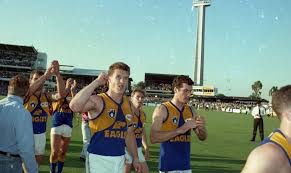
West Coast Demolish Cats For 1994 Flag

Two Out Of Three Ain’t Bad For Eagles

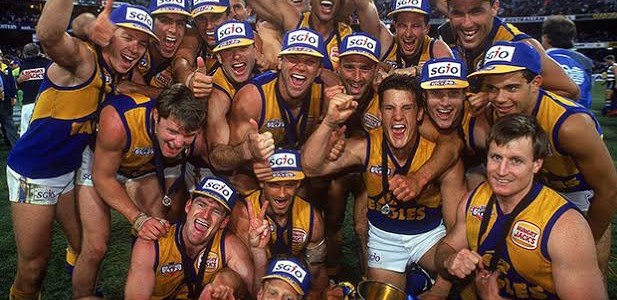
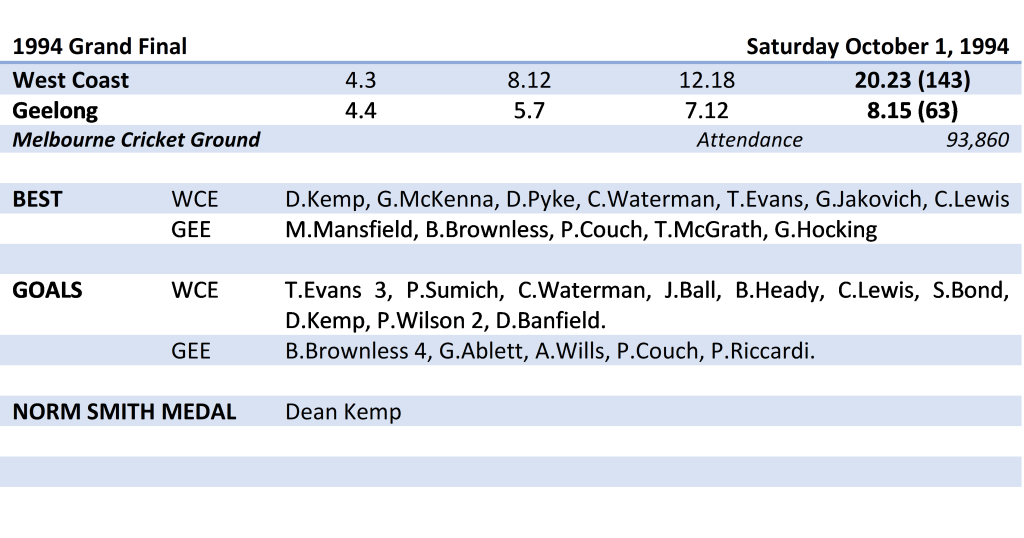
West Coast reinstated themselves as the kings of the competition when they crushed Geelong by 80 points to win the 1994 Grand Final.

Two years after an historic first flag, the Eagles steamrolled the Cats to their second premiership, erasing the disappointment of a failed 1993 season.

Dean Kemp claimed the Norm Smith medal for best afield and Tony Evans repeated his 1992 haul of three goals as West Coast booted their highest score in over two years.

Traditionally recognised as a defence-oriented side, the Eagles racked up 43 shots on goal in the Grand Final, a week after they posted 37 scoring shots against Melbourne. Ten Eagles in total hit the scoreboard as West Coast recorded the fourth largest winning margin in Grand Final history.

For the Cats, the defeat was their third loss in the season decider in six seasons, having gone down to the Eagles by 28 points in 1992 and the Hawks by six in 1989.

A shattered Malcolm Blight could offer no explanation after the match, saying there was ultimately nothing his side could do. “I could say a million things about what we might have done or could have done. But at the end of the day they were 80 points better than us, which is pretty hard to cop really.”

Eagles coach Mick Malthouse admitted he sympathised with the Cats, but was equally ecstatic with his side’s performance.

“I just love seeing the day for the club and all the players… I get a bigger kick out of seeing the players enjoy themselves.”

West Coast made just one change from the preliminary final, with Ashley McIntosh coming back into the team after missing with a knee injury. Mitchell White was the player to make way, after coming into the side as McIntosh’s replacement, but remained an outside chance on the morning of the game as West Coast debated whether to remove one of their ruckman.

However, the pair of David Hynes and Ryan Turnbull was retained to tackle John Barnes who was openly struggling with a lower leg injury. Geelong remained unchanged from their last-gasp six point win over North Melbourne, with Grant Tanner ruled out earlier in the week in his bid to recover from an ankle injury.

McIntosh started in defence on Bill Brownless, with Michael Brennan tasked with minding Gary Ablett. The Cats tried to throw the Eagles defence early, starting Ablett on the wing but he quickly moved to the goal square after failing to have an impact.

In a reverse to the 1992 meeting, it was West Coast who had the fast start, booting the first three goals in the game. Tony Evans, Chris Lewis and Shane Bond all kicked majors as the Eagles jumped to a 20 point lead.

West Coast had had all of the play out of the middle of the ground but the momentum of the game soon changed when Geelong piled on four goals in eight minutes. Tim McGrath and Michael Mansfield provided the dash off half back for the Cats with Paul Couch opening the Cats account.

Three more goals followed in quick time to give Geelong a seven point lead, before Brett Heady settled the Eagles just before quarter time to reduce the Cats lead to one point at the first change.

It would prove to be the only period of ascendency Geelong would have in the game.

West Coast resumed control at the start of the second term and only poor kicking on goal prevented the Eagles from having the game won by half time. Peter Wilson kicked consecutive goals to start the quarter as West Coast camped the ball in their forward half.

The Eagles created confusion at the Geelong kick-ins when they changed tack from their usual one-on-one set up to a zone defence. The usually precise Mansfield and Ken Hinkley were undecided with their re-entries preventing clean getaways from their back half, which had been a trademark through their finals campaign.

Twice in the second quarter West Coast picked off their kick-ins. Tony Evans intercepted a Ken Hinkley pass to mark and goal, before then having an intercepting hand that rebounded to Peter Sumich allowing the Eagles full forward to send the ball back over his opponent in Stephen O’Reilly.

The Eagles continued their dominance of general play but, remarkably, when Bill Brownless booted his third goal midway through the third term, the Cats were still within touching distance trailing by just 18 points.

However, three majors to Dean Kemp, Brett Heady and Peter Sumich extended their lead to six goals by three-quarter time and Geelong’s slimmer of Hope was all but gone.

The last quarter was a celebration for West Coast, as they slammed on eight goals to one to demoralise the opposition and the majority of the pro-Geelong crowd.

Symbolic of the day for West Coast and for their Norm Smith medallist Dean Kemp, their 17th goal came about purely by accident. Kemp’s kick inside 50 was intended for Chris Lewis who was crunched out of marking the ball by Tim McGrath, only for the ball to carry on its path and bounce harmlessly through for another goal.

Kemp was sublime for the Eagles on a day when they had a healthy number of contributors. The Eagles centreman had 23 disposals and booted two goals to outpoint Geelong captain Mark Bairstow, who had a dirty day. It also meant that Bairstow finished with the inglorious honour of once again playing on the Norm Smith medal, after lining up on Peter Matera’s wing in his five goal performance of 1992.
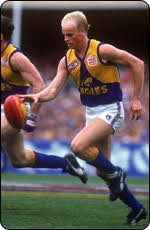
Dean Kemp was best afield for West Coast

Don Pyke collected 26 possessions through the middle and just had the edge over Geelong’s Paul Couch. One of Geelong’s prime movers was relegated into a defensive role as he tried to curb the influence of the Eagles centreline.

The Eagles defence was as impregnable as ever, led by Glen Jakovich (20 possessions) and Guy McKenna (23) across half back. Jakovich played his own game standing in the way of Geelong’s forward entries and proving too strong for both Steven Handley and David Mensch. McKenna provided the run from the backline as he outclassed Adrian Hickmott.

Michael Brennan blanketed Gary Ablett, with the Geelong superstar managing just one goal from five disposals and David Hart had the better of Leigh Tudor in the back pocket. Geelong’s only winner in their forward half was Billy Brownless, who exorcised some of his demons from the 1992 Grand Final when he was humbled by Ashley McIntosh.

Brownless kicked four goals for the Cats – he was the only Geelong player to kick a goal after quarter time – and took one of the great Grand Final marks when he soared over McIntosh and managed to hold onto the ball from a second attempt.

Michael Mansfield was arguably the Cats best player with 21 disposals out of defence and having the better of Shane Bond, while Tim McGrath also did his best to withstand the avalanche. Garry Hocking finished with 20 possessions after being forced off during the first term with a heavy cork and returning to the ground in the second half with heavy padding around his upper leg.

But it was a day that belonged to West Coast.

15 members of the 1992 triumph were now dual premiership players, while there was redemption for David Hynes and David Hart, who were the unlucky stories from two years earlier.

And even with two of the heroes from 1992, in Peter Sumich and Peter Matera, having subdued outings, there were plenty of others who stepped up. Sumich and Matera combined for 11 goals in the clubs first flag as West Coast had just four goal kickers for the day. This time around, nearly half of the team kicked goals, as the likes of Chris Lewis, Brett Heady and Jason Ball provided strong targets up forward.

Chris Waterman came onto the ground early in the second term after Chris Mainwaring was forced off with a corked hip and put in one of his finest performances with 18 disposals and two final quarter goals (to go with four behinds). Mainwaring himself was able to return to the field and pick up 18 disposals.

Mick Malthouse even broke with his own tradition in heading down to the bench with three minutes remaining. Malthouse had been reluctant to leave the box two years earlier, despite the urging of his coaching team, but with the game well in his side’s keeping, the Eagles coach revelled in the celebrations boundary side.

Malthouse admitted that he knew his side were home during the third quarter.

“We expected at some stage Geelong to give us a big quarter like they had over the last three or four weeks, so we were ready for it. We stuck to our basics, not to allow them to get that one quarter of football in.”

“At half-time I thought if we maintained our pressure, and we could hold them, we could do the job,” Malthouse said.

“So I guess three quarters of the way through the third quarter I thought we had them.”

Since taking over as senior coach at the end of 1989, Malthouse had steered the Eagles to no lower than fourth in five seasons, which now included two premierships from three Grand Final appearances.

The Eagles had massacred the Cats in one of the most emphatic premierships of the modern era and with that staked their claim as the pre-eminent club of the AFL.
1994 Rewind: West Coast Storm Into Decider

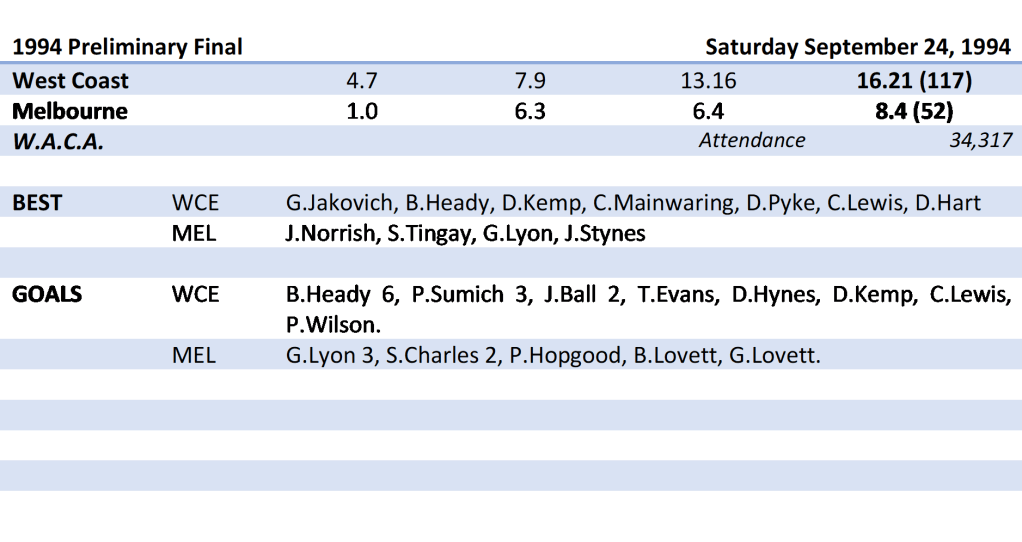
West Coast made it to their third grand final in four seasons when they convincingly defeated the Demons by 65 points in the preliminary final.

The Eagles ended Melbourne’s fairytale finals run, who had knocked off Carlton and then Footscray after finishing seventh at the end of the home and away season. Garry Lyon had booted a record 10 goals in the 79 point massacre of the Bulldogs, but the Demons ran out of steam against a refreshed Eagles outfit.

Despite having a fortnight to recover, Ashley McIntosh was ruled out of the preliminary final, allowing Mitchell White to come in for just his sixth game of the season as cover in the Eagles defence.

The Demons also made just one change to the team that thrashed Footscray the week before with sharpshooter Sean Charles adding to an already potent forward line, replacing the omitted Glenn Molloy.

Ahead of the game, tensions were raised between the two sides when two Melbourne officials were spotted watching the Eagles train in what was supposed to be a closed training session. While the Melbourne ‘spies’ – football manager Richard Griffiths and match committee chairman Greg Wells – had no issue with being asked to leave, the response from West Coast drew some mirth from Demons coach Neil Balme.

Balme proudly declared after the teams were submitted on Thursday night that Melbourne would go in as named. The Eagles, however, remained guarded over their final line up, with Mick Malthouse calling the antics from Melbourne as ‘childish games’.

The final 21 for West Coast wasn’t confirmed until just before bouncedown with West Coast swinging two late changes. Drew Banfield returned to the team after being dropped for the clash with Collingwood while Ryan Turnbull was brought into the team having recovered from a knee injury suffered against the Blues in Round 22. Craig Turley remained as the Eagles’ third emergency, unable to reclaim his spot in the side after serving a two games suspension for striking Greg Williams.

Turnbull’s inclusion to join David Hynes in the ruck was designed to counter the Demons’ strong ruck combination of Jim Stynes and Dean Irving. Tony Godden made way for Banfield, with Turnbull replacing Brett Spinks who was battling a knee concern picked up in the qualifying final.

The Demons stayed true to Balme’s claim that there would be no changes to the squad, but he still did his best to catch the Eagles off guard with a number of positional moves.

Stephen Tingay had previously matched against Chris Mainwaring on the wing, but he swapped sides with Matthew Febey to go head to head with Peter Matera. Febey was stationed against Mainwaring in a more defensive role, as the Demons looked to slow down the Eagles ball movement.

Dean Irving started in the ruck, leaving Jim Stynes to operate off the bench, while Andy Lovell shifted to half-back, initially matching up on Brett Heady.

However, only the Tingay move had any real effect as West Coast dominated the quarter, kicking with the wind. Matera had been under a cloud since injuring a back during the last quarter against Collingwood and was unable to work defensively on Tingay who collected 11 possessions in the first term. Malthouse moved Banfield to the wing to quell Tingay’s influence at the start of the second quarter, pushing Matera to a half forward flank.

Everywhere else on the ground was owned by the home team.

Tony Evans and Dean Kemp were both prominent early, with nine first-quarter possessions while Chris Lewis had eight across half-forward. All of the Eagles forwards got into the game early with the weight of possession in their forward half.

Mainwaring was dynamic on his wing opposed to Matthew Febey and Brett Heady was both too tall and too elusive for Lovell across half forward. The Eagles took control around the ball, with Irving lacking influence in the ruck against David Hynes.

The Eagles racked up 11 shots on goal for the term, but wasted a host of chances. West Coast were 1.7 at one stage, before three late majors to Jason Ball, Tony Evans and Peter Sumich created a deserved advantage.

The Demons, on the other hand, could manage just one shot on goal with Glenn Lovett responding to Brett Heady’s opener into the wind.

The second quarter became an arm wrestle as West Coast held the Demons at bay in defence but continually struggled to take chances up forward. Brett Heady missed a simple shot at the top of the goal square, before Garry Lyon broke the drought when he broke free of Michael Brennan.

That goal came with a tinge of controversy after Sumich was unlucky to be penalised at the other end. Sumich had a free kick paid against him after he pushed Sean Wight in the chest before going on a lead, with the Eagles full-forward then giving away 50 metres for remonstrating with the umpire.

The Lyon goal only served to open the game up.

Brett Heady found Chris Lewis for the instant reply, before kicking two himself as West Coast opened up a 32 point lead closing in on half time.

The Demons then showed the form that had propelled them through the first two weeks of the finals with three goals in as many minutes to close out the half.

Sean Charles swooped on a Michael Brennan fumble to snap truly, with the Demons kicking a second goal less than 20 seconds later when Andrew Obst won the clearance and found Brett Lovett who was able to kick on the breeze from the edge of the centre square.

Charles then had his second goal for the match after Melbourne were able to string a chain of handballs from half-back, with Viney releasing Charles into an open goal after reading the ball of a marking contest in the Demons forward 50. Melbourne had closed within 13 points in a blink of an eye and had one final chance on the half-time siren.

Andy Lovell had been moved to half-forward after losing the reins on Brett Heady and found himself on the end of a Dean Irving miskick to mark 40 metres out directly in front. Lovell could have brough the Demons to within a kick, but he skewed his shot on goal to allow West Coast to hold onto a 12 point lead.

The Eagles had smashed the Demons 13-3 in the centre clearances and had nearly 40 more possessions around the ground, but their inefficiency in front of goal prevented them from having one foot already in the Grand Final.

West Coast’s shooting on goal only got worse in the third quarter, but by the final changeit no longer mattered.

The Eagles had piled on 6.7 to a solitary behind with their second use of the wind to establish a nine goal lead that they were never going to give up.

The warning signs for Melbourne showed early in the term, with West Coast posting a further four points onto their half-time score, including what could almost have been a late goal of the year contender.

Glen Jakovich had completely shut out David Schwarz across half-back, and after picking up a loose ball in the back pocket, the burly centre half-back bounced his way through the middle of the WACA to the rousing roar of the home crowd. Jakovich launched from the top of the Eagles 50 metre arc only to see his shot on goal hit the base of the post, resulting in one of the more memorable points in club history.

Brett Heady ultimately got the first goal for the Eagles in the term, booting three in the quarter to take his match haul to six. His fifth goal came from another turnover from Andy Lovell in defence as Melbourne’s day started to capitulate.

Stephen Tingay – who had been the Demons best player in the first half – limped off with a knee injury, while David Neitz was forced to the bench after being crunched by Sumich in a marking contest.

The Eagles added three goals to two in the final quarter to run away with their largest ever win in a final.

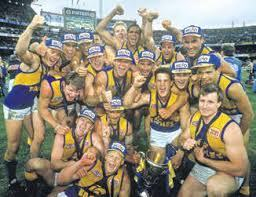
Eagle players celebrate another grand final

Malthouse was ecstatic post-match with the ‘almost faultless’ performance but was quick to point out that the job was still not done.

“Every club aims to make the Grand Final at the start of the season,” Malthouse said.

“Making the Grand Final is not good enough. Winning has got to be the aim.”

It was a deflating end for the Demons, who dared to dream after stunning finals wins over Carlton and Footscray left them one game shy of the big dance. Neil Balme admitted his team just couldn’t handle the occasion.

“I think our blokes just lost it. They lost all confidence in their ability to play footy.”

“They were shell-shocked.”

Melbourne struggled to have a winner on the ground, with West Coast’s defence supreme. Schwarz was virtually a spectator, with Mitchell White keeping Paul Prymke quiet. David Hart had the better of Sean Charles while John Worsfold and Guy McKenna provided their customary dash from half back.

Chris Mainwaring – who sported jumper number 43 after half-time due to blood rule stipulations – was the leading ball winner for the Eagles with 29, while Dean Kemp had the better of Jason Norrish, Andrew Obst and Andy Lovell with 25 disposals through the middle.

Brett Heady didn’t add to his six goal tally as he sat the final quarter on the bench. Peter Sumich finished with 3.3 despite a mixed performance, but Chris Lewis was electric with 20 disposals and a goal across half forward.

The Eagles Grand Final opponent had been decided earlier in the afternoon when Geelong defeated the Kangaroos in a classic encounter.

North Melbourne started the stronger of the two sides to lead by three goals at quarter time, but could have led by far more with straighter kicking on goal. The Cats then took charge with a seven goal to nil second term to lead by 24 points at the main break.

Geelong still led by 18 at the final change, but North Melbourne, with the benefit of a weeks rest, stormed home. The Cats drew level once again, before Leigh Tudor sent a wobbly kick to the top of the Geelong goal square in the dying seconds of the game. His kick landed in the arms of Gary Ablett, who sent the Cats into the Grand Final with a goal after the siren.

It was the second final in three weeks Geelong had won after the siren, with the Eagles and Cats set to square off two years after they clashed in the 1992 decider.

Building The Premiers

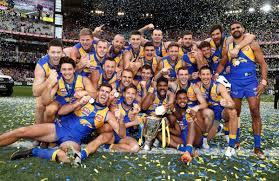
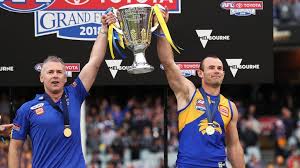
The trade period has ended for 2018 and the focus of 18 clubs now turns to this month’s draft as 17 clubs look to emulate the achievement of West Coast in 2019. The Eagles claimed their fourth flag – against pre-season odds – building a squad through a variety of trade and draft choices. How did West Coast bring their premiership side together? Here are five crucial trade and draft decisions that shaped the 2018 premiers.


The Chris Judd Trade

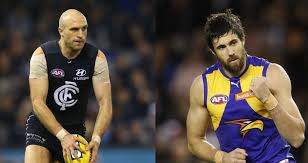
One of the most famous trades in modern AFL history brought two players to the Eagles who would play a part in the Eagles’ premiership success in their 11th season with the club. After being bundled out in straights sets in the 2007 finals series, the Eagles were rocked by confirmation from their club captain that he would return home to Victoria.

Captain of the 2006 premiership side, Judd was also a Brownlow medallist, a Norm Smith medallist and multiple best and fairest winner in six seasons with West Coast. The hottest property in the game, Judd commanded a big trade in return and after canvassing several clubs, Judd and West Coast believed that Carlton had the best to offer.

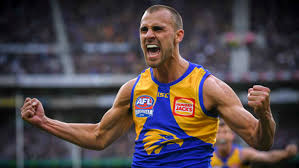
The Eagles were after the West Australian born forward taken two drafts earlier at number 4 and despite Carlton’s resistance (and also initially the player), Josh Kennedy was traded to West Coast in exchange for Judd. Also part of the deal were two of Carlton’s early draft picks, numbers 3 and 20 overall. While Tony Notte delivered little success with pick 20, Chris Masten arrived with the Eagles’ first selection and was an important link-man in 2018. With Kennedy, after years of debate, the Eagles have come out on top with that trade, Kennedy now the greatest goal kicker in the clubs history, and booting three important goals in the 2018 decider.

judd kennedy


Daniel McConnell Heads to the Kangaroos

Daniel McConnell had just a brief stint at West Coast, but his departure indirectly led to the Eagles’ selecting their 2018 premiership captain. McConnell had been an early draft pick in the 2003 National Draft, but after two games in two years, McConnell decided he wanted to head back to his native Victoria.

The Kangaroos were keen on the midfielder and stumped up two early draft picks in the 2005 National Draft to gain his services. North Melbourne gave West Coast picks 13 and 29, with the Eagles handing pick 18 back the other way along with McConnell. Having improved their initial position five spots in the draft, the Eagles settled on the strongly built Shannon Hurn from Central Districts. The Eagles would select forward Ben McKinley with pick 29, but he would find his way back to North Melbourne despite a promising 2008 season.

North for their part would trade pick 18 to the Hawks in exchange for Jonothan Hay, but the Eagles would be the big winners out of the trade in selecting their future captain. Hurn is set to play game 250 early in 2019 and will be etched in West Coast history in lifting the 2018 cup.

shannon hurn

Dale Thomas defects to Carlton

It has already circulated on social media, but Dale Thomas’ decision to leave Collingwood and join arch rival Carlton indirectly led to Dom Sheed – who would prove to be the match-winner in the Grand Final – finding his way to the Eagles. At the end of 2013, Thomas made the call to leave the Magpies and re-unite with former coach Mick Malthouse who had joined the Blues.

Thomas’ decision to leave Collingwood as a free agent resulted in the Magpies receiving a compensation pick through the middle of the first round – number 11 overall. The Eagles entered the 2013 trade period with pick 6 after a disastrous season had seen them fall to 13th on the ladder and signal the end of John Worsfold’s 12 year tenure at the club.

West Coast were set from the outset on taking Dom Sheed who hailed from Subiaco with pick 6 but were also in discussions with the Lions about securing Elliot Yeo, who after two seasons in Brisbane, had requested a move back home. The Lions wanted nothing less than the Eagles’ 2nd round selection (number 28 overall), but West Coast weren’t as keen as being without a pick in the second round.

Enter a pick swap with the Magpies who were desperate to hold two picks inside the top ten at the draft. West Coast and Collingwood negotiated a trade that would see the Eagles give away picks 6 and 44 in exchange for picks 11, 31 and 49 from the Magpies. Despite dropping five places, the Eagles were confident they would still land Sheed.

Collingwood had picks 6 and 10 and no doubt there would have been a side-agreement that they stay away from Sheed. North Melbourne had pick 8, but were already locked into recruiting father-son option Luke McDonald, leaving just Brisbane at pick 7 and Melbourne at pick 9 to bypass Sheed. The Lions and Demons took James Aish and Christian Salem, respectively, and Sheed was snapped up with pick 11.

The other two picks that West Coast received would prove to be busts, with the Eagles picking up small forward Malcolm Karpany at 31 and midfielder Dylan Main at 49, but a separate and much more convoluted pick swap with Collingwood helped West Coast land Tom Barrass with pick 43.

When Josh Fraser was selected by the Gold Coast Suns as part of their inaugural list at the end of 2010, the Magpies received a third round compensation pick which could be used over any of the following five drafts (2011-2014). The Magpies traded this pick with West Coast for their third round selection in the 2010 Draft, with West Coast sitting on this pick until the 2013 trade period. Having traded out pick 44 as part of the draft swap above, the Eagles got back into the third round by swapping the compensation pick they received from Collingwood to the Suns, in exchange for pick 43, which West Coast used on Barrass.

dom sheed


Two Defenders for a Forward

Andrew McDougall arrived at the Eagles at the end of 2000, as the great white hope in the forward line for the next decade. Peter Sumich had retired in 1997 and Fraser Gehrig had departed for the Saints as part of the trade period, leaving big holes up front. Fast forward to the end of 2006 and the promise that McDougall showed ahead of being selected with the fifth pick of the 2000 draft had not materialised, with both club and player keen on changing things up.

McDougall had played just 38 games in six seasons but found a new suitor in the Western Bulldogs who were keen on taking a punt on the former first rounder. The Eagles and Bulldogs engineered a multiple-round pick swap to get McDougall to the Bulldogs, resulting in West Coast receiving picks 29 and 50 in exchange for picks 34, 66 and McDougall. The Bulldogs would get just five games out of McDougall for their investment, but for the Eagles, the picks would deliver two stalwarts of the club.

Eric Mackenzie would be taken with pick 29, playing 147 games before retiring at the end of 2018, his last few years at the club cruelled by injury. Pick 50 would be used to select Will Schofield, with the veteran defender one of the Eagles’ best in their 2018 premiership. Schofield would play a near-perfect role, stepping into the shoes of Brad Sheppard after being unlucky to be left out earlier in the finals series. Schofield would curtail De Goey’s influence up forward and be the lockdown defender needed in the back half.

will schofield

Bargain Saints

Two Saints found their way to the Eagles during the 2012 trade period in contrasting manners. Jamie Cripps had spent two years with St Kilda for a modest return, but was keen on making his way back to WA. The Eagles recent draft picks for high half forwards had not come to fruition, with the likes of Ryan Neates, Gerrick Weedon and Andrew Strijk all delisted at the end of the season.

The Saints weren’t rapt on letting Cripps go and were initially hesitant with the offer from West Coast, who had already given away their first round selection (number 18) to Collingwood in a trade for Sharrod Wellingham. With new franchise GWS given bulk early draft picks, the Eagles’ next selection was number 40, which the Saints would eventually accept as part of a trade.

West Coast had received pick 43 from the Bulldogs for Koby Stevens, so both picks were packaged and sent to the Saints, with West Coast then receiving pick 45 in return, along with Cripps. Having given away their first two selections, the Eagles entered the draft in the third round, selecting midfielder Brant Colledge with pick 45 and then small defender Adam Carter with their ladder-allocated draft pick at 59.

The Eagles then had pick 60 to use, which they received as compensation for the departure of Quinten Lynch. Lynch had taken up a two year offer from the Magpies, following ten seasons with the Eagles, which resulted in an extra third round pick for West Coast. At pick 60, the Eagles chose Mark Hutchings, who had previously been on the Saints rookie list in 2011.

Hutchings only lasted one season with St Kilda, without playing a game, before returning to the WAFL, where he finished 2nd in the Sandover Medal. That was enough for West Coast to pick up the midfielder, with Hutchings evolving his game into being a solid run-with player. Hutchings would play vital role in the 2018 decider, clamping the influence of Steele Sidebottom, restring the Brownlow runner-up to just 14 disposals.

jamie cripps mark hutchings


And the rest?

1 Liam Ryan. The small forward would be picked up with the Eagles’ third selection in the 2017 draft after Geelong thwarted the Eagles’ initial intention of selecting Tim Kelly with their pick.

2 Mark LeCras. Selected with pick 37 in the 2004 National Draft, a selection the Eagles received from Collingwood in exchange for Chad Morrison.

8 Jack Redden. Traded to the West Coast from Brisbane, with the Lions receiving the Eagles’ first round selection in the 2015 draft, which would be number 17 overall. Redden arrived at the club as an inside mid, but found his role changed with the presence of Matt Priddis and then Sam Mitchell. Following the pair’s retirement, Redden showed his worth, claiming the joint Player of the Finals award with Dom Sheed.

13 Luke Shuey. The Norm Smith medallist would arrive to the club courtesy of a compensation pick. Following a disastrous 2008 season which reaped just four wins, both the Eagles and Demons received an extra pick at the end of the first round. Melbourne selected Sam Blease with pick 17; the Eagles got far greater return in picking Shuey with pick 18.

14 Liam Duggan. The Eagles first selection in the 2014 draft, selected at number 11 overall, allocated to West Coast for finishing ninth in 2014.

18 Daniel Venables. Another first round selection for West Coast, coming at pick 13 in the 2016 National Draft. Venables was considered a surprise selection ahead of local product Sam Powell-Pepper, but repaid the Eagles in 2018 after an injury-riddled first season.

19 Nathan Vardy. A trade more through necessity with first choice ruckmen Nic Naitanui and Scott Lycett expected to miss the 2017 season. Vardy came cheaply from the Cats; the Eagles offloaded pick 72 in the deal, a pick they had earlier received from the Hawks as part of the Sam Mitchell trade.

20 Jeremy McGovern. One of the bargain finds in Eagles history, with the defender coming with pick 44 in the 2010 rookie draft. McGovern would take some time to push through to the senior side, with a couple of close calls in between, but is now the premier defender in the competition after three consecutive All-Australian selections.

23 Lewis Jetta. A direct trade with the Sydney Swans for ruckman Callum Sinclair following the 2015 Grand Final defeat. The Eagles identified a lack of pace, and hoped Jetta’s line breaking and ball use would take the club the extra step in 2016. A little slow to get going, Jetta was worth the price in the finals series.

27 Jack Darling. Another compensation pick, with the Eagles receiving an end of first round selection for winning less than five games in 2010. Remarkably, Darling slid all the way to pick 26 despite being touted as a potential top five selection for much of his draft year.

28 Tom Cole. Drafted by the club in the 2015 National Draft, as one of two Eagles’ picks in the second round. The Eagles had given away their first pick for Jack Redden, but received an extra pick in the second round following the surprise decision by Matt Rosa to leave the club. Rosa headed to the Gold Coast for pick 36; the Eagles selected Tom Cole.

29 Scott Lycett. Part of the triumvirate of star players that were selected in the 2010 National Draft, Lycett came to the club with the Eagles’ third pick, number 29 overall. The 2010 Draft would see the Eagles also bring in Andrew Gaff and Jack Darling.

44 Willie Rioli. Used with one of the picks that changed hands between the Eagles and Hawks in the Sam Mitchell deal, Rioli was an astute choice selected with the Eagles’ third round selection – number 52 overall – in the 2016 draft.