1990 Rewind: Job Done, Eagles Eye Pies

Eagles One Point Away From Double Chance

Fitzroy made West Coast work, but the Eagles’ class rose to the top as they pulled away to a 37 point win at Subiaco Oval.

The Eagles led by just eight points at half-time against the lowly Lions, but a seven goal third quarter separated the two sides, consolidating the Eagles’ position inside the top five.

Peter Sumich booted six goals and Brett Heady four, while Dean Kemp put in the finest performance of his 12-game career to collect 35 disposals.

Sumich’s haul saw him move to the top of the Coleman medal, overtaking both Tony Lockett and Darren Bennett to lead the competition with 56. Lockett had been the pacesetter at the start of the season, booting 52 goals in the first eight games. But the Saints spearhead had been sidelined with a medial ligament injury since, allowing the likes of Sumich, Bennett and Kangaroos full forward John Longmire to make ground on the goalkickers list.  

With the state-of-origin clash between Western Australia and Victoria taking place at the W.A.C.A. in the lead up to the Fitzroy clash, the Eagles had had a 16 day break following their win over the Hawks.

However, the gap between the two games hadn’t equalled a relaxing period for many of the players.

12 Eagles were selected for WA, with a further three – John Worsfold, Dwayne Lamb and Phil Scott – pulling out ahead of the match due to niggles lingering from the Hawthorn game.

Steve Malaxos captained the WA side, with key Eagles players Chris Mainwaring, David Hart, Chris Lewis and Peter Sumich partaking. Brett Heady was selected for his state debut after a stellar start to his first AFL season, while squad member Tony Evans (who had yet to join his Eagles teammates since being drafted the previous year) and under-19 sensation Glen Jakovich were also picked.

WA were favourites to beat the Victorian team, who had already been embarrassed by New South Wales and Tasmania in earlier state-of-origin matches, but the ‘Big V’ were able to restore some pride with a 37 point win.

Simon Madden claimed the Simpson medal with a dominant performance in the ruck, while Gary Ablett (six goals) and Paul Salmon (four) ably filled the positions that were normally reserved for injured pair Tony Lockett and Jason Dunstall.

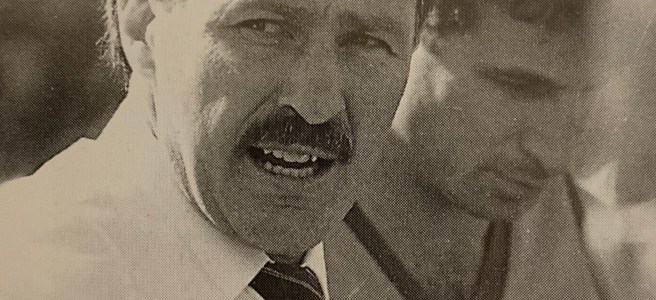
Eagles coach Mick Malthouse admitted the state-of-origin hadn’t been ideal for his club.

“It is a fact that interstate football affects the Eagles more than any other team in the competition.”

“While we are the only AFL side in WA, we will always provide a large proportion of players for the match,” Malthouse continued. “The disruption makes it extremely hard to prepare the side for a game during what is a vital part of the season.”

Malthouse suggested playing interstate matches as a pre-season carnival would be of greater benefit.

Following the interstate game, the Eagles had several players facing fitness tests to play the Lions.

Chris Mainwaring was the greatest concern, lining up for WA despite having scans on his knee. Guy McKenna (groin), Dwayne Lamb (achilles), Michael Brennan (groin), Karl Langdon (wrist) and Peter Wilson (groin) all needed to get through training, while Brett Heady suffered bruised ribs after being collected heavily front on by Simon Madden, while playing for WA.

When the teams were released, all were selected to play, with the suspended Craig McGrath the only change to the side that defeated the Hawks. Stevan Jackson – who had been dropped for the previous game after a poor run of form – was given the chance to reclaim his spot in the senior side as McGrath’s replacement at centre half forward.

Mainwaring would ultimately pull out ahead of the opening bounce, with Todd Breman coming into the side.

The Lions flew to Perth having found their best form ahead of the split round. Wins over Hawthorn and Sydney came either side of a competitive effort against the Kangaroos. And unlike West Coast, Fitzroy had enjoyed the benefit of a fully rested squad, with only ruckman John Ironmonger taking part in the mid-week interstate clash.

The Lions made two changes to the side that defeated the Swans in their last start by 45 points. Paul Broderick and Mark Trewella were both dropped in favour of Darren Kappler and David Strooper.

Interestingly, the Lions chose not to bring back full forward Richard Osborne, who had impressed in three consecutive reserves games in his comeback from a serious knee injury suffered the year before.

Regular defender Murray Rance started on the bench for the Eagles, with Phil Scott preferred at centre half back against Fitzroy superstar Paul Roos. At the other end, Alastair Lynch lined up at full back on Peter Sumich, while Kappler returned to the middle, opposed to Dean Kemp.

Despite half the side coming off just a five day break, there were no signs of sluggishness from the Eagles when they burst out of the blocks with the opening four goals, to establish a 21 point lead. Fitzroy soon closed down the contest and with Roos getting the better of Scott at half-forward, the Lions were able to work their way back into the game.

Fitzroy had almost 40 more disposals in the second quarter as they started to control the centre line. Matthew Dundas had 10 disposals on his own for the term up forward for the Lions, while Scott Clayton and Andrew Johnston had seven each as Fitzroy got on top through the middle.

Dale Kickett was relatively well held in the match, but his extraordinary checkside kick from the 50m arc helped Fitzroy bridge the Eagles lead back to eight points at the major break.

Twice during the third term Fitzroy drew within two points, but Troy Ugle sparked the Eagles up forward when he was switched from the back pocket. Ugle booted a goal and had a hand in four others as West Coast piled on seven for the quarter – five of which came in just nine minutes.

Leading by 39 points at the final change, the Eagles continued on with their momentum in the final term, but Wally Matera came off the bench to add three late goals and reduce the final margin.

The final quarter effort from Matera would prove costly for his former side. The Eagles were set to replace the Demons in third spot, but lost crucial percentage as Matera got off the chain, leaving West Coast sitting in fourth spot – just 0.07% behind the Demons.

In fact, just one more point would have been enough to elevate West Coast into the double chance positions.

Fitzroy coach Rod Austin conceded the Eagles’ burst in the third quarter was costly for his side. “We had done well to fight back, but we missed some opportunities – and that has been the story of the year as far as we’re concerned.”

Eagles coach Mick Malthouse was understandably pleased with the win, but quickly moved the focus post-match to the upcoming clash against the Magpies at Victoria Park.

“You haven’t played football until you’ve played at Victoria Park.”

Malthouse admitted that there was plenty to work on ahead of the Eagles match against the second-placed Magpies, but believed a lack of continuity had affected his sides’ preparations.

“… the past three weeks have been indifferent, in as much as we rarely trained together.” Happy to get the win and take the four points, Malthouse said his side ‘used the ball correctly after half-time.’

As well as Kemp’s 35 possession game through the middle, he was ably supported by captain Stephen Malaxos who tallied 32 touches. Chris Lewis finished with 27 possessions and Brett Heady recovered enough to pick up 25 rotating through the middle and half forward.

Paul Roos did all he could to keep the Lions’ in the contest with 19 disposals, 11 marks and 3.3 from centre half forward, but there were too few who could sustain the pressure on West Coast for the full four quarters. Michael Gale and Tony Woods each picked up 23 touches to lead the ball winners for the visitors, while former Eagle Wally Matera finished with four goals and Roos and Matthew Dundas three each.

The Eagles sat two games clear in fourth spot with nine wins after Hawthorn fell to the Bulldogs by 17 points at Waverley Park. The Hawks were replaced by the Saints in the top five, after David Grant booted five goals to engineer a 33 point win over a flat Melbourne.

Four teams sat behind the Eagles on seven wins as the race to qualify for the 1990 finals appeared to be down to one final spot. St Kilda, Hawthorn, Carlton and Footscray were all in the battle, with the Blues’ win over Geelong appearing to end the Cats finals’ hopes.

The Cats again paid dearly for woeful goal kicking, booting 13.26 in a 19 point loss. Ken Hinkley was the biggest culprit for Geelong finishing with 2.7, while Robert Scott managed just four behinds. The result followed similar matches earlier in the year when the Cats dropped points to Richmond and Sydney because of inaccurate kicking.

At the top, Essendon and Collingwood stayed a game ahead of the competition with routine wins over Brisbane and Richmond.

Malthouse believed his side was well placed heading into the second half of the season, but knew the Eagles’ greatest test would come the following week against one of the premiership favourites.

“We’ve had a good win under our belts and a good week of training in front of us before we go to Victoria Park.”

1994 Rewind: West Coast Storm Into Decider

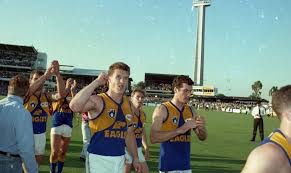
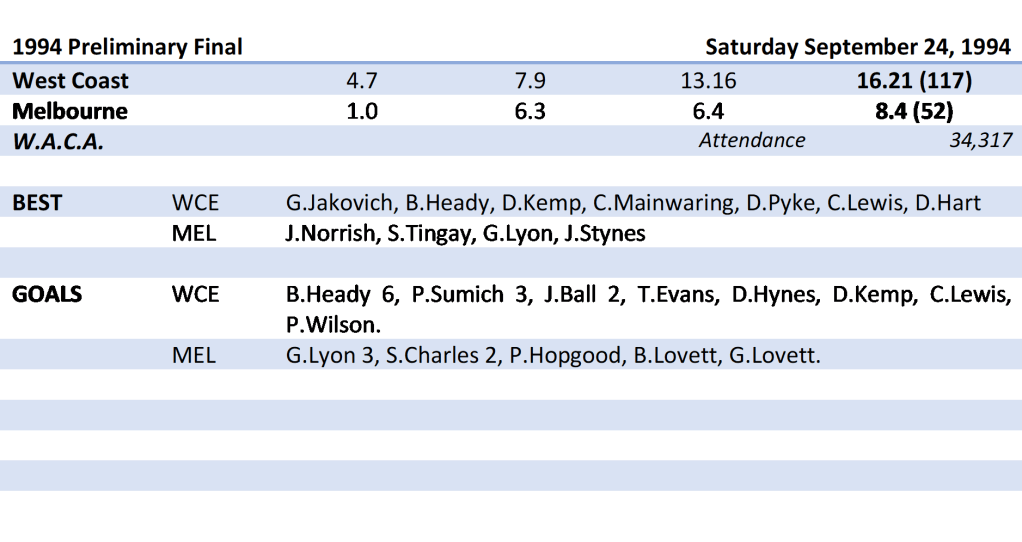
West Coast made it to their third grand final in four seasons when they convincingly defeated the Demons by 65 points in the preliminary final.

The Eagles ended Melbourne’s fairytale finals run, who had knocked off Carlton and then Footscray after finishing seventh at the end of the home and away season. Garry Lyon had booted a record 10 goals in the 79 point massacre of the Bulldogs, but the Demons ran out of steam against a refreshed Eagles outfit.

Despite having a fortnight to recover, Ashley McIntosh was ruled out of the preliminary final, allowing Mitchell White to come in for just his sixth game of the season as cover in the Eagles defence.

The Demons also made just one change to the team that thrashed Footscray the week before with sharpshooter Sean Charles adding to an already potent forward line, replacing the omitted Glenn Molloy.

Ahead of the game, tensions were raised between the two sides when two Melbourne officials were spotted watching the Eagles train in what was supposed to be a closed training session. While the Melbourne ‘spies’ – football manager Richard Griffiths and match committee chairman Greg Wells – had no issue with being asked to leave, the response from West Coast drew some mirth from Demons coach Neil Balme.

Balme proudly declared after the teams were submitted on Thursday night that Melbourne would go in as named. The Eagles, however, remained guarded over their final line up, with Mick Malthouse calling the antics from Melbourne as ‘childish games’.

The final 21 for West Coast wasn’t confirmed until just before bouncedown with West Coast swinging two late changes. Drew Banfield returned to the team after being dropped for the clash with Collingwood while Ryan Turnbull was brought into the team having recovered from a knee injury suffered against the Blues in Round 22. Craig Turley remained as the Eagles’ third emergency, unable to reclaim his spot in the side after serving a two games suspension for striking Greg Williams.

Turnbull’s inclusion to join David Hynes in the ruck was designed to counter the Demons’ strong ruck combination of Jim Stynes and Dean Irving. Tony Godden made way for Banfield, with Turnbull replacing Brett Spinks who was battling a knee concern picked up in the qualifying final.

The Demons stayed true to Balme’s claim that there would be no changes to the squad, but he still did his best to catch the Eagles off guard with a number of positional moves.

Stephen Tingay had previously matched against Chris Mainwaring on the wing, but he swapped sides with Matthew Febey to go head to head with Peter Matera. Febey was stationed against Mainwaring in a more defensive role, as the Demons looked to slow down the Eagles ball movement.

Dean Irving started in the ruck, leaving Jim Stynes to operate off the bench, while Andy Lovell shifted to half-back, initially matching up on Brett Heady.

However, only the Tingay move had any real effect as West Coast dominated the quarter, kicking with the wind. Matera had been under a cloud since injuring a back during the last quarter against Collingwood and was unable to work defensively on Tingay who collected 11 possessions in the first term. Malthouse moved Banfield to the wing to quell Tingay’s influence at the start of the second quarter, pushing Matera to a half forward flank.

Everywhere else on the ground was owned by the home team.

Tony Evans and Dean Kemp were both prominent early, with nine first-quarter possessions while Chris Lewis had eight across half-forward. All of the Eagles forwards got into the game early with the weight of possession in their forward half.

Mainwaring was dynamic on his wing opposed to Matthew Febey and Brett Heady was both too tall and too elusive for Lovell across half forward. The Eagles took control around the ball, with Irving lacking influence in the ruck against David Hynes.

The Eagles racked up 11 shots on goal for the term, but wasted a host of chances. West Coast were 1.7 at one stage, before three late majors to Jason Ball, Tony Evans and Peter Sumich created a deserved advantage.

The Demons, on the other hand, could manage just one shot on goal with Glenn Lovett responding to Brett Heady’s opener into the wind.

The second quarter became an arm wrestle as West Coast held the Demons at bay in defence but continually struggled to take chances up forward. Brett Heady missed a simple shot at the top of the goal square, before Garry Lyon broke the drought when he broke free of Michael Brennan.

That goal came with a tinge of controversy after Sumich was unlucky to be penalised at the other end. Sumich had a free kick paid against him after he pushed Sean Wight in the chest before going on a lead, with the Eagles full-forward then giving away 50 metres for remonstrating with the umpire.

The Lyon goal only served to open the game up.

Brett Heady found Chris Lewis for the instant reply, before kicking two himself as West Coast opened up a 32 point lead closing in on half time.

The Demons then showed the form that had propelled them through the first two weeks of the finals with three goals in as many minutes to close out the half.

Sean Charles swooped on a Michael Brennan fumble to snap truly, with the Demons kicking a second goal less than 20 seconds later when Andrew Obst won the clearance and found Brett Lovett who was able to kick on the breeze from the edge of the centre square.

Charles then had his second goal for the match after Melbourne were able to string a chain of handballs from half-back, with Viney releasing Charles into an open goal after reading the ball of a marking contest in the Demons forward 50. Melbourne had closed within 13 points in a blink of an eye and had one final chance on the half-time siren.

Andy Lovell had been moved to half-forward after losing the reins on Brett Heady and found himself on the end of a Dean Irving miskick to mark 40 metres out directly in front. Lovell could have brough the Demons to within a kick, but he skewed his shot on goal to allow West Coast to hold onto a 12 point lead.

The Eagles had smashed the Demons 13-3 in the centre clearances and had nearly 40 more possessions around the ground, but their inefficiency in front of goal prevented them from having one foot already in the Grand Final.

West Coast’s shooting on goal only got worse in the third quarter, but by the final changeit no longer mattered.

The Eagles had piled on 6.7 to a solitary behind with their second use of the wind to establish a nine goal lead that they were never going to give up.

The warning signs for Melbourne showed early in the term, with West Coast posting a further four points onto their half-time score, including what could almost have been a late goal of the year contender.

Glen Jakovich had completely shut out David Schwarz across half-back, and after picking up a loose ball in the back pocket, the burly centre half-back bounced his way through the middle of the WACA to the rousing roar of the home crowd. Jakovich launched from the top of the Eagles 50 metre arc only to see his shot on goal hit the base of the post, resulting in one of the more memorable points in club history.

Brett Heady ultimately got the first goal for the Eagles in the term, booting three in the quarter to take his match haul to six. His fifth goal came from another turnover from Andy Lovell in defence as Melbourne’s day started to capitulate.

Stephen Tingay – who had been the Demons best player in the first half – limped off with a knee injury, while David Neitz was forced to the bench after being crunched by Sumich in a marking contest.

The Eagles added three goals to two in the final quarter to run away with their largest ever win in a final.

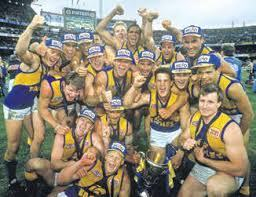
Eagle players celebrate another grand final

Malthouse was ecstatic post-match with the ‘almost faultless’ performance but was quick to point out that the job was still not done.

“Every club aims to make the Grand Final at the start of the season,” Malthouse said.

“Making the Grand Final is not good enough. Winning has got to be the aim.”

It was a deflating end for the Demons, who dared to dream after stunning finals wins over Carlton and Footscray left them one game shy of the big dance. Neil Balme admitted his team just couldn’t handle the occasion.

“I think our blokes just lost it. They lost all confidence in their ability to play footy.”

“They were shell-shocked.”

Melbourne struggled to have a winner on the ground, with West Coast’s defence supreme. Schwarz was virtually a spectator, with Mitchell White keeping Paul Prymke quiet. David Hart had the better of Sean Charles while John Worsfold and Guy McKenna provided their customary dash from half back.

Chris Mainwaring – who sported jumper number 43 after half-time due to blood rule stipulations – was the leading ball winner for the Eagles with 29, while Dean Kemp had the better of Jason Norrish, Andrew Obst and Andy Lovell with 25 disposals through the middle.

Brett Heady didn’t add to his six goal tally as he sat the final quarter on the bench. Peter Sumich finished with 3.3 despite a mixed performance, but Chris Lewis was electric with 20 disposals and a goal across half forward.

The Eagles Grand Final opponent had been decided earlier in the afternoon when Geelong defeated the Kangaroos in a classic encounter.

North Melbourne started the stronger of the two sides to lead by three goals at quarter time, but could have led by far more with straighter kicking on goal. The Cats then took charge with a seven goal to nil second term to lead by 24 points at the main break.

Geelong still led by 18 at the final change, but North Melbourne, with the benefit of a weeks rest, stormed home. The Cats drew level once again, before Leigh Tudor sent a wobbly kick to the top of the Geelong goal square in the dying seconds of the game. His kick landed in the arms of Gary Ablett, who sent the Cats into the Grand Final with a goal after the siren.

It was the second final in three weeks Geelong had won after the siren, with the Eagles and Cats set to square off two years after they clashed in the 1992 decider.