
Veterans and Youngsters Provide Glimpse to Brighter Future
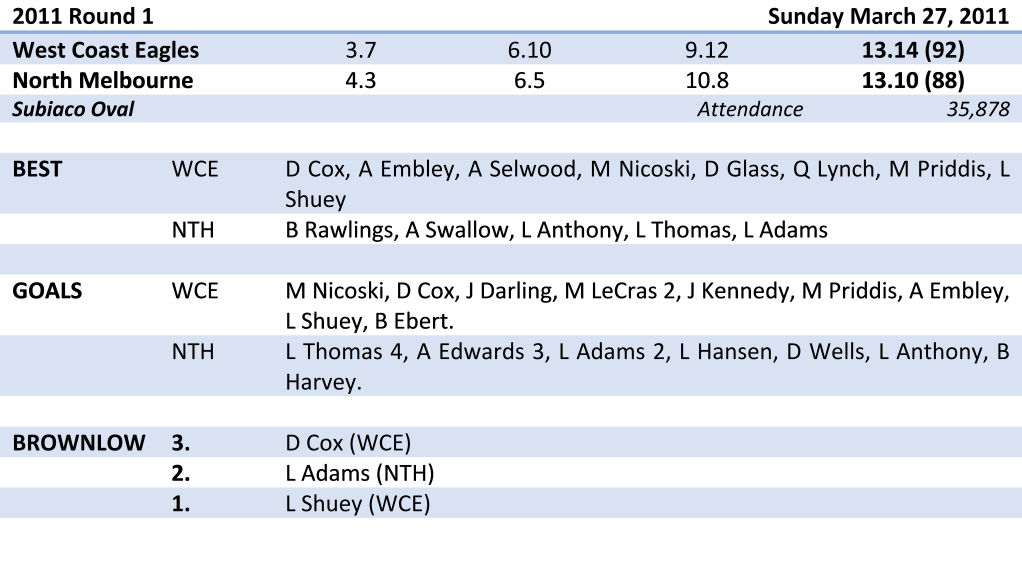
West Coast started the 2011 season in winning fashion with a narrow four point win over North Melbourne at Subiaco Oval.
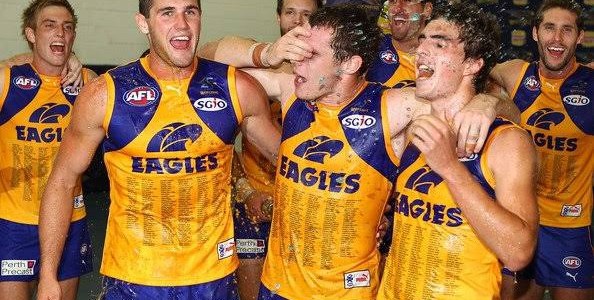
Wearing a commemorative guernsey to mark 25 years in the AFL competition, the Eagles outlasted the Kangaroos in a match where the margin at the end of each quarter was never more than five points.
Fresh off the club’s first ever wooden spoon, the Eagles approached the new season with a sense of renewal as a host of veterans returned from injury and a several high draftees joined the club.
After a season of speculation, coach John Worsfold was assured that he would see out the season, despite many predicting a bottom four finish for West Coast. However, the Eagles showed they would be an improving team after recording wins against 2010 finalists Fremantle and Hawthorn in the shortened pre-season format.
West Coast followed the round-robin win with a comfortable victory over newcomers Gold Coast, before falling to premiers Collingwood in the pre-season semi-finals.
Encouragingly, the Eagles had enjoyed a drama-free off-season which hadn’t been the case in recent years. And as West Coast approached the start of the 2011 season, they had virtually a full squad to choose from – another rarity of recent times.
Darren Glass and Dean Cox had appeared to shake off ongoing groin problems, while the likes of Beau Waters, Mark Nicoski and Sam Butler were available to start the season. Daniel Kerr was another who was set to return to the senior side after ripping his hamstring from the bone in round 4 of the previous season.
Remarkably, Kerr would make his league debut for junior club East Fremantle the week before the Eagles’ opening match against North Melbourne, 10 years after he was drafted by West Coast. Kerr would ultimately be left out of the Eagles side for the Kangaroos as West Coast opted for a cautious approach with their senior midfielder.
Two players who did make it into the final two were West Coast’s top two draft picks from the 2010 National Draft. By virtue of finishing last, the Eagles would normally secure the first selection, however the inclusion of the Gold Coast Suns had seen the expansion team monopolising many of the early draft choices.
West Coast took running wingman Andrew Gaff with the fourth overall selection and then West Perth forward Jack Darling with a priority selection at the end of the first round which the club had received for winning less than five games in 2010. The pair were named for their AFL debuts – the first time Worsfold had named multiple debutants in a match during his time as coach.
Gaff would earn the honour of being the clubs first interchange substitute, after the controversial rule was introduced by the AFL ahead of the season. Originally not named in the 22, Gaff came in as a late replacement for Patrick McGinnity who was pulled from the side after a hot spot was detected in his foot. Mark Nicoski also earnt a late selection when he replaced Naitanui who had concerns over a shoulder injury from the pre-season.
The Kangaroos were one of the big unknowns heading into 2011 after finishing ninth the year before. Brad Scott – entering his second season as coach – talked up his sides chances heading into the match, believing the Eagles off-season training in the Perth heat would serve as a disadvantage.
With the substitute rule effectively reducing interchange rotations from four players to three, Scott suggested the young Eagles would tire quicker, with the match to be played in mid-30’s heat.
The Kangaroos named four players for their first game, with Cameron Richardson, Cameron Pedersen and Shaun Atley all named for their AFL debut, with former Eagle Ben McKinley included for his first game after switching clubs at the end of the 2010 season.
McKinley and Pedersen were set to take up the key forward roles, with Drew Petrie out suspended and Hamish McIntosh unavailable, while small forward Matthew Campbell was sidelined with injury.
The Kangaroos were then dealt a further blow before the match with ruckman Todd Goldstein withdrawing from the side. Goldstein’s departure effectively balanced out the Eagles’ loss of Naitanui and left makeshift duo Lachie Hansen and Cameron Pedersen to battle it out against Cox.
Cox would be one of the influential players of the day as West Coast won out in a match that ebbed and flowed throughout.
Early on though, it seemed as the Eagles’ 2010 form would continue as the Kangaroos bounced to an early three goal lead. Brent Harvey had the first major inside a minute, with Hansen and Lindsay Thomas adding majors to see the visitors out to a 19 point lead.
Slowly, the Eagles worked their way into the game, with Matthew Priddis opening the Eagles account midway through the term. Brad Ebert and Andrew Embley kicked goals and West Coast hit the front having had all of the momentum as the quarter time loomed.
The Eagles arguably should have hit the lead sooner, but wasted several chances in front of goal, most notably Mark Nicoski who kicked three behinds for the term. Re-cast as a half forward after spending his career in defence, Nicoski was creative without getting reward on the scoreboard.
A late Liam Anthony goal put the Kangaroos back in front at quarter time, before the two teams traded goals through the second term. Jack Darling kicked his first career goal after running down Jack Ziebell as West Coast took a narrow five point lead into the major break.
The Eagles’ other debutant, Gaff, was into the action early after Chris Masten limped off early in the match with a knee injury and West Coast were soon down two on the bench when reigning best and fairest Mark LeCras was stretchered off with a torn adductor as he snapped through his second major.
Jack Darling added a second soon after as the Eagles skipped out to a 19 point advantage. Lindsay Thomas then dragged the Kangaroos back into the match with two goals in a minute.
North Melbourne closed with all of the momentum as Daniel Wells and Leigh Adams hit the scoreboard, to put North Melbourne in front by two points with a term to play.
In oppressive heat and with players down on the bench, West Coast could have been excused for wilting in the final term, but they came out the stronger at the start of the final quarter, with Nicoski finally getting some reward. With four behinds to his name, Nicoski found the major opening after two minutes of play
Dean Cox pushed forward for his second goal, before Nicoski added a second to see the Eagles back out to a 16 point advantage. The Kangaroos kept coming, reducing the margin to four points as the final term ticked into time-on, but a dubious Luke Shuey free kick and resultant goal sealed the match for West Coast.
Another ex-Eagle in Aaron Edwards goaled after the final siren to reduce the margin to four points, as West Coast started their season with a win for the first time since 2008. The victory saw the Eagles sit inside the top eight for just the second time since the opening round of 2008 and restored a winning feeling after West Coast managed just one win in the final 14 games of the 2010 season.
A delighted John Worsfold expressed pride that his side was able to hold and win despite losing numbers on the bench and being clearly fatigued in the final term. “Very proud of the way the players held up in a lot of individual efforts in terms of taking up a lot of the slack so we could keep the rotations going.”
One of those players was Quinten Lynch who rucked for large portions of the final term as Cox battled cramp. Lynch, who had fallen out of favour towards the end of the previous season, appeared to enjoy the freedom of the forward/ruck hybrid, with Kennedy and Darling holding down the key forward posts. The hulking forward collected 20 disposals and nine marks, as well as having 18 hit-outs.
Cox for his part finished as the leading ball winner at West Coast with 29 disposals, eight marks, 29 hit-outs and two goals, as well collecting the three Brownlow votes. Andrew Embley and Matt Priddis finished with 28 each, while Nicoski had 21 to go with eight inside 50s and 2.5.
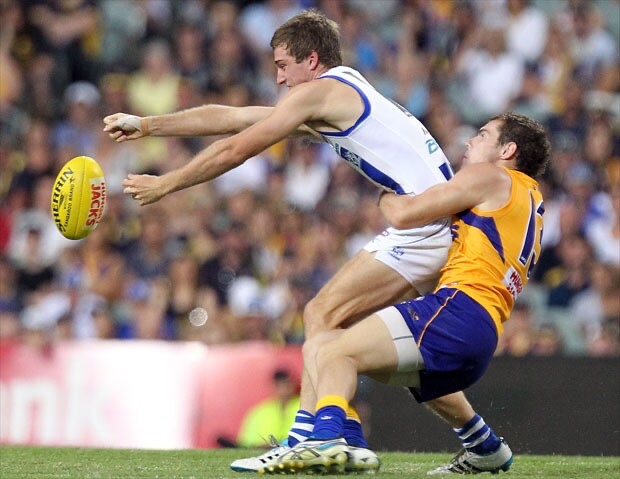
Brady Rawlings picked up 32 touches to lead the Kangaroos with Andrew Swallow next best with 26. Lindsay Thomas kicked four goals and Edwards three, but too many were down on the day. For McKinley, it was an unhappy homecoming, subbed off during the third term with just five disposals to his name.
Brent Harvey couldn’t shake the tag of Adam Selwood, finishing with just 11 disposals. Harvey had amassed 44 touches the last time the two sides met, but was given no space by the close-checking Selwood.
Darling and Gaff both showed they belonged at AFL level, with Darling’s two goals coming from 11 disposals and three marks, showing an intensity around the forward line as West Coast looked to implement a high press.
Gaff tallied 14 disposals in nearly three quarters of football while Luke Shuey was just as impressive in his seventh game of football, picking up 20 disposals and six clearances, as well as booting the important sealing goal. Brad Sheppard (15th game) and Ashton Hams (12th game) also both had their moments.
“It is fantastic for the young kids that have earned a spot in round one”, a beaming Worsfold declared.
 sportsphrase.blog