
Consecutive Losses See Eagles Slip Down Ladder
After a bright start with wins over North Melbourne and Port Adelaide to open the season, the Eagles soon found themselves with a squared ledger after dropping games against Sydney and Hawthorn.
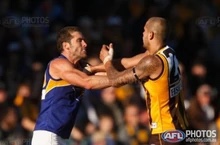
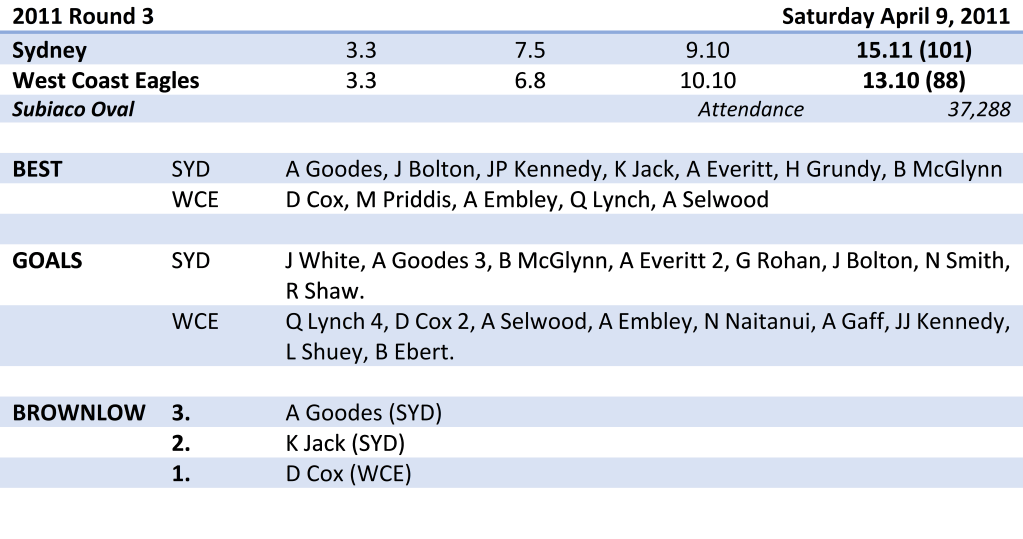
In a throwback to the classic encounters of the mid-2000’s, the Eagles and Swans played out another tight match, with the margin never going beyond three goals for the entire game.
Adam Goodes would be the difference between the two sides in the final term switching to the midfield after spending much of the first three quarters playing forward.
With West Coast holding a 12 point after Luke Shuey goaled inside the first minute of the quarter, Goodes provided the response to draw the Swans within six points, before adding a second major later in the term to level the scores. Goodes would finish with eight disposals for the term, along with three centre clearances and four contested marks as Sydney booted six goals to three to claim a narrow 13 point win.
The match itself was far less a spectacle and more a bruising battle, as the hardened Sydney midfield overwhelmed their younger opponents. The Swans laid 111 tackles (to West Coast’s 69), with Jude Bolton applying a game record 19 tackles himself.
The Swans got the quick jump with Jesse White booting the opening two goals of the match, but Quinten Lynch also managed a brace for the quarter which saw the two teams tied at the first change after Nic Naitanui floated home a goal on the siren.
Again Sydney got out to a two goal lead, with Goodes registering his first goal, but Lynch added two more goals, either side of a Lewis Jetta major, to keep the Eagles within touching distance. Andrew Embley put the Eagles in front, but Rhyce Shaw restored the Swans’ lead with the visitors in front by three points at the main break.
Dean Cox then took a hold of the match in the third quarter, putting in a quarter that matched the efforts of Goodes in the final. The Swans opted to play Shane Mumford as their sole ruckman against the pairing of Cox and Naitanui, with Mark Seaby – who had crossed to the Swans in the off-season – and Canadian Mike Pyke both left out of the side.
Sydney moved to a game high 17 point lead after Ben McGlynn and Jude Bolton both kicked majors when Cox stamped his authority. The Eagles ruckman picked up nine disposals for the term and kicked the final goal of an Eagles four-goal run that saw West Coast head into the final quarter with a six point lead.
Luke Shuey then made it five majors on the trot early in the last before Goodes drove his side to the line. Goodes finished with 21 disposals and three goals, complementing the workhorse Swans midfield group. Kieran Jack was the leading ball winner for the Swans, collecting 23 touches while also restricting Eagles dynamo Daniel Kerr to just 13.
Josh Kennedy also had 23 possessions, 18 of which were contested, while Jesse White joined Goodes in booting three goals.
Matt Priddis was one of the best for West Coast with 27 disposals and six clearances, doing what he could to match the Swans outfit. Cox’ strong start to the season continued, finishing with 20 disposals, two goals and 38 hit-outs. Naitanui tallied 28 himself with the Eagles winning the tap 68-38 but the Swans were still able to claim the clearances 49-34. Crucially their dominance through the middle in the final quarter saw them maintain their unbeaten record, following a draw with Melbourne in the opening round and a five point win over Essendon.
The Eagles on the other hand had been dealt their first loss of the season which saw them drop to ninth on the ladder.
The Eagles then made the long trek to Launceston to tackle the Hawks in what proved to be another narrow defeat. The match featured two of the upcoming forwards in the game, with Lance Franklin kicking six of the Hawks’ 10 goals, while Josh Kennedy booted four of the Eagles’ nine.
For the second week in a row the Eagles led at three-quarter time, but were run over by a more experienced side in the final quarter. Franklin kicked three of his six goals in the final quarter, as he got the better of young defender Mitch Brown.
With two points separating the sides at the final change, the Hawks broke the game open with the first four goals of the term, leading by 26 points as the term ticked into time-on. However West Coast finished with a rush, kicking the final three goals in the match but ultimately falling short by seven points.
The Eagles were made to pay for their early inaccuracy, as they failed to capitalise on their control of the match in the first quarter. The Eagles had twice as many inside-50s but kicked three goals to the Hawks’ two.
Josh Kennedy kicked his second late in the quarter to put the Eagles ten points ahead, but he was one culprit of missed chances, with three other efforts on goal either failing to score or going out on the full.
West Coast continued to hold the ascendancy in field position as the Hawks struggled to break through the Eagles forward press. However, the Hawks were devastating when they got the ball forward. Hawthorn booted the first three goals of the second term before Andrew Embley added one late for West Coast to reduce the Hawks’ lead to a solitary point.
While Franklin was proving a handful forward of centre, Sam Mitchell was racking up disposals in the irregular position of half back. Mitchell had averaged 27 disposals across the opening three rounds, but had matched that effort by half time.
The Eagles booted two goals to one in the third term to grab the lead before Franklin stepped up in the final term.
Mitchell finished with 37 disposals for the match as he was moved onto Kerr in the second half, who was also playing out of the middle, across half forward. Grant Birchall and Matt Suckling gathered 30 and 23 disposals, respectively, in defence while Brad Sewell was the enforcer through the middle with 19 possessions and 12 tackles.
The Eagles were well served once again by Matthew Priddis in the middle of the ground and Matt Rosa was strong on a wing with 25 touches and a goal. Josh Kennedy was the only multiple goal scorer for West Coast, while in defence Darren Glass was supreme in his 200th AFL match.
With Brown tracking Franklin and Eric Mackenzie lining up on Jarryd Roughead at full forward, Glass was released to play on the resting ruckman in either David Hale or Brent Renouf getting the better of both players. Mackenzie held Roughead to just one disposal for the first half to be one of the Eagles best.
Sam Butler, Jack Darling and Andrew Embley all had 24 touches, with Darling outstanding in the first half with 18 possessions.
The Eagles were now 2-2 for the season and dropped down to 10th on the ladder ahead of their bye in round five. With Gold Coast entering the competition as the 17th team, the competition had an uneven number of teams for the first time since 1994, with each side scheduled for two byes throughout the 24 round season.


 sportsphrase.blog