2011 Rewind: In Celebration Mode

Nicoski Kicks Six to Lead the Eagles Party

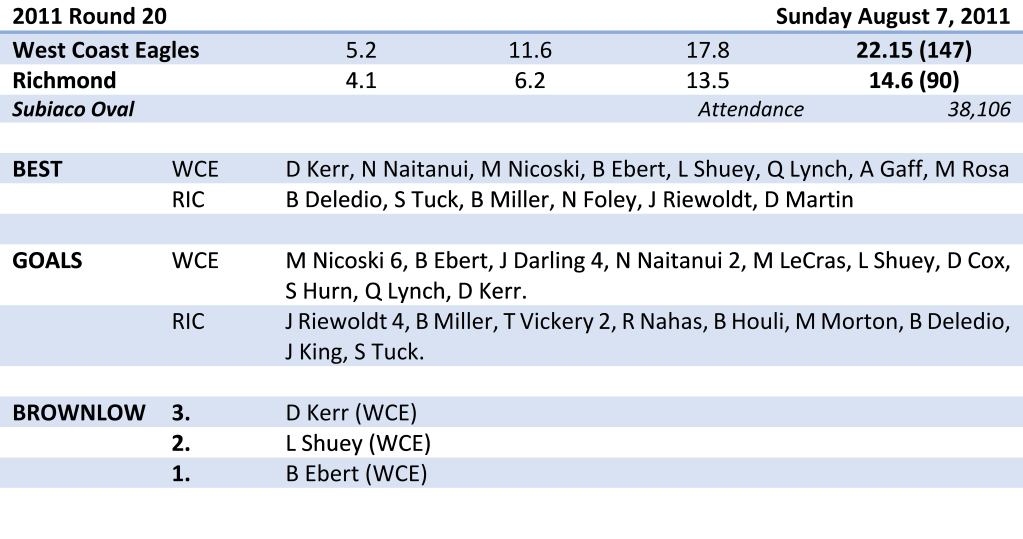
It was a week of celebration for West Coast as they honoured and paid homage to their first 25 years in the VFL/AFL competition, culminating in a 57 point win over Richmond.

The Eagles chose to celebrate their 25th season in the top tier competition in the lead up to their Round 20 clash with the Tigers, who were their first ever opponent in the opening round of 1987. In that game, the then VFL newcomers fought back from 33 points down to claim a 14 point win in their inaugural match courtesy of a nine goal final quarter.

However no such heroics were required in this meeting with the Eagles steering away from the Tigers during the second term and coasting to a 57 point win.

Josh Kennedy was again absent for the Eagles with an eye injury, but the Eagles were able to recall Daniel Kerr and Nic Naitanui. The pair were joined by defender Mitch Brown and midfielder Chris Masten who was selected for his first senior match since Round 12.

Vice-captain Beau Waters was ruled out with an elbow injury, which was initially played down by the club after he injured it during the win over the Western Bulldogs. Eric Mackenzie was also a casualty, straining a hamstring during the final training session of the week. Tom Swift and first-gamer Scott Lycett lost their places.

The Tigers also made four changes with captain Chris Newman succumbing to a knee injury and Jake Batchelor ruled out with a shoulder complaint. Ben Griffiths and Matt White were dropped, with Shaun Grigg, Brad Miller, Mitch Farmer and Matt Dea the four inclusions.

After an entertaining first term that saw the Eagles lead five goals to four at the first change, West Coast took grip of the match off the back of a dominant quarter from ruckman Nic Naitanui.

With Dean Cox limited to the full forward line after copping a knock to the hip in the opening minutes of the game, Naitanui was left to lead the ruck with Quinten Lynch rotated through to provide back up.

Naitanui relished the circumstance, as he controlled the ruck against Angus Graham and Ty Vickery, amassing eight possessions (all contested), four marks (all contested), several clearances and kicking two goals in the quarter – all the while providing silver service to the likes of Daniel Kerr and Luke Shuey.
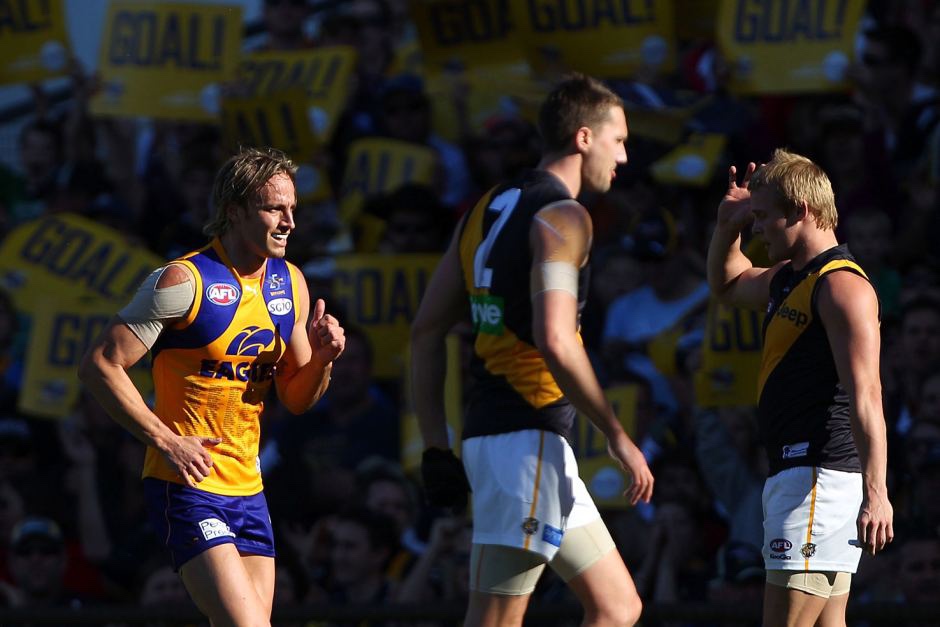
Mark Nicoski finished with a career high six goals in the win over Richmond

West Coast continued to dictate the match until late in the third quarter when the Tigers got on a roll to reduce a 45 point deficit to 27, keeping open the outside chance of an upset comeback.

In the last meeting between the two sides, at the MCG midway through the 2010 season, Jack Riewoldt had booted a career best ten goals, but to half time of this encounter, Darren Glass had kept the Tigers spearhead to just six disposals and no score. However, Riewoldt responded in the third quarter booting three goals as Richmond looked to continue on the attack.

Eagles coach John Worsfold admitted displeasure after the match with conceding seven goals in the third term, but West Coast tightened up their defence in the final term to kick five goals to one and run out 57 point winners.

14 of the Eagles’ 22 goals were kicked by the trio of Mark Nicoski, Jack Darling and Brad Ebert, who all recorded career best hauls in front of the sticks. Nicoski finished with six goals, while Darling and Ebert each booted four as the Eagles showed they could find other avenues to goal.

For Nicoski, his six goal return was just reward for a season that had reinvented the defender as a pressure forward as part of the Eagles’ strong forward press. Brad Ebert was another who had had to adapt to a different role this season with the return of Kerr, the arrival of Gaff and the rapid improvement of Shuey with Worsfold deploying the South Australian across half forward for much of the year.

Ebert appeared to find the balance in his role, hitting the scoreboard with four goals, as well as gathering 21 disposals with four tackles and four inside-50’s.

Kerr led the Eagles ball-winners with 34 disposals, 13 of which came in the second quarter when Naitanui got on top in the ruck battle. Kerr also finished with eight clearances, while Shuey had seven to go with 30 disposals, seven tackles and six inside-50s.

Andrew Gaff was tireless with 29 on the wing, while Lynch appeared to relish the freedom of running through the ruck with 23 touches, seven marks, 10 hit-outs and seven inside-50s.

Brett Deledio tallied 31 possessions and eight rebounds to lead the Tigers, with Shane Tuck (29 disposals) and Nathan Foley (24) the next best. Riewoldt kicked the Tigers only goal of the final term to finish with four for the match, with Brad Miller and Ty Vickery the only other multiple goal scorers for the visitors.

Scott Selwood was tasked with the job of minding Richmond captain Trent Cotchin, keeping the midfielder to just 17 disposals.

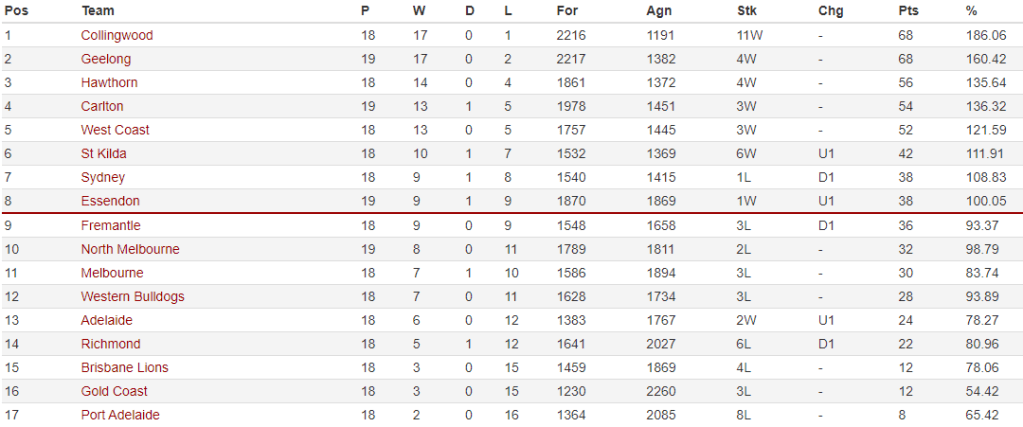
The result meant that the Eagles kept the pressure on Hawthorn and Carlton as they sought to push their way into the top four. The Hawks and Blues recorded wins against finals hopefuls North Melbourne and Melbourne, further denting their finals hopes.

The Kangaroos pushed the Hawks for three quarters before Lance Franklin kicked three final quarter goals to inspire his side to a 17 point victory. Todd Viney took charge of the Demons following the sacking of Dean Bailey, but it did little to improve things as they crashed to a 76 point defeat.

The battle for spots in the lower half of the top eight played out in dramatic fashion as the sixth placed Swans travelled to play the ninth-placed Bombers, and the seventh-placed Saints faced the eighth-placed Dockers. Just three points separated the Saints and Dockers at three-quarter time before St Kilda piled on six goals to none in the final term to run out 41 point winners.

That saw them climb to sixth on the ladder after the Swans fell to the Bombers by one point at Docklands after Adam Goodes had the chance to win the game on the siren. His long range set shot drifted wide allowing the Bombers to rise back into the top eight at the expense of the Dockers. Sydney also dropped to seventh on the ladder as a result, meaning the Eagles were now 10 points clear in fifth spot with four games to play.

The statement of the round though lay with the two leading premiership fancies in Collingwood and Geelong. The Magpies and the Cats were drawn against the two stragglers in the competition, in Port Adelaide and Gold Coast with the two sides not missing a chance at percentage boosters.

Geelong hammered the young Gold Coast side by 150 points, backing up from their 186 point thrashing of Melbourne the week before. Steve Johnson followed up his 34 disposal-7 goal effort against the Demons with 31 possessions and six goals against the Suns. The Ablett-less Suns matched the Cats early, with both sides kicking three goals to start the game before Geelong went on the rampage with the next 15 goals in the game to open up a 94 point lead at half time.

The Cats also booted the final 11 goals in the game to run out easy winners, with the combined 336 point margin over the previous fortnight boosting their percentage by 21.9 points in that time.

The Magpies proved they wouldn’t be outdone, smashing a hapless Port Adelaide by 138 points at Football Park. The Power managed just six scoring shots for the night – finishing with 3.3 for the match, compared to the Magpies’ total of 23.21 from 44 scoring shots. That kept the Magpies at the head of the ladder with their monstrous percentage of 186.1 from 17 wins keeping them in front of the Cats who had built their percentage to 160.4 from the same number of wins.

While happy with the win, there were concerns for the Eagles with a number of injuries out of the match against the Tigers. Wingman Matt Rosa was the most serious, limping off during the third quarter after clashing knees with Richmond’s Daniel Jackson while Jackson was attempting to kick. Both players would be substituted out of the game from the incident, with Rosa later diagnosed with a posterior cruciate ligament injury that was likely to keep him out of the rest of the home and away series.

It continued an unfortunate run for Rosa who was on the fringe of the Eagles’ 2006 premiership side, playing in the first two finals before being dropped for the preliminary final. Dean Cox would be monitored after his knock to the hip, while Naitanui limped off in the game late with a lower leg problem.

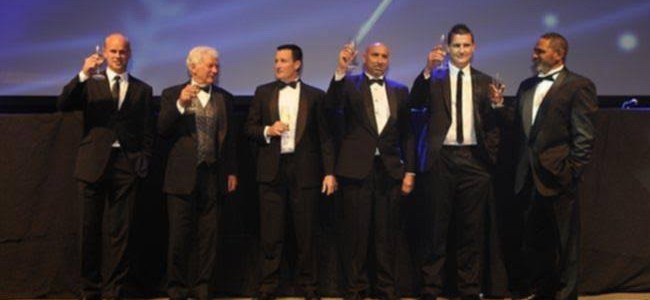
It would prove to be just a small scuff off the gloss of the week that saw West Coast celebrate their first quarter century of existence. The Eagles wore commemorative jumpers in the match that listed every Eagles to have represented the club, while the inaugural inductees of the West Coast Eagle Hall of Fame were announced in a gala event the night before the match.

Eight inductees were announced with current coach John Worsfold joined by former teammates Guy McKenna, Glen Jakovich, Peter Matera, Chris Lewis and Dean Kemp along with two time premiership coach Michael Malthouse and long-time trainer Bill Sutherland.
1990 Rewind: Exhausted Eagles Bow Out

Travel Load Catches Up With Young Eagles

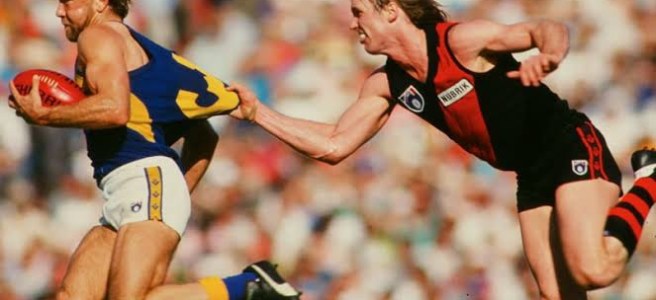
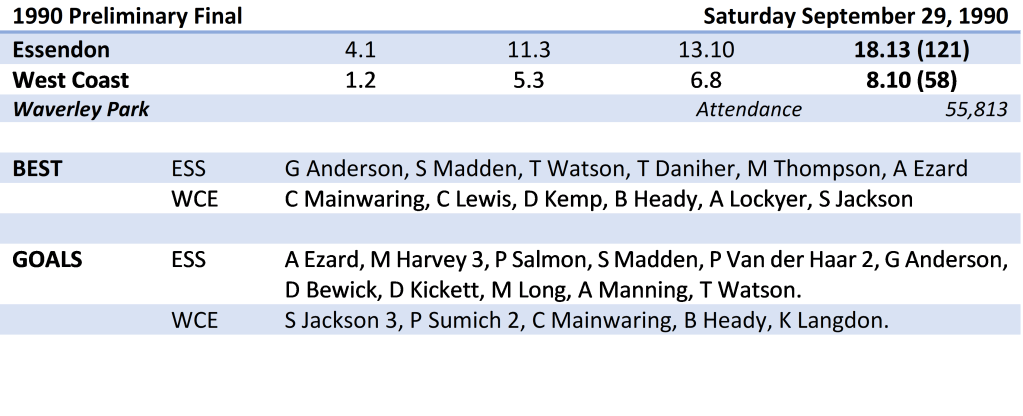
West Coast’s 1990 campaign fizzled out to a 63 point defeat against Essendon in the Preliminary Final, with the Bombers progressing to face Collingwood in the Grand Final.

Four consecutive matches at Waverley Park, and six interstate trips in a row, finally caught up with the young Eagles line-up, as they battled injury, illness and air strikes in the lead up to the match.

The Eagles were again forced to compromise their travel plans amid the ongoing national air strikes that had plagued much of their travelling over the previous six weeks.

West Coast ventured to Melbourne on a chartered flight, sharing the trip with the Perth Wildcats and Melbourne Tigers who were in the middle of their NBL Grand Final series. The trip required several stops along the way, and saw the three teams land in Melbourne on the Thursday – a day earlier than the Eagles’ usual schedule.

There were also concerns at the selection table.

Dwayne Lamb was unavailable, courtesy of a one week ban from the AFL tribunal, while nuggety midfielder Scott Watters was ruled out with a groin complaint.

Chris Mainwaring was struggling with a knee issue, Guy McKenna was racing the clock after injuring his arm late against the Demons and Laurie Keene was managing a groin injury. Craig Turley – who had been the Eagles best player over the prior fortnight – hadn’t trained all week due to the flu.

All four would take their place, but only Mainwaring would be a serviceable contributor.

Peter Melesso and Dean Turner were the two replacements for Lamb and Watters, with the selection of Turner somewhat of a surprise. Turner earned selection ahead of captain Steve Malaxos, who was left out of the side for a second week, as well as Don Pyke and Phil Narkle who had both been favoured to be included in the side.

Melesso was named after serving a five match suspension, but would then be a late withdrawal. Melesso took part in the warm-up ahead of the match, before being replaced by Todd Breman.

West Coast started the brighter of the two sides, but despite controlling possession struggled to find a way past half forward. Simon Madden, who had been heavily criticised during the week after a poor showing against the Magpies in the semi-final, was dominant both in the ruck and as the spare man in defence clogging up the space of the Eagle forwards.

Madden tallied 10 disposals and five marks for the term, as well as booting Essendon’s fourth goal of after a strong mark over Phil Scott in the goal square. The Eagles had just one major for the quarter; a solo effort from Mainwaring when he intercepted a defensive kick in the Eagles forward 50m area, before kicking truly on the run.

Stevan Jackson was busy early and finished with three goals

The quarter time deficit of 17 points was soon 43 as Essendon made West Coast pay for some sloppy play. Craig Turley started the rot when he dropped a simple mark in the middle of the ground, allowing the Bombers to regain possession with Darren Bewick finishing off a chain of play.

Alan Ezard then capitalised after the Eagles turned the ball over at half back before Simon Madden was able to boot his second of the match when John Worsfold was unable to handle the ball in defence.

Gary O’Donnell missed a golden opportunity, hitting the post running into an open goal, before Essendon caught a lucky break to boot their fourth major of the quarter. A scrappy kick forward by Derek Kickett eluded Phil Scott as he led Paul Salmon to the ball, allowing the Bomber full forward to hand off to Mark Harvey for a simple finish.

At this point, nothing was going right for West Coast.

Guy McKenna had copped a heavy hit that left him with a bloodied nose to along with the arm injury he was carrying, while Chris Mainwaring and Mark Harvey were involved in a brutal head clash that left both players on the ground for several minutes.

Finally, the Eagles found their second goal of the match. While they had been outplayed in most areas on the ground, the one spot they were winning was the centre clearances, even with Laurie Keene restricted.

Some good work out of the middle ended with Brett Heady steering through a second goal on his left foot from half forward, with the Eagles able to boot three more to give them an outside chance of victory.

However, a horrible handpass by Todd Breman deep in the Eagles defence gifted Ezard his second major of the quarter and the Bombers held a six goal lead at the main break.

Things only got harder straight after the restart when Karl Langdon was carted off after being knocked out cold in an accidental clash with Terry Daniher. Langdon attempted a diving mark, running back with the flight of the ball, with Daniher’s hip collecting Langdon in the head. With Keene also done for the day, the Eagles were without a bench, with a half to play and six goals behind.

Still, they refused to give up the fight. West Coast were the better side for much of the third term, with the play almost completely in their forward line. Essendon couldn’t find a way out of defence as West Coast continually pumped the ball into their forward 50, but they couldn’t make it count on the scoreboard.

Peter Sumich kicked the Eagles first goal, but then missed two more set shots, before Stevan Jackson hit the post from close range, and then Tony Begovich missed from directly in front after receiving a 50m penalty.

Mainwaring had a chance that failed to score, as did Michael Brennan, whose long range shot was marked on the line by Ezard. Sumich had a third chance that sailed out of bounds and for all their dominance, the Eagles had posted just 1.5 for the quarter.

Dean Turner then best exemplified the Eagles’ frustration when he cannoned into Ezard, well after the Bomber forward had taken a running shot on goal. Ezard’s effort missed, but the umpire awarded a second shot following Turner’s indiscretion, with Ezard able to boot his third goal and all but finish West Coast’s resistance in the match.

The Bombers added a further five goals in the final quarter to run out easy, albeit unconvincing, winners.

Malthouse admitted the heavy travel load had caught up with his side, but had nothing but praise, despite bowing out in penultimate week of the season.

“We looked and acted tired.”

“But I think the spirit was there to generate as much play as possible… it all caught up with them,” Malthouse said.

“The players showed enormous courage and fortitude… at no stage in six weeks of criss-crossing Australia was their a complaint. There was no sign of weakness during a severe test of the team’s character and competitiveness.”

Essendon coach Kevin Sheedy was happy enough with the performance, confident his side would bounce back from the thrashing by Collingwood the week before. “We were switched on early, and the players worked hard to get 18 wins this year and they did not want to let that slip.”

“I feel that will make us 10 percent better next week.”

Greg Anderson and Chris Mainwaring were both their respective sides’ best players, despite being opposed to each other on the wing for much of the afternoon. Anderson finished with 25 touches and booted 1.3, while Mainwaring had 19 disposals and booted a goal.

Terry Daniher and Mark Thompson also finished with 25 touches to lead the way at Essendon, while Tim Watson picked up 22 disposals and booted a goal. Simon Madden was another standout during the game with 21 possessions, 12 marks, 10 hitouts and two goals.

Alan Ezard and Mark Harvey each booted three goals.

At West Coast, Chris Lewis finished as the leading ball winner with 22 in his battle with Mark Thompson. Thompson was influential in the opening term, but Lewis had the better of the match-up over the remainder of the match despite Thompson still finding plenty of the ball. Lewis had been sublime through the second half of the season, with his consistent showing culminating in winning the club best and fairest, as well as being named in the All-Australian side (along with John Worsfold).

Chris Mainwaring was one of the Eagles’ best despite barely being able to see by games end

Dean Kemp picked up 21 touches and Brett Heady 20, as the two finished their impressive debut seasons with strong performances. Stevan Jackson offered plenty in the forward line with three goals from 14 disposals and six marks, while Peter Sumich would rue a wasteful day, finishing with 2.5.

Andrew Lockyer won his battle at centre half back on Paul Van der Haar, keeping the veteran Bomber to just nine disposals and two late goals. Craig Turley (17 disposals) and Guy McKenna (16) toiled hard despite their operating below their capacity.

The Eagles coach was openly proud of his side’s season, but the gains made in season 1990 were best summed up by opposing coach Kevin Sheedy. The Bombers coach – a former teammate of Malthouse’s at Richmond – praised Malthouse, saying he had added professionalism to the four year old club, while also lauding WA’s ‘sensational’ year.

Sheedy said playing four finals in a row was the equivalent of two finals series’ worth of experience, which would be ‘invaluable’.

“After physically and mentally going through it, the standard for West Coast has been set.”

The Eagles for their part had risen from a bit-part team out in the west, to one of premier clubs in the revamped competition in just one season. The addition of Malthouse had been an immediate success – and the board knew as much.

Days before Christmas, the Eagles announced that Malthouse had signed a three year extension to his initial contract, keeping him at the club until the end of 1994.

The ’90s had begun – as had the first Eagles dynasty.  

1990 Rewind: Eagles Exorcise Demons

Historic First Finals Win For West Coast

West Coast set up a meeting with Essendon in the preliminary final after defeating Melbourne by five goals in the semi final.

Mick Malthouse’s drastic changes at the selection table paid off, as West Coast overcame a poor recent record against Melbourne to produce the clubs first ever win in a final.

One of those selections – Chris Waterman – produced a career best outing booting six goals across half forward.

Waterman was one of six changes for West Coast, with Eagles coach Mick Malthouse ruthlessly axing a quarter of the side that was demolished by Collingwood the week before in the Qualifying Final replay.

The most controversial omission was captain Steve Malaxos, who lost his place after a period of indifferent form. Malaxos had spent much of the previous two games against Collingwood on the bench, with Malthouse later saying the Eagles needed greater leg speed and running power on the wide expanses of Waverley Park.

Joining Malaxos out of the side were ruckman Dean Irving, who had been well beaten in both Collingwood matches, Troy Ugle, Craig McGrath, Murray Rance with a fractured jaw and Peter Wilson who would be a late withdrawal ahead of the game with a hamstring strain.

Phil Scott returned to the Eagles line-up, after being dropped on the eve of the finals, to partner Laurie Keene in the ruck, while Scott Watters returned after missing the replay with a knee injury. Stevan Jackson replaced McGrath up forward after ten goals with South Fremantle in the previous fortnight, while Waterman and Tony Begovich were added for their ability to run and spread.

When Wilson pulled out ahead of the game, Andrew Lockyer was called up, slotting into defence in place of the missing Rance. Guy McKenna had been in doubt after breaking a nose late in the loss to the Magpies, but held his spot, as did Mainwaring whose knee was becoming a week by week proposition.

Stevan Jackson returned to the Eagles side to be one of their best

Melbourne made no change when teams were announced but were soon to have their own late drama. Captain Garry Lyon was pulled from the side on the morning of the game after he suffered a corked thigh colliding with teammate Steven O’Dwyer the day before at training. Todd Viney was called up to the side.

Despite being without Lyon and midfielders Brian Wilson and Alan Johnson, the Demons were still hot favourites to progress to the preliminary final.

It took just 90 seconds for West Coast to show they weren’t going to just whimper away.

Kicking into the wind, the Eagles had two goals on the board – both to Chris Mainwaring – before Melbourne had even worked out their direct match-ups.

As well as bringing in a host of new players, Malthouse also moved his side around as he sought to catch the Demons off guard. Mainwaring started at half forward and his quick brace forced a shuffle of the Melbourne defence with Steven Stretch moved from the wing to replace Matthew Febey.

John Worsfold also started forward, as did Chris Lewis as the Eagles looked to avoid an early tag. Lewis still had Stephen Newport for company, but was influential early as West Coast established an important 13 point lead at quarter time.

Andrew Obst had been instrumental in Melbourne’s win over the Eagles in Perth several weeks earlier and Malthouse wasn’t keen on letting the midfielder run unattended again. Guy McKenna shifted into the midfield in a run-with role, holding Obst to just 12 disposals for the game.

Laurie Keene led the ruck, with Phil Scott taking the resting ruckman in the back pocket, while Andrew Lockyer had first crack at Darren Bennett.

The Demons tried to repeat the physical approach that had seen them defeat West Coast twice during the regular season, but the Eagles kept their focus on the ball.

The 13 point advantage exploded to 45 points by the main break, with the Eagles booting six goals to none with the wind, and the match was as good as done.

Melbourne outscored the Eagles in the second half, but West Coast were never in danger of giving up their spot in the Grand Final playoff.

West Coast would have to get past Essendon if they were to make their first ever Grand Final, after the Bombers were comprehensively beaten by Collingwood in the other semi-final.

Kevin Sheedy denied the Bombers would be affected by the additional layoff because of the drawn Qualifying Final leading into the match, but they appeared sluggish going on to lose by 63 points. The Magpies led by 12 points at half time, but ten goals to two after half time saw Collingwood qualify for their first premiership decider in nine years.

While West Coast could feel satisfied with the history-making first ever finals win in the clubs history, there were concerns to come out of the five goal win.

Scott Watters had arguably been the Eagles’ best player in the first half, but spent the entire second half on the bench with a groin complaint. Guy McKenna suffered a suspected broken arm after clashing with Earl Spalding in the dying minutes of the game and three Eagles wound up on report from separate incidents in the game.

Chris Lewis was placed on report for charging Graeme Yeats and Stevan Jackson was reported for striking Jim Stynes. Both players would get off at the tribunal during the week, but Dwayne Lamb wasn’t so fortunate.

The Eagles tagger was also charged for reporting Stynes, copping a one week ban. Lamb, and many of the other Eagles, were still seeking retribution from the last match between the two sides which saw Stynes break Lamb’s arm with an attempted soccer off the ground.

The Eagles gave it to Stynes, every chance they could, and it appeared to work as Keene controlled the stoppages and provided plenty of attacking run off Stynes around the ground.

The move appeared to work with Melbourne unable to get any direction or structure on the field with their captain missing and their ruckman ineffective.

At the feet of Keene, Craig Turley, Dean Kemp and David Hart had plenty of the ball as they overwhelmed their Demons counterparts. For the second week in a row Turley was one of the best for West Coast, revelling in the centreman role in the absence of Malaxos.

Turley finished with 26 disposals, one behind Mainwaring who had a team high 27 possessions to go with his two goals at the start of the match. Hart, Kemp and Brett Heady all tallied 21 while Keene himself finished with 23 touches, four marks and ten hit-outs.

Scott Watters was one of the best for West Coast but finished on the bench injured

Up forward, the change in dynamic did wonders with West Coast kicking their highest score since round 19. Waterman was the surprise packet with six goals from 17 disposals and nine marks, while Peter Sumich booted four and Stevan Jackson three, the trio combining for 13 of the Eagles’ 19 goals.

Sumich and Jackson also each booted five behinds, with Jackson also gathering 21 disposals and five marks – highlighting the dominance of the Eagles’ tall forwards.

The Demons had few players who shone, with Simon Eishold and Greg Healy the leading ball winners with 20 disposals. Stephen Newport gathered 16 disposals and seven marks after starting in a tagging role on Chris Lewis. Newport was then replaced by Glenn Lovett, but Lewis had the better of both players as his blistering second half of the season continued.

Rod Grinter booted four last quarter goals when he was shifted forward, with Ricky Jackson, Graeme Yeats and Darren Bennett each kicking two.

Demons coach John Northey called his side’s performance ‘pathetic’, with Melbourne unable to live up to their favouritism billing heading into the match. “In finals football, you have to find something extra all the time, and our players weren’t prepared to do it.”

Northey believed that the underdog status had worked in the Eagles’ favour, after two testing weeks against the Magpies.

“When everyone is kicking us in the guts, we have something to prove, but as soon as we become favourites in something, we have always faltered, and not just once, it has happened many, many times,” expressed a frustrated Northey.

 For Mick Malthouse, the performance was justification for their season and followed his earlier comments the week before that West Coast would bounce back. “I think a lot of people underestimated the fighting spirit of this group.”

“We didn’t make the finals series for the sake of making the finals series.”

Malthouse also believed the first ever finals win would be a great fillip for his side as they continued their push for a maiden flag.

“It (a finals win) is fantastic for the players… this year we have won in Sydney for the first time, the MCG for the first time. These are all little hurdles all along that are being looked at by the players.”

The Eagles coach also denied it was a risk making the mass number of changes ahead of the game, with many of the inclusions having a strong say in the final result.

“If it hadn’t come off, I suppose it may have been the biggest gamble of my coaching career,” Malthouse wryly admitted.

1990 Rewind: Finals Chaos As Eagles, Magpies Draw

Sumich Shoots Wide On Siren

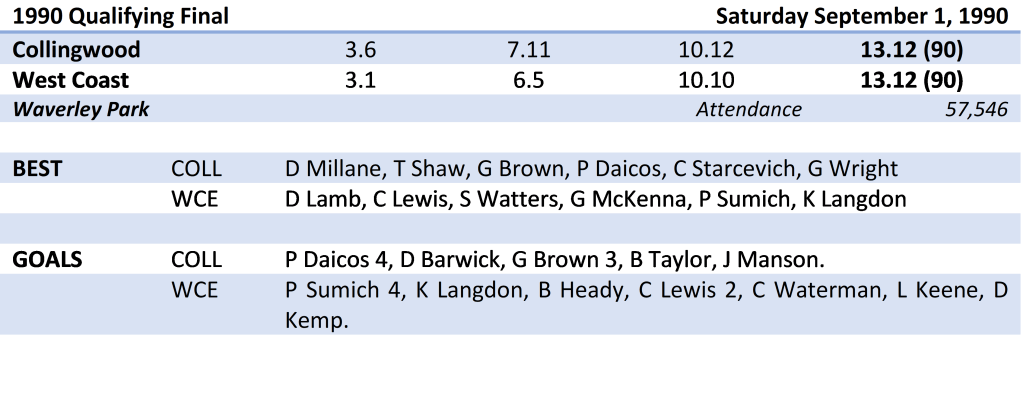
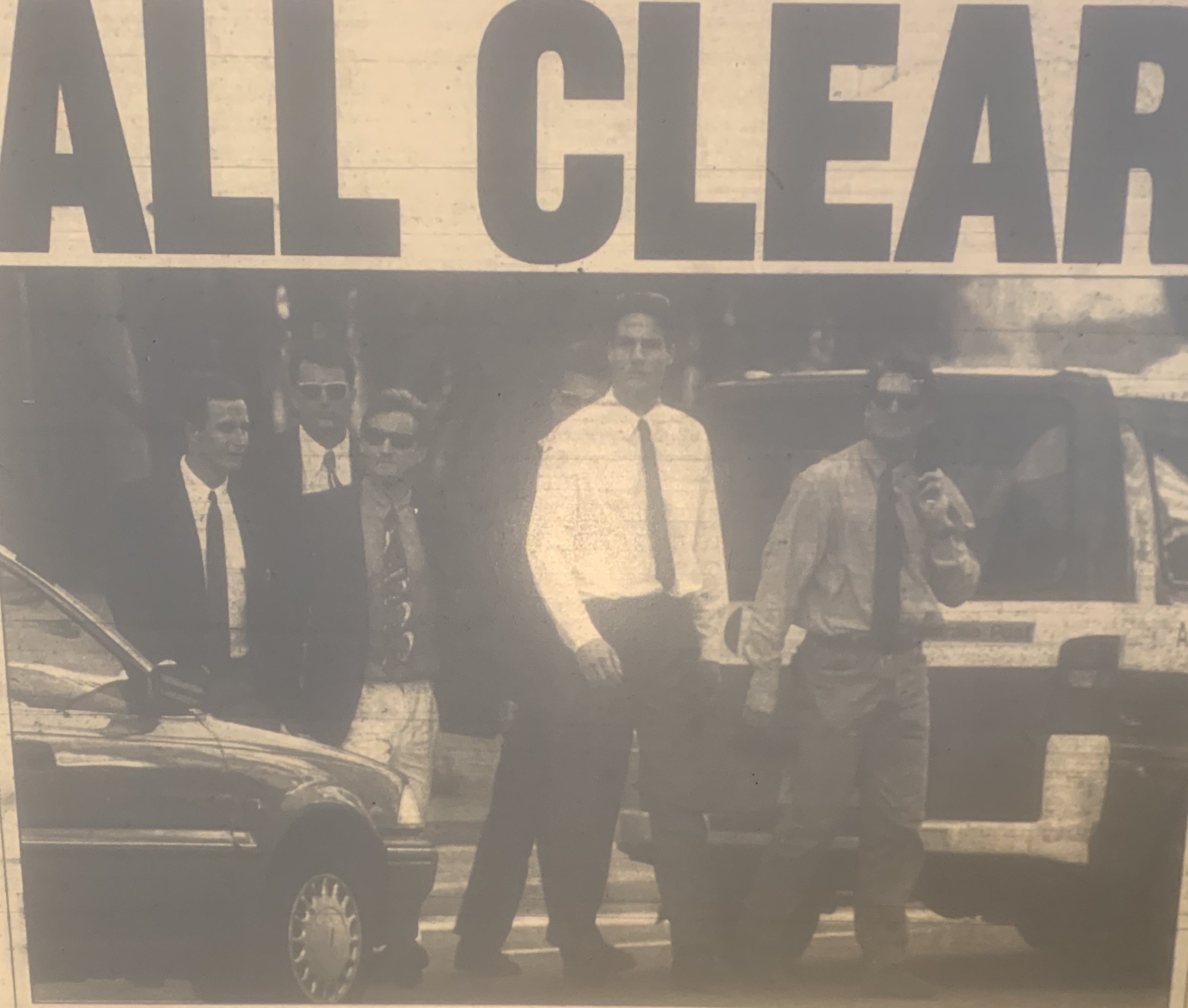
West Coast and Collingwood opened the 1990 finals series with a dramatic draw in the Qualifying Final, flipping the entire finals series on its head.

Peter Sumich had the chance to win the game in the dying seconds, but his missed set shot from close range in the left forward pocket, left the two teams matched on 13.12 (90) as the final siren rang.

The result – the first draw in a final since the 1977 Grand Final – was set to throw the finals series into disarray, with the Eagles and Magpies due to return to Waverley Park the following weekend to determine who would progress to the first semi-final to tackle the Bombers.

Melbourne were awaiting the loser of the replayed match, after they knocked reigning premiers Hawthorn out of the premiership race with a nine-point win in front of nearly 75,000 fans at the MCG.

The Demons now also had the added benefit of a week off ahead of the second semi-final after winning through the elimination final. Conversely, Essendon – who had earned the week off in the first week of the finals for finishing top at the end of the home-and-away season – were now facing a second straight week off, complicating their preparations for their first final.

Essendon coach Kevin Sheedy dismissed suggestions the protracted series would work against the Bombers, despite the prospect of over three weeks between their final round match against the Saints and the first semi-final. “We have played 22 home and away games this year, four Fosters Cup games and eight practice matches. I don’t think we need to worry about fitness.”

While the AFL were estimating an additional $800,000 would be generated from the extra match to be played, they were also forced to busily reschedule many of the planned events over the coming month. The Grand Final was now set to be played a week later on October 6, however the date for the Brownlow medal wasn’t expected to change.

The Magpies were heavy favourites heading into the match, off the back of their two largest wins of the season in the final two rounds. The Magpies took in an unchanged side from the win over North Melbourne, despite a couple of key injury concerns. 

Darren Millane stayed in the side despite fracturing a thumb against the Kangaroos, as did ruckman James Manson who trained lightly leading up to the match due to an ongoing groin issue. The Magpies also had Denis Banks and Shane Kerrison available to return from injury, although neither was recalled for the clash against the Eagles.

Full-forward Brian Taylor also kept his spot, despite an indifferent two seasons at the club. Taylor had managed just one game in the back half of 1989 due to a knee injury (coincidentally against the Eagles) and had featured in just five further matches in 1990, returning to the side in round 21 against Fitzroy.

The Eagles made just one change with Dean Irving returning after being dropped for the final round match against Geelong. Controversially, fellow ruckman Phil Scott was the one to make way after playing all 22 games during the home-and-away season.

For Mick Malthouse, it was a heart-wrenching decision. “This was the toughest decision I have made in seven years of coaching.”

“Phil accepted the decision like the professional sportsman that he is.”

Craig Turley also held his place despite concerns over a groin problem. West Coast were considered outsiders – namely by the Victorian media – with ten players playing in their first final. The Eagles were also playing only their third game ever in club history at Waverley Park; their other two appearances had both resulted in losses.

Steve Malaxos won the toss and sent his side the way of the breeze in the opening term, but the more experienced Magpies were able to settle first. Taylor had an early chance in the game, hitting the post with his first shot, before sending his second effort on goal out of bounds on the full.

His presence on the game forced an early positional change in the match, with Murray Rance and Michael Brennan swapping. The larger Rance headed to the goal square to match on Taylor, with Brennan shifting to centre half back on Craig Starcevich.

Dean Irving was stationed as a loose man in defence as Collingwood continued to push the ball forward, but while West Coast were able to limit the damage on the scoreboard early, the Magpies’ opposing ruckman Damien Monkhorst was allowed to dictate play and provide the link playing loose through the middle of the ground.

Monkhorst would be involved in the chain that delivered Collingwood the opening goal of the game. Chris Mainwaring was caught holding the ball across half forward, by opponent Mick McGuane, with Collingwood able to transition quickly to the other end of the ground.

Graeme Wright received the handpass from Monkhorst through the centre square, and kicked inside forward 50, looking for Taylor. However, Peter Daicos was able to read the spoil from Rance and after a handpass exchange with Starcevich, Daicos found some space to slot the important first major.

Gavin Brown added a second after being held by Guy McKenna in a marking contest, before West Coast worked their way into the game. Laurie Keene wobbled through the Eagles’ first on the run, before Brett Heady made it two goals in succession.

Brown added a second for the quarter, and third for the match for the Magpies, but his effort was cancelled out by Peter Sumich from long range leaving West Coast five points behind at the first change.

Mick McGuane was the clear standout at quarter time, picking up 16 disposals on the wing for the term opposed to Chris Mainwaring. His red hot start continued into the second term when an early shot on goal cannoned into the post. The Magpies managed several more efforts without success, before Sumich swung the game back in favour of West Coast.

Sumich goaled twice from long range to draw the Eagles level, before Karl Langdon sent through his own long bomb from beyond the arc to put West Coast in front.

However, that only seemed to spark the Magpies into gear.

Brian Taylor was dragged to the bench and the more mobile Craig Starcevich became the prime target up forward. Peter Daicos continued to present a threat, as did Gavin Brown who was now operating out of the goal square.

The Magpies booted the final three goals of the term to open up a 12 point lead at the main break. Collingwood were also guilty of wasting their chances on goal, having had seven more scoring shots for the half than West Coast.

Both coaches made moves to start the second half, as they looked for the all-important edge in the match. Ron McKeown replaced Craig Kelly at full back on Peter Sumich and Worsfold took Daicos in the Eagles defensive half.

And as the match grew in intensity, so did the sublime skills of its participants.

Dean Kemp drew the Eagles within a kick with a pinpoint goal from the pocket, before Daicos responded with a 40 metre snap. Peter Sumich add his fourth of the match, again from long range, and Chris Waterman kicked truly after being found on his own in the forward pocket, to see the Eagles reach parity.

West Coast were now in control of the game, led by Dwayne Lamb who gathered 12 possessions for the quarter, and Scott Watters, who had nine. James Manson put the Magpies back in front against the run of play after a sloppy turnover in defence, but the Eagles continued to generate opportunities.

Brett Heady, Chris Mainwaring and Dwayne Lamb all missed before Chris Lewis typified the class of the game, with a truly outrageous goal to put the Eagles back in front.

Ron McKeown was captured in defence by Kemp, with the ball spilling towards the boundary line where Lewis was able to swoop, gather, brush off the tackling attempt from Scott Russell before snapping through an incredible goal on his non-preferred foot in amongst a nest of Magpies.

Further adding to the difficulty of Lewis’ effort, Lewis had also lost his footing during the play, stranded on his knees before being able to lift back to his feet and kick an important goal for the Eagles.

Lewis had been instrumental in the second quarter in keeping West Coast in touch with Collingwood as they built an early advantage and now, as the match closed in on three-quarter time, the Eagles were the ones with all of the momentum.

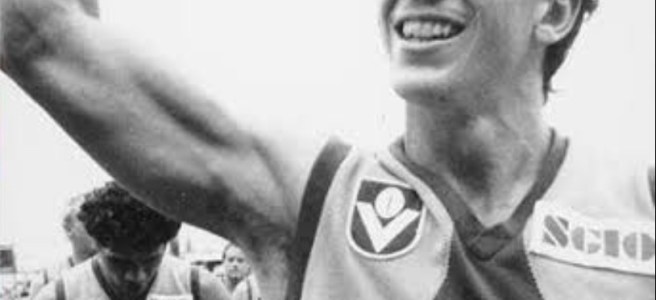
Chris Lewis continued his excellent form from the second half of the season in the drawn final

Heady would miss a chance after some clever play by Lewis at half forward, where he was able to pluck the ball away just as Collingwood were set to clear from defence, before Heady and Sumich would then clash competing for the same mark. Dwayne Lamb would also miss a chance to get a shot on goal after fumbling at the top of the goal square.

A swift chain of passes from defence ended with Doug Barwick kicking truly to give Collingwood an unlikely two point lead, against the run of play, with a quarter to play.

The two point deficit became a ten point lead for West Coast early in the final quarter after Heady and Lewis each booted majors in quick succession. The Eagles runners – the likes of Watters, Lamb, Chris Mainwaring and Guy McKenna – had controlled the tempo of the game since half-time and the Magpies were struggling to keep pace.

Mick McGuane had faded out of the game after his blistering first quarter and found himself on the pine, while James Manson had been sent from attack to defence to quell Karl Langdon who had been in everything during the third term.

Trailing, Leigh Matthews reinstated Brian Taylor to the field after spending the second and third terms on the bench and the move paid immediate dividends. Taylor was able to claim a diving mark in front of Murray Rance, and goal, to reduce the Eagles lead to four points.

A few minutes later, Taylor added a second after Rance caught him high in a marking contest, and Collingwood had worked their way back into the lead.

The Magpies appeared to have done away with the Eagles challenge when Peter Daicos extended their lead with an effort that managed to top Lewis’ freakish effort in the previous term.

The Eagles attempt to exit their defensive 50m arc came unstuck when Guy McKenna missed John Worsfold with a pass, after a strong mark in the Magpies’ goal square. Gavin Brown was able to win the loose ball back near the boundary line, feeding a handpass up the line to Darren Millane, who instantly handpassed over his shoulder to Daicos deep in the forward pocket.

With the outside of his right boot, from the wrong pocket, Daicos magically worked the ball to land at the feet of the goal umpire and extend the Magpies’ lead out to eight points with just five minutes remaining.

West Coast though continued to push.

A desperate effort from Steve Malaxos across half forward prevented Collingwood from clearing out of defence, with Langdon able to snap truly from a boundary throw-in. Waterman dragged a shot on goal from deep in the pocket, reducing Collingwood’s lead to a solitary point before the final last play that had the game in the balance.

Chris Mainwaring twice failed to find an Eagles target in the forward half before Darren Millane attempted to clear out of defence. However, Eagles runner Rob Wiley inadvertently kept the ball in the Eagles forward line when he got in the way of Millane’s handpass resulting in a boundary throw in.

Langdon won the ball from Keene at the restart with his attempt on goal floating across the face into the opposite pocket where Sumich was able to mark over his shoulder. His final kick would become instantly folklore.

Peter Sumich laments his late miss

All up, the lead changed eight times during the match, and while the teams may not have been separated at the completion of four quarters, the same couldn’t be said for the attitude of the two coaches.

While Leigh Matthews was relieved to have a second chance at the second chance, his counterpart in Malthouse was left ruing the missed opportunity.

“We didn’t make the most of the opportunities. When the game was there to be won, we didn’t grab it.”

Malthouse expressed frustration that West Coast couldn’t take advantage of the lead they built during the final quarter and run out to win the game. “I feel bitterly disappointed. We didn’t achieve what we came here to achieve.”

The Eagles coach was also unwilling to accept much of the post-match praise from the Victorian media, who joined in with Matthews’ assessment that the Eagles were stronger contenders for the flag than many scribes had suggested.

“They were always going to play better than the public perception of them – that almost inevitably is the case,” Matthews said.

“It was never going to be easy. We didn’t think we played well, but we live to fight another day and that’s the way we are looking at it.”

The Collingwood coach refused to admit they were fortunate to make it out with a draw, but said they were ‘thankful’ to get another crack. “With a draw you tend to be disappointed because you haven’t won – until you tell yourself you haven’t lost either.”

“We feel quite positive about having another chance.”

The ramifications of the draw would lead the AFL to change how drawn matches were decided, with the Commission voting to introduce two five-minute periods of extra time for all finals, other than the Grand Final.

For now though, West Coast and Collingwood had a week to prepare to do it all again and Malthouse had one message for those who had decided to jump on the Eagles bandwagon.

“Do us a favour and write us off,” Malthouse declared.

“Maybe they (the media) have underestimated the fierceness and willingness to contest. We showed today what we are capable of doing.”

“As far as I’m concerned it’s half time in the match. It’s a 14-day game.”

1990 Rewind: Lewis Magic Lifts West Coast

Eagles Get Necessary Win In Penultimate Round

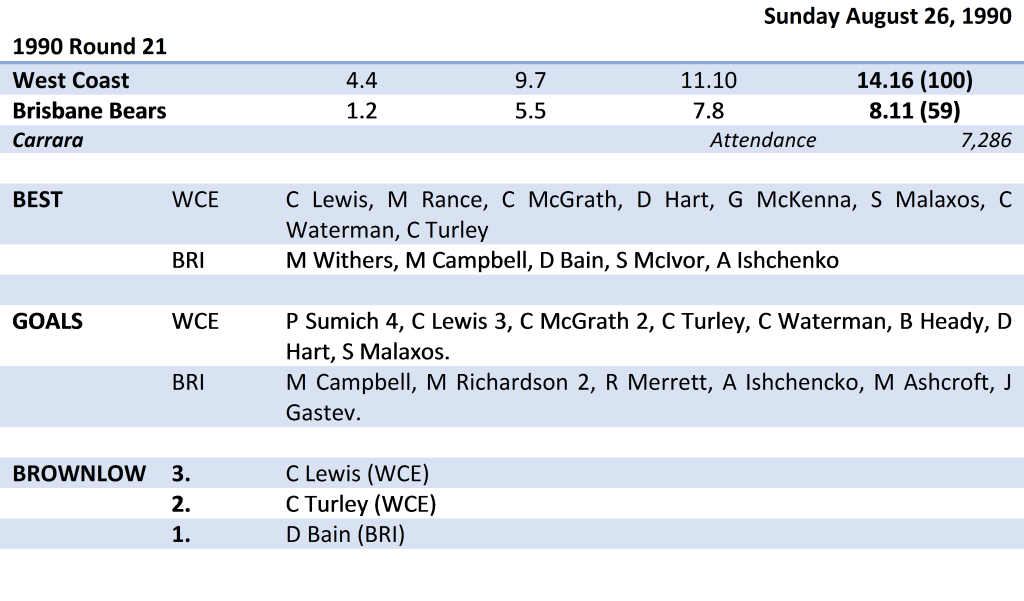
In a game that failed to reach great heights, West Coast got the four points against the Brisbane Bears to keep their hold on third place, with just one regular-season game left.

The Eagles were solid, rather than spectacular in the win, opening up a 20 point lead at the first change before going on to a 41 point result in front of just 7,286 fans at Carrara.

And while those that did come to the ground would have seen the match play out as expected between a team vying for the double chance and another team near the foot of the ladder, they were treated to one of the great individual performances of the year.

Chris Lewis had endured a frustrating start to the season when a hamstring injury and then an ankle problem restricted the midfielder/forward to just one quarter in the opening five games.

A fortnight with WAFL club Claremont built some match fitness before Lewis returned to the Eagles side, hitting his stride in the second half of the season. In ten matches from round 11, Lewis averaged 23 disposals per game and booted 15 goals as West Coast consolidated their spot in the top five.

Against the Bears in Round 21, Lewis put in a career best performance.

Running through the midfield, Lewis collected 28 kicks, 10 handballs, seven marks and booted three goals in a clear best on ground display. The Bears had no answer to the masterful showing from Lewis, who displayed his skills both in the stoppage and out in space and had a hand in creating a number of scoring opportunities.

The Eagles made a host of changes to the side that played the Bears, following their loss to the Demons a week earlier. Dwayne Lamb was forced out with a broken arm and Peter Melesso commenced his five-week suspension for stomping. The casualties from the defeat were Troy Ugle, Tony Begovich and Geoff Miles.

Into the West Coast line up were John Worsfold, who returned from serving a two week ban, Craig McGrath who was a late withdrawal the week before, as well as Scott Watters, Dean Turner and Murray Rance who forced his way into the side after six weeks in the WAFL.

The Bears made just two changes with Chris O’Sullivan and Brad Rowe replacing dropped pair Ray Windsor and Shaun Hart.

Laurie Keene made the trip with the Eagles squad as the travelling emergency, with Malthouse remaining cagey over whether the ruckman would make his return from injury. Keene had been sidelined since the second match of 1989 and even Bears coach Norm Dare predicted pre-match that Keene would be included in the Eagles side.

“I can’t believe Keene would come all this way and not play.”

Keene wasn’t a late inclusion with Malthouse giving the pairing of Dean Irving and Phil Scott a chance to bounce back from the beating they copped against Jim Stynes the week before.

And while both lowered their colours to ex-Eagle Alex Ishchenko, it mattered little as Lewis led the strong showing from the West Coast midfield. David Hart and Stephen Malaxos complemented the silky skills of Lewis with the inside grunt, while Craig Turley and Chris Mainwaring provided the linking run on the wings.

Up forward, Peter Sumich booted four goals, taking his total to 73 for the season, equalling the club record set by Ross Glendinning in 1988. However, Sumich would finish the afternoon on the bench. In only his second game back from missing a month with a hamstring, Sumich once again felt a twinge with the Eagles medical staff taking no chances on their spearhead.

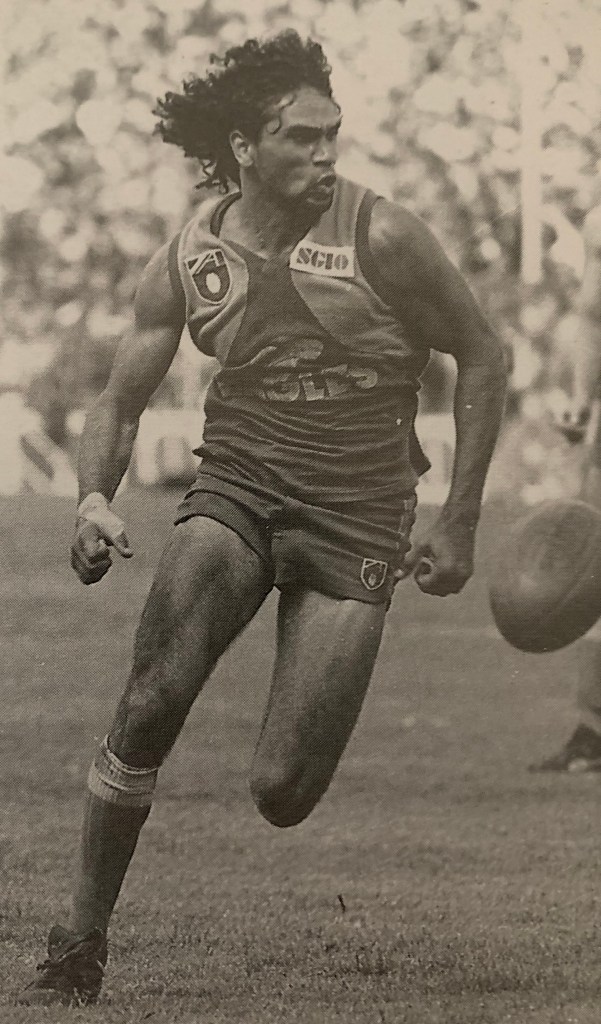
Chris Lewis was sublime for the Eagles against Brisbane

For Malthouse, the defensive effort was the most pleasing aspect, having conceded 100 points in each of the previous two games.

“The idea was to restrict their scoring, which is something we’ve not done in the last two weeks. The Bears only got eight goals – that’s exactly the result we wanted.”

“They had some good runners but we were able to shut them down and we broke through their defence enough times to kick a winning score.”

Pleased with the performance of his defence, Malthouse had special praise for the returning Rance who restricted Bears full-forward Roger Merrett to just nine disposals and a goal.

“It was just about his (Rance) best game this year. Not because of how many kicks he got, but because of who he was playing on and the way he handled himself under pressure.” Malthouse went on to say it was the best game Rance had played at the club.

Rance himself tallied 15 disposals and seven marks to finish as one of the best for West Coast. David Hart relished not having a tag for the match to gather 31 disposals through the middle, while Steve Malaxos picked up 29 touches.

Guy McKenna had 25 disposals off half back, while Craig McGrath provided the perfect foil for Sumich in the forward line with 21 touches, nine marks and 2.3. Chris Waterman – who held his spot after being a late inclusion the week before – was also one of the Eagles’ best with 19 possessions, nine marks and a goal.

Mark Withers was the leading disposal winner for the Bears with 27, while David Bain and Scott McIvor each picked up 26 touches. With the Bears’ key forwards well held by the tight West Coast defence, only Michael Richardson and Matthew Campbell finished as multiple goal scorers with two each.

Bears coach Norm Dare admitted he was flat after the match believing many of his players already had their eye on the end of the season. The Bears were relegated to last on the ladder and were set for the wooden spoon, after Sydney stunned the Cats by two points at Kardinia Park.

The win kept West Coast in third, with all of the finals incumbents registering wins in the penultimate round of the regular season. Essendon stayed top, despite being jumped by Footscray. The Bulldogs opened up a four goal lead at the first change, but the Bombers had hit the front by half-time, before rolling away to a 24 point win.

That kept the Bombers a win ahead at the top of the ladder, with Collingwood putting in the most impressive performance from the top five, thrashing Fitzroy by 86 points. The Demons and Hawks kept their own double chance hopes alive with efficient wins over Richmond and Carlton.

Melbourne broke free of the Tigers with a five goal second quarter, to run out steady 36 point winners, while Jason Dunstall kicked six goals for the Hawks in their 31 point win over the Blues.

While West Coast mostly tailored through their win against the Bears, the performance wasn’t a concern for Eagles coach Mick Malthouse, pointing out the eight hour trip from Perth to the Gold Coast was an acceptable factor.

The air strike that had debilitated much of the national travel system meant West Coast had to make stops in Adelaide and then Sydney, before eventually reaching their destination in Queensland. Conditions at the ground were also tough with hot, blustery winds greeting the teams at Carrara.

“Fatigue was a big factor. It’s a long journey, it’s a big ground and we haven’t played in that sort of heat for a long time.”

“A win, is a win, is a win – and that’s all it was.”

1990 Rewind: Eagles Squeeze Past Swans

Eagles Below Best, But Still Grab The Points

West Coast put in a sub-par performance against the Swans, but still came away with an important 15 point win that kept them in touch with the top two.

The Eagles led by just a point at three-quarter time, but four goals to two in the final term was enough to secure a fourth straight win and leave them just one game behind ladder-leading duo Essendon and Collingwood.

Twice, West Coast pushed their lead beyond twenty points, only to be reeled in by an inexperienced Swans outfit.

Following their 75 point thrashing by the Saints the week before, Sydney turned over a quarter of their side for the clash with West Coast.

Paul Kelly, Matthew Ryan, Troy Luff, Matt Lloyd and Mark Eustice were all dropped, as Sydney brought in a number of youngsters. Craig Nettlebeck and Chris O’Dwyer were both selected for their AFL debuts, while Darren Denneman was picked for just his fifth game of football. Robert Teal was selected for his first game of the season after battling injury for much of the year, with veteran Rod Carter also returning.

The Swans were then dealt a further blow when Darren McAsey was rubbed out for two weeks after being charged for striking on trial-by-video. McAsey received the two week ban after teams were initially submitted during the week, with his place taken by small forward Shane Fell.

The Eagles on the other hand were far more settled making just the one change, with Karl Langdon replacing out of form forward Stevan Jackson. Peter Melesso remained at full forward with Peter Sumich still out injured.

Both teams slugged it out in the early stages, before a burst from West Coast just before quarter time allowed them to hold a 20 point lead at the first change. Undeterred, Sydney plugged away through the second term with goals to Leon Higgins, Shane Fell and Steven Wright to close within two points before a late Craig Turley goal saw West Coast head to half time with an eight point lead.

West Coast opened the third term with the first three goals to reach a game high 26 point lead and looked set to ease to a comfortable victory. But Sydney again wrested control in the game. The Swans booted the last four goals of the quarter to reduce the margin to just a solitary behind with a quarter to play.

Eagles coach Mick Malthouse didn’t hide his displeasure at three quarter time, demanding an improved performance in the final quarter. West Coast responded, led by Chris Lewis and Chris Mainwaring, to claim a 15 point win and hold their spot in third place.

While happy with the win, Malthouse acknowledged his side were far from their best.

“We won it playing poor football, but I’m just happy to get out of this bloody joint with a win.”

“That was our flattest game of the year.”

Sydney coach Col Kinnear was equally disappointed after the match, believing his side had missed out on a golden chance to claim just their fourth win of the season.

“At the 15-minute mark of the final quarter, I don’t think we believed we could win. When we wanted a lift from some of the senior players, it wasn’t coming,” a dejected Kinnear said.

Indeed many of the Swans’ best players came from their younger crew.

Six-gamer Gareth John was arguably best on ground for the Swans, as he had the better of Dean Irving in the ruck. John picked up 24 touches and seven marks, to go with 14 hit-outs, and was virtually another midfielder for the Swans.

Leon Higgins tallied 22 touches and booted two goals, while in defence Craig Nettlebeck stood tall in his debut game, blanketing Eagles forward Karl Langdon. Langdon managed just five disposals for the game, although he did manage to goal twice.

“The kids were terrific. I am bitterly disappointed for them,” Kinnear said.

Dwayne Lamb was one of the best for West Coast in his match up against Greg Williams

The Eagles, on the other hand, had a far greater spread and key players stood up when it mattered.

Captain Steve Malaxos again led from the front, finishing with a game high 31 disposals and a goal, while Dwayne Lamb was effective for the Eagles, while attempting to minimise the damage inflicted by Swans centreman Greg Williams.

Williams still finished with 30 disposals, but was not as dominant as he has shown in 1990, with Lamb able to match him with 25 possessions and a goal. Chris Mainwaring (24 disposals) and Chris Lewis (23) both had important touches in the final term as West Coast again built ascendancy in the match.

Up forward Craig McGrath kicked three goals from 16 disposals and with Langdon and Jackson both largely ineffective, remained the one constant focal point for the Eagles.

The result allowed the Eagles to hold onto third spot as pressure for the double chance continued to come from the Demons and Hawks below them.

“It was more a battle of survival and we are delighted to come away with a win at this time of the year when we are fighting for our top-three position.”

While the Eagles had worked their way through a lethargic performance to still claim the four points, Malthouse reminded the rest of the competition that his side were still expecting to be a force come September.

“A good side wins those sorts of games and we are a good side.”

The one downside from the match was the two game suspension handed down to vice-captain John Worsfold. Worsfold had been cited for striking Williams, with the tribunal rubbing Worsfold out of the Eagles’ next two matches against Richmond and Melbourne.

The Eagles remained hot on the heels of Essendon and Collingwood who both recorded victories. The Bombers scraped past Geelong, booting six goals in the final term to overturn a 27 point three-quarter time deficit. Gary Ablett booted eight goals for the Cats, but it would be another disappointing result for the 1989 runner-ups.

Collingwood made far lighter work of their opponent, thrashing a toothless Saints team by 68 points. The Magpies showed they were on early, registering 12 scoring shots in the opening term, but only managing an inaccurate 3.9 for their effort. Collingwood controlled the game throughout, delivering the Saints their worst loss of the season.

Hawthorn and Melbourne also won, meaning the top five held their positions at the completion of the round. The Hawks defeated the Kangaroos by 18 points in the Friday night opener, while the Demons held off Brisbane to win by 13 points, despite only kicking one goal in the second half.

In the other crucial match-up of the round, sixth-placed Footscray hosted the eighth-placed Carlton at the Western Oval, with both sides harbouring hopes of sneaking into the top five. At quarter time, the home fans would have had September action firmly in their minds, as the Bulldogs led by 26 points having held the Blues scoreless.

But Carlton managed to flip the script in the final three quarters, booting 15 goals to five to run out easy 29 point winners. Simon Minton-Connell proved the difference between the two sides, kicking eight goals, with Footscray unable to find a reliable target up forward.

The win saw the Blues join the Bulldogs on 10 wins, taking over sixth place on percentage, but the Hawks benefitted most of the result to move one game clear of the pair in the final spot for finals action.

West Coast Demolish Cats For 1994 Flag

Two Out Of Three Ain’t Bad For Eagles

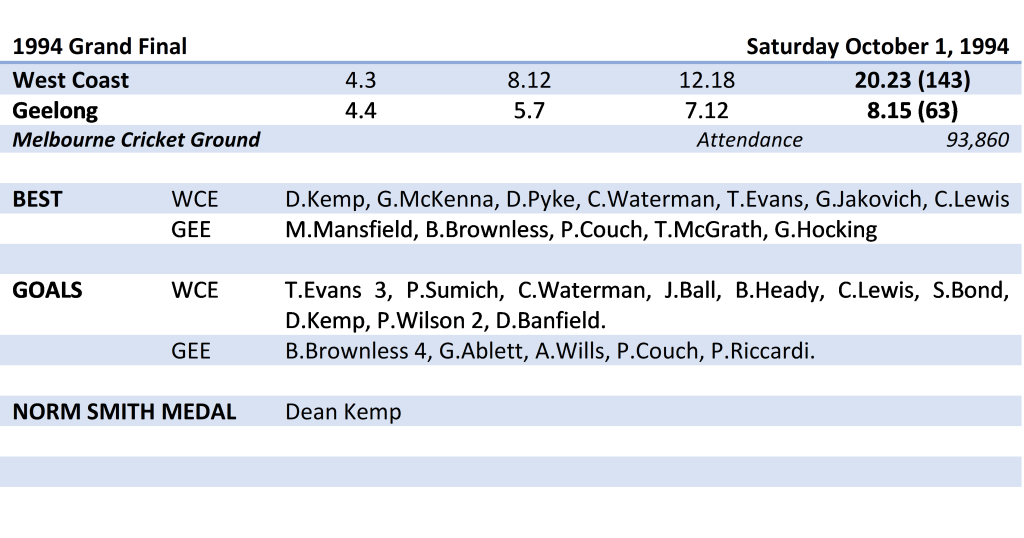
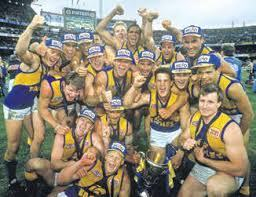
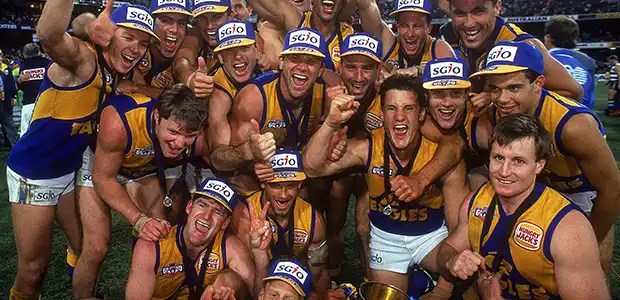
West Coast reinstated themselves as the kings of the competition when they crushed Geelong by 80 points to win the 1994 Grand Final.

Two years after an historic first flag, the Eagles steamrolled the Cats to their second premiership, erasing the disappointment of a failed 1993 season.

Dean Kemp claimed the Norm Smith medal for best afield and Tony Evans repeated his 1992 haul of three goals as West Coast booted their highest score in over two years.

Traditionally recognised as a defence-oriented side, the Eagles racked up 43 shots on goal in the Grand Final, a week after they posted 37 scoring shots against Melbourne. Ten Eagles in total hit the scoreboard as West Coast recorded the fourth largest winning margin in Grand Final history.

For the Cats, the defeat was their third loss in the season decider in six seasons, having gone down to the Eagles by 28 points in 1992 and the Hawks by six in 1989.

A shattered Malcolm Blight could offer no explanation after the match, saying there was ultimately nothing his side could do. “I could say a million things about what we might have done or could have done. But at the end of the day they were 80 points better than us, which is pretty hard to cop really.”

Eagles coach Mick Malthouse admitted he sympathised with the Cats, but was equally ecstatic with his side’s performance.

“I just love seeing the day for the club and all the players… I get a bigger kick out of seeing the players enjoy themselves.”

West Coast made just one change from the preliminary final, with Ashley McIntosh coming back into the team after missing with a knee injury. Mitchell White was the player to make way, after coming into the side as McIntosh’s replacement, but remained an outside chance on the morning of the game as West Coast debated whether to remove one of their ruckman.

However, the pair of David Hynes and Ryan Turnbull was retained to tackle John Barnes who was openly struggling with a lower leg injury. Geelong remained unchanged from their last-gasp six point win over North Melbourne, with Grant Tanner ruled out earlier in the week in his bid to recover from an ankle injury.

McIntosh started in defence on Bill Brownless, with Michael Brennan tasked with minding Gary Ablett. The Cats tried to throw the Eagles defence early, starting Ablett on the wing but he quickly moved to the goal square after failing to have an impact.

In a reverse to the 1992 meeting, it was West Coast who had the fast start, booting the first three goals in the game. Tony Evans, Chris Lewis and Shane Bond all kicked majors as the Eagles jumped to a 20 point lead.

West Coast had had all of the play out of the middle of the ground but the momentum of the game soon changed when Geelong piled on four goals in eight minutes. Tim McGrath and Michael Mansfield provided the dash off half back for the Cats with Paul Couch opening the Cats account.

Three more goals followed in quick time to give Geelong a seven point lead, before Brett Heady settled the Eagles just before quarter time to reduce the Cats lead to one point at the first change.

It would prove to be the only period of ascendency Geelong would have in the game.

West Coast resumed control at the start of the second term and only poor kicking on goal prevented the Eagles from having the game won by half time. Peter Wilson kicked consecutive goals to start the quarter as West Coast camped the ball in their forward half.

The Eagles created confusion at the Geelong kick-ins when they changed tack from their usual one-on-one set up to a zone defence. The usually precise Mansfield and Ken Hinkley were undecided with their re-entries preventing clean getaways from their back half, which had been a trademark through their finals campaign.

Twice in the second quarter West Coast picked off their kick-ins. Tony Evans intercepted a Ken Hinkley pass to mark and goal, before then having an intercepting hand that rebounded to Peter Sumich allowing the Eagles full forward to send the ball back over his opponent in Stephen O’Reilly.

The Eagles continued their dominance of general play but, remarkably, when Bill Brownless booted his third goal midway through the third term, the Cats were still within touching distance trailing by just 18 points.

However, three majors to Dean Kemp, Brett Heady and Peter Sumich extended their lead to six goals by three-quarter time and Geelong’s slimmer of Hope was all but gone.

The last quarter was a celebration for West Coast, as they slammed on eight goals to one to demoralise the opposition and the majority of the pro-Geelong crowd.

Symbolic of the day for West Coast and for their Norm Smith medallist Dean Kemp, their 17th goal came about purely by accident. Kemp’s kick inside 50 was intended for Chris Lewis who was crunched out of marking the ball by Tim McGrath, only for the ball to carry on its path and bounce harmlessly through for another goal.

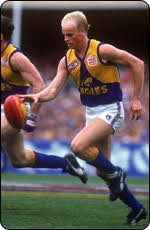
Kemp was sublime for the Eagles on a day when they had a healthy number of contributors. The Eagles centreman had 23 disposals and booted two goals to outpoint Geelong captain Mark Bairstow, who had a dirty day. It also meant that Bairstow finished with the inglorious honour of once again playing on the Norm Smith medal, after lining up on Peter Matera’s wing in his five goal performance of 1992.

Dean Kemp was best afield for West Coast

Don Pyke collected 26 possessions through the middle and just had the edge over Geelong’s Paul Couch. One of Geelong’s prime movers was relegated into a defensive role as he tried to curb the influence of the Eagles centreline.

The Eagles defence was as impregnable as ever, led by Glen Jakovich (20 possessions) and Guy McKenna (23) across half back. Jakovich played his own game standing in the way of Geelong’s forward entries and proving too strong for both Steven Handley and David Mensch. McKenna provided the run from the backline as he outclassed Adrian Hickmott.

Michael Brennan blanketed Gary Ablett, with the Geelong superstar managing just one goal from five disposals and David Hart had the better of Leigh Tudor in the back pocket. Geelong’s only winner in their forward half was Billy Brownless, who exorcised some of his demons from the 1992 Grand Final when he was humbled by Ashley McIntosh.

Brownless kicked four goals for the Cats – he was the only Geelong player to kick a goal after quarter time – and took one of the great Grand Final marks when he soared over McIntosh and managed to hold onto the ball from a second attempt.

Michael Mansfield was arguably the Cats best player with 21 disposals out of defence and having the better of Shane Bond, while Tim McGrath also did his best to withstand the avalanche. Garry Hocking finished with 20 possessions after being forced off during the first term with a heavy cork and returning to the ground in the second half with heavy padding around his upper leg.

But it was a day that belonged to West Coast.

15 members of the 1992 triumph were now dual premiership players, while there was redemption for David Hynes and David Hart, who were the unlucky stories from two years earlier.

And even with two of the heroes from 1992, in Peter Sumich and Peter Matera, having subdued outings, there were plenty of others who stepped up. Sumich and Matera combined for 11 goals in the clubs first flag as West Coast had just four goal kickers for the day. This time around, nearly half of the team kicked goals, as the likes of Chris Lewis, Brett Heady and Jason Ball provided strong targets up forward.

Chris Waterman came onto the ground early in the second term after Chris Mainwaring was forced off with a corked hip and put in one of his finest performances with 18 disposals and two final quarter goals (to go with four behinds). Mainwaring himself was able to return to the field and pick up 18 disposals.

Mick Malthouse even broke with his own tradition in heading down to the bench with three minutes remaining. Malthouse had been reluctant to leave the box two years earlier, despite the urging of his coaching team, but with the game well in his side’s keeping, the Eagles coach revelled in the celebrations boundary side.

Malthouse admitted that he knew his side were home during the third quarter.

“We expected at some stage Geelong to give us a big quarter like they had over the last three or four weeks, so we were ready for it. We stuck to our basics, not to allow them to get that one quarter of football in.”

“At half-time I thought if we maintained our pressure, and we could hold them, we could do the job,” Malthouse said.

“So I guess three quarters of the way through the third quarter I thought we had them.”

Since taking over as senior coach at the end of 1989, Malthouse had steered the Eagles to no lower than fourth in five seasons, which now included two premierships from three Grand Final appearances.

The Eagles had massacred the Cats in one of the most emphatic premierships of the modern era and with that staked their claim as the pre-eminent club of the AFL.

1994 Rewind: Eagles, Bulldogs Thrown Into Tribunal Chaos

West Coast claimed their second minor premiership with a 71 point thumping of Footscray in the final round, but the win was marred by a half-time brawl that ultimately dragged the club through a farcical AFL investigation.

The Bulldogs arrived in Perth in third position on the ladder on the back of six wins in seven games, but were no match for a West Coast side that had been given a boost by reigning premiers Essendon 24 hours earlier.

The Bombers had already been ruled out of finals action for 1994, but they doubled down on the misery of Carlton’s 1993 Grand Final defeat, with an upset 18 point win over the Blues that opened the door for West Coast to reclaim top spot.  

The bye in round 23 had allowed several Eagles to recover from minor niggles but the break wasn’t enough for John Worsfold who missed with a groin strain. Craig Turley was also out, serving the first game of a two week suspension, allowing Chris Waterman to return after several weeks in the WAFL. Brett Spinks was the other inclusion when teams were first named.

Before the bounce, the Eagles made two further changes. Ashley McIntosh, Chris Mainwaring and Glen Jakovich had all been reported as struggling heading into the game, but it was Ryan Turnbull and Dean Kemp who were given an extra week of recovery. David Hynes and Tony Godden were brought in, with Hynes grasping the late opportunity with both hands.

Hynes put in a best on ground performance, controlling the ruck against Bulldogs counterparts Ilija Grgic and Barry Standfield. Hynes had 24 hit-outs (to the Bulldogs pair of 17), to go with 23 disposals and a goal. Don Pyke proved to be the greatest beneficiary from Hynes’ dominance, picking up 24 touches and capping off a fine game with three second half goals.

Pyke was too good for Simon Atkins early, gathering eight first quarter possessions, before Bulldogs coach Alan Joyce swung seven-gamer Brad Johnson onto the Eagle ruck rover. Chris Mainwaring and David Hart topped the ball-getters for West Coast with 25 each, while there was a strong spread of goal kickers with Pyke, Jason Ball and Chris Lewis leading the way with three each.

Lewis was magical across the half forward line having a hand in several goals from his 17 disposals and eight marks, while the Eagles defence again stood strong, conceding just six goals to the Bulldogs.

The Bulldogs had few winners on the day but Scott West and Tony Liberatore each finished with 18 touches through the middle, while Chris Grant had 11 disposals and seven marks roaming up the ground and also booted two goals.

West Coast jumped to a 20 point lead at quarter time, building their lead to 37 at the main break with only inaccurate kicking preventing the margin from being greater. The Eagles then booted four goals in each of the next two quarters, while the Bulldogs were held goalless in the last term. With the game in their keeping, West Coast turned their attention to the first final, resting a host of players in the final term, which saw them even finish with just 16 players on the ground.

The routine win was soon overshadowed when the focus turned onto the half-time brawl that involved most players on the ground.

The incident first began following a shirtfront on Brett Heady from Steve Wallis along the boundary line moments before the half time siren.

That caused remonstration between players, which quickly escalated as players rushed from all over the ground and even those that were on the bench.

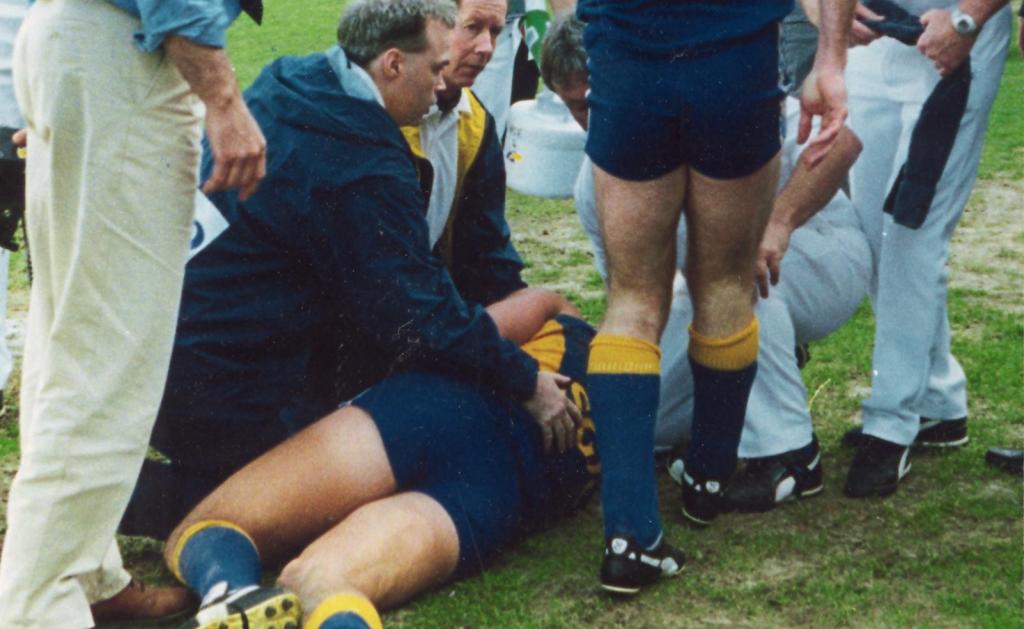
With players tangled up, the brawl took a disturbing turn when Eagles spearhead Peter Sumich was taken into a headlock from rookie Bulldogs defender Danny Southern. Sumich blacked out on the ground and with the teams eventually dispersing and heading into the changerooms, the West Coast medical staff remained on the ground to tend to their full forward.

Eagles coach Mick Malthouse also remained on the field, opting to watch over Sumich until he was stretchered into the changerooms. Sumich would play no further part in the game, with the Eagles doctors eventually reviving the Eagles full-forward following several minutes on an oxygen tank.

Tensions remained high between the two sides through the second half, despite the one-sided scoreline. Southern – who had spent time with West Coast a couple of seasons earlier as he rehabilitated from a knee injury suffered while playing at Claremont – became the target of verbal abuse at the final siren from both Glen Jakovich and Jason Ball.

Peter Sumich is attended too after being choked into unconsciousness by Danny Southern

After the game, Malthouse described the brawl as a ‘blight’ on the game. “We come here to play football.”

“We can accept solid bumps and we can accept that footy is a physical game. But there were certain elements of today’s game that have surprised and disappointed us.”

No match-day reports were laid by umpires, with the clubs then the centre of an AFL investigation, led by Max Crawford. After Crawford spoke individually with both clubs, he found that no players should be charged, with AFL general manager Ian Collins supporting the findings and declaring both clubs would be fined $20,000.

However, Eagles officials were left stunned 24 hours later when the AFL overruled both Crawford and Collins to charge five West Coast players for their part in the melee. Glen Jakovich, Jason Ball, Tony Evans, Chris Lewis and Peter Sumich were all summoned to face the AFL judiciary five days after the game took place.

Jakovich copped two charges for striking Richard Osborne and Danny Southern, as did Ball who had two striking charges on Ilija Grgic and Chris Grant. Sumich was also charged for striking Grgic, while Chris Lewis and Tony Evans each received one charge for striking Doug Hawkins, who suffered a torn abdominal muscle during the fracas.

The Bulldogs weren’t spared with three players also called up to face the tribunal. Chris Grant was cited for striking Jakovich and Darcy  MacPherson was cited for striking Lewis, while Danny Southern faced the more serious charge of conduct unbecoming for his headlock on Sumich.

West Coast general manager Brian Cook expressed the thoughts of both clubs, whose finals preparations were now under serious threat. “We are extremely disappointed and somewhat shocked. This has thrown our finals preparations into turmoil.”

The Bulldogs dropped to fifth at the completion of the home and away season, falling behind North Melbourne and Geelong who both recorded large wins in round 24. North Melbourne moved back to third when they comfortably accounted for the Magpies in the opening game of the round. The Kangaroos controlled the game from the outset, with eight goals to John Longmire delivering a 64 point win.

That left the Magpies nervously waiting on other results to stay in the finals hunt, but their place in the top eight was confirmed the following day when Richmond were trounced by Geelong. Despite being without Gary Ablett, the Cats were never troubled, running out 76 point winners as Bill Brownless replicated Longmire’s haul of eight goals.

Having suffered horrid defeats of 113 points to the Blues and 76 points to the Cats in the final two rounds of the season, it would be Richmond who were relegated to ninth position after Melbourne won a high scoring clash against the Swans to move back into the top eight.

The Tigers finished on 12 wins – the same as Melbourne and Collingwood – but had lost nearly 10 percentage points in the previous fortnight to finish well behind the Demons and Magpies. Geelong, on the other hand, found themselves inside the top four for the first time since Round 10 on the back of a late season revival after coach Malcolm Blight was at risk of losing his job midway through the year.

With Melbourne and West Coast recording wins on the Sunday, the first week finals schedule had been set. The Demons rose to seventh to book a first week final against Carlton, with North Melbourne to host Hawthorn and the Cats and the Dogs to square off.

That left eighth-placed Collingwood with the unenviable task of travelling to Perth to tackle the Eagles in a virtual elimination final, although who West Coast would have available for the game still remained up in the air.

With Footscray due to play their qualifying final on the Saturday night, the Bulldogs immediately sought an injunction with the Victorian Supreme Court to delay the tribunal hearings for Grant, MacPherson and Southern until the following Monday.

With the Bulldogs successful, West Coast considered a similar tack.

Ultimately, the Eagles decided to push ahead with the hearings with the five players to face the AFL tribunal less than 48 hours before they were due to play Collingwood.

Eagles Chairman Dwane Buckland denied that West Coast had missed the boat in joining the Bulldogs in submitting a joint injunction, as a war of words broke out between the two clubs.

The Bulldogs had responded in the wake of Malthouse’s post-match comments, calling their former coach’s words as ‘untrue, outrageous and defamatory’.

Footscray coach Alan Joyce was particularly pointed towards his counterpart. “I have been coaching in the AFL for several years now and I just wish other coaches, particularly Malthouse in Perth, would have the same degree of professionalism.”

General manager Dennis Galimberti went even further, defending the actions of Danny Southern  and declaring it was the West Coast players who instigated the whole melee.

“The incident between Steve Wallis and Brett Heady was totally fair and within the rules of the game,” Galimberti said.

“As a result of the collision, several West Coast Eagles players ran a considerable distance to remonstrate with Wallis. That was the single thing that incited the events that followed.”

The Bulldogs were particularly critical of Malthouse speaking about the incident between Southern and Sumich, saying that it was inappropriate for comments to be made before the case was put to the tribunal.

Malthouse had stated that Sumich ‘was grabbed from behind by a bloke who came from their bench and was virtually strangled’

Malthouse retorted, saying he had never named Southern.

“You would have to be blind not to see the Channel 7 replay and determine the player responsible for Sumich’s condition,” Malthouse said. The Eagles coach also rejected suggestions he had confronted Southern at three quarter time. “I did not utter one word to Danny Southern. I can honestly say I did not utter one word to any Footscray player and I would never do that, never.”

Ultimately, West Coast decided to send their players to the tribunal, with the hearing taking place less than 48 hours before their finals match against Collingwood and the night after they had announced their squad for the game.

Buckland said that it was the view of the Board to have the matter dealt with before the clubs first final, to ensure that any potential penalties handed down could be served earlier in the finals campaign.

“If you are going to have a few players out, we’d prefer to have them out in a game we can afford to lose, rather than a game we can’t afford to lose.”

In the end, Buckland and the Eagles had nothing to worry about.

After a marathon four hour hearing, via video link up from Perth, all five West Coast players were cleared of any wrongdoing. The Eagles even called up Crawford as one of their own witnesses, to reiterate his view that no players should be charged over the melee.

Eagles players leave the tribunal after having their charges thrown out.

The Bulldogs would subsequently front the tribunal after the weekend with Grant and MacPherson equally cleared of any wrongdoing, while Southern was hit with a $10,000 fine.

After a week of disruption, West Coast were happy to move on from the whole situation and turn their attention into their match with Collingwood.

“Where it went off the rails I don’t know. And we are not going to pursue it,” a relieved Buckland declared.

1994 Rewind: Eagles Class Shines In Wet

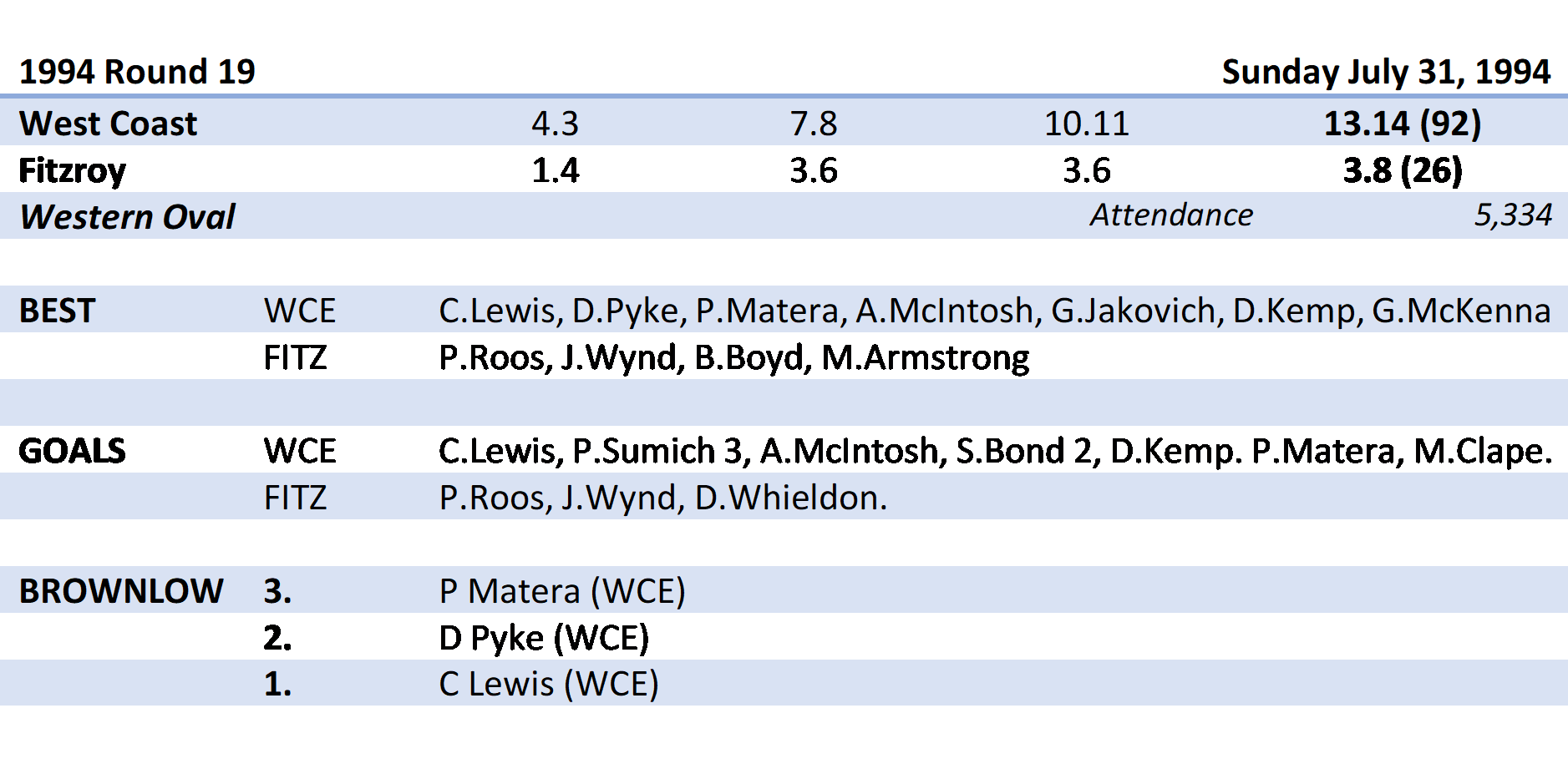
West Coast swept aside the Fitzroy Lions with an easy 66 point win at the Western Oval. Fitzroy were held to just two behinds after half-time, unable to break through the Eagles hardened defence in wet and heavy conditions.

On a cold, wintry afternoon where a crowd of just 5,334 braved the conditions, Chris Lewis provided the shine with 16 disposals and three first half goals, as well as having a hand in several others. Peter Sumich also finished with three goals as he continued to build his match fitness from consecutive hamstring injuries.

The Eagles strong performance came despite missing several key players. Brett Heady was never a chance of lining up after dislocating his shoulder the week before against Richmond, while Chris Mainwaring (hamstring) and Chris Waterman (foot) were ruled out during the week.

John Worsfold was given an extra week to recover from his groin problem, as was Tony Evans who had a back complaint. The Eagles consequently made four changes at the selection table, with Michael Brennan returning from injury, and fringe players Matt Clape, Brendan Krummel and Paul Symmons all earning call-ups.

Damien Hampson was initially dropped, alongside injured trio Heady, Mainwaring and Waterman, but earned a reprieve ahead of the opening bounce when David Hynes pulled out.

Krummel’s selection marked his first Eagles appearance in over a year, but it didn’t come without controversy. After being named in the Eagles squad on Thursday night, Krummel became the centre of an investigation over an incident from the previous weeks WAFL derby between East Fremantle and South Fremantle.

Young Bulldog Owen Woods was collected behind the play, suffering a broken jaw in several places, and South Fremantle officials pointed the finger at Krummel. The Bulldogs lodged an official complaint with the WAFL and demanded that Krummel be charged, with Woods expected to miss the remainder of the season after undergoing surgery.

However, the WAFL tribunal were unable to determine whether there would be a case to answer, leaving Krummel free to play with West Coast. Krummel, for his part, said that he knew nothing of the incident.

The Lions dropped four players in response to their narrow loss to Brisbane the week before, with Tom Kavanagh, Danny Morton, James Manson and Nick Mitchell all losing their place. Rick Lyon, Brett Cook, Trent Cummings and Mark Zanotti were the four inclusions, but Zanotti and Cummings then became late withdrawals ahead of the match. Their spots were in turn taken by David Bain and Marcus Seecamp.

Brendan Krummel returned to the Eagles line-up for the first time in over a year

Despite the wet conditions, Malthouse started three talls in the Eagles forward line, as he looked to expose the depleted Fitzroy defence. Ashley McIntosh and Jason Ball took their spots across half forward, with Peter Sumich taking his regular spot in the goal square.

Fitzroy had first use of the wind, but the Eagles got first blood when Lewis soccered home from the goal square. The Lions held on for much of the quarter, but a three goal burst in time-on put West Coast out to a 17 point lead at the first change and there was never any coming back for the Lions from there.

The Eagles would extend their lead to 26 by the major break, then leading by 47 at three quarter time and finally running out 66 point winners as Fitzroy failed to register a second-half major. In fact, the Lions remained scoreless after half-time until the dying minutes of the last term when they kicked consecutive behinds.

When the game was there to be won, Lewis was a cut above most others on the field, proving a constant danger and giving Fitzroy defender Steven Stretch the run-around. Peter Matera added the flashes of brilliance, getting the better of Michael Dunstan on the wing, while down back the Eagles defence proved impenetrable.

Michael Brennan held Darren Wheildon to just one goal, while Guy McKenna, Glen Jakovich and Mitchell White all shut out their opponents in a complete display.

The win further enhanced this Eagles group with the club not always renowned for their performances in the wet. However, the win over Fitzroy was the fourth win in wet weather after victories over St Kilda, Essendon and Richmond in recent weeks, all of which were played in the rain.

The performance impressed Fitzroy coach Robert Shaw, declaring West Coast as ‘the best team I have seen in those conditions’.

Eagles coach Mick Malthouse acknowledged that the conditions suited the more developed Eagles against a young Fitzroy outfit. “Jarrod Molloy is a good marking player so the conditions didn’t suit him. Chris Johnson has great pace but is still finding his way.”

“We had a lot of experienced players in the midfield.”

Shaw though was far more circumspect over the difference between the two sides. “They played the percentages and followed the basic principles a lot better than us.”

“And they did it for longer and more often.”

While Lewis and Matera were the polish up forward and around the wings, Dean Kemp and Don Pyke provided the grunt through the midfield. Kemp finished with 28 disposals and a goal while Pyke had 30 through the centre. Ashley McIntosh had 18 disposals, four marks and booted 2.2 across half forward, while Glen Jakovich collected 20 touches across half back.

Paul Roos was clearly the best player for Fitzroy, gathering 31 disposals and booting a goal in an intriguing battle with Craig Turley through the middle. Jim Wynd also found plenty of the ball, finishing with 29 disposals and joined Roos as one of the Lions’ three goal kickers.

The win saw West Coast hold their one game advantage over the Blues, who defeated an inaccurate Hawthorn by 32 points at Princes Park. The Blues, in turn, held their position in second ahead of North Melbourne, with the Kangaroos coming from behind to defeat Footscray by 20 points in a Friday night classic.

Richmond became the benefactors of the losses suffered by the Hawks and the Bulldogs, climbing into the top four after their straight forward win over Sydney. Melbourne were the other big movers, storming into the top eight  for the first time since Round 13. The Demons thumped a faltering Essendon by 77 points, lifting them from ninth to fifth on the ladder as they passed a number of clubs – including the Bombers – with a superior percentage.

Melbourne led a group of five teams who all had nine wins as the race for the bottom half of the top eight continued to tighten. The Cats rose to sixth after they thrashed Adelaide, with Hawthorn and Footscray filling out the rest of the finals positions. The Magpies slipped to ninth due to having the bye.

While West Coast were all but guaranteed finals and strengthened their position on a top two finish and two home finals, the fallout for Fitzroy was substantial.

Robert Shaw resigned as coach in the days following the Eagles defeat, although he agreed to coach out the remainder of the season as the Lions continued to be the centrepiece of merger discussions. Speculation suggested that a deal with either Brisbane or Melbourne was imminent, leading Fremantle to claim they should be given first right to Fitzroy players as part of their inaugural 1995 squad.

The comments angered president Dyson Hore-Lacy, who had already been vocal about the Dockers’ attempts to lure Paul Roos west with a ‘substantial’ offer, which included the captaincy. Hore-Lacy remained resolute about Fitzroy’s future, declaring the club wouldn’t hold back from launching legal action against any AFL club who tried to poach their players while under contract.

Hore-Lacy also scoffed at the idea the club would head interstate, saying a merger with the Bears would be ‘like taking the last chair on the Titanic.’