1990 Rewind: Exhausted Eagles Bow Out

Travel Load Catches Up With Young Eagles

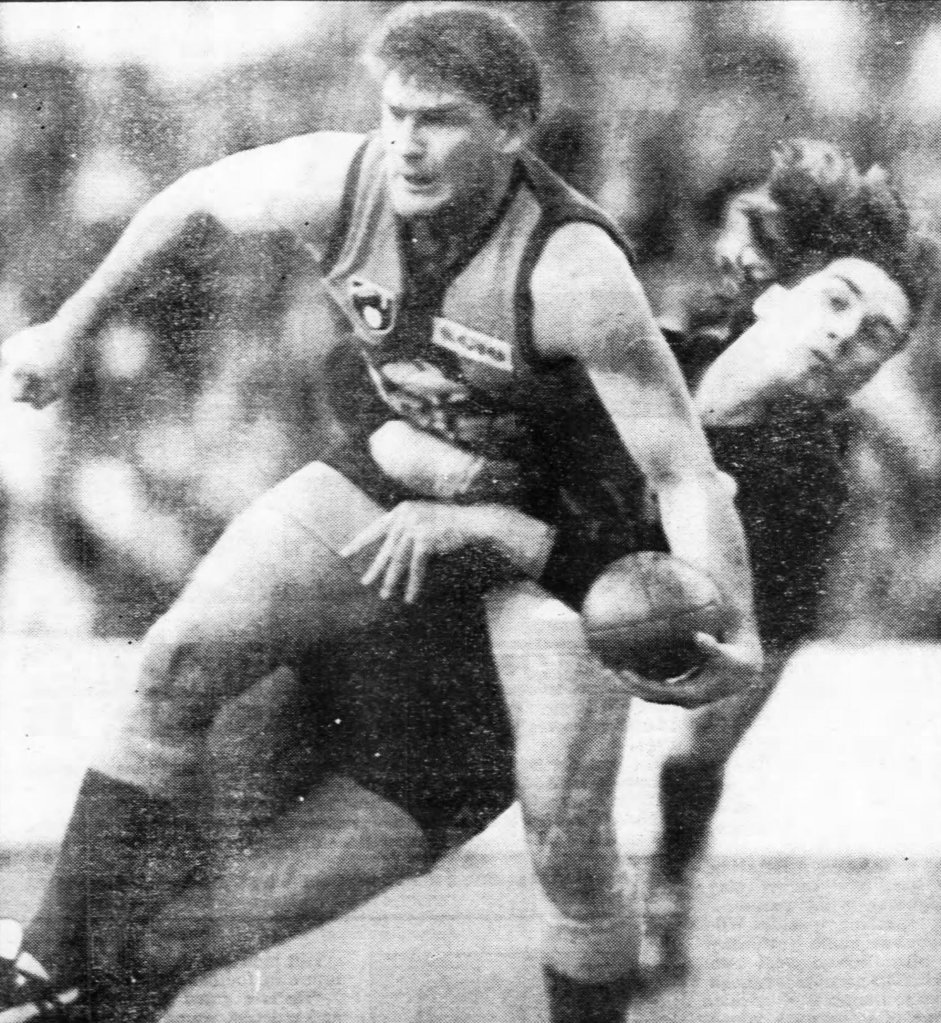
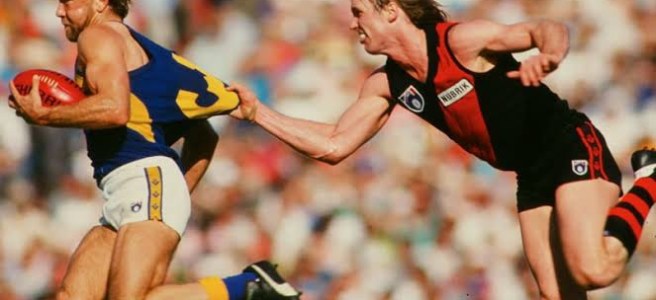
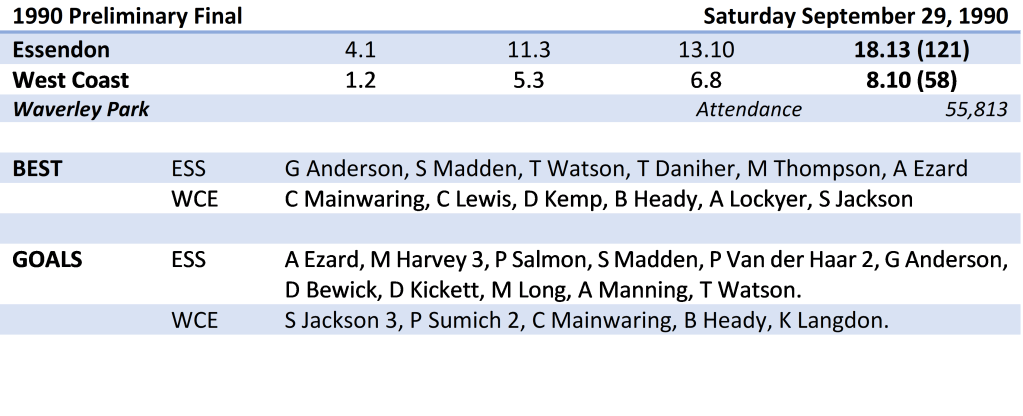
West Coast’s 1990 campaign fizzled out to a 63 point defeat against Essendon in the Preliminary Final, with the Bombers progressing to face Collingwood in the Grand Final.

Four consecutive matches at Waverley Park, and six interstate trips in a row, finally caught up with the young Eagles line-up, as they battled injury, illness and air strikes in the lead up to the match.

The Eagles were again forced to compromise their travel plans amid the ongoing national air strikes that had plagued much of their travelling over the previous six weeks.

West Coast ventured to Melbourne on a chartered flight, sharing the trip with the Perth Wildcats and Melbourne Tigers who were in the middle of their NBL Grand Final series. The trip required several stops along the way, and saw the three teams land in Melbourne on the Thursday – a day earlier than the Eagles’ usual schedule.

There were also concerns at the selection table.

Dwayne Lamb was unavailable, courtesy of a one week ban from the AFL tribunal, while nuggety midfielder Scott Watters was ruled out with a groin complaint.

Chris Mainwaring was struggling with a knee issue, Guy McKenna was racing the clock after injuring his arm late against the Demons and Laurie Keene was managing a groin injury. Craig Turley – who had been the Eagles best player over the prior fortnight – hadn’t trained all week due to the flu.

All four would take their place, but only Mainwaring would be a serviceable contributor.

Peter Melesso and Dean Turner were the two replacements for Lamb and Watters, with the selection of Turner somewhat of a surprise. Turner earned selection ahead of captain Steve Malaxos, who was left out of the side for a second week, as well as Don Pyke and Phil Narkle who had both been favoured to be included in the side.

Melesso was named after serving a five match suspension, but would then be a late withdrawal. Melesso took part in the warm-up ahead of the match, before being replaced by Todd Breman.

West Coast started the brighter of the two sides, but despite controlling possession struggled to find a way past half forward. Simon Madden, who had been heavily criticised during the week after a poor showing against the Magpies in the semi-final, was dominant both in the ruck and as the spare man in defence clogging up the space of the Eagle forwards.

Madden tallied 10 disposals and five marks for the term, as well as booting Essendon’s fourth goal of after a strong mark over Phil Scott in the goal square. The Eagles had just one major for the quarter; a solo effort from Mainwaring when he intercepted a defensive kick in the Eagles forward 50m area, before kicking truly on the run.
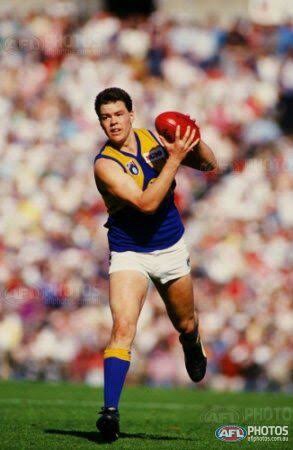
Stevan Jackson was busy early and finished with three goals

The quarter time deficit of 17 points was soon 43 as Essendon made West Coast pay for some sloppy play. Craig Turley started the rot when he dropped a simple mark in the middle of the ground, allowing the Bombers to regain possession with Darren Bewick finishing off a chain of play.

Alan Ezard then capitalised after the Eagles turned the ball over at half back before Simon Madden was able to boot his second of the match when John Worsfold was unable to handle the ball in defence.

Gary O’Donnell missed a golden opportunity, hitting the post running into an open goal, before Essendon caught a lucky break to boot their fourth major of the quarter. A scrappy kick forward by Derek Kickett eluded Phil Scott as he led Paul Salmon to the ball, allowing the Bomber full forward to hand off to Mark Harvey for a simple finish.

At this point, nothing was going right for West Coast.

Guy McKenna had copped a heavy hit that left him with a bloodied nose to along with the arm injury he was carrying, while Chris Mainwaring and Mark Harvey were involved in a brutal head clash that left both players on the ground for several minutes.

Finally, the Eagles found their second goal of the match. While they had been outplayed in most areas on the ground, the one spot they were winning was the centre clearances, even with Laurie Keene restricted.

Some good work out of the middle ended with Brett Heady steering through a second goal on his left foot from half forward, with the Eagles able to boot three more to give them an outside chance of victory.

However, a horrible handpass by Todd Breman deep in the Eagles defence gifted Ezard his second major of the quarter and the Bombers held a six goal lead at the main break.

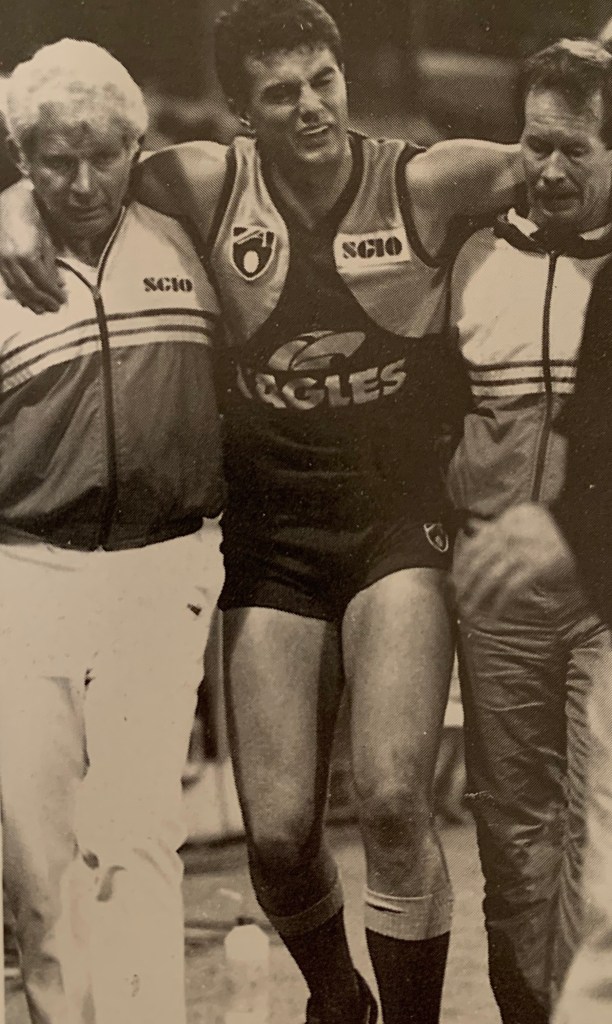
Things only got harder straight after the restart when Karl Langdon was carted off after being knocked out cold in an accidental clash with Terry Daniher. Langdon attempted a diving mark, running back with the flight of the ball, with Daniher’s hip collecting Langdon in the head. With Keene also done for the day, the Eagles were without a bench, with a half to play and six goals behind.

Still, they refused to give up the fight. West Coast were the better side for much of the third term, with the play almost completely in their forward line. Essendon couldn’t find a way out of defence as West Coast continually pumped the ball into their forward 50, but they couldn’t make it count on the scoreboard.

Peter Sumich kicked the Eagles first goal, but then missed two more set shots, before Stevan Jackson hit the post from close range, and then Tony Begovich missed from directly in front after receiving a 50m penalty.

Mainwaring had a chance that failed to score, as did Michael Brennan, whose long range shot was marked on the line by Ezard. Sumich had a third chance that sailed out of bounds and for all their dominance, the Eagles had posted just 1.5 for the quarter.

Dean Turner then best exemplified the Eagles’ frustration when he cannoned into Ezard, well after the Bomber forward had taken a running shot on goal. Ezard’s effort missed, but the umpire awarded a second shot following Turner’s indiscretion, with Ezard able to boot his third goal and all but finish West Coast’s resistance in the match.

The Bombers added a further five goals in the final quarter to run out easy, albeit unconvincing, winners.

Malthouse admitted the heavy travel load had caught up with his side, but had nothing but praise, despite bowing out in penultimate week of the season.

“We looked and acted tired.”

“But I think the spirit was there to generate as much play as possible… it all caught up with them,” Malthouse said.

“The players showed enormous courage and fortitude… at no stage in six weeks of criss-crossing Australia was their a complaint. There was no sign of weakness during a severe test of the team’s character and competitiveness.”

Essendon coach Kevin Sheedy was happy enough with the performance, confident his side would bounce back from the thrashing by Collingwood the week before. “We were switched on early, and the players worked hard to get 18 wins this year and they did not want to let that slip.”

“I feel that will make us 10 percent better next week.”

Greg Anderson and Chris Mainwaring were both their respective sides’ best players, despite being opposed to each other on the wing for much of the afternoon. Anderson finished with 25 touches and booted 1.3, while Mainwaring had 19 disposals and booted a goal.

Terry Daniher and Mark Thompson also finished with 25 touches to lead the way at Essendon, while Tim Watson picked up 22 disposals and booted a goal. Simon Madden was another standout during the game with 21 possessions, 12 marks, 10 hitouts and two goals.

Alan Ezard and Mark Harvey each booted three goals.

At West Coast, Chris Lewis finished as the leading ball winner with 22 in his battle with Mark Thompson. Thompson was influential in the opening term, but Lewis had the better of the match-up over the remainder of the match despite Thompson still finding plenty of the ball. Lewis had been sublime through the second half of the season, with his consistent showing culminating in winning the club best and fairest, as well as being named in the All-Australian side (along with John Worsfold).

Chris Mainwaring was one of the Eagles’ best despite barely being able to see by games end

Dean Kemp picked up 21 touches and Brett Heady 20, as the two finished their impressive debut seasons with strong performances. Stevan Jackson offered plenty in the forward line with three goals from 14 disposals and six marks, while Peter Sumich would rue a wasteful day, finishing with 2.5.

Andrew Lockyer won his battle at centre half back on Paul Van der Haar, keeping the veteran Bomber to just nine disposals and two late goals. Craig Turley (17 disposals) and Guy McKenna (16) toiled hard despite their operating below their capacity.

The Eagles coach was openly proud of his side’s season, but the gains made in season 1990 were best summed up by opposing coach Kevin Sheedy. The Bombers coach – a former teammate of Malthouse’s at Richmond – praised Malthouse, saying he had added professionalism to the four year old club, while also lauding WA’s ‘sensational’ year.

Sheedy said playing four finals in a row was the equivalent of two finals series’ worth of experience, which would be ‘invaluable’.

“After physically and mentally going through it, the standard for West Coast has been set.”

The Eagles for their part had risen from a bit-part team out in the west, to one of premier clubs in the revamped competition in just one season. The addition of Malthouse had been an immediate success – and the board knew as much.

Days before Christmas, the Eagles announced that Malthouse had signed a three year extension to his initial contract, keeping him at the club until the end of 1994.

The ’90s had begun – as had the first Eagles dynasty.  
1990 Rewind: Eagles Exorcise Demons

Historic First Finals Win For West Coast

West Coast set up a meeting with Essendon in the preliminary final after defeating Melbourne by five goals in the semi final.

Mick Malthouse’s drastic changes at the selection table paid off, as West Coast overcame a poor recent record against Melbourne to produce the clubs first ever win in a final.

One of those selections – Chris Waterman – produced a career best outing booting six goals across half forward.

Waterman was one of six changes for West Coast, with Eagles coach Mick Malthouse ruthlessly axing a quarter of the side that was demolished by Collingwood the week before in the Qualifying Final replay.

The most controversial omission was captain Steve Malaxos, who lost his place after a period of indifferent form. Malaxos had spent much of the previous two games against Collingwood on the bench, with Malthouse later saying the Eagles needed greater leg speed and running power on the wide expanses of Waverley Park.

Joining Malaxos out of the side were ruckman Dean Irving, who had been well beaten in both Collingwood matches, Troy Ugle, Craig McGrath, Murray Rance with a fractured jaw and Peter Wilson who would be a late withdrawal ahead of the game with a hamstring strain.

Phil Scott returned to the Eagles line-up, after being dropped on the eve of the finals, to partner Laurie Keene in the ruck, while Scott Watters returned after missing the replay with a knee injury. Stevan Jackson replaced McGrath up forward after ten goals with South Fremantle in the previous fortnight, while Waterman and Tony Begovich were added for their ability to run and spread.

When Wilson pulled out ahead of the game, Andrew Lockyer was called up, slotting into defence in place of the missing Rance. Guy McKenna had been in doubt after breaking a nose late in the loss to the Magpies, but held his spot, as did Mainwaring whose knee was becoming a week by week proposition.

Stevan Jackson returned to the Eagles side to be one of their best

Melbourne made no change when teams were announced but were soon to have their own late drama. Captain Garry Lyon was pulled from the side on the morning of the game after he suffered a corked thigh colliding with teammate Steven O’Dwyer the day before at training. Todd Viney was called up to the side.

Despite being without Lyon and midfielders Brian Wilson and Alan Johnson, the Demons were still hot favourites to progress to the preliminary final.

It took just 90 seconds for West Coast to show they weren’t going to just whimper away.

Kicking into the wind, the Eagles had two goals on the board – both to Chris Mainwaring – before Melbourne had even worked out their direct match-ups.

As well as bringing in a host of new players, Malthouse also moved his side around as he sought to catch the Demons off guard. Mainwaring started at half forward and his quick brace forced a shuffle of the Melbourne defence with Steven Stretch moved from the wing to replace Matthew Febey.

John Worsfold also started forward, as did Chris Lewis as the Eagles looked to avoid an early tag. Lewis still had Stephen Newport for company, but was influential early as West Coast established an important 13 point lead at quarter time.

Andrew Obst had been instrumental in Melbourne’s win over the Eagles in Perth several weeks earlier and Malthouse wasn’t keen on letting the midfielder run unattended again. Guy McKenna shifted into the midfield in a run-with role, holding Obst to just 12 disposals for the game.

Laurie Keene led the ruck, with Phil Scott taking the resting ruckman in the back pocket, while Andrew Lockyer had first crack at Darren Bennett.

The Demons tried to repeat the physical approach that had seen them defeat West Coast twice during the regular season, but the Eagles kept their focus on the ball.

The 13 point advantage exploded to 45 points by the main break, with the Eagles booting six goals to none with the wind, and the match was as good as done.

Melbourne outscored the Eagles in the second half, but West Coast were never in danger of giving up their spot in the Grand Final playoff.

West Coast would have to get past Essendon if they were to make their first ever Grand Final, after the Bombers were comprehensively beaten by Collingwood in the other semi-final.

Kevin Sheedy denied the Bombers would be affected by the additional layoff because of the drawn Qualifying Final leading into the match, but they appeared sluggish going on to lose by 63 points. The Magpies led by 12 points at half time, but ten goals to two after half time saw Collingwood qualify for their first premiership decider in nine years.

While West Coast could feel satisfied with the history-making first ever finals win in the clubs history, there were concerns to come out of the five goal win.

Scott Watters had arguably been the Eagles’ best player in the first half, but spent the entire second half on the bench with a groin complaint. Guy McKenna suffered a suspected broken arm after clashing with Earl Spalding in the dying minutes of the game and three Eagles wound up on report from separate incidents in the game.

Chris Lewis was placed on report for charging Graeme Yeats and Stevan Jackson was reported for striking Jim Stynes. Both players would get off at the tribunal during the week, but Dwayne Lamb wasn’t so fortunate.

The Eagles tagger was also charged for reporting Stynes, copping a one week ban. Lamb, and many of the other Eagles, were still seeking retribution from the last match between the two sides which saw Stynes break Lamb’s arm with an attempted soccer off the ground.

The Eagles gave it to Stynes, every chance they could, and it appeared to work as Keene controlled the stoppages and provided plenty of attacking run off Stynes around the ground.

The move appeared to work with Melbourne unable to get any direction or structure on the field with their captain missing and their ruckman ineffective.

At the feet of Keene, Craig Turley, Dean Kemp and David Hart had plenty of the ball as they overwhelmed their Demons counterparts. For the second week in a row Turley was one of the best for West Coast, revelling in the centreman role in the absence of Malaxos.

Turley finished with 26 disposals, one behind Mainwaring who had a team high 27 possessions to go with his two goals at the start of the match. Hart, Kemp and Brett Heady all tallied 21 while Keene himself finished with 23 touches, four marks and ten hit-outs.

Scott Watters was one of the best for West Coast but finished on the bench injured

Up forward, the change in dynamic did wonders with West Coast kicking their highest score since round 19. Waterman was the surprise packet with six goals from 17 disposals and nine marks, while Peter Sumich booted four and Stevan Jackson three, the trio combining for 13 of the Eagles’ 19 goals.

Sumich and Jackson also each booted five behinds, with Jackson also gathering 21 disposals and five marks – highlighting the dominance of the Eagles’ tall forwards.

The Demons had few players who shone, with Simon Eishold and Greg Healy the leading ball winners with 20 disposals. Stephen Newport gathered 16 disposals and seven marks after starting in a tagging role on Chris Lewis. Newport was then replaced by Glenn Lovett, but Lewis had the better of both players as his blistering second half of the season continued.

Rod Grinter booted four last quarter goals when he was shifted forward, with Ricky Jackson, Graeme Yeats and Darren Bennett each kicking two.

Demons coach John Northey called his side’s performance ‘pathetic’, with Melbourne unable to live up to their favouritism billing heading into the match. “In finals football, you have to find something extra all the time, and our players weren’t prepared to do it.”

Northey believed that the underdog status had worked in the Eagles’ favour, after two testing weeks against the Magpies.

“When everyone is kicking us in the guts, we have something to prove, but as soon as we become favourites in something, we have always faltered, and not just once, it has happened many, many times,” expressed a frustrated Northey.

 For Mick Malthouse, the performance was justification for their season and followed his earlier comments the week before that West Coast would bounce back. “I think a lot of people underestimated the fighting spirit of this group.”

“We didn’t make the finals series for the sake of making the finals series.”

Malthouse also believed the first ever finals win would be a great fillip for his side as they continued their push for a maiden flag.

“It (a finals win) is fantastic for the players… this year we have won in Sydney for the first time, the MCG for the first time. These are all little hurdles all along that are being looked at by the players.”

The Eagles coach also denied it was a risk making the mass number of changes ahead of the game, with many of the inclusions having a strong say in the final result.

“If it hadn’t come off, I suppose it may have been the biggest gamble of my coaching career,” Malthouse wryly admitted.

1990 Rewind: Finals Chaos As Eagles, Magpies Draw

Sumich Shoots Wide On Siren

West Coast and Collingwood opened the 1990 finals series with a dramatic draw in the Qualifying Final, flipping the entire finals series on its head.

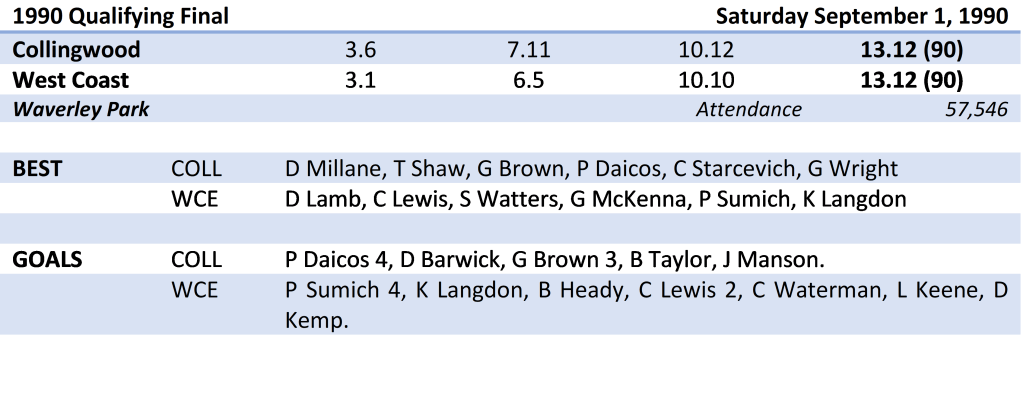
Peter Sumich had the chance to win the game in the dying seconds, but his missed set shot from close range in the left forward pocket, left the two teams matched on 13.12 (90) as the final siren rang.

The result – the first draw in a final since the 1977 Grand Final – was set to throw the finals series into disarray, with the Eagles and Magpies due to return to Waverley Park the following weekend to determine who would progress to the first semi-final to tackle the Bombers.

Melbourne were awaiting the loser of the replayed match, after they knocked reigning premiers Hawthorn out of the premiership race with a nine-point win in front of nearly 75,000 fans at the MCG.

The Demons now also had the added benefit of a week off ahead of the second semi-final after winning through the elimination final. Conversely, Essendon – who had earned the week off in the first week of the finals for finishing top at the end of the home-and-away season – were now facing a second straight week off, complicating their preparations for their first final.

Essendon coach Kevin Sheedy dismissed suggestions the protracted series would work against the Bombers, despite the prospect of over three weeks between their final round match against the Saints and the first semi-final. “We have played 22 home and away games this year, four Fosters Cup games and eight practice matches. I don’t think we need to worry about fitness.”

While the AFL were estimating an additional $800,000 would be generated from the extra match to be played, they were also forced to busily reschedule many of the planned events over the coming month. The Grand Final was now set to be played a week later on October 6, however the date for the Brownlow medal wasn’t expected to change.

The Magpies were heavy favourites heading into the match, off the back of their two largest wins of the season in the final two rounds. The Magpies took in an unchanged side from the win over North Melbourne, despite a couple of key injury concerns. 

Darren Millane stayed in the side despite fracturing a thumb against the Kangaroos, as did ruckman James Manson who trained lightly leading up to the match due to an ongoing groin issue. The Magpies also had Denis Banks and Shane Kerrison available to return from injury, although neither was recalled for the clash against the Eagles.

Full-forward Brian Taylor also kept his spot, despite an indifferent two seasons at the club. Taylor had managed just one game in the back half of 1989 due to a knee injury (coincidentally against the Eagles) and had featured in just five further matches in 1990, returning to the side in round 21 against Fitzroy.

The Eagles made just one change with Dean Irving returning after being dropped for the final round match against Geelong. Controversially, fellow ruckman Phil Scott was the one to make way after playing all 22 games during the home-and-away season.

For Mick Malthouse, it was a heart-wrenching decision. “This was the toughest decision I have made in seven years of coaching.”

“Phil accepted the decision like the professional sportsman that he is.”

Craig Turley also held his place despite concerns over a groin problem. West Coast were considered outsiders – namely by the Victorian media – with ten players playing in their first final. The Eagles were also playing only their third game ever in club history at Waverley Park; their other two appearances had both resulted in losses.

Steve Malaxos won the toss and sent his side the way of the breeze in the opening term, but the more experienced Magpies were able to settle first. Taylor had an early chance in the game, hitting the post with his first shot, before sending his second effort on goal out of bounds on the full.

His presence on the game forced an early positional change in the match, with Murray Rance and Michael Brennan swapping. The larger Rance headed to the goal square to match on Taylor, with Brennan shifting to centre half back on Craig Starcevich.

Dean Irving was stationed as a loose man in defence as Collingwood continued to push the ball forward, but while West Coast were able to limit the damage on the scoreboard early, the Magpies’ opposing ruckman Damien Monkhorst was allowed to dictate play and provide the link playing loose through the middle of the ground.

Monkhorst would be involved in the chain that delivered Collingwood the opening goal of the game. Chris Mainwaring was caught holding the ball across half forward, by opponent Mick McGuane, with Collingwood able to transition quickly to the other end of the ground.

Graeme Wright received the handpass from Monkhorst through the centre square, and kicked inside forward 50, looking for Taylor. However, Peter Daicos was able to read the spoil from Rance and after a handpass exchange with Starcevich, Daicos found some space to slot the important first major.

Gavin Brown added a second after being held by Guy McKenna in a marking contest, before West Coast worked their way into the game. Laurie Keene wobbled through the Eagles’ first on the run, before Brett Heady made it two goals in succession.

Brown added a second for the quarter, and third for the match for the Magpies, but his effort was cancelled out by Peter Sumich from long range leaving West Coast five points behind at the first change.

Mick McGuane was the clear standout at quarter time, picking up 16 disposals on the wing for the term opposed to Chris Mainwaring. His red hot start continued into the second term when an early shot on goal cannoned into the post. The Magpies managed several more efforts without success, before Sumich swung the game back in favour of West Coast.

Sumich goaled twice from long range to draw the Eagles level, before Karl Langdon sent through his own long bomb from beyond the arc to put West Coast in front.

However, that only seemed to spark the Magpies into gear.

Brian Taylor was dragged to the bench and the more mobile Craig Starcevich became the prime target up forward. Peter Daicos continued to present a threat, as did Gavin Brown who was now operating out of the goal square.

The Magpies booted the final three goals of the term to open up a 12 point lead at the main break. Collingwood were also guilty of wasting their chances on goal, having had seven more scoring shots for the half than West Coast.

Both coaches made moves to start the second half, as they looked for the all-important edge in the match. Ron McKeown replaced Craig Kelly at full back on Peter Sumich and Worsfold took Daicos in the Eagles defensive half.

And as the match grew in intensity, so did the sublime skills of its participants.

Dean Kemp drew the Eagles within a kick with a pinpoint goal from the pocket, before Daicos responded with a 40 metre snap. Peter Sumich add his fourth of the match, again from long range, and Chris Waterman kicked truly after being found on his own in the forward pocket, to see the Eagles reach parity.

West Coast were now in control of the game, led by Dwayne Lamb who gathered 12 possessions for the quarter, and Scott Watters, who had nine. James Manson put the Magpies back in front against the run of play after a sloppy turnover in defence, but the Eagles continued to generate opportunities.

Brett Heady, Chris Mainwaring and Dwayne Lamb all missed before Chris Lewis typified the class of the game, with a truly outrageous goal to put the Eagles back in front.

Ron McKeown was captured in defence by Kemp, with the ball spilling towards the boundary line where Lewis was able to swoop, gather, brush off the tackling attempt from Scott Russell before snapping through an incredible goal on his non-preferred foot in amongst a nest of Magpies.

Further adding to the difficulty of Lewis’ effort, Lewis had also lost his footing during the play, stranded on his knees before being able to lift back to his feet and kick an important goal for the Eagles.

Lewis had been instrumental in the second quarter in keeping West Coast in touch with Collingwood as they built an early advantage and now, as the match closed in on three-quarter time, the Eagles were the ones with all of the momentum.

Chris Lewis continued his excellent form from the second half of the season in the drawn final

Heady would miss a chance after some clever play by Lewis at half forward, where he was able to pluck the ball away just as Collingwood were set to clear from defence, before Heady and Sumich would then clash competing for the same mark. Dwayne Lamb would also miss a chance to get a shot on goal after fumbling at the top of the goal square.

A swift chain of passes from defence ended with Doug Barwick kicking truly to give Collingwood an unlikely two point lead, against the run of play, with a quarter to play.

The two point deficit became a ten point lead for West Coast early in the final quarter after Heady and Lewis each booted majors in quick succession. The Eagles runners – the likes of Watters, Lamb, Chris Mainwaring and Guy McKenna – had controlled the tempo of the game since half-time and the Magpies were struggling to keep pace.

Mick McGuane had faded out of the game after his blistering first quarter and found himself on the pine, while James Manson had been sent from attack to defence to quell Karl Langdon who had been in everything during the third term.

Trailing, Leigh Matthews reinstated Brian Taylor to the field after spending the second and third terms on the bench and the move paid immediate dividends. Taylor was able to claim a diving mark in front of Murray Rance, and goal, to reduce the Eagles lead to four points.

A few minutes later, Taylor added a second after Rance caught him high in a marking contest, and Collingwood had worked their way back into the lead.

The Magpies appeared to have done away with the Eagles challenge when Peter Daicos extended their lead with an effort that managed to top Lewis’ freakish effort in the previous term.

The Eagles attempt to exit their defensive 50m arc came unstuck when Guy McKenna missed John Worsfold with a pass, after a strong mark in the Magpies’ goal square. Gavin Brown was able to win the loose ball back near the boundary line, feeding a handpass up the line to Darren Millane, who instantly handpassed over his shoulder to Daicos deep in the forward pocket.

With the outside of his right boot, from the wrong pocket, Daicos magically worked the ball to land at the feet of the goal umpire and extend the Magpies’ lead out to eight points with just five minutes remaining.

West Coast though continued to push.

A desperate effort from Steve Malaxos across half forward prevented Collingwood from clearing out of defence, with Langdon able to snap truly from a boundary throw-in. Waterman dragged a shot on goal from deep in the pocket, reducing Collingwood’s lead to a solitary point before the final last play that had the game in the balance.

Chris Mainwaring twice failed to find an Eagles target in the forward half before Darren Millane attempted to clear out of defence. However, Eagles runner Rob Wiley inadvertently kept the ball in the Eagles forward line when he got in the way of Millane’s handpass resulting in a boundary throw in.

Langdon won the ball from Keene at the restart with his attempt on goal floating across the face into the opposite pocket where Sumich was able to mark over his shoulder. His final kick would become instantly folklore.

Peter Sumich laments his late miss

All up, the lead changed eight times during the match, and while the teams may not have been separated at the completion of four quarters, the same couldn’t be said for the attitude of the two coaches.

While Leigh Matthews was relieved to have a second chance at the second chance, his counterpart in Malthouse was left ruing the missed opportunity.

“We didn’t make the most of the opportunities. When the game was there to be won, we didn’t grab it.”

Malthouse expressed frustration that West Coast couldn’t take advantage of the lead they built during the final quarter and run out to win the game. “I feel bitterly disappointed. We didn’t achieve what we came here to achieve.”

The Eagles coach was also unwilling to accept much of the post-match praise from the Victorian media, who joined in with Matthews’ assessment that the Eagles were stronger contenders for the flag than many scribes had suggested.

“They were always going to play better than the public perception of them – that almost inevitably is the case,” Matthews said.

“It was never going to be easy. We didn’t think we played well, but we live to fight another day and that’s the way we are looking at it.”

The Collingwood coach refused to admit they were fortunate to make it out with a draw, but said they were ‘thankful’ to get another crack. “With a draw you tend to be disappointed because you haven’t won – until you tell yourself you haven’t lost either.”

“We feel quite positive about having another chance.”

The ramifications of the draw would lead the AFL to change how drawn matches were decided, with the Commission voting to introduce two five-minute periods of extra time for all finals, other than the Grand Final.

For now though, West Coast and Collingwood had a week to prepare to do it all again and Malthouse had one message for those who had decided to jump on the Eagles bandwagon.

“Do us a favour and write us off,” Malthouse declared.

“Maybe they (the media) have underestimated the fierceness and willingness to contest. We showed today what we are capable of doing.”

“As far as I’m concerned it’s half time in the match. It’s a 14-day game.”

1990 Rewind: Eagles Lock In Double Chance

West Coast Hold Third With Final Quarter Fightback

As the clock ticked into time-on of the third quarter at Kardinia Park, the Eagles’ double chance hopes looked shot.

A goal to Trevor Poole had extended Geelong’s lead out to 31 points over a sluggish West Coast side that had been unable to match the Cats throughout the afternoon. Elsewhere, results were not favouring the Eagles.

With the Magpies thrashing North Melbourne and the Demons holding a handy advantage heading towards three quarter time over the Hawks, West Coast were poised to drop to fourth to face reigning premiers Hawthorn in an elimination final in the first week of the finals.

But the Eagles of 1990 have developed the steely resolve of their back-pocket coach and by game’s end, West Coast were celebrating another incredible win in the clubs short history.

Goals to Craig McGrath, Peter Sumich and Chris Waterman in the final six minutes leading into three-quarter time reduced the margin to 18 points, to give West Coast hope and put the stutters into the Cats and their fans.

Then Brett Heady – who had been well beaten by Geelong’s best player on the afternoon, Ken Hinkley – bobbed up to kick two quick goals to start the final term when Hinkley was forced off the ground with injury.

Karl Langdon also added a brace of goals in the final term as West Coast steamrolled the home side five goals to one, securing a seven point victory.

And it was a returning big man who seemed to be the catalyst for the Eagles comeback.

Laurie Keene hadn’t been seen at AFL level since Round 2 1989 as he battled knee and lower leg complaints but was named after stringing together a number of games with Subiaco. Keene had travelled with the squad to Brisbane the week before and was promoted to the senior side after Mick Malthouse lost patience with the ruck pairing of Phil Scott and Dean Irving.

Scott held his place but Irving was omitted from the team that defeated Brisbane, along with Phil Narkle and Dean Turner. Joining Keene into the team were Paul Peos, who was selected for his first match since suffering a knee injury in round 3, and Dwayne Lamb who made a surprise return just two weeks after breaking his forearm.

Lamb took to the field with an arm brace and was assigned the job of minding Cats centreman Paul Couch. Scott started in the ruck, with Keene forward and John Worsfold was matched on dangerous Cats forward Gary Ablett.

Geelong had endured a horror season, with just eight wins for the season and would have been excused for having their minds on Mad Monday, rather than the clash with the Eagles. But it was Geelong who started the game like there was something on the line.

Stoneham controlled the ruck, allowing the likes of Neville Bruns and Garry Hocking to drive Geelong forward where Ablett was all over Worsfold. The Geelong forward had six shots on goal in the first quarter alone, but was wasteful with 2.3 and one that sailed out of bounds.

The Cats had only a four point lead at quarter time to show for their early dominance, but they were able to grow their lead over the next two terms with Ken Hinkley controlling the play at half back and the Malekellis brothers joining Hocking and Bruns in winning plenty of the ball through the middle.

Malthouse persisted with Worsfold on Ablett and Lamb had the better of his duel with Couch, but many other Eagles struggled to work their way into the game. Steve Malaxos, David Hart, Dean Kemp and Craig Turley had limited impact in the game, while up forward Peter Sumich was well held by novice Cats defender Mark Neeld.

Sumich had limped off with a hamstring concern the week before against the Bears, but played against Geelong with Malthouse adamant during the week that there was nothing wrong with the Eagle spearhead.

It took the move of Keene into the ruck to swing the match.

Keene took over from Phil Scott in the ruck midway through the third term and his influence at the stoppages was immediate. Chris Lewis and Scott Watters were able to gain an upper hand at the clearances and the Eagles started to generate meaningful forward entries.

Scott Watters produced his best game of the season against the Cats

The Eagles would finish with eight of the last ten goals in the match, confirming third spot – the position they had held on the ladder since round 14 – and were set for the clubs’ second ever final against Collingwood.

The win to West Coast said as much as the loss did about Geelong.

For the second week in a row, the Cats had lost at home late in the game after giving up a decisive lead. The Cats had capitulated on multiple occasions during the season and this match was the fifth time instance where Geelong had lost despite having more scoring shots.

For Geelong, the writing on the wall for season 1990 may have been in the humiliating 115 point round one loss to Hawthorn, in the Grand Final replay.

Cats coach Malcolm Blight was pointed in his criticism of the football club. “I’m starting to think that if a side gets close to us, history shows they can beat us.”

“That’s going to be the biggest thing for the Geelong Football Club to overcome.”

The return of Keene also added a new element to the West Coast side, with Blight stating ‘he gave the Eagles a look they haven’t had all year’.

Chris Lewis was again one of the best for West Coast with 20 touches and two goals, while Dwayne Lamb marked his remarkable return with a team high 26 disposals. Lamb also nullified the influence of Paul Couch, with Blight dragging his Brownlow medallist from the ground during the third term.

Scott Watters recorded his highest possession count for the season with 23 and had appeared to time his claim for a senior spot to perfection, having returned to the league side the week before against Brisbane.

Chris Mainwaring worked his way into the game with 24 disposals and Paul Peos also produced a strong showing in his return from injury with 22 touches on the wing.

Neville Bruns was a four-quarter performer for the Cats with 24 kicks and 11 handpasses and Ken Hinkley was the Cats’ best before he hobbled off early in the final term, having accumulated 30 disposals and nine marks.

Garry Hocking picked up 24 touches, Barry Stoneham collected 20 disposals and nine marks in his battle with Phil Scott and then Keene in the ruck, while Gary Ablett was the prime forward in the match, booting 6.5 from 15 disposals.

All spots were up for grabs heading into the final round, but with West Coast overcoming the Cats, there were no changes to the final make-up of the top five.

Essendon secured the minor premiership with a 35 point win over the Saints, who were once again without Tony Lockett. The Bombers trailed at half-time, but a seven-goal final term got the Bombers the win. The match was most notable for the appearance of all four Daniher brothers in the same team; the first time a quartet of brothers played together in the same team.

Collingwood did it easy over North Melbourne, coasting to an 89 point win to finish second on the ladder. With the result determined by half-time, most of the interest surrounded whether Kangaroos full forward and Coleman medal incumbent John Longmire could reach 100 goals for the season.

Longmire had started the match with 96 goals for the season, but his accuracy in front of goal deserted him, returning an inaccurate 2.8 to fall two goals short of the ton.

Melbourne and Hawthorn stayed in fourth and fifth with the Demons holding to a 12 point win, upsetting Hawks captain Michael Tuck’s record-breaking 404th AFL game. The Demons led by 39 points at three-quarter time, but had to withstand a fightback from the Hawks in the final term. The result meant that the two teams were set to play again the following week in the elimination final.

Eagles coach Mick Malthouse acknowledged the achievement of rebounding from a poor 1989 season to reaching finals in 1990, but declared his side would have much to improve on ahead of the Magpies.

Malthouse was also confident that Keene had put the ongoing injury issues of the past 18 months behind him, and could be an important cog in West Coast’s finals campaign.

1990 Rewind: Eagles Fail Demons Challenge… Again

Final Five Set, But Double Chance Remains Up For Grabs

West Coast missed out on securing the double chance in the finals when they lost to Melbourne in a heated encounter in front of a packed house at Subiaco Oval.

The Demons ended the Eagles’ 15-game winning streak at home – stretching back to round 11, 1989 – with a comprehensive 36 point win.

A win would have pushed the Eagles two games clear of the fourth-placed Demons, with two rounds to play, but the race to finish in the top three and secure the double chance in the opening week of the finals was set to be decided over the final two weeks of the home and away season.

Further compounding the loss, West Coast could have climbed to equal top of the ladder after Essendon and Collingwood both suffered defeats 24 hours earlier.

The Bombers, minus a host of stars from their last gasp win over Collingwood the week before, fell to arch-rivals Carlton by 20 points, with Blues captain Stephen Kernahan booting seven goals. The win kept Carlton’s slim finals hopes alive, but the satisfaction of victory was quickly extinguished when news filtered through of Hawthorn’s stunning win over the Magpies at Waverley Park.

Jason Dunstall kicked 11 goals as Hawthorn romped to an 83 point win, virtually assuring the Hawks of a ninth-straight finals appearance. North Melbourne’s defeat of Footscray left the Kangaroos, Blues and Bulldogs all two wins and a hefty chunk of percentage behind the fifth-placed Hawks, essentially setting the participants for the 1990 AFL finals.

Nearly 36,000 fans piled into Subiaco for the blockbuster clash between two of the form teams of the competition. West Coast had won their previous five matches, while the Demons had rediscovered their early-season form to claim four wins on the trot.

The Eagles made two changes when teams were announced, with full-forward Peter Sumich returning after three weeks out with a hamstring injury. Phil Narkle was the other inclusion, with Peter Wilson sidelined with a broken jaw and Don Pyke dropped after just one game in the seniors.

Melbourne also made two changes, with John Howat and Brent Heaver both dropped and Garry Lyon and Steven Febey coming into the line-up. The Eagles were then forced into a third change when forward Craig McGrath withdrew ahead of the bounce, allowing Chris Waterman to make his first appearance of the season.

Waterman had endured a frustrating season on the sidelines after fracturing his ankle in a pre-season match, but had worked his way back into contention for AFL selection after strong form with Subiaco.

Demons coach John Northey had made the trip to Perth the week before to watch West Coast tackle the Tigers and his side followed the lead set by Richmond by approaching the game with physical intent.

Melbourne’s ferocity at the ball – and the man – saw them jump the home side with full-forward Darren Bennett finishing off the midfield ascendancy.

Jim Stynes took immediate control in the ruck against Dean Irving as Melbourne repeatedly sent the ball forward in the early exchanges. The Demons wasted their early chances, starting the match with three behinds, but Bennett soon gave them reward on the scoreboard.

Bennett booted the first four goals of the game, forcing Mick Malthouse to frantically shift around his under-siege defence. With Sumich back in the Eagles goal square, Peter Melesso started at full-back, but he lasted barely ten minutes before Michael Brennan replaced him on the last line.

Melesso was swapped to centre half back on Earl Spalding, Guy McKenna went to Garry Lyon and Steve Malaxos was sent to the back pocket.

Trailing 4.5 to nil, the Eagles worked themselves into the game late in the term, with Peter Sumich booting their only goal for the term.

Melbourne then started the second term as they did the first, with Bennett adding a fifth goal and Ricky Jackson crumbing from the top of the goal square to stretch the Demons lead out to six goals. Andrew Obst was dominant out of the middle of the ground off the back of Jim Stynes’ work in the ruck, while Steven Stretch and Graeme Yeats gave the Demons plenty of drive on the expanses of Subiaco.

But a late hit on Rod Grinter by Chris Mainwaring seemed to spark the home side into action.

The Eagles booted four goals heading into time on to reduce the margin down to 11 points. Troy Ugle came off the bench, as he has done on many occasions through the year, to have a hand in several chances and Dean Irving switched from the ruck to centre half forward where he took several strong marks and kicked the first of the goals to start the Eagles run.

Against the momentum of the game, Melbourne added two late majors. Andrew Obst set up Earl Spalding to run into an open goal, before Ricky Jackson finished off a chain of handballs from the next centre bounce to give the Demons an important break of 21 points at the main break.

The third term would prove to be one of the most exhilarating and controversial quarters of the year.

After being well held during the first half by McKenna, Garry Lyon was switched to the half back line, with Tony Campbell sent forward. Campbell kicked the opening goal of the quarter, but Karl Langdon responded after Jim Stynes failed to adequately clear the Demons defence.

Campbell then went to defence in a direct swap with full-back Danny Hughes who was struggling to contain Peter Sumich, despite the Eagles’ full-forward failing to maximise his chances on goal. The change had immediate effect with Hughes marking strongly in front of goal and converting.

Goals to Yeats and Stephen Tingay followed with Melbourne’s lead reaching 40 points.

The Eagles kept pressing with Waterman goalling twice, but for all of West Coast’s effort, the Demons were able to find a response. Seven goals to five in favour of Melbourne had them head to the final break with a 32 point advantage with the two teams as tensions between the clubs flared.

In the final seconds of the quarter, Jim Stynes’ swinging attempt to kick the ball of the ground only managed to connect with Dwayne Lamb’s arm, forcing the midfielder off with a suspected broken forearm. Chris Lewis was able to goal from the resultant free kick and at the next centre bounce, the Eagles players made their thoughts known when Stynes was collected at the ruck tap.

The animosity continued beyond the three quarter time siren between the players as a secondary melee broke out, while Demons coach John Northey and Eagles trainer Ian Monck also clashed as the pair were making their way to the respective huddles.

Dwayne Lamb finished with a broken arm after a stray kick from Jim Stynes

Any chance of a West Coast fightback in the final quarter was snuffed out early when Andrew Obst and Stephen Tingay kicked the opening two majors to all but end the contest. The midfield pair finished with 19 and 17 disposals, respectively, to be two of the best for Melbourne.

Jim Stynes was the architect, overwhelming both Irving and Phil Scott in the ruck and providing the Demons midfield with first use out of the stoppages. Simon Eishold was the leading ball winner for the Demons playing through the middle and across half forward with 26 possessions, while Brian Wilson was the next best with 24.

David Hart was initially assigned to Wilson, but couldn’t curb his work out of the middle, with Tony Begovich given the task after half time. Bennett finished with six goals for the afternoon, but his four-goal burst to start the match would provide the buffer Melbourne held for much of the afternoon.

Steve Malaxos was the leading possession winner in the game with 32, while midfielders Dean Kemp and Chris Lewis each collected 26. Lewis also booted three goals, as did Chris Waterman and Peter Sumich, who had a mixed afternoon.

Sumich almost summed up the Eagles’ afternoon in the final term when in the space of a minute, the full-forward fluffed two set shots. The first failed to make the distance from gettable range, while his second attempt only managed to go as far as the man on the mark.

The Eagles spearhead finished with 3.5 in his return match, but it could have been a double-digit haul if he made the most of all of his chances.

The fallout from the match continued in the days after.

Emerging Eagles utility Peter Melesso copped a five week suspension after being reported on trial-by-video for ‘assaulting Earl Spalding with his boot’ shortly before half time.

Footage showed Melesso stepping on Spalding as the centre half forward was on the ground, with Melesso arguing the contact was accidental. However the tribunal found Melesso guilty, leading chief executive Brian Cook to call the ‘whole AFL tribunal and video system frustrating’.

To further incense the Eagles, no action was taken on Stynes despite his swinging foot potentially costing Dwayne Lamb the rest of the season with a broken arm. Both club and player considered legal action over the incident, but ultimately chose not to, settling on a request to the AFL to re-define the law around kicking in danger.

Monck and Northey would both receive written warnings from the AFL over their stoush at three quarter time.

With the opportunity lost to cement the double chance, the Eagles now had to secure their place in the top three by getting wins on the road in the final two weeks against Brisbane and Geelong.

1990 Rewind: 2nd Spot Opens Up For West Coast

Eagles Survive Tiger Scare

Richmond got the early jump, but it still wasn’t enough to prevent West Coast from romping to a 45 point win at Subiaco.

The Tigers booted seven goals in the opening quarter to open up a four goal lead at quarter time, but the Eagles took control in the final three terms to close in on second spot.

The lowly Tigers weren’t expected to present much of a challenge to the finals-bound Eagles, who were priced as short as $1.06 during the week, but they got the better of the early match-ups to stun the home team and fans to get an early break.

Michael Mitchell was electric in the first quarter, while Stuart Maxfield had the better of Chris Mainwaring on the wing and Matthew Knights provided the drive out of the centre.

The Eagles were also uncharacteristically clumsy in defence as Richmond pounced on a number of errors from the West Coast backmen.

At quarter time, Eagles coach Mick Malthouse moved the magnets and found the right balance, with West Coast booting 7.6 for the quarter and orchestrating a 38 point turnaround.

David Hart moved from Trent Nichols to Mitchell, Brett Heady went to half-forward and Dean Kemp shifted into the middle.

Heady was one of two inclusions for West Coast, who lost vice-captain John Worsfold during the week to suspension. Worsfold was slapped with a two week ban for striking Sydney midfielder Greg Williams. Dean Turner was the other change, omitted in favour of Don Pyke, who was recalled for just his fourth game of the season.

Leading by 14 points at the break, Richmond closed the margin to just six with the first two goals of the term but the Eagles booted five of the next eight goals into the breeze to hold the lead going into the last quarter.

Troy Ugle came off the bench after half-time, to boot three of the Eagles’ five for the third term. The Eagles then ran away with the game in the last term, with their second use of the breeze.

West Coast registered 16 scoring shots for the term and their inaccurate effort of 7.9 prevented the margin from being higher. The Tigers, for all their effort at the start of the game, fell off the pace as Eagle players did as they pleased in the final quarter.

Twice Guy McKenna drifted forward to boot goals, finishing as one of the best players for West Coast after a jittery opening quarter. Defenders Geoff Miles and Phil Scott also drifted forward to hit the scoreboard as the last quarter descended into one-way traffic.

Chris Mainwaring was another to finish as one of the Eagles’ best after lowering his colours early in the game to Maxfield. Malthouse persisted with Mainwaring on the wing, and the Eagle had a hand in many of the Eagles’ scoring opportunities.

Stephen Malaxos again finished as the Eagles’ prime possession winner, tallying 27 through the middle, as did Kemp. Craig Turley picked up 24 disposals, while David Hart was able to gather 22 and kick three goals, while also putting the clamps on Mitchell in the final three terms.

Hart was one of four players to finish with three goals for West Coast, who were still without spearhead Peter Sumich and had a goalless performance from Craig McGrath up forward.

Hart, Ugle, Heady and Karl Langdon all booted three goals, while Chris Lewis could have had a day out but could only return an inaccurate 2.4. The Eagles spread the load of the scoreboard, with 12 Eagles kicking majors.

Dean Kemp was one of the best for West Coast

Jeff Hogg booted four majors for the Tigers, while Matthew Knights chipped in with three goals to go with 22 touches as his side’s standout player. With Dale Weightman copping a four week ban during the week for a late hit on Fitzroy midfielder Paul Broderick, Craig Lambert stepped into the vacant centreman role picking up a team high 26 disposals.

The major disappointment for West Coast was the likely season-ending injury to half-forward Peter Wilson. Wilson suffered a double fracture in his jaw after he was crashed into by former teammate Richard Nixon during the third quarter, prompting Malthouse to question the incident with the field umpires during the three-quarter time break.

After the match, Malthouse expressed happiness over the win, but admitted that his side needed to show a lot more improvement.

“We have a fair way to go to be the side we all want to be.”

“The true test is against the top sides. They are the ones that expose the team’s old mannerisms.”

Interestingly, Richmond coach Kevin Bartlett agreed with Malthouse’s summation that West Coast had plenty to improve on. “I didn’t think the Eagles played well at all. If we could have bolstered our side with some of our injured players, we could have made it a lot tougher.”

The Eagles remained third on the ladder following the win, but joined the Magpies on points, after Collingwood fell to Essendon in a top-of-the-table clash.

Such was the anticipation for the match, in what was strongly predicted as the Grand Final preview, the AFL broadcast the game live on television into Victoria – the first time a match had been shown live against the gate, excluding Grand Finals, since 1970.

And the match didn’t disappoint, as Essendon withstood a late Magpie fightback and a debilitating injury list to hold on for a six point victory. The Bombers broke out to a six goal lead by early in the second term and still held a 28 point lead with a quarter to play.

But the Bombers had just 15 fit players through the final term as Collingwood booted four goals to close in on the lead. Neither side could find the goals in the final ten minutes of the game, as Collingwood relentlessly attacked and Essendon resiliently defended.

James Manson had two simple chances late in the game to put the Magpies in front, but butchered both opportunities, allowing Essendon to hold on at the final siren. The result meant Essendon held onto their spot at the top of the ladder, but were now a game clear of the Magpies and Eagles.

Melbourne continued their push for the double chance when they coasted to a 67 point win over Sydney. Ricky Jackson and Darren Bennett combined for 11 majors as the Demons primed themselves ahead of a trip to Perth to take on West Coast in a crucial game for both sides.

The Hawks rounded out the top five with an impressive 36 point win over St Kilda, which all but snuffed out the Saints’ finals chances. A nine-goal second term proved the difference in the game, with Jason Dunstall booting five goals for the victors and Tony Lockett four in the battle of the heavyweight forwards.

Footscray appeared to be the last team fighting for a finals spot after North Melbourne defeated Carlton by 34 points. The Kangaroos kicked six goals to nil in the opening term and maintained their lead through the remainder of the match, leaving both clubs sitting two games behind Hawthorn with four matches to play.

The Bulldogs leapt up to sixth, one win behind the Hawks, when they got the job done against Fitzroy, winning by 35 points. In the other match in the round, Brisbane climbed off the bottom of the ladder when they thrashed a pathetic Geelong by eleven goals. Roger Merrett booted eight goals for the Bears, with the result relegating the Swans to the foot of the table.

1990 Rewind: Eagles Squeeze Past Swans

Eagles Below Best, But Still Grab The Points

West Coast put in a sub-par performance against the Swans, but still came away with an important 15 point win that kept them in touch with the top two.

The Eagles led by just a point at three-quarter time, but four goals to two in the final term was enough to secure a fourth straight win and leave them just one game behind ladder-leading duo Essendon and Collingwood.

Twice, West Coast pushed their lead beyond twenty points, only to be reeled in by an inexperienced Swans outfit.

Following their 75 point thrashing by the Saints the week before, Sydney turned over a quarter of their side for the clash with West Coast.

Paul Kelly, Matthew Ryan, Troy Luff, Matt Lloyd and Mark Eustice were all dropped, as Sydney brought in a number of youngsters. Craig Nettlebeck and Chris O’Dwyer were both selected for their AFL debuts, while Darren Denneman was picked for just his fifth game of football. Robert Teal was selected for his first game of the season after battling injury for much of the year, with veteran Rod Carter also returning.

The Swans were then dealt a further blow when Darren McAsey was rubbed out for two weeks after being charged for striking on trial-by-video. McAsey received the two week ban after teams were initially submitted during the week, with his place taken by small forward Shane Fell.

The Eagles on the other hand were far more settled making just the one change, with Karl Langdon replacing out of form forward Stevan Jackson. Peter Melesso remained at full forward with Peter Sumich still out injured.

Both teams slugged it out in the early stages, before a burst from West Coast just before quarter time allowed them to hold a 20 point lead at the first change. Undeterred, Sydney plugged away through the second term with goals to Leon Higgins, Shane Fell and Steven Wright to close within two points before a late Craig Turley goal saw West Coast head to half time with an eight point lead.

West Coast opened the third term with the first three goals to reach a game high 26 point lead and looked set to ease to a comfortable victory. But Sydney again wrested control in the game. The Swans booted the last four goals of the quarter to reduce the margin to just a solitary behind with a quarter to play.

Eagles coach Mick Malthouse didn’t hide his displeasure at three quarter time, demanding an improved performance in the final quarter. West Coast responded, led by Chris Lewis and Chris Mainwaring, to claim a 15 point win and hold their spot in third place.

While happy with the win, Malthouse acknowledged his side were far from their best.

“We won it playing poor football, but I’m just happy to get out of this bloody joint with a win.”

“That was our flattest game of the year.”

Sydney coach Col Kinnear was equally disappointed after the match, believing his side had missed out on a golden chance to claim just their fourth win of the season.

“At the 15-minute mark of the final quarter, I don’t think we believed we could win. When we wanted a lift from some of the senior players, it wasn’t coming,” a dejected Kinnear said.

Indeed many of the Swans’ best players came from their younger crew.

Six-gamer Gareth John was arguably best on ground for the Swans, as he had the better of Dean Irving in the ruck. John picked up 24 touches and seven marks, to go with 14 hit-outs, and was virtually another midfielder for the Swans.

Leon Higgins tallied 22 touches and booted two goals, while in defence Craig Nettlebeck stood tall in his debut game, blanketing Eagles forward Karl Langdon. Langdon managed just five disposals for the game, although he did manage to goal twice.

“The kids were terrific. I am bitterly disappointed for them,” Kinnear said.

Dwayne Lamb was one of the best for West Coast in his match up against Greg Williams

The Eagles, on the other hand, had a far greater spread and key players stood up when it mattered.

Captain Steve Malaxos again led from the front, finishing with a game high 31 disposals and a goal, while Dwayne Lamb was effective for the Eagles, while attempting to minimise the damage inflicted by Swans centreman Greg Williams.

Williams still finished with 30 disposals, but was not as dominant as he has shown in 1990, with Lamb able to match him with 25 possessions and a goal. Chris Mainwaring (24 disposals) and Chris Lewis (23) both had important touches in the final term as West Coast again built ascendancy in the match.

Up forward Craig McGrath kicked three goals from 16 disposals and with Langdon and Jackson both largely ineffective, remained the one constant focal point for the Eagles.

The result allowed the Eagles to hold onto third spot as pressure for the double chance continued to come from the Demons and Hawks below them.

“It was more a battle of survival and we are delighted to come away with a win at this time of the year when we are fighting for our top-three position.”

While the Eagles had worked their way through a lethargic performance to still claim the four points, Malthouse reminded the rest of the competition that his side were still expecting to be a force come September.

“A good side wins those sorts of games and we are a good side.”

The one downside from the match was the two game suspension handed down to vice-captain John Worsfold. Worsfold had been cited for striking Williams, with the tribunal rubbing Worsfold out of the Eagles’ next two matches against Richmond and Melbourne.

The Eagles remained hot on the heels of Essendon and Collingwood who both recorded victories. The Bombers scraped past Geelong, booting six goals in the final term to overturn a 27 point three-quarter time deficit. Gary Ablett booted eight goals for the Cats, but it would be another disappointing result for the 1989 runner-ups.

Collingwood made far lighter work of their opponent, thrashing a toothless Saints team by 68 points. The Magpies showed they were on early, registering 12 scoring shots in the opening term, but only managing an inaccurate 3.9 for their effort. Collingwood controlled the game throughout, delivering the Saints their worst loss of the season.

Hawthorn and Melbourne also won, meaning the top five held their positions at the completion of the round. The Hawks defeated the Kangaroos by 18 points in the Friday night opener, while the Demons held off Brisbane to win by 13 points, despite only kicking one goal in the second half.

In the other crucial match-up of the round, sixth-placed Footscray hosted the eighth-placed Carlton at the Western Oval, with both sides harbouring hopes of sneaking into the top five. At quarter time, the home fans would have had September action firmly in their minds, as the Bulldogs led by 26 points having held the Blues scoreless.

But Carlton managed to flip the script in the final three quarters, booting 15 goals to five to run out easy 29 point winners. Simon Minton-Connell proved the difference between the two sides, kicking eight goals, with Footscray unable to find a reliable target up forward.

The win saw the Blues join the Bulldogs on 10 wins, taking over sixth place on percentage, but the Hawks benefitted most of the result to move one game clear of the pair in the final spot for finals action.

1990 Rewind: No Scoring Blues For Eagles

Second Quarter Burst Proves The Difference

The Eagles may have wondered where their goals were going to come from in their clash with Carlton at Princes Park, but they need not have worried as they tallied their highest score of the season so far in a 31 point win over the Blues.

The Eagles started the game without their three leading goalscorers from the season – Peter Sumich, Brett Heady and Karl Langdon – but found the spread of contributors they required to post a winning score.

Eleven Eagles kicked majors, with Craig McGrath and Peter Wilson leading the way with three apiece.

In a high scoring encounter, both sides opened with five goals, and each side managed eight goals after half time, but it was a seven goal burst to the Eagles in the second quarter that steered them to their 12th win of the season.

The victory also marked the Eagles’ first win over Carlton at their home ground in the third clash between the two teams at the Blues’ home ground.

West Coast coach Mick Malthouse believed the win would do wonders for the confidence of his side. “There was just that lingering doubt in the back of their minds about whether we could win here. I would hope that we have turned that corner.”

The Eagles made two changes with full-forward Peter Sumich ruled out with a hamstring injury and Brad Gwilliam dropped after just one game back with the senior team. Despite the absence of Sumich, Stevan Jackson was surprisingly overlooked as his replacement, having served his one match ban.

Instead Peter Melesso was picked for his first senior game in 1990 after a consistent season with East Perth. Dean Kemp also returned after a fortnight sidelined with a hamstring strain.

The Blues also made two changes with important players Fraser Brown and Peter Dean included for dropped pair Simon Verbeek and Tim Rieniets.

Carlton had won four of their past five games to have them outside the top five on percentage, with the only blemish a nine-goal defeat to league leaders Collingwood. With Hawthorn and Melbourne expected to account for their opponents in Brisbane and Fitzroy, a win at home against West Coast was imperative to stay in touch.

Jackson would find his way into the Eagles side ahead of the opening bounce, when Karl Langdon was a late withdrawal due to illness.

With losses in their last four visits to Melbourne, a strong start from West Coast was required, and the two teams traded blows in the first quarter, booting five goals apiece. The Eagles controlled much of the early play, but Carlton were able to maximise their opportunities up forward.

But in the second quarter, it all turned the way of the visitors.

Stephen Malaxos was once again the catalyst, as West Coast got the upper hand in the stoppages. The Eagles captain teamed up with Craig Turley, in the centre as the Eagles continually surged the ball forward to hit the scoreboard.

Conversely, the Blues started to struggle under the Eagles man-on approach and were made to pay for costly mistakes down back.

The Eagles had customarily built their season on their rebound from defence and their ability to outgun the opposition, but West Coast employed a far tighter approach on their opponents, and the Blues cracked.

Malaxos put the Eagles two goals clear early in the term when he marked an errant kick out of the back pocket from Tom Alvin, before Melesso marked his return to senior football with a goal after Jon Dorotich dropped a defensive mark in the goal square.

Fraser Murphy twice responded with goals in the quarter, first after Melesso’s major, and then again after Dwayne Lamb goaled, but the Eagles finished with the final three goals in the term in what would be a match-winning break.

Craig McGrath ran onto a clever handball from Troy Ugle to boot the first, before Craig Turley goaled from a long range effort after some quick transition play by Chris Mainwaring and John Worsfold through the middle of the ground. Dwayne Lamb then added a second goal for the term after being found in space by Dean Kemp to put West Coast 33 points clear at the main break.

The Eagles applied the clamps through the second half as the margin hovered around the five goal mark for the rest of the game.

Dwayne Lamb claimed another victim for the year in his tagging role on Craig Bradley, restricting the Blues prime runner to 19 disposals. Lamb himself finished with 22 touches and two goal to be one of the Eagles’ best, with the centreline of West Coast getting the better of their counterparts.

David Hart ran with Andrew Phillips, Malaxos had the better of Adrian Gleeson and Craig Turley and Chris Mainwaring were too strong on the wings for Mil Hanna and David Glascott.

Guy McKenna led the Eagles possession winners with 28 from half back, with Turley the next best with 25 and two goals. Chris Lewis had 23 disposals through the centre, while Peter Wilson was ever-present with 20 possessions at half forward.

Craig McGrath appeared to relish being the focal point, producing the finest game of his short career with 22 touches and three goals.

In defence, Michael Brennan had the better of Simon Minton-Connell, although the Blues forward managed to boot three goals late.

Peter Wilson gets a handpass away despite the attention of Stephen Silvagni

Wayne Johnston was the clear best for Carlton with 32 touches in the middle of the ground, while Stephen Silvagni stood tough in defence in the first half before switching forward after half time. Stephen Kernahan booted four goals from 15 disposals and ten marks, in an intriguing battle with Phil Scott.

After the game, Alex Jesaulenko was upbeat about his sides’ hopes of still making finals, but the defeat to West Coast saw them complete the round in eighth spot, a game and percentage behind the Hawks.

Hawthorn held onto fifth spot after fighting their way past a tough Brisbane outfit. The Hawks early inaccuracy almost proved costly as the Bears raced to a 25 point lead at quarter time. Hawthorn booted 1.7 in the first term, before closing within 11 points at the main break as their kicking on goal improved slightly.

Nine goals to four after half time saw the Hawks home, with Footscray taking the Blues spot in sixth position when they held onto a valiant three point win over the top-of-the-table Magpies in one of the games of the season. Like the Hawks, Collingwood fell to an early deficit due to poor conversion, before just failing in their bid to steal the win.

At three quarter time, the Magpies still trailed by 26 points – despite having two more scoring shots – but they grabbed the lead late in the final quarter after rattling on five goals. However, Stephen Kolyniuk bobbed up for the match-winner for Footscray when he marked 45 metres out and audaciously ran around Graeme Wright on the mark to kick the decisive goal.

The result saw Collingwood lose top spot on the ladder, with Essendon moving back to the top following a thumping 79 point win over a dismal Richmond. Melbourne made it consecutive wins when they held off Fitzroy by 19 points to stay a game ahead of the Hawks and Bulldogs in fourth.

North Melbourne and St Kilda remained in the logjam for fifth spot with wins over Geelong and Sydney. John Longmire booted seven goals as North Melbourne held off the Cats in a high-scoring encounter, while the Saints were just glad to have their full forward playing again in a comfortable win over Sydney.

Tony Lockett returned for his first game in over two months, booting three goals. Stewart Loewe (five goals) and Nicky Winmar (four) were the major contributors for the Saints as they put the disappointment of consecutive narrow losses to West Coast and Carlton behind them in a 75 point thrashing of the Swans.

The Saints were two games behind the Hawks, but their superior percentage meant they were still a sneaky chance for finals with five rounds remaining in the season.

For West Coast, losses to Essendon and Collingwood in the previous two weeks had seen the Eagle close within a game of the pair, opening the chance they could still finish in the top two.

1990 Rewind: Sumich Injury Mars Bulldogs Win

Mainwaring & Malaxos Lead Midfield Battle

West Coast continued their winning ways in Perth, but it came at a cost with full-forward Peter Sumich suffering a concerning hamstring injury.

The Eagles recorded their 14th straight win at home, jumping out to a five goal lead at the first change before holding the Bulldogs at bay for the rest of the evening to run out 43 point winners.

Peter Sumich was the key difference in the first half, booting six of the Eagles’ seven goals for the half, but his night quickly soured when he was helped off by trainers early in the third term. While Sumich remained upbeat after the match that the injury wasn’t too serious, coach Mick Malthouse was more downcast.

“Peter (Sumich) says he’ll be right for next week, but that would mean a miracle cure,” Malthouse said.

“Injuries like that are generally two to four weeks, so we’ll have to get by without our major goal-scoring avenue.”

The Eagles made two changes to the side to tackle Footscray with Brad Gwilliam and Dean Turner coming into the line-up. Turner replaced Dean Kemp, who had originally been named as a replacement for Brett Heady but was forced to withdraw ahead of the opening bounce. Stevan Jackson was the other omission, serving a one week ban for striking Russell Jeffrey.

Footscray arrived in Perth on a three game winning streak, having broken into the top five the week before after their win over Sydney. The Bulldogs made just the one change with captain Doug Hawkins returning to the side, replacing Mark Williams.

After conceding nine goals in the opening quarter against the Saints a week earlier, it was a vastly different start for West Coast.

The Eagles held the Bulldogs goalless in the opening term, kicking five goals with the breeze to take an early advantage. Peter Sumich kicked the first four goals in the match, proving a handful for Footscray defender Adrian Campbell with Peter Wilson swooping on a loose ball to add a fifth late in the term.

Footscray got on the board with two majors early in the second term, but Sumich added his fifth and sixth goals for the game to keep West Coast four goals to the good at half-time. Bulldogs coach Terry Wheeler was forced to shuffle his defence in a bid to stop Sumich, but in the end it was Sumich’s left hamstring that halted the full-forward’s influence.

Not that Wheeler didn’t have other matters on his mind.

Malthouse was winning the tactical battle between the two coaches as West Coast smashed the Bulldogs through the midfield.

David Hart and Dwayne Lamb were both assigned negative roles restricting the influence of Tony McGuinness and Tony Liberatore. Stephen Malaxos was matched against former Hawthorn teammate Terry Wallace in the centre and he claimed the honours with Wallace dragged during the third term, remaining on the bench until the final siren.  

Malaxos finished the game as one of the Eagles’ best with 35 disposals and a goal, but he was bettered for best afield honours by wingman Chris Mainwaring.

Mainwaring managed a personal best 45 disposals (20 kicks and 25 handpasses), falling just three possessions short of Malaxox’ club record 48 touches against the Saints in the final round of 1987.

The blonde Eagle provided the link between the Eagles defence and forward half, as West Coast regularly hurt the Bulldogs on the rebound. Without Sumich through the second half, the Eagles went small, with the goals shared amongst the midfield and half forwards.

Peter Sumich is helped off by trainers after damaging a hamstring

As well as Malaxos and Mainwaring, Chris Lewis (23 diposals) and Craig Turley (22) were both proficient through the middle and Guy McKenna provided the rebound with 20 touches. David Hart was able to get the better of McGuinness with 19 disposals and two second half goals.

Despite the attention of Dwayne Lamb, Tony Liberatore still managed to lead the Bulldogs’ ball winners with 29 touches. Brian Royal was arguably Footscray’s best with 23 touches and a goal, while Glenn Coleman had the better of Dean Irving around the ground to collect 27 disposals and eight marks.

Up forward, Chris Grant was providing a strong focal point for the Bulldogs. The 17 year old was too nimble for Michael Brennan but he wasted his chances on goal finishing with an inaccurate 2.5. Grant’s tally was symbolic of the Bulldogs night, with Terry Wheeler remaining positive about his sides’ finals hopes post-match.

“We blew a chance to consolidate our place in the top five, but I couldn’t question the endeavour of the players or the way they fought the game out.”

“With a bit more goal-shooting luck, we could have been five points behind at quarter-time, not five goals and that would have made a big difference.”

The defeat saw Footscray fall back out of the five as the rest of Round 16 played out. Hawthorn moved back into fifth position with a percentage boosting win over Richmond, courtesy of an 11 goal performance from Dermott Brereton.

Brereton himself outscored the Tigers by four points as Hawthorn controlled the contest from the outset to run out 91 point winners. The Hawks had yet to show their premiership winning form of 1989 on a consistent basis, but were doing enough to keep themselves in the finals hunt.

Carlton also moved past the Bulldogs when they beat an inaccurate St Kilda at Princes Park. The Saints had five more scoring shots, but still went down by 15 points to the frustration of coach Ken Sheldon. Nicky Winmar (4.5) and Ricky Nixon (0.4) were the main culprits on the scoreboard, with the defeat all but ending St Kilda’s finals hopes for 1990.

1989 Grand Finalists Geelong also appeared done for 1990 when they slumped to a 27 point loss to Fitzroy. The Cats led by five points at half-time, but ten goals to five after the major break saw the Lions home at Waverley Park. Paul Roos (six goals) and Richard Osborne (four) were the difference between the two sides.

The race for the final spot in the top five was effectively down to four clubs, with the Hawks, Blues and Bulldogs all sitting on nine wins and the Kangaroos still in the hunt, one win back, after they came from four goals down at quarter time to defeat the Brisbane Bears by 36 points.

At the head of the ladder, the Magpies moved one game clear after Melbourne produced a stunning resurgence against the Bombers. The Demons were staring down the barrel of a fourth straight defeat early in the final quarter at Windy Hill when Greg Anderson’s goal from the boundary stretched the Bombers lead out to 34 points.

Melbourne then produced a stunning flurry, booting seven goals in 17 minutes to secure a narrow win, and right their ailing season. Collingwood moved to the top of the ladder with a 24 point win over the Swans in an entertaining clash. The two sides combined for 40 goals in the match with Sydney defying their second-last position to take it right up to the Magpies.

Collingwood led by five goals at three quarter time, but on three occasions in the final term the Swans closed within five points. However the Magpies were able to settle and bank the four points.

The Eagles sat comfortably third on the ladder following the win over Footscray and with games to come against Carlton, Sydney and Richmond, hopes of a double-chance finish were well within their sights.

Zero to Hero

Ugle Lifts Eagles Across Line After Horror Start

Early in the second quarter of the Eagle’s clash against St Kilda, most of the 20,000 strong crowd who had braved the inclement conditions sat in stunned silence.

An errant handball out of defence by Dwayne Lamb had gone straight to Saints wingman Robert Harvey, who swung the ball inboard to Nicky Winmar. Winmar strolled through the 50m arc and sent the ball through for the Saints 10th goal.

It was Friday the 13th and the Eagles were in their own horror story, trailing by 50 points.

Just over an hour later West Coast were celebrating one of their most famous wins, off the back of a Jekyll and Hyde performance from utility Troy Ugle.

Ugle had had the ignominy of being dragged to the bench late in the first term as opponent Craig Davenport ran riot in St Kilda’s fast start.  

Davenport booted the opening three goals of the game and by the first break he had five to his name, and was on to his third opponent. After starting in the middle, Dwayne Lamb had been deployed to the back pocket, replacing David Hart who had switched into defence as Ugle’s replacement.

Davenport had ignited the Saints, who piled on seven goals before West Coast had scored. In fact, the Eagles had entered their forward 50 just once, with the Saints routinely winning the ball out of the middle through Frank Coghlan and Nathan Burke.

The Eagles finally hit the scoreboard when Peter Sumich received a free kick for being held, after the home side’s most productive passage of play for the evening. Nathan Burke responded with a clever goal from the boundary before Brett Heady added a second for West Coast. The rookie midfielder ran into an open goal after he snuck out the back of a marking contest, set up by Chris Mainwaring on the wing who won two decisive contests to send the ball forward.

However, Peter Russo was able to goal after the quarter time siren to record St Kilda’s ninth goal for the term, resulting in their best first quarter score in over a decade.

After the insipid performance against the Magpies the week before, this was not the start Mick Malthouse would have been hoping for.

The Eagles made four changes to the side that lost to Collingwood. Dean Kemp and Phil Narkle were both sidelined with injury, while Todd Breman and Murray Rance were dropped. Chris Mainwaring returned from a knee injury, Craig McGrath was back from suspension and Geoff Miles and Tony Begovich were also recalled.

The selection of Begovich was particularly surprising, with Begovich rising to the senior squad after a fortnight with the Claremont reserves team – bypassing the senior Claremont side to earn a spot in the Eagles squad. The inclusion of McGrath was also noteworthy, because with Stevan Jackson holding his place, the Eagles forward line was set to be top-heavy with McGrath, Jackson, Langdon and Sumich all forward of centre.

The Saints made three changes for the trip to Perth, with West Australian Nicky Winmar returning to the side, while Kain Taylor earned a recall and Greg Doyle was selected for his debut. Doyle was named at full forward with the Saints still without spearhead Tony Lockett.

St Kilda also lost half forward Ricky Nixon and midfielder Jim Krakouer to injury. Jody Arnol was dropped.

Despite the failed case example of the Hawks a fortnight earlier, the Saints opted to fly into Perth on the morning of the game. Hawthorn coughed up eight of the first nine goals against the Eagles, but it was the complete opposite for the Saints who burst out of the blocks.

Incessant rain leading up to the opening bounce had turned the WACA into a muddy quagmire – not dissimilar to the playing conditions normally expected at Moorabbin – and it was St Kilda who adapted quickest.

An all-in brawl ahead of the first bounce had players riled up early, but while West Coast were intent on attacking the man, the Saints maintained their focus on the ball. The result was a one-way stream of goals, with Davenport the recipient.

Davenport had the first of the match inside 30 seconds, and added two more before Coghlan floated forward to mark in front of Michael Brennan and Doyle to put through the Saints’ fourth. Davenport then chimed in with two more majors as West Coast struggled to get a hold of the contest.

When Phil Scott overran a bumbling ball inside the Saints forward 50, Stewart Loewe had slammed through the visitor’s seventh goal of the term with West Coast unable to get the ball past the halfway mark.

The Eagles were finally able to get onto the scoreboard through the goals to Sumich and Heady, but their first quarter performance was best summed up by a bizarre piece of play by Chris Lewis inside the final minute of the term.

With the Eagles attempting to the win the ball back on their half forward line close to the boundary, Lewis believed the ball had crossed the line ahead of the boundary umpire making the call. Lewis stopped the play and nonchalantly handpassed the ball directly over the line, only to give away a free kick for deliberate out of bounds.

The Saints ultimately managed a point from the free kick, but made the Eagles pay shortly after when Jayson Daniels won the ball back from the resultant kick-in and found Peter Russo at half forward to goal and take their quarter time lead to 44 points.

If the perplexity of Lewis’ error on the forward line wasn’t enough, there was further drama through the middle of the ground as St Kilda built their play leading up to Russo’s missed attempt. Centre half forward Stewart Loewe was felled behind play with the Saints medical team frantically running onto the field and calling for the stretcher.

With great relief to Saints fans, Loewe refused the stretcher and was able to join his teammates in their quarter time huddle, walking off under his own steam.

Eagles coach Mick Malthouse was expectedly displeased with his sides showing, chastising his players’ ‘disgraceful’ effort.

Malthouse may have hoped for an immediate response at the start of the second term, following his quarter time spray, but the Saints maintained their control on the game stretching out their lead to 50 points when Winmar slotted the opening goal of the quarter.

Troy Ugle had made the switch from the back pocket to the forward pocket, but that did little to change his fortunes when he gave away a free kick just as Craig McGrath was set to kick on goal.

With the game on the Saints’ terms, the Eagles needed a spark and they found it through firebrand Karl Langdon.

The enigmatic blonde kicked two goals and set up a third as West Coast worked their way into the game off the back of careless errors by the Saints. Jayson Daniels was the culprit on both of the goals to Langdon, first turning the ball over at half back to John Worsfold, who in turn found Langdon in space at the top of the 50m arc and then again moments later when an ambitious kick into the middle was picked off by Chris Lewis and resulted in a second major to Langdon.

Around the ground, West Coast were gaining the ascendancy. Dwayne Lamb continued to quell Craig Davenport, with the Saints suddenly looking short of options up forward. Despite the conditions, many of the Saints small forwards couldn’t find the ball, with John Worsfold and Guy McKenna providing plenty of rebound for the home side.

Through the middle Coghlan and Burke both drifted out of the game, while Nicky Winmar was being well contained by Craig Turley. Chris Mainwaring was providing the link up play on the opposite wing and ruckman Dean Irving was starting to wield an influence in the ruck, bringing the likes of Stephen Malaxos and Lewis into the game.

Stewart Loewe kicked a settler for the Saints after marking on the behind line, but the Eagles continued to push forward with Ugle hitting the scoreboard after another poor Saints error. A simple dropped mark by Damian Kitschke on the wing allowed Turley to gather the loose ball and find David Hart in space.

Hart kicked inside forward 50 looking for Peter Sumich, but Ugle was able to drift across the pack and mark, kicking his first goal in the match and heading into half time with a small hit of confidence.

The Eagles still trailed by five goals at the main break, but momentum in the game had noticeably shifted to the home side. Paul Harding was deployed as a loose man in defence for the Saints as West Coast continued to surge with the aid of the breeze.

A string of behinds in the dying minutes of half time prevented West Coast from being closer, but the Eagles coaching staff and players would have been immeasurably more pleased at their position in the game than quarter time.

Many of the Eagles’ playmakers had worked their way into the game through the second half of the quarter, although there were still concerns up forward with Jackson, McGrath and Sumich all lacking any significant impact.

Saints captain Danny Frawley was wearing Sumich like a glove, although there was concern for the skipper when he headed into the changerooms at half-time over a shoulder complaint.

The third quarter started very much as the second quarter had ended, even with West Coast now working back into the wind. The Eagles monopolised the early possession and were able to lock the ball in their forward half but failed to capitalise on the scoreboard.

Against the run of play, debutant Greg Doyle stepped up to kick a major, but the Eagles would not be deterred. Ugle bobbed up for his second goal of the game after a clever one-handed juggling mark before a tight battle ensued.

Both defences were on top as the game sat on a knife’s edge.

Robert Harvey and Stewart Loewe both failed to score for the Saints, while the Eagles also wasted opportunities at their end. Chris Lewis and Peter Wilson both missed gettable chances, while Craig Turley has a shot marked on the line.

The desperation in the game was no more evident than a sickening clash that saw Langdon forced off the ground after being crunched by Peter Sumich and Kain Taylor.

Eventually, it was the Eagles who broke through. After a period of sustained ball in their forward half, Tony Begovich marked a clearing defensive kick from the Saints, and sent the ball back to the top of the goal square where McGrath floated through to mark and convert the simple finish.

Stewart Loewe had one final chance for the term, after the three-quarter time siren, but his shot from 60m failed to make the distance, and the Eagles would turn for home just 19 points in arrears.

The start of the final term was played at a frenetic pace. The ball zipped up and down the WACA as both sides looked for the vital first goal. Bernie Harris was brought down twice close to goal, before Chris Mainwaring had a long shot that sailed out of bounds.

Peter Sumich would ultimately kick the all-important first goal.

The Eagles full forward was the recipient of a free kick against Frawley and duly slotted his second goal of the evening from the forward pocket. The goal kick-started a flurry of majors for the home side, with the Eagles kicking four goals in as many minutes to take the lead for the first time in the evening.

Stewart Loewe – now virtually the Saints only viable target forward of centre – restored the Saints lead after marking in the goal square, but West Coast continued to press. Ugle and Begovich both missed to tie the scores up, before Ugle had the final say on the contest.

The diminutive forward was proving a handful for Kain Taylor, kicking the next two goals. The first came after Stephen Malaxos was released from a clearance through clever work by David Hart, hitting Ugle in space. Shortly after, Chris Mainwaring’s long ball to the top of the goal square was marked by Ugle drifting in front of the pack.

Loewe kicked his fourth for the night to bring the Saints back within a goal, but Ugle’s fourth goal for the quarter, and sixth for the match had the game in West Coast’s keeping. Karl Langdon symbolically kicked the final goal of the game to complete the Eagle’s historic comeback, having miraculously returned to the field after having his face smashed in during the third term.

Troy Ugle proved the epitomy of the Eagles’ performance against St Kilda, well beaten early in the game before returning to ignite a famous West Coast win.

The storming final quarter had produced eight goals for the Eagles – as many as they had kicked in the first three quarters – to produce their 10th win of the season and position them two games inside the top five. For St Kilda, their eighth loss of the year had all but ended their finals hopes.

Shatteringly for the Saints, all eight losses in 1990 had been under 20 points. Coach Ken Sheldon wouldn’t give up on their finals hopes, despite falling two games behind the Bulldogs who had moved up to fifth spot. “We just have to win at least six out of the last remaining seven games if we want to play finals.”

Sheldon though dismissed the Saints’ decision to fly in on the day of the match had led to his sides fadeout. “We gave it our best shot and that just wasn’t good enough. We didn’t run out of legs. They just ran over the top of us.”

While Ugle and Langdon provided the finishing up forward, Chris Mainwaring provided the impetus through the middle as West Coast engineered their fightback. The Eagles’ defence created plenty of run through the likes of John Worsfold and Guy McKenna, while David Hart relished playing further up the ground to finish with 25 touches.

For St Kilda, Stewart Loewe was a one-man band by the end of the game, as he eclipsed Phil Scott. Malthouse persisted with Scott in defence throughout the contest, but he was no match for Loewe who tallied the impressive stats of 24 disposals, 18 marks and four goals.

Unfortunately for the Saints, most players drifted out of the game after quarter time. Craig Davenport disappeared after his opening quarter performance, spending time in defence towards the end of the game as St Kilda desperately clung to the lead.

Midifelder Robert Harvey toiled hard for 19 disposals and Nathan Burke finished with a game-high 29, but not many Saints stood up when the game was there to be won late.

The 68 point turnaround marked Mick Malthouse’s 150th game as a senior coach in style and sat West Coast a game clear of Melbourne in third spot.

The Demons lost their third straight match, falling to Geelong by 10 points at Kardinia Park. They were joined on 36 points by Footscray, who worked their way into the top five for the first time this season after coming from behind to beat Sydney by 16 points.

The Bulldogs pushed past Carlton and Hawthorn, who both suffered heavy losses to league leaders Collingwood and Essendon. The Blues could manage just one goal to half time, going down to the Magpies by 54 points, while 14 goals to five in the second half in favour of the Bombers saw Essendon coast to a 75 point win.