1994 Rewind: Rookie Tranquilli Inspires Upset

The Eagles six game winning streak was brought to a surprising end when they were toppled by an undermanned Collingwood at the MCG.

Andrew Tranquilli proved the unlikely star for the Magpies, booting six goals in just his third AFL game as Collingwood held sway for most of the day to record the 37 point victory, in front of a disappointing crowd of only 27,699.

The Magpies entered the match as rank outsiders after a humiliating 66 point defeat to Richmond on the Queens Birthday just six days earlier as well as dealing with a crippling injury list.

Already without Paul Williams (knee), Craig Kelly (hamstring), Gary Pert (knee) and Jon Ballantyne (knee), Collingwood lost a further three players in the loss to the Tigers. Jason McCartney pulled out before the game, with Brad Rowe (dislocated shoulder) and Brad Plain (groin) both out of action before half-time.

In response to the loss, the Magpies made six changes for their clash with West Coast. McCartney returned to the line-up and was joined by veteran midfielder Scott Russell, wingmen Mark Fraser and Todd Curley, and rookies Paul Sharkey and Tranquilli.

Brad Rowe and Bradley Plain were both forced out with their respective injuries, as was defender Damian Houlihan who was suspended for striking Chris Naish. Stephen Ryan, Brenton Sanderson and Glenn Sandford were all dropped.

The Eagles, on the other hand, welcomed back a number of reinforcements. Brett Heady returned to the side after two false starts in the previous two weeks, with Peter Wilson also returning from a week off due to a hamstring strain. The Eagles brought in Paul Harding to partner Ryan Turnbull in the ruck, with West Coast conscious of the threat of Magpie ruckman Damian Monkhorst.

Out for the Eagles were David Hynes and Jarrad Schofield, who were both dropped, while Shane Bond missed out due to a hamstring complaint. Craig Turley was considered unlucky not to be named after a strong month of football with West Perth, but was a late inclusion for his first game since Round 5 when he replaced John Worsfold. The Eagles captain failed to recover from an arm injury suffered against the Bears.

Despite the Magpies’ troubles heading into the game, Eagles coach Mick Malthouse forewarned a response from Collingwood, saying the preparation had worked in the Magpies favour. Malthouse believed that the negative reporting from the Victorian media over the Magpies’ recent performance and injury woes had given Collingwood a psychological edge.

“They will go in as the rank underdogs basically because of a media beat-up on their injuries. The reports don’t say anything about the quality players that are in their side,” Malthouse said.

“The day a side loses a game because of who is sitting in the grandstand, is the day I’ll give the game away.”

Malthouse’s concerns would prove to be right.

The diminutive Tranquilli booted the opening goal of the match as Collingwood opened up a two goal lead at the first change. The Eagles though would rue a host of missed early chances. They had four behinds on the board before Brett Heady kicked their only goal for the quarter.

The Magpies then broke the game open in the second term with three goals in eight minutes, off the back of a courageous act from captain Tony Shaw. Running back with the flight of the ball, Shaw marked in the middle of the ground with Eagles winger Chris Mainwaring bearing down on him from the opposite direction, which led to a goal to Mick McGuane. Saverio Rocca and Nathan Buckley quickly followed with majors and the Magpies were out to a 23 point lead.

The Eagles worked their way back into the game, but could only match Collingwood for the rest of the term as the Magpies headed into the half-time break with an 18 point advantage.

After managing just four goals the week before against Richmond, Matthews’ loaded up his forward line and instructed his side to ‘kick the bloody thing in there and don’t mess around’. The Magpies started with Sav Rocca, Brett James and Jason McCartney in the forward line, with ruckman Damian Monkhorst also drifting inside the Collingwood 50.

This caused a shuffle for West Coast with Ashley McIntosh, who started up forward, moved to defence to counter the Magpie height. The forced move denied the Eagles a marking target of their own up forward, which was soon compounded when Brett Spinks was forced off the ground with concussion in the second quarter.

Matthews had also identified the Eagles half-back line as their main driver and looked to minimise their impact. Matthews put his strongest line at half-forward, with McCartney opposed to Glen Jakovich and Nathan Buckley and Gavin Brown on the two half-forward flanks.

Buckley had yet to make his mark at Collingwood after a high-profile switch from Brisbane ahead of the 1994 season and had managed just 10 disposals against the Tigers the week before. However, he responded with arguably his best performance thus far in the black-and-white stripes, picking up 26 disposals and booting two goals and giving Guy McKenna the run-around.

Buckley and Brown pushed high up the ground and stayed wide of each other to prevent the Eagles half-backs from teaming together. McCartney was operating as a decoy to drag Jakovich out of the play, which left Tranquilli deep in the forward line, often one-out against David Hart.

The other important tactical match-up was the use of Mark Fraser on a wing against Peter Matera. While Chris Mainwaring was having the better of McGuane, Matera struggled to have any influence on the game with Fraser keeping him company.

Matera had just 13 disposals for the game, while Fraser finished with 21 and two goals, including the vital first goal of the second half. Fraser extended the Magpies lead to 24 points just two minutes into the third term, and while West Coast responded, Damian Monkhorst and Andrew Tranquilli made it three of the first four goals to Collingwood.

Trailing by 31 points heading into time-on, the Eagles once again rallied. Brett Heady – who had been the only productive forward for West Coast all day – booted two goals in as many minutes, with Tony Evans and McKenna also kicking truly. The Eagles trailed by just 13 points at the final break, but a six goal to two final term in favour of Collingwood handed West Coast their first defeat in nearly two months.

Brett Heady matched Tranquilli’s haul of six, but the rest of the West Coast forward line struggled. Eagles coach Mick Malthouse was philosophical after the game, saying his team had been good but the Magpies had been the better.

“The game is in flux right through, it shuffles one way and then the other… we struck a very good side in Collingwood and they beat us.”

“Every match is against a different club, at a different ground on a different week,” Malthouse continued. “The competition now is so regulated – weighted draws, drafts and salary caps – that the game is a fluctuating thing that changes every week… every quarter… what worked last week will not necessarily do the trick again.”

While Malthouse accepted the result as one that was par for the tightness of the competition, Matthews praised the win as one of his side’s best. “It’s got to rank as a good win because we’ve beaten the top side by six goals.”

More importantly though, for Matthews, the result restored the Magpies standing within the competition. “Respect and pride. You either gain a bit or lose a bit and we lost some on Monday.”

“But we gained a bit today.”

Tony Shaw and Damian Monkhorst were the best for Collingwood, with Monkhorst too good for both Turnbull and Harding. Monkhorst finished with 16 disposals, 13 hit-outs and two goals while Shaw had 20 with a number of clearances.

Mainwaring had 26 touches for the Eagles and Don Pyke 24 but the Eagles had too few winners. “As honest as our players tried to be, they weren’t good enough.”

“They were beaten by their direct opponents and when shuffled around they were beaten by another opponent,” Malthouse said. “I don’t know how we got that close at three-quarter time. But they rallied, steadied and kicked goals when it counted most.”

“Collingwood did it better than us and won the game.”

Despite the loss, the Eagles remained a game clear at the top of the ladder, courtesy of a number of favourable results. Only two teams who started the round in the top eight – fourth-placed Carlton and the eighth-placed Magpies – won, while the Cats had the bye.

Carlton moved into third spot when they thumped a hapless St Kilda by 80 points, drawing level with the Kangaroos who lost narrowly to Richmond. Both teams sat one win behind the Eagles and one win ahead of Collingwood, who climbed to fifth following their win over West Coast, and Hawthorn, who lost to Fitzroy by 13 points in a low-scoring match at Waverley.

Melbourne’s season continued to freefall with a narrow defeat to Adelaide and Essendon were the latest victim of the giant-killing Bears, going down by 33 points at the GABBA.

1994 Rewind: Finals Secured But Too Soon For Malthouse

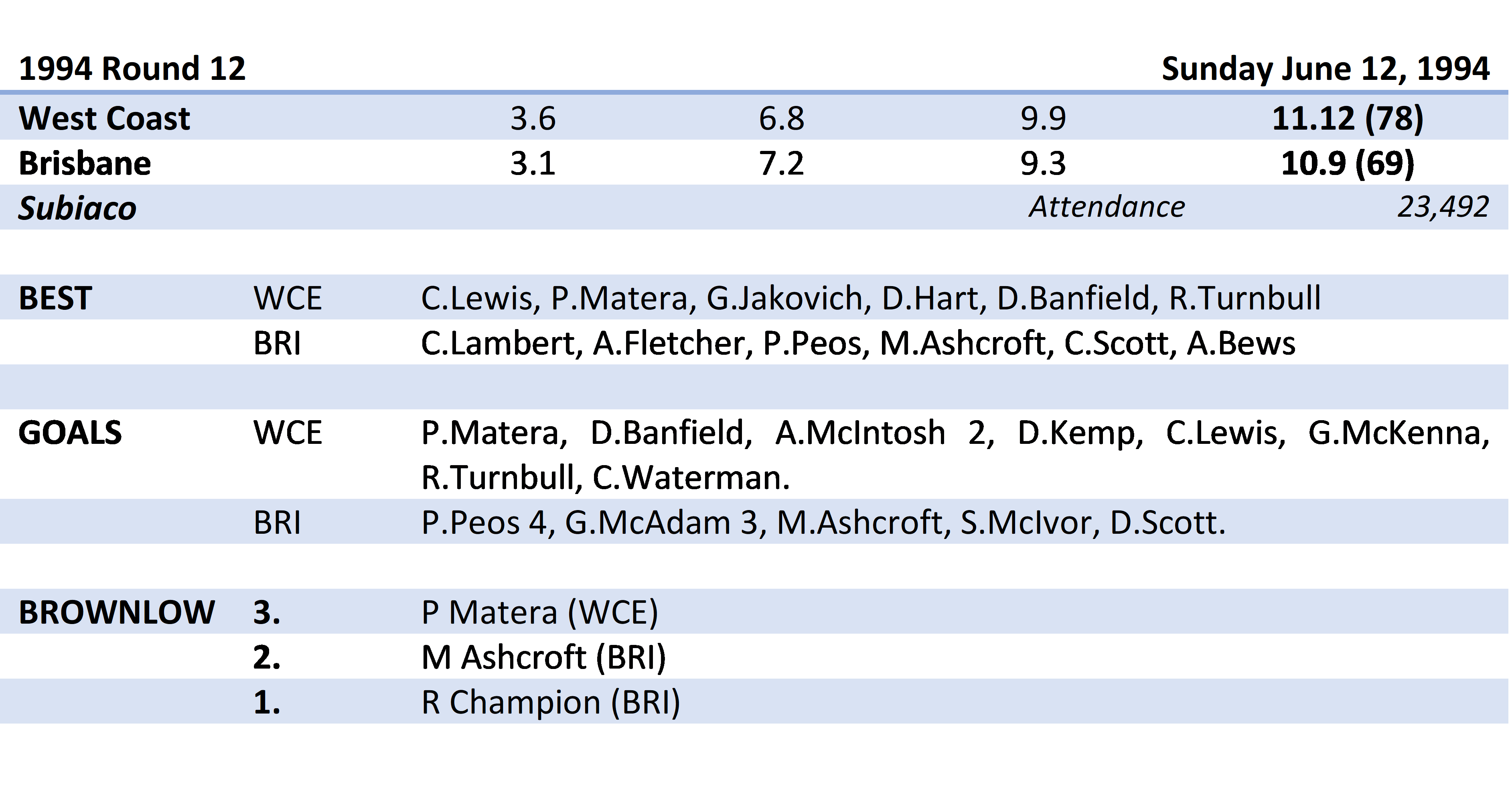
The Eagles were unimpressive but still made it six wins in a row when they held off a plucky Brisbane at Subiaco Oval.

The Bears arrived in Perth off wins against finals fancies North Melbourne and Geelong and threatened to topple the ladder-leading Eagles for much of the afternoon. However, the Bears butchered their chances in the final term meaning the Eagles are still yet to lose to Brisbane – a draw in 1992 the closest the Bears have gotten.

The Eagles 9-2 record after 11 games kept them a game clear at the top of the ladder and virtually assured them of a fifth straight finals appearance, although Eagles coach Mick Malthouse wasn’t exactly celebrating.

Post-match, an agitated Malthouse resumed his criticism from before the season about the newly implemented top eight. Malthouse had derided a system that ‘rewarded’ more than half the of the teams in the competition with a finals spot and also suggested that the larger finals system had eliminated the late season drama of teams competing for finals.

Malthouse said that the season had developed a clear division of the top teams and the bottom teams at the halfway mark and that the finals make up had already been decided, killing any interest in the second half of the year.

“I think its ridiculous. In the past two seasons we have gone to round 22 or 24, we’ve gone to the final siren in many instances to find out who would make the top six. Now, in round 12 we have got real division.”

Malthouse said that only Adelaide – who were in ninth position – were capable of pushing into the top eight out of the sides sitting in the bottom half.

“That’s the unfortunate thing about the final eight,” Malthouse continued. “You can get all the Victorian sides in that you like, but it doesn’t solve the problem of having a competition that’s fierce right to the end.”

Malthouse though wasn’t done after expressing his views on the top eight.

The Eagles had been put on notice by the AFL during the week after they had exploited a loophole which allowed Dean Kemp to be a late inclusion to the team that played Melbourne a week before, despite not being named in the squad of 24 submitted to the AFL on the Thursday night.

Under AFL rules, clubs were allowed to add an extra player to their emergency list the following day if they were playing on Sunday, with Kemp added as the 25th player in the Eagles squad. Kemp was subsequently included in the final side the morning of the clash with Melbourne, replacing Brett Heady who was never expected to play after straining a hamstring a week earlier.

As such, the AFL announced they would revoke the rule from Round 13, expressing their disappointment that West Coast had blatantly benefitted from the situation. For Malthouse, the whole scenario seemed unwarranted, simply stating that they were entitled to ‘use it to their advantage’. “While the rule is there, you use it.”

“We took the opportunity to take Dean Kemp across and he filled the role of the player (Heady) who pulled out of the side late.”

The Eagles clearly weren’t bothered by the AFL’s stance, as they made a further two late changes for their clash with Brisbane.

Brett Heady was named to return from a hamstring injury, but failed to come up on game day allowing Jarrad Schofield to reclaim his place after he was omitted for Heady. The other late change was Peter Wilson, who had been surprisingly named after Malthouse had ruled the half-forward out earlier in the week with a hamstring injury suffered against the Demons.

Wilson had his place taken by Matt Clape, who returned to the West Coast side for his first game since round 4. Brett Spinks was another who spent much of the week under an injury cloud, but he recovered enough from an ankle concern to take his place.

Michael Brennan plays game 150

The Bears were dealt a double blow for their trip west with captain Roger Merrett unavailable due to a thigh complaint and Matthew Kennedy ruled out with a fractured cheekbone. Merrett, in particular, was a bad loss for the Bears. The veteran had booted five goals and two goals in the previous two weeks as Brisbane recorded consecutive upset wins.

Scott McIvor was named for his 100th game at full forward in place of Merrett, with Fabian Francis the other inclusion.

The Eagles had the better of the early chances, but wasteful kicking at goal kept the Bears in the game at quarter-time with the visitors then dictating the play after the first change.

Adrian Fletcher and Craig Lambert led the Brisbane midfield who had the better of their Eagle counterparts. Dean Kemp struggled in his second game back from a knee injury and Chris Mainwaring found himself on the pine with Chris Scott getting the better of their duel.

Paul Peos then changed the game with three goals in 13 minutes. The former Eagle was proving a handful for several of his ex-teammates, with John Worsfold and then Guy McKenna both unable to contain the half-forward. Michael Brennan – who was playing game 150 – became his third opponent but the Bears had taken a seven point lead following Peos’ purple patch.

At the other end, West Coast were sorely missing Sumich, Heady and Wilson. Malthouse had a constant rotation of players through his front half, as he searched for an effective combination. David Hynes, Ashley McIntosh and Karl Langdon all started the game in the forward 50 but failed to have an impact, with Hynes well beaten by Martin Leslie and Darryl White getting the better of McIntosh.

A goal to Chris Waterman right before half-time levelled the scores at 44 apiece with West Coast then taking charge again in the third quarter. The Waterman goal started a run of four for the Eagles, with Peter Matera (twice) and Ryan Turnbull kicking majors to have the hosts ahead by 17 points.

Still, the Bears wouldn’t go away.

Brisbane booted the last two goals in the term to reduce the Eagles lead to six at three-quarter time, making it anyone’s game to win.

It would be the Eagles who would find the goals when it mattered in the final term. Guy McKenna was shifted to the forward line at the start of the last quarter, with the move paying immediate dividends. McKenna goaled just three minutes into the term to take the Eagles lead out to 12 points.

The Bears continued to pepper the goals, but couldn’t hit the major target. Peos and Alastair Lynch both missed from close range and then Troy Clarke slammed his rushed shot on goal into the post. The game was then decided heading into time-on with the Eagles pouncing on a Scott McIvor turnover. McIvor’s errant disposal was swooped on by the Eagles at half-back and a quick movement up the ground finished with McIntosh kicking an easy goal on the run to put the Eagles out to a three goal lead and end the contest.

A late goal to Brisbane reduced the final margin, but they paid for their missed chances earlier in the quarter. The Bears booted 1.6 for the term and Robert Walls was left to rue the opportunities. “We had our chances. Whoever won today could say they were a bit fortunate.”

“We weren’t able to close it and to their credit they bottled it up and did all the things that an experienced and good team should do in the final minutes.”

Malthouse though was blunt in his assessment of the performance. “We were ordinary in certain passages of the game… a lot of them are very disappointed in their performance today and are not buoyed at all by the fact that we got over the line.”

In further sour news, the Eagles lost Don Pyke and John Worsfold during the second half to injury. Pyke was forced off the ground with a shoulder injury early in the third quarter, while Worsfold played for nearly a quarter with an arm complaint, before then sitting out the last term.

Asked why Worsfold spent so long on the ground despite being clearly hampered, Malthouse said he did all he could get to his captain off. “Have you ever had front teeth extracted? That’s how hard it was to get him to leave the ground.”

1994 Rewind: Lewis Shines in Top of the Table Fizzer

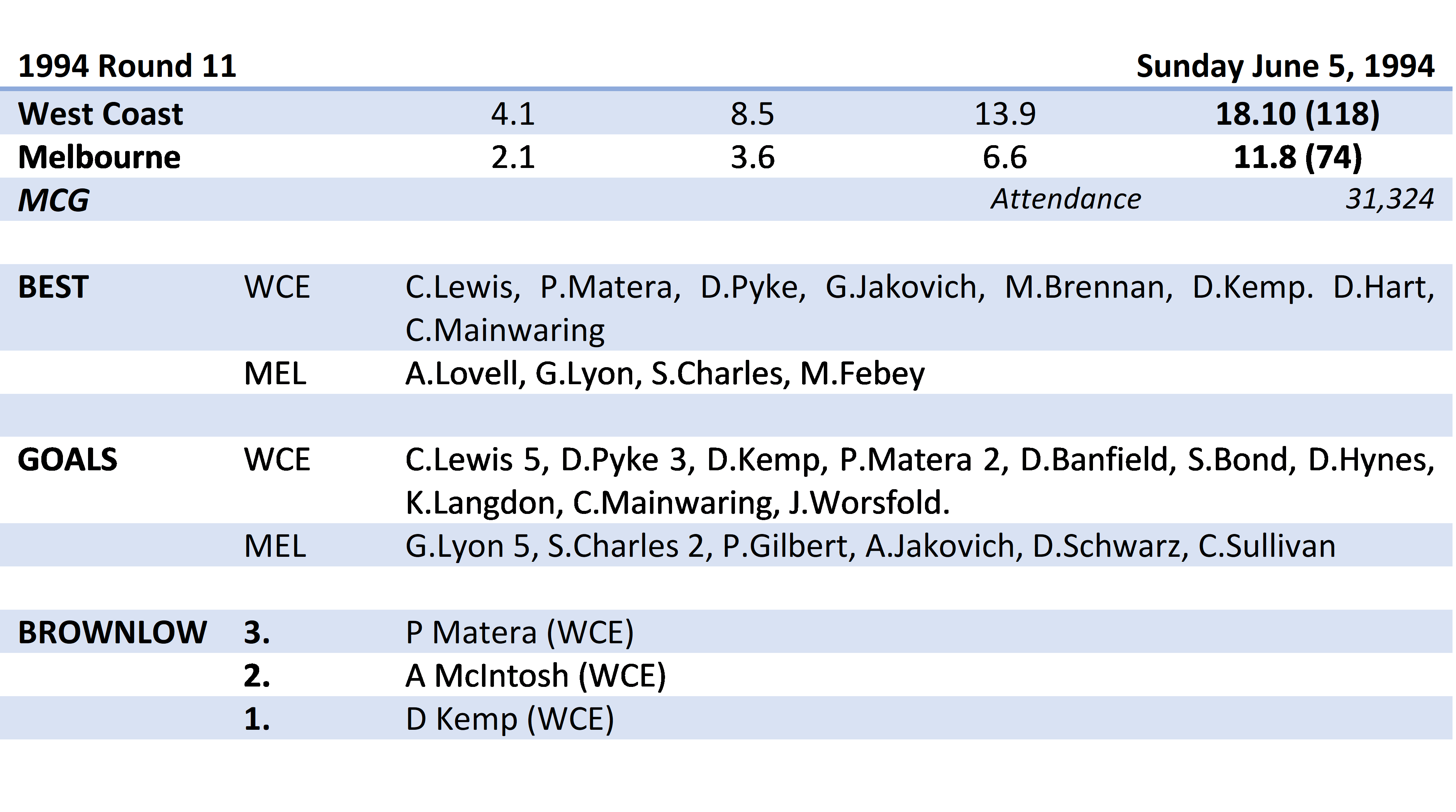
The Eagles turned a potentially intriguing top-of-the-table clash with Melbourne into a one-sided masterclass when they were too strong for Melbourne at the MCG.

The Eagles and Demons were sitting in first and second spot coming into the clash, but the strong performances of West Coast players, coupled with an excellent coaching effort, prevented the Demons from ever being a realistic chance.

The win was the Eagles’ fifth in a row, while the Demons had slumped to their fourth loss in five games, after starting the season with five straight wins.

Chris Lewis was the star for West Coast in a performance that Mick Malthouse described as the ‘best he has played in several years.”

Stationed permanently in the forward line – and operating mostly out of the goal square – Lewis was the class between the two sides, finishing with five goals (from nine scoring shots) and having a hand in several others.

With Peter Sumich once again sidelined with a hamstring injury, the Eagles were forced to experiment with their forward set up. Ashley McIntosh was swung back to the forward line, alongside Lewis, while there was also an element of the old and the new brought back into the team.

Rookie Brett Spinks returned to the forward line after being a shock omission the week before, while Karl Langdon was named for just his second game since the 1992 premiership. Injuries had restricted the blonde firebrand to just one game in 1993, with suspension then delaying his start to the 1994 season.

Langdon copped a three week ban for tripping Mark Bickley during the Fosters Cup and was then forced to bide his time at Subiaco until a spot opened up at West Coast. Langdon and Spinks were joined by half-forward Tony Evans who was playing his first game since injuring a foot in the round one loss to Essendon and second-year midfielder Jarrad Schofield.

Out of the side with Sumich, were omitted trio Jason Ball, Tony Godden and Dwayne Lamb, the latter having celebrated his milestone 150th game the week before.

After naming their initial side, there was still plenty of intrigue over the Eagles’ final team. Under recently revised AFL rules, clubs playing on Sundays were allowed to add an extra emergency player to their squad on the Friday, with West Coast curiously adding Dean Kemp to the squad, the midfielder having not played since injuring a knee in the round 7 win over Carlton.

Kemp would ultimately be a late inclusion ahead of the first bounce replacing Brett Heady. Heady had limped off the ground with a hamstring injury the previous game and was a surprise selection on the half-forward flank.  

While the Eagles played games over their playing 21, the Demons were having their own player issues. Steven Febey and Todd Viney were both named in the Melbourne line-up, despite looking incredibly proppy during the week, before Jim Stynes created a stir when he limped off the training track 24 hours before bouncedown.

Stynes appeared to roll an ankle but made it out to the field, in what was his 158th consecutive appearance. While Stynes, Febey and Viney all took their place, Jeff Hilton wasn’t as fortunate after he was another casualty at training. Hilton strained a calf and was one of two changes along with Kevin Dyson who was left out of the side despite a 24-possession, two goal effort against St Kilda the week before. Sean Charles and Glenn Molloy were the two players to come in.

After plenty of activity leading into the game, the match itself turned into a one-sided affair quickly. The Eagles ruck duo of David Hynes and Ryan Turnbull overwhelmed Stynes and the Eagles midfield capitalised on the ruck advantage.

Kemp, Don Pyke and Drew Banfield were all busy early, as the Eagles kicked four goals to two in the first quarter. Melbourne were unable to get their hands on the ball, as West Coast controlled possession and often outnumbered their opponents at the stoppages and around the ground.

With a weight of possession forward of centre, Lewis was given plenty of opportunity to show his wares. Lewis proved too elusive for Sean Wight and Graeme Yeats, finishing with his best haul in a game since round 6, 1988.

Malthouse was glowing in his praise of Lewis after the match and had a simple reasoning for his impressive outing. “He enjoys his footy now. People who enjoy their football play with that sort of enthusiasm.”

Lewis’ creativity up forward brought others into the game, with many of the Eagles’ smaller players hitting the scoreboard. Ashley McIntosh provided a solid target up forward but could manage just three behinds from 18 possessions and nine marks, but Brett Spinks and Karl Langdon both failed to have any influence.

Spinks went possession-less, registering just five hit-outs, while Langdon fared slightly better with one goal from four touches and two marks. Don Pyke and Dean Kemp combined for five goals as they alternated through the centre and half-forward, while Peter Matera kicked two goals from the wing.

Malthouse was happy with the ‘good even performance’ despite the quiet games from his tall forwards, commenting that he was happy Langdon ‘got through a game without getting injured or reported’.

Glen Jakovich was strong at half-back, getting the better of David Schwarz with 29 disposals and six marks. Don Pyke had 29 possessions through the middle to go with his three goals, while Chris Mainwaring was rampant on the wing on his way to 27 disposals, six marks and a goal.

The Demons on the other hand had few winners. Garry Lyon finished with five goals from the half-forward flank in his battle with 100-gamer Chris Waterman and Andy Lovell and Matthew Febey tried hard with 26 and 20 disposals, respectively.

Allan Jakovich – who was the difference the last time the two teams met, with six goals in an upset Melbourne victory – was well beaten by Michael Brennan, managing just six disposals before he was dragged in the third quarter and replaced by Phil Gilbert.

After the game, Melbourne coach Neil Balme was in no doubt as to where the Eagles sat in the competition. “Before the game I rated them very highly – and I probably rate them even higher now.”

While Neil Balme was declaring the Eagles the team to beat, Malthouse was looking to deflect attention elsewhere. He declared the reigning premiers, Essendon, as the benchmark of the season, despite West Coast sitting a game and 18 percent clear of 2nd placed North Melbourne.

“Essendon are the best side contrary to what Kevin (Sheedy) would like everyone to believe. They won the premiership last year and they’re going along in very much the same way.”

The Bombers were sitting seventh with six wins, but equal on points with Melbourne who held onto third place on percentage, despite the humbling defeat to West Coast. Carlton, Hawthorn and Collingwood filled the positions in between after all recording comfortable wins.

With eight wins from their opening ten games, the Eagles were one win better off than at the same time in 1993. The Eagles had recorded wins over North Melbourne and Melbourne at the MCG, as well as thumping Carlton at home. Still, Malthouse was cautious over the Eagles’ standing.

“If you gave me 8-2 at the beginning of the year I’d take it… we don’t judge where we’re going to be. We just like to be competitive and better than what we were last year,” Malthouse said.

“We’re steady at the moment. Nothing over the top. We’re steady.”