2011 Rewind: In Celebration Mode

Nicoski Kicks Six to Lead the Eagles Party

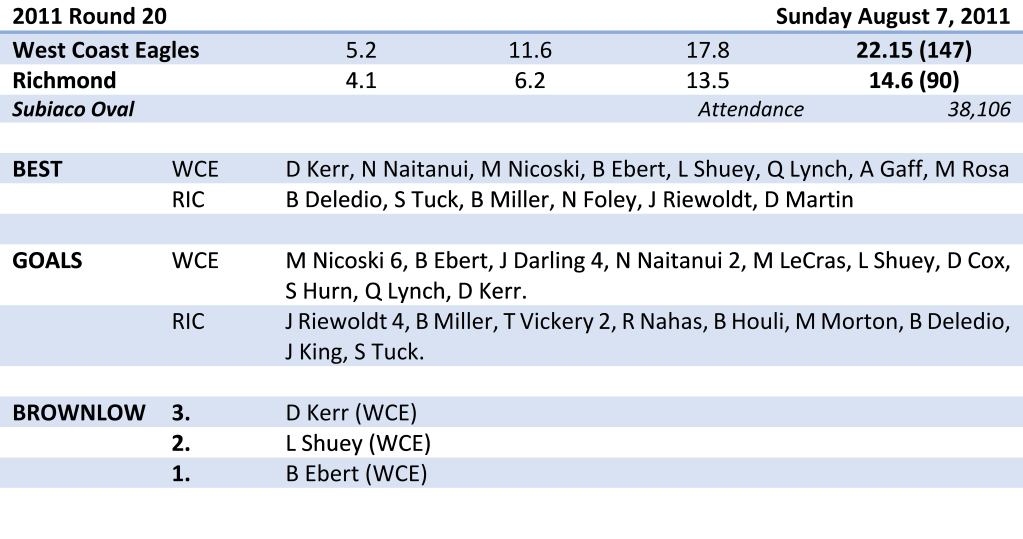
It was a week of celebration for West Coast as they honoured and paid homage to their first 25 years in the VFL/AFL competition, culminating in a 57 point win over Richmond.

The Eagles chose to celebrate their 25th season in the top tier competition in the lead up to their Round 20 clash with the Tigers, who were their first ever opponent in the opening round of 1987. In that game, the then VFL newcomers fought back from 33 points down to claim a 14 point win in their inaugural match courtesy of a nine goal final quarter.

However no such heroics were required in this meeting with the Eagles steering away from the Tigers during the second term and coasting to a 57 point win.

Josh Kennedy was again absent for the Eagles with an eye injury, but the Eagles were able to recall Daniel Kerr and Nic Naitanui. The pair were joined by defender Mitch Brown and midfielder Chris Masten who was selected for his first senior match since Round 12.

Vice-captain Beau Waters was ruled out with an elbow injury, which was initially played down by the club after he injured it during the win over the Western Bulldogs. Eric Mackenzie was also a casualty, straining a hamstring during the final training session of the week. Tom Swift and first-gamer Scott Lycett lost their places.

The Tigers also made four changes with captain Chris Newman succumbing to a knee injury and Jake Batchelor ruled out with a shoulder complaint. Ben Griffiths and Matt White were dropped, with Shaun Grigg, Brad Miller, Mitch Farmer and Matt Dea the four inclusions.

After an entertaining first term that saw the Eagles lead five goals to four at the first change, West Coast took grip of the match off the back of a dominant quarter from ruckman Nic Naitanui.

With Dean Cox limited to the full forward line after copping a knock to the hip in the opening minutes of the game, Naitanui was left to lead the ruck with Quinten Lynch rotated through to provide back up.

Naitanui relished the circumstance, as he controlled the ruck against Angus Graham and Ty Vickery, amassing eight possessions (all contested), four marks (all contested), several clearances and kicking two goals in the quarter – all the while providing silver service to the likes of Daniel Kerr and Luke Shuey.
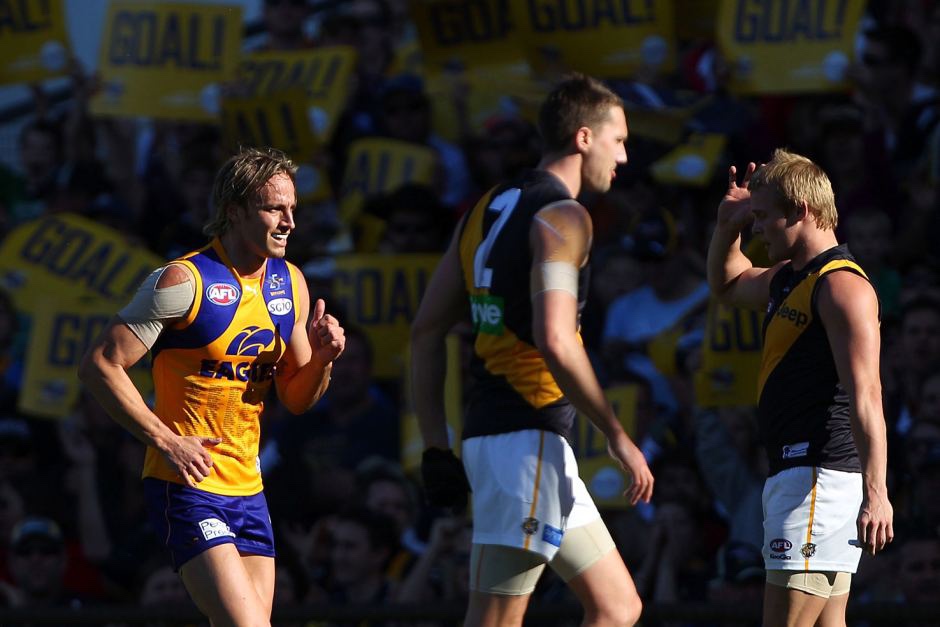
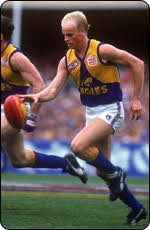
Mark Nicoski finished with a career high six goals in the win over Richmond

West Coast continued to dictate the match until late in the third quarter when the Tigers got on a roll to reduce a 45 point deficit to 27, keeping open the outside chance of an upset comeback.

In the last meeting between the two sides, at the MCG midway through the 2010 season, Jack Riewoldt had booted a career best ten goals, but to half time of this encounter, Darren Glass had kept the Tigers spearhead to just six disposals and no score. However, Riewoldt responded in the third quarter booting three goals as Richmond looked to continue on the attack.

Eagles coach John Worsfold admitted displeasure after the match with conceding seven goals in the third term, but West Coast tightened up their defence in the final term to kick five goals to one and run out 57 point winners.

14 of the Eagles’ 22 goals were kicked by the trio of Mark Nicoski, Jack Darling and Brad Ebert, who all recorded career best hauls in front of the sticks. Nicoski finished with six goals, while Darling and Ebert each booted four as the Eagles showed they could find other avenues to goal.

For Nicoski, his six goal return was just reward for a season that had reinvented the defender as a pressure forward as part of the Eagles’ strong forward press. Brad Ebert was another who had had to adapt to a different role this season with the return of Kerr, the arrival of Gaff and the rapid improvement of Shuey with Worsfold deploying the South Australian across half forward for much of the year.

Ebert appeared to find the balance in his role, hitting the scoreboard with four goals, as well as gathering 21 disposals with four tackles and four inside-50’s.

Kerr led the Eagles ball-winners with 34 disposals, 13 of which came in the second quarter when Naitanui got on top in the ruck battle. Kerr also finished with eight clearances, while Shuey had seven to go with 30 disposals, seven tackles and six inside-50s.

Andrew Gaff was tireless with 29 on the wing, while Lynch appeared to relish the freedom of running through the ruck with 23 touches, seven marks, 10 hit-outs and seven inside-50s.

Brett Deledio tallied 31 possessions and eight rebounds to lead the Tigers, with Shane Tuck (29 disposals) and Nathan Foley (24) the next best. Riewoldt kicked the Tigers only goal of the final term to finish with four for the match, with Brad Miller and Ty Vickery the only other multiple goal scorers for the visitors.

Scott Selwood was tasked with the job of minding Richmond captain Trent Cotchin, keeping the midfielder to just 17 disposals.

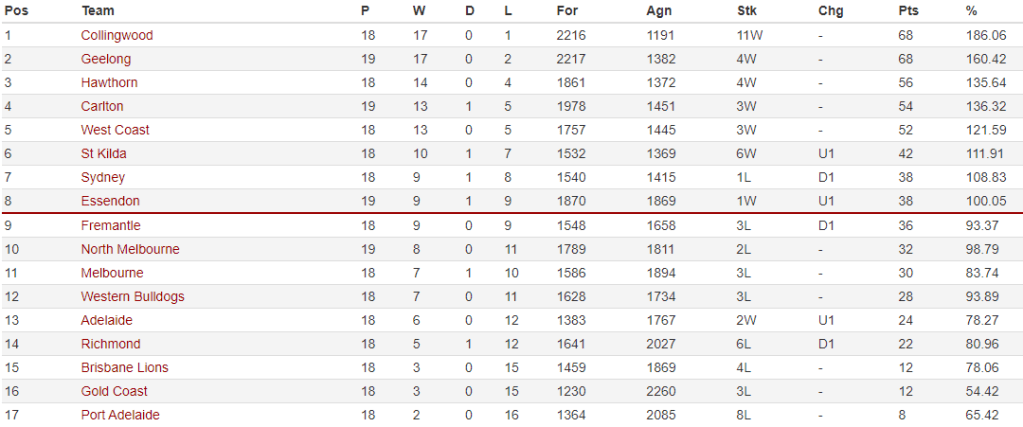
The result meant that the Eagles kept the pressure on Hawthorn and Carlton as they sought to push their way into the top four. The Hawks and Blues recorded wins against finals hopefuls North Melbourne and Melbourne, further denting their finals hopes.

The Kangaroos pushed the Hawks for three quarters before Lance Franklin kicked three final quarter goals to inspire his side to a 17 point victory. Todd Viney took charge of the Demons following the sacking of Dean Bailey, but it did little to improve things as they crashed to a 76 point defeat.

The battle for spots in the lower half of the top eight played out in dramatic fashion as the sixth placed Swans travelled to play the ninth-placed Bombers, and the seventh-placed Saints faced the eighth-placed Dockers. Just three points separated the Saints and Dockers at three-quarter time before St Kilda piled on six goals to none in the final term to run out 41 point winners.

That saw them climb to sixth on the ladder after the Swans fell to the Bombers by one point at Docklands after Adam Goodes had the chance to win the game on the siren. His long range set shot drifted wide allowing the Bombers to rise back into the top eight at the expense of the Dockers. Sydney also dropped to seventh on the ladder as a result, meaning the Eagles were now 10 points clear in fifth spot with four games to play.

The statement of the round though lay with the two leading premiership fancies in Collingwood and Geelong. The Magpies and the Cats were drawn against the two stragglers in the competition, in Port Adelaide and Gold Coast with the two sides not missing a chance at percentage boosters.

Geelong hammered the young Gold Coast side by 150 points, backing up from their 186 point thrashing of Melbourne the week before. Steve Johnson followed up his 34 disposal-7 goal effort against the Demons with 31 possessions and six goals against the Suns. The Ablett-less Suns matched the Cats early, with both sides kicking three goals to start the game before Geelong went on the rampage with the next 15 goals in the game to open up a 94 point lead at half time.

The Cats also booted the final 11 goals in the game to run out easy winners, with the combined 336 point margin over the previous fortnight boosting their percentage by 21.9 points in that time.

The Magpies proved they wouldn’t be outdone, smashing a hapless Port Adelaide by 138 points at Football Park. The Power managed just six scoring shots for the night – finishing with 3.3 for the match, compared to the Magpies’ total of 23.21 from 44 scoring shots. That kept the Magpies at the head of the ladder with their monstrous percentage of 186.1 from 17 wins keeping them in front of the Cats who had built their percentage to 160.4 from the same number of wins.

While happy with the win, there were concerns for the Eagles with a number of injuries out of the match against the Tigers. Wingman Matt Rosa was the most serious, limping off during the third quarter after clashing knees with Richmond’s Daniel Jackson while Jackson was attempting to kick. Both players would be substituted out of the game from the incident, with Rosa later diagnosed with a posterior cruciate ligament injury that was likely to keep him out of the rest of the home and away series.

It continued an unfortunate run for Rosa who was on the fringe of the Eagles’ 2006 premiership side, playing in the first two finals before being dropped for the preliminary final. Dean Cox would be monitored after his knock to the hip, while Naitanui limped off in the game late with a lower leg problem.

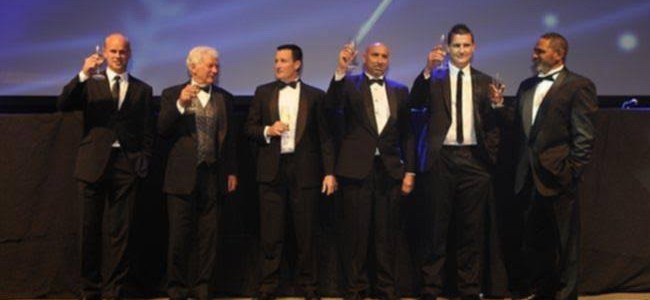
It would prove to be just a small scuff off the gloss of the week that saw West Coast celebrate their first quarter century of existence. The Eagles wore commemorative jumpers in the match that listed every Eagles to have represented the club, while the inaugural inductees of the West Coast Eagle Hall of Fame were announced in a gala event the night before the match.

Eight inductees were announced with current coach John Worsfold joined by former teammates Guy McKenna, Glen Jakovich, Peter Matera, Chris Lewis and Dean Kemp along with two time premiership coach Michael Malthouse and long-time trainer Bill Sutherland.
1990 Rewind: Eagles Bounce Back Against Bears

Eagles Get Four Points But Miss Percentage Booster

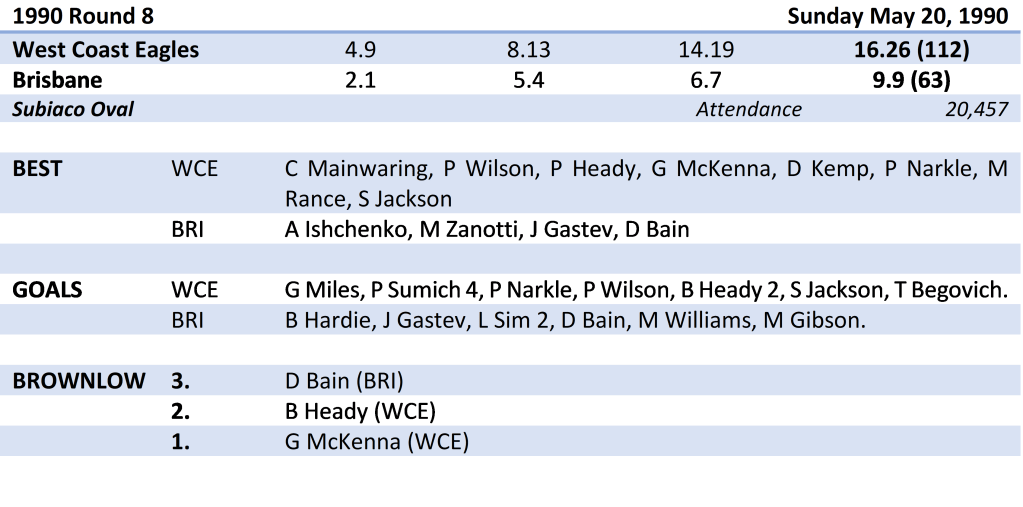
West Coast returned to winning ways when they comfortably accounted for the Brisbane Bears at Subiaco Oval. In a performance that warranted a triple-digit winning margin, poor kicking on goal meant the Eagles had to settle for a 59 point victory.

Peter Sumich booted four goals, as did Geoff Miles who was thrown forward in the second half. With such a complete performance, many Eagles stood out, but the performance that would have most delighted the West Coast match committee was that of Phil Narkle, who returned for his first senior match in over two and a half years.

Narkle – a member of the Eagles inaugural squad of 1987 – was delisted at the end of 1988 after injuries restricted the gifted wingman to just nine games in two seasons. Returning to the WAFL, Narkle managed some games with Swan Districts late in the 1989 season, with the Eagles throwing a lifeline ahead of the 1990 season, with their final selection at the pre-season draft.

Narkle’s last appearance for the Eagles had been the 130 shellacking against Sydney in Round 16 of the 1987 season.

Narkle shone in his first game back, picking up 22 disposals and booting 2.3 playing mostly from the forward pocket. Malthouse, in particular, was delighted by Narkle’s showing.

“I was tickled pink with Phil’s game, especially as he was a bundle of nerves beforehand,” a ‘rapt’ Malthouse said after the game.

“His pace and genuine crumbing ability gave us something that we lacked.”

Narkle was one of four inclusions for the Eagles, who swung the axe after their poor display against the Demons the previous week.

Chris Mainwaring earned an instant reprieve after being dropped to East Fremantle the week before, responding as one of the best players for West Coast. Scott Watters and Tony Begovich were the others brought in, with Craig Turley, Andrew Lockyer and Todd Breman dropped. Dean Laidley was finished for season 1990 having undergone a knee reconstruction during the week.

Begovich debuted for the Eagles after being selected at the 1989 National Draft, but his selection capped off a rampant rise. Begovich initially rejected the Eagles offer to join the club, choosing instead to remain with WAFL club Claremont, alongside fellow draftee Peter Mann.

However, a change of heart in the new year saw Begovich join his new Eagle teammates and a strong start to the WAFL season garnered his first senior AFL game. While he spent most of his first match on the bench, Begovich still managed to have an impact booting his first goal.

The need for Begovich was limited as West Coast controlled the contest from the get go.

The Eagles registered 13 scoring shots in the first term and the game could have been done at the first change if not for an inaccurate return of 4.9.

Chris Mainwaring slotted back on a wing and gave plenty of drive, as did rookie Peter Matera who produced a more rounded effort in his 3rd AFL game. Fellow rookie Brett Heady provided class through the midfield and at half forward, while Peter Wilson was industrious around the ground.

The Bears had arrived in Perth off the back of their second win of the season, by eight points over Sydney, with forward Cameron O’Brien the difference in the win with seven goals. However, he was completely blanketed up forward by Michael Brennan. Murray Rance was similarly effective on Bears captain Roger Merrett.

Guy McKenna provided the drive from the backline and with Karl Langdon and Stevan Jackson up forward, along with Sumich and later Geoff Miles, there was too much class across the ground for the Bears to contain.

The Eagles added another four goals in the second term, and put the foot down after half time with six majors to take their lead out to 60 points with a quarter to play. However 2.7 in the final quarter cost the Eagles a chance at a significant percentage boost.

Remarkably, the Eagles booted 8.13 in each half, to finish with one of their most inaccurate displays in the clubs history, a final score of 16.26, from 42 scoring shots.

Mainwaring, McKenna and Wilson all tallied 26 disposals to be the leading ball winners for the Eagles, with rookies Dean Kemp (22 disposals) and Brett Heady (21 disposals, two goals) also impressive. The only concern for West Coast was full forward Peter Sumich limping off midway through the third term.

Bears coach Norm Dare admitted his side were ‘just not tough enough’ in the contest with the result undoing much of the good work they had showed the week before.

Ironically for the Bears, their best players were also Eagles. Mark Zanotti, John Gastev and Alex Ishchenko had all been a part of the Eagles’ inaugural squad, but had worked their way east to the Bears in subsequent seasons.

Zanotti was the leading possession getter for the Bears with 25 from defence, while Gastev offered an avenue to goal with 18 touches and two goals. Ishchenko was the Bears’ best on the day, completely monstering Phil Scott in the ruck and getting the better of his former teammate around the ground.

Ishchenko finished with 18 disposals and 10 marks, while also having 25 hit-outs in the ruck, compared to just nine for Scott.

While happy with the win, Malthouse bemoaned the missed opportunities on goal. “We worked hard to set up goals rather than kick them.”

And despite the win lifting the Eagles back up to second spot on the ladder, a game clear of the chasing pack, Malthouse acknowledged the win would mean nothing if they lost to the Cats the following week.

“We have to defeat Geelong next week,” Malthouse declared. “That will put us three games up on them.”

“In the wash-up, after 22 rounds they (Geelong) will be vying as we will be, for a place in the five.”

It was déjà vu for the Cats when inaccurate kicking cost them what should have been a straight forward win against a side at the bottom of the ladder. A week on from their shock defeat to Richmond at Kardinia Park, the Cats booted 13.20 in their nine point loss to the Swans at the SCG, who had started the round in equal bottom.

The consecutive defeats had robbed the 1989 Grand Finalists the chance to sit comfortably inside the top five, instead languishing in eighth position, a game and percentage out of the top five. Carlton pushed past the Cats into seventh when they won their third straight match, thrashing the Hawks.

The Blues led from the outset and slammed their advantage home in the final term with an eight goal quarter securing a 67 point win. The Hawks would be the big losers of the round, dropping from 2nd on the ladder to 5th.

Essendon and St Kilda each climbed a spot with narrow wins over Footscray and North Melbourne, respectively, while the Magpies remained stayed in touch with the top five with a ten goal final term turning a 17 point three-quarter time deficit into a 45 point win over Fitzroy. The Demons remained the pacesetters at the top of the ladder with an easy win over the Tigers.

MCG Demons Return

Melbourne Claim Points in Top-of-the-Table Fizzer

A week can be a long time in football.

Seven days on from their breakthrough first win at the MCG, the Eagles horror record at the ground was once again at the forefront when they were humbled by the Demons to the tune of 55 points.

The Eagles and Demons headed into their round seven meeting occupying the top two spots on the ladder, with 5-1 records, but the top-of-the-table clash proved a non-event as Melbourne ran away with the game in the first half.

The Demons opened up a three goal break at the first change and were never seriously troubled, finishing with a seven goal final quarter to blow out the margin, and regain their spot at the top of the table.

And there was plenty of insult to injury.

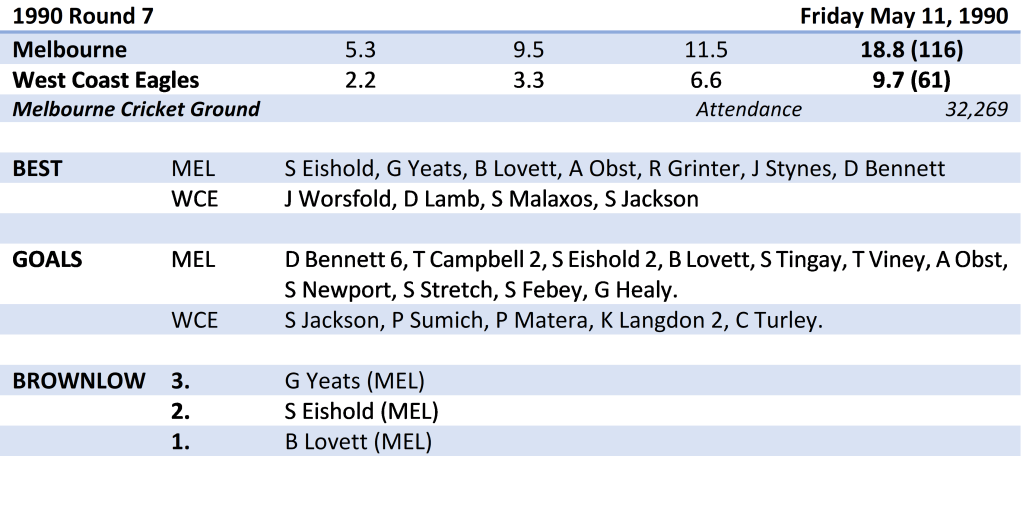
Inaugural Eagle Darren Bennett – who was let go by the club after just one season – did the damage up forward for Melbourne, booting six goals, while West Coast were also left reeling after Dean Laidley was carted off the ground in the second quarter with a knee injury that would rule the half-back flanker out for the rest of the season.

Laidley would be one of three players who would fall victim to a serious knee injury at the MCG in Round 7. North Melbourne pair Brenton Harris (playing in the reserves) and Darren Steele both went down the following day, as criticism over the state of the MCG playing surface grew.

Both Melbourne and West Coast had aired concerns over before the match, with the Eagles declaring they were lucky not to incur any injuries the week before against Richmond. Demons coach John Northey was particularly vocal about the dangers, but AFL communications manager Tony Peek played down the comments.

“We will be keeping a close watch on the situation”, Peek said.

Peek would come to rue those words, with three serious injuries in less than 24 hours. Footscray and North Melbourne joined the chorus of voices demanding action over the state of the ground, with recent attempts to fill holes in the ground with sand failing to deliver any improvement.

Following the Eagles’ defeat, Malthouse wouldn’t be drawn on the playing field, but expressed disappointment over losing Laidley. “It did not look good.”

Malthouse also delivered a blunt analysis of his team’s showing.

“We made far too many mistakes.”

“I thought we could do better and it was a learning curve for all concerned”, Malthouse continued. “We will make adjustments and be a better side.”

The Eagles made two changes coming into the match, with Troy Ugle and wingman Chris Mainwaring both dropped. Mainwaring had struggled in his two games since returning from a back injury, but was still a surprise omission, marking the first time in his 63-game career he had lost his position.

First-year player Peter Matera was chosen for his second game to replace Mainwaring, with Geoff Miles the other inclusion. Miles had failed to play so far this season as he recovered from a hamstring injury, named at full back.

The Demons also made two changes, as they battled somewhat of an injury crisis. Already without Steven Clark and Trevor Spencer for the season, Melbourne lost defender Sean Wight the week before with a knee injury suffered while playing for the reserves and veteran Alan Johnson was unable to prove his fitness in his effort to come back from a calf injury.

The Demons also lost Brian Wilson to a broken cheekbone during the loss to Sydney the week before, with Wilson ruled out, along with Jay Viney who was dropped. Rod Grinter and Glenn Lovett were the two inclusions.

The Eagles started brightly enough with goals to Peter Sumich and Stevan Jackson early in the first quarter, after Simon Eishold opened the scoring. But the Eagles soon became their own worst enemy as Melbourne capitalised on a number of errors in defence.

Michael Brennan twice turned over the ball coming out of defence, leading to Demon goals before Greg Healy led the race back to goal to toe-poke from the square after Murray Rance couldn’t mark at centre half back.

The Demons added a fifth to take their lead out to 19 points at quarter time. The Eagles’ ball use didn’t improve in the second quarter as Melbourne doubled their advantage to 38 at the major break. Dean Laidley had come off the ground after his knee crumpled beneath him, with West Coast leaving plenty to do for an unlikely victory.

The Eagles for their part responded at the start of the second half, booting the first three goals, as they closed to within 17 points. But they were left to rue several other missed opportunities and some poor kicking into their forward line.

“We could have got closer and it may have been a different story in the final term”, Malthouse said.

Having worn everything the Eagles could muster, the Demons responded with two late goal to take their lead out to 29 at the final change, and when Melbourne booted the first three goals of the final quarter, the game was all but won.

While Bennett was the major contributor on the scoreboard, the Demons had an impressive spread of goal kickers with 11 players registering majors. In contrast, the Eagles had just five goal kickers as they constantly broke down going forward.

Dashing Melbourne defender Graeme Yeats provided plenty of rebound from the backline, picking off a number of errant passes, while Rod Grinter was impenetrable in the back half.  

The Eagles decision to only run with one recognised ruckman against Demon pair Jim Stynes and Steven O’Dwyer also proved costly as the Melbourne midfield were regularly gifted first use of the ball from stoppages. Phil Scott managed just five hit-outs for the match, compared to the combined tally of 23 of his direct opponents.

Andrew Obst and Simon Eishold were influential early, finishing with 21 and 15 disposals respectively, while Brett Lovett led the Demons with 26 touches through the middle. Stephen Newport (23 dipsosals), Steven Stretch (21) and Stephen Tingay (20) all gave the Demons plenty of drive, as West Coast often had to build their attacks from defence.

Dwayne Lamb was the sole winner for West Coast in the middle, collecting 20 kicks and 13 handballs. Stephen Malaxos picked up 26 touches and John Worsfold had 28 in a performance that drew praise from Malthouse after the game.

“He was outstanding, considering we only decided to play him five minutes before the game because of a nagging (leg) injury.”

John Worsfold was one of the few winners for West Coast

The result saw Melbourne reclaim top spot, a game ahead of Hawthorn and West Coast, who had fallen to third. However, a number of surprise results over the weekend meant the Eagles maintained a game advantage over the chasing pack.

Essendon were beaten by an improving Carlton, by 20 points, while St Kilda suffered a shock 18 point loss to the bottom-placed Fitzroy, despite seven goals to spearhead Tony Lockett. Despite the losses, the Saints and Bombers both held their spots in the top five, after Geelong blew a golden opportunity to move into the finals positions.

Hosting the second-last Tigers at Kardinia Park, the Cats booted a horrid 9.28 in a 14 point defeat, giving Richmond just their second win of the season. Collingwood were also left outside the top five when they fell to the Hawks in one of the rollercoaster games of the season. The Magpies trailed by five goals at half time, only to hold a 10 point lead at three-quarter time, before falling short by two points.

Following back-to-back games at the MCG, the Eagles were set for a fortnight at home against Brisbane and Geelong, but Malthouse was quick to dismiss the suggestion that the Eagles were happy relying on their perceived home ground advantage to bank the wins they needed for finals.

“We will end up on our backsides if we think [we are guaranteed those games]”, Malthouse warned.

“There are seven or eight sides vying for the top five and it might take at least 14 wins to make the finals.”

1990 Rewind: Malthouse Begins

Off-Season of Change Brings Winning Start

The 1990 season promised a new beginning.

The AFL was officially born with league headquarters re-branding from the VFL to recognise that the competition was now national, with clubs located in Victoria, New South Wales, Queensland and Western Australia.

The West Coast Eagles had also undergone significant changes since a disappointing 1989 campaign.

John Todd was replaced as coach after two seasons, with Victorian Michael Malthouse taking over the reins following six seasons at Footscray. The Bulldogs had only made the finals once during Malthouse’s tenure as coach, falling agonisingly short of a Grand Final appearance in 1985 in Malthouse’s second year.

The Bulldogs had remained competitive since, hovering just outside the final five, before crashing to second-last in Malthouse’s final year in charge, as the club battled football extinction. The Bulldogs would exist in their own right for season 1990 – saved from merging with Fitzroy – but Malthouse sought a new challenge across the Nullabor.

The transition between Todd and Malthouse hadn’t been a smooth one; news of Malthouse’s appointment had been leaked before Todd was formally told he would not be offered a new contract, with the Eagles hierarchy scrambling together a press conference on the afternoon of October 3, 1989 to present Malthouse as the clubs third coach.

Malthouse would not be the only key change for the Eagles heading into 1990.

Brian Cook was appointed CEO, after two years with the WAFC, and Trevor Nisbett was appointed football manager. On-field, Stephen Malaxos was named captain with John Worsfold vice-captain and the club was able to establish Subiaco Oval as its permanent training base, having operated out of a number of different locations across their first three seasons.

Leading up to the clubs opening game against Collingwood, the signs were positive the Eagles could return to finals action.

The Eagles lost narrowly to Essendon in their Fosters cup opening game, but were given a reprieve in the competition after Brisbane failed to travel down for the pre-season competition. West Coast played the Bears’ opponent in North Melbourne, and narrowly lost again. The Eagles lost both games by three points, with poor kicking for goal to blame in both defeats.

West Coast then hosted the previous seasons Grand Finalists in practice matches to round out the pre-season. Both were resounding victories. The Eagles thrashed the Cats by 89 points and then followed up that performance with a 12 goal win over the Hawks.

West Coast named a fresh squad to tackle the Magpies, who were one of the premiership favourites heading into the season. Collingwood had made the finals the previous two seasons under Leigh Matthews, but had been bundled straight out in both years. With a number of key recruits over the off-season, many believed the Magpies were ready to take the next step.

The Eagles named four players for their AFL debut. Peter Matera – the Eagles first selection at the 1989 draft – Dean Kemp, Dean Irving and Brad Gwilliam were all selected for their first matches, while Peter Wilson was also picked for his first game with the club, having switched across from Richmond.

John Worsfold was left to lead the club, after new captain Steve Malaxos was forced to miss the game with a broken foot. Malaxos had suffered the injury, stepping on a picket at his home, missing the start of the season.

The Magpies named new recruits Tony Francis and Scott Russell, who had both joined the club from the SANFL, but prized addition Paul Hawke and defender Michael Christian were both unavailable due to hamstring injuries.

The two sides had met in the final round of the 1989 season, with Collingwood easy 49 point winners.

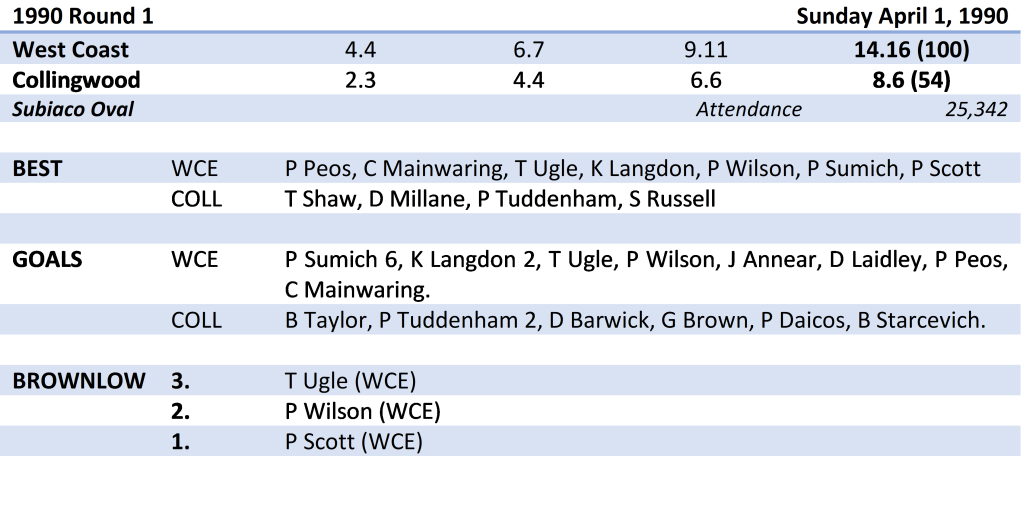
But in a clear sign of how much the Eagles had progressed in one summer, West Coast extended their lead in every quarter to run away with a 46 point win.

In a bruising encounter that had plenty of moments of spite between the two sides, it was an all-in brawl midway through the third quarter that set the course of the final outcome. Collingwood first-gamer Tony Francis lashed out at Eagles defender Murray Rance as the two tumbled over the boundary line, sparking an altercation that involved most players from both sides.

Play was held up for several minutes as the umpires tried to separate the players and when the two teams did get back to playing football, it was the Eagles who settled quicker. The Eagles booted the next three goals to stretch their lead out to 34 points, and while Collingwood responded with the last two goals in the term, a five goal to two last quarter sealed an impressive win for the home side.

Peter Sumich starred up forward with six goals, but it was the improved defensive attitude that pleased new coach Mick Malthouse most. Collingwood could manage just eight goals for the afternoon, with Michael Brennan shutting out full forward Brian Taylor and Murray Rance the better of Craig Starcevich.

Sumich led the way up forward with six goals

Dean Laidley had the better of Jamie Turner, while John Annear found a new role in defence, marked with the task of minding Gavin Brown.

The Magpies struggled throughout the day with the man-on-man structure that Malthouse implemented, as well as the intense pressure around the ball.

“They (the players) didn’t talk about how much they’d won by or who kicked the goals. The first thing they said when they came in was the tackling was terrific”, an excited Malthouse proclaimed after the match.

“They acknowledged each other and it’s important that they think that’s one criterion of success, either at Subiaco Oval or Melbourne.”

Troy Ugle was stationed in the back pocket for the Eagles and provided plenty of dash through the first half, before being forced off the ground when he was caught under the pack of the melee, injuring an arm in the process. However, he returned to the field in the forward line for the final quarter, booting a goal and setting up two others in a best-afield display.

First-gamer Dean Irving combined well with Phil Scott in the ruck with the duo proving too strong for Collingwood pair Damien Monkhorst and James Manson at the stoppages. The Eagles midfield benefitted from this advantage with Paul Peos the leading ball-winner with 25 disposals and Chris Mainwaring next-best with 22.

Dean Kemp had 20 touches on the wing to get the better of Graeme Wright and Dwayne Lamb restricted Peter Daicos to just six kicks and a goal.

After having his colours lowered by Paul Tuddenham in the first quarter, acting captain John Worsfold was released into the middle, where he finished with 19 disposals and gave plenty of drive along with Karl Langdon, who collected 21 touches and booted two goals roaming between half forward and the centre.

For Collingwood, only captain Tony Shaw (24 disposals), newcomer Scott Russell (22) and Darren Millane (21) showed they were capable of matching the fierceness that West Coast brought to the contest.

It only got worse for the Magpies, with Francis later suspended for six games for kicking Rance. In his tribunal hearing, Francis remarked that he had been provoked when he felt Rance brush his groin area, and while he admitted responding with a kicking action, believed that he had missed Rance. The Eagles defender supported the claim by Francis that he didn’t make any contact, but that didn’t stop tribunal chairman Neil Busse rubbing the Collingwood midfielder out until round 8.

The Eagles themselves weren’t immune from the tribunal, with runner Rob Wiley charged for his involvement in the melee. Wiley was sanctioned and fined $1000.

While the result proved an awakening to the rest of the competition, Malthouse remained calm, saying there was plenty for his side to work on.

“If you come away from round one with a win, and plenty of work to do, that’s good.”

West Coast Demolish Cats For 1994 Flag

Two Out Of Three Ain’t Bad For Eagles

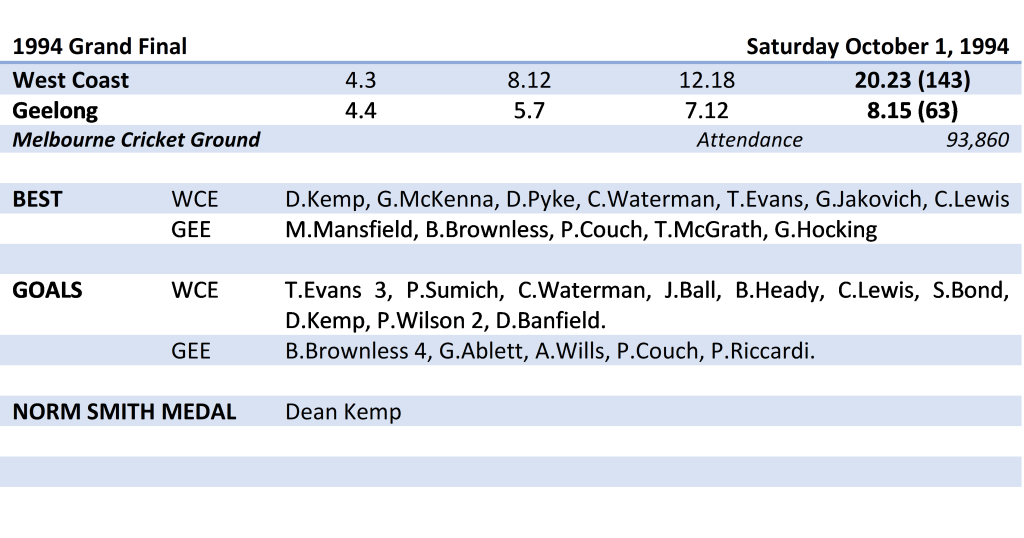
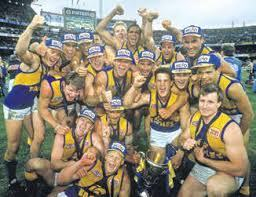
West Coast reinstated themselves as the kings of the competition when they crushed Geelong by 80 points to win the 1994 Grand Final.

Two years after an historic first flag, the Eagles steamrolled the Cats to their second premiership, erasing the disappointment of a failed 1993 season.

Dean Kemp claimed the Norm Smith medal for best afield and Tony Evans repeated his 1992 haul of three goals as West Coast booted their highest score in over two years.

Traditionally recognised as a defence-oriented side, the Eagles racked up 43 shots on goal in the Grand Final, a week after they posted 37 scoring shots against Melbourne. Ten Eagles in total hit the scoreboard as West Coast recorded the fourth largest winning margin in Grand Final history.

For the Cats, the defeat was their third loss in the season decider in six seasons, having gone down to the Eagles by 28 points in 1992 and the Hawks by six in 1989.

A shattered Malcolm Blight could offer no explanation after the match, saying there was ultimately nothing his side could do. “I could say a million things about what we might have done or could have done. But at the end of the day they were 80 points better than us, which is pretty hard to cop really.”

Eagles coach Mick Malthouse admitted he sympathised with the Cats, but was equally ecstatic with his side’s performance.

“I just love seeing the day for the club and all the players… I get a bigger kick out of seeing the players enjoy themselves.”

West Coast made just one change from the preliminary final, with Ashley McIntosh coming back into the team after missing with a knee injury. Mitchell White was the player to make way, after coming into the side as McIntosh’s replacement, but remained an outside chance on the morning of the game as West Coast debated whether to remove one of their ruckman.

However, the pair of David Hynes and Ryan Turnbull was retained to tackle John Barnes who was openly struggling with a lower leg injury. Geelong remained unchanged from their last-gasp six point win over North Melbourne, with Grant Tanner ruled out earlier in the week in his bid to recover from an ankle injury.

McIntosh started in defence on Bill Brownless, with Michael Brennan tasked with minding Gary Ablett. The Cats tried to throw the Eagles defence early, starting Ablett on the wing but he quickly moved to the goal square after failing to have an impact.

In a reverse to the 1992 meeting, it was West Coast who had the fast start, booting the first three goals in the game. Tony Evans, Chris Lewis and Shane Bond all kicked majors as the Eagles jumped to a 20 point lead.

West Coast had had all of the play out of the middle of the ground but the momentum of the game soon changed when Geelong piled on four goals in eight minutes. Tim McGrath and Michael Mansfield provided the dash off half back for the Cats with Paul Couch opening the Cats account.

Three more goals followed in quick time to give Geelong a seven point lead, before Brett Heady settled the Eagles just before quarter time to reduce the Cats lead to one point at the first change.

It would prove to be the only period of ascendency Geelong would have in the game.

West Coast resumed control at the start of the second term and only poor kicking on goal prevented the Eagles from having the game won by half time. Peter Wilson kicked consecutive goals to start the quarter as West Coast camped the ball in their forward half.

The Eagles created confusion at the Geelong kick-ins when they changed tack from their usual one-on-one set up to a zone defence. The usually precise Mansfield and Ken Hinkley were undecided with their re-entries preventing clean getaways from their back half, which had been a trademark through their finals campaign.

Twice in the second quarter West Coast picked off their kick-ins. Tony Evans intercepted a Ken Hinkley pass to mark and goal, before then having an intercepting hand that rebounded to Peter Sumich allowing the Eagles full forward to send the ball back over his opponent in Stephen O’Reilly.

The Eagles continued their dominance of general play but, remarkably, when Bill Brownless booted his third goal midway through the third term, the Cats were still within touching distance trailing by just 18 points.

However, three majors to Dean Kemp, Brett Heady and Peter Sumich extended their lead to six goals by three-quarter time and Geelong’s slimmer of Hope was all but gone.

The last quarter was a celebration for West Coast, as they slammed on eight goals to one to demoralise the opposition and the majority of the pro-Geelong crowd.

Symbolic of the day for West Coast and for their Norm Smith medallist Dean Kemp, their 17th goal came about purely by accident. Kemp’s kick inside 50 was intended for Chris Lewis who was crunched out of marking the ball by Tim McGrath, only for the ball to carry on its path and bounce harmlessly through for another goal.

Kemp was sublime for the Eagles on a day when they had a healthy number of contributors. The Eagles centreman had 23 disposals and booted two goals to outpoint Geelong captain Mark Bairstow, who had a dirty day. It also meant that Bairstow finished with the inglorious honour of once again playing on the Norm Smith medal, after lining up on Peter Matera’s wing in his five goal performance of 1992.

Dean Kemp was best afield for West Coast

Don Pyke collected 26 possessions through the middle and just had the edge over Geelong’s Paul Couch. One of Geelong’s prime movers was relegated into a defensive role as he tried to curb the influence of the Eagles centreline.

The Eagles defence was as impregnable as ever, led by Glen Jakovich (20 possessions) and Guy McKenna (23) across half back. Jakovich played his own game standing in the way of Geelong’s forward entries and proving too strong for both Steven Handley and David Mensch. McKenna provided the run from the backline as he outclassed Adrian Hickmott.

Michael Brennan blanketed Gary Ablett, with the Geelong superstar managing just one goal from five disposals and David Hart had the better of Leigh Tudor in the back pocket. Geelong’s only winner in their forward half was Billy Brownless, who exorcised some of his demons from the 1992 Grand Final when he was humbled by Ashley McIntosh.

Brownless kicked four goals for the Cats – he was the only Geelong player to kick a goal after quarter time – and took one of the great Grand Final marks when he soared over McIntosh and managed to hold onto the ball from a second attempt.

Michael Mansfield was arguably the Cats best player with 21 disposals out of defence and having the better of Shane Bond, while Tim McGrath also did his best to withstand the avalanche. Garry Hocking finished with 20 possessions after being forced off during the first term with a heavy cork and returning to the ground in the second half with heavy padding around his upper leg.

But it was a day that belonged to West Coast.

15 members of the 1992 triumph were now dual premiership players, while there was redemption for David Hynes and David Hart, who were the unlucky stories from two years earlier.

And even with two of the heroes from 1992, in Peter Sumich and Peter Matera, having subdued outings, there were plenty of others who stepped up. Sumich and Matera combined for 11 goals in the clubs first flag as West Coast had just four goal kickers for the day. This time around, nearly half of the team kicked goals, as the likes of Chris Lewis, Brett Heady and Jason Ball provided strong targets up forward.

Chris Waterman came onto the ground early in the second term after Chris Mainwaring was forced off with a corked hip and put in one of his finest performances with 18 disposals and two final quarter goals (to go with four behinds). Mainwaring himself was able to return to the field and pick up 18 disposals.

Mick Malthouse even broke with his own tradition in heading down to the bench with three minutes remaining. Malthouse had been reluctant to leave the box two years earlier, despite the urging of his coaching team, but with the game well in his side’s keeping, the Eagles coach revelled in the celebrations boundary side.

Malthouse admitted that he knew his side were home during the third quarter.

“We expected at some stage Geelong to give us a big quarter like they had over the last three or four weeks, so we were ready for it. We stuck to our basics, not to allow them to get that one quarter of football in.”

“At half-time I thought if we maintained our pressure, and we could hold them, we could do the job,” Malthouse said.

“So I guess three quarters of the way through the third quarter I thought we had them.”

Since taking over as senior coach at the end of 1989, Malthouse had steered the Eagles to no lower than fourth in five seasons, which now included two premierships from three Grand Final appearances.

The Eagles had massacred the Cats in one of the most emphatic premierships of the modern era and with that staked their claim as the pre-eminent club of the AFL.

1994 Rewind: Eagles Remain On Course Despite Magpie Scare

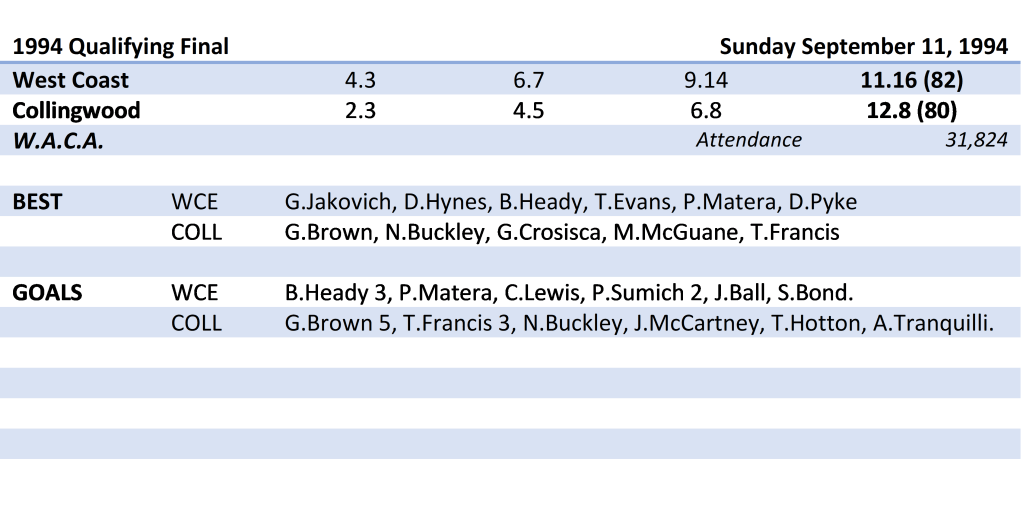
The Eagles survived a Gavin Brown inspired comeback to defeat the Magpies by two points and progress to a home preliminary final.

West Coast weren’t expected to be troubled by the eighth placed Magpies, but scraped over the line when Mick McGuane dropped a chest mark within scoring distance, seconds before the final siren. Trailing by 24 points at the final break, Collingwood surged home with the aid of the Fremantle Doctor, narrowly falling short of a famous finals victory.

The Magpies only booted six goals in the first three quarters, but doubled their tally in the final term with Brown booting three, on his way to a match haul of five.

In a match filled with controversy, umpires twice failed to hear the siren at the ground, allowing play to continue well beyond the signal for the end of the quarter. On both occasions West Coast posted scores with a Don Pyke behind at the end of the second quarter allowed to stand despite the siren blaring for nearly 10 seconds before umpires heard it. Play was also allowed to continue beyond the three-quarter time siren, with Chris Lewis slotting a goal, only for umpires to then correctly annul the score ahead of the fourth quarter.

The errors around the siren almost proved catastrophic in the two point margin.

Despite arriving in Perth off consecutive losses to St Kilda and North Melbourne in the final two rounds of the regular season, the Magpies were confident they could replicate their 37 point victory from when the two sides met earlier in the season.

Surprisingly, the hero of their Round 13 victory, Andrew Tranquilli, was not initially named in the Magpies line-up, with Gary Pert returning to the side after missing the final game with a groin strain. Pert passed a vigorous fitness test to take his place, while Tony Shaw was also included despite concerns over a hamstring strain.

Mark Fraser was included along with Pert, replacing Paul Sharkey and Brett James. However, Tranquilli made his way into the final 21 as one of two late inclusions, with Sharkey reinstated after being dropped. The duo came in on the morning of the game, replacing Tony Woods and Kent Butcher.

The Eagles made two changes to their side named on Thursday night, with Dean Kemp and John Worsfold returning in place of dropped duo Paul Symmons and Drew Banfield. Banfield could consider himself unlucky to lose his spot having played all 22 home and away games, with Mick Malthouse saying team balance was the reason behind his omission.

After releasing their squad, the Eagles were still on tenterhooks until the following afternoon, with five players fronting the tribunal for their roles in the spiteful clash against Footscray the previous weekend. West Coast were able to breathe a sigh of relief when Glen Jakovich, Peter Sumich, Chris Lewis, Tony Evans and Jason Ball were all cleared to play.

Gavin Brown won the toss but gave West Coast first use of the strong afternoon breeze that favoured the end where the WACA’s famous cricket scoreboard sat. The move initially worked with West Coast failing to capitalise early under the pressure of Collingwood’s physical intent.

Even before the opening bounce, the emergency umpire was required on the field to disperse players and Don Pyke sought treatment from the Eagles medical staff after a crunching hit. When the Eagles’ first goal did come, it was via a relayed free kick after Mick McGuane bowled over Chris Mainwaring.

McGuane was doing his best to distract Mainwaring, as one of a number of enterprising moves from Leigh Matthews to stifle the Eagles’ prime movers. Usually playing through the centre, McGuane started on a wing in a defensive role on Mainwaring, while the hard-running Fraser went to the other wing on Matera in an attacking move.

First year forward Trent Hotton was preferred to spearhead Sav Rocca at full-forward, with Jason McCartney lining up at centre half forward on Jakovich. McCartney’s role was purely as a decoy, dragging Jakovich into the deep pockets of the WACA. Nathan Buckley lined up on a half forward flank opposed to McKenna but became the pseudo centre half forward with McCartney pushing wide.

When Tony Francis was released into the Magpies forward 50 to goal on the run, the Magpies had drawn level with West Coast and Brown’s decision at the coin toss was looking a masterstroke. However, the Eagles were able to finish the term with a flurry of goals to take a 12 point lead into quarter time.

Shane Bond ran into an open goal, Peter Sumich kicked his second for the term and after Nathan Buckley launched a long bomb into the wind, Chris Lewis out-bodied Gavin Crosisca to mark and goal to close out the term.

The quarter time break brought further changes for the Magpies. Tony Shaw had lasted less than a minute before the hamstring went, with the former captain resigned to the bench for the rest of the afternoon. Shane Kerrison came onto the ground in his place and was given the task of minding Dean Kemp, while Jon Hassall was sent to Tony Evans, with the Eagles duo running riot in the opening quarter.

The Eagles maintained the status quo for the second term extending their lead by two despite defending against the wind. Jason Ball kicked the opening term after marking a Sumich set shot on the goal line, before Trent Hotton roved a marking contest to keep the Magpies in the game. Brett Heady got out the back to kick the Eagles second for the quarter but the Magpies were able to respond again through Gavin Brown with just 44 seconds remaining in the term.

The first missed siren of the afternoon came at the half-time break, with play allowed to continue deep in the Eagles forward line as the siren wailed in the background. No umpire on the ground heard the siren, with play only coming to a stop when Don Pyke scrounged home a behind. The score stood.

West Coast took complete control in the third term, but it took two magical moments from Peter Matera to get some separation from the Magpies. The Eagles were inaccurate early, kicking four straight behinds with Peter Wilson also sending a shot out on the full. Brett Heady finally found the major opening before Matera put his first stamp on the game.

The Eagles wingman had worked into the game after a slow start opposed to Mark Fraser, picking up nine disposals in the second quarter. After Chris Lewis missed yet another shot on goal, the Magpies clearance from the kick-in only went as far as Jason Ball on the wing. His quick handpass released Matera who sent a long shot on goal from inside the centre square which sailed post high on the wind and lifted the mood of an anxious home crowd.

Tony Francis got an immediate response after receiving a free kick at the next centre bounce and then a 50m penalty paid against Jakovich. Unable to get into the game in the first half, Jakovich was swung forward during the third term but he was forced back to the backline just minutes later when Ashley McIntosh went down with a hamstring injury.

Collingwood grimly hung on in defence for the rest of the term, with Damien Monkhorst providing extra support sitting in the Eagles forward 50. In the final minute, Matera provided his second highlight of the term.

Gathering a loose ball on the wing, Matera went on a jinking run, weaving his way past several Collingwood opponents before finishing from 40m on the run. Umpires again failed to hear the siren when it called for three quarter time, with Chris Lewis kicking truly from the pocket. Originally given a goal, the decision was overturned by the non-officiating umpire in the middle of the ground who had heard the siren ring before Lewis got boot to ball.

Peter Matera was electric in the third term

West Coast managed 3.7 for the quarter and for all of their dominance, the 24 point three quarter left Collingwood in the game, with the advantage of the Fremantle Doctor in the final term.

And the Magpies wasted no time to get themselves back into the game with three quick goals to start the final quarter. The Collingwood skipper had moved to the goal square, with McKenna as his new opponent, kick-starting his side with the opening goal. Tony Francis booted his third for the game after Mainwaring is captured in the Magpies forward line, with Brown then kicking his second for the term after a relayed free kick was paid against Peter Matera.

After being caught holding the ball in the middle of the ground by Mark Fraser, Matera – incensed by the umpires decision – flatted Tony Francis well after he disposed of the ball, injuring his back in the process. Brown reduced the margin to just seven points, while Matera hobbled off the ground, joining McIntosh in taking no further part in the game.

Chris Lewis provided a settler to take the Eagles lead back out to 13 points, but two errors in as many minutes from the normally unflappable McKenna had Collingwood within a point of the lead. Failing to get the ball over the boundary line on the half back line, McKenna gave up possession of the ball to Brown with a chain of handballs ending with Tranquilli who slotted home on the run from the pocket.

From the Magpies’ next forward entry, McKenna again had the ball and looking to rush through a behind, sent the ball out of bounds alongside the behind post. The defender was pinned for deliberate out of bounds and Brown was able to snap home his fifth goal of the match from the resultant free kick.

The Magpies had cut the Eagles lead to just one point with still eight minutes to play, but the Eagles defence held strong against the wind. David Hynes was standing tall in his battle with Damien Monkhorst and with the clock continuing to count down, released the Eagles with a 30m spike from a ball up on the wing.

Chris Lewis pounced on the loose ball across half forward and after an exchange with Peter Wilson, sent a scrubby ball towards the top of the goal square. Collingwood defender Craig Kelly couldn’t hold onto the mark, allowing Brett Heady to swoop and run into an open goal. With under two minutes remaining, the Eagles lead was eight points, but there was still plenty to play out.

Jason McCartney had the Magpies back within two after being set free through the middle of the ground and with only seconds on the clock, Collingwood had one final thrust forward.

Jon Hassall won a free kick on the wing and released Gary Pert with a handball, with the defenders long kick floating towards half-forward. Mick McGuane found himself best placed, but spilled the mark allowing West Coast to hold on.

After the match, Malthouse praised the spirit of his players in fighting the game to the end. “It was a great win for us. But we knew Collingwood were always going to tough it out. You don’t expect any different from Collingwood.”

Malthouse refused to accept that the distraction of the tribunal in the lead up to the game had had any impact, instead expressing disappointment over a number of ‘easy’ goals that kept Collingwood in the game.

Magpies coach Leigh Matthews was equally full of praise for his side, declaring that the brace of goals from Matera in the third term was the difference in the game. “I would go as far to say that is what beat us.”

“A couple of goals that come from just a pure, sensational one-off. A bloke grabs the ball from midfield and says ‘don’t worry about anyone else, I’m going to finish’, Matthews exclaimed.

“We got beaten by maybe just those two fantastic individual efforts by him at that point… I thought for the rest of it, we hung in there fairly well.”

The thrilling finish capped off an incredible weekend of results in the AFL’s first instalment of the top eight system. The Cats made it through their qualifying final against the Dogs courtesy of a Billy Brownless goal after the siren. Geelong got the blistering start with an eight goal opening quarter, but the Dogs clawed their way back into the game to trail by just two points at the final change.

In a see-sawing last term, Footscray appeared to be home when Simon Atkins put them in front with just 24 seconds remaining, but a Geelong clearance from the next centre bounce landed in the lap of Brownless. Brownless coolly finished to get the Cats over the line.

Earlier that day, North Melbourne and Hawthorn played the first ever final that required extra time, when the two sides were locked at 91 points apiece. The Kangaroos dominated the extra time period, kicking 3.5 to 0.0 in the additional playing time, with Wayne Carey guiding his team to victory.

The narrow defeat was exacerbated 24 hours later for the Hawks when seventh placed Melbourne upset the second placed Blues. After an even first half, the Demons exposed Carlton’s lack of pace to run away with a 27 point win and keep their finals hopes alive, when defeat would have ended their season.

That meant the sixth placed Hawks joined Collingwood on the scrapheap for 1994 and also saw North Melbourne join the Eagles with direct entry to the preliminary final.

Malthouse admitted the week off would be beneficial for the Eagles, with injury concerns over Ashley McIntosh and Peter Matera. West Coast would wait on the winner of the Melbourne/Footscray clash, but doubt remained over where the game would be held, with many Victorian based identities adamant that the MCG should host both preliminary finals to satisfy the AFL’s agreement with the MCC.

1994 Rewind: Scarves & Swamps

West Coast retained their premiership favouritism and Eagles fans got to exact their revenge but the biggest talking point after West Coast’s 36 point win over Essendon was the dilapidated surface of Subiaco Oval.

With Perth in the midst of an uncharacteristic wet spell, Subiaco Oval resembled more of a muddy swamp than its customary fast-track, drawing the ire of Eagles coach Mick Malthouse.

The Eagles coach seemed more interested in savaging the state of the surface than discussing his side’s committed win over the reigning premiers. With one side of the stadium torn down ahead of the building of the new southern stand, Malthouse was sceptical over whether there had been appropriate care towards maintenance of the playing arena, with drainage around the ground, virtually non-existent.

Malthouse extended his criticism towards the WAFC in the hope that improvements would be made before the end of the season.

And when the Eagles coach did talk about his side’s performance, he remained stoically understated.

The game appeared done at quarter time with the Eagles jumping the Bombers booting five goals to one. Any chance of Essendon staging a comeback was extinguished at the start of the second term when driving rain descended the game into a quagmire.

By three-quarter time, West Coast had extended their lead to 45 points, before the two teams combined for 1.9 in the last quarter, with the two teams out on their legs in the heavy conditions.

The win kept West Coast at the top of the ladder a game ahead of the Blues, with Malthouse acknowledging that a win over the 1993 premiers gave a good indication of where the Eagles sat. “I believed if you want to assess yourself you have to do it against the previous year’s premiership side. Last year everyone wanted to have a crack at us to see where they sat.”

“I think after the halfway mark if you are on top, you should really aspire to stay there. It is tough enough to get there and its going to be tough to stay there”, Malthouse said.

More pleasing for Malthouse was the successful return of Peter Sumich, who made it through four quarters, despite having little impact. Sumich was held scoreless from three kicks but there was relief after the game that the full-forward had managed to get through his first full game in over three months. “Peter did everything we wanted from him today,” Malthouse said.

Sumich was one of two inclusions, with Eagles captain John Worsfold finally making it to his 150th game after missing two of the previous three games. Sumich replaced David Hynes at full forward, while Shane Bond was the other exclusion through injury. Brett Spinks became the third out for the Eagles on game day, after being under an injury cloud all week, with Tony Godden coming in for his first game since Round 10.

The Bombers dropped Glenn Kilpatrick and Robert Stevenson, while their hero from the Round 1 win over West Coast, Che Cockatoo-Collins, couldn’t be considered after he dislocated a finger. Captain Mark Thompson was then a fourth change for the Bombers, when he was withdrawn on the morning of the game through illness.

David Grenvold replaced Thompson, with Anthony Daniher, Lachlan Ross and Russell Williams the other inclusions. The Bombers had been hopeful of bringing back a number of premiership stars for the trip West, but the likes of Mark Mercuri (groin), Dean Wallis (achilles), Rick Olarenshaw (back) and David Flood (hamstring) remained sidelined.

Dustin Fletcher, Michael Long and Mark Harvey were three more premiership players missing from the Essendon line-up, a fact that Malthouse was willing to present. “Essendon had three or four key players out of the side so we don’t want to get carried away with the victory.”

The make-up of the Bombers side would not have mattered to Eagles fans, who got their right of reply to Kevin Sheedy’s antics 12 months earlier. In the corresponding game of 1993, Sheedy emerged from the coaches box waving his jacket above his head after Paul Salmon had snatched a two point win over the Eagles in the final minute of the game.

The Eagles had lost the two meetings since that game – the semi final of 1993 and then the opening round of 1994, both of which had been played in Melbourne – but as Kevin Sheedy walked the muddy boundary line towards the Bombers race, he was met with the mass celebration of scarves and jackets twirling above the heads of the jubliant Eagles crowd. The Essendon coach could do no more, than acknowledge the gesture with a wry smile and a nod of the head.

The Essendon coach is met with flying scarves after the Eagles 36 point win

If Sumich lasting 100 minutes was one feel good factor from the day, the other pleasing performance for the Eagles match committee would have been that of Craig Turley. After returning to the club following his retirement during the 1993 season, Turley’s form had been rather indifferent as he struggled to recapture the form that made him one of the premier midfielders of the preceding two seasons.

But against the Bombers, Turley bobbed up with three crucial goals from 12 disposals across half-forward as he appeared to revel in the tough, slippery conditions. Turley was also handed the task of stopping Essendon playmaker Gary O’Donnell, with the stand-in captain restricted to just 11 possessions, and a couple of stints on the bench.

The Eagles wingmen were again the standouts, with Chris Mainwaring leading the way with 27 disposals, while Peter Matera finished with 24 touches and five shots on goal, booting 2.3. Mainwaring benefitted from being matched against Darren Bewick, who had been moved to a wing to avoid the tag of David Hart. Bewick had enough of the ball (finishing with 18 possessions) but was nowhere near as damaging as the blonde Eagle, who continually linked the ball from defence to the forward line.

Glen Jakovich was again the rock in defence, picking up 22 disposals in his absorbing battles with James Hird. Hird often drifted up to the wing, but Jakovich remained in the Eagles defensive 50, often setting up as the Eagles seventh defender. Steven Alessio was sent to centre half forward to create a match-up with Jakovich, but Jason Ball was sent to defence, allowing Jakovich to pick off Essendon’s forward entries, many off Hird himself.

Ryan Turnbull also enjoyed plenty of freedom around the ground and had an important influence on the contest, particularly early in the game. With Paul Salmon often dropping a kick a behind the play after contesting the ruck, Turnbull positioned himself through the middle of the ground, drifting forward twice in the opening term to boot goals.

Peter Wilson picked up 22 disposals around the ground and Dean Kemp had 20 through the centre, although he lowered his colours slightly to Joe Misiti who finished with 25 disposals.

James Hird was the next best for Essendon, after Misiti, with 24 disposals and seven marks, while Sean Denham had 21. Gavin Wanganeed was switched forward after half-time and gathered 19 disposals, but the Bombers lacked few options forward of centre. Third-gamer Scott Cummings was the only winner in the Essendon forward line, booting three of the Bombers’ five goals for the game.

Sheedy was left to lament a poor attitude from his side in the opening quarter, which ultimately decided the game. “We were very undisciplined in the first quarter. It cost us dearly.”

One such incident involved Gary O’Donnell choosing to wrestle with Eagles captain John Worsfold, rather than contest a loose ball, which allowed Turley to stroll in and boot one of his three goals.  

While declaring that ‘the Eagles were looking pretty good’, Sheedy admitted that his side would have a battle to make finals, after they dropped to seventh on the ladder, amongst a strong group of teams vying for the lower spots in the top eight.

Richmond climbed to sixth on the ladder when they recorded a narrow three point win over Footscray, in what was a virtual eight-point clash. The Bulldogs dropped out of the top eight as a result, replaced by Geelong who, off the back of 10 goals from Gary Ablett, defeated Melbourne by 30 points.

At the pointy end of the table, Carlton and Hawthorn both recorded ten goal wins over Adelaide and St Kilda, respectively, to maintain their chase of West Coast. Collingwood moved into the top four after they beat Fitzroy by 49 points at the Western Oval, moving past North Melbourne who had the bye.