2011 Rewind: Eagles Try, Magpies Fly

Class and Experience Sees Collingwood Home

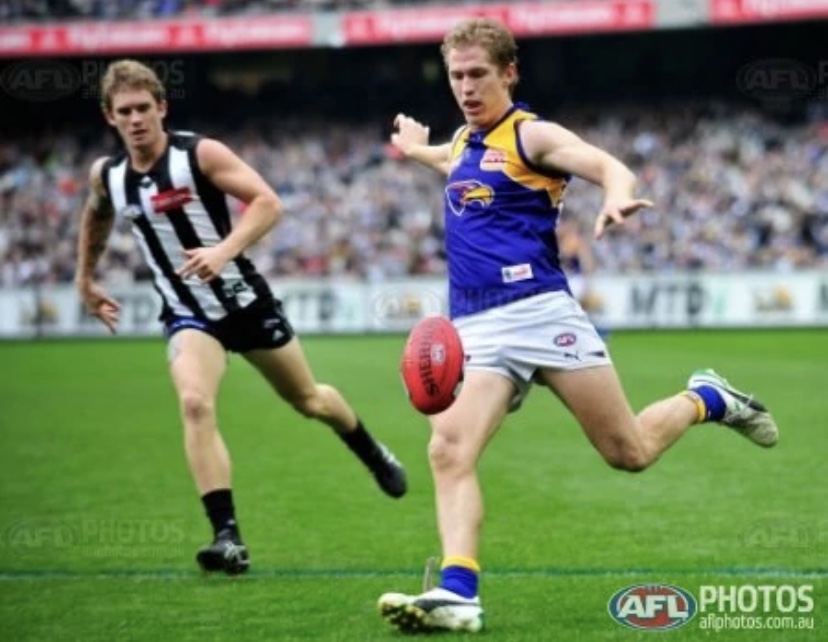
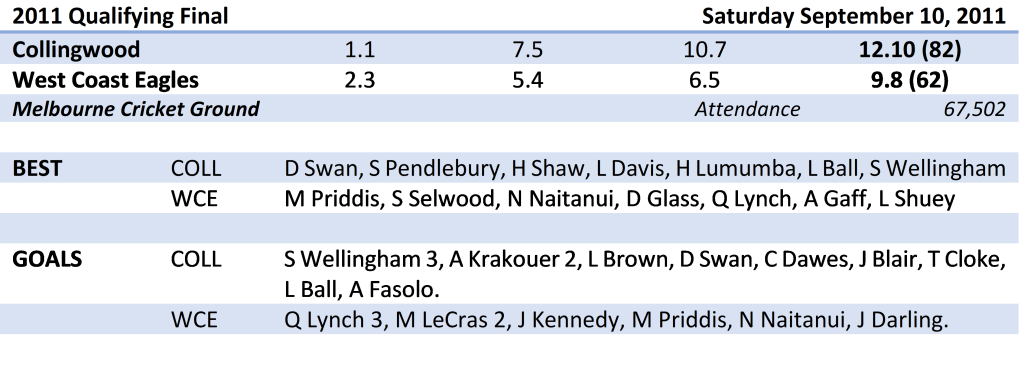
West Coast gave their all but lacked the extra edge, poise and finish needed to book a preliminary final birth in a 20-point defeat to Collingwood.

The Eagles were never out of the game, but never looked completely in the game in what Eagles coach John Worsfold called a ‘learning experience’.

Ten Eagles were taking part in their first final as opposed to the Magpies who had 18 of their premiership stars from the previous years triumph.

Luke Shuey best exemplified the step up needed in finals when he was caught with the ball three times in the opening half, as the experienced Magpies pressured the young Eagles into numerous skill errors and wasted opportunities.

Shuey had finished runner up in the rising star award to Essendon’s Dyson Heppell in what turned out to be a two-horse race earlier in the week, and for much of the first half seemed overwhelmed by the play around him. However, he improved as the game went on and was one of the Eagles’ best.

But while Shuey led an Eagles midfield that applied themselves to the final siren, they were outshone by Dane Swan and Scott Pendlebury who led a masterclass.

Swan, who was considered one of the favourites for the Brownlow medal, collected 43 disposals, including nine clearances, nine inside-50s and a goal. Pendlebury was the perfect sidekick, with 38 touches, seven inside-50s and five clearances. The duo worked off each other perfectly, with Pendlebury picking up 25 of his 38 possessions in the first half, before Swan carried the side home with 27 disposals after half time.

The two teams named near full-strength sides ahead of the game, with the Eagles selecting Daniel Kerr and Will Schofield to return from injury, while the Magpies welcomed back Nick Maxwell, Leon Davis and Heath Shaw.

The teams may have looked strong on paper, but there was still plenty of doubt for the two sides going into the game. Chris Tarrant, Travis Cloke and Ben Johnson had all finished with issues from the thrashing to Geelong and Daniel Kerr was still under a serious cloud for the Eagles.

The doubts on Kerr would be confirmed when he was a late withdrawal ahead of the opening bounce. Patrick McGinnity, who had lost his place at selection, was reinstated. Collingwood were also forced into a late change when Ben Reid injured a groin at the final training session of the week. With patchy weather expected, the Magpies replaced a tall with a small in rookie forward Alex Fasolo.

The visitors came into the match as major underdogs but they started the better of the two sides with the first four scoring shots of the game. Josh Kennedy and Quinten Lynch both kicked majors as West Coast established an early 2.2 to zero lead.

Nic Naitanui and Dean Cox presented as the biggest challenge for Collingwood and while they claimed an advantage in the ruck knocks, the Magpie midfield soon got the upper hand at the stoppages.

Sharrod Wellingham opened the Magpie account to reduce the Eagles lead to eight points at quarter time, before Collingwood turned the game their way in the second term.

The Magpies booted six goals for the quarter as Pendlebury, Swan, Jarryd Blair, Leon Davis and Ben Johnson kick-started the black-and-whites. Davis and Johnson were particularly damaging out of the back half, along with Heritier Lumumba, as they carved and weaved their way through the Eagles press.
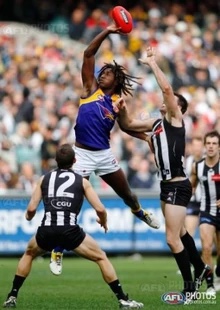
Naitanui was dominant at the ruck knocks for West Coast but the Eagles couldn’t get the upper hand at the stoppages

Leading by 13 points at the main change, the Magpies extended their lead to 26 after goals to Jarryd Blair and Andrew Krakouer. That remained the margin at three-quarter time after Mark LeCras and Travis Cloke traded goals heading into time-on and Collingwood appeared to have done what they needed to, to put the finals upstarts away.

West Coast, though, refused to accept what most others expected.

Even with Cox subbed out during the third term with back spasms, the Eagles found their ascendancy in the middle off the back of Naitanui as the Eagles found consistent forward position for the first time in the match since the opening term.

Quinten Lynch got the Eagles rolling after just 38 seconds when West Coast won the opening centre clearance, before adding a second for the quarter (and third for the match) when he took clean possession from a boundary throw in and snapped truly.

The Eagles continued to push and Jack Darling’s goal at the beginning of time-on had West Coast within seven points and a grandstand finish was on the cards. But Collingwood’s class and experience again came to the fore and they settled in the final minutes to earn the coveted week off.

Worsfold was proud of the commitment of his players but acknowledged the difference between a seasoned opponent and where his young Eagles had come from. Simple misses by Shuey and Scott Selwood as West Coast had all the momentum in the final quarter would prove costly.

“It felt like we were just a little bit short of the class of Collingwood, not the effort but the class. I think we matched them for intensity and effort, but they showed the way with clean ball handling, clean ball use.”

“We just made some errors at times that might have got us more inside 50s, more scoring opportunities and we didn’t quite capitalise”, Worsfold said.

The key to the game lay in the middle of the ground where the Magpies were able to control the stoppages despite Naitanui and Cox’ tap ascendancy. The Eagles eclipsed their opponents 50-29 in the hit-outs, but Collingwood turned the tables at the stoppages, winning the clearances 53-31.

Luke Ball nullified Priddis’ influence at the first possession, limiting Priddis to just four for the match. Nic Naitanui and Luke Shuey combined for 14 clearances – half of the Eagles’ total – but too much was left to too few at the inside-ball contest, where Collingwood had a greater spread of contributors.
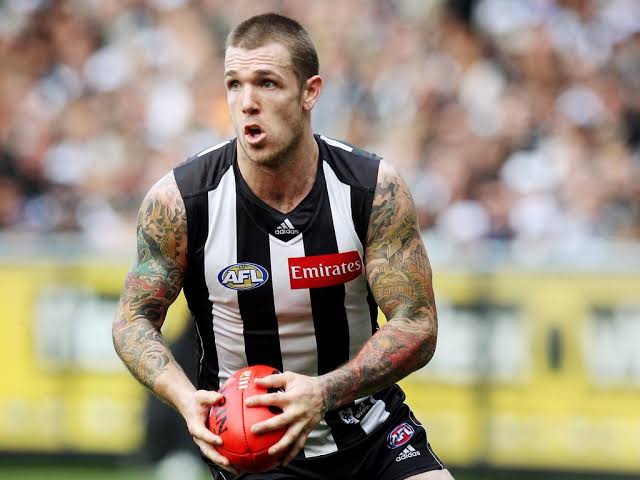
Dane Swan was dominant in the Collingwood midfield with 43 disposals

That prevented the Eagles from getting forward and setting up their defensive press, leaving much of their attack to come from the back half of the ground.

Collingwood coach Mick Malthouse lauded his side’s ability to claim a decisive win in the Eagles strongest part of the ground. “They are very, very good at stoppage work and we knew we wouldn’t be in the plus as far as hit-outs go.”

“We needed a contest. We got a contest… we won quite convincingly on these figures… which is a credit to the boys.”

That forced the Eagle tall forwards to work further up the ground, where Kennedy and Darling struggled to have an influence. The pair kicked the Eagles’ first and last goals in the game, but did little for the rest of the game as they were well contained by Chris Tarrant and Alan Toovey.

And where the Eagles were unable to counter from defence, the Magpies were able to bounce from half back, with a number of the Magpie defenders racking up high possession numbers. Leon Davis finished with 33 disposals, Heritier Lumumba and Heath Shaw each had 30 and Ben Johnson collected 26.

Their performances were even more meritorious considering the disrupted preparations for many of them. Davis and Maxwell had missed the defeat to Geelong, Tarrant and Johnson had queries over their fitness and Shaw was playing his first game after serving an eight week ban for betting on AFL matches during the season.

Up forward, it was the smalls who did the damage, with Sharrod Wellingham booting three first half goals and Andrew Krakouer the other multiple goal scorer for the Magpies. Travis Cloke and Chris Dawes were both defeated in their battles against Eric Mackenzie and Darren Glass.

Priddis led the Eagles with 24 disposals, while laying 13 tackles, with Chris Masten (22 disposals, seven tackles) and Scott Selwood (21 disposals, eight tackles) the next best. West Coast laid 100 tackles for the game which both symbolised their ability to meet Collingwood’s attack at the contest, but also that the Magpies players were often a step ahead in the contest.

The two coaches noted the pressure in the game, with Worsfold calling it a ‘pretty intense game’.

“A lot of pressure and we didn’t cope with the pressure as well as we believe that we can. Our players will learn from that.”

Collingwood were joined in the preliminary finals by Geelong, who overcame an early slow start to account for the Hawks. Hawthorn paid for their early inaccuracy when they had the game on their terms, with the Cats systematically working their way towards a 31 point victory in the final three quarters.

Hawthorn were due to meet Sydney in the second week of the finals after they provided the upset of the weekend. The Swans got an early jump on the Saints before St Kilda pegged them back to trail by eight points at the final change. However, four goals to one in the final term saw the grand finalists of the past two seasons out in the first week of finals, following an inconsistent season.

West Coast were due to play Carlton in their knockout semi-final, setting up a mouth-watering clash against their former premiership captain in Chris Judd. In front of over 90,000 fans crammed into the MCG, the Bombers were no match for the Blues who steamrolled their way to a 62 point win.
Eagles Fall Short Against Benchmark

Magpie Magic the Difference

After an encouraging start to the season, West Coast tested themselves up against the best of the competition – and found they still had a way to go as Collingwood cruised to a 52 point win.

West Coast matched the reigning premiers at the stoppages and had just two less inside-50s, but the Magpies’ superior class and ability to produce magical moments showed the gulf in the two sides.

Dale Thomas was the standout on the ground, producing a mark-of-the-year and goal-of-the-year contender to go with 30 disposals and two goals. Thomas worked all over the ground, pushing back in defence with six rebound 50s while also floating forward to hit the scoreboard.

Collingwood coach Mick Malthouse praised the performance of Thomas after the win, as well as Leon Davis who finished with 25 disposals and seven rebounds. Few sides have been able to break the Eagles forward press in 2011, but the Magpies were able to burst through with speed, through the likes of Thomas, Davis, Heritier Lumumba and Heath Shaw.

Malthouse was full of admiration for West Coast in the lead up to the match for their rapid improvement on 2010, but after the win proudly acknowledged his side’s ability to eliminate the strengths of the new Eagles.

“When you analyse their contested ball, they hadn’t been beaten I don’t think this year. Their first quarters (travelling interstate), they’ve always won them.”

“We took both of those away from today, which is good.”

Much had been made about a host of Collingwood players in the lead up to the match with Davis one of a number of Magpies under a cloud. Dane Swan and Leigh Brown were limited to walking laps for much of the week, while Davis and Heath Shaw were both rumoured to miss.

However, all four lined up with the only change for Collingwood being Alan Toovey replacing Tyson Goldsack in defence.

West Coast also made the one change with Brad Sheppard called up to replace Sam Butler who suffered a thigh injury during training.

The Eagles couldn’t have asked for a better start with Josh Kennedy outmarked Chris Tarrant and slotted the opening goal after just 27 seconds. But Collingwood made the most of their chances through some remarkable individual efforts.

Steele Sidebottom rolled Collingwood’s first from the boundary line, Thomas hacked the ball out of mid-air for the Magpies’ second before Alan Didak swivelled through four Eagles for three in a row. Scott Pendlebury added a fourth to have the Magpies out to a 19 point lead at quarter time.

The Eagles had their best period of the match in the second term, but the Magpie defence held firm with Daniel Kerr adding the only goal for West Coast in the quarter. The deficit had been reduced to 10 points midway through the term before a quickfire three-goal burst to the Magpies extended their lead to 27 at the major break.

Adam Selwood was one of the best for West Coast

Collingwood continued to stretch their lead through the second half, taking their advantage out to beyond ten goals during the last term, before West Coast booted three of the final four goals in the match to add some respectability.  

Despite the poor showing against the competition benchmark, Worsfold remained upbeat after the match, keeping to the tune that the season was all about improvement.

“The margin is disappointing but the effort and matching Collingwood in certain areas shows that we are bridging the gap between the absolute best in the competition and where we’re at.”

Worsfold also boldly declared he was keen to coach on beyond this season when his current deal is set to expire. Having survived calls to be sacked over the preceding 18 months, Worsfold said he was as eager as ever to continue coaching, buoyed by the sharp improvement the club had seen across the opening ten rounds of the season.

“If we hadn’t shown any improvement, I would be guiding this team along and getting them as well prepared as I could for someone to take over.”

“Where I’m at is, when this season finishes, I’d love to sit down with our management and our board and find out the direction that, one, the club wants to go and, two, my direction.”

“If they match up and we’re all happy, then I’d expect to push forward with it.”

Matt Priddis was industrious as ever with 32 disposals and eight clearances, with Adam Selwood (27 disposals) and Daniel Kerr (24) the next best for West Coast. Josh Kennedy was the only clear winner up forward with three goals opposed to Chris Tarrant while Dean Cox and Nic Naitanui again were supreme in the ruck.

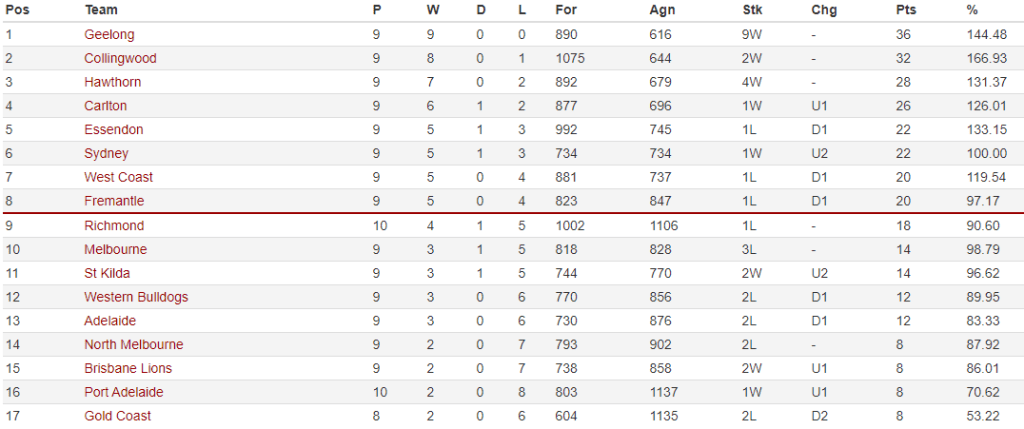
The Magpies held 2nd spot on the ladder with the win, with Geelong remaining undefeated after they easily accounted for former champion Gary Ablett’s Gold Coast side. The Eagles dropped to back to seventh on the ladder, with the Dockers falling to eighth after they lost their third match in four weeks, thrashed by St Kilda.

Sydney moved past both WA sides when they scraped past a horribly inaccurate Kangaroos side by one point. Hawthorn and Carlton both recorded simple wins over the Western Bulldogs and Melbourne to shore up their places in the top four, while Essendon sat fifth with the bye.

Richmond missed out on a chance to move into the top eight past the Eagles and Dockers when they fell to bottom-placed Port Adelaide by 15 points. That saw the Power jump out of last and coupled with Brisbane’s surprise 40 point win over the Crows, the Suns were relegated to the foot of the table.

While West Coast didn’t get the result, there was a noticeable name in the 25-man squad. Jacob Brennan was listed as an emergency, moving one step closer to becoming the first son of a former player to play for the Eagles.

Brennan was the final choice for West Coast at the 2010 National Draft, selected in the footsteps of father Michael who played 179 games with the club. Jacob’s selection in the Eagles squad was interesting timing after Trevor Nisbett earlier in the week professed frustration over the limitations of the current father-son eligibility that had cost the Eagles the chance at selecting several under-18 WA players in recent drafts.

Brandon Matera and Alex Rance had both been selected by other clubs, while promising defender Jordan Lockyer was another who the Eagles wouldn’t have first crack at due to the restrictive father-son rules imposed on the two WA clubs.

Under current rules, former players must have either played 100 AFL games with the Eagles or 150 WAFL games prior to the Eagles formation in 1986, to qualify as father-son selections. Nisbett had lobbied to the AFL that inaugural squad members should automatically be eligible for the father-son rule, claiming that many of the players selected in 1986 were older-aged recruits who would never have been able to meet either of the playing parameters.

As such, West Coast could have had first option at Brandon Matera (son of Wally) and Jordan Lockyer (son of Andrew). Nisbett’s suggestion was subsequently rejected by the AFL, leading the Eagles CEO to lament West Coast had missed out on a generation of father-son players.

1990 Rewind: Eagles Caught On The Hop

MCG Woes Return

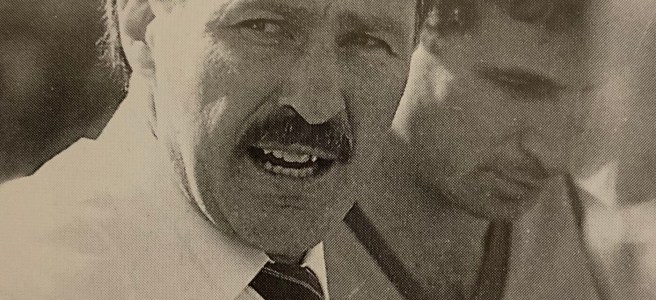
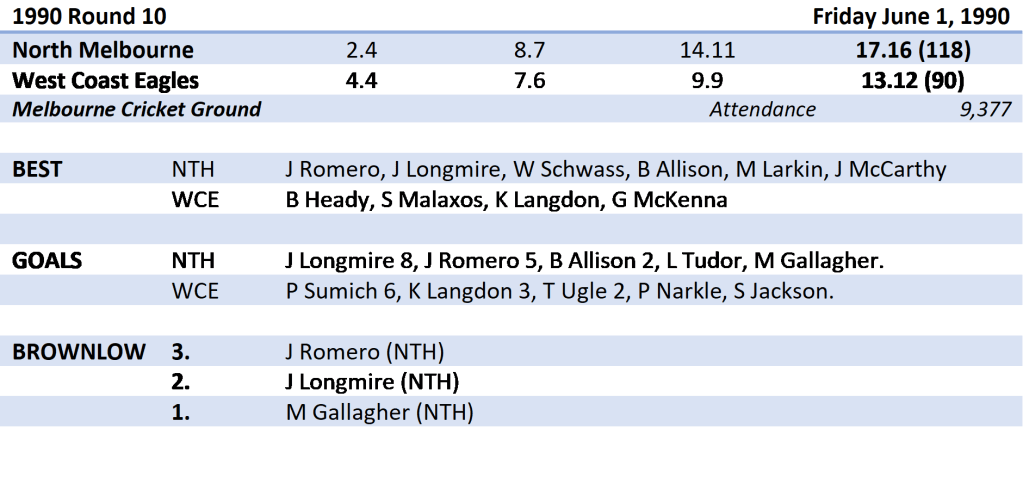
West Coast Eagles coach Mick Malthouse blasted his players ‘very soft’ performance, when they succumbed to a 28 point loss to North Melbourne at the MCG.

Sitting equal top, the Eagles had entered the match as hot favourites against a Kangaroos side who were on a six game losing streak, without a win since round 3.  

Malthouse had warned his players not to take the stumbling Kangaroos lightly, and it seemed the Eagles players had heeded their coach’s instructions when they booted the opening four goals of the game. But from there North Melbourne owned the contest and the ball, edging their way to the lead by half-time and then pulling away through the second half.

“We were second to the ball, did not run and allowed North Melbourne to dictate terms totally”, a furious Malthouse said after the game. “We are very soft.”

“Unfortunately, this seems to be the norm when we are beaten.”

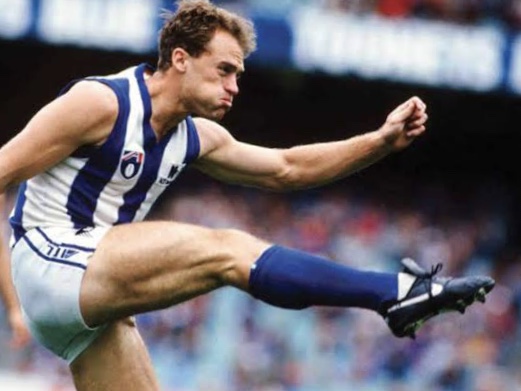
North Melbourne full forward John Longmire booted eight goals in the win, matching his effort from nine days earlier when he led New South Wales to one of the great upsets in Australian football, over the powerhouse Victorian side in the state-of-origin.

Longmire had four goals by midway through the second term, forcing Malthouse to shift Murray Rance to full back, in place of Michael Brennan, but Longmire remained a strong focal point for the Kangaroos up forward. Jose Romero provided the supporting act, kicking five goals from 26 disposals in a clear best on ground display.

Tagger Dwayne Lamb would have been assigned with the job of minding Romero, but was one of three players unavailable for the Eagles, following their win in the heavy slog conditions over Geelong just five days earlier.

Lamb was ruled out with a calf complaint, while Peter Wilson was unavailable after straining a hamstring the week before. John Worsfold would then be a late withdrawal ahead of the bounce, with Don Pyke, Dean Turner and Troy Ugle the three inclusions.

North Melbourne made a staggering seven changes to the side that was comprehensively thrashed by Collingwood to the tune of 80 points. Alastair Clarkson was ruled out with concussion, while Ross Smith, Peter German, Ian Fairley, Donald McDonald, Anthony Stevens and Warwick Angus were all dropped.

Kangaroos coach Wayne Schimmelbusch turned to youth, bringing in Liam Pickering, Leigh Tudor, Craig Sholl, Shaun Smith and Mark Brayshaw. Ruckman Michael Gallagher was selected for his first game with the club after switching from Carlton in the off-season, while ‘veteran’ Matthew Larkin was also brought into the side.

Such was the youth of the Kangaroos, Larkin was the only player in the side with more than 60 games experience, while nine players had played less than 20.

John Longmire proved too good for both Michael Brennan and Murray Rance, on his way to a match haul of eight goals.

The Eagles started strongly with John Annear and Scott Watters providing plenty of drive through the middle. Karl Langdon provided the target up forward, booting two goals for the term as West Coast raced to a 22 point lead.

However North Melbourne kicked the final two goals of the quarter to reduce the Eagles advantage to 12 points, before taking control after quarter time.

Wayne Schwass and Matthew Larkin imprinted themselves into the game, John McCarthy closed down the dangerous Langdon and the ruck pairing of Mark Hepburn and Gallagher got on top of Phil Scott.

With the game delicately poised at half-time, Jose Romero stepped up. Romero gathered the ball at will around the ground and also hit the scoreboard, with the Eagles unable to find a match-up to quell his influence.

Conversely, the Eagles lacked any substantial contributors through the middle.

Peter Matera struggled to find the ball, Annear faded out of the game and Dean Turner could neither find the ball, nor limit Larkin in a defensive role.

In fact, only a handful of Eagles gave a solid showing.

In just his seventh AFL game, Brett Heady showed he had all the makings of an impressive career, picking up 28 disposals and taking 13 marks playing predominantly through the middle. Malaxos finished with 23 touches through the centre and Chris Mainwaring tried to bring run to the Eagles game on the wing.

Peter Sumich finished with six goals, but many came towards the end of the match when the result was already safely in the Kangaroos keeping.

The defeat, along with several other key results over the weekend meant that four teams shared equal spot at the close of Round 10. With Collingwood easily defeating league-leaders Melbourne by 52 points and Essendon thrashing Sydney by 15 goals, the Demons, Eagles, Magpies and Bombers were all equal on points.

Essendon moved to top spot, and premiership favouritism, with their thumping win over the Swans putting them 10 percent clear. Melbourne sat second, ahead of West Coast and Collingwood, with just 3.3% separating the three sides.

St Kilda completed the top five after they beat a terrible Brisbane outfit by 77 points, with Stewart Loewe kicking six goals. The Saints had opened up a 73 point lead by half-time, before coasting through the second half to record their largest win since an 89 point triumph over Richmond in 1972.  

The Saints took their position at the expense of Hawthorn, after they suffered a shock 14 point loss to Fitzroy at Princes Park. Carlton also missed a chance to climb the ladder when they lost to lowly Richmond by 23 points at the MCG, in David Cloke’s 300th AFL game.

Geelong arrested their slide when they came out on top by two points over Footscray. With Gary Ablett back in the side, the Cats bounced to a five goal lead at the first change, courtesy of four first-quarter goals to Ablett. Slowly, the Bulldogs worked their way back into the game and by midway through the third term, had opened up a 17 point lead. However, the Cats found something extra to will themselves back into the lead and end a three-game losing streak.  

As the battle for the finals, and specifically the double chance, tightened up, Malthouse forecast that the result could prove costly.

“At the end of round 22, they (the players), may rue the night they gave up the opportunity against North Melbourne.”

MCG Demons Return

Melbourne Claim Points in Top-of-the-Table Fizzer

A week can be a long time in football.

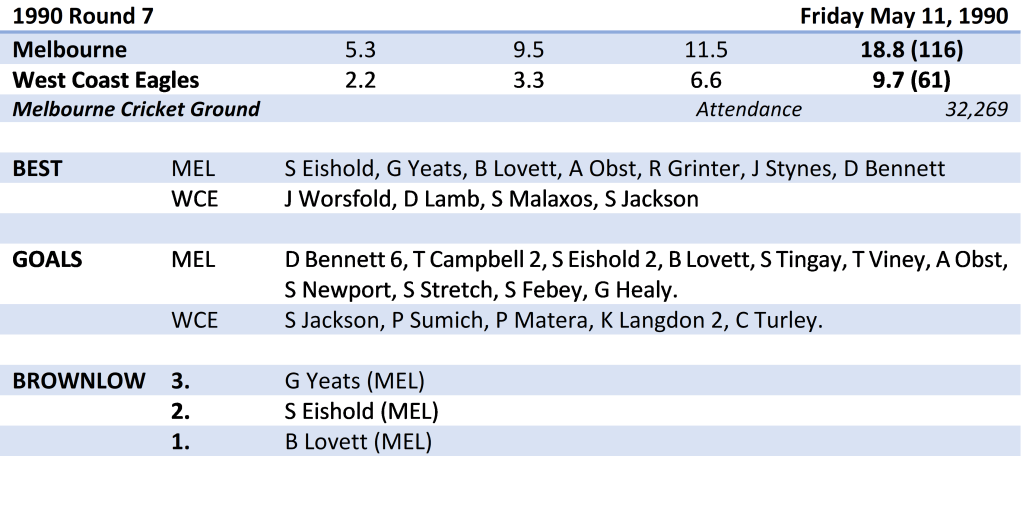
Seven days on from their breakthrough first win at the MCG, the Eagles horror record at the ground was once again at the forefront when they were humbled by the Demons to the tune of 55 points.

The Eagles and Demons headed into their round seven meeting occupying the top two spots on the ladder, with 5-1 records, but the top-of-the-table clash proved a non-event as Melbourne ran away with the game in the first half.

The Demons opened up a three goal break at the first change and were never seriously troubled, finishing with a seven goal final quarter to blow out the margin, and regain their spot at the top of the table.

And there was plenty of insult to injury.

Inaugural Eagle Darren Bennett – who was let go by the club after just one season – did the damage up forward for Melbourne, booting six goals, while West Coast were also left reeling after Dean Laidley was carted off the ground in the second quarter with a knee injury that would rule the half-back flanker out for the rest of the season.

Laidley would be one of three players who would fall victim to a serious knee injury at the MCG in Round 7. North Melbourne pair Brenton Harris (playing in the reserves) and Darren Steele both went down the following day, as criticism over the state of the MCG playing surface grew.

Both Melbourne and West Coast had aired concerns over before the match, with the Eagles declaring they were lucky not to incur any injuries the week before against Richmond. Demons coach John Northey was particularly vocal about the dangers, but AFL communications manager Tony Peek played down the comments.

“We will be keeping a close watch on the situation”, Peek said.

Peek would come to rue those words, with three serious injuries in less than 24 hours. Footscray and North Melbourne joined the chorus of voices demanding action over the state of the ground, with recent attempts to fill holes in the ground with sand failing to deliver any improvement.

Following the Eagles’ defeat, Malthouse wouldn’t be drawn on the playing field, but expressed disappointment over losing Laidley. “It did not look good.”

Malthouse also delivered a blunt analysis of his team’s showing.

“We made far too many mistakes.”

“I thought we could do better and it was a learning curve for all concerned”, Malthouse continued. “We will make adjustments and be a better side.”

The Eagles made two changes coming into the match, with Troy Ugle and wingman Chris Mainwaring both dropped. Mainwaring had struggled in his two games since returning from a back injury, but was still a surprise omission, marking the first time in his 63-game career he had lost his position.

First-year player Peter Matera was chosen for his second game to replace Mainwaring, with Geoff Miles the other inclusion. Miles had failed to play so far this season as he recovered from a hamstring injury, named at full back.

The Demons also made two changes, as they battled somewhat of an injury crisis. Already without Steven Clark and Trevor Spencer for the season, Melbourne lost defender Sean Wight the week before with a knee injury suffered while playing for the reserves and veteran Alan Johnson was unable to prove his fitness in his effort to come back from a calf injury.

The Demons also lost Brian Wilson to a broken cheekbone during the loss to Sydney the week before, with Wilson ruled out, along with Jay Viney who was dropped. Rod Grinter and Glenn Lovett were the two inclusions.

The Eagles started brightly enough with goals to Peter Sumich and Stevan Jackson early in the first quarter, after Simon Eishold opened the scoring. But the Eagles soon became their own worst enemy as Melbourne capitalised on a number of errors in defence.

Michael Brennan twice turned over the ball coming out of defence, leading to Demon goals before Greg Healy led the race back to goal to toe-poke from the square after Murray Rance couldn’t mark at centre half back.

The Demons added a fifth to take their lead out to 19 points at quarter time. The Eagles’ ball use didn’t improve in the second quarter as Melbourne doubled their advantage to 38 at the major break. Dean Laidley had come off the ground after his knee crumpled beneath him, with West Coast leaving plenty to do for an unlikely victory.

The Eagles for their part responded at the start of the second half, booting the first three goals, as they closed to within 17 points. But they were left to rue several other missed opportunities and some poor kicking into their forward line.

“We could have got closer and it may have been a different story in the final term”, Malthouse said.

Having worn everything the Eagles could muster, the Demons responded with two late goal to take their lead out to 29 at the final change, and when Melbourne booted the first three goals of the final quarter, the game was all but won.

While Bennett was the major contributor on the scoreboard, the Demons had an impressive spread of goal kickers with 11 players registering majors. In contrast, the Eagles had just five goal kickers as they constantly broke down going forward.

Dashing Melbourne defender Graeme Yeats provided plenty of rebound from the backline, picking off a number of errant passes, while Rod Grinter was impenetrable in the back half.  

The Eagles decision to only run with one recognised ruckman against Demon pair Jim Stynes and Steven O’Dwyer also proved costly as the Melbourne midfield were regularly gifted first use of the ball from stoppages. Phil Scott managed just five hit-outs for the match, compared to the combined tally of 23 of his direct opponents.

Andrew Obst and Simon Eishold were influential early, finishing with 21 and 15 disposals respectively, while Brett Lovett led the Demons with 26 touches through the middle. Stephen Newport (23 dipsosals), Steven Stretch (21) and Stephen Tingay (20) all gave the Demons plenty of drive, as West Coast often had to build their attacks from defence.

Dwayne Lamb was the sole winner for West Coast in the middle, collecting 20 kicks and 13 handballs. Stephen Malaxos picked up 26 touches and John Worsfold had 28 in a performance that drew praise from Malthouse after the game.

“He was outstanding, considering we only decided to play him five minutes before the game because of a nagging (leg) injury.”

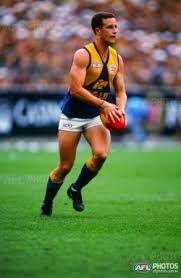
John Worsfold was one of the few winners for West Coast

The result saw Melbourne reclaim top spot, a game ahead of Hawthorn and West Coast, who had fallen to third. However, a number of surprise results over the weekend meant the Eagles maintained a game advantage over the chasing pack.

Essendon were beaten by an improving Carlton, by 20 points, while St Kilda suffered a shock 18 point loss to the bottom-placed Fitzroy, despite seven goals to spearhead Tony Lockett. Despite the losses, the Saints and Bombers both held their spots in the top five, after Geelong blew a golden opportunity to move into the finals positions.

Hosting the second-last Tigers at Kardinia Park, the Cats booted a horrid 9.28 in a 14 point defeat, giving Richmond just their second win of the season. Collingwood were also left outside the top five when they fell to the Hawks in one of the rollercoaster games of the season. The Magpies trailed by five goals at half time, only to hold a 10 point lead at three-quarter time, before falling short by two points.

Following back-to-back games at the MCG, the Eagles were set for a fortnight at home against Brisbane and Geelong, but Malthouse was quick to dismiss the suggestion that the Eagles were happy relying on their perceived home ground advantage to bank the wins they needed for finals.

“We will end up on our backsides if we think [we are guaranteed those games]”, Malthouse warned.

“There are seven or eight sides vying for the top five and it might take at least 14 wins to make the finals.”

West Coast Demolish Cats For 1994 Flag

Two Out Of Three Ain’t Bad For Eagles

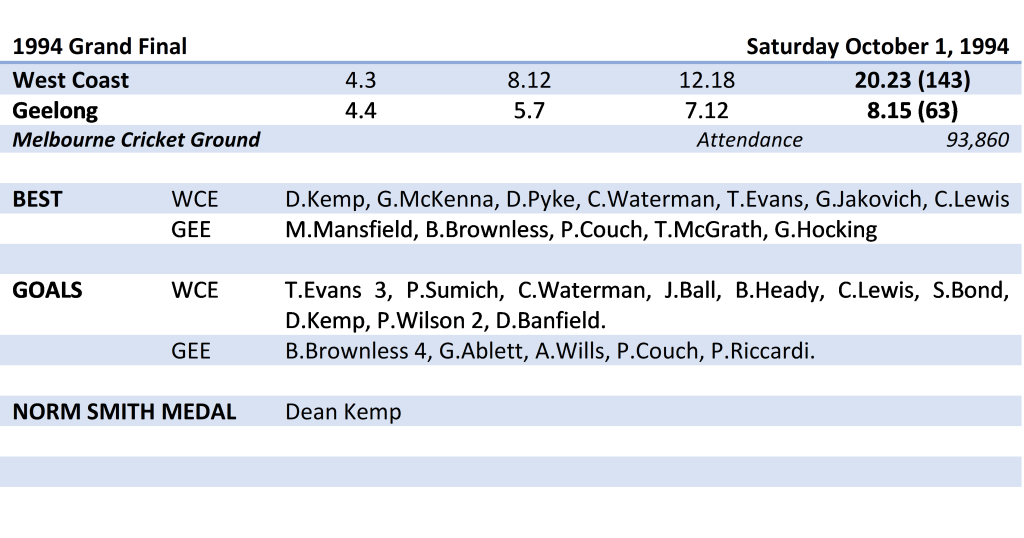
West Coast reinstated themselves as the kings of the competition when they crushed Geelong by 80 points to win the 1994 Grand Final.

Two years after an historic first flag, the Eagles steamrolled the Cats to their second premiership, erasing the disappointment of a failed 1993 season.

Dean Kemp claimed the Norm Smith medal for best afield and Tony Evans repeated his 1992 haul of three goals as West Coast booted their highest score in over two years.

Traditionally recognised as a defence-oriented side, the Eagles racked up 43 shots on goal in the Grand Final, a week after they posted 37 scoring shots against Melbourne. Ten Eagles in total hit the scoreboard as West Coast recorded the fourth largest winning margin in Grand Final history.

For the Cats, the defeat was their third loss in the season decider in six seasons, having gone down to the Eagles by 28 points in 1992 and the Hawks by six in 1989.

A shattered Malcolm Blight could offer no explanation after the match, saying there was ultimately nothing his side could do. “I could say a million things about what we might have done or could have done. But at the end of the day they were 80 points better than us, which is pretty hard to cop really.”

Eagles coach Mick Malthouse admitted he sympathised with the Cats, but was equally ecstatic with his side’s performance.

“I just love seeing the day for the club and all the players… I get a bigger kick out of seeing the players enjoy themselves.”

West Coast made just one change from the preliminary final, with Ashley McIntosh coming back into the team after missing with a knee injury. Mitchell White was the player to make way, after coming into the side as McIntosh’s replacement, but remained an outside chance on the morning of the game as West Coast debated whether to remove one of their ruckman.

However, the pair of David Hynes and Ryan Turnbull was retained to tackle John Barnes who was openly struggling with a lower leg injury. Geelong remained unchanged from their last-gasp six point win over North Melbourne, with Grant Tanner ruled out earlier in the week in his bid to recover from an ankle injury.

McIntosh started in defence on Bill Brownless, with Michael Brennan tasked with minding Gary Ablett. The Cats tried to throw the Eagles defence early, starting Ablett on the wing but he quickly moved to the goal square after failing to have an impact.

In a reverse to the 1992 meeting, it was West Coast who had the fast start, booting the first three goals in the game. Tony Evans, Chris Lewis and Shane Bond all kicked majors as the Eagles jumped to a 20 point lead.

West Coast had had all of the play out of the middle of the ground but the momentum of the game soon changed when Geelong piled on four goals in eight minutes. Tim McGrath and Michael Mansfield provided the dash off half back for the Cats with Paul Couch opening the Cats account.

Three more goals followed in quick time to give Geelong a seven point lead, before Brett Heady settled the Eagles just before quarter time to reduce the Cats lead to one point at the first change.

It would prove to be the only period of ascendency Geelong would have in the game.

West Coast resumed control at the start of the second term and only poor kicking on goal prevented the Eagles from having the game won by half time. Peter Wilson kicked consecutive goals to start the quarter as West Coast camped the ball in their forward half.

The Eagles created confusion at the Geelong kick-ins when they changed tack from their usual one-on-one set up to a zone defence. The usually precise Mansfield and Ken Hinkley were undecided with their re-entries preventing clean getaways from their back half, which had been a trademark through their finals campaign.

Twice in the second quarter West Coast picked off their kick-ins. Tony Evans intercepted a Ken Hinkley pass to mark and goal, before then having an intercepting hand that rebounded to Peter Sumich allowing the Eagles full forward to send the ball back over his opponent in Stephen O’Reilly.

The Eagles continued their dominance of general play but, remarkably, when Bill Brownless booted his third goal midway through the third term, the Cats were still within touching distance trailing by just 18 points.

However, three majors to Dean Kemp, Brett Heady and Peter Sumich extended their lead to six goals by three-quarter time and Geelong’s slimmer of Hope was all but gone.

The last quarter was a celebration for West Coast, as they slammed on eight goals to one to demoralise the opposition and the majority of the pro-Geelong crowd.

Symbolic of the day for West Coast and for their Norm Smith medallist Dean Kemp, their 17th goal came about purely by accident. Kemp’s kick inside 50 was intended for Chris Lewis who was crunched out of marking the ball by Tim McGrath, only for the ball to carry on its path and bounce harmlessly through for another goal.

Kemp was sublime for the Eagles on a day when they had a healthy number of contributors. The Eagles centreman had 23 disposals and booted two goals to outpoint Geelong captain Mark Bairstow, who had a dirty day. It also meant that Bairstow finished with the inglorious honour of once again playing on the Norm Smith medal, after lining up on Peter Matera’s wing in his five goal performance of 1992.

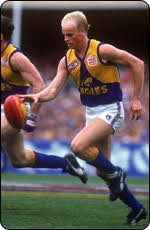
Dean Kemp was best afield for West Coast

Don Pyke collected 26 possessions through the middle and just had the edge over Geelong’s Paul Couch. One of Geelong’s prime movers was relegated into a defensive role as he tried to curb the influence of the Eagles centreline.

The Eagles defence was as impregnable as ever, led by Glen Jakovich (20 possessions) and Guy McKenna (23) across half back. Jakovich played his own game standing in the way of Geelong’s forward entries and proving too strong for both Steven Handley and David Mensch. McKenna provided the run from the backline as he outclassed Adrian Hickmott.

Michael Brennan blanketed Gary Ablett, with the Geelong superstar managing just one goal from five disposals and David Hart had the better of Leigh Tudor in the back pocket. Geelong’s only winner in their forward half was Billy Brownless, who exorcised some of his demons from the 1992 Grand Final when he was humbled by Ashley McIntosh.

Brownless kicked four goals for the Cats – he was the only Geelong player to kick a goal after quarter time – and took one of the great Grand Final marks when he soared over McIntosh and managed to hold onto the ball from a second attempt.

Michael Mansfield was arguably the Cats best player with 21 disposals out of defence and having the better of Shane Bond, while Tim McGrath also did his best to withstand the avalanche. Garry Hocking finished with 20 possessions after being forced off during the first term with a heavy cork and returning to the ground in the second half with heavy padding around his upper leg.

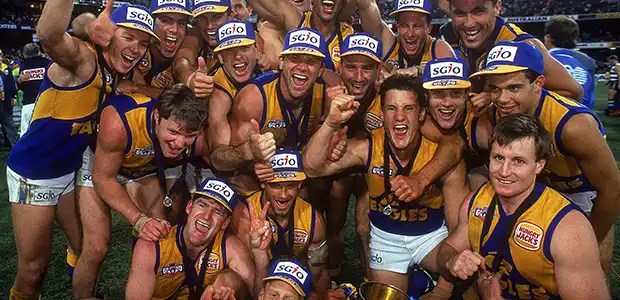
But it was a day that belonged to West Coast.

15 members of the 1992 triumph were now dual premiership players, while there was redemption for David Hynes and David Hart, who were the unlucky stories from two years earlier.

And even with two of the heroes from 1992, in Peter Sumich and Peter Matera, having subdued outings, there were plenty of others who stepped up. Sumich and Matera combined for 11 goals in the clubs first flag as West Coast had just four goal kickers for the day. This time around, nearly half of the team kicked goals, as the likes of Chris Lewis, Brett Heady and Jason Ball provided strong targets up forward.

Chris Waterman came onto the ground early in the second term after Chris Mainwaring was forced off with a corked hip and put in one of his finest performances with 18 disposals and two final quarter goals (to go with four behinds). Mainwaring himself was able to return to the field and pick up 18 disposals.

Mick Malthouse even broke with his own tradition in heading down to the bench with three minutes remaining. Malthouse had been reluctant to leave the box two years earlier, despite the urging of his coaching team, but with the game well in his side’s keeping, the Eagles coach revelled in the celebrations boundary side.

Malthouse admitted that he knew his side were home during the third quarter.

“We expected at some stage Geelong to give us a big quarter like they had over the last three or four weeks, so we were ready for it. We stuck to our basics, not to allow them to get that one quarter of football in.”

“At half-time I thought if we maintained our pressure, and we could hold them, we could do the job,” Malthouse said.

“So I guess three quarters of the way through the third quarter I thought we had them.”

Since taking over as senior coach at the end of 1989, Malthouse had steered the Eagles to no lower than fourth in five seasons, which now included two premierships from three Grand Final appearances.

The Eagles had massacred the Cats in one of the most emphatic premierships of the modern era and with that staked their claim as the pre-eminent club of the AFL.

1994 Rewind: Lewis Shines in Top of the Table Fizzer

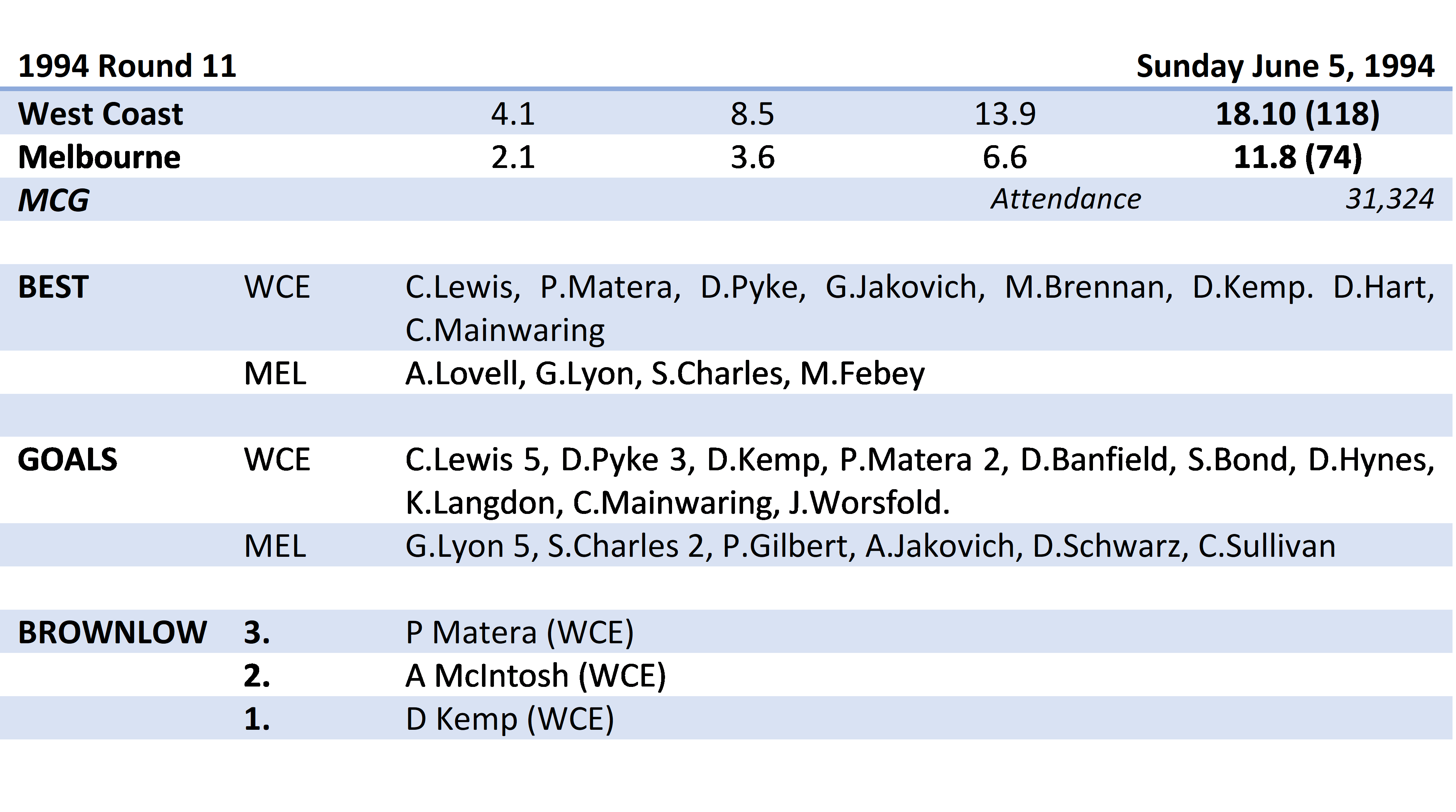
The Eagles turned a potentially intriguing top-of-the-table clash with Melbourne into a one-sided masterclass when they were too strong for Melbourne at the MCG.

The Eagles and Demons were sitting in first and second spot coming into the clash, but the strong performances of West Coast players, coupled with an excellent coaching effort, prevented the Demons from ever being a realistic chance.

The win was the Eagles’ fifth in a row, while the Demons had slumped to their fourth loss in five games, after starting the season with five straight wins.

Chris Lewis was the star for West Coast in a performance that Mick Malthouse described as the ‘best he has played in several years.”

Stationed permanently in the forward line – and operating mostly out of the goal square – Lewis was the class between the two sides, finishing with five goals (from nine scoring shots) and having a hand in several others.

With Peter Sumich once again sidelined with a hamstring injury, the Eagles were forced to experiment with their forward set up. Ashley McIntosh was swung back to the forward line, alongside Lewis, while there was also an element of the old and the new brought back into the team.

Rookie Brett Spinks returned to the forward line after being a shock omission the week before, while Karl Langdon was named for just his second game since the 1992 premiership. Injuries had restricted the blonde firebrand to just one game in 1993, with suspension then delaying his start to the 1994 season.

Langdon copped a three week ban for tripping Mark Bickley during the Fosters Cup and was then forced to bide his time at Subiaco until a spot opened up at West Coast. Langdon and Spinks were joined by half-forward Tony Evans who was playing his first game since injuring a foot in the round one loss to Essendon and second-year midfielder Jarrad Schofield.

Out of the side with Sumich, were omitted trio Jason Ball, Tony Godden and Dwayne Lamb, the latter having celebrated his milestone 150th game the week before.

After naming their initial side, there was still plenty of intrigue over the Eagles’ final team. Under recently revised AFL rules, clubs playing on Sundays were allowed to add an extra emergency player to their squad on the Friday, with West Coast curiously adding Dean Kemp to the squad, the midfielder having not played since injuring a knee in the round 7 win over Carlton.

Kemp would ultimately be a late inclusion ahead of the first bounce replacing Brett Heady. Heady had limped off the ground with a hamstring injury the previous game and was a surprise selection on the half-forward flank.  

While the Eagles played games over their playing 21, the Demons were having their own player issues. Steven Febey and Todd Viney were both named in the Melbourne line-up, despite looking incredibly proppy during the week, before Jim Stynes created a stir when he limped off the training track 24 hours before bouncedown.

Stynes appeared to roll an ankle but made it out to the field, in what was his 158th consecutive appearance. While Stynes, Febey and Viney all took their place, Jeff Hilton wasn’t as fortunate after he was another casualty at training. Hilton strained a calf and was one of two changes along with Kevin Dyson who was left out of the side despite a 24-possession, two goal effort against St Kilda the week before. Sean Charles and Glenn Molloy were the two players to come in.

After plenty of activity leading into the game, the match itself turned into a one-sided affair quickly. The Eagles ruck duo of David Hynes and Ryan Turnbull overwhelmed Stynes and the Eagles midfield capitalised on the ruck advantage.

Kemp, Don Pyke and Drew Banfield were all busy early, as the Eagles kicked four goals to two in the first quarter. Melbourne were unable to get their hands on the ball, as West Coast controlled possession and often outnumbered their opponents at the stoppages and around the ground.

With a weight of possession forward of centre, Lewis was given plenty of opportunity to show his wares. Lewis proved too elusive for Sean Wight and Graeme Yeats, finishing with his best haul in a game since round 6, 1988.

Malthouse was glowing in his praise of Lewis after the match and had a simple reasoning for his impressive outing. “He enjoys his footy now. People who enjoy their football play with that sort of enthusiasm.”

Lewis’ creativity up forward brought others into the game, with many of the Eagles’ smaller players hitting the scoreboard. Ashley McIntosh provided a solid target up forward but could manage just three behinds from 18 possessions and nine marks, but Brett Spinks and Karl Langdon both failed to have any influence.

Spinks went possession-less, registering just five hit-outs, while Langdon fared slightly better with one goal from four touches and two marks. Don Pyke and Dean Kemp combined for five goals as they alternated through the centre and half-forward, while Peter Matera kicked two goals from the wing.

Malthouse was happy with the ‘good even performance’ despite the quiet games from his tall forwards, commenting that he was happy Langdon ‘got through a game without getting injured or reported’.

Glen Jakovich was strong at half-back, getting the better of David Schwarz with 29 disposals and six marks. Don Pyke had 29 possessions through the middle to go with his three goals, while Chris Mainwaring was rampant on the wing on his way to 27 disposals, six marks and a goal.

The Demons on the other hand had few winners. Garry Lyon finished with five goals from the half-forward flank in his battle with 100-gamer Chris Waterman and Andy Lovell and Matthew Febey tried hard with 26 and 20 disposals, respectively.

Allan Jakovich – who was the difference the last time the two teams met, with six goals in an upset Melbourne victory – was well beaten by Michael Brennan, managing just six disposals before he was dragged in the third quarter and replaced by Phil Gilbert.

After the game, Melbourne coach Neil Balme was in no doubt as to where the Eagles sat in the competition. “Before the game I rated them very highly – and I probably rate them even higher now.”

While Neil Balme was declaring the Eagles the team to beat, Malthouse was looking to deflect attention elsewhere. He declared the reigning premiers, Essendon, as the benchmark of the season, despite West Coast sitting a game and 18 percent clear of 2nd placed North Melbourne.

“Essendon are the best side contrary to what Kevin (Sheedy) would like everyone to believe. They won the premiership last year and they’re going along in very much the same way.”

The Bombers were sitting seventh with six wins, but equal on points with Melbourne who held onto third place on percentage, despite the humbling defeat to West Coast. Carlton, Hawthorn and Collingwood filled the positions in between after all recording comfortable wins.

With eight wins from their opening ten games, the Eagles were one win better off than at the same time in 1993. The Eagles had recorded wins over North Melbourne and Melbourne at the MCG, as well as thumping Carlton at home. Still, Malthouse was cautious over the Eagles’ standing.

“If you gave me 8-2 at the beginning of the year I’d take it… we don’t judge where we’re going to be. We just like to be competitive and better than what we were last year,” Malthouse said.

“We’re steady at the moment. Nothing over the top. We’re steady.”

1994 Rewind: Eagles Bounce Back Against Roos

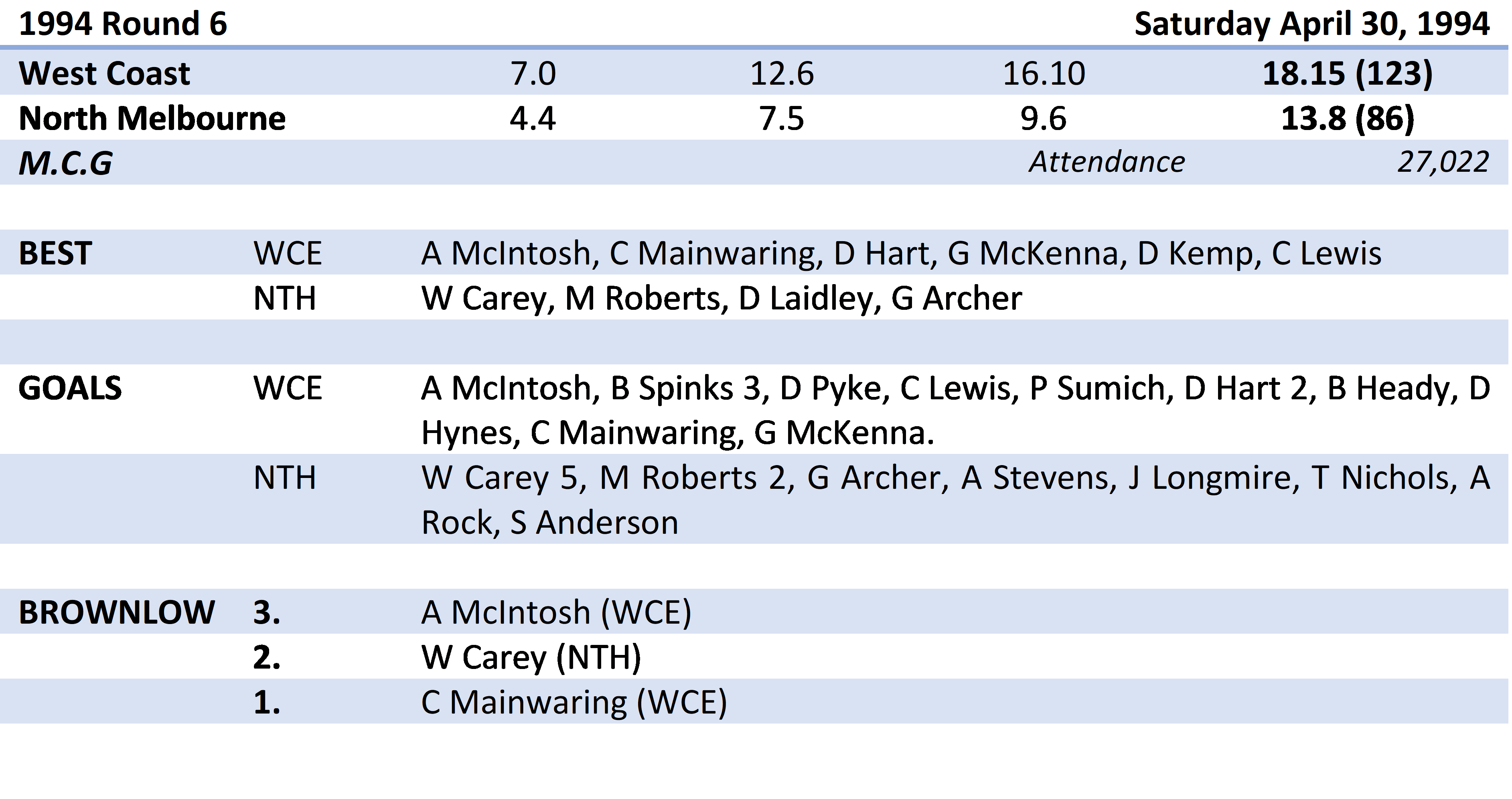
Wayne Carey may have won the battle, but the Eagles won the war as they righted the shock defeat to Hawthorn the week before with an impressive 37-point win over premiership rivals North Melbourne.

Carey was a lone force for the Kangaroos, eclipsing opponent Glen Jakovich in the hotly-anticipated duel. The North Melbourne skipper racked up 21 disposals, 15 marks (out of the 45 marks North Melbourne managed as an entire team) and booted 5.3. However, it mattered little as West Coast put in their most accomplished performance of the season.

Both teams entered the clash keen to atone for poor defeats the week before. The Kangaroos suffered their first loss of the season when they fell to Geelong by 15 points, while the Eagles had been humiliated by 71 points at home to lowly Hawthorn.

The Eagles responded to the loss by making four changes, although two of them were forced through injury. Paul Harding had escaped serious concerns over a knee injury suffered against the Hawks but was still not considered fit enough to take on the Kangaroos, while Peter Matera was also left at home, still dealing with the after effects of a broken nose and concussion from the Hawks game.

Jarrad Schofield and Craig Turley were both dropped, with the latter failing to recapture his best form in his first five games back from retirement. Dwayne Lamb, David Hynes and Tony Godden were all selected for their first games of 1994, while Chris Waterman came back into the team after three weeks exiled at East Fremantle.

North Melbourne weren’t without their injury concerns either heading into the game, with both Corey McKernan and Peter Mann unavailable for selection. Glenn Archer did make the cut, despite injuring a hamstring at state-of-origin training the week before, while Anthony Rock also played in spite of a back complaint.

Along with Archer, Stuart Anderson was selected for his AFL debut, while journeyman Gareth John was picked for his first game with the Kangaroos after swapping over from the Swans. It is the Kangaroo ruckman’s first senior game of football since 1991 with injuries curtailing the end of his time with Sydney. Ian Fairley, Jason Daniltchenko and Brett Allison were all omitted.

The Kangaroos started strongly with Carey having immediate impact. The North Melbourne captain took an early mark and kicked truly before hitting the post with a second shot on goal moments later. Peter Sumich kicked a brace in quick time, after two strong marks opposed to Mick Martyn, before Carey had a third shot on goal, his second miss of the term.

The early missed chances from Carey would prove costly as West Coast’s running game troubled the Kangaroos. Chris Mainwaring and Guy McKenna – who was moved up the field as Matera’s replacement on the wing – were providing plenty of drive, as was Dean Kemp who was being used across half-back. Mainwaring racked up nine first quarter possessions opposed to Stuart Anderson, while McKenna was giving former teammate Trent Nichols a bath.

McKenna was involved in setting up the Eagles third goal through Ashley McIntosh – who had started forward alongside Sumich and Brett Spinks – before kicking the Eagles’ fourth with a long range shot on the run.

Adam McAdam came off the bench for the Kangaroos to provide some run and immediately found Mark Roberts for the Kangaroo’s second goal but the Eagles responded almost immediately through Don Pyke. McKenna then had this third goal involvement of the term when he found Brett Spinks on the run to put West Coast 20 points clear.

Carey did his best to keep the Kangaroos in the contest, booting consecutive goals. The first came from a free kick given away by Michael Brennan off the ball, before he then out-marked Jakovich to kick his third for the term. Don Pyke kicked his second goal late in the quarter to take the Eagles lead back out to 14 points.

The Eagles kicked seven straight for the first term and their impeccable goal kicking continued into the second quarter. The Eagles had ten goals on the board before their first blemish when Ashley McIntosh hit the post. Before that, McIntosh had kicked two successive goals to open the term, as he proved too fast and too agile for John Blakey. Wayne Carey added a fourth goal (out of North’s five), before a cleverly crumbed goal to Chris Lewis saw West Coast’s lead stretch out to 26 points.

The Eagles running game was too much for the Kangaroos, recording three times as many handballs, as they continually swarmed forward in waves from half-back. With the game starting to get out of hand, Denis Pagan swung a number of changes.

Mark Roberts was switched to defence to curtail McIntosh, John Blakey was moved forward, Glenn Archer went to half-back and Dean Laidley pushed onto the wing against Mainwaring. Gareth John was introduced into the ruck off the bench, while Adam McAdam returned to the field and was stationed at full forward.

But the changes did little to stop the Eagles momentum. Brett Spinks goaled from the boundary line, and David Hart roamed forward to goal from 50m, after some good forward pressure from Shane Bond. After being so accurate through the first quarter and a half, the Eagles’ radar went missing as they butchered a host of other chances late in the term, with a John Longmire goal after the half-time siren reducing their lead to 31.

It was more of the same for West Coast after the main break, with the Eagles booting the opening four goals of the term as their lead pushed towards ten goals.

Brett Spinks marked in a heavy pack in the goal square to open the scoring, with Mainwaring kicking truly when he received a 50m penalty against Laidley. David Hart had his second running goal, when a scrappy kick out of the Eagles defensive fifty evaded a number of players, releasing Hart from the centre circle to the top of the West Coast 50. Brett Heady had his first of the afternoon when he scouted the back of a marking contest to snap truly on his opposite foot.

The Eagles had winners all over the ground, with even Carey’s influence waning as the ball stayed locked in the Eagles forward half. While Pagan was busily moving the magnets to stop the tide, the Eagles were perfectly quelling the Kangaroo’s prime movers.

Wayne Schwass managed just one kick in the first half opposed to Drew Banfield, while Anthony Rock had Dwayne Lamb for company and had been barely sighted. Don Pyke was given the role on Anthony Stevens, but Stevens was soon moved to the wing to be Mainwaring’s third opponent for the day.

Two late goals to Glenn Archer and Trent Nichols before the three quarter time siren stopped the Eagles run, but the visitors still headed for home with a 46 point lead.

That lead stretched beyond ten goals with David Hynes and Chris Lewis both kicking majors, before the Kangaroos kicked the last four goals in the game, as the heat dissipated out of the contest.

Apart from Carey, there were few notable performances from the Kangaroos. Glenn Archer tallied 20 disposals to go with his third quarter goal, while Mark Roberts had 19 possessions and two goals rotating between the forward line and defence and Ross Smith was the best in the midfield with 16 disposals.

For Malthouse, the performance was a good response to the previous week’s thrashing. “Hawthorn were very good last week and we needed to be this week. Everyone that is in top sports knows that you’ve got to have the right attitude.”

After a blistering start, Chris Mainwaring finished with 25 touches, with Anthony Stevens restricting his output through the second half. Guy McKenna picked up 21 disposals, 7 marks and a goal, David Hart finished with 22, while Dean Kemp was the highest ball winner with 27 playing out of defence.

Brett Spinks and Ashley McIntosh each kicked three goals, with ten players hitting the scoreboard. “He (Spinks) has given us a new dimension. He’s a very capable player who will only get better… he’s a good grab and he kicks the ball out of sight.”

The result lifted the Eagles to 2nd on the ladder, behind only the undefeated Demons, but the win came at a cost. Peter Sumich limped off during the third term with a hamstring injury that was expected to sideline the spearhead until at least after the Eagles bye in Round 8.