2011 Rewind: Eagles Continue Demon Misery

McGinnity Charge Overshadows Melbourne Win

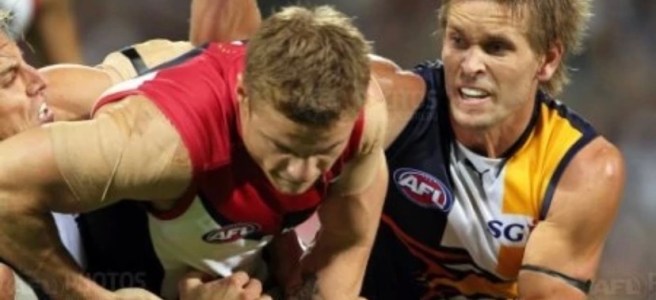
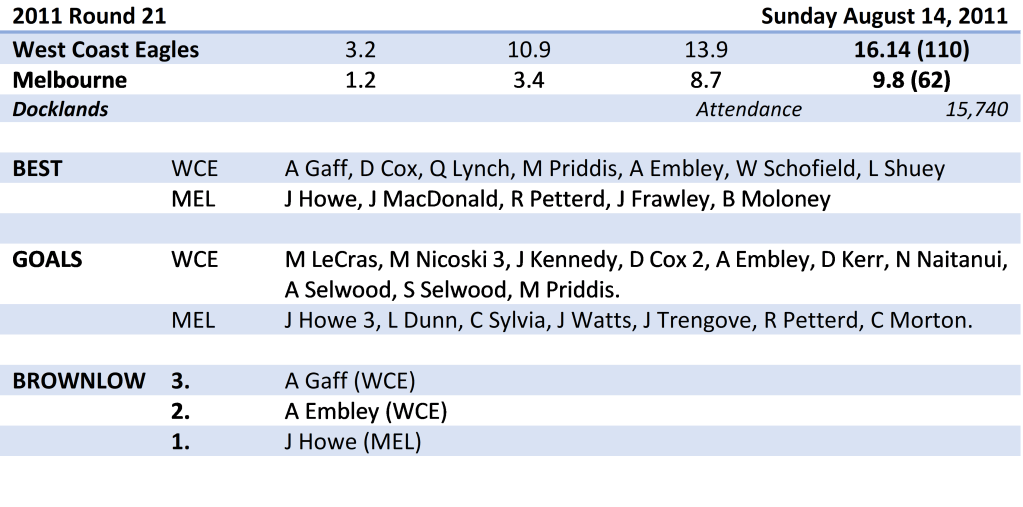
West Coast continued to stalk the Blues and the Hawks in the top four, with a comfortable 48 point win over Melbourne at Docklands.

The Eagles recorded their fifth away win of the season – one more than they had managed home and away in 2010 – off the back of a seven goal second quarter that put the dysfunctional Demons out of the game by the major break.

Despite being still mathematically in the hunt for finals, the Demons had endured a horror three-week period that had seen them fall to 54, 186 and 76 point defeats, part ways with senior coach Dean Bailey, before enduring renewed backlash over their previous season performances when Bailey suggested following his sacking that the club had tanked for priority draft picks.

After making a host of changes at selection during the week, the Demons then lost Brad Green on the morning of the game. Green joined Jake Gysberts and James Strauss as casualties, while young ruckman Max Gawn and midfielder Matthew Bate were dropped. Into the Melbourne side came Colin Sylvia, Sam Blease, Cale Morton and Mark Jamar.

Like Melbourne, the Eagles also went into the game without their skipper with Darren Glass spared the trip east due to soreness. Matt Rosa was sidelined with a knee injury, while Chris Masten was a surprise omission despite coming on as the injury substitute for Rosa the previous week, tallying 12 disposals in little over a quarter.

Instead the Eagles recalled Ashton Hams for just his second game of the season, with Eric Mackenzie and Josh Kennedy obvious inclusions returning from injury. With vice-captain Beau Waters still not considered ready for senior action, Dean Cox was instilled as captain despite being under an injury cloud for much of the week.

Cox was hampered by a knock to his hip early in the Eagles last game against Richmond and failed to train in the lead up to the clash with Melbourne. However, West Coast coach John Worsfold said they wouldn’t follow the lead of Geelong and Collingwood and rest players ahead of the finals.

Despite starting as outsiders, the Demons started the game with much more purpose than the visitors. Jeremy Howe kicked the opening goal after ten minutes, but for the Demons that would be their only scoreboard joy until time-on of the second term.

In that time, the Eagles had slammed on eight majors with Howe ending the run with his and his side’s second goal. Mark LeCras and Mark Nicoski each added two goals during the run as the Eagles midfield were all over their counterparts.

Andrew Gaff continued his impressive late season form with 10 disposals in the second term, and 15 for the half, with Luke Shuey and Andrew Embley each tallying eight disposals for the second quarter. As good as West Coast were for the quarter, the Demons were equally bad.

The exuberance they showed in the early stages of the game were long gone, with senior players in particular guilty of giving up possession either through poor use of the ball or ill discipline. Nearly half of their kicks in the first half were either ineffective or clangers, with the Eagles capitalising.

Leading by 47 points at half time, the Eagles continued their recent trend of dropping off in the third term to allow the Demons to close within five goals with a quarter to play. Worsfold referenced the Bermuda Triangle post-match when discussing the drop off immediately after half time, but the Demons followed the lead of the Bulldogs a fortnight earlier.

The Demons opted for a man-on-man style in the third quarter and looked to maintain possession and deny the Eagles ball. Melbourne recorded 47 more disposals for the quarter with Brent Moloney (12 disposals) and Sam Blease (10) proficient. Colin Sylvia managed just four touches in the first half, but sparked the Demons mini-revival with nine disposals and a goal in the third term.

However, that would be Melbourne’s best shot for the day.

West Coast muted their momentum in the final term and after a 15 minute stalemate where neither team could find the big openings, stand in captain Dean Cox kicked the vital goal that snuffed out any chance of a Demon comeback.

The Eagles added three goals to one to essentially restore their half time lead, with Josh Kennedy and Dean Cox for a second time, hitting the scoreboard.

Worsfold was expectedly pleased with the result, but again refused to entertain the discussion around the clubs return to finals. “We don’t talk about it (finals), we’re focused on improving the way we’re playing. We had patches today that were pretty average and we want to keep improving.”

“I’m sure they (the players) might be striving for (finals) but… we play a very good team this week, so that’s our immediate focus,” Worsfold said.

“In three or four weeks we’ll know what the ladder looks like. There’s still plenty of football to be played, a lot of games.”

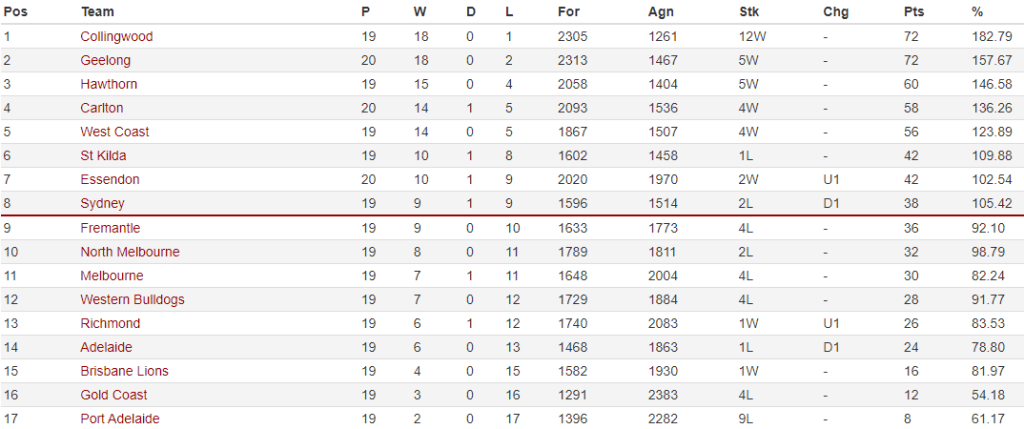
While Worsfold remained deadpan about the Eagles positioning at the end of the season, the Eagles continued to firm for a top four finish. West Coast remained two points behind the Blues, with a game in hand, and weren’t expected to drop their final three games against Essendon, Brisbane and Adelaide.

As had been the case the previous three rounds, the top five sides all won with the gap building between them and the rest of the competition. The Eagles were three and a half games clear of St Kilda in fifth spot with another string of one-sided results.

AFL Chief Executive Andrew Demetriou denied that the competition lacked competitiveness, but a second consecutive thrashing of Port Adelaide must have had those at AFL House worried. A week after copping a 138 point pasting at the hands of Collingwood, the Power were comprehensively whacked by Hawthorn to the tune of 165 points.

The Hawks fell three points short of notching 200 points scored, with Lance Franklin (eight) and Cyril Rioli (six) contributing 14 goals between them. Brisbane recorded a ten goal win over new rivals Gold Coast in a battle of the cellar-dwellers while Essendon accounted for the Bulldogs by 49 points.

The two leading sides were both forced into strong battles with their opposition, but like they had most weeks, still found a way to come out on top. The Magpies ended the Saints’ six game winning streak with a 19 point win. In the highly anticipated clash between last year’s grand finalists, Collingwood got the early jump in the opening term and maintained their lead throughout.

Geelong were given a scare by lowly Adelaide who threatened to steal the game late. After Adelaide controlled the game early, the Cats got separation with six of the seven goals heading into half time. Early in the final term, Geelong led by four goals, but the Crows kept coming. Adelaide closed within a kick as the game entered time-on, but the Cats steadied for an 11 point win.

Richmond threw a spanner in the works for Sydney when they produced an upset 43 point win at the MCG. The result saw the Swans drop to the edge of the top eight, but they were able to maintain their position courtesy of the Dockers’ 30 point defeat to Carlton and the Kangaroos serving their second bye.

The defeat made it 12 losses in a row for the Demons at Docklands and while their season was petering out to a nondescript end, there was still plenty to be gained according to stand in coach Todd Viney. Viney believed the Eagles’ 2011 season gave many other clubs hope that their fortunes could be turned around quickly.

“It’s a great story that you modify your game plan, you keep tinkering with it, you keep persisting, you keep positive and you can turn things around,” Viney enthused.

“It’s amazing, their turnaround. They are fighting for a top four spot.”

While Worsfold refused to acknowledge finals, he did believe that the Eagles had earned back the respect of many within the AFL competition after three years of poor off-field and on-field performances. “I would expect so. I suppose it depends on whether you are talking about respect from opposition teams or the footballing public. I’m sure its happened.”

Gaff finished with 33 disposals to lead the Eagles, ahead of Matt Priddis (26, 11 tackles) and Andrew Embley (25, five inside 50s). Dean Cox stood tall through the second half to collect 17 disposals along with 21 hit-outs, seven clearances and two goals.

Mark LeCras and Mark Nicoski each booted three majors, while for just the second time, Adam and Scott Selwood each contributed goals in the same game. It would be the second quirky record for Adam on the day after he and Troy earlier moved up to equal fourth on the list of games to be played by twins. The pair had now combined for 227 games total (Adam 152, Troy 75) to join Ryan and Nathan Lonie.

The post-script to the fine win was a one week ban handed down to Patrick McGinnity following an unsavoury incident on half-time. McGinnity was referred directly to the tribunal for violating the AFL’s respect and responsibility policy for comments direct towards Demon player Ricky Petterd.

McGinnity was overheard telling Petterd that he would ‘rape his mother’ after Petterd had earlier threatened to kill him during a brawl at the half-time break involving a host of players. An investigation was launched after an umpires report following the game with several officials hearing the comment.

AFL CEO Andrew Demetriou condemned the comments, labelling them ‘totally disgusting’ while operations boss Adrian Anderson applauded Petterd for reporting the incident. His praise came in direct contrast with McGinnity’s player manager David Sierakowski, who believed the exchange should have remained on the football field and not been brought to public light.

McGinnity would later release a statement apologising for his actions, accepting the one match ban plus a $2,500 fine. Eagles chief executive Trevor Nisbett was also critical of McGinnity’s actions saying the club expected better from their players and that his words did ‘not reflect the values of our football club.’
Eagles Resurgence Takes Next Step

Fast Start Allows Eagles to Coast Home

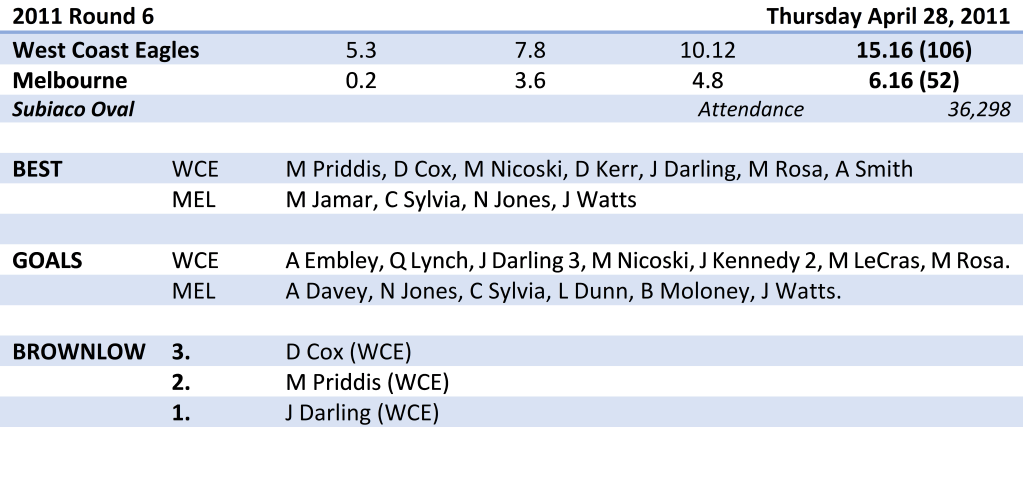
West Coast showed that they would be a significant improver on their 2010 wooden spoon finish with a comprehensive nine goal win over Melbourne at Subiaco Oval.

The Demons had also been expected to rise after a strong finish to the 2010 season and started the season with two wins and a draw from their first four games.

However, they were no match for the Eagles’ famed forward press as West Coast locked the ball in their forward half for much of the night. The Eagles bounced to a five goal quarter time lead off the back of an astonishing 22-3 inside 50 advantage and they never looked like relinquishing the lead.

After their first four matches had been decided by 18 points or less (for two wins and two losses), Eagles coach John Worsfold was pleased to have the match out of the opposition’s reach early.

“We’ve had four pretty tight games leading into this one so to actually get the margin out a little bit is some good reward for the players”, Worsfold said.

Over 36,000 fans attended the rare Thursday night fixture in Perth, with the Eagles and Demons both coming off byes in round 5. West Coast made three changes to the side that lost to Hawthorn a fortnight earlier with Will Schofield and Mitch Brown unavailable due to injury and Bradd Dalziell omitted.

Mark LeCras returned for his first game since damaging a groin in the opening round, with Ashley Smith selected for his first match of the season and Patrick McGinnity also included. The Demons smashed newcomers Gold Coast by 90 points before the bye, with the Demons coaching staff sticking with the same 22 for the trip west.

However, it wouldn’t be long before Dean Bailey would have wished he could have called on more reinforcements.

Nic Naitanui took clean possession from the opening bounce and sent the ball deep into the Eagles’ forward line in what would prove indicative of the rest of the term. The Demons defence were under siege and the Eagles arguably could have led by more at the first break.

Jack Darling kicked the home sides first major shortly after and by the time Andrew Embley waltzed through for his second goal just before quarter time, there had been a distinct difference in level between the two sides.

It was much of the same for the second term before Melbourne briefly brought some life to the contest on the brink of half-time. Two goals in a minute to Colin Sylvia and Aaron Davey reduced the margin at the major break to 26 points but West Coast reasserted themselves in the second half, coasting to their third win of the year.

The tale of the match was told in the stats, with the Eagles well ahead in most areas. The Eagles had 40 more disposals on the night, which translated into a 65-36 inside-50 count, following their opening quarter blitz. The Eagles also out-tackled the Demons 68-57 and claimed a win in the clearances 35-29.

West Coast also made the most of the advantage they had in their forward line, with the likes of Kennedy, Lynch, Darling and the resting ruckmen of Naitanui and Cox proving too strong for the smaller Demon defence. The Eagles took 22 contested marks for the match, and had 14 marks inside 50.

Individually, Matt Priddis was the leading ball winner on the ground with 33 disposals (9 kicks, 24 handballs), while also amassing eight clearances and seven inside 50’s. Daniel Kerr tallied 27 possessions, six clearances and seven inside 50s with Matt Rosa picking up 26.

Dean Cox wasn’t as proficient as previous weeks but still managed 23 disposals and 12 marks to go with 20 hit-outs in an intriguing duel with Demons ruckman Mark Jamar. Jamar was easily the Demons best player and only four-quarter performer with the pair breaking even in their contest.

Ashley Smith gathered 25 disposals in his first senior outing of the year, Sam Butler had 21 and laid nine tackles, while Mark Nicoski was again lively in his new role across half forward. Nicoski kicked two goals and had a hand in several other goals from 15 disposals.

Young forward Jack Darling put in his best performance of his burgeoning career with three goals from 14 disposals and nine marks while Andrew Embley and Quinten Lynch also each booted three goals.

Apart from Jamar, it was slim pickings for the Demons.

With the ball spending much of the night in their defence, Jack Grimes finished with the most disposals (27), while Colin Garland (19) and James Frawley (18) also saw plenty of the pill. Nathan Jones collected 23 possessions, while Colin Sylvia tried hard through the middle and across half forward with 21 disposals, seven tackles and a goal.

Coach Dean Bailey couldn’t hide his disappointment after the match.

“It is a poor performance, it is a poor performance”, Bailey lamented.

“We turned the ball over too much. We’ve got to go back to the fundamentals of the game and get better in those areas.”

“You don’t start well, you get what you deserve really.”

The win catapulted the Eagles back into the top eight, into seventh spot ahead of Melbourne who slipped to eighth. With three wins, the Eagles were equal on points with Hawthorn, but there was already separation at the top of the ladder.

The last two premiers were the trendsetters early in the year, with both sides undefeated at the end of Round 6. The Magpies were a game clear, courtesy of having played an extra game, with Geelong, Hawthorn and Fremantle (who had started the year with four wins from five matches) all having byes this round.

Carlton overcame Sydney in the final quarter to record their fourth win of the season and move up to third behind the Magpies and Cats and in front of the Dockers who rounded out the top four. Essendon pushed up to fifth after they were the latest team to annihilate the Suns. The Bombers kicked a record 15 goals in the first term to lead by an astonishing 93 points at quarter time, ultimately ‘easing’ to a 139 point win. The victory bumped their percentage by almost 27 percentage points.

West Coast sat two points ahead of the Demons, Swans and Tigers who defeated the winless Brisbane by 26 points. The Lions were left last on the ladder after North Melbourne earned their first win of the season with a ten goal triumph over Port Adelaide.

The Eagles had showed in their win over Melbourne that the early season form was sustainable and three wins from five matches had put the team in good stead for a return to finals action ahead of a tough month with matches to come against Essendon, Fremantle, the Bulldogs and reigning premiers Collingwood.

1990 Rewind: Eagles Exorcise Demons

Historic First Finals Win For West Coast

West Coast set up a meeting with Essendon in the preliminary final after defeating Melbourne by five goals in the semi final.

Mick Malthouse’s drastic changes at the selection table paid off, as West Coast overcame a poor recent record against Melbourne to produce the clubs first ever win in a final.

One of those selections – Chris Waterman – produced a career best outing booting six goals across half forward.

Waterman was one of six changes for West Coast, with Eagles coach Mick Malthouse ruthlessly axing a quarter of the side that was demolished by Collingwood the week before in the Qualifying Final replay.

The most controversial omission was captain Steve Malaxos, who lost his place after a period of indifferent form. Malaxos had spent much of the previous two games against Collingwood on the bench, with Malthouse later saying the Eagles needed greater leg speed and running power on the wide expanses of Waverley Park.

Joining Malaxos out of the side were ruckman Dean Irving, who had been well beaten in both Collingwood matches, Troy Ugle, Craig McGrath, Murray Rance with a fractured jaw and Peter Wilson who would be a late withdrawal ahead of the game with a hamstring strain.

Phil Scott returned to the Eagles line-up, after being dropped on the eve of the finals, to partner Laurie Keene in the ruck, while Scott Watters returned after missing the replay with a knee injury. Stevan Jackson replaced McGrath up forward after ten goals with South Fremantle in the previous fortnight, while Waterman and Tony Begovich were added for their ability to run and spread.

When Wilson pulled out ahead of the game, Andrew Lockyer was called up, slotting into defence in place of the missing Rance. Guy McKenna had been in doubt after breaking a nose late in the loss to the Magpies, but held his spot, as did Mainwaring whose knee was becoming a week by week proposition.

Stevan Jackson returned to the Eagles side to be one of their best

Melbourne made no change when teams were announced but were soon to have their own late drama. Captain Garry Lyon was pulled from the side on the morning of the game after he suffered a corked thigh colliding with teammate Steven O’Dwyer the day before at training. Todd Viney was called up to the side.

Despite being without Lyon and midfielders Brian Wilson and Alan Johnson, the Demons were still hot favourites to progress to the preliminary final.

It took just 90 seconds for West Coast to show they weren’t going to just whimper away.

Kicking into the wind, the Eagles had two goals on the board – both to Chris Mainwaring – before Melbourne had even worked out their direct match-ups.

As well as bringing in a host of new players, Malthouse also moved his side around as he sought to catch the Demons off guard. Mainwaring started at half forward and his quick brace forced a shuffle of the Melbourne defence with Steven Stretch moved from the wing to replace Matthew Febey.

John Worsfold also started forward, as did Chris Lewis as the Eagles looked to avoid an early tag. Lewis still had Stephen Newport for company, but was influential early as West Coast established an important 13 point lead at quarter time.

Andrew Obst had been instrumental in Melbourne’s win over the Eagles in Perth several weeks earlier and Malthouse wasn’t keen on letting the midfielder run unattended again. Guy McKenna shifted into the midfield in a run-with role, holding Obst to just 12 disposals for the game.

Laurie Keene led the ruck, with Phil Scott taking the resting ruckman in the back pocket, while Andrew Lockyer had first crack at Darren Bennett.

The Demons tried to repeat the physical approach that had seen them defeat West Coast twice during the regular season, but the Eagles kept their focus on the ball.

The 13 point advantage exploded to 45 points by the main break, with the Eagles booting six goals to none with the wind, and the match was as good as done.

Melbourne outscored the Eagles in the second half, but West Coast were never in danger of giving up their spot in the Grand Final playoff.

West Coast would have to get past Essendon if they were to make their first ever Grand Final, after the Bombers were comprehensively beaten by Collingwood in the other semi-final.

Kevin Sheedy denied the Bombers would be affected by the additional layoff because of the drawn Qualifying Final leading into the match, but they appeared sluggish going on to lose by 63 points. The Magpies led by 12 points at half time, but ten goals to two after half time saw Collingwood qualify for their first premiership decider in nine years.

While West Coast could feel satisfied with the history-making first ever finals win in the clubs history, there were concerns to come out of the five goal win.

Scott Watters had arguably been the Eagles’ best player in the first half, but spent the entire second half on the bench with a groin complaint. Guy McKenna suffered a suspected broken arm after clashing with Earl Spalding in the dying minutes of the game and three Eagles wound up on report from separate incidents in the game.

Chris Lewis was placed on report for charging Graeme Yeats and Stevan Jackson was reported for striking Jim Stynes. Both players would get off at the tribunal during the week, but Dwayne Lamb wasn’t so fortunate.

The Eagles tagger was also charged for reporting Stynes, copping a one week ban. Lamb, and many of the other Eagles, were still seeking retribution from the last match between the two sides which saw Stynes break Lamb’s arm with an attempted soccer off the ground.

The Eagles gave it to Stynes, every chance they could, and it appeared to work as Keene controlled the stoppages and provided plenty of attacking run off Stynes around the ground.

The move appeared to work with Melbourne unable to get any direction or structure on the field with their captain missing and their ruckman ineffective.

At the feet of Keene, Craig Turley, Dean Kemp and David Hart had plenty of the ball as they overwhelmed their Demons counterparts. For the second week in a row Turley was one of the best for West Coast, revelling in the centreman role in the absence of Malaxos.

Turley finished with 26 disposals, one behind Mainwaring who had a team high 27 possessions to go with his two goals at the start of the match. Hart, Kemp and Brett Heady all tallied 21 while Keene himself finished with 23 touches, four marks and ten hit-outs.

Scott Watters was one of the best for West Coast but finished on the bench injured

Up forward, the change in dynamic did wonders with West Coast kicking their highest score since round 19. Waterman was the surprise packet with six goals from 17 disposals and nine marks, while Peter Sumich booted four and Stevan Jackson three, the trio combining for 13 of the Eagles’ 19 goals.

Sumich and Jackson also each booted five behinds, with Jackson also gathering 21 disposals and five marks – highlighting the dominance of the Eagles’ tall forwards.

The Demons had few players who shone, with Simon Eishold and Greg Healy the leading ball winners with 20 disposals. Stephen Newport gathered 16 disposals and seven marks after starting in a tagging role on Chris Lewis. Newport was then replaced by Glenn Lovett, but Lewis had the better of both players as his blistering second half of the season continued.

Rod Grinter booted four last quarter goals when he was shifted forward, with Ricky Jackson, Graeme Yeats and Darren Bennett each kicking two.

Demons coach John Northey called his side’s performance ‘pathetic’, with Melbourne unable to live up to their favouritism billing heading into the match. “In finals football, you have to find something extra all the time, and our players weren’t prepared to do it.”

Northey believed that the underdog status had worked in the Eagles’ favour, after two testing weeks against the Magpies.

“When everyone is kicking us in the guts, we have something to prove, but as soon as we become favourites in something, we have always faltered, and not just once, it has happened many, many times,” expressed a frustrated Northey.

 For Mick Malthouse, the performance was justification for their season and followed his earlier comments the week before that West Coast would bounce back. “I think a lot of people underestimated the fighting spirit of this group.”

“We didn’t make the finals series for the sake of making the finals series.”

Malthouse also believed the first ever finals win would be a great fillip for his side as they continued their push for a maiden flag.

“It (a finals win) is fantastic for the players… this year we have won in Sydney for the first time, the MCG for the first time. These are all little hurdles all along that are being looked at by the players.”

The Eagles coach also denied it was a risk making the mass number of changes ahead of the game, with many of the inclusions having a strong say in the final result.

“If it hadn’t come off, I suppose it may have been the biggest gamble of my coaching career,” Malthouse wryly admitted.

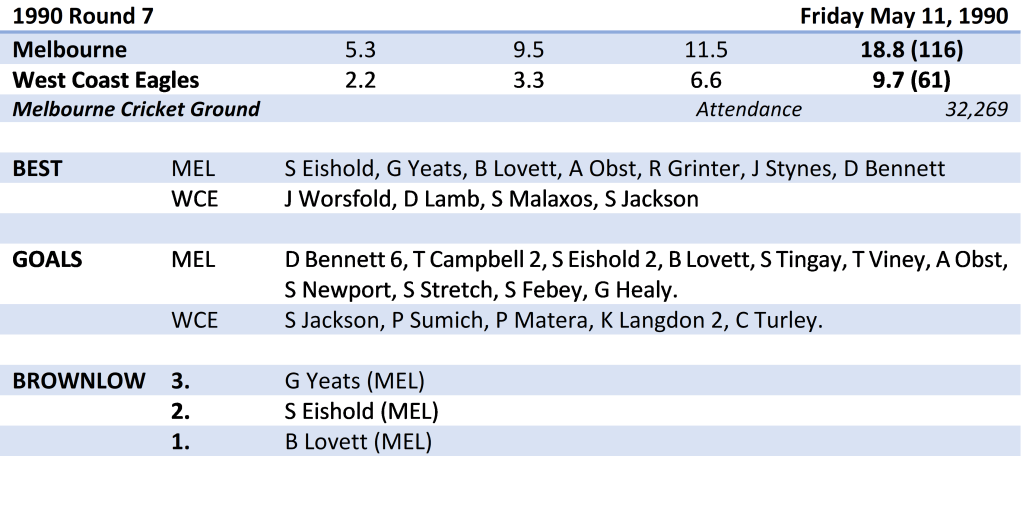
MCG Demons Return

Melbourne Claim Points in Top-of-the-Table Fizzer

A week can be a long time in football.

Seven days on from their breakthrough first win at the MCG, the Eagles horror record at the ground was once again at the forefront when they were humbled by the Demons to the tune of 55 points.

The Eagles and Demons headed into their round seven meeting occupying the top two spots on the ladder, with 5-1 records, but the top-of-the-table clash proved a non-event as Melbourne ran away with the game in the first half.

The Demons opened up a three goal break at the first change and were never seriously troubled, finishing with a seven goal final quarter to blow out the margin, and regain their spot at the top of the table.

And there was plenty of insult to injury.

Inaugural Eagle Darren Bennett – who was let go by the club after just one season – did the damage up forward for Melbourne, booting six goals, while West Coast were also left reeling after Dean Laidley was carted off the ground in the second quarter with a knee injury that would rule the half-back flanker out for the rest of the season.

Laidley would be one of three players who would fall victim to a serious knee injury at the MCG in Round 7. North Melbourne pair Brenton Harris (playing in the reserves) and Darren Steele both went down the following day, as criticism over the state of the MCG playing surface grew.

Both Melbourne and West Coast had aired concerns over before the match, with the Eagles declaring they were lucky not to incur any injuries the week before against Richmond. Demons coach John Northey was particularly vocal about the dangers, but AFL communications manager Tony Peek played down the comments.

“We will be keeping a close watch on the situation”, Peek said.

Peek would come to rue those words, with three serious injuries in less than 24 hours. Footscray and North Melbourne joined the chorus of voices demanding action over the state of the ground, with recent attempts to fill holes in the ground with sand failing to deliver any improvement.

Following the Eagles’ defeat, Malthouse wouldn’t be drawn on the playing field, but expressed disappointment over losing Laidley. “It did not look good.”

Malthouse also delivered a blunt analysis of his team’s showing.

“We made far too many mistakes.”

“I thought we could do better and it was a learning curve for all concerned”, Malthouse continued. “We will make adjustments and be a better side.”

The Eagles made two changes coming into the match, with Troy Ugle and wingman Chris Mainwaring both dropped. Mainwaring had struggled in his two games since returning from a back injury, but was still a surprise omission, marking the first time in his 63-game career he had lost his position.

First-year player Peter Matera was chosen for his second game to replace Mainwaring, with Geoff Miles the other inclusion. Miles had failed to play so far this season as he recovered from a hamstring injury, named at full back.

The Demons also made two changes, as they battled somewhat of an injury crisis. Already without Steven Clark and Trevor Spencer for the season, Melbourne lost defender Sean Wight the week before with a knee injury suffered while playing for the reserves and veteran Alan Johnson was unable to prove his fitness in his effort to come back from a calf injury.

The Demons also lost Brian Wilson to a broken cheekbone during the loss to Sydney the week before, with Wilson ruled out, along with Jay Viney who was dropped. Rod Grinter and Glenn Lovett were the two inclusions.

The Eagles started brightly enough with goals to Peter Sumich and Stevan Jackson early in the first quarter, after Simon Eishold opened the scoring. But the Eagles soon became their own worst enemy as Melbourne capitalised on a number of errors in defence.

Michael Brennan twice turned over the ball coming out of defence, leading to Demon goals before Greg Healy led the race back to goal to toe-poke from the square after Murray Rance couldn’t mark at centre half back.

The Demons added a fifth to take their lead out to 19 points at quarter time. The Eagles’ ball use didn’t improve in the second quarter as Melbourne doubled their advantage to 38 at the major break. Dean Laidley had come off the ground after his knee crumpled beneath him, with West Coast leaving plenty to do for an unlikely victory.

The Eagles for their part responded at the start of the second half, booting the first three goals, as they closed to within 17 points. But they were left to rue several other missed opportunities and some poor kicking into their forward line.

“We could have got closer and it may have been a different story in the final term”, Malthouse said.

Having worn everything the Eagles could muster, the Demons responded with two late goal to take their lead out to 29 at the final change, and when Melbourne booted the first three goals of the final quarter, the game was all but won.

While Bennett was the major contributor on the scoreboard, the Demons had an impressive spread of goal kickers with 11 players registering majors. In contrast, the Eagles had just five goal kickers as they constantly broke down going forward.

Dashing Melbourne defender Graeme Yeats provided plenty of rebound from the backline, picking off a number of errant passes, while Rod Grinter was impenetrable in the back half.  

The Eagles decision to only run with one recognised ruckman against Demon pair Jim Stynes and Steven O’Dwyer also proved costly as the Melbourne midfield were regularly gifted first use of the ball from stoppages. Phil Scott managed just five hit-outs for the match, compared to the combined tally of 23 of his direct opponents.

Andrew Obst and Simon Eishold were influential early, finishing with 21 and 15 disposals respectively, while Brett Lovett led the Demons with 26 touches through the middle. Stephen Newport (23 dipsosals), Steven Stretch (21) and Stephen Tingay (20) all gave the Demons plenty of drive, as West Coast often had to build their attacks from defence.

Dwayne Lamb was the sole winner for West Coast in the middle, collecting 20 kicks and 13 handballs. Stephen Malaxos picked up 26 touches and John Worsfold had 28 in a performance that drew praise from Malthouse after the game.

“He was outstanding, considering we only decided to play him five minutes before the game because of a nagging (leg) injury.”

John Worsfold was one of the few winners for West Coast

The result saw Melbourne reclaim top spot, a game ahead of Hawthorn and West Coast, who had fallen to third. However, a number of surprise results over the weekend meant the Eagles maintained a game advantage over the chasing pack.

Essendon were beaten by an improving Carlton, by 20 points, while St Kilda suffered a shock 18 point loss to the bottom-placed Fitzroy, despite seven goals to spearhead Tony Lockett. Despite the losses, the Saints and Bombers both held their spots in the top five, after Geelong blew a golden opportunity to move into the finals positions.

Hosting the second-last Tigers at Kardinia Park, the Cats booted a horrid 9.28 in a 14 point defeat, giving Richmond just their second win of the season. Collingwood were also left outside the top five when they fell to the Hawks in one of the rollercoaster games of the season. The Magpies trailed by five goals at half time, only to hold a 10 point lead at three-quarter time, before falling short by two points.

Following back-to-back games at the MCG, the Eagles were set for a fortnight at home against Brisbane and Geelong, but Malthouse was quick to dismiss the suggestion that the Eagles were happy relying on their perceived home ground advantage to bank the wins they needed for finals.

“We will end up on our backsides if we think [we are guaranteed those games]”, Malthouse warned.

“There are seven or eight sides vying for the top five and it might take at least 14 wins to make the finals.”

1994 Rewind: West Coast Storm Into Decider

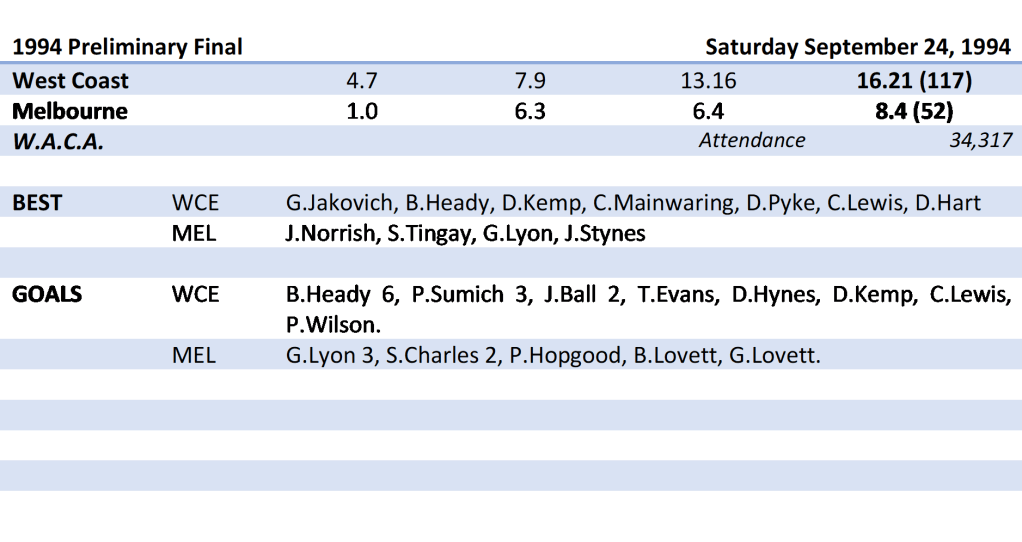
West Coast made it to their third grand final in four seasons when they convincingly defeated the Demons by 65 points in the preliminary final.

The Eagles ended Melbourne’s fairytale finals run, who had knocked off Carlton and then Footscray after finishing seventh at the end of the home and away season. Garry Lyon had booted a record 10 goals in the 79 point massacre of the Bulldogs, but the Demons ran out of steam against a refreshed Eagles outfit.

Despite having a fortnight to recover, Ashley McIntosh was ruled out of the preliminary final, allowing Mitchell White to come in for just his sixth game of the season as cover in the Eagles defence.

The Demons also made just one change to the team that thrashed Footscray the week before with sharpshooter Sean Charles adding to an already potent forward line, replacing the omitted Glenn Molloy.

Ahead of the game, tensions were raised between the two sides when two Melbourne officials were spotted watching the Eagles train in what was supposed to be a closed training session. While the Melbourne ‘spies’ – football manager Richard Griffiths and match committee chairman Greg Wells – had no issue with being asked to leave, the response from West Coast drew some mirth from Demons coach Neil Balme.

Balme proudly declared after the teams were submitted on Thursday night that Melbourne would go in as named. The Eagles, however, remained guarded over their final line up, with Mick Malthouse calling the antics from Melbourne as ‘childish games’.

The final 21 for West Coast wasn’t confirmed until just before bouncedown with West Coast swinging two late changes. Drew Banfield returned to the team after being dropped for the clash with Collingwood while Ryan Turnbull was brought into the team having recovered from a knee injury suffered against the Blues in Round 22. Craig Turley remained as the Eagles’ third emergency, unable to reclaim his spot in the side after serving a two games suspension for striking Greg Williams.

Turnbull’s inclusion to join David Hynes in the ruck was designed to counter the Demons’ strong ruck combination of Jim Stynes and Dean Irving. Tony Godden made way for Banfield, with Turnbull replacing Brett Spinks who was battling a knee concern picked up in the qualifying final.

The Demons stayed true to Balme’s claim that there would be no changes to the squad, but he still did his best to catch the Eagles off guard with a number of positional moves.

Stephen Tingay had previously matched against Chris Mainwaring on the wing, but he swapped sides with Matthew Febey to go head to head with Peter Matera. Febey was stationed against Mainwaring in a more defensive role, as the Demons looked to slow down the Eagles ball movement.

Dean Irving started in the ruck, leaving Jim Stynes to operate off the bench, while Andy Lovell shifted to half-back, initially matching up on Brett Heady.

However, only the Tingay move had any real effect as West Coast dominated the quarter, kicking with the wind. Matera had been under a cloud since injuring a back during the last quarter against Collingwood and was unable to work defensively on Tingay who collected 11 possessions in the first term. Malthouse moved Banfield to the wing to quell Tingay’s influence at the start of the second quarter, pushing Matera to a half forward flank.

Everywhere else on the ground was owned by the home team.

Tony Evans and Dean Kemp were both prominent early, with nine first-quarter possessions while Chris Lewis had eight across half-forward. All of the Eagles forwards got into the game early with the weight of possession in their forward half.

Mainwaring was dynamic on his wing opposed to Matthew Febey and Brett Heady was both too tall and too elusive for Lovell across half forward. The Eagles took control around the ball, with Irving lacking influence in the ruck against David Hynes.

The Eagles racked up 11 shots on goal for the term, but wasted a host of chances. West Coast were 1.7 at one stage, before three late majors to Jason Ball, Tony Evans and Peter Sumich created a deserved advantage.

The Demons, on the other hand, could manage just one shot on goal with Glenn Lovett responding to Brett Heady’s opener into the wind.

The second quarter became an arm wrestle as West Coast held the Demons at bay in defence but continually struggled to take chances up forward. Brett Heady missed a simple shot at the top of the goal square, before Garry Lyon broke the drought when he broke free of Michael Brennan.

That goal came with a tinge of controversy after Sumich was unlucky to be penalised at the other end. Sumich had a free kick paid against him after he pushed Sean Wight in the chest before going on a lead, with the Eagles full-forward then giving away 50 metres for remonstrating with the umpire.

The Lyon goal only served to open the game up.

Brett Heady found Chris Lewis for the instant reply, before kicking two himself as West Coast opened up a 32 point lead closing in on half time.

The Demons then showed the form that had propelled them through the first two weeks of the finals with three goals in as many minutes to close out the half.

Sean Charles swooped on a Michael Brennan fumble to snap truly, with the Demons kicking a second goal less than 20 seconds later when Andrew Obst won the clearance and found Brett Lovett who was able to kick on the breeze from the edge of the centre square.

Charles then had his second goal for the match after Melbourne were able to string a chain of handballs from half-back, with Viney releasing Charles into an open goal after reading the ball of a marking contest in the Demons forward 50. Melbourne had closed within 13 points in a blink of an eye and had one final chance on the half-time siren.

Andy Lovell had been moved to half-forward after losing the reins on Brett Heady and found himself on the end of a Dean Irving miskick to mark 40 metres out directly in front. Lovell could have brough the Demons to within a kick, but he skewed his shot on goal to allow West Coast to hold onto a 12 point lead.

The Eagles had smashed the Demons 13-3 in the centre clearances and had nearly 40 more possessions around the ground, but their inefficiency in front of goal prevented them from having one foot already in the Grand Final.

West Coast’s shooting on goal only got worse in the third quarter, but by the final changeit no longer mattered.

The Eagles had piled on 6.7 to a solitary behind with their second use of the wind to establish a nine goal lead that they were never going to give up.

The warning signs for Melbourne showed early in the term, with West Coast posting a further four points onto their half-time score, including what could almost have been a late goal of the year contender.

Glen Jakovich had completely shut out David Schwarz across half-back, and after picking up a loose ball in the back pocket, the burly centre half-back bounced his way through the middle of the WACA to the rousing roar of the home crowd. Jakovich launched from the top of the Eagles 50 metre arc only to see his shot on goal hit the base of the post, resulting in one of the more memorable points in club history.

Brett Heady ultimately got the first goal for the Eagles in the term, booting three in the quarter to take his match haul to six. His fifth goal came from another turnover from Andy Lovell in defence as Melbourne’s day started to capitulate.

Stephen Tingay – who had been the Demons best player in the first half – limped off with a knee injury, while David Neitz was forced to the bench after being crunched by Sumich in a marking contest.

The Eagles added three goals to two in the final quarter to run away with their largest ever win in a final.

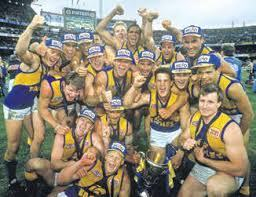
Eagle players celebrate another grand final

Malthouse was ecstatic post-match with the ‘almost faultless’ performance but was quick to point out that the job was still not done.

“Every club aims to make the Grand Final at the start of the season,” Malthouse said.

“Making the Grand Final is not good enough. Winning has got to be the aim.”

It was a deflating end for the Demons, who dared to dream after stunning finals wins over Carlton and Footscray left them one game shy of the big dance. Neil Balme admitted his team just couldn’t handle the occasion.

“I think our blokes just lost it. They lost all confidence in their ability to play footy.”

“They were shell-shocked.”

Melbourne struggled to have a winner on the ground, with West Coast’s defence supreme. Schwarz was virtually a spectator, with Mitchell White keeping Paul Prymke quiet. David Hart had the better of Sean Charles while John Worsfold and Guy McKenna provided their customary dash from half back.

Chris Mainwaring – who sported jumper number 43 after half-time due to blood rule stipulations – was the leading ball winner for the Eagles with 29, while Dean Kemp had the better of Jason Norrish, Andrew Obst and Andy Lovell with 25 disposals through the middle.

Brett Heady didn’t add to his six goal tally as he sat the final quarter on the bench. Peter Sumich finished with 3.3 despite a mixed performance, but Chris Lewis was electric with 20 disposals and a goal across half forward.

The Eagles Grand Final opponent had been decided earlier in the afternoon when Geelong defeated the Kangaroos in a classic encounter.

North Melbourne started the stronger of the two sides to lead by three goals at quarter time, but could have led by far more with straighter kicking on goal. The Cats then took charge with a seven goal to nil second term to lead by 24 points at the main break.

Geelong still led by 18 at the final change, but North Melbourne, with the benefit of a weeks rest, stormed home. The Cats drew level once again, before Leigh Tudor sent a wobbly kick to the top of the Geelong goal square in the dying seconds of the game. His kick landed in the arms of Gary Ablett, who sent the Cats into the Grand Final with a goal after the siren.

It was the second final in three weeks Geelong had won after the siren, with the Eagles and Cats set to square off two years after they clashed in the 1992 decider.