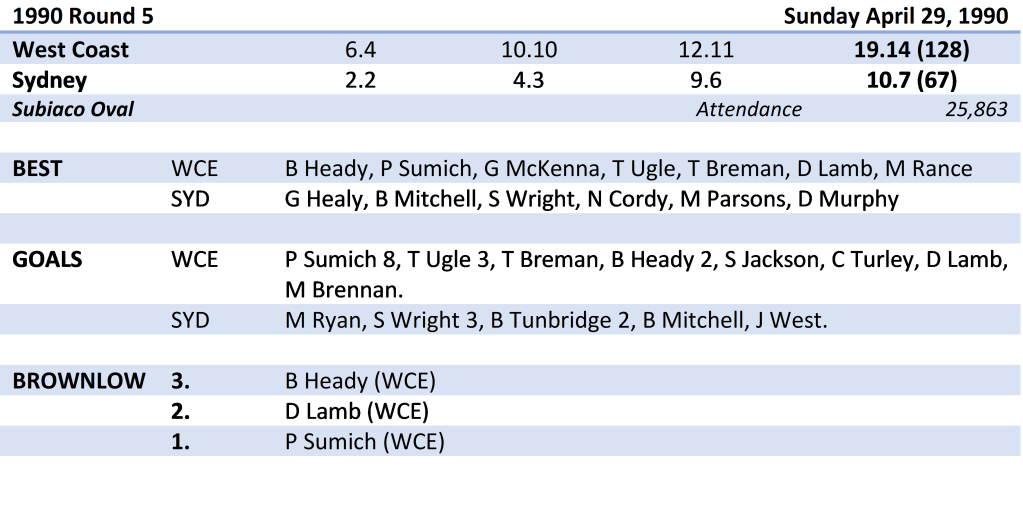
Eight goals from Peter Sumich helped West Coast to a commanding 61 point win over Sydney at Subiaco Oval. The Eagles recorded their third straight win to take their season record to 4-1, rising to third on the ladder.
The Eagles were sandwiched between the Hawks and Magpies, with all three teams on four wins, while the Demons remained the competition benchmark with their fifth win from five games after demolishing the Bears.
Sumich’s haul of eight came in two bursts during the game, mirroring the performance of West Coast through the match.
The Swans arrived in Perth without a win since round 1 and had lost key midfielder Greg Williams to a broken thumb the week before in their defeat to St Kilda. Sydney kept pace with the Eagles early in the game, before three goals to Sumich in time-on helped the Eagles build a 26 point lead at the first change.
West Coast remained in control of the game during the second term as they extended their lead to 43, before the Swans mounted a comeback after half-time. Sydney ruckman Michael Parsons took hold of the ruck combining with rover Gerard Healy to drive the visitors back within touching distance.
Healy had been well contained by Dwayne Lamb in the first half, but racked up 11 disposals in the third quarter as Sydney took over in the centre square. Healy had strong support from fellow midfielders Steven Wright (nine disposals) and Barry Mitchell (eight disposals) as the Swans slammed on five goals for the quarter to reduce the deficit to just 23 points at the final change.
Sumich had failed to add to his goal tally since quarter time, but another four goal burst in six minutes to start the final quarter snuffed out Sydney’s comeback effort. Three of those goals were set up by second-gamer Brett Heady, who was one of the Eagles’ best with 21 disposals and two goals.
Sumich kicked a fifth late goal for the quarter late in the term, finishing with a career-best eight for the match, equalling his effort against the Bulldogs in round five the year before.
Troy Ugle provided the perfect foil for Sumich up forward with three goals from 22 disposals and eight marks, while Peter Wilson (22 disposals) and Guy McKenna (21) were major ball winners for the Eagles. McKenna’s performance was even more striking considering the defender was forced off the ground during the third term with food poisoning.
Troy Ugle was a focal point up forward with three goals
McKenna’s departure from the game coincided with the Sydney’s strongest period of the game, as they converted centre square ascendancy into scores. But, unlike West Coast, the Swans didn’t have a reliable target in their forward arc, with Murray Rance a major roadblock in defence. Rance finished with 21 disposals and seven marks and had the better of a number of Swans opponents who were tried in the key forward position.
Malthouse again praised his defensive unit, admitting that it wasn’t his side’s best performance. John Worsfold stepped into McKenna’s role after he departed the field, while Dean Laidley was strong off the other half back flank.
For Sydney, Gerard Healy finished with 29 touches in his battle against Dwayne Lamb, while Barry Mitchell racked up 28 touches, although was less effective through the centre with Steve Malaxos for company. Neil Cordy tried hard in defence and Stevie Wright had 22 disposals to go with his three goals.
With the final quarter still fresh in his mind, Sydney coach Col Kinnear expressed disappointment in his sides’ ‘very soft’ finish. “As a realist, you can’t think of finals’, Kinnear said.
Mick Malthouse though was happy to take the four points from the underwhelming performance, as West Coast consolidated their position in the top five.
A week on from their impressive dismantling of the Magpies, the Eagles were given a fierce reality check in a 68 point defeat to St Kilda, led by spearhead Tony Lockett.
Lockett finished with nine goals – six of which came in a devastating burst in the second term when the Saints were kicking into a howling wind, all but sealing the contest.
West Coast made just the one change to the team that accounted for Collingwood in Round 1, with Chris Lewis returning to the line up from injury. Lewis hadn’t played since aggravating his hamstring against North Melbourne in the Eagles second Fosters Cup match.
Lewis replaced Peter Matera, who managed just nine disposals in a quiet debut the week before. Stand-in captain John Worsfold held his spot despite sporting strapping around his thigh at training during the week and again led the team in the absence of Steve Malaxos.
The Saints also made the one change to the team that defeated Footscray in the opening round. Captain Danny Frawley returned after being a late withdrawal the week before, with Ian Muller making way.
Heading into the game, Malthouse made no secret of the danger Lockett posed, with the burly full forward the difference in the previous meeting between the two sides. In the only meeting between the two sides in 1989, Lockett booted 12 of the Saints 18 goals in a 35 point win.
The Saints scored first use of the wind, but the Eagles did well to stay within reaching distance at quarter time. Karl Langdon opened the scoring, before the Saints finished with the last 10 scoring shots in the quarter, for an inaccurate 4.6.
24 points down at the first break was an acceptable margin given the wind advantage and Lockett had managed just one major for the term as the Eagles employed a loose man in defence to block his space. Michael Brennan was given the role on Lockett, teaming with Murray Rance to regularly double-team Lockett.
West Coast abandoned the tactic at the start of the second term kicking with the wind, leaving Lockett one-out with Brennan. Peter Sumich booted the opening goal when he was left alone in the goal square to reduce the Saints lead to 18 points.
Andrew Lockyer fell short in his attempt on goal moments later, before Chris Mainwaring blew a golden opportunity when he overran the ball in front of goal. The Eagles had much of the play early in the quarter as they worked their way into the contest.
Then ‘Plugger’ ripped the game apart.
With the Saints getting on top through the midfield, Lockett kicked five of the next six goals in the game, with only a long range effort from Murray Rance, breaking the run.
Lockett powered through the Eagles defence, often marking against multiple defenders in the air and in one instance, brushing aside two Eagles as he soccered the ball through at the top of the goal square.
Ruckman Damien Kitschke added a sixth goal for the term for the Saints when he was found unmarked in front of goal by Dean Rice, before Lockett booted his seventh goal for the match – and sixth goal in the quarter – when he was paid a juggled contested mark.
The Saints had booted seven goals to two against the wind to take a commanding 58 point lead into the main break. Their lead increased to 78 at the final change, before the Eagles limited some of the damage with a five goal final quarter.
Murray Rance took over from Brennan on Lockett in the second half, holding the full forward to just two second half majors. Still, Lockett finished with an impressive match haul of 9.4 from 18 disposals and 12 marks, making it 19 goals in two weeks after opening the season with a bag of 10 against the Bulldogs.
“Let’s face it, the man is awesome. Once he gets his hands on the ball, it’s good night Irene”, Malthouse exclaimed.
While Lockett was terrorising the Eagles defence up one end, the same couldn’t be said at the other, where Frawley and regular forward Stewart Loewe were impenetrable. Frawley held Eagles forward Peter Sumich to just one goal, while Loewe vied with Lockett for best afield honours as he continually intercepted many of the Eagles’ forward thrusts.
Loewe finished with 31 disposals and 15 marks in a dominant performance at centre half back. The Eagles could not find a way through their half forward line, with Murray Rance, Andrew Lockyer, Karl Langdon and Phil Scott all tried with little success.
The Saints were also well served by a number of recruits. Damien Kitschke – in just his second AFL game – was too strong in his duel with fellow second gamer Dean Irving, often providing the Saints midfield with first use at the stoppages.
Kitschke finished with 25 disposals, seven marks, 14 hit-outs and a goal, many of his possessions coming as he sat behind the play when West Coast kicked with the wind. Tim Pekin gathered a career best 38 disposals in just his second game at Moorabbin, after switching across from Fitzroy ahead of the 1990 season.
Pekin was particularly damaging early as St Kilda built their lead, with John Annear brought onto the ground in a bid to quell his influence. Grant Lawrie and Jim Krakouer were others to impress in their second games with the Saints, after crossing from Fitzroy and North Melbourne respectively, collecting 22 and 21 possessions.
Krakouer had shone in his club debut the week before with 36 disposals, earning the tag of Dwayne Lamb, but still having moments of magic. Peter Russo (32 disposals and a goal) and Nathan Burke (31 disposals) were other major ball-winners through the midfield.
And with Lockett garnering much of the attention of the West Coast defence, Rod Owen was allowed to slip under the radar across half forward, booting 4.4 from 21 disposals.
Ken Sheldon – who had made it two wins from two games in charge at the Saints – lauded his side’s second quarter into the wind. “It was a tremendous effort by the players.”
“The second quarter was one of the best quarters of football you would see anywhere. Our players have proved to themselves that they can match it with anybody.”
For West Coast, there were too few players who contributed.
Dean Laidley was arguably the Eagles best player in his negating role on Nicky Winmar at half back. Winmar still tallied 23 disposals, but didn’t have the impact he was renowned for, while Laidley finished as the Eagles leading disposal getter with 27.
Don Pyke booted three second half goals as the Eagles major goal kicker, while Guy McKenna was dependable at half back. Peter Wilson put on a second strong showing at his new club as one of the few Eagles to bring physicality to the game.
Peter Wilson was one of the few performers for West Coast on a poor day
“I’m totally at a loss”, Malthouse said. “I’ll talk to the players as individuals. But there is no magic formula.”
“There was a complete lack of pressure on their runners.”
The turnaround in performance wasn’t the only concern for West Coast out of the match. Chris Lewis, in his return from injury, failed to last a quarter when he succumbed to an ankle complaint. Michael Brennan suffered a groin injury and Laidley played out the game with a corked calf.
Karl Langdon was placed on report for striking Tim Pekin with a forearm to the head.
The result also continued the Eagles’ poor record in Melbourne. The Eagles had now won just five games from 28 matches in Victoria, with Malthouse declaring changes would be made to arrest the horror record away from home.
The AFL was officially born with league headquarters re-branding from the VFL to recognise that the competition was now national, with clubs located in Victoria, New South Wales, Queensland and Western Australia.
The West Coast Eagles had also undergone significant changes since a disappointing 1989 campaign.
John Todd was replaced as coach after two seasons, with Victorian Michael Malthouse taking over the reins following six seasons at Footscray. The Bulldogs had only made the finals once during Malthouse’s tenure as coach, falling agonisingly short of a Grand Final appearance in 1985 in Malthouse’s second year.
The Bulldogs had remained competitive since, hovering just outside the final five, before crashing to second-last in Malthouse’s final year in charge, as the club battled football extinction. The Bulldogs would exist in their own right for season 1990 – saved from merging with Fitzroy – but Malthouse sought a new challenge across the Nullabor.
The transition between Todd and Malthouse hadn’t been a smooth one; news of Malthouse’s appointment had been leaked before Todd was formally told he would not be offered a new contract, with the Eagles hierarchy scrambling together a press conference on the afternoon of October 3, 1989 to present Malthouse as the clubs third coach.
Malthouse would not be the only key change for the Eagles heading into 1990.
Brian Cook was appointed CEO, after two years with the WAFC, and Trevor Nisbett was appointed football manager. On-field, Stephen Malaxos was named captain with John Worsfold vice-captain and the club was able to establish Subiaco Oval as its permanent training base, having operated out of a number of different locations across their first three seasons.
Leading up to the clubs opening game against Collingwood, the signs were positive the Eagles could return to finals action.
The Eagles lost narrowly to Essendon in their Fosters cup opening game, but were given a reprieve in the competition after Brisbane failed to travel down for the pre-season competition. West Coast played the Bears’ opponent in North Melbourne, and narrowly lost again. The Eagles lost both games by three points, with poor kicking for goal to blame in both defeats.
West Coast then hosted the previous seasons Grand Finalists in practice matches to round out the pre-season. Both were resounding victories. The Eagles thrashed the Cats by 89 points and then followed up that performance with a 12 goal win over the Hawks.
West Coast named a fresh squad to tackle the Magpies, who were one of the premiership favourites heading into the season. Collingwood had made the finals the previous two seasons under Leigh Matthews, but had been bundled straight out in both years. With a number of key recruits over the off-season, many believed the Magpies were ready to take the next step.
The Eagles named four players for their AFL debut. Peter Matera – the Eagles first selection at the 1989 draft – Dean Kemp, Dean Irving and Brad Gwilliam were all selected for their first matches, while Peter Wilson was also picked for his first game with the club, having switched across from Richmond.
John Worsfold was left to lead the club, after new captain Steve Malaxos was forced to miss the game with a broken foot. Malaxos had suffered the injury, stepping on a picket at his home, missing the start of the season.
The Magpies named new recruits Tony Francis and Scott Russell, who had both joined the club from the SANFL, but prized addition Paul Hawke and defender Michael Christian were both unavailable due to hamstring injuries.
The two sides had met in the final round of the 1989 season, with Collingwood easy 49 point winners.
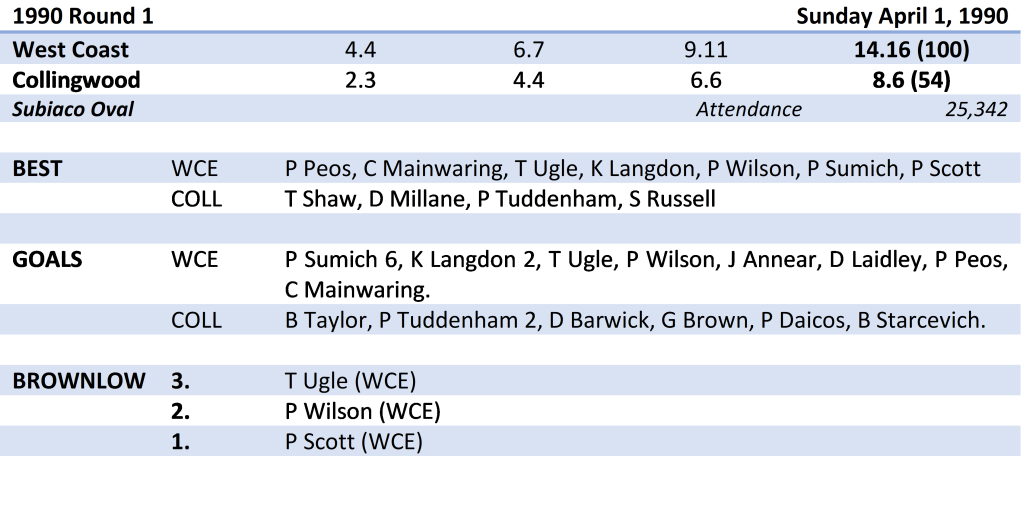
But in a clear sign of how much the Eagles had progressed in one summer, West Coast extended their lead in every quarter to run away with a 46 point win.
In a bruising encounter that had plenty of moments of spite between the two sides, it was an all-in brawl midway through the third quarter that set the course of the final outcome. Collingwood first-gamer Tony Francis lashed out at Eagles defender Murray Rance as the two tumbled over the boundary line, sparking an altercation that involved most players from both sides.
Play was held up for several minutes as the umpires tried to separate the players and when the two teams did get back to playing football, it was the Eagles who settled quicker. The Eagles booted the next three goals to stretch their lead out to 34 points, and while Collingwood responded with the last two goals in the term, a five goal to two last quarter sealed an impressive win for the home side.
Peter Sumich starred up forward with six goals, but it was the improved defensive attitude that pleased new coach Mick Malthouse most. Collingwood could manage just eight goals for the afternoon, with Michael Brennan shutting out full forward Brian Taylor and Murray Rance the better of Craig Starcevich.
Sumich led the way up forward with six goals
Dean Laidley had the better of Jamie Turner, while John Annear found a new role in defence, marked with the task of minding Gavin Brown.
The Magpies struggled throughout the day with the man-on-man structure that Malthouse implemented, as well as the intense pressure around the ball.
“They (the players) didn’t talk about how much they’d won by or who kicked the goals. The first thing they said when they came in was the tackling was terrific”, an excited Malthouse proclaimed after the match.
“They acknowledged each other and it’s important that they think that’s one criterion of success, either at Subiaco Oval or Melbourne.”
Troy Ugle was stationed in the back pocket for the Eagles and provided plenty of dash through the first half, before being forced off the ground when he was caught under the pack of the melee, injuring an arm in the process. However, he returned to the field in the forward line for the final quarter, booting a goal and setting up two others in a best-afield display.
First-gamer Dean Irving combined well with Phil Scott in the ruck with the duo proving too strong for Collingwood pair Damien Monkhorst and James Manson at the stoppages. The Eagles midfield benefitted from this advantage with Paul Peos the leading ball-winner with 25 disposals and Chris Mainwaring next-best with 22.
Dean Kemp had 20 touches on the wing to get the better of Graeme Wright and Dwayne Lamb restricted Peter Daicos to just six kicks and a goal.
After having his colours lowered by Paul Tuddenham in the first quarter, acting captain John Worsfold was released into the middle, where he finished with 19 disposals and gave plenty of drive along with Karl Langdon, who collected 21 touches and booted two goals roaming between half forward and the centre.
For Collingwood, only captain Tony Shaw (24 disposals), newcomer Scott Russell (22) and Darren Millane (21) showed they were capable of matching the fierceness that West Coast brought to the contest.
It only got worse for the Magpies, with Francis later suspended for six games for kicking Rance. In his tribunal hearing, Francis remarked that he had been provoked when he felt Rance brush his groin area, and while he admitted responding with a kicking action, believed that he had missed Rance. The Eagles defender supported the claim by Francis that he didn’t make any contact, but that didn’t stop tribunal chairman Neil Busse rubbing the Collingwood midfielder out until round 8.
The Eagles themselves weren’t immune from the tribunal, with runner Rob Wiley charged for his involvement in the melee. Wiley was sanctioned and fined $1000.
While the result proved an awakening to the rest of the competition, Malthouse remained calm, saying there was plenty for his side to work on.
“If you come away from round one with a win, and plenty of work to do, that’s good.”
The Eagles six game winning streak was brought to a
surprising end when they were toppled by an undermanned Collingwood at the MCG.
Andrew Tranquilli proved the unlikely star for the Magpies,
booting six goals in just his third AFL game as Collingwood held sway for most
of the day to record the 37 point victory, in front of a disappointing crowd of
only 27,699.
The Magpies entered the match as rank outsiders after a
humiliating 66 point defeat to Richmond on the Queens Birthday just six days
earlier as well as dealing with a crippling injury list.
Already without Paul Williams (knee), Craig Kelly
(hamstring), Gary Pert (knee) and Jon Ballantyne (knee), Collingwood lost a
further three players in the loss to the Tigers. Jason McCartney pulled out
before the game, with Brad Rowe (dislocated shoulder) and Brad Plain (groin)
both out of action before half-time.
In response to the loss, the Magpies made six changes for
their clash with West Coast. McCartney returned to the line-up and was joined
by veteran midfielder Scott Russell, wingmen Mark Fraser and Todd Curley, and
rookies Paul Sharkey and Tranquilli.
Brad Rowe and Bradley Plain were both forced out with their
respective injuries, as was defender Damian Houlihan who was suspended for
striking Chris Naish. Stephen Ryan, Brenton Sanderson and Glenn Sandford were
all dropped.
The Eagles, on the other hand, welcomed back a number of
reinforcements. Brett Heady returned to the side after two false starts in the
previous two weeks, with Peter Wilson also returning from a week off due to a
hamstring strain. The Eagles brought in Paul Harding to partner Ryan Turnbull
in the ruck, with West Coast conscious of the threat of Magpie ruckman Damian
Monkhorst.
Out for the Eagles were David Hynes and Jarrad Schofield,
who were both dropped, while Shane Bond missed out due to a hamstring complaint.
Craig Turley was considered unlucky not to be named after a strong month of
football with West Perth, but was a late inclusion for his first game since
Round 5 when he replaced John Worsfold. The Eagles captain failed to recover
from an arm injury suffered against the Bears.
Despite the Magpies’ troubles heading into the game, Eagles
coach Mick Malthouse forewarned a response from Collingwood, saying the
preparation had worked in the Magpies favour. Malthouse believed that the
negative reporting from the Victorian media over the Magpies’ recent
performance and injury woes had given Collingwood a psychological edge.
“They will go in as the rank underdogs basically because of
a media beat-up on their injuries. The reports don’t say anything about the quality
players that are in their side,” Malthouse said.
“The day a side loses a game because of who is sitting in
the grandstand, is the day I’ll give the game away.”
Malthouse’s concerns would prove to be right.
The diminutive Tranquilli booted the opening goal of the
match as Collingwood opened up a two goal lead at the first change. The Eagles
though would rue a host of missed early chances. They had four behinds on the
board before Brett Heady kicked their only goal for the quarter.
The Magpies then broke the game open in the second term with
three goals in eight minutes, off the back of a courageous act from captain
Tony Shaw. Running back with the flight of the ball, Shaw marked in the middle
of the ground with Eagles winger Chris Mainwaring bearing down on him from the opposite
direction, which led to a goal to Mick McGuane. Saverio Rocca and Nathan
Buckley quickly followed with majors and the Magpies were out to a 23 point
lead.
The Eagles worked their way back into the game, but could
only match Collingwood for the rest of the term as the Magpies headed into the
half-time break with an 18 point advantage.
After managing just four goals the week before against
Richmond, Matthews’ loaded up his forward line and instructed his side to ‘kick
the bloody thing in there and don’t mess around’. The Magpies started with Sav
Rocca, Brett James and Jason McCartney in the forward line, with ruckman Damian
Monkhorst also drifting inside the Collingwood 50.
This caused a shuffle for West Coast with Ashley McIntosh,
who started up forward, moved to defence to counter the Magpie height. The
forced move denied the Eagles a marking target of their own up forward, which was
soon compounded when Brett Spinks was forced off the ground with concussion in
the second quarter.
Matthews had also identified the Eagles half-back line as
their main driver and looked to minimise their impact. Matthews put his strongest
line at half-forward, with McCartney opposed to Glen Jakovich and Nathan Buckley
and Gavin Brown on the two half-forward flanks.
Buckley had yet to make his mark at Collingwood after a
high-profile switch from Brisbane ahead of the 1994 season and had managed just
10 disposals against the Tigers the week before. However, he responded with arguably
his best performance thus far in the black-and-white stripes, picking up 26
disposals and booting two goals and giving Guy McKenna the run-around.
Buckley and Brown pushed high up the ground and stayed wide
of each other to prevent the Eagles half-backs from teaming together. McCartney
was operating as a decoy to drag Jakovich out of the play, which left
Tranquilli deep in the forward line, often one-out against David Hart.
The other important tactical match-up was the use of Mark
Fraser on a wing against Peter Matera. While Chris Mainwaring was having the
better of McGuane, Matera struggled to have any influence on the game with
Fraser keeping him company.
Matera had just 13 disposals for the game, while Fraser finished
with 21 and two goals, including the vital first goal of the second half.
Fraser extended the Magpies lead to 24 points just two minutes into the third
term, and while West Coast responded, Damian Monkhorst and Andrew Tranquilli made
it three of the first four goals to Collingwood.
Trailing by 31 points heading into time-on, the Eagles once
again rallied. Brett Heady – who had been the only productive forward for West Coast
all day – booted two goals in as many minutes, with Tony Evans and McKenna also
kicking truly. The Eagles trailed by just 13 points at the final break, but a
six goal to two final term in favour of Collingwood handed West Coast their
first defeat in nearly two months.
Brett Heady matched Tranquilli’s haul of six, but the rest
of the West Coast forward line struggled. Eagles coach Mick Malthouse was
philosophical after the game, saying his team had been good but the Magpies had
been the better.
“The game is in flux right through, it shuffles one way and
then the other… we struck a very good side in Collingwood and they beat us.”
“Every match is against a different club, at a different ground
on a different week,” Malthouse continued. “The competition now is so regulated
– weighted draws, drafts and salary caps – that the game is a fluctuating thing
that changes every week… every quarter… what worked last week will not
necessarily do the trick again.”
While Malthouse accepted the result as one that was par for
the tightness of the competition, Matthews praised the win as one of his side’s
best. “It’s got to rank as a good win because we’ve beaten the top side by six
goals.”
More importantly though, for Matthews, the result restored
the Magpies standing within the competition. “Respect and pride. You either
gain a bit or lose a bit and we lost some on Monday.”
“But we gained a bit today.”
Tony Shaw and Damian Monkhorst were the best for
Collingwood, with Monkhorst too good for both Turnbull and Harding. Monkhorst
finished with 16 disposals, 13 hit-outs and two goals while Shaw had 20 with a
number of clearances.
Mainwaring had 26 touches for the Eagles and Don Pyke 24 but
the Eagles had too few winners. “As honest as our players tried to be, they
weren’t good enough.”
“They were beaten by their direct opponents and when shuffled
around they were beaten by another opponent,” Malthouse said. “I don’t know how
we got that close at three-quarter time. But they rallied, steadied and kicked
goals when it counted most.”
“Collingwood did it better than us and won the game.”
Despite the loss, the Eagles remained a game clear at the
top of the ladder, courtesy of a number of favourable results. Only two teams
who started the round in the top eight – fourth-placed Carlton and the eighth-placed
Magpies – won, while the Cats had the bye.
Carlton moved into third spot when they thumped a hapless St
Kilda by 80 points, drawing level with the Kangaroos who lost narrowly to
Richmond. Both teams sat one win behind the Eagles and one win ahead of
Collingwood, who climbed to fifth following their win over West Coast, and
Hawthorn, who lost to Fitzroy by 13 points in a low-scoring match at Waverley.
Melbourne’s season continued to freefall with a narrow defeat
to Adelaide and Essendon were the latest victim of the giant-killing Bears,
going down by 33 points at the GABBA.



 sportsphrase.blog