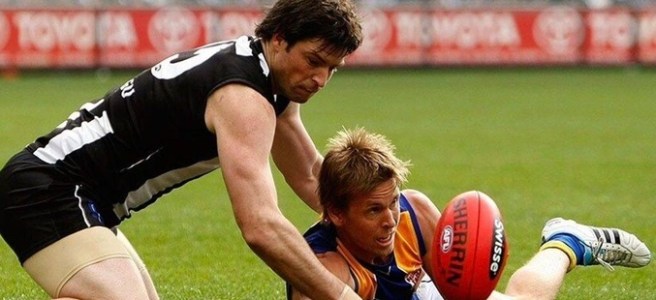
2011 Rewind: Eagles Try, Magpies Fly

Class and Experience Sees Collingwood Home

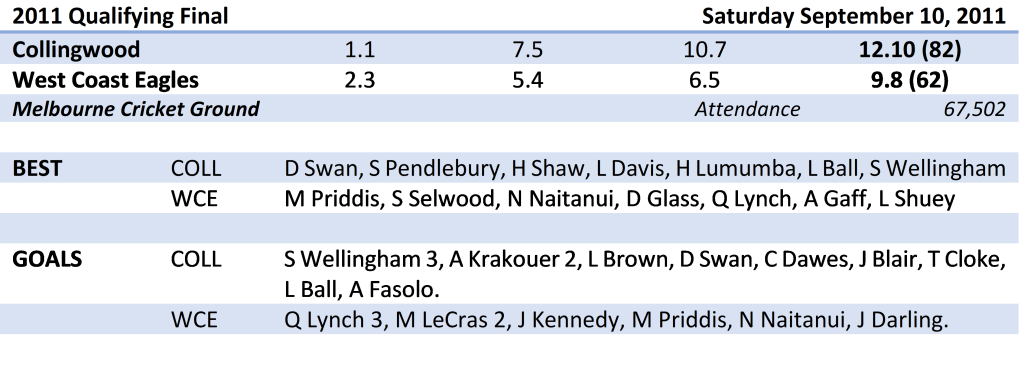
West Coast gave their all but lacked the extra edge, poise and finish needed to book a preliminary final birth in a 20-point defeat to Collingwood.

The Eagles were never out of the game, but never looked completely in the game in what Eagles coach John Worsfold called a ‘learning experience’.

Ten Eagles were taking part in their first final as opposed to the Magpies who had 18 of their premiership stars from the previous years triumph.

Luke Shuey best exemplified the step up needed in finals when he was caught with the ball three times in the opening half, as the experienced Magpies pressured the young Eagles into numerous skill errors and wasted opportunities.

Shuey had finished runner up in the rising star award to Essendon’s Dyson Heppell in what turned out to be a two-horse race earlier in the week, and for much of the first half seemed overwhelmed by the play around him. However, he improved as the game went on and was one of the Eagles’ best.

But while Shuey led an Eagles midfield that applied themselves to the final siren, they were outshone by Dane Swan and Scott Pendlebury who led a masterclass.

Swan, who was considered one of the favourites for the Brownlow medal, collected 43 disposals, including nine clearances, nine inside-50s and a goal. Pendlebury was the perfect sidekick, with 38 touches, seven inside-50s and five clearances. The duo worked off each other perfectly, with Pendlebury picking up 25 of his 38 possessions in the first half, before Swan carried the side home with 27 disposals after half time.

The two teams named near full-strength sides ahead of the game, with the Eagles selecting Daniel Kerr and Will Schofield to return from injury, while the Magpies welcomed back Nick Maxwell, Leon Davis and Heath Shaw.

The teams may have looked strong on paper, but there was still plenty of doubt for the two sides going into the game. Chris Tarrant, Travis Cloke and Ben Johnson had all finished with issues from the thrashing to Geelong and Daniel Kerr was still under a serious cloud for the Eagles.

The doubts on Kerr would be confirmed when he was a late withdrawal ahead of the opening bounce. Patrick McGinnity, who had lost his place at selection, was reinstated. Collingwood were also forced into a late change when Ben Reid injured a groin at the final training session of the week. With patchy weather expected, the Magpies replaced a tall with a small in rookie forward Alex Fasolo.

The visitors came into the match as major underdogs but they started the better of the two sides with the first four scoring shots of the game. Josh Kennedy and Quinten Lynch both kicked majors as West Coast established an early 2.2 to zero lead.

Nic Naitanui and Dean Cox presented as the biggest challenge for Collingwood and while they claimed an advantage in the ruck knocks, the Magpie midfield soon got the upper hand at the stoppages.

Sharrod Wellingham opened the Magpie account to reduce the Eagles lead to eight points at quarter time, before Collingwood turned the game their way in the second term.

The Magpies booted six goals for the quarter as Pendlebury, Swan, Jarryd Blair, Leon Davis and Ben Johnson kick-started the black-and-whites. Davis and Johnson were particularly damaging out of the back half, along with Heritier Lumumba, as they carved and weaved their way through the Eagles press.
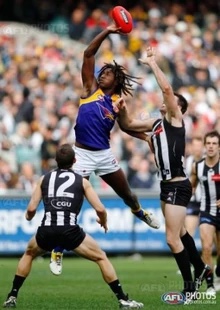
Naitanui was dominant at the ruck knocks for West Coast but the Eagles couldn’t get the upper hand at the stoppages

Leading by 13 points at the main change, the Magpies extended their lead to 26 after goals to Jarryd Blair and Andrew Krakouer. That remained the margin at three-quarter time after Mark LeCras and Travis Cloke traded goals heading into time-on and Collingwood appeared to have done what they needed to, to put the finals upstarts away.

West Coast, though, refused to accept what most others expected.

Even with Cox subbed out during the third term with back spasms, the Eagles found their ascendancy in the middle off the back of Naitanui as the Eagles found consistent forward position for the first time in the match since the opening term.

Quinten Lynch got the Eagles rolling after just 38 seconds when West Coast won the opening centre clearance, before adding a second for the quarter (and third for the match) when he took clean possession from a boundary throw in and snapped truly.

The Eagles continued to push and Jack Darling’s goal at the beginning of time-on had West Coast within seven points and a grandstand finish was on the cards. But Collingwood’s class and experience again came to the fore and they settled in the final minutes to earn the coveted week off.

Worsfold was proud of the commitment of his players but acknowledged the difference between a seasoned opponent and where his young Eagles had come from. Simple misses by Shuey and Scott Selwood as West Coast had all the momentum in the final quarter would prove costly.

“It felt like we were just a little bit short of the class of Collingwood, not the effort but the class. I think we matched them for intensity and effort, but they showed the way with clean ball handling, clean ball use.”

“We just made some errors at times that might have got us more inside 50s, more scoring opportunities and we didn’t quite capitalise”, Worsfold said.

The key to the game lay in the middle of the ground where the Magpies were able to control the stoppages despite Naitanui and Cox’ tap ascendancy. The Eagles eclipsed their opponents 50-29 in the hit-outs, but Collingwood turned the tables at the stoppages, winning the clearances 53-31.

Luke Ball nullified Priddis’ influence at the first possession, limiting Priddis to just four for the match. Nic Naitanui and Luke Shuey combined for 14 clearances – half of the Eagles’ total – but too much was left to too few at the inside-ball contest, where Collingwood had a greater spread of contributors.
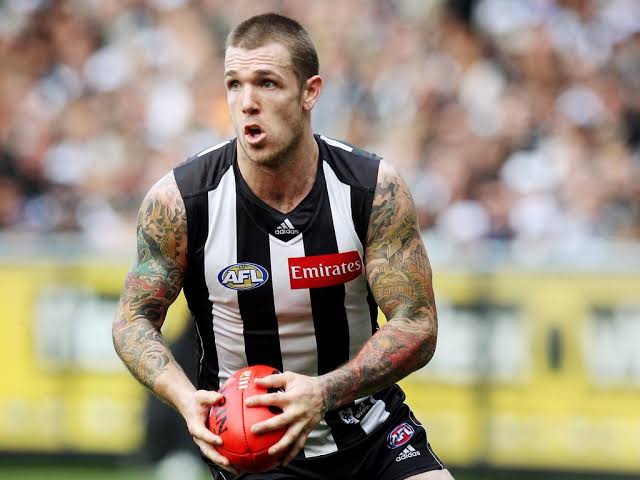
Dane Swan was dominant in the Collingwood midfield with 43 disposals

That prevented the Eagles from getting forward and setting up their defensive press, leaving much of their attack to come from the back half of the ground.

Collingwood coach Mick Malthouse lauded his side’s ability to claim a decisive win in the Eagles strongest part of the ground. “They are very, very good at stoppage work and we knew we wouldn’t be in the plus as far as hit-outs go.”

“We needed a contest. We got a contest… we won quite convincingly on these figures… which is a credit to the boys.”

That forced the Eagle tall forwards to work further up the ground, where Kennedy and Darling struggled to have an influence. The pair kicked the Eagles’ first and last goals in the game, but did little for the rest of the game as they were well contained by Chris Tarrant and Alan Toovey.

And where the Eagles were unable to counter from defence, the Magpies were able to bounce from half back, with a number of the Magpie defenders racking up high possession numbers. Leon Davis finished with 33 disposals, Heritier Lumumba and Heath Shaw each had 30 and Ben Johnson collected 26.

Their performances were even more meritorious considering the disrupted preparations for many of them. Davis and Maxwell had missed the defeat to Geelong, Tarrant and Johnson had queries over their fitness and Shaw was playing his first game after serving an eight week ban for betting on AFL matches during the season.

Up forward, it was the smalls who did the damage, with Sharrod Wellingham booting three first half goals and Andrew Krakouer the other multiple goal scorer for the Magpies. Travis Cloke and Chris Dawes were both defeated in their battles against Eric Mackenzie and Darren Glass.

Priddis led the Eagles with 24 disposals, while laying 13 tackles, with Chris Masten (22 disposals, seven tackles) and Scott Selwood (21 disposals, eight tackles) the next best. West Coast laid 100 tackles for the game which both symbolised their ability to meet Collingwood’s attack at the contest, but also that the Magpies players were often a step ahead in the contest.

The two coaches noted the pressure in the game, with Worsfold calling it a ‘pretty intense game’.

“A lot of pressure and we didn’t cope with the pressure as well as we believe that we can. Our players will learn from that.”

Collingwood were joined in the preliminary finals by Geelong, who overcame an early slow start to account for the Hawks. Hawthorn paid for their early inaccuracy when they had the game on their terms, with the Cats systematically working their way towards a 31 point victory in the final three quarters.

Hawthorn were due to meet Sydney in the second week of the finals after they provided the upset of the weekend. The Swans got an early jump on the Saints before St Kilda pegged them back to trail by eight points at the final change. However, four goals to one in the final term saw the grand finalists of the past two seasons out in the first week of finals, following an inconsistent season.

West Coast were due to play Carlton in their knockout semi-final, setting up a mouth-watering clash against their former premiership captain in Chris Judd. In front of over 90,000 fans crammed into the MCG, the Bombers were no match for the Blues who steamrolled their way to a 62 point win.
2011 Rewind: Eagles Cruise Past Crows

Simple Tune-Up For West Coast as Magpies Await

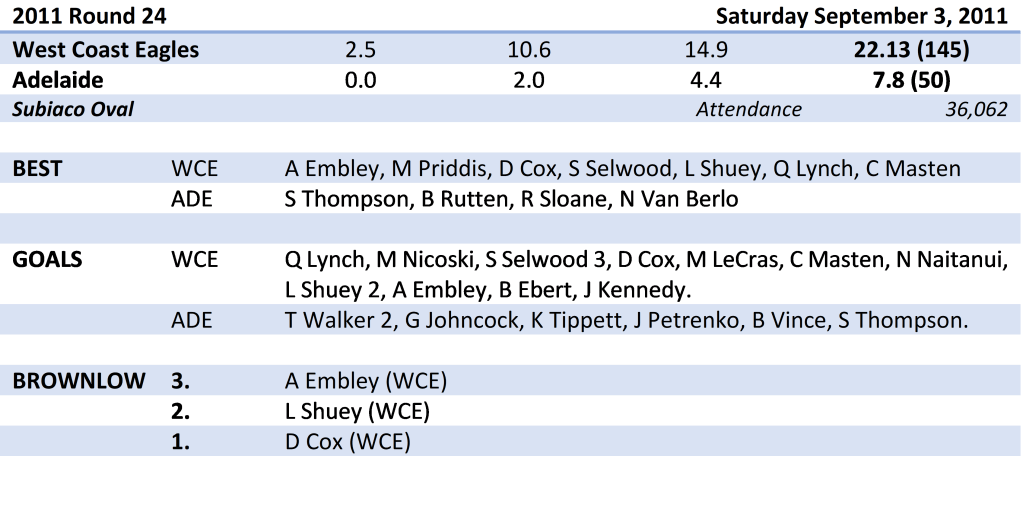
The Eagles wrapped up their 2011 home-and-away campaign with an effortless 95 point win over an uninterested Crows outfit, as they shifted their focus to finals action.

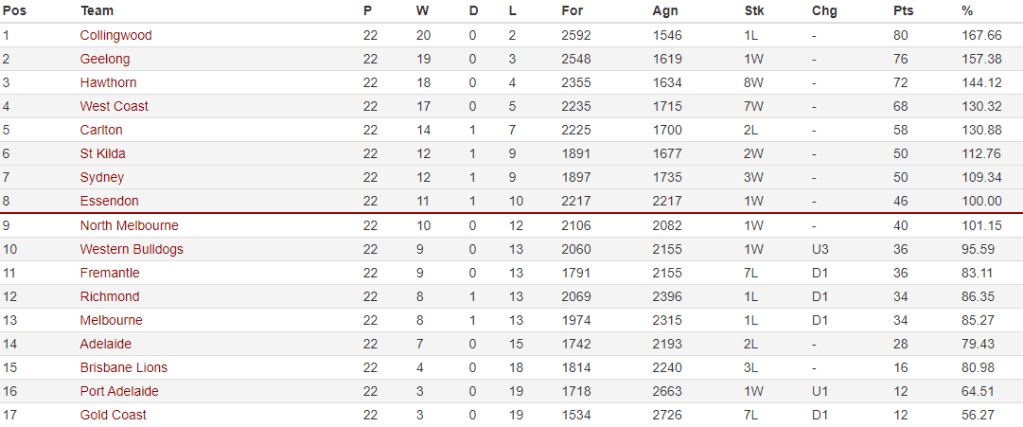
The win was West Coast’s 17th of the season – equalling their record from the grand final and premiership seasons of 2005 and 2006. However, while they had finished in the top two in each of those years to secure multiple home finals, a 17-5 return was only good enough for fourth position in what finished as a lopsided ladder.

The Magpies claimed the minor premiership and were the Eagles’ next opponents, but the reigning premiers suddenly looked vulnerable after being humbled by Geelong by 96 points. The top-of-the-table clash soon became a fizzer as the Cats steamrolled Collingwood, highlighted by a ten goal second quarter.

The defeat was just Collingwood’s second of the season – both of which had come against Geelong – but the invincibility that had surrounded the Magpies for much of the year was starting to wear off as injury and off-field issues affected the back end of Collingwood’s season.

While the Eagles were expected to start as distant outsiders in the qualifying final, the Eagles were as well positioned as they could expect to be. There were no late complications ahead of the finals series as Adelaide offered little competition.

Jack Darling returned after two weeks sidelined with injury, with Sam Butler the other inclusion in a somewhat controversial selection. With defender Will Schofield expected to miss just the one week after fracturing a cheekbone against the Lions, it had been anticipated that premiership players Brett Jones would earn a game ahead of his likely retirement at seasons end.

However, Worsfold opted against the sentiment bringing Butler back into the side after recovering from a groin strain. Ashton Hams was the other change, losing his place to Darling.

The Crows made a host of changes for their final game of the season with Jack Gunston (shoulder), Andy Otten (concussion) and Brodie Martin (groin) all out with injury. Aiden Reilly was dropped with Ian Callinan, Richard Tambling, Ricky Henderson and Michael Doughty all brought into the side.

The signs were early that the Crows wouldn’t be able to match West Coast and they set about minimising the damage.

For a quarter it worked as West Coast bombarded their forward 50 arc for little reward. Brad Ebert and Mark Nicoski both kicked majors, but the home side were mostly frustrated as the Crows bunkered down.

On the flip side, the Crows were no chance of scoring as they looked to just exit out of their back half, but the Eagles backline just sat back and racked up the possessions as Adelaide players continually kicked the ball to them. Butler had 12 disposals for the term in his return game, Adam Selwood had 11 and Beau Waters 7.

Leading by 17 points at the first change, Nic Naitanui goaled inside the first minute of the second term as West Coast broke the Adelaide shackles. Kurt Tippett registered the first Adelaide score a few minutes later, but West Coast finished with seven of the last eight goals in the term to break the game apart and head into the major break with a nine goal advantage.

The second half was purely going through the motions, but another eight goals in the final term ensured West Coast would finish the regular season in emphatic fashion. Chris Masten added a second goal late in the game to take the Eagles lead into triple figures, but Adelaide avoided a 100 plus point loss in Mark Bickley’s final game as caretaker coach thanks to a late Taylor Walker goal.

West Coast posted 22 goals for the match, but pleasingly their strong offensive performance came despite a quiet showing from full forward Josh Kennedy. Kennedy managed just one goal from eight disposals and one mark as he was well held by Ben Rutten.

Instead eight Eagles managed multiple goals in the game, with Quinten Lynch, Scott Selwood and Mark Nicoski leading the way with three each.

After being restricted to just a handful of possessions the week before by Brisbane tagger Andrew Raines, Andrew Embley bounced back with a strong performance on the wing. Embley was the Eagles’ best with 33 disposals and eight inside 50s providing plenty of run on the outside. Inside the contest, Matt Priddis did much of the heavy work with 12 clearances from 23 possessions, while also laying 13 tackles.

Adam Selwood (28 disposals), Chris Masten (27, 7 clearances & 2 goals), Luke Shuey (25, 2 goals) and Quinten Lynch (22 & 7 marks) were all proficient as the Eagles dominated in most areas. West Coast recorded 23 more inside 50s in the game (59-36), controlled the clearances (60-43) and even with the huge margin still managed to lay more tackles than their opposition (79-65).

The Crows offered little, with Scott Thompson flying a lone flag in the middle of the ground. Thompson finished as the leading ball winner on the ground with 40 disposals and a goal with minor support from Nathan Van Berlo and Rory Sloane.

The only disappointment for the Eagles was a hamstring injury to Ashley Smith that saw the running defender subbed out during the second term with Andrew Gaff coming on. It was the sixth time this season that Gaff had started the game with the green vest.

Smith was set to be the only ill bill of health for West Coast, with Daniel Kerr, Matt Rosa and Schofield all set to be available for the first final against Collingwood.

While the Geelong-Collingwood result sent a shockwave through the competition, the rest of the fixtures essentially went as expected. Hawthorn held onto third place despite being pushed to the edge by lowly Gold Coast. The Hawks made 10 changes for the match as they openly focused on their first final against Geelong, and the reinforcements did what they needed to do in a nine point win.

The only finals match up that wasn’t know heading into the final round centred around sixth and seventh. While St Kilda and Sydney knew they were playing each other, the Swans could still pass the Saints and claim a home final, if the Saints couldn’t claim a win against the fifth placed Blues.

Sydney did what they needed to do, easily defeating Brisbane, but the Saints ensured the final would be played in Victoria, when they came from behind to beat Carlton by 20 points. The Blues led by 11 points at half time and extended their lead to 18 early in the third quarter when Zach Touhy goaled. However the Saints booted seven of the next eight goals to hold their position of sixth.

The Bombers rounded out the top eight, safe in the knowledge they would make the finals despite having a bye in the final round. Essendon were set for a blockbuster first week match up against Carlton, who similarly, were sure of completing the season in fifth.

The only other interest in the round came at the foot of the ladder where Port Adelaide were able to escape the wooden spoon with a dramatic eight point win over Melbourne. The Suns were relegated to last on the ladder in their debut season, with the Power recording their third win of the season in a historic match at the home of the SACA.

Following extended negotiations between the SANFL and SA Cricket Association, the Power were able to secure the first game played at the Adelaide Oval for premiership points in the AFL competition, marking the occasion with an entertaining eight point win over the Demons in front of nearly 30,000 fans – the largest non-Showdown home crowd they had had in over 18 months.

But for West Coast, attention now turned to September action for the first time since 2007 and they were set to play the team they last played in a final in Collingwood. With a double chance and a guaranteed home final in either the second or third week of the finals, the Eagles were riding the wave of momentum and the public sentiment towards a fairytale finish.

2011 Rewind: In Celebration Mode

Nicoski Kicks Six to Lead the Eagles Party

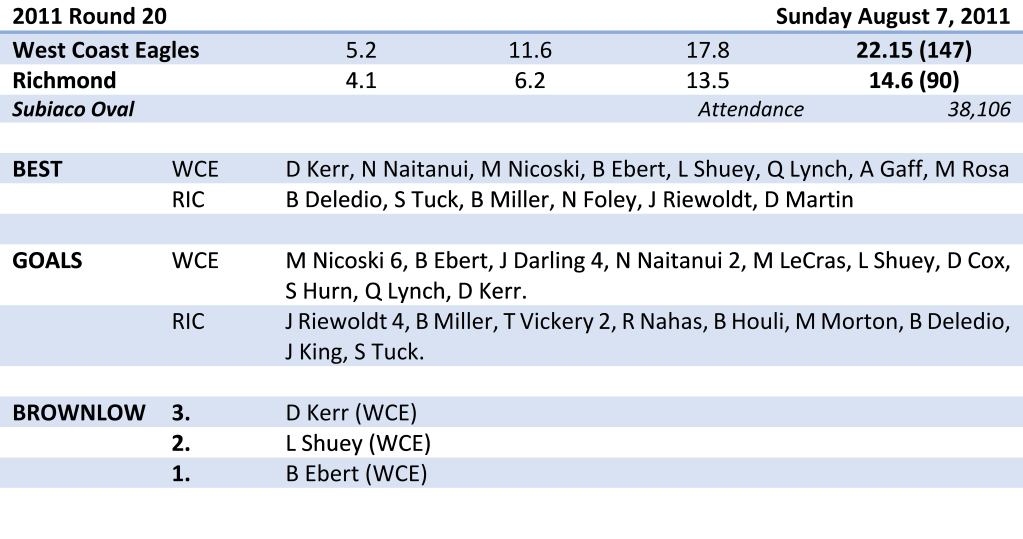
It was a week of celebration for West Coast as they honoured and paid homage to their first 25 years in the VFL/AFL competition, culminating in a 57 point win over Richmond.

The Eagles chose to celebrate their 25th season in the top tier competition in the lead up to their Round 20 clash with the Tigers, who were their first ever opponent in the opening round of 1987. In that game, the then VFL newcomers fought back from 33 points down to claim a 14 point win in their inaugural match courtesy of a nine goal final quarter.

However no such heroics were required in this meeting with the Eagles steering away from the Tigers during the second term and coasting to a 57 point win.
Josh Kennedy was again absent for the Eagles with an eye injury, but the Eagles were able to recall Daniel Kerr and Nic Naitanui. The pair were joined by defender Mitch Brown and midfielder Chris Masten who was selected for his first senior match since Round 12.

Vice-captain Beau Waters was ruled out with an elbow injury, which was initially played down by the club after he injured it during the win over the Western Bulldogs. Eric Mackenzie was also a casualty, straining a hamstring during the final training session of the week. Tom Swift and first-gamer Scott Lycett lost their places.

The Tigers also made four changes with captain Chris Newman succumbing to a knee injury and Jake Batchelor ruled out with a shoulder complaint. Ben Griffiths and Matt White were dropped, with Shaun Grigg, Brad Miller, Mitch Farmer and Matt Dea the four inclusions.

After an entertaining first term that saw the Eagles lead five goals to four at the first change, West Coast took grip of the match off the back of a dominant quarter from ruckman Nic Naitanui.

With Dean Cox limited to the full forward line after copping a knock to the hip in the opening minutes of the game, Naitanui was left to lead the ruck with Quinten Lynch rotated through to provide back up.

Naitanui relished the circumstance, as he controlled the ruck against Angus Graham and Ty Vickery, amassing eight possessions (all contested), four marks (all contested), several clearances and kicking two goals in the quarter – all the while providing silver service to the likes of Daniel Kerr and Luke Shuey.

Mark Nicoski finished with a career high six goals in the win over Richmond

West Coast continued to dictate the match until late in the third quarter when the Tigers got on a roll to reduce a 45 point deficit to 27, keeping open the outside chance of an upset comeback.

In the last meeting between the two sides, at the MCG midway through the 2010 season, Jack Riewoldt had booted a career best ten goals, but to half time of this encounter, Darren Glass had kept the Tigers spearhead to just six disposals and no score. However, Riewoldt responded in the third quarter booting three goals as Richmond looked to continue on the attack.

Eagles coach John Worsfold admitted displeasure after the match with conceding seven goals in the third term, but West Coast tightened up their defence in the final term to kick five goals to one and run out 57 point winners.

14 of the Eagles’ 22 goals were kicked by the trio of Mark Nicoski, Jack Darling and Brad Ebert, who all recorded career best hauls in front of the sticks. Nicoski finished with six goals, while Darling and Ebert each booted four as the Eagles showed they could find other avenues to goal.

For Nicoski, his six goal return was just reward for a season that had reinvented the defender as a pressure forward as part of the Eagles’ strong forward press. Brad Ebert was another who had had to adapt to a different role this season with the return of Kerr, the arrival of Gaff and the rapid improvement of Shuey with Worsfold deploying the South Australian across half forward for much of the year.

Ebert appeared to find the balance in his role, hitting the scoreboard with four goals, as well as gathering 21 disposals with four tackles and four inside-50’s.

Kerr led the Eagles ball-winners with 34 disposals, 13 of which came in the second quarter when Naitanui got on top in the ruck battle. Kerr also finished with eight clearances, while Shuey had seven to go with 30 disposals, seven tackles and six inside-50s.

Andrew Gaff was tireless with 29 on the wing, while Lynch appeared to relish the freedom of running through the ruck with 23 touches, seven marks, 10 hit-outs and seven inside-50s.

Brett Deledio tallied 31 possessions and eight rebounds to lead the Tigers, with Shane Tuck (29 disposals) and Nathan Foley (24) the next best. Riewoldt kicked the Tigers only goal of the final term to finish with four for the match, with Brad Miller and Ty Vickery the only other multiple goal scorers for the visitors.

Scott Selwood was tasked with the job of minding Richmond captain Trent Cotchin, keeping the midfielder to just 17 disposals.

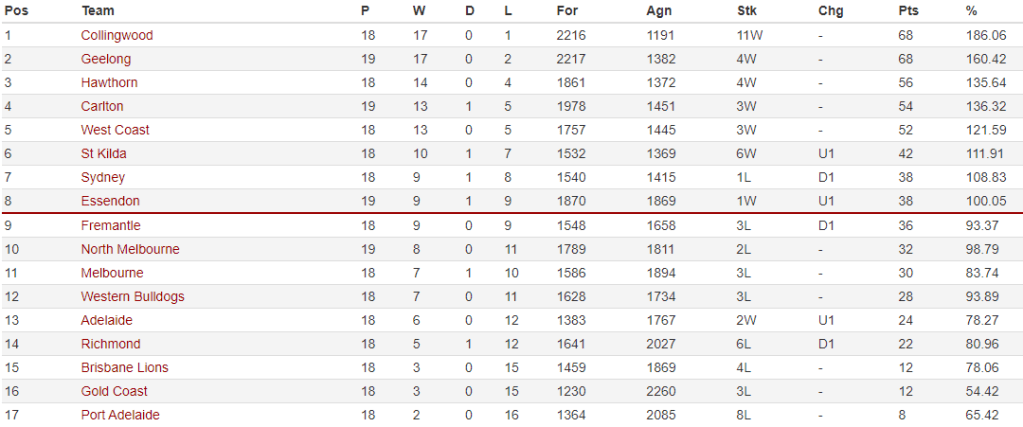
The result meant that the Eagles kept the pressure on Hawthorn and Carlton as they sought to push their way into the top four. The Hawks and Blues recorded wins against finals hopefuls North Melbourne and Melbourne, further denting their finals hopes.

The Kangaroos pushed the Hawks for three quarters before Lance Franklin kicked three final quarter goals to inspire his side to a 17 point victory. Todd Viney took charge of the Demons following the sacking of Dean Bailey, but it did little to improve things as they crashed to a 76 point defeat.

The battle for spots in the lower half of the top eight played out in dramatic fashion as the sixth placed Swans travelled to play the ninth-placed Bombers, and the seventh-placed Saints faced the eighth-placed Dockers. Just three points separated the Saints and Dockers at three-quarter time before St Kilda piled on six goals to none in the final term to run out 41 point winners.

That saw them climb to sixth on the ladder after the Swans fell to the Bombers by one point at Docklands after Adam Goodes had the chance to win the game on the siren. His long range set shot drifted wide allowing the Bombers to rise back into the top eight at the expense of the Dockers. Sydney also dropped to seventh on the ladder as a result, meaning the Eagles were now 10 points clear in fifth spot with four games to play.

The statement of the round though lay with the two leading premiership fancies in Collingwood and Geelong. The Magpies and the Cats were drawn against the two stragglers in the competition, in Port Adelaide and Gold Coast with the two sides not missing a chance at percentage boosters.

Geelong hammered the young Gold Coast side by 150 points, backing up from their 186 point thrashing of Melbourne the week before. Steve Johnson followed up his 34 disposal-7 goal effort against the Demons with 31 possessions and six goals against the Suns. The Ablett-less Suns matched the Cats early, with both sides kicking three goals to start the game before Geelong went on the rampage with the next 15 goals in the game to open up a 94 point lead at half time.

The Cats also booted the final 11 goals in the game to run out easy winners, with the combined 336 point margin over the previous fortnight boosting their percentage by 21.9 points in that time.

The Magpies proved they wouldn’t be outdone, smashing a hapless Port Adelaide by 138 points at Football Park. The Power managed just six scoring shots for the night – finishing with 3.3 for the match, compared to the Magpies’ total of 23.21 from 44 scoring shots. That kept the Magpies at the head of the ladder with their monstrous percentage of 186.1 from 17 wins keeping them in front of the Cats who had built their percentage to 160.4 from the same number of wins.

While happy with the win, there were concerns for the Eagles with a number of injuries out of the match against the Tigers. Wingman Matt Rosa was the most serious, limping off during the third quarter after clashing knees with Richmond’s Daniel Jackson while Jackson was attempting to kick. Both players would be substituted out of the game from the incident, with Rosa later diagnosed with a posterior cruciate ligament injury that was likely to keep him out of the rest of the home and away series.

It continued an unfortunate run for Rosa who was on the fringe of the Eagles’ 2006 premiership side, playing in the first two finals before being dropped for the preliminary final. Dean Cox would be monitored after his knock to the hip, while Naitanui limped off in the game late with a lower leg problem.

It would prove to be just a small scuff off the gloss of the week that saw West Coast celebrate their first quarter century of existence. The Eagles wore commemorative jumpers in the match that listed every Eagles to have represented the club, while the inaugural inductees of the West Coast Eagle Hall of Fame were announced in a gala event the night before the match.

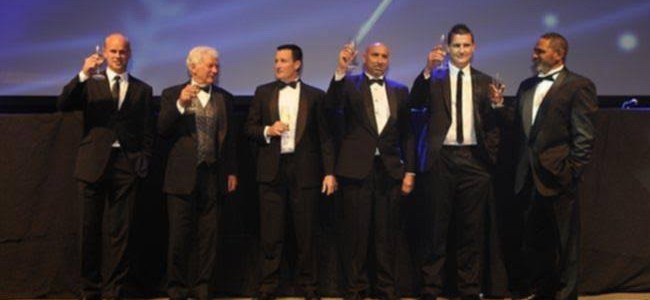
Eight inductees were announced with current coach John Worsfold joined by former teammates Guy McKenna, Glen Jakovich, Peter Matera, Chris Lewis and Dean Kemp along with two time premiership coach Michael Malthouse and long-time trainer Bill Sutherland.

Eagles Get The Cream

West Coast Withstand Cats Comeback

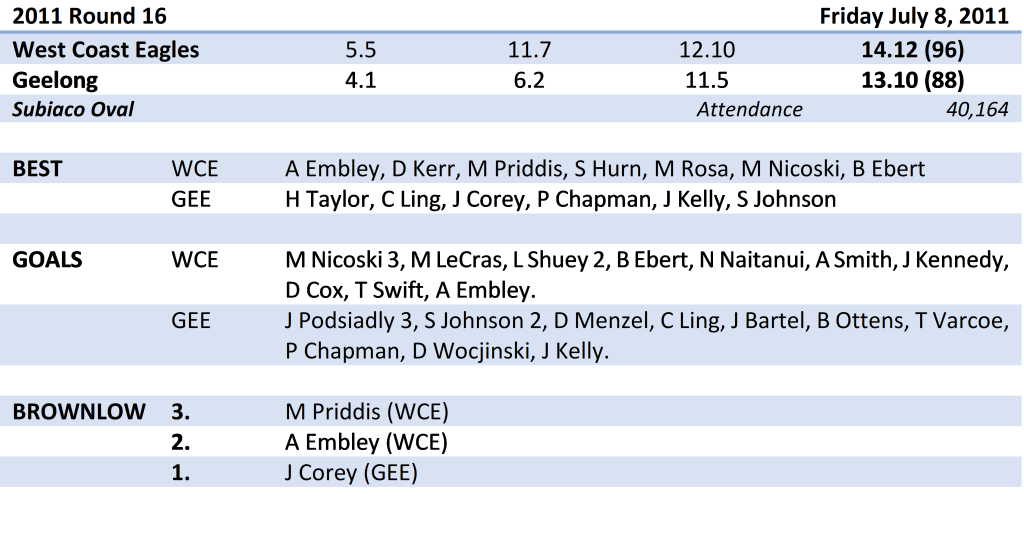
Thirty scintillating minutes either side of quarter time and some desperate final quarter defence saw West Coast get home by eight points over ladder-leaders Geelong in one of the games of the 2011 season.

Over 40,000 people packed Subiaco Oval on the Friday night to see the Eagles score their second straight win over a top-four side and continue their push to break into the double chance position.

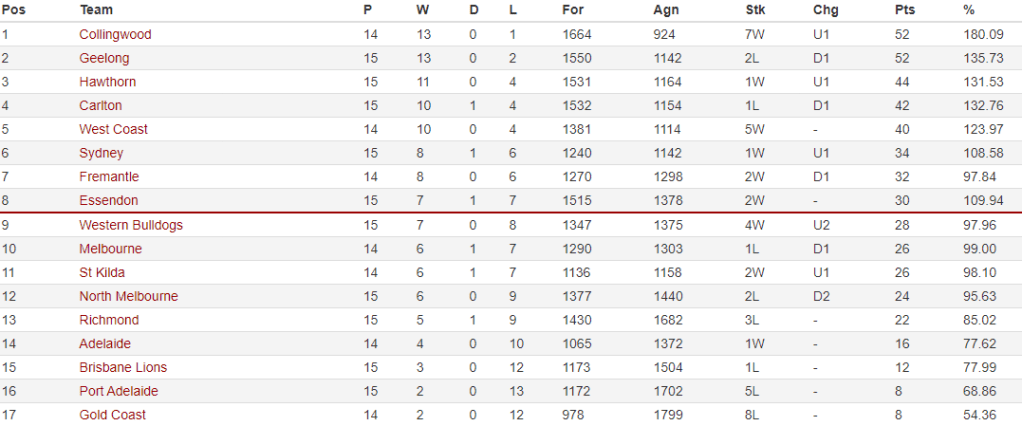
The Eagles remained fifth following the win, but after serving their second bye the week before, now sat within four points of the Blues and Hawks, with an extra game up their sleeve.

Geelong arrived in Perth as the competition’s benchmark after first-year coach Chris Scott had guided his side to 13 wins from his first 13 games in charge – a VFL/AFL record – but had had their unbeaten streak ended the week before with a surprise four point loss to Essendon.

Scott talked up the Eagles in the lead up, declaring the trip to WA as the biggest challenge in the competition and the Cats could have been accused of having an eye on the Eagles ahead of their match with Essendon.

The Cats made the left-field decision to send several players to WA the week before, with Travis Varcoe and Joel Corey – who were both rested against Essendon – along with suspended midfielder Joel Selwood spending the week training with South Fremantle.

West Coast had their own tribunal issues ahead of the match with Quinten Lynch copping two one week suspensions for separate incidents involving Marc Murphy in the Eagles win over Carlton a fortnight earlier.

While Lynch would plead guilty to a striking charge, confirming his ineligibility for the Geelong match, the Eagles successfully challenged the grading of a rough conduct, reducing the level from high to medium which meant Lynch would serve just the one match suspension.

Lynch was joined by Sam Butler on the sidelines after the defender strained a quad in the final training session of the week. Patrick McGinnity and Koby Stevens were the two inclusions for West Coast, with Stevens making his first appearance of the season.

Geelong made three changes, with Varcoe and Corey returning, along with Taylor Hunt. The Cats were clear in their match selection as they chose a number of mid-sized runners to come into the side in place of tall forwards Mitch Brown and Tom Gillies. Andrew Mackie was the third exclusion for Geelong due to soreness.

Dean Cox started in the ruck for West Coast, but had partner Nic Naitanui beside him at the opening bounce with John Worsfold throwing the Fijian into the centre square alongside Daniel Kerr and Matt Priddis.

The Eagles brought the early intensity with a number of forward entries that had the Geelong defence scrambling. However, for all of the home side’s endeavour, the class of the Cats stood out as they capitalised on the rebound.

Geelong booted four of the first five goals in the game – including their first three from just four forward 50 entries – with James Podsiadly bobbing up for two of them.

West Coast on the other hand were blowing their chances, with Mark Nicoski (twice) and Naitanui both missing simple shots in front of goal.

With five minutes left in the quarter Geelong led 4.1 to 1.3 but West Coast finished the quarter with a flurry of majors to get reward for their dominance. And it was the two players who had been guilty in front of goal earlier in the term who sparked what would be an unanswered nine goal run.

Naitanui would be the fortunate recipient of an overturned free kick in the forward pocket after Jack Darling had sprayed a set shot out on the full. With Geelong set to take possession, Steve Johnson took unkindly to the attention he was receiving from Adam Selwood off the ball, gifting the ball back to the Eagles, where Naitanui snapped truly from the behind post.

Josh Kennedy eked through the Eagles’ third goal after a scramble near the goal square before Mark Nicoski produced a moment of magic.

Collecting the ball on the bounce near the boundary line and cornered by two Geelong defenders, Nicoski fashioned a checkside effort as he was falling backwards that purely defied his two earlier misses from dead in front. That put West Coast in front with Mark LeCras extending the Eagles lead to ten points at the first change in the dying seconds.

The final major told the tale of the first term.

The longer the quarter went, the less sure and composed the Cats defence appeared in the face of the Eagles forward pressure. With the seconds ticking down, Travis Varcoe had possession and looked to exit the ball from the defensive arc. Varcoe overshot his handpass which went directly to Mark LeCras, who then cut a swathe through two defenders and caressed the ball home for the Eagles’ fifth goal from the 50m line.

West Coast had enjoyed 77% of the play in their forward half and led the inside 50 count 18-8 with many of their early matchups were working in their advantage.

Adam Selwood was minding the enigmatic Steve Johnson, brother Scott was doing a similar job on Bartel and Darren Glass had kept the dangerous Daniel Menzel to just two disposals. Brad Ebert had been deployed as a defensive forward on Matthew Scarlett, with the intent of dragging the Cats full back out of the play.

If West Coast had been guilty of not maximising the glut of forward entries in the first quarter, there was no such issue in the second term as the Eagles piled on five goals in 17 minutes to stun the Cats. From sixteen points down entering time-on of the first term, West Coast had advanced to a 40 point lead entering time-on of the second.

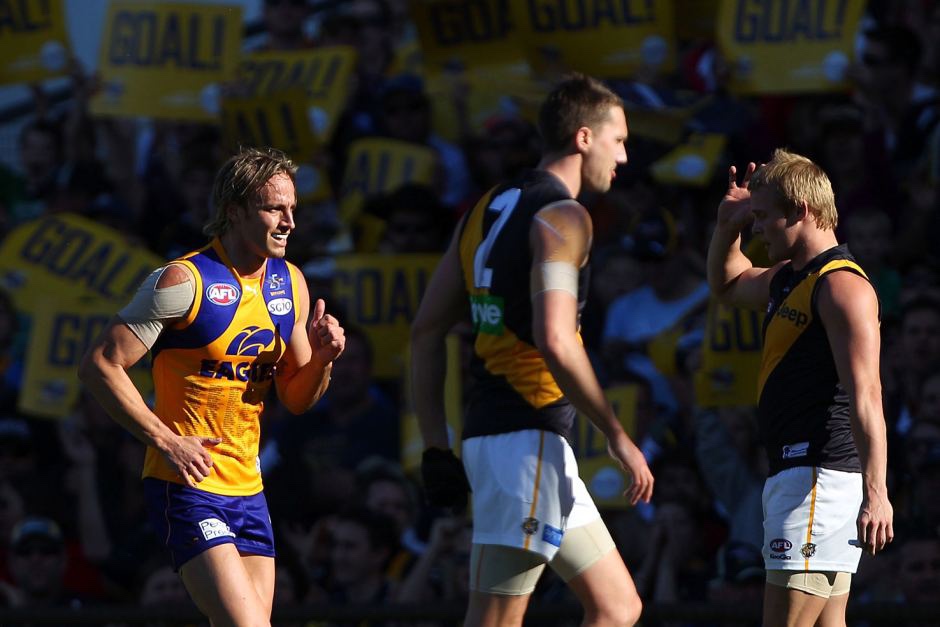
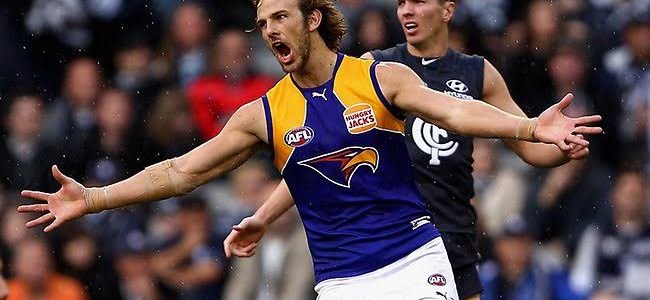
Mark Nicoski was dynamic for West Coast up forward with three goals

Bartel eventually ended the Eagles run, but when Brad Ebert rolled home his first major just before half time after another poor turnover in defence by Geelong, this time by Taylor Hunt, West Coast had secured a 35 point lead at the main break.

The Eagles midfield were in complete control from the first half, with Andrew Embley (20 disposals, three clearances), Daniel Kerr (15 disposals, four clearances) and Matt Priddis (14 disposals, four clearances) all prominent.

For Geelong, only Cameron Ling with 18 disposals for the half showed resistance.

The Cats though weren’t the top side in the competition by accident and they proved as such in the early stages of the third quarter when they slammed on four goals in nine minutes to cut the Eagles lead back to 10 points.

Dean Cox provided a steadier but David Wocjinski reduced the margin once again heading into three-quarter time as the match started to take on a different look than earlier in the piece.

Where West Coast had virtually monopolised forward half possession and hunted the Cats when they attempted to control the ball, it was now Geelong that was generating multiple forward 50 entries with the Eagles trying to hold off their momentum.

The first goal of the final term was crucial to both sides, and it would be West Coast who would get the vital strike. With a ball up in their goal square, James Kelly took possession and looked to switch the ball towards the Chris Mainwaring wing. But the ball had barely travelled a metre off his boot before being intercepted by Mark Nicoski, who cleanly took the ball and drilled his third goal of the night.

Geelong continued to press but the first quarter efficiency had all but disappeared as they butchered a spate of chances in front of goal. Paul Chapman, Wocjinski, Steve Johnson and Steven Motlop all missed gettable shots and they were made to pay when Andrew Embley sealed the match on a breakaway move.

Having endured repeat forward entries, Darren Glass was able to mark a Podsiadly entry into the forward line and switch the play as West Coast found a way around the Geelong defence. Josh Kennedy was able to mark at half forward and spotted Embley alone in the forward pocket.

Having taken the mark, Embley inadvertently took a step forward – enough for the umpire to wave play on as Scarlett and Taylor came bearing down on the Eagles wingman. Corralled towards the boundary line and on the wrong side for a right footer, Embley ducked and baulked the pair before swinging home the sealer.

The Cats finished with the final two majors to keep fans on edge, but West Coast had done enough to keep Geelong at bay and record their 10th win of the season.

A pleased John Worsfold commended the maturity of his side as Geelong mounted their comeback. “I think holding on to win with Geelong throwing everything at us in the second half to get back into the game… and the composure the boys showed through the last quarter. I thought that was great…”

“Beating Carlton was fairly important for us because we had some pretty closes losses against some of the other teams that… were going pretty well. It was reward for effort, I think, because we had pushed those teams and lost close games.”

“In the last two weeks we have pushed good teams and won.”

Chris Scott lamented his side’s poor second quarter, which ultimately cost them the game despite the strong second half performance. The Cats recorded 34 inside 50s after half-time, to just 13 for the Eagles and ended up winning the count 52-43 for the match, but had left themselves too much to do.

“Our first half was really bad, theirs was really good. We just didn’t do enough to stop the momentum. They kicked nine straight at one stage.”

“We left ourselves with too much to do, but our gusy are pretty tough and have great character. Even our young players are showing that they play the Geelong way when the chips are down and the disappointing thing is we just didn’t do enough.”

Joel Corey, Corey Enright and Paul Chapman all lifted their rate in the second half with rookie ruckman Nathan Vardy getting a handle of the stoppages. Cameron Ling finished as the leading ball winner with 30 disposals, while Chapman collected 13 touches in the final term to finish the match with 29. Joel Corey tallied 28 possessions and Harry Taylor had 23 disposals and nine marks opposed to Darling in defence.

Andrew Embley was outstanding for West Coast for four quarters, picking up 32 touches on top of kicking the sealing goal. Matt Priddis did much of the grunt work in the middle, while Shannon Hurn and Daniel Kerr each picked up 24 touches. Brad Ebert quelled the influence of Matthew Scarlett and chimed in for 20 disposals and a goal and Matt Rosa was important in the last quarter.

The Cats lost more than the four points on the evening, as they were usurped from top position following a second successive defeat. Collingwood overtook the Cats with a superior percentage after they demolished North Melbourne by 117 points.

Carlton’s surprise 27 point defeat to the Bulldogs, which had the Bulldogs on the edge of the top eight, now had the Blues prime for the picking in fourth spot. West Coast had the prize of the double chance firmly in their grasp but the ever-straight Worsfold continued to preach the evolution of his squad.

“Our goals have always been about continual improvement.”

“It has come pretty quickly in terms of this year, but we are still a long way short of where we want to be”, Worsfold said.

“But we are prepared to do the hard work it is going to take.”

West Coast Claim The 8-Pointer

Eagles Firm For Top Four With Blue Win

For every team, there is a defining match of their season. Whether they are on the slide or on the rise, retrospect allows all to realise that that game was it.

In Round 14 of the 2011 season, the Eagles’ finals and premiership aspirations claimed legitimacy across the competition and with many pundits and scribes when they travelled to Victoria and toppled Carlton by 36 points.

West Coast had delighted their fans with strong showings in the first half of the season with the mix of blossoming youngsters and the returning form of some old hands suggesting the Eagles’ stay down the bottom of the ladder might finally be coming to an end.

But heading into the round 14 clash with the third-placed Blues, Carlton were warm favourites for most with the expectation the Eagles would receive a reality check. Both sides were in strong form with the Eagles winning five of their last six games, and the Blues having won seven of their past eight matches.

But the Blues were seen as the genuine challenger to Geelong and Collingwood for the flag were clear $1.15 favourites heading into the match.

Carlton coach Brett Ratten didn’t shy away from his sides favouritism heading into the game, adamant that the Blues would be able to handle the Eagles forward press that had confounded much of their opposition so far this season.

The Blues were dealt some blows leading into the game with ruckman Shaun Hampson, midfielder Ed Curnow and defender Nick Duigan unable to recover from injuries picked up in the win over Sydney the week before. Jarrod Waite also failed to gain selection with Carlton opting to give the key forward an extra week to recover from a hamstring injury.

Rhys O’Keefe was selected for his debut, with David Armfield and Robbie Warnock the other inclusions. Warnock was set to partner Matthew Kruezer in the vital ruck battle against Eagles pair Dean Cox and Nic Naitanui.

West Coast took a far greater settled side into the match with Eric Mackenzie the one change. Patrick McGinnity made way with Mark Nicoski reaching 100 games in his eighth season in the AFL. McGinnity’s exclusion was somewhat of a surprise with the expectation that the tagger would go to one of the strong Carlton midfield, or even play a role down back against the mosquito fleet in the Blues forward line.

Mitch Robinson became the fourth out for the Blues ahead of the opening bounce, replaced by Mark Austin, but Carlton started strongly as they followed through with Ratten’s promise from during the week in the opening minutes.

The Blues had most of the forward play and laid seven tackles inside their front 50 as West Coast were served a taste of their own medicine. The Eagles valiantly held their own, conceding just the one goal, to Jeff Garlett.

While Carlton were looking to get the game on the ground, the Eagles had the upper hand in the aerial battle and midway through the first quarter, they got the game on their terms.

That advantage only increased when Carlton full back Michael Jamieson wrenched his knee on the wing, rendering him virtually useless. Jamieson attempted to play on, but his incapacitation resulted in a reshuffle in defence that aided the Eagle talls.

Bret Thornton was moved onto Kennedy, Jordan Russell was left to deal with the much taller Jack Darling and Lachie Henderson was switched from forward to defence. Nicoski and Kennedy goaled to put West Coast in front and while former Eagles captain Chris Judd drew the Blues back to level terms on the scoreboard, the match was clearly going in one direction.

Naitanui, LeCras, Rosa and Shuey all missed chances they should have kicked to see the Eagles to a narrow quarter time lead, but West Coast got the separation they warranted in the second term.

Dean Cox was controlling the tap as the Eagles slammed on six goals for the term. Matt Priddis and Daniel Kerr turned Cox’ ruckwork into clearances and the trio of talls in Kennedy, Darling and Lynch were proving too much for their opponents.

Lynch in particular was giving Carlton the blues all over the ground as he worked up and down the wings to drive the ball into the Eagles forward 50 and provide additional support to prevent it coming back out.

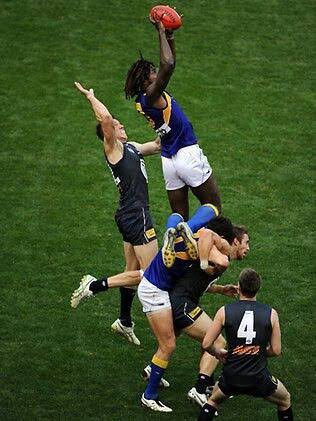
The tale of the two sides in the second quarter could be best described in a respective player from each side. While Michael Jamieson, like his Blues, spent much of the term hobbled around the forward line, Eagles ruckman Nic Naitanui soared to sit on the shoulders of teammate Darling and Carlton’s Zach Touhy and provide a mark of the year contender.

Naitanui subsequently slotted the goal and when LeCras added his second for the term moments later, the Eagles had skipped to a five goal lead.

Lynch was the leading ball winner for the half for West Coast, with 11, while Daniel Kerr, Matt Priddis, Dean Cox and Ashley Smith each had 10 disposals. Carlton’s best performers were defenders Bret Thornton and Kade Simpson who had been exposed to a glut of ball in the Eagles forward half, while Heath Scotland was the lone performer in the Blues midfield.

For all of their efforts, thought, Carlton weren’t occupying a top four spot for no reason and in a flash after half-time, the match was again up for grabs. The Blues opened the second half with four goals in the first twelve minutes to claw back to within four points of the Eagles.

Carlton had earned the upper hand through the midfield, when Brett Ratten went the unorthodox route of sending Judd to tag Kerr. Scott Selwood had restricted Judd to just six disposals in the first half and with his prime mover having no impact, Ratten used his captain to nullify former teammate and still current friend Kerr.

The sight of the reigning brownlow medallist thrown into a tagging role remarkably wasn’t the strangest sight of the third term; rain began to fall, which wouldn’t normally be an issue at Docklands, except that whoever controlled the roof hadn’t run their eye over the weather forecast for the day and left it open.

Nonetheless, the move of Judd freed up Marc Murphy who got Carlton ticking, while Ryan Houlihan and Scotland provided the drive from the wings.

However, West Coast then showed they had the mettle to match the top sides.

The Eagles finished with four of the last five goals in the term to work their way to a 22 point lead. Ashley Smith and Will Schofield kicked two of those four, as West Coast pressed forward en masse.

Nic Naitanui soars in the second term for one of the marks of 2011

The final term was a battle with neither team gaining or giving ground, until late in time on when Jack Darling and Ashley Smith put the icing on a vital result.

The 36 point win may have only added four points to the Eagles tally on the ladder, but the result had far greater ramifications.

Heading into the match, the Blues had a one and a half game break on West Coast and a Carlton win would have almost knocked West Coast out of top four contention. Instead, the Eagles claimed the atypical eight-point match to heap the pressure back on the Blues and Hawks.

Matt Priddis as the best afield for West Coast, despite close attention from David Ellard, to collect 30 disposals, 10 clearances and six tackles. Sam Butler was a strong four quarter contributor to finish with 22 touches, as did Quinten Lynch who added 12 marks, eight inside-50s and two goals to his 22 possessions.

Dean Cox picked up 21 touches to go with 22 hit-outs and Ashley Smith kicked multiple goals with 21 disposals and nine marks from defence. Mark LeCras finished with three majors, while Smith, Lynch, Josh Kennedy and Mark Nicoski were the other multiple goal scorers.

Heath Scotland tallied 32 disposals and Marc Murphy 28 as many of Carlton’s important players were well held. Judd managed just four kicks and 13 handballs as Scott Selwood managed to apply the clamp. Bret Thornton had 26 disposals and 11 marks in defence, while Garlett and Betts booted half of the Blues’ goals, as Kreuzer, Walker and Henderson failed to trouble the scoreboard.

The Eagles performance left rival coach Brett Ratten in no doubt as to the potential of this season’s rapid risers.

“They outplayed us today. I thought they outworked us today all over the ground and it’s a credit to them.”

“I’ve seen them a fair bit and I think their work rate and what they’ve done as a team… they’ve backed it up week-in, week-out. And it’s a credit to Woosha and his group changing the game plan and getting the success he has so far.”

As well as moving to within two points of the top four, the Eagles also gained separation on the lower section of the top eight. West Coast pushed six points clear of the sixth-placed Swans after they fell to Collingwood by six points.

The Magpies held their spot in the top two ahead of Hawthorn who replaced the Blues in third spot with a thumping 65 point win over the Bombers, despite being without usual Essendon tormentor Lance Franklin. Geelong held sway at the top of the ladder when they extended their unbeaten start to the year to 13 games after defeating Adelaide by 52 points.

Fremantle overcame a half-time deficit to defeat the Lions, while Melbourne rounded out the top eight after they replaced Essendon following a 27 point win over Richmond.

Ahead of their second bye of the season, Worsfold played down comments he had made the year before when he declared the Eagles would be challengers for the 2012 premiership despite being on the cusp of the top four.

But the Eagles coach did admit that it was the most significant win for West Coast this season.

“Every win for us for where we’re building to as a young team is really important. We’re just looking to win our next game now as quickly as we can.”

“Our aim is to build a team that can challenge for a premiership… I think what people have seen so far is that there is a pathway that we believe in and we’re heading down.”

Bomber Burst Undoes West Coast

Third Quarter Lapse Proves Costly

There are two well known adages that are as old as the game itself. Poor kicking is poor football and the third quarter is the premiership quarter, where games can be won or lost.

Both of these proved true for West Coast when they fell to Essendon in round seven.

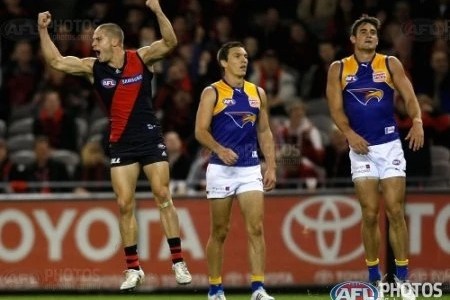
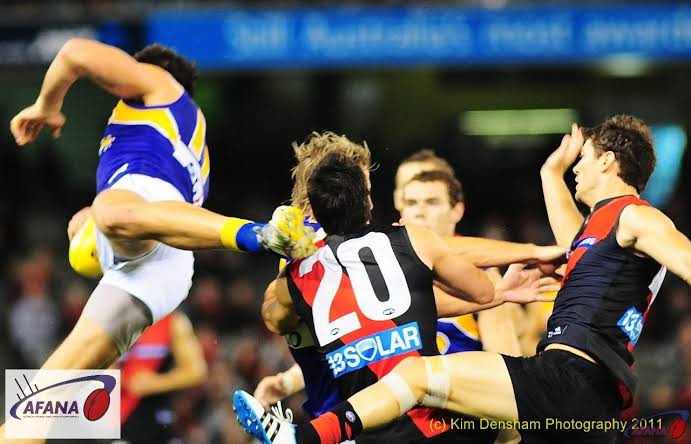
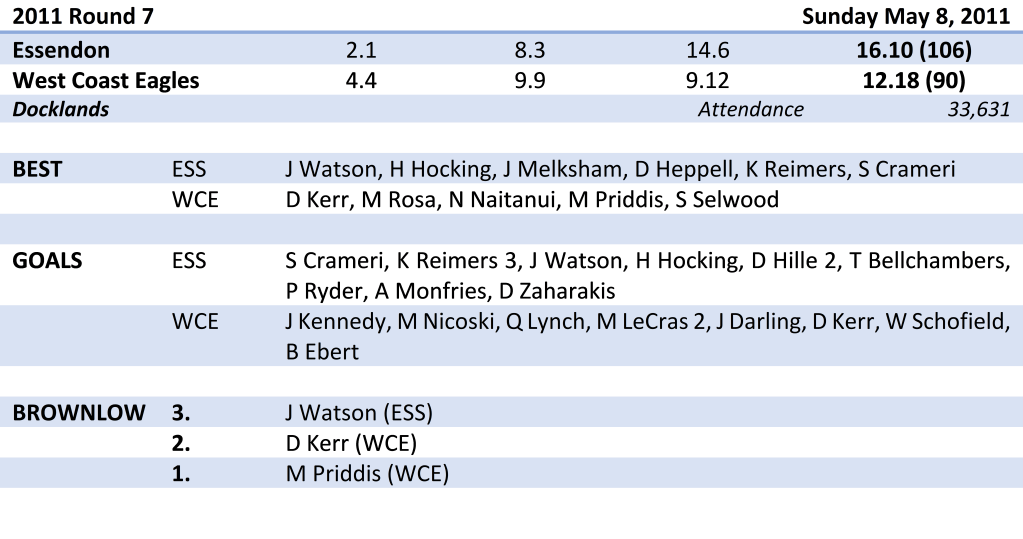
For three quarters, the Eagles controlled the contest and looked the better side. But the four points slipped from their grasp during a horrible 30 minute period after half time, when Essendon slammed on six goals to nil in the third term to open up the decisive break that would prove the difference between the two sides.

That the Bombers had the chance to sew up the win from one quarter was also down to the numerous chances that West Coast butchered during the first half, and then again in the final term as they valiantly tried to run the Bombers down.

For John Worsfold, the loss was a disappointing outcome from a match that presented the Eagles plenty of chances. “We had opportunities to make it either a closer result or get the result our way, but we weren’t good enough to take it… in the end… it was that third quarter where Essendon dominated for a period and we couldn’t kick a goal.”

After Essendon opened up the match with two of the first three goals, the game was played completely on the Eagles’ terms, with Daniel Kerr particularly outstanding. Kerr was in everything, tallying 14 disposals in the opening term, with four clearances, four inside-50s, six contested possessions and a goal.

Nic Naitanui also notched up a double figure possession total for the term with 10 and along with Matt Rosa (8 disposals) and Matt Priddis (6), the Eagles midfield provided plenty of opportunity for the Eagle forwards.

The Eagles were able to set up their press once again, at one stage cornering all 18 Bomber players in their forward 50. West Coast enjoyed the forward territory for the remainder of the quarter and their 13 point lead should have been far great.

It was much of the same to start the second quarter with Quinten Lynch extending the lead to 21 points. But all West Coast could manage further was a slew of behinds before Essendon worked their way into the match. The spark on the scoreboard came from an unlikely source with Heath Hocking booting two goals in four minutes. Stewart Crameri and David Zaharakis also booted majors and for all of the Eagles effort, scores were level approaching half time.

Brad Ebert and Josh Kennedy restored a two goal lead at the major break, but the 12 point advantage was poor reward for a half that had seen West Coast record 18 more inside-50s (34-16) and seven more scoring shots (18-11).

In a blink after half-time, the match was flipped on its head.

Kyle Reimers broke free of Adam Selwood’s watch to kick three goals in eight minutes as Essendon turned a 12 point deficit at the break into a 13 point lead. The Bomber midfield took a stranglehold in the midfield, with Jobe Watson and Heath Hocking controlling the stoppages.

Angus Monfries and David Hille made it six for the quarter and the Bombers turned for home with a four goal lead. Many of the Eagles early prime movers faded out of the game as Essendon were allowed to control the ball and the tempo in the match. The Bombers had 37 more disposals for the term as they worked through the Eagles press with a kick-mark method.

Crameri booted his third and the Bombers’ seventh in a row a minute into the final term with Essendon stretching their lead to a game high 33 points. Quinten Lynch broke the drought for the Eagles, which seemed to click them back into gear.

Such was the flow of the game, the Eagles had their chances, yet never seemed a realistic chance of hitting the lead in the final term. The Eagles finished with 9 of the last 11 scoring shots in the game but as they had done in the first half, butchered many of them to get as close as ten points before David Hille added his second goal after the final siren.

Josh Kennedy did whatever he could up front but West Coast would fall short

For Worsfold, another almost-result just added to his frustration. “We don’t want to keep playing OK and losing. For us as a club now, to show we really want to grow and get better and we are improving, we need to win some of these tough games against good opponents.”

For Essendon coach James Hird, the win was an important one as they looked to climb the ladder after a poor 2010 campaign. “That game should give both sides great confidence, both sides played some really hard, contested football.”

“I think they’re (West Coast) very well coached, they’re committed, they play hard football… it was a good game to be a part of for our players because they played a good football team.”

Captain Jobe Watson was the standout between the two sides, finishing with a game high 31 disposals, including nine clearances, six tackles and two goals. Heath Hocking played the sidekick with 15 disposals, five tackles and two goals, while Sam Lonergan (23 touches) and Jake Melksham (21) found the ball for Essendon as West Coast struggled.

Daniel Kerr still finished as the leading ball winner for the Eagles, finishing the match with 28 after collecting 14 in the first term. Matthew Priddis picked up 27 and Nic Naitanui had 24 touches to go with 27 hit-outs and seven clearances.

There were though, too many who failed to repeat the performances of the first five matches. Dean Cox was uncharacteristically subdued as Essendon challenged the Eagles duo with their own trio. Tom Bellchambers, David Hille and Paddy Ryder all spent time through the ruck and while Cox and Naitanui were dominant in the tap, winning the count 61-24, the Bombers were able to square the stoppages and limit the influence of the Eagle ruck pair around the ground.

It was a vital early result for Essendon and West Coast who entered the match on 14 and 12 points respectively. The loss saw West Coast fall back out of the top eight to 10th, while Essendon were able to rise to fourth.

The Eagles sat behind Melbourne, Sydney and Richmond who all moved two points ahead of West Coast following wins in round seven. The Tigers ran away from Fremantle with a second half avalanche to record a 49 point win at the MCG, Sydney held off a fast-finishing Bulldogs team to squeak home by eight points and Melbourne bounced back from their poor showing against West Coast the previous week to thrash a hapless Adelaide by 96 points.

The Dockers slipped to sixth following their defeat to the Tigers, with Hawthorn overtaking them in fifth after a stock standard 32 point win over Port Adelaide. At the top, Geelong joined the Magpies on six wins when they thumped North Melbourne by 11 goals. Collingwood, who had the bye in round seven, held onto top spot with a superior percentage, with the undefeated pair remaining the benchmarks of the competition.

Carlton were leading the challengers in third spot after Andrew Walker kicked the late winner against St Kilda to see the Blues home by three points. In the other match of the round, Gold Coast claimed victory against Brisbane in the first ever derby clash between the two Queensland sides.

After Simon Black raised tensions between the two clubs over the defection of Jarrod Brennan and Michael Rischitelli over the previous off-season, it was the upstarts who had the final say in a high-scoring encounter. The defeat left the Lions on the bottom of the ladder, winless after six games this season.

Back In The Pack

Consecutive Losses See Eagles Slip Down Ladder

After a bright start with wins over North Melbourne and Port Adelaide to open the season, the Eagles soon found themselves with a squared ledger after dropping games against Sydney and Hawthorn.

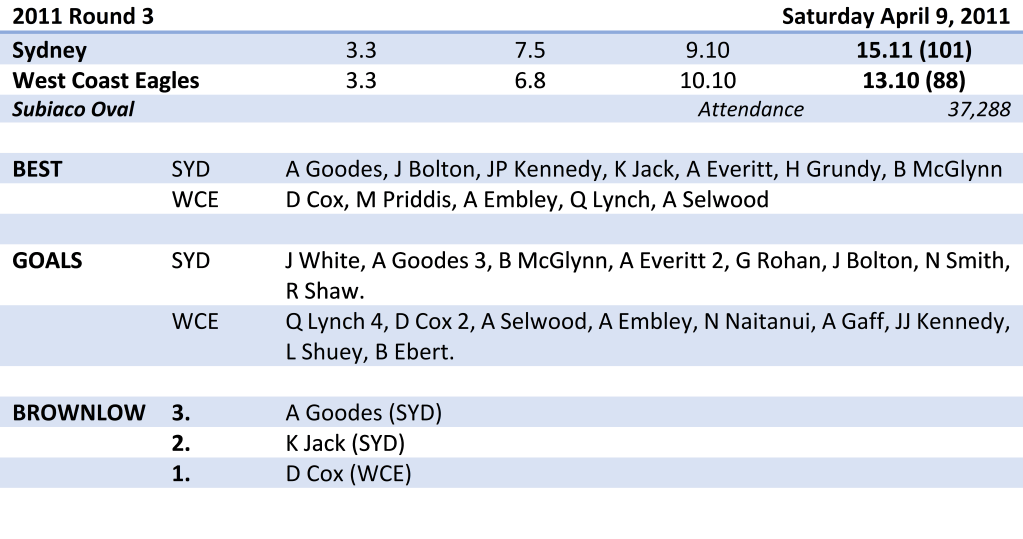
In a throwback to the classic encounters of the mid-2000’s, the Eagles and Swans played out another tight match, with the margin never going beyond three goals for the entire game.

Adam Goodes would be the difference between the two sides in the final term switching to the midfield after spending much of the first three quarters playing forward.

With West Coast holding a 12 point after Luke Shuey goaled inside the first minute of the quarter, Goodes provided the response to draw the Swans within six points, before adding a second major later in the term to level the scores. Goodes would finish with eight disposals for the term, along with three centre clearances and four contested marks as Sydney booted six goals to three to claim a narrow 13 point win.

The match itself was far less a spectacle and more a bruising battle, as the hardened Sydney midfield overwhelmed their younger opponents. The Swans laid 111 tackles (to West Coast’s 69), with Jude Bolton applying a game record 19 tackles himself.

The Swans got the quick jump with Jesse White booting the opening two goals of the match, but Quinten Lynch also managed a brace for the quarter which saw the two teams tied at the first change after Nic Naitanui floated home a goal on the siren.

Again Sydney got out to a two goal lead, with Goodes registering his first goal, but Lynch added two more goals, either side of a Lewis Jetta major, to keep the Eagles within touching distance. Andrew Embley put the Eagles in front, but Rhyce Shaw restored the Swans’ lead with the visitors in front by three points at the main break.

Dean Cox then took a hold of the match in the third quarter, putting in a quarter that matched the efforts of Goodes in the final. The Swans opted to play Shane Mumford as their sole ruckman against the pairing of Cox and Naitanui, with Mark Seaby – who had crossed to the Swans in the off-season – and Canadian Mike Pyke both left out of the side.

Sydney moved to a game high 17 point lead after Ben McGlynn and Jude Bolton both kicked majors when Cox stamped his authority. The Eagles ruckman picked up nine disposals for the term and kicked the final goal of an Eagles four-goal run that saw West Coast head into the final quarter with a six point lead.

Luke Shuey then made it five majors on the trot early in the last before Goodes drove his side to the line. Goodes finished with 21 disposals and three goals, complementing the workhorse Swans midfield group. Kieran Jack was the leading ball winner for the Swans, collecting 23 touches while also restricting Eagles dynamo Daniel Kerr to just 13.

Josh Kennedy also had 23 possessions, 18 of which were contested, while Jesse White joined Goodes in booting three goals.

Matt Priddis was one of the best for West Coast with 27 disposals and six clearances, doing what he could to match the Swans outfit. Cox’ strong start to the season continued, finishing with 20 disposals, two goals and 38 hit-outs. Naitanui tallied 28 himself with the Eagles winning the tap 68-38 but the Swans were still able to claim the clearances 49-34. Crucially their dominance through the middle in the final quarter saw them maintain their unbeaten record, following a draw with Melbourne in the opening round and a five point win over Essendon.

The Eagles on the other hand had been dealt their first loss of the season which saw them drop to ninth on the ladder.

The Eagles then made the long trek to Launceston to tackle the Hawks in what proved to be another narrow defeat. The match featured two of the upcoming forwards in the game, with Lance Franklin kicking six of the Hawks’ 10 goals, while Josh Kennedy booted four of the Eagles’ nine.

For the second week in a row the Eagles led at three-quarter time, but were run over by a more experienced side in the final quarter. Franklin kicked three of his six goals in the final quarter, as he got the better of young defender Mitch Brown.

With two points separating the sides at the final change, the Hawks broke the game open with the first four goals of the term, leading by 26 points as the term ticked into time-on. However West Coast finished with a rush, kicking the final three goals in the match but ultimately falling short by seven points.

The Eagles were made to pay for their early inaccuracy, as they failed to capitalise on their control of the match in the first quarter. The Eagles had twice as many inside-50s but kicked three goals to the Hawks’ two.

Josh Kennedy kicked his second late in the quarter to put the Eagles ten points ahead, but he was one culprit of missed chances, with three other efforts on goal either failing to score or going out on the full.

West Coast continued to hold the ascendancy in field position as the Hawks struggled to break through the Eagles forward press. However, the Hawks were devastating when they got the ball forward. Hawthorn booted the first three goals of the second term before Andrew Embley added one late for West Coast to reduce the Hawks’ lead to a solitary point.

While Franklin was proving a handful forward of centre, Sam Mitchell was racking up disposals in the irregular position of half back. Mitchell had averaged 27 disposals across the opening three rounds, but had matched that effort by half time.

The Eagles booted two goals to one in the third term to grab the lead before Franklin stepped up in the final term.

Mitchell finished with 37 disposals for the match as he was moved onto Kerr in the second half, who was also playing out of the middle, across half forward. Grant Birchall and Matt Suckling gathered 30 and 23 disposals, respectively, in defence while Brad Sewell was the enforcer through the middle with 19 possessions and 12 tackles.

The Eagles were well served once again by Matthew Priddis in the middle of the ground and Matt Rosa was strong on a wing with 25 touches and a goal. Josh Kennedy was the only multiple goal scorer for West Coast, while in defence Darren Glass was supreme in his 200th AFL match.

With Brown tracking Franklin and Eric Mackenzie lining up on Jarryd Roughead at full forward, Glass was released to play on the resting ruckman in either David Hale or Brent Renouf getting the better of both players. Mackenzie held Roughead to just one disposal for the first half to be one of the Eagles best.  

Sam Butler, Jack Darling and Andrew Embley all had 24 touches, with Darling outstanding in the first half with 18 possessions.

The Eagles were now 2-2 for the season and dropped down to 10th on the ladder ahead of their bye in round five. With Gold Coast entering the competition as the 17th team, the competition had an uneven number of teams for the first time since 1994, with each side scheduled for two byes throughout the 24 round season.

1990 Rewind: Exhausted Eagles Bow Out

Travel Load Catches Up With Young Eagles

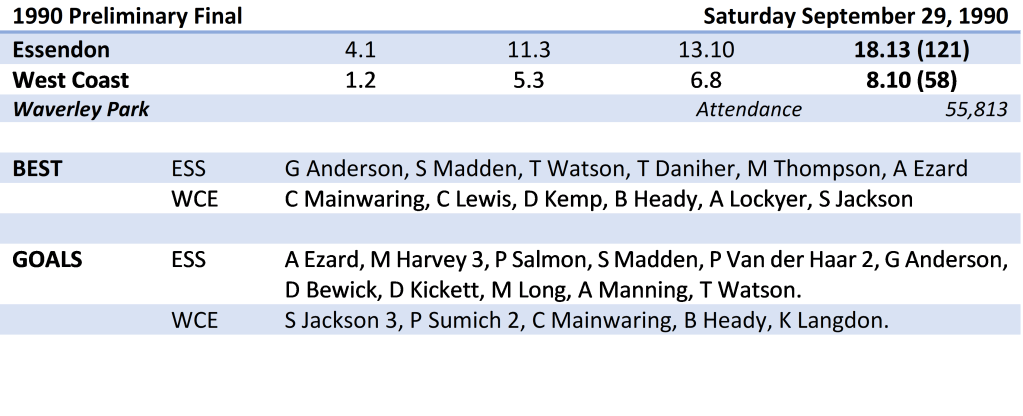
West Coast’s 1990 campaign fizzled out to a 63 point defeat against Essendon in the Preliminary Final, with the Bombers progressing to face Collingwood in the Grand Final.

Four consecutive matches at Waverley Park, and six interstate trips in a row, finally caught up with the young Eagles line-up, as they battled injury, illness and air strikes in the lead up to the match.

The Eagles were again forced to compromise their travel plans amid the ongoing national air strikes that had plagued much of their travelling over the previous six weeks.

West Coast ventured to Melbourne on a chartered flight, sharing the trip with the Perth Wildcats and Melbourne Tigers who were in the middle of their NBL Grand Final series. The trip required several stops along the way, and saw the three teams land in Melbourne on the Thursday – a day earlier than the Eagles’ usual schedule.

There were also concerns at the selection table.

Dwayne Lamb was unavailable, courtesy of a one week ban from the AFL tribunal, while nuggety midfielder Scott Watters was ruled out with a groin complaint.

Chris Mainwaring was struggling with a knee issue, Guy McKenna was racing the clock after injuring his arm late against the Demons and Laurie Keene was managing a groin injury. Craig Turley – who had been the Eagles best player over the prior fortnight – hadn’t trained all week due to the flu.

All four would take their place, but only Mainwaring would be a serviceable contributor.

Peter Melesso and Dean Turner were the two replacements for Lamb and Watters, with the selection of Turner somewhat of a surprise. Turner earned selection ahead of captain Steve Malaxos, who was left out of the side for a second week, as well as Don Pyke and Phil Narkle who had both been favoured to be included in the side.

Melesso was named after serving a five match suspension, but would then be a late withdrawal. Melesso took part in the warm-up ahead of the match, before being replaced by Todd Breman.

West Coast started the brighter of the two sides, but despite controlling possession struggled to find a way past half forward. Simon Madden, who had been heavily criticised during the week after a poor showing against the Magpies in the semi-final, was dominant both in the ruck and as the spare man in defence clogging up the space of the Eagle forwards.

Madden tallied 10 disposals and five marks for the term, as well as booting Essendon’s fourth goal of after a strong mark over Phil Scott in the goal square. The Eagles had just one major for the quarter; a solo effort from Mainwaring when he intercepted a defensive kick in the Eagles forward 50m area, before kicking truly on the run.

Stevan Jackson was busy early and finished with three goals

The quarter time deficit of 17 points was soon 43 as Essendon made West Coast pay for some sloppy play. Craig Turley started the rot when he dropped a simple mark in the middle of the ground, allowing the Bombers to regain possession with Darren Bewick finishing off a chain of play.

Alan Ezard then capitalised after the Eagles turned the ball over at half back before Simon Madden was able to boot his second of the match when John Worsfold was unable to handle the ball in defence.

Gary O’Donnell missed a golden opportunity, hitting the post running into an open goal, before Essendon caught a lucky break to boot their fourth major of the quarter. A scrappy kick forward by Derek Kickett eluded Phil Scott as he led Paul Salmon to the ball, allowing the Bomber full forward to hand off to Mark Harvey for a simple finish.

At this point, nothing was going right for West Coast.

Guy McKenna had copped a heavy hit that left him with a bloodied nose to along with the arm injury he was carrying, while Chris Mainwaring and Mark Harvey were involved in a brutal head clash that left both players on the ground for several minutes.

Finally, the Eagles found their second goal of the match. While they had been outplayed in most areas on the ground, the one spot they were winning was the centre clearances, even with Laurie Keene restricted.

Some good work out of the middle ended with Brett Heady steering through a second goal on his left foot from half forward, with the Eagles able to boot three more to give them an outside chance of victory.

However, a horrible handpass by Todd Breman deep in the Eagles defence gifted Ezard his second major of the quarter and the Bombers held a six goal lead at the main break.

Things only got harder straight after the restart when Karl Langdon was carted off after being knocked out cold in an accidental clash with Terry Daniher. Langdon attempted a diving mark, running back with the flight of the ball, with Daniher’s hip collecting Langdon in the head. With Keene also done for the day, the Eagles were without a bench, with a half to play and six goals behind.

Still, they refused to give up the fight. West Coast were the better side for much of the third term, with the play almost completely in their forward line. Essendon couldn’t find a way out of defence as West Coast continually pumped the ball into their forward 50, but they couldn’t make it count on the scoreboard.

Peter Sumich kicked the Eagles first goal, but then missed two more set shots, before Stevan Jackson hit the post from close range, and then Tony Begovich missed from directly in front after receiving a 50m penalty.

Mainwaring had a chance that failed to score, as did Michael Brennan, whose long range shot was marked on the line by Ezard. Sumich had a third chance that sailed out of bounds and for all their dominance, the Eagles had posted just 1.5 for the quarter.

Dean Turner then best exemplified the Eagles’ frustration when he cannoned into Ezard, well after the Bomber forward had taken a running shot on goal. Ezard’s effort missed, but the umpire awarded a second shot following Turner’s indiscretion, with Ezard able to boot his third goal and all but finish West Coast’s resistance in the match.

The Bombers added a further five goals in the final quarter to run out easy, albeit unconvincing, winners.

Malthouse admitted the heavy travel load had caught up with his side, but had nothing but praise, despite bowing out in penultimate week of the season.

“We looked and acted tired.”

“But I think the spirit was there to generate as much play as possible… it all caught up with them,” Malthouse said.

“The players showed enormous courage and fortitude… at no stage in six weeks of criss-crossing Australia was their a complaint. There was no sign of weakness during a severe test of the team’s character and competitiveness.”

Essendon coach Kevin Sheedy was happy enough with the performance, confident his side would bounce back from the thrashing by Collingwood the week before. “We were switched on early, and the players worked hard to get 18 wins this year and they did not want to let that slip.”

“I feel that will make us 10 percent better next week.”

Greg Anderson and Chris Mainwaring were both their respective sides’ best players, despite being opposed to each other on the wing for much of the afternoon. Anderson finished with 25 touches and booted 1.3, while Mainwaring had 19 disposals and booted a goal.

Terry Daniher and Mark Thompson also finished with 25 touches to lead the way at Essendon, while Tim Watson picked up 22 disposals and booted a goal. Simon Madden was another standout during the game with 21 possessions, 12 marks, 10 hitouts and two goals.

Alan Ezard and Mark Harvey each booted three goals.

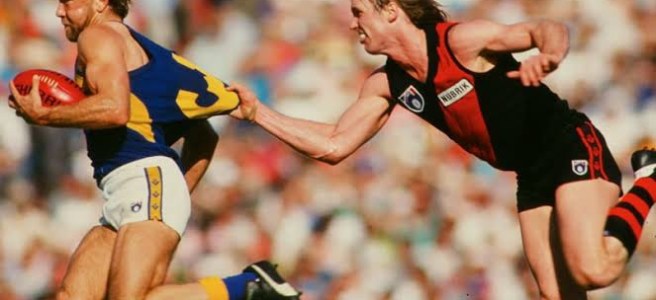
At West Coast, Chris Lewis finished as the leading ball winner with 22 in his battle with Mark Thompson. Thompson was influential in the opening term, but Lewis had the better of the match-up over the remainder of the match despite Thompson still finding plenty of the ball. Lewis had been sublime through the second half of the season, with his consistent showing culminating in winning the club best and fairest, as well as being named in the All-Australian side (along with John Worsfold).

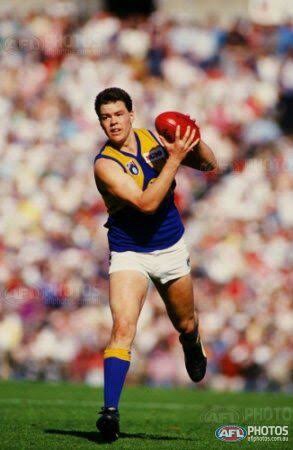
Chris Mainwaring was one of the Eagles’ best despite barely being able to see by games end

Dean Kemp picked up 21 touches and Brett Heady 20, as the two finished their impressive debut seasons with strong performances. Stevan Jackson offered plenty in the forward line with three goals from 14 disposals and six marks, while Peter Sumich would rue a wasteful day, finishing with 2.5.

Andrew Lockyer won his battle at centre half back on Paul Van der Haar, keeping the veteran Bomber to just nine disposals and two late goals. Craig Turley (17 disposals) and Guy McKenna (16) toiled hard despite their operating below their capacity.

The Eagles coach was openly proud of his side’s season, but the gains made in season 1990 were best summed up by opposing coach Kevin Sheedy. The Bombers coach – a former teammate of Malthouse’s at Richmond – praised Malthouse, saying he had added professionalism to the four year old club, while also lauding WA’s ‘sensational’ year.

Sheedy said playing four finals in a row was the equivalent of two finals series’ worth of experience, which would be ‘invaluable’.

“After physically and mentally going through it, the standard for West Coast has been set.”

The Eagles for their part had risen from a bit-part team out in the west, to one of premier clubs in the revamped competition in just one season. The addition of Malthouse had been an immediate success – and the board knew as much.

Days before Christmas, the Eagles announced that Malthouse had signed a three year extension to his initial contract, keeping him at the club until the end of 1994.

The ’90s had begun – as had the first Eagles dynasty.  

1990 Rewind: Finals Chaos As Eagles, Magpies Draw

Sumich Shoots Wide On Siren

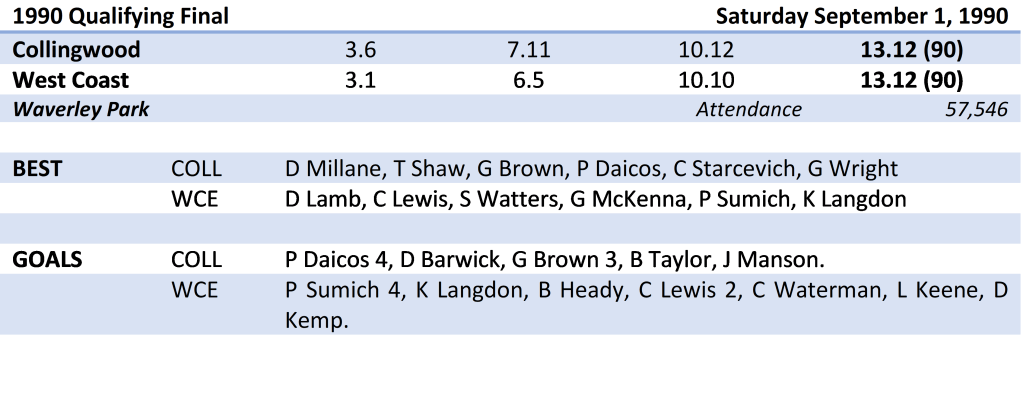
West Coast and Collingwood opened the 1990 finals series with a dramatic draw in the Qualifying Final, flipping the entire finals series on its head.

Peter Sumich had the chance to win the game in the dying seconds, but his missed set shot from close range in the left forward pocket, left the two teams matched on 13.12 (90) as the final siren rang.

The result – the first draw in a final since the 1977 Grand Final – was set to throw the finals series into disarray, with the Eagles and Magpies due to return to Waverley Park the following weekend to determine who would progress to the first semi-final to tackle the Bombers.

Melbourne were awaiting the loser of the replayed match, after they knocked reigning premiers Hawthorn out of the premiership race with a nine-point win in front of nearly 75,000 fans at the MCG.

The Demons now also had the added benefit of a week off ahead of the second semi-final after winning through the elimination final. Conversely, Essendon – who had earned the week off in the first week of the finals for finishing top at the end of the home-and-away season – were now facing a second straight week off, complicating their preparations for their first final.

Essendon coach Kevin Sheedy dismissed suggestions the protracted series would work against the Bombers, despite the prospect of over three weeks between their final round match against the Saints and the first semi-final. “We have played 22 home and away games this year, four Fosters Cup games and eight practice matches. I don’t think we need to worry about fitness.”

While the AFL were estimating an additional $800,000 would be generated from the extra match to be played, they were also forced to busily reschedule many of the planned events over the coming month. The Grand Final was now set to be played a week later on October 6, however the date for the Brownlow medal wasn’t expected to change.

The Magpies were heavy favourites heading into the match, off the back of their two largest wins of the season in the final two rounds. The Magpies took in an unchanged side from the win over North Melbourne, despite a couple of key injury concerns. 

Darren Millane stayed in the side despite fracturing a thumb against the Kangaroos, as did ruckman James Manson who trained lightly leading up to the match due to an ongoing groin issue. The Magpies also had Denis Banks and Shane Kerrison available to return from injury, although neither was recalled for the clash against the Eagles.

Full-forward Brian Taylor also kept his spot, despite an indifferent two seasons at the club. Taylor had managed just one game in the back half of 1989 due to a knee injury (coincidentally against the Eagles) and had featured in just five further matches in 1990, returning to the side in round 21 against Fitzroy.

The Eagles made just one change with Dean Irving returning after being dropped for the final round match against Geelong. Controversially, fellow ruckman Phil Scott was the one to make way after playing all 22 games during the home-and-away season.

For Mick Malthouse, it was a heart-wrenching decision. “This was the toughest decision I have made in seven years of coaching.”

“Phil accepted the decision like the professional sportsman that he is.”

Craig Turley also held his place despite concerns over a groin problem. West Coast were considered outsiders – namely by the Victorian media – with ten players playing in their first final. The Eagles were also playing only their third game ever in club history at Waverley Park; their other two appearances had both resulted in losses.

Steve Malaxos won the toss and sent his side the way of the breeze in the opening term, but the more experienced Magpies were able to settle first. Taylor had an early chance in the game, hitting the post with his first shot, before sending his second effort on goal out of bounds on the full.

His presence on the game forced an early positional change in the match, with Murray Rance and Michael Brennan swapping. The larger Rance headed to the goal square to match on Taylor, with Brennan shifting to centre half back on Craig Starcevich.

Dean Irving was stationed as a loose man in defence as Collingwood continued to push the ball forward, but while West Coast were able to limit the damage on the scoreboard early, the Magpies’ opposing ruckman Damien Monkhorst was allowed to dictate play and provide the link playing loose through the middle of the ground.

Monkhorst would be involved in the chain that delivered Collingwood the opening goal of the game. Chris Mainwaring was caught holding the ball across half forward, by opponent Mick McGuane, with Collingwood able to transition quickly to the other end of the ground.

Graeme Wright received the handpass from Monkhorst through the centre square, and kicked inside forward 50, looking for Taylor. However, Peter Daicos was able to read the spoil from Rance and after a handpass exchange with Starcevich, Daicos found some space to slot the important first major.

Gavin Brown added a second after being held by Guy McKenna in a marking contest, before West Coast worked their way into the game. Laurie Keene wobbled through the Eagles’ first on the run, before Brett Heady made it two goals in succession.

Brown added a second for the quarter, and third for the match for the Magpies, but his effort was cancelled out by Peter Sumich from long range leaving West Coast five points behind at the first change.

Mick McGuane was the clear standout at quarter time, picking up 16 disposals on the wing for the term opposed to Chris Mainwaring. His red hot start continued into the second term when an early shot on goal cannoned into the post. The Magpies managed several more efforts without success, before Sumich swung the game back in favour of West Coast.

Sumich goaled twice from long range to draw the Eagles level, before Karl Langdon sent through his own long bomb from beyond the arc to put West Coast in front.

However, that only seemed to spark the Magpies into gear.

Brian Taylor was dragged to the bench and the more mobile Craig Starcevich became the prime target up forward. Peter Daicos continued to present a threat, as did Gavin Brown who was now operating out of the goal square.

The Magpies booted the final three goals of the term to open up a 12 point lead at the main break. Collingwood were also guilty of wasting their chances on goal, having had seven more scoring shots for the half than West Coast.

Both coaches made moves to start the second half, as they looked for the all-important edge in the match. Ron McKeown replaced Craig Kelly at full back on Peter Sumich and Worsfold took Daicos in the Eagles defensive half.

And as the match grew in intensity, so did the sublime skills of its participants.

Dean Kemp drew the Eagles within a kick with a pinpoint goal from the pocket, before Daicos responded with a 40 metre snap. Peter Sumich add his fourth of the match, again from long range, and Chris Waterman kicked truly after being found on his own in the forward pocket, to see the Eagles reach parity.

West Coast were now in control of the game, led by Dwayne Lamb who gathered 12 possessions for the quarter, and Scott Watters, who had nine. James Manson put the Magpies back in front against the run of play after a sloppy turnover in defence, but the Eagles continued to generate opportunities.

Brett Heady, Chris Mainwaring and Dwayne Lamb all missed before Chris Lewis typified the class of the game, with a truly outrageous goal to put the Eagles back in front.

Ron McKeown was captured in defence by Kemp, with the ball spilling towards the boundary line where Lewis was able to swoop, gather, brush off the tackling attempt from Scott Russell before snapping through an incredible goal on his non-preferred foot in amongst a nest of Magpies.

Further adding to the difficulty of Lewis’ effort, Lewis had also lost his footing during the play, stranded on his knees before being able to lift back to his feet and kick an important goal for the Eagles.

Lewis had been instrumental in the second quarter in keeping West Coast in touch with Collingwood as they built an early advantage and now, as the match closed in on three-quarter time, the Eagles were the ones with all of the momentum.

Chris Lewis continued his excellent form from the second half of the season in the drawn final

Heady would miss a chance after some clever play by Lewis at half forward, where he was able to pluck the ball away just as Collingwood were set to clear from defence, before Heady and Sumich would then clash competing for the same mark. Dwayne Lamb would also miss a chance to get a shot on goal after fumbling at the top of the goal square.

A swift chain of passes from defence ended with Doug Barwick kicking truly to give Collingwood an unlikely two point lead, against the run of play, with a quarter to play.

The two point deficit became a ten point lead for West Coast early in the final quarter after Heady and Lewis each booted majors in quick succession. The Eagles runners – the likes of Watters, Lamb, Chris Mainwaring and Guy McKenna – had controlled the tempo of the game since half-time and the Magpies were struggling to keep pace.

Mick McGuane had faded out of the game after his blistering first quarter and found himself on the pine, while James Manson had been sent from attack to defence to quell Karl Langdon who had been in everything during the third term.

Trailing, Leigh Matthews reinstated Brian Taylor to the field after spending the second and third terms on the bench and the move paid immediate dividends. Taylor was able to claim a diving mark in front of Murray Rance, and goal, to reduce the Eagles lead to four points.

A few minutes later, Taylor added a second after Rance caught him high in a marking contest, and Collingwood had worked their way back into the lead.

The Magpies appeared to have done away with the Eagles challenge when Peter Daicos extended their lead with an effort that managed to top Lewis’ freakish effort in the previous term.

The Eagles attempt to exit their defensive 50m arc came unstuck when Guy McKenna missed John Worsfold with a pass, after a strong mark in the Magpies’ goal square. Gavin Brown was able to win the loose ball back near the boundary line, feeding a handpass up the line to Darren Millane, who instantly handpassed over his shoulder to Daicos deep in the forward pocket.

With the outside of his right boot, from the wrong pocket, Daicos magically worked the ball to land at the feet of the goal umpire and extend the Magpies’ lead out to eight points with just five minutes remaining.

West Coast though continued to push.

A desperate effort from Steve Malaxos across half forward prevented Collingwood from clearing out of defence, with Langdon able to snap truly from a boundary throw-in. Waterman dragged a shot on goal from deep in the pocket, reducing Collingwood’s lead to a solitary point before the final last play that had the game in the balance.

Chris Mainwaring twice failed to find an Eagles target in the forward half before Darren Millane attempted to clear out of defence. However, Eagles runner Rob Wiley inadvertently kept the ball in the Eagles forward line when he got in the way of Millane’s handpass resulting in a boundary throw in.

Langdon won the ball from Keene at the restart with his attempt on goal floating across the face into the opposite pocket where Sumich was able to mark over his shoulder. His final kick would become instantly folklore.

Peter Sumich laments his late miss

All up, the lead changed eight times during the match, and while the teams may not have been separated at the completion of four quarters, the same couldn’t be said for the attitude of the two coaches.

While Leigh Matthews was relieved to have a second chance at the second chance, his counterpart in Malthouse was left ruing the missed opportunity.

“We didn’t make the most of the opportunities. When the game was there to be won, we didn’t grab it.”

Malthouse expressed frustration that West Coast couldn’t take advantage of the lead they built during the final quarter and run out to win the game. “I feel bitterly disappointed. We didn’t achieve what we came here to achieve.”

The Eagles coach was also unwilling to accept much of the post-match praise from the Victorian media, who joined in with Matthews’ assessment that the Eagles were stronger contenders for the flag than many scribes had suggested.

“They were always going to play better than the public perception of them – that almost inevitably is the case,” Matthews said.

“It was never going to be easy. We didn’t think we played well, but we live to fight another day and that’s the way we are looking at it.”

The Collingwood coach refused to admit they were fortunate to make it out with a draw, but said they were ‘thankful’ to get another crack. “With a draw you tend to be disappointed because you haven’t won – until you tell yourself you haven’t lost either.”

“We feel quite positive about having another chance.”

The ramifications of the draw would lead the AFL to change how drawn matches were decided, with the Commission voting to introduce two five-minute periods of extra time for all finals, other than the Grand Final.

For now though, West Coast and Collingwood had a week to prepare to do it all again and Malthouse had one message for those who had decided to jump on the Eagles bandwagon.

“Do us a favour and write us off,” Malthouse declared.

“Maybe they (the media) have underestimated the fierceness and willingness to contest. We showed today what we are capable of doing.”

“As far as I’m concerned it’s half time in the match. It’s a 14-day game.”

Zero to Hero

Ugle Lifts Eagles Across Line After Horror Start

Early in the second quarter of the Eagle’s clash against St Kilda, most of the 20,000 strong crowd who had braved the inclement conditions sat in stunned silence.

An errant handball out of defence by Dwayne Lamb had gone straight to Saints wingman Robert Harvey, who swung the ball inboard to Nicky Winmar. Winmar strolled through the 50m arc and sent the ball through for the Saints 10th goal.

It was Friday the 13th and the Eagles were in their own horror story, trailing by 50 points.

Just over an hour later West Coast were celebrating one of their most famous wins, off the back of a Jekyll and Hyde performance from utility Troy Ugle.

Ugle had had the ignominy of being dragged to the bench late in the first term as opponent Craig Davenport ran riot in St Kilda’s fast start.  

Davenport booted the opening three goals of the game and by the first break he had five to his name, and was on to his third opponent. After starting in the middle, Dwayne Lamb had been deployed to the back pocket, replacing David Hart who had switched into defence as Ugle’s replacement.

Davenport had ignited the Saints, who piled on seven goals before West Coast had scored. In fact, the Eagles had entered their forward 50 just once, with the Saints routinely winning the ball out of the middle through Frank Coghlan and Nathan Burke.

The Eagles finally hit the scoreboard when Peter Sumich received a free kick for being held, after the home side’s most productive passage of play for the evening. Nathan Burke responded with a clever goal from the boundary before Brett Heady added a second for West Coast. The rookie midfielder ran into an open goal after he snuck out the back of a marking contest, set up by Chris Mainwaring on the wing who won two decisive contests to send the ball forward.

However, Peter Russo was able to goal after the quarter time siren to record St Kilda’s ninth goal for the term, resulting in their best first quarter score in over a decade.

After the insipid performance against the Magpies the week before, this was not the start Mick Malthouse would have been hoping for.

The Eagles made four changes to the side that lost to Collingwood. Dean Kemp and Phil Narkle were both sidelined with injury, while Todd Breman and Murray Rance were dropped. Chris Mainwaring returned from a knee injury, Craig McGrath was back from suspension and Geoff Miles and Tony Begovich were also recalled.

The selection of Begovich was particularly surprising, with Begovich rising to the senior squad after a fortnight with the Claremont reserves team – bypassing the senior Claremont side to earn a spot in the Eagles squad. The inclusion of McGrath was also noteworthy, because with Stevan Jackson holding his place, the Eagles forward line was set to be top-heavy with McGrath, Jackson, Langdon and Sumich all forward of centre.

The Saints made three changes for the trip to Perth, with West Australian Nicky Winmar returning to the side, while Kain Taylor earned a recall and Greg Doyle was selected for his debut. Doyle was named at full forward with the Saints still without spearhead Tony Lockett.

St Kilda also lost half forward Ricky Nixon and midfielder Jim Krakouer to injury. Jody Arnol was dropped.

Despite the failed case example of the Hawks a fortnight earlier, the Saints opted to fly into Perth on the morning of the game. Hawthorn coughed up eight of the first nine goals against the Eagles, but it was the complete opposite for the Saints who burst out of the blocks.

Incessant rain leading up to the opening bounce had turned the WACA into a muddy quagmire – not dissimilar to the playing conditions normally expected at Moorabbin – and it was St Kilda who adapted quickest.

An all-in brawl ahead of the first bounce had players riled up early, but while West Coast were intent on attacking the man, the Saints maintained their focus on the ball. The result was a one-way stream of goals, with Davenport the recipient.

Davenport had the first of the match inside 30 seconds, and added two more before Coghlan floated forward to mark in front of Michael Brennan and Doyle to put through the Saints’ fourth. Davenport then chimed in with two more majors as West Coast struggled to get a hold of the contest.

When Phil Scott overran a bumbling ball inside the Saints forward 50, Stewart Loewe had slammed through the visitor’s seventh goal of the term with West Coast unable to get the ball past the halfway mark.

The Eagles were finally able to get onto the scoreboard through the goals to Sumich and Heady, but their first quarter performance was best summed up by a bizarre piece of play by Chris Lewis inside the final minute of the term.

With the Eagles attempting to the win the ball back on their half forward line close to the boundary, Lewis believed the ball had crossed the line ahead of the boundary umpire making the call. Lewis stopped the play and nonchalantly handpassed the ball directly over the line, only to give away a free kick for deliberate out of bounds.

The Saints ultimately managed a point from the free kick, but made the Eagles pay shortly after when Jayson Daniels won the ball back from the resultant kick-in and found Peter Russo at half forward to goal and take their quarter time lead to 44 points.

If the perplexity of Lewis’ error on the forward line wasn’t enough, there was further drama through the middle of the ground as St Kilda built their play leading up to Russo’s missed attempt. Centre half forward Stewart Loewe was felled behind play with the Saints medical team frantically running onto the field and calling for the stretcher.

With great relief to Saints fans, Loewe refused the stretcher and was able to join his teammates in their quarter time huddle, walking off under his own steam.

Eagles coach Mick Malthouse was expectedly displeased with his sides showing, chastising his players’ ‘disgraceful’ effort.

Malthouse may have hoped for an immediate response at the start of the second term, following his quarter time spray, but the Saints maintained their control on the game stretching out their lead to 50 points when Winmar slotted the opening goal of the quarter.

Troy Ugle had made the switch from the back pocket to the forward pocket, but that did little to change his fortunes when he gave away a free kick just as Craig McGrath was set to kick on goal.

With the game on the Saints’ terms, the Eagles needed a spark and they found it through firebrand Karl Langdon.

The enigmatic blonde kicked two goals and set up a third as West Coast worked their way into the game off the back of careless errors by the Saints. Jayson Daniels was the culprit on both of the goals to Langdon, first turning the ball over at half back to John Worsfold, who in turn found Langdon in space at the top of the 50m arc and then again moments later when an ambitious kick into the middle was picked off by Chris Lewis and resulted in a second major to Langdon.

Around the ground, West Coast were gaining the ascendancy. Dwayne Lamb continued to quell Craig Davenport, with the Saints suddenly looking short of options up forward. Despite the conditions, many of the Saints small forwards couldn’t find the ball, with John Worsfold and Guy McKenna providing plenty of rebound for the home side.

Through the middle Coghlan and Burke both drifted out of the game, while Nicky Winmar was being well contained by Craig Turley. Chris Mainwaring was providing the link up play on the opposite wing and ruckman Dean Irving was starting to wield an influence in the ruck, bringing the likes of Stephen Malaxos and Lewis into the game.

Stewart Loewe kicked a settler for the Saints after marking on the behind line, but the Eagles continued to push forward with Ugle hitting the scoreboard after another poor Saints error. A simple dropped mark by Damian Kitschke on the wing allowed Turley to gather the loose ball and find David Hart in space.

Hart kicked inside forward 50 looking for Peter Sumich, but Ugle was able to drift across the pack and mark, kicking his first goal in the match and heading into half time with a small hit of confidence.

The Eagles still trailed by five goals at the main break, but momentum in the game had noticeably shifted to the home side. Paul Harding was deployed as a loose man in defence for the Saints as West Coast continued to surge with the aid of the breeze.

A string of behinds in the dying minutes of half time prevented West Coast from being closer, but the Eagles coaching staff and players would have been immeasurably more pleased at their position in the game than quarter time.

Many of the Eagles’ playmakers had worked their way into the game through the second half of the quarter, although there were still concerns up forward with Jackson, McGrath and Sumich all lacking any significant impact.

Saints captain Danny Frawley was wearing Sumich like a glove, although there was concern for the skipper when he headed into the changerooms at half-time over a shoulder complaint.

The third quarter started very much as the second quarter had ended, even with West Coast now working back into the wind. The Eagles monopolised the early possession and were able to lock the ball in their forward half but failed to capitalise on the scoreboard.

Against the run of play, debutant Greg Doyle stepped up to kick a major, but the Eagles would not be deterred. Ugle bobbed up for his second goal of the game after a clever one-handed juggling mark before a tight battle ensued.

Both defences were on top as the game sat on a knife’s edge.

Robert Harvey and Stewart Loewe both failed to score for the Saints, while the Eagles also wasted opportunities at their end. Chris Lewis and Peter Wilson both missed gettable chances, while Craig Turley has a shot marked on the line.

The desperation in the game was no more evident than a sickening clash that saw Langdon forced off the ground after being crunched by Peter Sumich and Kain Taylor.

Eventually, it was the Eagles who broke through. After a period of sustained ball in their forward half, Tony Begovich marked a clearing defensive kick from the Saints, and sent the ball back to the top of the goal square where McGrath floated through to mark and convert the simple finish.

Stewart Loewe had one final chance for the term, after the three-quarter time siren, but his shot from 60m failed to make the distance, and the Eagles would turn for home just 19 points in arrears.

The start of the final term was played at a frenetic pace. The ball zipped up and down the WACA as both sides looked for the vital first goal. Bernie Harris was brought down twice close to goal, before Chris Mainwaring had a long shot that sailed out of bounds.

Peter Sumich would ultimately kick the all-important first goal.

The Eagles full forward was the recipient of a free kick against Frawley and duly slotted his second goal of the evening from the forward pocket. The goal kick-started a flurry of majors for the home side, with the Eagles kicking four goals in as many minutes to take the lead for the first time in the evening.

Stewart Loewe – now virtually the Saints only viable target forward of centre – restored the Saints lead after marking in the goal square, but West Coast continued to press. Ugle and Begovich both missed to tie the scores up, before Ugle had the final say on the contest.

The diminutive forward was proving a handful for Kain Taylor, kicking the next two goals. The first came after Stephen Malaxos was released from a clearance through clever work by David Hart, hitting Ugle in space. Shortly after, Chris Mainwaring’s long ball to the top of the goal square was marked by Ugle drifting in front of the pack.

Loewe kicked his fourth for the night to bring the Saints back within a goal, but Ugle’s fourth goal for the quarter, and sixth for the match had the game in West Coast’s keeping. Karl Langdon symbolically kicked the final goal of the game to complete the Eagle’s historic comeback, having miraculously returned to the field after having his face smashed in during the third term.

Troy Ugle proved the epitomy of the Eagles’ performance against St Kilda, well beaten early in the game before returning to ignite a famous West Coast win.

The storming final quarter had produced eight goals for the Eagles – as many as they had kicked in the first three quarters – to produce their 10th win of the season and position them two games inside the top five. For St Kilda, their eighth loss of the year had all but ended their finals hopes.

Shatteringly for the Saints, all eight losses in 1990 had been under 20 points. Coach Ken Sheldon wouldn’t give up on their finals hopes, despite falling two games behind the Bulldogs who had moved up to fifth spot. “We just have to win at least six out of the last remaining seven games if we want to play finals.”

Sheldon though dismissed the Saints’ decision to fly in on the day of the match had led to his sides fadeout. “We gave it our best shot and that just wasn’t good enough. We didn’t run out of legs. They just ran over the top of us.”

While Ugle and Langdon provided the finishing up forward, Chris Mainwaring provided the impetus through the middle as West Coast engineered their fightback. The Eagles’ defence created plenty of run through the likes of John Worsfold and Guy McKenna, while David Hart relished playing further up the ground to finish with 25 touches.

For St Kilda, Stewart Loewe was a one-man band by the end of the game, as he eclipsed Phil Scott. Malthouse persisted with Scott in defence throughout the contest, but he was no match for Loewe who tallied the impressive stats of 24 disposals, 18 marks and four goals.

Unfortunately for the Saints, most players drifted out of the game after quarter time. Craig Davenport disappeared after his opening quarter performance, spending time in defence towards the end of the game as St Kilda desperately clung to the lead.

Midifelder Robert Harvey toiled hard for 19 disposals and Nathan Burke finished with a game-high 29, but not many Saints stood up when the game was there to be won late.

The 68 point turnaround marked Mick Malthouse’s 150th game as a senior coach in style and sat West Coast a game clear of Melbourne in third spot.

The Demons lost their third straight match, falling to Geelong by 10 points at Kardinia Park. They were joined on 36 points by Footscray, who worked their way into the top five for the first time this season after coming from behind to beat Sydney by 16 points.

The Bulldogs pushed past Carlton and Hawthorn, who both suffered heavy losses to league leaders Collingwood and Essendon. The Blues could manage just one goal to half time, going down to the Magpies by 54 points, while 14 goals to five in the second half in favour of the Bombers saw Essendon coast to a 75 point win.