1994 Rewind: Eagles Class Shines In Wet

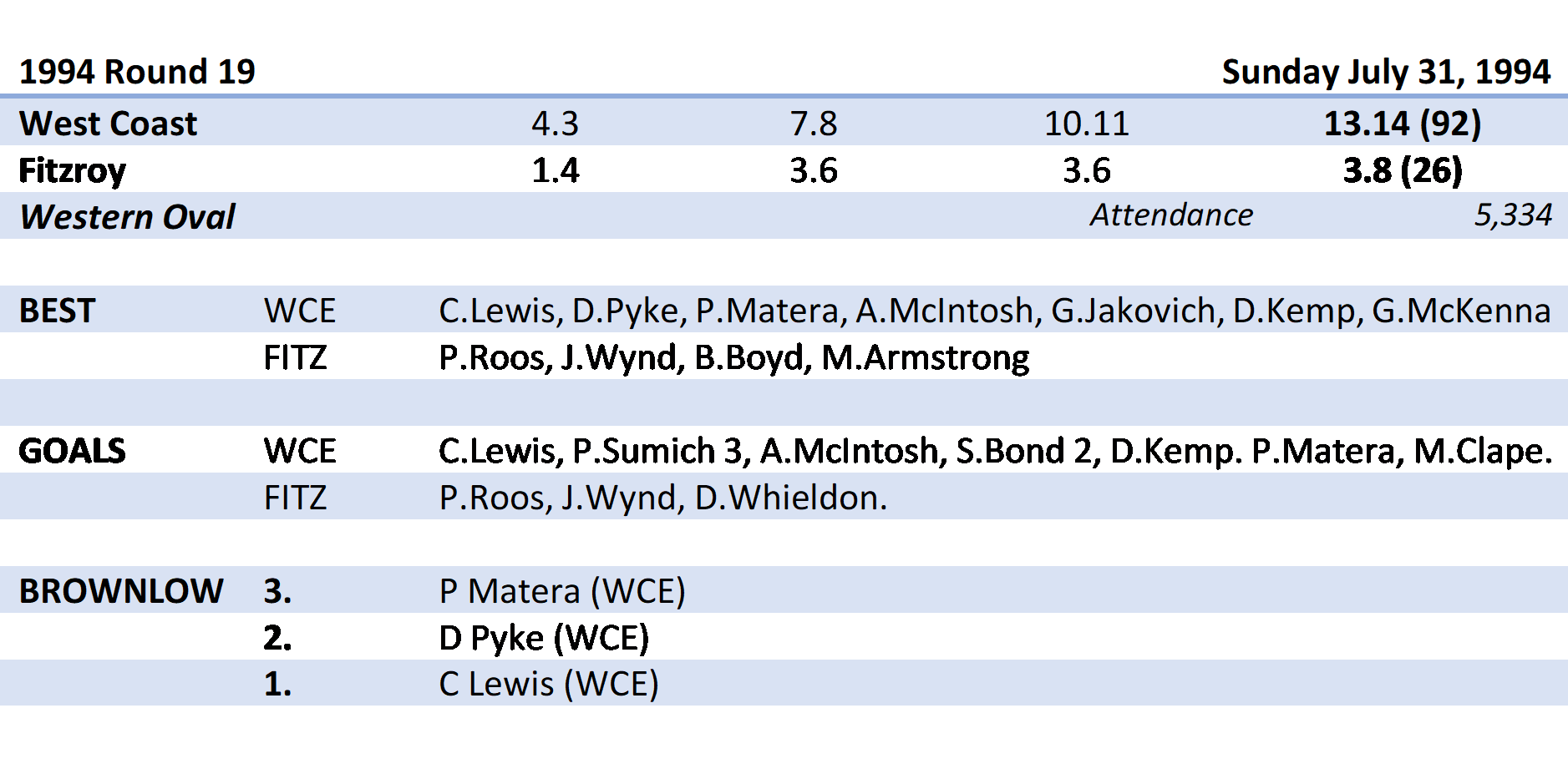
West Coast swept aside the Fitzroy Lions with an easy 66 point win at the Western Oval. Fitzroy were held to just two behinds after half-time, unable to break through the Eagles hardened defence in wet and heavy conditions.

On a cold, wintry afternoon where a crowd of just 5,334 braved the conditions, Chris Lewis provided the shine with 16 disposals and three first half goals, as well as having a hand in several others. Peter Sumich also finished with three goals as he continued to build his match fitness from consecutive hamstring injuries.

The Eagles strong performance came despite missing several key players. Brett Heady was never a chance of lining up after dislocating his shoulder the week before against Richmond, while Chris Mainwaring (hamstring) and Chris Waterman (foot) were ruled out during the week.

John Worsfold was given an extra week to recover from his groin problem, as was Tony Evans who had a back complaint. The Eagles consequently made four changes at the selection table, with Michael Brennan returning from injury, and fringe players Matt Clape, Brendan Krummel and Paul Symmons all earning call-ups.

Damien Hampson was initially dropped, alongside injured trio Heady, Mainwaring and Waterman, but earned a reprieve ahead of the opening bounce when David Hynes pulled out.

Krummel’s selection marked his first Eagles appearance in over a year, but it didn’t come without controversy. After being named in the Eagles squad on Thursday night, Krummel became the centre of an investigation over an incident from the previous weeks WAFL derby between East Fremantle and South Fremantle.

Young Bulldog Owen Woods was collected behind the play, suffering a broken jaw in several places, and South Fremantle officials pointed the finger at Krummel. The Bulldogs lodged an official complaint with the WAFL and demanded that Krummel be charged, with Woods expected to miss the remainder of the season after undergoing surgery.

However, the WAFL tribunal were unable to determine whether there would be a case to answer, leaving Krummel free to play with West Coast. Krummel, for his part, said that he knew nothing of the incident.

The Lions dropped four players in response to their narrow loss to Brisbane the week before, with Tom Kavanagh, Danny Morton, James Manson and Nick Mitchell all losing their place. Rick Lyon, Brett Cook, Trent Cummings and Mark Zanotti were the four inclusions, but Zanotti and Cummings then became late withdrawals ahead of the match. Their spots were in turn taken by David Bain and Marcus Seecamp.
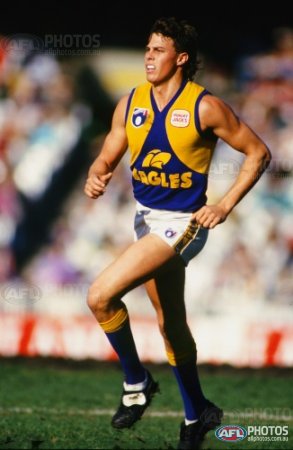
Brendan Krummel returned to the Eagles line-up for the first time in over a year

Despite the wet conditions, Malthouse started three talls in the Eagles forward line, as he looked to expose the depleted Fitzroy defence. Ashley McIntosh and Jason Ball took their spots across half forward, with Peter Sumich taking his regular spot in the goal square.

Fitzroy had first use of the wind, but the Eagles got first blood when Lewis soccered home from the goal square. The Lions held on for much of the quarter, but a three goal burst in time-on put West Coast out to a 17 point lead at the first change and there was never any coming back for the Lions from there.

The Eagles would extend their lead to 26 by the major break, then leading by 47 at three quarter time and finally running out 66 point winners as Fitzroy failed to register a second-half major. In fact, the Lions remained scoreless after half-time until the dying minutes of the last term when they kicked consecutive behinds.

When the game was there to be won, Lewis was a cut above most others on the field, proving a constant danger and giving Fitzroy defender Steven Stretch the run-around. Peter Matera added the flashes of brilliance, getting the better of Michael Dunstan on the wing, while down back the Eagles defence proved impenetrable.

Michael Brennan held Darren Wheildon to just one goal, while Guy McKenna, Glen Jakovich and Mitchell White all shut out their opponents in a complete display.

The win further enhanced this Eagles group with the club not always renowned for their performances in the wet. However, the win over Fitzroy was the fourth win in wet weather after victories over St Kilda, Essendon and Richmond in recent weeks, all of which were played in the rain.

The performance impressed Fitzroy coach Robert Shaw, declaring West Coast as ‘the best team I have seen in those conditions’.

Eagles coach Mick Malthouse acknowledged that the conditions suited the more developed Eagles against a young Fitzroy outfit. “Jarrod Molloy is a good marking player so the conditions didn’t suit him. Chris Johnson has great pace but is still finding his way.”

“We had a lot of experienced players in the midfield.”

Shaw though was far more circumspect over the difference between the two sides. “They played the percentages and followed the basic principles a lot better than us.”

“And they did it for longer and more often.”

While Lewis and Matera were the polish up forward and around the wings, Dean Kemp and Don Pyke provided the grunt through the midfield. Kemp finished with 28 disposals and a goal while Pyke had 30 through the centre. Ashley McIntosh had 18 disposals, four marks and booted 2.2 across half forward, while Glen Jakovich collected 20 touches across half back.

Paul Roos was clearly the best player for Fitzroy, gathering 31 disposals and booting a goal in an intriguing battle with Craig Turley through the middle. Jim Wynd also found plenty of the ball, finishing with 29 disposals and joined Roos as one of the Lions’ three goal kickers.

The win saw West Coast hold their one game advantage over the Blues, who defeated an inaccurate Hawthorn by 32 points at Princes Park. The Blues, in turn, held their position in second ahead of North Melbourne, with the Kangaroos coming from behind to defeat Footscray by 20 points in a Friday night classic.

Richmond became the benefactors of the losses suffered by the Hawks and the Bulldogs, climbing into the top four after their straight forward win over Sydney. Melbourne were the other big movers, storming into the top eight  for the first time since Round 13. The Demons thumped a faltering Essendon by 77 points, lifting them from ninth to fifth on the ladder as they passed a number of clubs – including the Bombers – with a superior percentage.

Melbourne led a group of five teams who all had nine wins as the race for the bottom half of the top eight continued to tighten. The Cats rose to sixth after they thrashed Adelaide, with Hawthorn and Footscray filling out the rest of the finals positions. The Magpies slipped to ninth due to having the bye.

While West Coast were all but guaranteed finals and strengthened their position on a top two finish and two home finals, the fallout for Fitzroy was substantial.

Robert Shaw resigned as coach in the days following the Eagles defeat, although he agreed to coach out the remainder of the season as the Lions continued to be the centrepiece of merger discussions. Speculation suggested that a deal with either Brisbane or Melbourne was imminent, leading Fremantle to claim they should be given first right to Fitzroy players as part of their inaugural 1995 squad.

The comments angered president Dyson Hore-Lacy, who had already been vocal about the Dockers’ attempts to lure Paul Roos west with a ‘substantial’ offer, which included the captaincy. Hore-Lacy remained resolute about Fitzroy’s future, declaring the club wouldn’t hold back from launching legal action against any AFL club who tried to poach their players while under contract.

Hore-Lacy also scoffed at the idea the club would head interstate, saying a merger with the Bears would be ‘like taking the last chair on the Titanic.’
1994 Rewind: Eagles End Tiger Streak

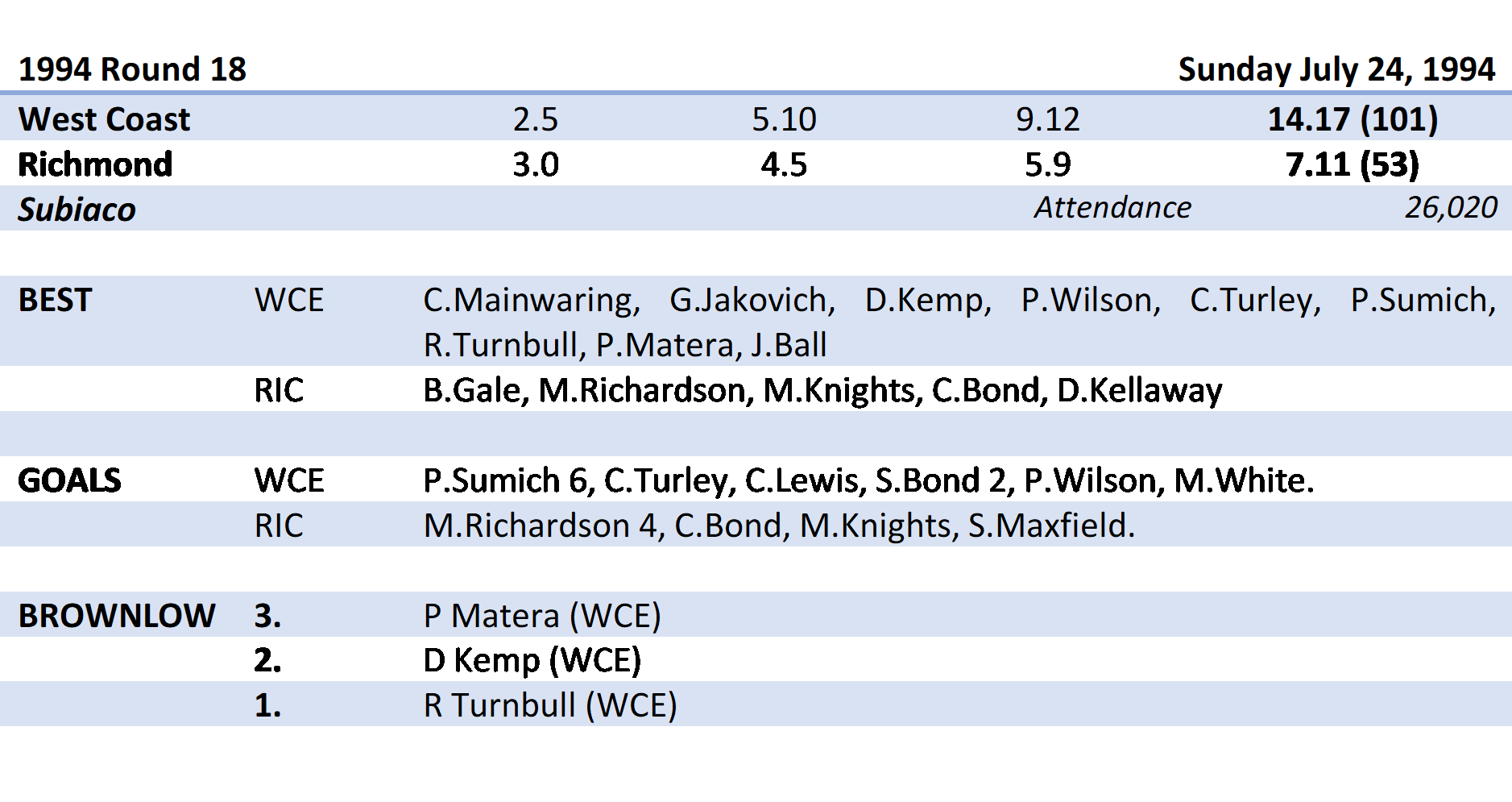
West Coast bounced back from their narrow loss to Adelaide with an eight goal win over Richmond, which ended the Tigers’ six game winning streak.

Richmond arrived in Perth as one of the form teams of the competition, rising to fifth on the ladder on the back of a mid-season revival that had the Tiger faithful dreaming of a first finals appearance since 1982. But they were no match for one of the premiership favourites on their home turf.

However, it was that home turf which once again hit the headlines after Richmond coach John Northey blasted the surface for not being up to scratch. A fortnight after Mick Malthouse was critical over the poor standard of the ground, Northey labelled the surface ‘absolutely pathetic’.

“It’s no good having tremendous facilities and the ground being as poor as it is… to me this is an absolute disgrace.”

Northey’s comments were echoed by Malthouse who reiterated his thoughts after the last Eagles home game. “We’ve been a victim of our home ground in many respects. When it is like it is at the moment… we have modified our training while we wait and see how the ground comes up.”

The ongoing discussion prompted the General Manager at Subiaco Football Club Alan White to reveal they had presented an offer to the WAFC to subsidise the resurfacing costs of the ground, in exchange for an extension of their current lease at Subiaco until 2011. However, White claimed that WAFC Chief Executive Jeff Ovens rejected the offer.

The WAFC said they needed $700,000 to repair the drainage at the ground, but with West Coast not scheduled to play at the ground again until the final round, and with any home finals set to be staged at the WACA due to capacity concerns, the hope was that the ground would recover on its own.

While the deterioration of the ground and who was responsible continued to be debated, what couldn’t be questioned was the gap between the two sides. West Coast controlled the contest from midway through the first quarter and only poor kicking on goal prevented the final margin from being far greater.

The Eagles made four changes to the team that lost to Adelaide, with three players forced out with injury. Michael Brennan damaged a hamstring, John Worsfold was ruled out with a groin and then Tony Evans was pulled on the morning of the game with a back concern. Brett Spinks was dropped after a poor showing against the Crows.

Shane Bond and David Hynes returned from injury, while Mitchell White was selected for his first senior game of the year, after recurring groin problems had kept the premiership forward sidelined since pre-season. Damien Hampson was then selected for his first game in over a year when he came in as the late replacement for Evans.

The Tigers has their own injury concerns entering the game losing Mark Neeld (knee) and Stuart Edwrds (groin) at selection. Paul Bulless and Tony Free were the two inclusions.

After being humbled by Shaun Rehn the week before, Eagles duo Ryan Turnbull and Jason Ball responded in fine fashion. Turnbull was dominant in the ruck against Tiger counterpart Greg Dear, so much so, that David Hynes rarely got off the bench as Turnbull provided the Eagles midfield with first use from the ruck knock.

Turnbull had 23 hit-outs to go with 14 disposals and four marks as he showed his versatility around the ground. After spending parts of the year either in the ruck and in defence, Ball played primarily out of his favoured position at centre-half-forward in the absence of Brett Spinks. Ball produced the best performance of his 10-game career with 23 disposals and ten marks.

Ball’s showing at half-forward also created plenty of opportunities for full-forward Peter Sumich, who had his best return for the year. Sumich finished with 6.5 from 11 kicks and six marks and most pleasingly showed no concerns with his questionable hamstring opposed to Tiger full-back Scott Turner.

The Tigers had the better start with Matthew Richardson proving too much for Ashley McIntosh to boot the opening two goals. Brendan Gale was similarly getting the better of Glen Jakovich picking up five marks in the first 14 minutes of the game.

However, with Turnbull getting the ascendancy at the stoppages, the Eagles soon had the momentum of the game through the likes of Craig Turley, Dean Kemp and Peter Wilson. Turley, in particular, started strongly in his customary ruck-rover position, getting the better of Paul Broderick with seven first-quarter possessions.

Sumich and Peter Wilson got West Coast on the board but wayward kicking allowed Richmond to hold a one point lead at the first change. Shane Bond and Sumich kicked early goals to put West Coast in front, but held only an 11 point lead at the main break following further inaccuracy in front of goal.

After half-time, the Eagles got reward for their dominance with a nine goal to three second half bringing about a 48 point win.

Eagles coach Mick Malthouse was happy enough with the win, although admitted that he felt his side should have been better in front of goal considering their statistical advantage. “By our tally we had 70 or 80 more kicks and 60 more handpasses. I think we really should have done better than win by seven or eight goals.”

The Eagles had 78 more kicks and 26 more handpasses, resulting in 13 more scoring shots.

Chris Mainwaring finished with 31 disposals to lead the Eagles, with Dean Kemp (29), Craig Turley (23) and Peter Wilson (18) all prominent. Stand-in captain Guy McKenna marshalled the Eagles defence with David Hart restricting Nick Daffy to just eight disposals.

Brendan Gale was the Tigers’ best player, clearly getting the better of Glen Jakovich at centre half forward, but the dominance of Turnbull forced Richmond to move Gale into the ruck, depriving them of a key target ahead of the ball. Matthew Richardson booted four goals from limited chances and Duncan Kellaway was defiant in defence, having the better of Brett Heady and then Chris Lewis.

Heady would be the one low point out of the match for West Coast, dislocating a shoulder during the third term.

The win meant West Coast moved back to one game clear at the top of the ladder after Carlton fell to Geelong by 36 points at Waverley Park. The Cats charged to a five goal lead at the first change and held sway for the remainder of the afternoon to record their eighth win of the season and stay in touch with the top eight.

North Melbourne took a hold of third place when they ran away from the fourth-placed Hawks. The Kangaroos led by just four points at three-quarter time after a tight struggle, but six goals to just one point in the last term saw North Melbourne record a comfortable 40 point win. Despite the loss, Hawthorn stayed in fourth spot but they were joined on points by Footscray who were the big movers of the weekend.

The Bulldogs were too good for the Mapgies, recording their fifth win in six games to rise from eighth on the ladder to fifth bypassing the Magpies, Tigers and Bombers, who suffered a shock loss to lowly St Kilda. Tony Lockett booted six goals for the Saints who produced a remarkable display of accuracy to finish with 18.2 in a ten point win.

The other surprising result of the weekend was Adelaide’s defeat at home to Sydney. A week after they toppled the ladder-leading Eagles, the Crows fell to the bottom of the ladder Swans by 12 points, all but ending their finals aspirations. The loss ended a tumultuous week for the Crows who stood down high-flying full forward Tony Modra after he missed a training session during the week. The situation prompted growing rumours that Modra was set to join new club Fremantle for their inaugural season in 1995.

Despite being a game clear of Carlton and three games clear of third-placed North Melbourne, Eagles coach Mick Malthouse refused to entertain the idea that West Coast had secured a top two position which guaranteed two home finals.

“We are not even thinking about that,” a terse Malthouse declared.

1994 Rewind: Wall of Jakovich Halts Cats

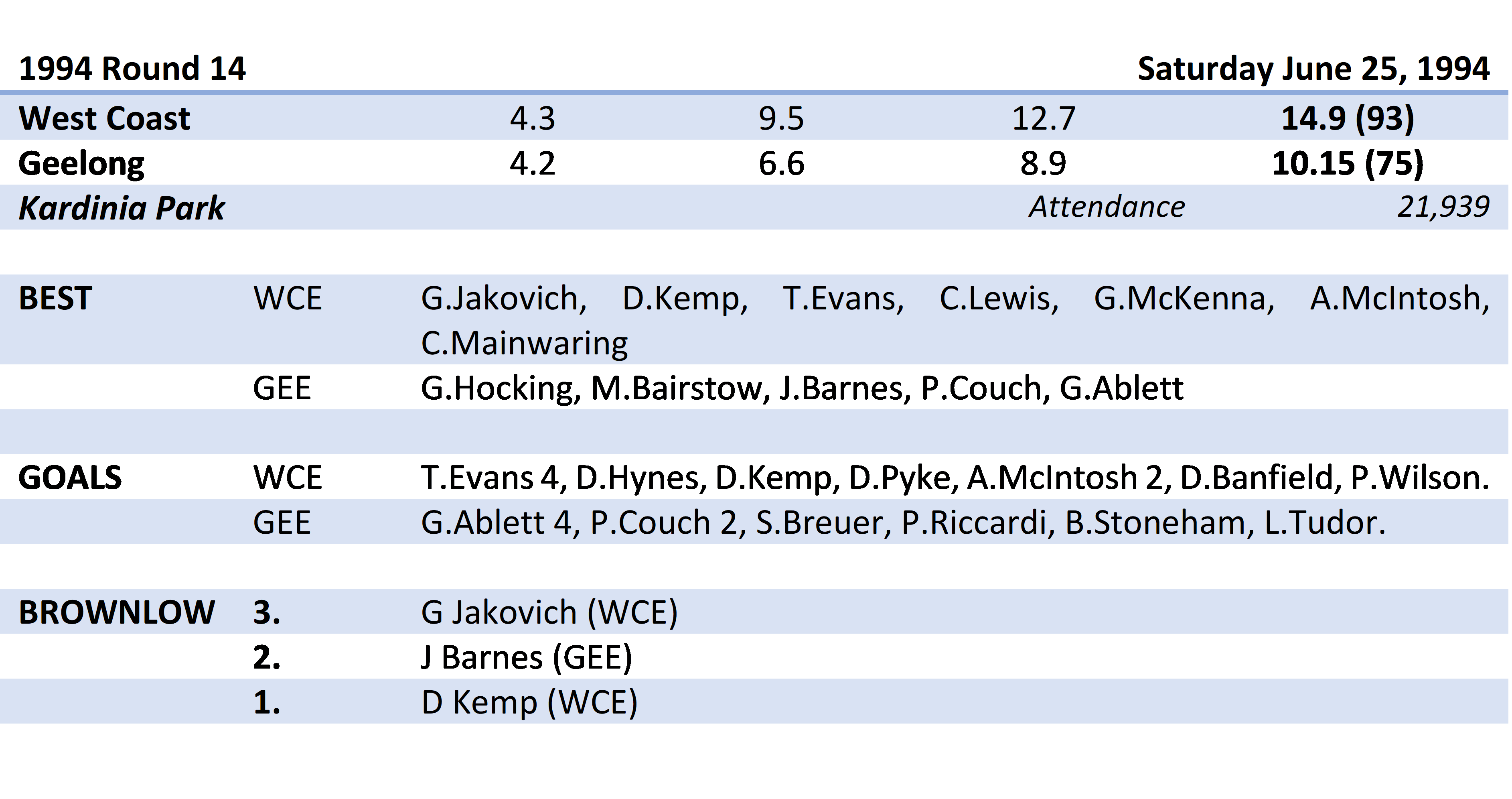
It was a case of the Eagles taking their chances and the Cats ruing theirs when West Coast bounced back from their loss to Collingwood with an 18 point win over Geelong at Kardinia Park.

Glen Jakovich was arguably the difference between the two sides, with the hulking centre half back picking up 28 disposals and 10 marks in a best on ground display. Jakovich had the better of first Barry Stoneham and then Leigh Colbert with Geelong coach Malcolm Blight unable to diffuse the Eagle’s output.

“The biggest problem we had all day was Jakovich. Forget the rest,” an exasperated Blight remarked after the game.

Jakovich had spent much of the week in doubt with a shoulder injury, but he proved to be an integral part in the Eagles win. Jakovich combined well with Guy McKenna who rebounded strongly off the half-back flank, while Tony Evans produced his best performance of an injury-interrupted season with four goals up forward.

Evans was considered lucky to have held his spot after managing just five disposals the week before, but several others weren’t so fortunate as West Coast made a raft of changes. Karl Langdon, Paul Harding and Matt Clape were all dropped, while Brett Spinks was ruled out with concussion.

Coming into the Eagles line-up were Jason Ball, David Hynes, captain John Worsfold and debutant Paul Symmons. Symmons’ inclusion capped a whirlwind week for the skinny redhead, after he was named best afield for Western Australia in their state league match against South Australia the previous week.

The inclusion of Hynes and Ball was with the intention of giving the Eagles forward line greater presence after Mick Malthouse thought too much reliance had been placed on mid-sized forwards Chris Lewis and Brett Heady the week before.

Peter Sumich remained sidelined as the Eagles opted for caution on their full forward. Sumich, along with Worsfold and Shane Bond, had undergone a fitness test before the squad departed for Geelong, but only Worsfold was declared fit.

The Cats were missing their own spearhead in Bill Brownless, who had not made an appearance since being dropped after the round 10 defeat to Essendon. Geelong, though, still brought back three important players in Leigh Colbert, Leigh Tudor and Peter Riccardi, who was set to resume his battle on the wing with Peter Matera. Sean Simpson was then the Cats’ fourth inclusion when he replaced Leigh Pickering ahead of the bounce.

But while there was no consternation when the team was announced, there were plenty of raised eyebrows when the teams lined up at the opening bounce.

Blight – not immune to thinking outside the box – abandoned his traditional attacking nature by starting many of his playmakers in unorthodox positions in a bid to match the Eagles defensive style. Garry Hocking lined up at half-forward, Robert Scott was sent to a back pocket on Evans, while Paul Couch – who had shown form in the previous month that was reminiscent of his 1989 Brownlow win – started on the bench.

Steven Hocking and Sean Simpson were both moved into the middle in tagging roles on Dean Kemp and Don Pyke, while Grant Tanner was given a similar task on the wing opposed to Chris Mainwaring. Ken Hinkley went to half-forward matching up against McKenna, with Andrew Wills sent to defence on Chris Lewis.

The moves worked for the first 30 seconds when Mark Bairstow was able to win the opening clearance and find Gary Ablett, who snapped the opening goal. But that was about as effective as Blight’s changes got.

Dean Kemp had nine first-quarter possessions – trailing only Jakovich on the ground who had 11 – and Tony Evans was proving too elusive for Robert Scott in the forward line. Chris Lewis was proving equally as difficult for Wills and the Cats were lacking drive with Hocking and Couch not involved in the game.

Two late goals put the Eagles in front at quarter time and they continued to dictate play in the second term. The Cats stuck to the task for the majority of the term, but again West Coast were able to nab a pair of goals late in the quarter to head into half-time with a 17 point advantage.

Kemp had tallied 17 disposals in the first half as he shook off the tagging effort of Steven Hocking, as did Jakovich who had restricted Stoneham to just seven disposals and no marks. Mainwaring picked up seven kicks and three handpasses in the second term to take him to 14 for the half, with Matera also recording 14 disposals in the first half on the other wing.

With the Eagles midfield controlling the game, Blight was forced to do away with his defensive tactics and resort back to Plan A, bringing Couch off the bench and putting he and Garry Hocking in the middle. West Coast booted the first two goals after the main break to stretch their lead to a game high 29 points, but Hocking soon dragged the Cats back into the contest.

The Cats midfielder went head to head with Kemp and had the better of the Eagle as Geelong got more ball in their forward half. However, for all their ball, they were continually met with the imposing presence of Jakovich.

Stoneham was moved to centre half back at the start of the third term, switching positions with Leigh Colbert who had struggled to contain Ashley McIntosh. Colbert moved to centre half forward and tried to drag Jakovich out of the play, but it was to no avail.

The Cats though still managed to kick the final two goals of the third term and Mark Bairstow could have made it three in a row after the siren, only to see his set shot hit slam into the post. Trailing by 22 points at the final change, the Cats continued to push, closing within eight points.

But they failed to capitalise on their chances with Gary Ablett and Tim McGrath, in particular both missing gettable shots. West Coast finished with the final two goals of the game to seal the four points in Chris Mainwaring’s 150th game, but Geelong’s 2.6 in the last term blew any chance they had of stealing the win at the death.

“It was a game of chances, I thought. When we had control of the game in the last quarter we didn’t take ours,” Blight said. The Geelong coach refused to accept that his positional changes at the start of the game had played into the Eagles hands, instead saying they were in the game but couldn’t make their shots on goal count.

Garry Hocking ended with 33 possessions, 21 of which came in the second half, while Paul Couch collected 19, despite spending the best part of half the game on the bench. Gary Ablett finished with four goals, but was well held by Michael Brennan and John Barnes had 18 disposals to go with 25 hit-outs through the middle.

Jakovich’s 28 disposals was the second-best effort in his career and he was the leading ball winner for the Eagles, ahead of Kemp who had 27. Guy McKenna had 25 and Mainwaring finished with 22 touches in his milestone game.

Remarkably, the win was the Eagles’ fourth in a row against Geelong at Kardinia Park, stretching back to 1989. In that time, they had also won twice against the Cats at Waverley Park and twice at the MCG, making it eight consecutive wins over Geelong in Victoria. On the flipside, they had lost twice at home in that same period.

Mick Malthouse was confident that his side would bounce back from their disappointing showing against Collingwood. “We have very rarely lost two in a row. The players responded to direct criticism during the week,” Malthouse proclaimed.

“If that’s the character they showed, then Geelong showed it too. It was a tough game from go to whoa. It was only in the last minute that I put my headphones down.”

When asked about Jakovich’s performance, Malthouse was naturally understated. “Good young player.”

The win maintained the Eagles position at the top of the ladder, one game ahead of Carlton who had defeated North Melbourne by 18 points in their Friday night blockbuster. The Blues leapfrogged the Kangaroos into second spot, with North Melbourne dropping to third. The Hawks held onto fourth position despite having the bye.

Footscray were the big winners of the round, rocketing from ninth to fifth when they thrashed Fitzroy by 104 points. The Bombers defeated Sydney by 34 points but fell behind the Bulldogs on percentage, while the Magpies were the latest team to fall victim at the GABBA, losing to the Bears by 44 points.

Richmond’s narrow win over Melbourne had them knocking on the top eight, while Adelaide missed a golden chance to jump back into the finals spots when they were held to a draw by lowly St Kilda. The Cats remained in eighth spot on percentage, with Malcolm Blight under increasing pressure to hold his position as senior coach.

A fortnight earlier, Blight had been booed by his own fans at three-quarter time when Geelong trailed the Saints by 26 points at home, only to have his blushes saved when the Cats stormed home to win by three points. With a 6-6 record after 12 games, Geelong were well short of expectations and reports of tension between players and the coach were surfacing.

However, Geelong president Greg Durham allayed any suggestions that Blight’s position was under threat, confirming the experienced coach wasn’t going anywhere.

1994 Rewind: Rookie Tranquilli Inspires Upset

The Eagles six game winning streak was brought to a surprising end when they were toppled by an undermanned Collingwood at the MCG.

Andrew Tranquilli proved the unlikely star for the Magpies, booting six goals in just his third AFL game as Collingwood held sway for most of the day to record the 37 point victory, in front of a disappointing crowd of only 27,699.

The Magpies entered the match as rank outsiders after a humiliating 66 point defeat to Richmond on the Queens Birthday just six days earlier as well as dealing with a crippling injury list.

Already without Paul Williams (knee), Craig Kelly (hamstring), Gary Pert (knee) and Jon Ballantyne (knee), Collingwood lost a further three players in the loss to the Tigers. Jason McCartney pulled out before the game, with Brad Rowe (dislocated shoulder) and Brad Plain (groin) both out of action before half-time.

In response to the loss, the Magpies made six changes for their clash with West Coast. McCartney returned to the line-up and was joined by veteran midfielder Scott Russell, wingmen Mark Fraser and Todd Curley, and rookies Paul Sharkey and Tranquilli.

Brad Rowe and Bradley Plain were both forced out with their respective injuries, as was defender Damian Houlihan who was suspended for striking Chris Naish. Stephen Ryan, Brenton Sanderson and Glenn Sandford were all dropped.

The Eagles, on the other hand, welcomed back a number of reinforcements. Brett Heady returned to the side after two false starts in the previous two weeks, with Peter Wilson also returning from a week off due to a hamstring strain. The Eagles brought in Paul Harding to partner Ryan Turnbull in the ruck, with West Coast conscious of the threat of Magpie ruckman Damian Monkhorst.

Out for the Eagles were David Hynes and Jarrad Schofield, who were both dropped, while Shane Bond missed out due to a hamstring complaint. Craig Turley was considered unlucky not to be named after a strong month of football with West Perth, but was a late inclusion for his first game since Round 5 when he replaced John Worsfold. The Eagles captain failed to recover from an arm injury suffered against the Bears.

Despite the Magpies’ troubles heading into the game, Eagles coach Mick Malthouse forewarned a response from Collingwood, saying the preparation had worked in the Magpies favour. Malthouse believed that the negative reporting from the Victorian media over the Magpies’ recent performance and injury woes had given Collingwood a psychological edge.

“They will go in as the rank underdogs basically because of a media beat-up on their injuries. The reports don’t say anything about the quality players that are in their side,” Malthouse said.

“The day a side loses a game because of who is sitting in the grandstand, is the day I’ll give the game away.”

Malthouse’s concerns would prove to be right.

The diminutive Tranquilli booted the opening goal of the match as Collingwood opened up a two goal lead at the first change. The Eagles though would rue a host of missed early chances. They had four behinds on the board before Brett Heady kicked their only goal for the quarter.

The Magpies then broke the game open in the second term with three goals in eight minutes, off the back of a courageous act from captain Tony Shaw. Running back with the flight of the ball, Shaw marked in the middle of the ground with Eagles winger Chris Mainwaring bearing down on him from the opposite direction, which led to a goal to Mick McGuane. Saverio Rocca and Nathan Buckley quickly followed with majors and the Magpies were out to a 23 point lead.

The Eagles worked their way back into the game, but could only match Collingwood for the rest of the term as the Magpies headed into the half-time break with an 18 point advantage.

After managing just four goals the week before against Richmond, Matthews’ loaded up his forward line and instructed his side to ‘kick the bloody thing in there and don’t mess around’. The Magpies started with Sav Rocca, Brett James and Jason McCartney in the forward line, with ruckman Damian Monkhorst also drifting inside the Collingwood 50.

This caused a shuffle for West Coast with Ashley McIntosh, who started up forward, moved to defence to counter the Magpie height. The forced move denied the Eagles a marking target of their own up forward, which was soon compounded when Brett Spinks was forced off the ground with concussion in the second quarter.

Matthews had also identified the Eagles half-back line as their main driver and looked to minimise their impact. Matthews put his strongest line at half-forward, with McCartney opposed to Glen Jakovich and Nathan Buckley and Gavin Brown on the two half-forward flanks.

Buckley had yet to make his mark at Collingwood after a high-profile switch from Brisbane ahead of the 1994 season and had managed just 10 disposals against the Tigers the week before. However, he responded with arguably his best performance thus far in the black-and-white stripes, picking up 26 disposals and booting two goals and giving Guy McKenna the run-around.

Buckley and Brown pushed high up the ground and stayed wide of each other to prevent the Eagles half-backs from teaming together. McCartney was operating as a decoy to drag Jakovich out of the play, which left Tranquilli deep in the forward line, often one-out against David Hart.

The other important tactical match-up was the use of Mark Fraser on a wing against Peter Matera. While Chris Mainwaring was having the better of McGuane, Matera struggled to have any influence on the game with Fraser keeping him company.

Matera had just 13 disposals for the game, while Fraser finished with 21 and two goals, including the vital first goal of the second half. Fraser extended the Magpies lead to 24 points just two minutes into the third term, and while West Coast responded, Damian Monkhorst and Andrew Tranquilli made it three of the first four goals to Collingwood.

Trailing by 31 points heading into time-on, the Eagles once again rallied. Brett Heady – who had been the only productive forward for West Coast all day – booted two goals in as many minutes, with Tony Evans and McKenna also kicking truly. The Eagles trailed by just 13 points at the final break, but a six goal to two final term in favour of Collingwood handed West Coast their first defeat in nearly two months.

Brett Heady matched Tranquilli’s haul of six, but the rest of the West Coast forward line struggled. Eagles coach Mick Malthouse was philosophical after the game, saying his team had been good but the Magpies had been the better.

“The game is in flux right through, it shuffles one way and then the other… we struck a very good side in Collingwood and they beat us.”

“Every match is against a different club, at a different ground on a different week,” Malthouse continued. “The competition now is so regulated – weighted draws, drafts and salary caps – that the game is a fluctuating thing that changes every week… every quarter… what worked last week will not necessarily do the trick again.”

While Malthouse accepted the result as one that was par for the tightness of the competition, Matthews praised the win as one of his side’s best. “It’s got to rank as a good win because we’ve beaten the top side by six goals.”

More importantly though, for Matthews, the result restored the Magpies standing within the competition. “Respect and pride. You either gain a bit or lose a bit and we lost some on Monday.”

“But we gained a bit today.”

Tony Shaw and Damian Monkhorst were the best for Collingwood, with Monkhorst too good for both Turnbull and Harding. Monkhorst finished with 16 disposals, 13 hit-outs and two goals while Shaw had 20 with a number of clearances.

Mainwaring had 26 touches for the Eagles and Don Pyke 24 but the Eagles had too few winners. “As honest as our players tried to be, they weren’t good enough.”

“They were beaten by their direct opponents and when shuffled around they were beaten by another opponent,” Malthouse said. “I don’t know how we got that close at three-quarter time. But they rallied, steadied and kicked goals when it counted most.”

“Collingwood did it better than us and won the game.”

Despite the loss, the Eagles remained a game clear at the top of the ladder, courtesy of a number of favourable results. Only two teams who started the round in the top eight – fourth-placed Carlton and the eighth-placed Magpies – won, while the Cats had the bye.

Carlton moved into third spot when they thumped a hapless St Kilda by 80 points, drawing level with the Kangaroos who lost narrowly to Richmond. Both teams sat one win behind the Eagles and one win ahead of Collingwood, who climbed to fifth following their win over West Coast, and Hawthorn, who lost to Fitzroy by 13 points in a low-scoring match at Waverley.

Melbourne’s season continued to freefall with a narrow defeat to Adelaide and Essendon were the latest victim of the giant-killing Bears, going down by 33 points at the GABBA.

1994 Rewind: Finals Secured But Too Soon For Malthouse

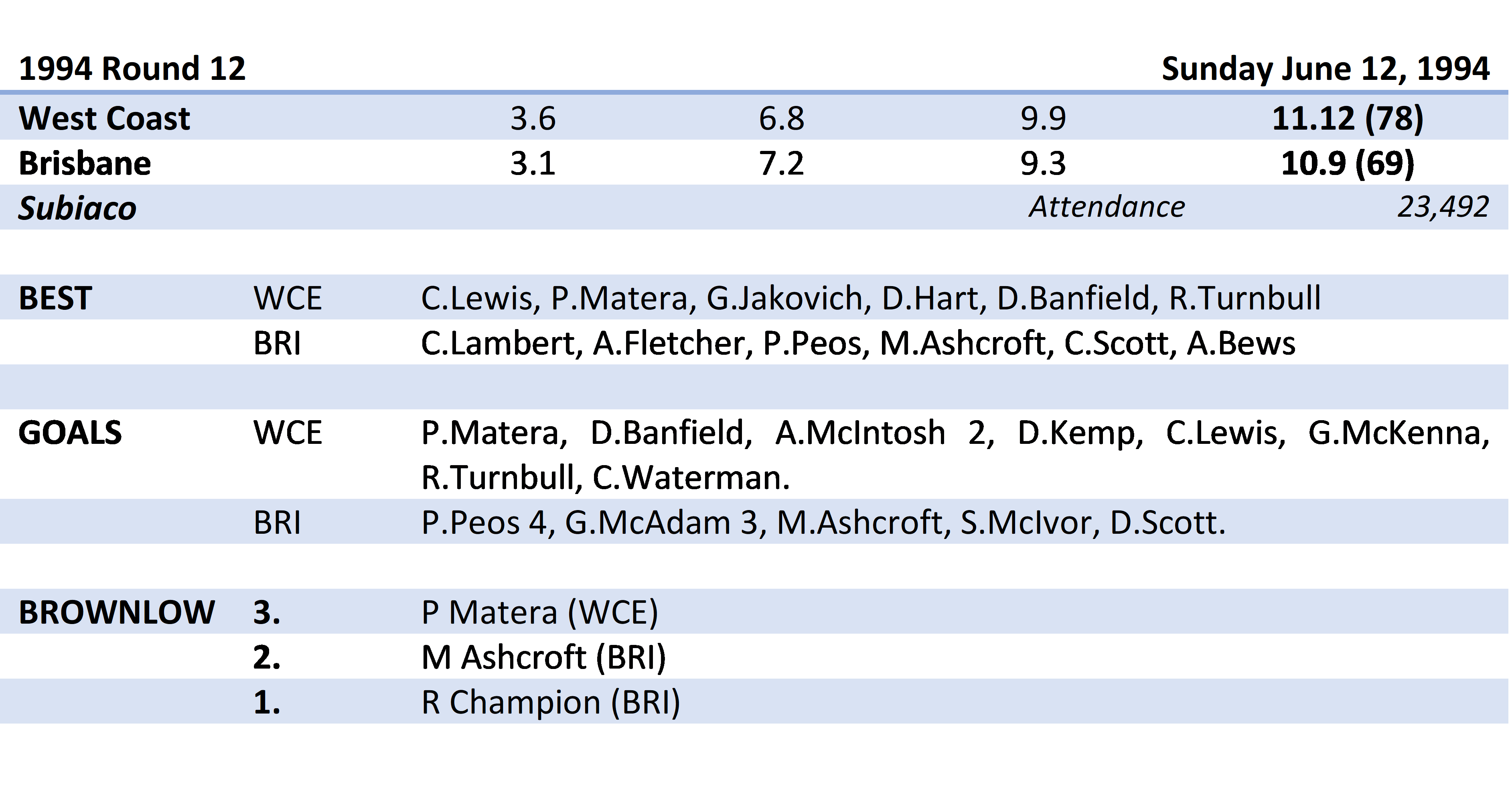
The Eagles were unimpressive but still made it six wins in a row when they held off a plucky Brisbane at Subiaco Oval.

The Bears arrived in Perth off wins against finals fancies North Melbourne and Geelong and threatened to topple the ladder-leading Eagles for much of the afternoon. However, the Bears butchered their chances in the final term meaning the Eagles are still yet to lose to Brisbane – a draw in 1992 the closest the Bears have gotten.

The Eagles 9-2 record after 11 games kept them a game clear at the top of the ladder and virtually assured them of a fifth straight finals appearance, although Eagles coach Mick Malthouse wasn’t exactly celebrating.

Post-match, an agitated Malthouse resumed his criticism from before the season about the newly implemented top eight. Malthouse had derided a system that ‘rewarded’ more than half the of the teams in the competition with a finals spot and also suggested that the larger finals system had eliminated the late season drama of teams competing for finals.

Malthouse said that the season had developed a clear division of the top teams and the bottom teams at the halfway mark and that the finals make up had already been decided, killing any interest in the second half of the year.

“I think its ridiculous. In the past two seasons we have gone to round 22 or 24, we’ve gone to the final siren in many instances to find out who would make the top six. Now, in round 12 we have got real division.”

Malthouse said that only Adelaide – who were in ninth position – were capable of pushing into the top eight out of the sides sitting in the bottom half.

“That’s the unfortunate thing about the final eight,” Malthouse continued. “You can get all the Victorian sides in that you like, but it doesn’t solve the problem of having a competition that’s fierce right to the end.”

Malthouse though wasn’t done after expressing his views on the top eight.

The Eagles had been put on notice by the AFL during the week after they had exploited a loophole which allowed Dean Kemp to be a late inclusion to the team that played Melbourne a week before, despite not being named in the squad of 24 submitted to the AFL on the Thursday night.

Under AFL rules, clubs were allowed to add an extra player to their emergency list the following day if they were playing on Sunday, with Kemp added as the 25th player in the Eagles squad. Kemp was subsequently included in the final side the morning of the clash with Melbourne, replacing Brett Heady who was never expected to play after straining a hamstring a week earlier.

As such, the AFL announced they would revoke the rule from Round 13, expressing their disappointment that West Coast had blatantly benefitted from the situation. For Malthouse, the whole scenario seemed unwarranted, simply stating that they were entitled to ‘use it to their advantage’. “While the rule is there, you use it.”

“We took the opportunity to take Dean Kemp across and he filled the role of the player (Heady) who pulled out of the side late.”

The Eagles clearly weren’t bothered by the AFL’s stance, as they made a further two late changes for their clash with Brisbane.

Brett Heady was named to return from a hamstring injury, but failed to come up on game day allowing Jarrad Schofield to reclaim his place after he was omitted for Heady. The other late change was Peter Wilson, who had been surprisingly named after Malthouse had ruled the half-forward out earlier in the week with a hamstring injury suffered against the Demons.

Wilson had his place taken by Matt Clape, who returned to the West Coast side for his first game since round 4. Brett Spinks was another who spent much of the week under an injury cloud, but he recovered enough from an ankle concern to take his place.

Michael Brennan plays game 150

The Bears were dealt a double blow for their trip west with captain Roger Merrett unavailable due to a thigh complaint and Matthew Kennedy ruled out with a fractured cheekbone. Merrett, in particular, was a bad loss for the Bears. The veteran had booted five goals and two goals in the previous two weeks as Brisbane recorded consecutive upset wins.

Scott McIvor was named for his 100th game at full forward in place of Merrett, with Fabian Francis the other inclusion.

The Eagles had the better of the early chances, but wasteful kicking at goal kept the Bears in the game at quarter-time with the visitors then dictating the play after the first change.

Adrian Fletcher and Craig Lambert led the Brisbane midfield who had the better of their Eagle counterparts. Dean Kemp struggled in his second game back from a knee injury and Chris Mainwaring found himself on the pine with Chris Scott getting the better of their duel.

Paul Peos then changed the game with three goals in 13 minutes. The former Eagle was proving a handful for several of his ex-teammates, with John Worsfold and then Guy McKenna both unable to contain the half-forward. Michael Brennan – who was playing game 150 – became his third opponent but the Bears had taken a seven point lead following Peos’ purple patch.

At the other end, West Coast were sorely missing Sumich, Heady and Wilson. Malthouse had a constant rotation of players through his front half, as he searched for an effective combination. David Hynes, Ashley McIntosh and Karl Langdon all started the game in the forward 50 but failed to have an impact, with Hynes well beaten by Martin Leslie and Darryl White getting the better of McIntosh.

A goal to Chris Waterman right before half-time levelled the scores at 44 apiece with West Coast then taking charge again in the third quarter. The Waterman goal started a run of four for the Eagles, with Peter Matera (twice) and Ryan Turnbull kicking majors to have the hosts ahead by 17 points.

Still, the Bears wouldn’t go away.

Brisbane booted the last two goals in the term to reduce the Eagles lead to six at three-quarter time, making it anyone’s game to win.

It would be the Eagles who would find the goals when it mattered in the final term. Guy McKenna was shifted to the forward line at the start of the last quarter, with the move paying immediate dividends. McKenna goaled just three minutes into the term to take the Eagles lead out to 12 points.

The Bears continued to pepper the goals, but couldn’t hit the major target. Peos and Alastair Lynch both missed from close range and then Troy Clarke slammed his rushed shot on goal into the post. The game was then decided heading into time-on with the Eagles pouncing on a Scott McIvor turnover. McIvor’s errant disposal was swooped on by the Eagles at half-back and a quick movement up the ground finished with McIntosh kicking an easy goal on the run to put the Eagles out to a three goal lead and end the contest.

A late goal to Brisbane reduced the final margin, but they paid for their missed chances earlier in the quarter. The Bears booted 1.6 for the term and Robert Walls was left to rue the opportunities. “We had our chances. Whoever won today could say they were a bit fortunate.”

“We weren’t able to close it and to their credit they bottled it up and did all the things that an experienced and good team should do in the final minutes.”

Malthouse though was blunt in his assessment of the performance. “We were ordinary in certain passages of the game… a lot of them are very disappointed in their performance today and are not buoyed at all by the fact that we got over the line.”

In further sour news, the Eagles lost Don Pyke and John Worsfold during the second half to injury. Pyke was forced off the ground with a shoulder injury early in the third quarter, while Worsfold played for nearly a quarter with an arm complaint, before then sitting out the last term.

Asked why Worsfold spent so long on the ground despite being clearly hampered, Malthouse said he did all he could get to his captain off. “Have you ever had front teeth extracted? That’s how hard it was to get him to leave the ground.”

1994 Rewind: Eagles Firm As Premiership Favourites

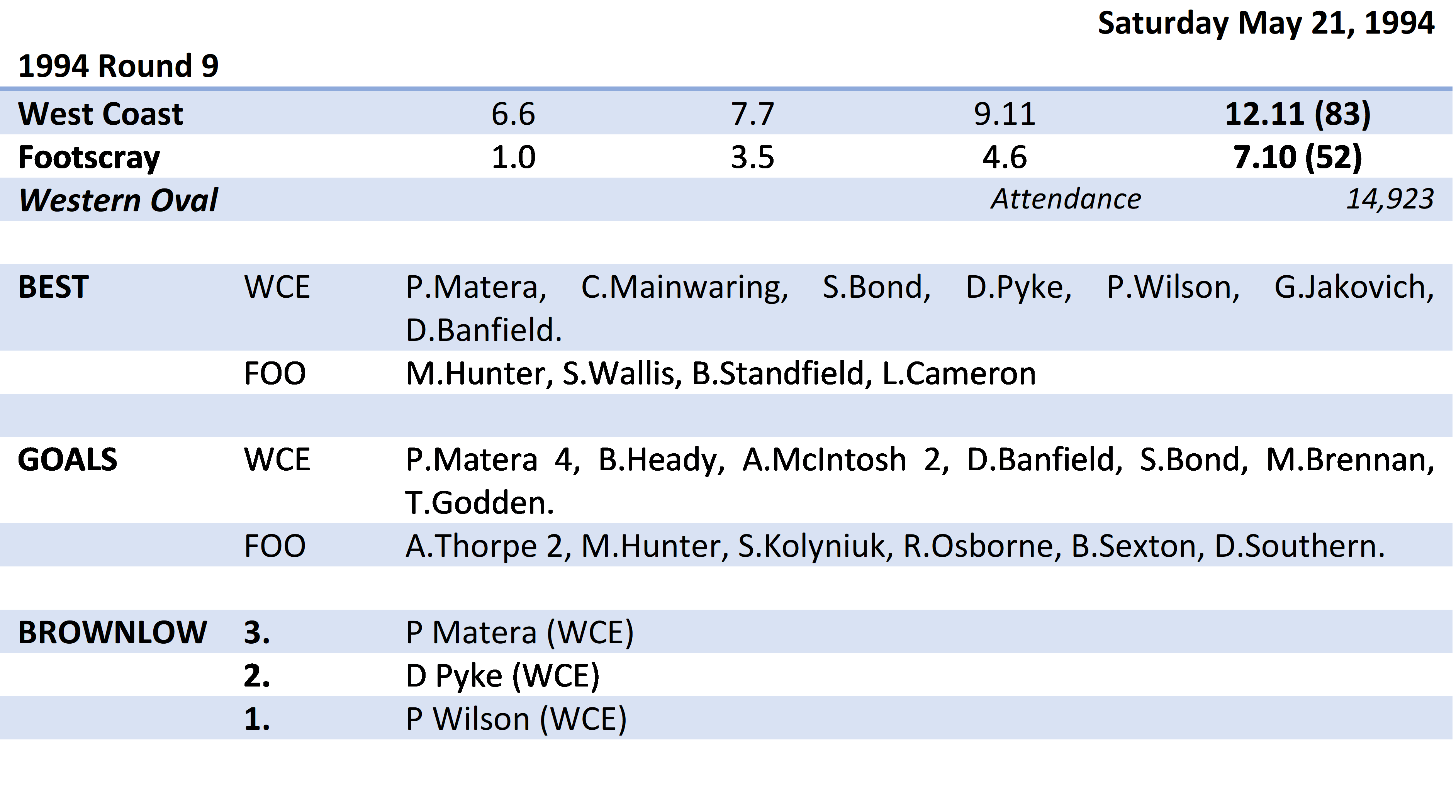
West Coast moved to outright premiership favouritism when they negotiated tricky conditions at the Western Oval to defeat Footscray by 31 points.

After a quiet month, Peter Matera returned to his best form with four goals from 19 disposals in a best on ground display. The dashing wingman was the standout in an even team performance, where forwards were efficient with their chances and the defence were as imperious as they had been all season.

The Eagles were moved to $2.50 favourites, ahead of Geelong ($4.50), North Melbourne and Essendon ($6), Adelaide and early season bolter Melbourne ($10), following their sixth win of the season at a ground that had been their undoing in the previous two seasons.

The Eagles had suffered demoralising defeats in their previous two visits to the ground, managing just three goals in their premiership year of 1992 and then falling to a 42 point defeat in the penultimate round of 1993 which ultimately cost West Coast a top two finish.

Ironically, the Bulldogs had done West Coast a favour the week before when they scraped home by three points against the Demons, allowing the Eagles to leapfrog Melbourne into top spot on the ladder, despite having the bye.

The win over Melbourne was the Bulldogs’ third in succession after earlier victories over Brisbane and Adelaide at Football Park, to have them knocking on the top eight. It had been a vast improvement in form after a tumultuous start to the season.

Terry Wheeler had been sacked just two weeks into the season with a narrow round 1 win over perennial strugglers Richmond and then an 88-point shellacking at the hands of Geelong enough for Footscray powerbrokers to orchestrate a change. Hawthorn premiership coach Alan Joyce was swiftly appointed to the role and after two further losses, the Bulldogs had found their rhythm.

They would have been confident going into the game against West Coast, particularly when persistent rain during the week turned the Western Oval into a quagmire. The rain dissipated by bouncedown, but both teams had to handle a howling gale favouring the Princes Highway end.

The conditions were enough to put off the Eagles who played it cautiously with a couple of their stars. Peter Sumich had initially been named after going down with a hamstring injury three weeks earlier, but he was a late withdrawal, replaced by Jason Ball who had been dropped for the full-forward. Dean Kemp was the other change, sidelined with a knee injury picked up late in the win over Carlton. Tony Godden was his replacement.

The Bulldogs made just the one change, with former Eagle Robbie West dropped in favour of rookie Craig Ellis.

Ultimately, the key moment of the game came before a ball had been bounced. Eagles captain John Worsfold called correctly at the toss and had no hesitation in pointing his team the same direction as the wind.

Michael Brennan and Ashley McIntosh both started forward as West Coast looked to maximise their advantage with long kicks to marking targets. Midway through the quarter the Bulldogs were holding their ground but a four goal burst – the last of which was a bomb from Matera on the wing that carried nearly 80m on the wind – saw the Eagles take a six goal lead into the first break.

Despite the deficit, Bulldogs coach Alan Joyce remained positive his side was still in the game ahead of their first use of the wind. That had all changed at the half, following a defensive masterclass from West Coast.

Brennan and McIntosh were switched from the forward line to defence – a pattern they would continue through the third and fourth quarters – with the Eagles turning the game into a rolling maul of stoppages to eat away the time Footscray had with the wind.

The Bulldogs could manage just two goals with the wind, while Matera bagged his second of the match to keep West Coast in front by 26 at the main break. The Bulldogs closed within 22 but goals to Brett Heady and McIntosh late in the third quarter and then a brace to Matera straight after three-quarter time stretched the Eagles lead to an unassailable 47 points and the game was run and done.

The first term proved the difference by the end of the game, but Malthouse praised his side’s ability to adapt to the conditions and a tough opponent.

 “It’s one of the remaining grounds where you do really get affected by the conditions and you have to adjust very quickly.”

Both sides adopted defensive tactics working against the wind, with Doug Hawkins used as a spare player behind the ball when the Eagles looked to attack. With Chris Mainwaring working the defensive wing on the ground, that freed up space for Matera to run and carry, with neither Mark Hunter or Steven Kretiuk able to dull his influence.

Peter Matera was best on ground in tough conditions

As hard as the Bulldogs worked against the wind, they failed to captialise when they had the advantage, with the Eagles defence again strong against their opponent. Glen Jakovich completely shut out Chris Grant, while Richard Osborne, Ben Sexton and Ilija Grgic all lacked impact in the tough conditions. Alan Thorpe was their only multiple goal scorer, with West Coast able to shut down many of their forays forward.

“We were able to play on their home ground in their conditions and hold them out, which is a very good sign.”

 “We talked about not panicking and that’s what happened during the third quarter. There were times when we looked at the scoreboard and thought we haven’t scored… but we stuck to it and it fell our way in the end.”

The win kept the Eagles atop the ladder, equal on points with North Melbourne who scored a 33 point win over Collingwood, despite being without Wayne Carey. The Demons slipped to a third straight loss when they coughed up a 23 point three-quarter time lead against the bottom-placed Swans at the MCG, to sit one game behind, as did Hawthorn and Geelong who recorded thumping victories over Adelaide and Richmond, respectively.

Footscray were left in a bottleneck of teams scrambling for spots in the lower half of the top eight, with four wins and four losses from their opening eight games.

Alan Joyce, though, was in no doubt as to who the frontrunners of the competition were. “The boys have now seen what the benchmark is in the competition and the level they have to attain.”

1994 Rewind: Eagles Bounce Back Against Roos

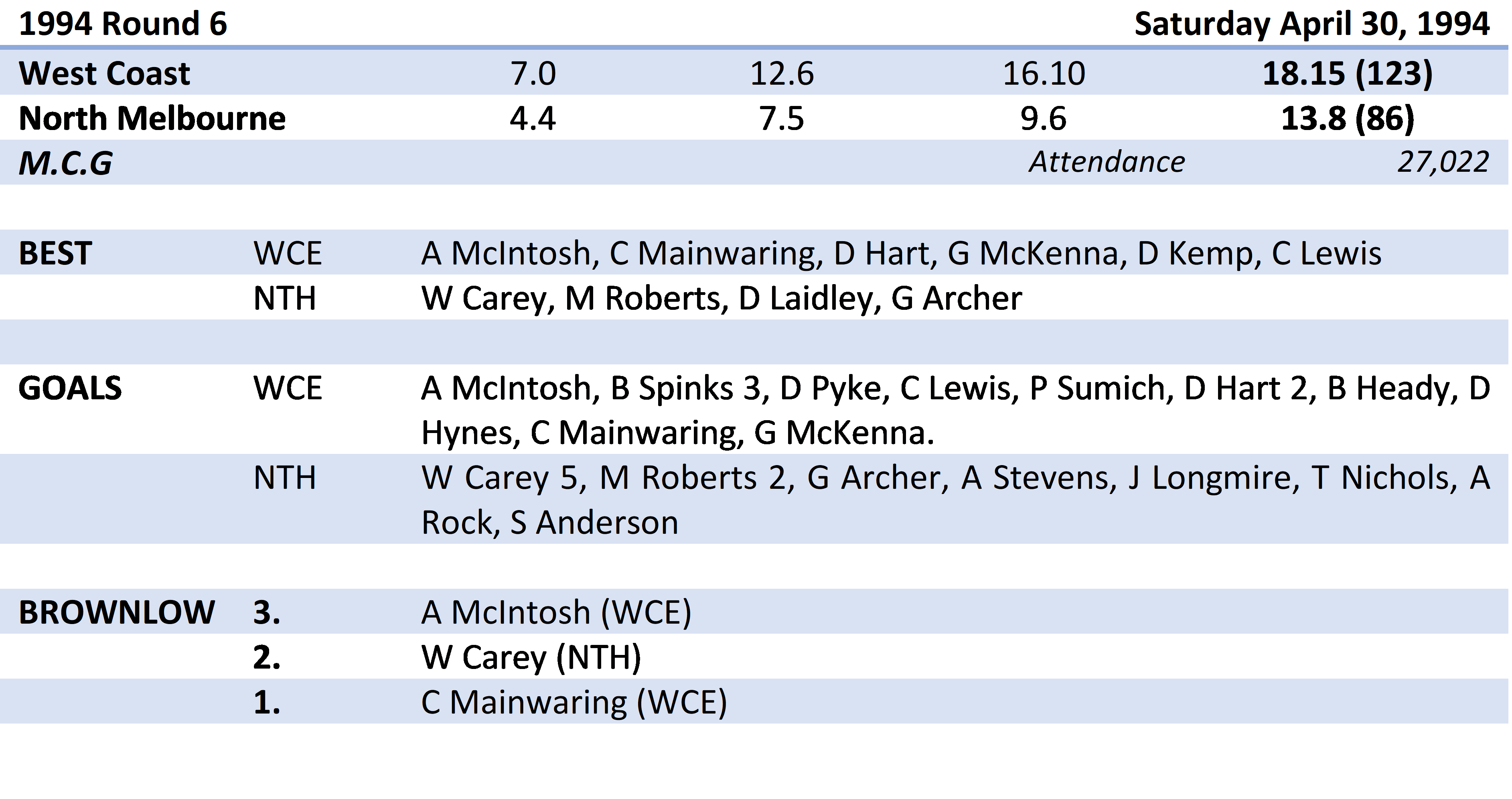
Wayne Carey may have won the battle, but the Eagles won the war as they righted the shock defeat to Hawthorn the week before with an impressive 37-point win over premiership rivals North Melbourne.

Carey was a lone force for the Kangaroos, eclipsing opponent Glen Jakovich in the hotly-anticipated duel. The North Melbourne skipper racked up 21 disposals, 15 marks (out of the 45 marks North Melbourne managed as an entire team) and booted 5.3. However, it mattered little as West Coast put in their most accomplished performance of the season.

Both teams entered the clash keen to atone for poor defeats the week before. The Kangaroos suffered their first loss of the season when they fell to Geelong by 15 points, while the Eagles had been humiliated by 71 points at home to lowly Hawthorn.

The Eagles responded to the loss by making four changes, although two of them were forced through injury. Paul Harding had escaped serious concerns over a knee injury suffered against the Hawks but was still not considered fit enough to take on the Kangaroos, while Peter Matera was also left at home, still dealing with the after effects of a broken nose and concussion from the Hawks game.

Jarrad Schofield and Craig Turley were both dropped, with the latter failing to recapture his best form in his first five games back from retirement. Dwayne Lamb, David Hynes and Tony Godden were all selected for their first games of 1994, while Chris Waterman came back into the team after three weeks exiled at East Fremantle.

North Melbourne weren’t without their injury concerns either heading into the game, with both Corey McKernan and Peter Mann unavailable for selection. Glenn Archer did make the cut, despite injuring a hamstring at state-of-origin training the week before, while Anthony Rock also played in spite of a back complaint.

Along with Archer, Stuart Anderson was selected for his AFL debut, while journeyman Gareth John was picked for his first game with the Kangaroos after swapping over from the Swans. It is the Kangaroo ruckman’s first senior game of football since 1991 with injuries curtailing the end of his time with Sydney. Ian Fairley, Jason Daniltchenko and Brett Allison were all omitted.

The Kangaroos started strongly with Carey having immediate impact. The North Melbourne captain took an early mark and kicked truly before hitting the post with a second shot on goal moments later. Peter Sumich kicked a brace in quick time, after two strong marks opposed to Mick Martyn, before Carey had a third shot on goal, his second miss of the term.

The early missed chances from Carey would prove costly as West Coast’s running game troubled the Kangaroos. Chris Mainwaring and Guy McKenna – who was moved up the field as Matera’s replacement on the wing – were providing plenty of drive, as was Dean Kemp who was being used across half-back. Mainwaring racked up nine first quarter possessions opposed to Stuart Anderson, while McKenna was giving former teammate Trent Nichols a bath.

McKenna was involved in setting up the Eagles third goal through Ashley McIntosh – who had started forward alongside Sumich and Brett Spinks – before kicking the Eagles’ fourth with a long range shot on the run.

Adam McAdam came off the bench for the Kangaroos to provide some run and immediately found Mark Roberts for the Kangaroo’s second goal but the Eagles responded almost immediately through Don Pyke. McKenna then had this third goal involvement of the term when he found Brett Spinks on the run to put West Coast 20 points clear.

Carey did his best to keep the Kangaroos in the contest, booting consecutive goals. The first came from a free kick given away by Michael Brennan off the ball, before he then out-marked Jakovich to kick his third for the term. Don Pyke kicked his second goal late in the quarter to take the Eagles lead back out to 14 points.

The Eagles kicked seven straight for the first term and their impeccable goal kicking continued into the second quarter. The Eagles had ten goals on the board before their first blemish when Ashley McIntosh hit the post. Before that, McIntosh had kicked two successive goals to open the term, as he proved too fast and too agile for John Blakey. Wayne Carey added a fourth goal (out of North’s five), before a cleverly crumbed goal to Chris Lewis saw West Coast’s lead stretch out to 26 points.

The Eagles running game was too much for the Kangaroos, recording three times as many handballs, as they continually swarmed forward in waves from half-back. With the game starting to get out of hand, Denis Pagan swung a number of changes.

Mark Roberts was switched to defence to curtail McIntosh, John Blakey was moved forward, Glenn Archer went to half-back and Dean Laidley pushed onto the wing against Mainwaring. Gareth John was introduced into the ruck off the bench, while Adam McAdam returned to the field and was stationed at full forward.

But the changes did little to stop the Eagles momentum. Brett Spinks goaled from the boundary line, and David Hart roamed forward to goal from 50m, after some good forward pressure from Shane Bond. After being so accurate through the first quarter and a half, the Eagles’ radar went missing as they butchered a host of other chances late in the term, with a John Longmire goal after the half-time siren reducing their lead to 31.

It was more of the same for West Coast after the main break, with the Eagles booting the opening four goals of the term as their lead pushed towards ten goals.

Brett Spinks marked in a heavy pack in the goal square to open the scoring, with Mainwaring kicking truly when he received a 50m penalty against Laidley. David Hart had his second running goal, when a scrappy kick out of the Eagles defensive fifty evaded a number of players, releasing Hart from the centre circle to the top of the West Coast 50. Brett Heady had his first of the afternoon when he scouted the back of a marking contest to snap truly on his opposite foot.

The Eagles had winners all over the ground, with even Carey’s influence waning as the ball stayed locked in the Eagles forward half. While Pagan was busily moving the magnets to stop the tide, the Eagles were perfectly quelling the Kangaroo’s prime movers.

Wayne Schwass managed just one kick in the first half opposed to Drew Banfield, while Anthony Rock had Dwayne Lamb for company and had been barely sighted. Don Pyke was given the role on Anthony Stevens, but Stevens was soon moved to the wing to be Mainwaring’s third opponent for the day.

Two late goals to Glenn Archer and Trent Nichols before the three quarter time siren stopped the Eagles run, but the visitors still headed for home with a 46 point lead.

That lead stretched beyond ten goals with David Hynes and Chris Lewis both kicking majors, before the Kangaroos kicked the last four goals in the game, as the heat dissipated out of the contest.

Apart from Carey, there were few notable performances from the Kangaroos. Glenn Archer tallied 20 disposals to go with his third quarter goal, while Mark Roberts had 19 possessions and two goals rotating between the forward line and defence and Ross Smith was the best in the midfield with 16 disposals.

For Malthouse, the performance was a good response to the previous week’s thrashing. “Hawthorn were very good last week and we needed to be this week. Everyone that is in top sports knows that you’ve got to have the right attitude.”

After a blistering start, Chris Mainwaring finished with 25 touches, with Anthony Stevens restricting his output through the second half. Guy McKenna picked up 21 disposals, 7 marks and a goal, David Hart finished with 22, while Dean Kemp was the highest ball winner with 27 playing out of defence.

Brett Spinks and Ashley McIntosh each kicked three goals, with ten players hitting the scoreboard. “He (Spinks) has given us a new dimension. He’s a very capable player who will only get better… he’s a good grab and he kicks the ball out of sight.”

The result lifted the Eagles to 2nd on the ladder, behind only the undefeated Demons, but the win came at a cost. Peter Sumich limped off during the third term with a hamstring injury that was expected to sideline the spearhead until at least after the Eagles bye in Round 8.