1990 Rewind: Big Fish Sinks Eagles

Eagles Drop To The Edge of Finals as Forwards Misfire

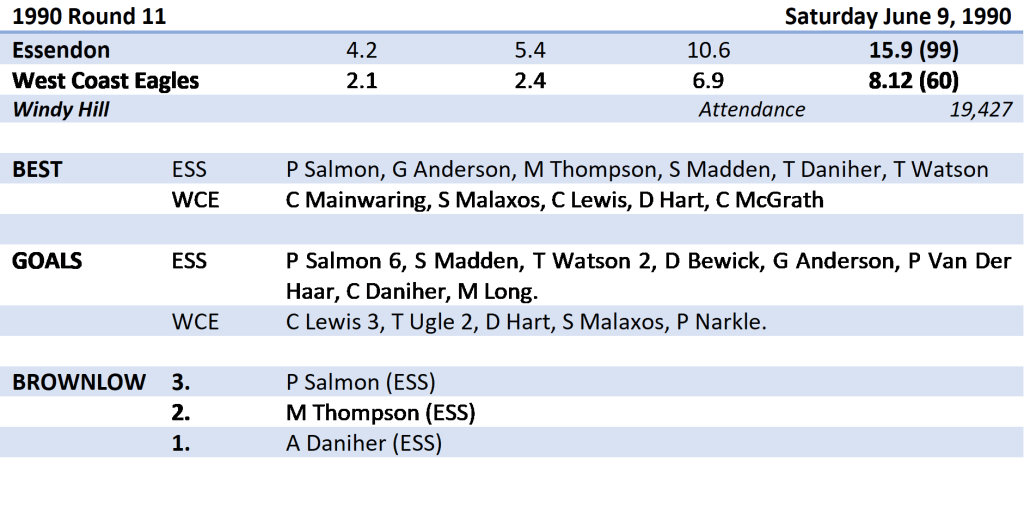
It was a tale of the full forwards as West Coast dropped a second consecutive game to leave their finals aspirations sitting on the brink at the halfway mark of the season.

Windy Hill lived up to its name as the Eagles struggled to handle the swirling breeze that encased the ground with a forward line function that was virtually non-existent.

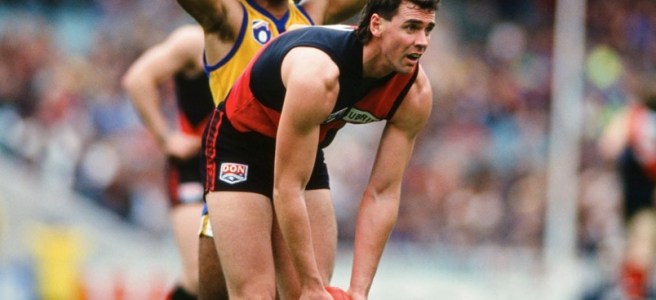
The Eagles were unable to contain Essendon full-forward Paul Salmon, who booted six goals from 20 disposals and 14 marks alternating between the forward line and in the ruck, while Peter Sumich was held goalless by Anthony Daniher.

In fact, not only did Sumich fail to register a goal, the Eagles spearhead failed to register a possession, despite spending all bar three minutes on the ground.

Stevan Jackson was another who struggled up forward, managing just a kick and a handpass in the opening half, before spending the entire second half on the bench.

The 39 point defeat left the Eagles precariously placed in fifth position, as a host of teams pressed their claims for a spot in the top five.

The disappointment of the previous weeks effort against North Melbourne lingered through the week, as coach Michael Malthouse took his team to task.

A brutal two and a half hour training session on the Monday was followed by a tackling session led by rugby league coach Russ Devonshire with Malthouse keen on igniting aggression towards the opposition.

The Eagles were then savage at match committee, dropping seven players for the clash with the Bombers. Peter Matera, Dean Turner, Geoff Miles, John Annear, Scott Watters, Dean Kemp and Don Pyke all lost their spots, with the Eagles inclusion centred around height to battle the plethora of talls at Essendon.

Craig McGrath was selected for his club debut after being picked up in the pre-season draft, following six seasons with Fitzroy. Dean Irving was also recalled for his first game since round 3, to partner Phil Scott in the ruck against Essendon pair Simon Madden and Paul Salmon. Geelong and North Melbourne had both exposed the Eagles in the ruck in recent weeks, with Phil Scott going it alone.

Peter Wilson, Dwayne Lamb and John Worsfold all returned after missing the loss to the Kangaroos through injury, while Craig Turley and David Hart were also welcomed back to the side. Troy Ugle held his place up forward after being a late replacement for Worsfold the week before.

Essendon were forced to make four changes, due to a raft of players left unavailable after their 90 point win over Sydney. Derek Kickett, Billy Duckworth and Ian McMillan were all out injured, while Andrew Manning copped a two week suspension.

Into the Bombers line up came defender Chris Daniher and midfielders Adrian Burns, Tony Antrobus and Ed Consadine. Kevin Walsh pressed his claims to return from a knee injury, but failed to recover in time.

In tricky conditions, the first half was a tightly fought affair.

Paul Salmon made his first imprint on the game with three goals in the opening quarter as Essendon opened up a 13 point quarter time lead. The two teams then managed just one goal between them as the game developed into a fierce lockdown.

Trailing by 18 points at the main break, the Eagles started the third quarter brightly, but ill-discipline undid much of the early good work in the term as Essendon were handed a string of easy goals.

The Eagles gave away three 50m penalties in the quarter, all of which directly resulted in goals for the home side. Greg Anderson kicked a goal from the first penalty, with Salmon then the recipient of the next two as he booted another three goals in the term to take his match haul to six.

Two goals late in the term to Troy Ugle kept the Eagles within 21 points at the final change, but a five goal to two last quarter sealed the win for the Bombers and consolidated their position at the top of the ladder.
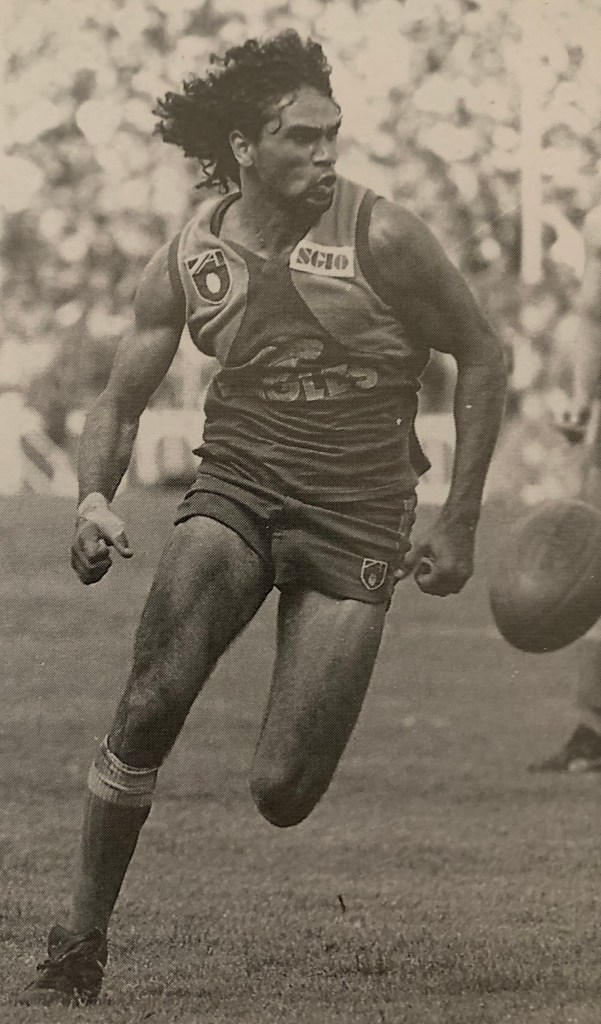
Chris Lewis was the exception up forward for the misfiring Eagles, booting three goals

After the match, Mick Malthouse was blunt about his non-firing forward line.

“When we get the ball as often as we did and don’t score as often as our opposition – that is our breakdown.”

The Eagles matched the Bombers in total disposals and managed nine more forward 50 entries (64-55), yet registered four less scoring shots.

“At no stage did our forward line click”, Malthouse continued.

Malthouse was also forthright in his assessment of the umpires, questioning the legitimacy of the 50 metre penalties awarded against his side in the crucial third quarter.

“One was soft,” an exasperated Malthouse declared, “and I could almost argue about (the other) two of them.”

“I get sick and tired of trying to justify how good or bad the umpires are. It’s time (national director) Bill Deller… have a good look at the situation.”

Chris Lewis was the best forward for the Eagles on the day, finishing with three goals from 20 disposals across half forward. Lewis also proved he had paid attention during the week, laying eight tackles in the match.

Chris Mainwaring had 26 disposals on the wing and Stephen Malaxos was again industrious in the centre with 24 disposals and a goal. Dwayne Lamb and David Hart both had successful returns with 21 and 20 possessions, respectively.

Craig McGrath also impressed in his first game as an Eagle, collecting 21 disposals and six marks, showcasing his wares at both ends of the ground.

However, the Eagles had no answer for Salmon, who was arguably the difference between the two sides. Dean Irving was tasked with the role of tagging Salmon around the ground, but appeared out of his depth and the Eagles backline were again exposed for height against the taller forwards in the competition.

Simon Madden booted two goals while resting forward, with Salmon’s haul of six coming a week after John Longmire booted eight goals for the Kangaroos.

Greg Anderson finished as the leading possession winner for the Bombers with 26, while Terry Daniher was the next best with 24 touches and 11 marks. Tim Watson also booted a brace of goals from 22 disposals and Mark Thompson finished with 23 and eight marks through the middle.

The result moved Essendon a game clear of the Eagles, and they were joined by the Magpies and Demons. Collingwood recorded a routine win over the bottom-placed Bears at Carrara, while Melbourne survived an incredible Carlton comeback to fall over the line.

The Demons streaked away to a 56 point lead midway through the third term, off the back of a five goal performance from debutant Brent Heaver. However, the Blues stepped into gear to kick the final five goals of the term and reduce the Demons advantage to 21 at the final change. Carlton continued to surge with Stephen Kernahan leading the charge in the final term, but a poor return of 3.6 left them six points short.

Hawthorn also moved ahead of the Eagles when they had little trouble defeating the Swans, despite being without Jason Dunstall. John Platten booted five to be the surprise leading goal scorer for the Hawks, who returned to the top five in place of St Kilda.

The Saints lost their place in the five with a narrow eight point defeat to the Cats. In a high-tempo clash, Geelong worked their way to a 25 point advantage at the final change, before second-year Saint Robert Harvey dragged his side back into the contest. Harvey booted four goals in the final quarter to bring St Kilda within touching distance of the lead, but Stewart Loewe and Tim Pekin missed simple chances late in the game, which ultimately proved costly.

The result meant that St Kilda and Geelong both sat one game behind West Coast, as did Footscray who did what they had to in a 14 point win over Richmond. The Eagles’ hopes of finals now rested on a crunch home game against the 4th-placed Hawks the following week.

While the 39 point defeat wasn’t the desired outcome, the Eagles could find some solace in this performance compared to the previous season. In the corresponding fixture of 1989, West Coast conjured up just one goal for the afternoon in a 160 point shellacking – a 20 goal improvement on their last visit to Windy Hill!
1994 Rewind: Scarves & Swamps

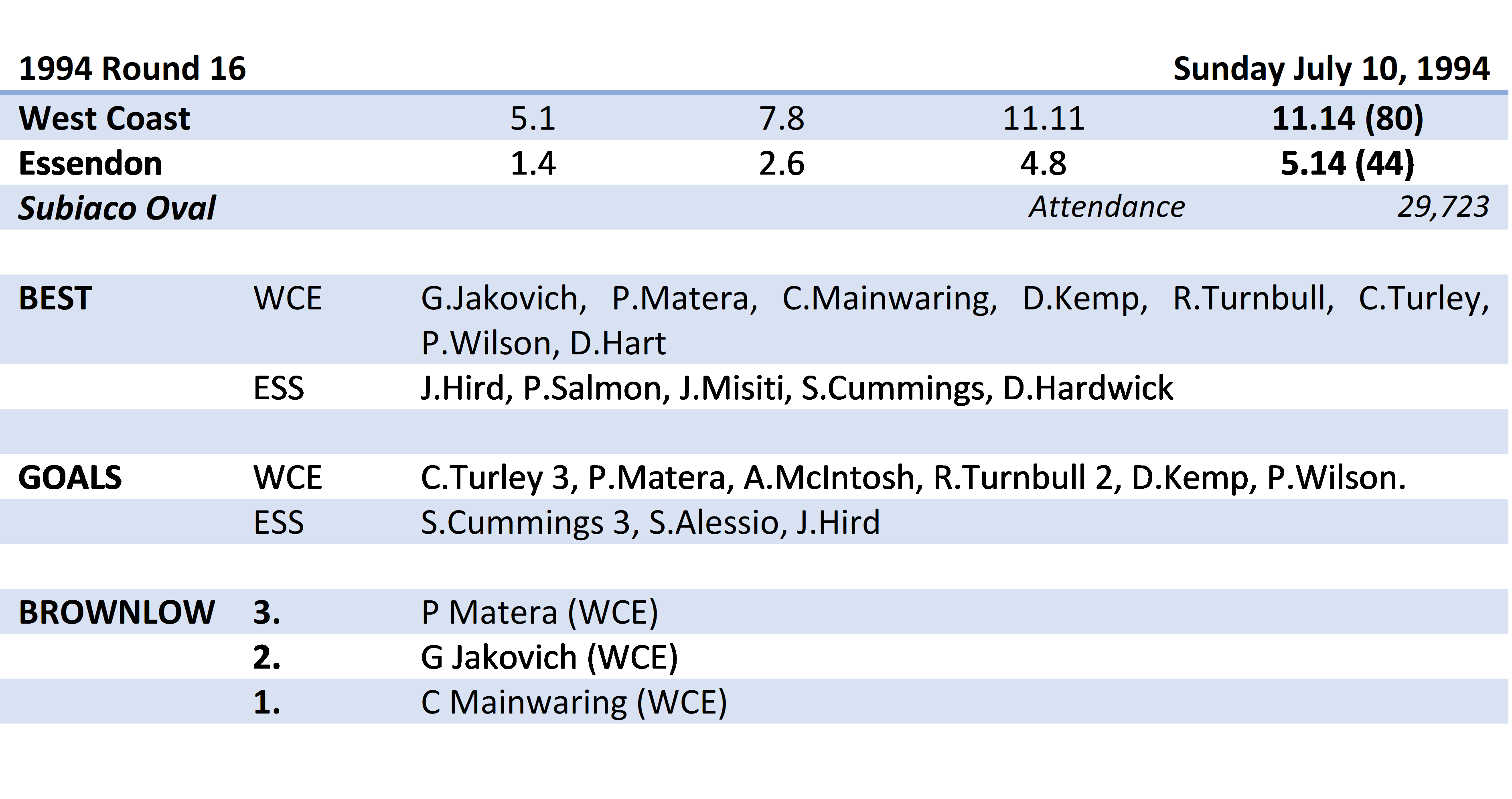
West Coast retained their premiership favouritism and Eagles fans got to exact their revenge but the biggest talking point after West Coast’s 36 point win over Essendon was the dilapidated surface of Subiaco Oval.

With Perth in the midst of an uncharacteristic wet spell, Subiaco Oval resembled more of a muddy swamp than its customary fast-track, drawing the ire of Eagles coach Mick Malthouse.

The Eagles coach seemed more interested in savaging the state of the surface than discussing his side’s committed win over the reigning premiers. With one side of the stadium torn down ahead of the building of the new southern stand, Malthouse was sceptical over whether there had been appropriate care towards maintenance of the playing arena, with drainage around the ground, virtually non-existent.

Malthouse extended his criticism towards the WAFC in the hope that improvements would be made before the end of the season.

And when the Eagles coach did talk about his side’s performance, he remained stoically understated.

The game appeared done at quarter time with the Eagles jumping the Bombers booting five goals to one. Any chance of Essendon staging a comeback was extinguished at the start of the second term when driving rain descended the game into a quagmire.

By three-quarter time, West Coast had extended their lead to 45 points, before the two teams combined for 1.9 in the last quarter, with the two teams out on their legs in the heavy conditions.

The win kept West Coast at the top of the ladder a game ahead of the Blues, with Malthouse acknowledging that a win over the 1993 premiers gave a good indication of where the Eagles sat. “I believed if you want to assess yourself you have to do it against the previous year’s premiership side. Last year everyone wanted to have a crack at us to see where they sat.”

“I think after the halfway mark if you are on top, you should really aspire to stay there. It is tough enough to get there and its going to be tough to stay there”, Malthouse said.

More pleasing for Malthouse was the successful return of Peter Sumich, who made it through four quarters, despite having little impact. Sumich was held scoreless from three kicks but there was relief after the game that the full-forward had managed to get through his first full game in over three months. “Peter did everything we wanted from him today,” Malthouse said.

Sumich was one of two inclusions, with Eagles captain John Worsfold finally making it to his 150th game after missing two of the previous three games. Sumich replaced David Hynes at full forward, while Shane Bond was the other exclusion through injury. Brett Spinks became the third out for the Eagles on game day, after being under an injury cloud all week, with Tony Godden coming in for his first game since Round 10.

The Bombers dropped Glenn Kilpatrick and Robert Stevenson, while their hero from the Round 1 win over West Coast, Che Cockatoo-Collins, couldn’t be considered after he dislocated a finger. Captain Mark Thompson was then a fourth change for the Bombers, when he was withdrawn on the morning of the game through illness.

David Grenvold replaced Thompson, with Anthony Daniher, Lachlan Ross and Russell Williams the other inclusions. The Bombers had been hopeful of bringing back a number of premiership stars for the trip West, but the likes of Mark Mercuri (groin), Dean Wallis (achilles), Rick Olarenshaw (back) and David Flood (hamstring) remained sidelined.

Dustin Fletcher, Michael Long and Mark Harvey were three more premiership players missing from the Essendon line-up, a fact that Malthouse was willing to present. “Essendon had three or four key players out of the side so we don’t want to get carried away with the victory.”

The make-up of the Bombers side would not have mattered to Eagles fans, who got their right of reply to Kevin Sheedy’s antics 12 months earlier. In the corresponding game of 1993, Sheedy emerged from the coaches box waving his jacket above his head after Paul Salmon had snatched a two point win over the Eagles in the final minute of the game.

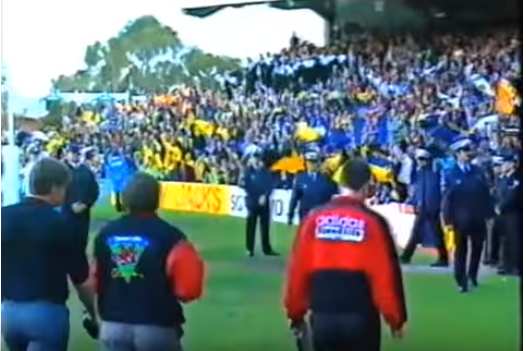
The Eagles had lost the two meetings since that game – the semi final of 1993 and then the opening round of 1994, both of which had been played in Melbourne – but as Kevin Sheedy walked the muddy boundary line towards the Bombers race, he was met with the mass celebration of scarves and jackets twirling above the heads of the jubliant Eagles crowd. The Essendon coach could do no more, than acknowledge the gesture with a wry smile and a nod of the head.

The Essendon coach is met with flying scarves after the Eagles 36 point win

If Sumich lasting 100 minutes was one feel good factor from the day, the other pleasing performance for the Eagles match committee would have been that of Craig Turley. After returning to the club following his retirement during the 1993 season, Turley’s form had been rather indifferent as he struggled to recapture the form that made him one of the premier midfielders of the preceding two seasons.

But against the Bombers, Turley bobbed up with three crucial goals from 12 disposals across half-forward as he appeared to revel in the tough, slippery conditions. Turley was also handed the task of stopping Essendon playmaker Gary O’Donnell, with the stand-in captain restricted to just 11 possessions, and a couple of stints on the bench.

The Eagles wingmen were again the standouts, with Chris Mainwaring leading the way with 27 disposals, while Peter Matera finished with 24 touches and five shots on goal, booting 2.3. Mainwaring benefitted from being matched against Darren Bewick, who had been moved to a wing to avoid the tag of David Hart. Bewick had enough of the ball (finishing with 18 possessions) but was nowhere near as damaging as the blonde Eagle, who continually linked the ball from defence to the forward line.

Glen Jakovich was again the rock in defence, picking up 22 disposals in his absorbing battles with James Hird. Hird often drifted up to the wing, but Jakovich remained in the Eagles defensive 50, often setting up as the Eagles seventh defender. Steven Alessio was sent to centre half forward to create a match-up with Jakovich, but Jason Ball was sent to defence, allowing Jakovich to pick off Essendon’s forward entries, many off Hird himself.

Ryan Turnbull also enjoyed plenty of freedom around the ground and had an important influence on the contest, particularly early in the game. With Paul Salmon often dropping a kick a behind the play after contesting the ruck, Turnbull positioned himself through the middle of the ground, drifting forward twice in the opening term to boot goals.

Peter Wilson picked up 22 disposals around the ground and Dean Kemp had 20 through the centre, although he lowered his colours slightly to Joe Misiti who finished with 25 disposals.

James Hird was the next best for Essendon, after Misiti, with 24 disposals and seven marks, while Sean Denham had 21. Gavin Wanganeed was switched forward after half-time and gathered 19 disposals, but the Bombers lacked few options forward of centre. Third-gamer Scott Cummings was the only winner in the Essendon forward line, booting three of the Bombers’ five goals for the game.

Sheedy was left to lament a poor attitude from his side in the opening quarter, which ultimately decided the game. “We were very undisciplined in the first quarter. It cost us dearly.”

One such incident involved Gary O’Donnell choosing to wrestle with Eagles captain John Worsfold, rather than contest a loose ball, which allowed Turley to stroll in and boot one of his three goals.  

While declaring that ‘the Eagles were looking pretty good’, Sheedy admitted that his side would have a battle to make finals, after they dropped to seventh on the ladder, amongst a strong group of teams vying for the lower spots in the top eight.

Richmond climbed to sixth on the ladder when they recorded a narrow three point win over Footscray, in what was a virtual eight-point clash. The Bulldogs dropped out of the top eight as a result, replaced by Geelong who, off the back of 10 goals from Gary Ablett, defeated Melbourne by 30 points.

At the pointy end of the table, Carlton and Hawthorn both recorded ten goal wins over Adelaide and St Kilda, respectively, to maintain their chase of West Coast. Collingwood moved into the top four after they beat Fitzroy by 49 points at the Western Oval, moving past North Melbourne who had the bye.