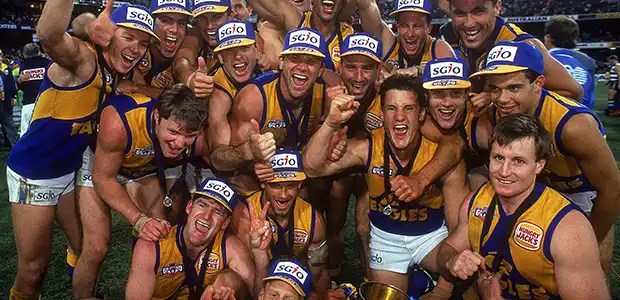
1994 Rewind: Eagles Class Shines In Wet

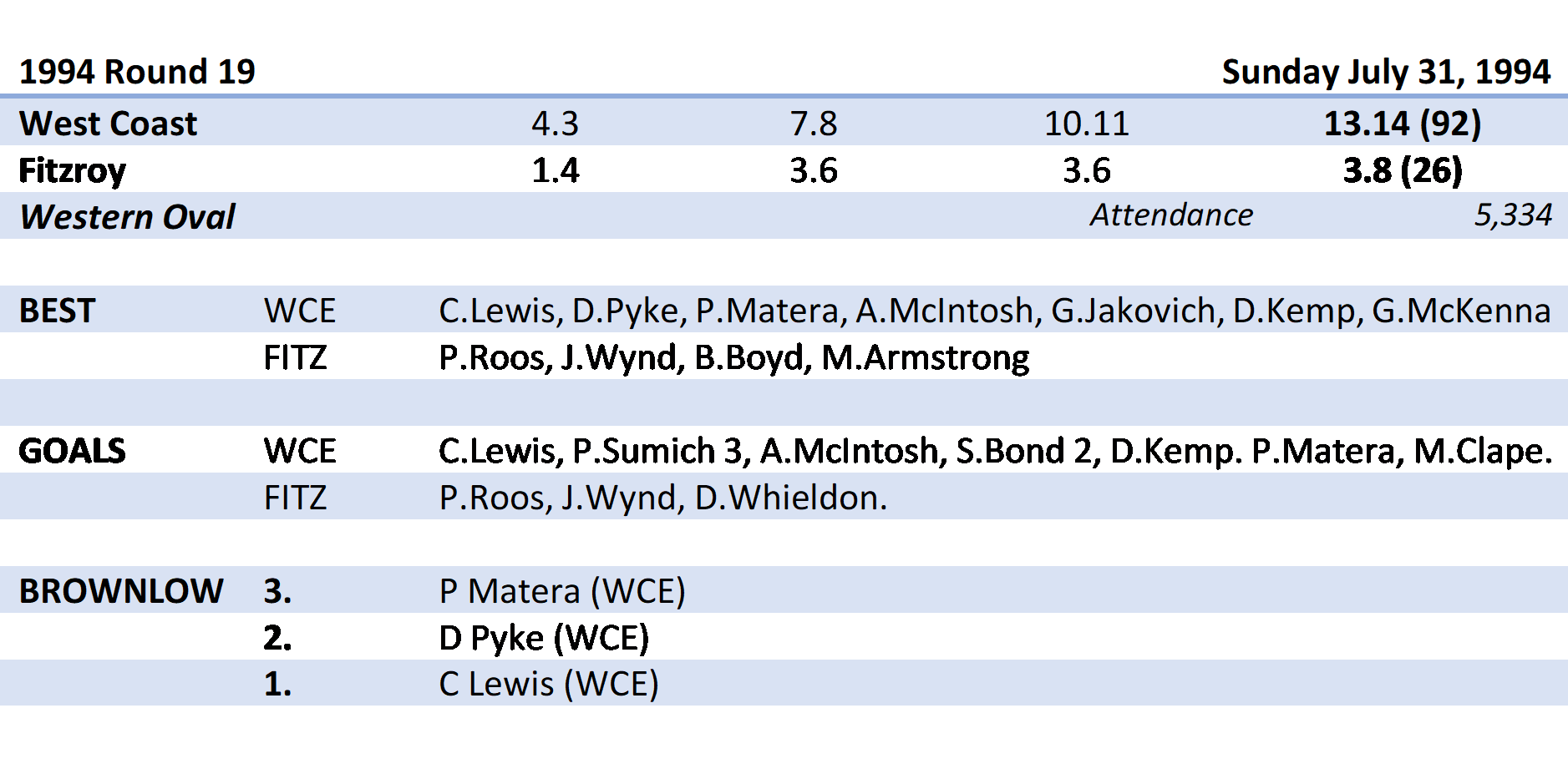
West Coast swept aside the Fitzroy Lions with an easy 66 point win at the Western Oval. Fitzroy were held to just two behinds after half-time, unable to break through the Eagles hardened defence in wet and heavy conditions.

On a cold, wintry afternoon where a crowd of just 5,334 braved the conditions, Chris Lewis provided the shine with 16 disposals and three first half goals, as well as having a hand in several others. Peter Sumich also finished with three goals as he continued to build his match fitness from consecutive hamstring injuries.

The Eagles strong performance came despite missing several key players. Brett Heady was never a chance of lining up after dislocating his shoulder the week before against Richmond, while Chris Mainwaring (hamstring) and Chris Waterman (foot) were ruled out during the week.

John Worsfold was given an extra week to recover from his groin problem, as was Tony Evans who had a back complaint. The Eagles consequently made four changes at the selection table, with Michael Brennan returning from injury, and fringe players Matt Clape, Brendan Krummel and Paul Symmons all earning call-ups.

Damien Hampson was initially dropped, alongside injured trio Heady, Mainwaring and Waterman, but earned a reprieve ahead of the opening bounce when David Hynes pulled out.

Krummel’s selection marked his first Eagles appearance in over a year, but it didn’t come without controversy. After being named in the Eagles squad on Thursday night, Krummel became the centre of an investigation over an incident from the previous weeks WAFL derby between East Fremantle and South Fremantle.

Young Bulldog Owen Woods was collected behind the play, suffering a broken jaw in several places, and South Fremantle officials pointed the finger at Krummel. The Bulldogs lodged an official complaint with the WAFL and demanded that Krummel be charged, with Woods expected to miss the remainder of the season after undergoing surgery.

However, the WAFL tribunal were unable to determine whether there would be a case to answer, leaving Krummel free to play with West Coast. Krummel, for his part, said that he knew nothing of the incident.

The Lions dropped four players in response to their narrow loss to Brisbane the week before, with Tom Kavanagh, Danny Morton, James Manson and Nick Mitchell all losing their place. Rick Lyon, Brett Cook, Trent Cummings and Mark Zanotti were the four inclusions, but Zanotti and Cummings then became late withdrawals ahead of the match. Their spots were in turn taken by David Bain and Marcus Seecamp.
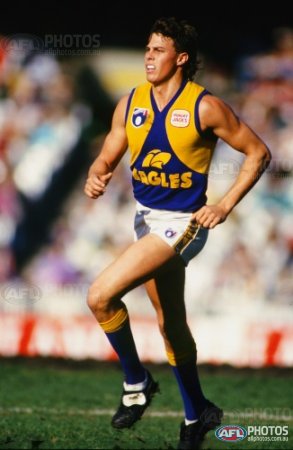
Brendan Krummel returned to the Eagles line-up for the first time in over a year

Despite the wet conditions, Malthouse started three talls in the Eagles forward line, as he looked to expose the depleted Fitzroy defence. Ashley McIntosh and Jason Ball took their spots across half forward, with Peter Sumich taking his regular spot in the goal square.

Fitzroy had first use of the wind, but the Eagles got first blood when Lewis soccered home from the goal square. The Lions held on for much of the quarter, but a three goal burst in time-on put West Coast out to a 17 point lead at the first change and there was never any coming back for the Lions from there.

The Eagles would extend their lead to 26 by the major break, then leading by 47 at three quarter time and finally running out 66 point winners as Fitzroy failed to register a second-half major. In fact, the Lions remained scoreless after half-time until the dying minutes of the last term when they kicked consecutive behinds.

When the game was there to be won, Lewis was a cut above most others on the field, proving a constant danger and giving Fitzroy defender Steven Stretch the run-around. Peter Matera added the flashes of brilliance, getting the better of Michael Dunstan on the wing, while down back the Eagles defence proved impenetrable.

Michael Brennan held Darren Wheildon to just one goal, while Guy McKenna, Glen Jakovich and Mitchell White all shut out their opponents in a complete display.

The win further enhanced this Eagles group with the club not always renowned for their performances in the wet. However, the win over Fitzroy was the fourth win in wet weather after victories over St Kilda, Essendon and Richmond in recent weeks, all of which were played in the rain.

The performance impressed Fitzroy coach Robert Shaw, declaring West Coast as ‘the best team I have seen in those conditions’.

Eagles coach Mick Malthouse acknowledged that the conditions suited the more developed Eagles against a young Fitzroy outfit. “Jarrod Molloy is a good marking player so the conditions didn’t suit him. Chris Johnson has great pace but is still finding his way.”

“We had a lot of experienced players in the midfield.”

Shaw though was far more circumspect over the difference between the two sides. “They played the percentages and followed the basic principles a lot better than us.”

“And they did it for longer and more often.”

While Lewis and Matera were the polish up forward and around the wings, Dean Kemp and Don Pyke provided the grunt through the midfield. Kemp finished with 28 disposals and a goal while Pyke had 30 through the centre. Ashley McIntosh had 18 disposals, four marks and booted 2.2 across half forward, while Glen Jakovich collected 20 touches across half back.

Paul Roos was clearly the best player for Fitzroy, gathering 31 disposals and booting a goal in an intriguing battle with Craig Turley through the middle. Jim Wynd also found plenty of the ball, finishing with 29 disposals and joined Roos as one of the Lions’ three goal kickers.

The win saw West Coast hold their one game advantage over the Blues, who defeated an inaccurate Hawthorn by 32 points at Princes Park. The Blues, in turn, held their position in second ahead of North Melbourne, with the Kangaroos coming from behind to defeat Footscray by 20 points in a Friday night classic.

Richmond became the benefactors of the losses suffered by the Hawks and the Bulldogs, climbing into the top four after their straight forward win over Sydney. Melbourne were the other big movers, storming into the top eight  for the first time since Round 13. The Demons thumped a faltering Essendon by 77 points, lifting them from ninth to fifth on the ladder as they passed a number of clubs – including the Bombers – with a superior percentage.

Melbourne led a group of five teams who all had nine wins as the race for the bottom half of the top eight continued to tighten. The Cats rose to sixth after they thrashed Adelaide, with Hawthorn and Footscray filling out the rest of the finals positions. The Magpies slipped to ninth due to having the bye.

While West Coast were all but guaranteed finals and strengthened their position on a top two finish and two home finals, the fallout for Fitzroy was substantial.

Robert Shaw resigned as coach in the days following the Eagles defeat, although he agreed to coach out the remainder of the season as the Lions continued to be the centrepiece of merger discussions. Speculation suggested that a deal with either Brisbane or Melbourne was imminent, leading Fremantle to claim they should be given first right to Fitzroy players as part of their inaugural 1995 squad.

The comments angered president Dyson Hore-Lacy, who had already been vocal about the Dockers’ attempts to lure Paul Roos west with a ‘substantial’ offer, which included the captaincy. Hore-Lacy remained resolute about Fitzroy’s future, declaring the club wouldn’t hold back from launching legal action against any AFL club who tried to poach their players while under contract.

Hore-Lacy also scoffed at the idea the club would head interstate, saying a merger with the Bears would be ‘like taking the last chair on the Titanic.’
1994 Rewind: Eagles End Tiger Streak

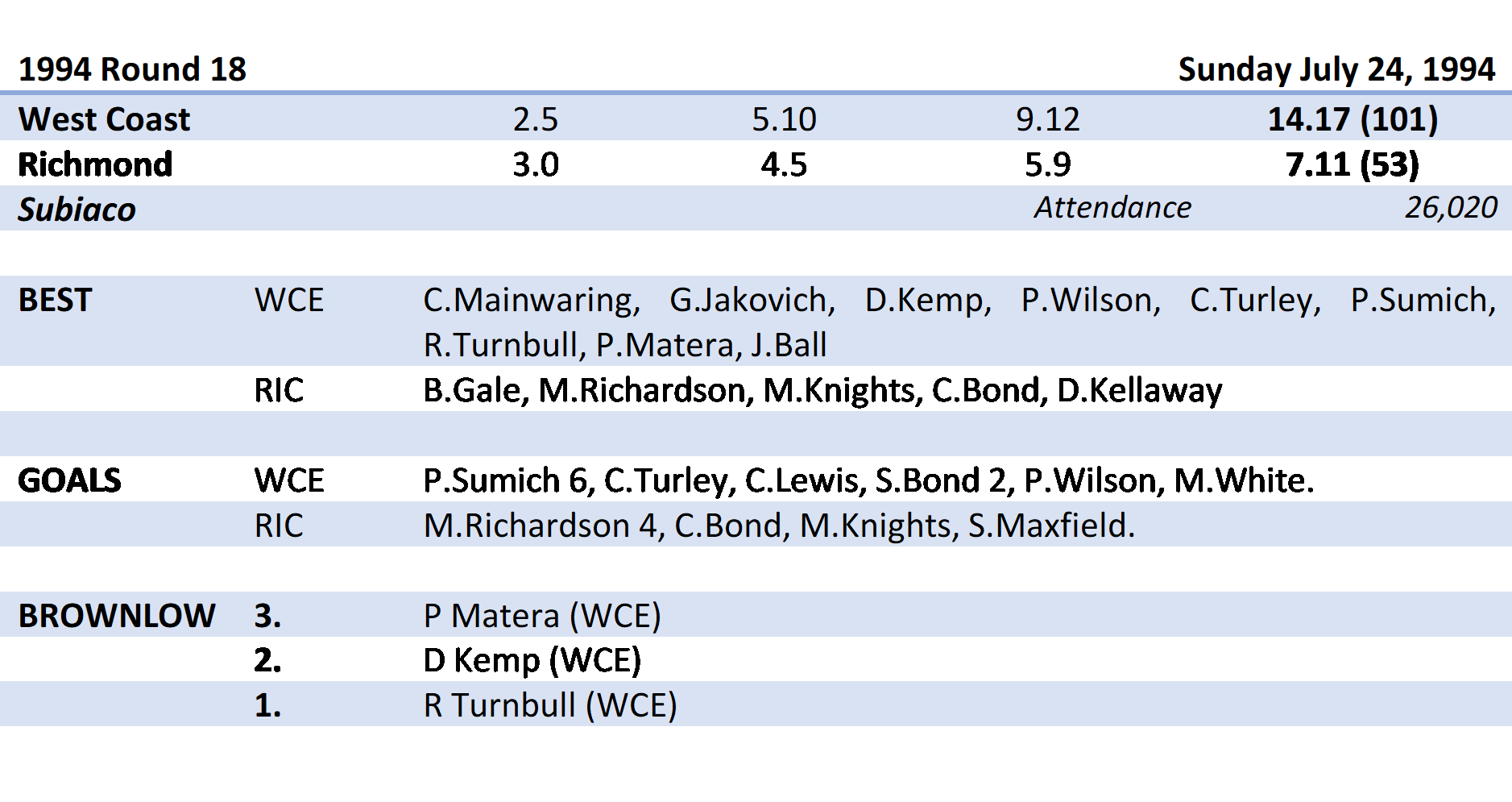
West Coast bounced back from their narrow loss to Adelaide with an eight goal win over Richmond, which ended the Tigers’ six game winning streak.

Richmond arrived in Perth as one of the form teams of the competition, rising to fifth on the ladder on the back of a mid-season revival that had the Tiger faithful dreaming of a first finals appearance since 1982. But they were no match for one of the premiership favourites on their home turf.

However, it was that home turf which once again hit the headlines after Richmond coach John Northey blasted the surface for not being up to scratch. A fortnight after Mick Malthouse was critical over the poor standard of the ground, Northey labelled the surface ‘absolutely pathetic’.

“It’s no good having tremendous facilities and the ground being as poor as it is… to me this is an absolute disgrace.”

Northey’s comments were echoed by Malthouse who reiterated his thoughts after the last Eagles home game. “We’ve been a victim of our home ground in many respects. When it is like it is at the moment… we have modified our training while we wait and see how the ground comes up.”

The ongoing discussion prompted the General Manager at Subiaco Football Club Alan White to reveal they had presented an offer to the WAFC to subsidise the resurfacing costs of the ground, in exchange for an extension of their current lease at Subiaco until 2011. However, White claimed that WAFC Chief Executive Jeff Ovens rejected the offer.

The WAFC said they needed $700,000 to repair the drainage at the ground, but with West Coast not scheduled to play at the ground again until the final round, and with any home finals set to be staged at the WACA due to capacity concerns, the hope was that the ground would recover on its own.

While the deterioration of the ground and who was responsible continued to be debated, what couldn’t be questioned was the gap between the two sides. West Coast controlled the contest from midway through the first quarter and only poor kicking on goal prevented the final margin from being far greater.

The Eagles made four changes to the team that lost to Adelaide, with three players forced out with injury. Michael Brennan damaged a hamstring, John Worsfold was ruled out with a groin and then Tony Evans was pulled on the morning of the game with a back concern. Brett Spinks was dropped after a poor showing against the Crows.

Shane Bond and David Hynes returned from injury, while Mitchell White was selected for his first senior game of the year, after recurring groin problems had kept the premiership forward sidelined since pre-season. Damien Hampson was then selected for his first game in over a year when he came in as the late replacement for Evans.

The Tigers has their own injury concerns entering the game losing Mark Neeld (knee) and Stuart Edwrds (groin) at selection. Paul Bulless and Tony Free were the two inclusions.

After being humbled by Shaun Rehn the week before, Eagles duo Ryan Turnbull and Jason Ball responded in fine fashion. Turnbull was dominant in the ruck against Tiger counterpart Greg Dear, so much so, that David Hynes rarely got off the bench as Turnbull provided the Eagles midfield with first use from the ruck knock.

Turnbull had 23 hit-outs to go with 14 disposals and four marks as he showed his versatility around the ground. After spending parts of the year either in the ruck and in defence, Ball played primarily out of his favoured position at centre-half-forward in the absence of Brett Spinks. Ball produced the best performance of his 10-game career with 23 disposals and ten marks.

Ball’s showing at half-forward also created plenty of opportunities for full-forward Peter Sumich, who had his best return for the year. Sumich finished with 6.5 from 11 kicks and six marks and most pleasingly showed no concerns with his questionable hamstring opposed to Tiger full-back Scott Turner.

The Tigers had the better start with Matthew Richardson proving too much for Ashley McIntosh to boot the opening two goals. Brendan Gale was similarly getting the better of Glen Jakovich picking up five marks in the first 14 minutes of the game.

However, with Turnbull getting the ascendancy at the stoppages, the Eagles soon had the momentum of the game through the likes of Craig Turley, Dean Kemp and Peter Wilson. Turley, in particular, started strongly in his customary ruck-rover position, getting the better of Paul Broderick with seven first-quarter possessions.

Sumich and Peter Wilson got West Coast on the board but wayward kicking allowed Richmond to hold a one point lead at the first change. Shane Bond and Sumich kicked early goals to put West Coast in front, but held only an 11 point lead at the main break following further inaccuracy in front of goal.

After half-time, the Eagles got reward for their dominance with a nine goal to three second half bringing about a 48 point win.

Eagles coach Mick Malthouse was happy enough with the win, although admitted that he felt his side should have been better in front of goal considering their statistical advantage. “By our tally we had 70 or 80 more kicks and 60 more handpasses. I think we really should have done better than win by seven or eight goals.”

The Eagles had 78 more kicks and 26 more handpasses, resulting in 13 more scoring shots.

Chris Mainwaring finished with 31 disposals to lead the Eagles, with Dean Kemp (29), Craig Turley (23) and Peter Wilson (18) all prominent. Stand-in captain Guy McKenna marshalled the Eagles defence with David Hart restricting Nick Daffy to just eight disposals.

Brendan Gale was the Tigers’ best player, clearly getting the better of Glen Jakovich at centre half forward, but the dominance of Turnbull forced Richmond to move Gale into the ruck, depriving them of a key target ahead of the ball. Matthew Richardson booted four goals from limited chances and Duncan Kellaway was defiant in defence, having the better of Brett Heady and then Chris Lewis.

Heady would be the one low point out of the match for West Coast, dislocating a shoulder during the third term.

The win meant West Coast moved back to one game clear at the top of the ladder after Carlton fell to Geelong by 36 points at Waverley Park. The Cats charged to a five goal lead at the first change and held sway for the remainder of the afternoon to record their eighth win of the season and stay in touch with the top eight.

North Melbourne took a hold of third place when they ran away from the fourth-placed Hawks. The Kangaroos led by just four points at three-quarter time after a tight struggle, but six goals to just one point in the last term saw North Melbourne record a comfortable 40 point win. Despite the loss, Hawthorn stayed in fourth spot but they were joined on points by Footscray who were the big movers of the weekend.

The Bulldogs were too good for the Mapgies, recording their fifth win in six games to rise from eighth on the ladder to fifth bypassing the Magpies, Tigers and Bombers, who suffered a shock loss to lowly St Kilda. Tony Lockett booted six goals for the Saints who produced a remarkable display of accuracy to finish with 18.2 in a ten point win.

The other surprising result of the weekend was Adelaide’s defeat at home to Sydney. A week after they toppled the ladder-leading Eagles, the Crows fell to the bottom of the ladder Swans by 12 points, all but ending their finals aspirations. The loss ended a tumultuous week for the Crows who stood down high-flying full forward Tony Modra after he missed a training session during the week. The situation prompted growing rumours that Modra was set to join new club Fremantle for their inaugural season in 1995.

Despite being a game clear of Carlton and three games clear of third-placed North Melbourne, Eagles coach Mick Malthouse refused to entertain the idea that West Coast had secured a top two position which guaranteed two home finals.

“We are not even thinking about that,” a terse Malthouse declared.

1994 Rewind: Scarves & Swamps

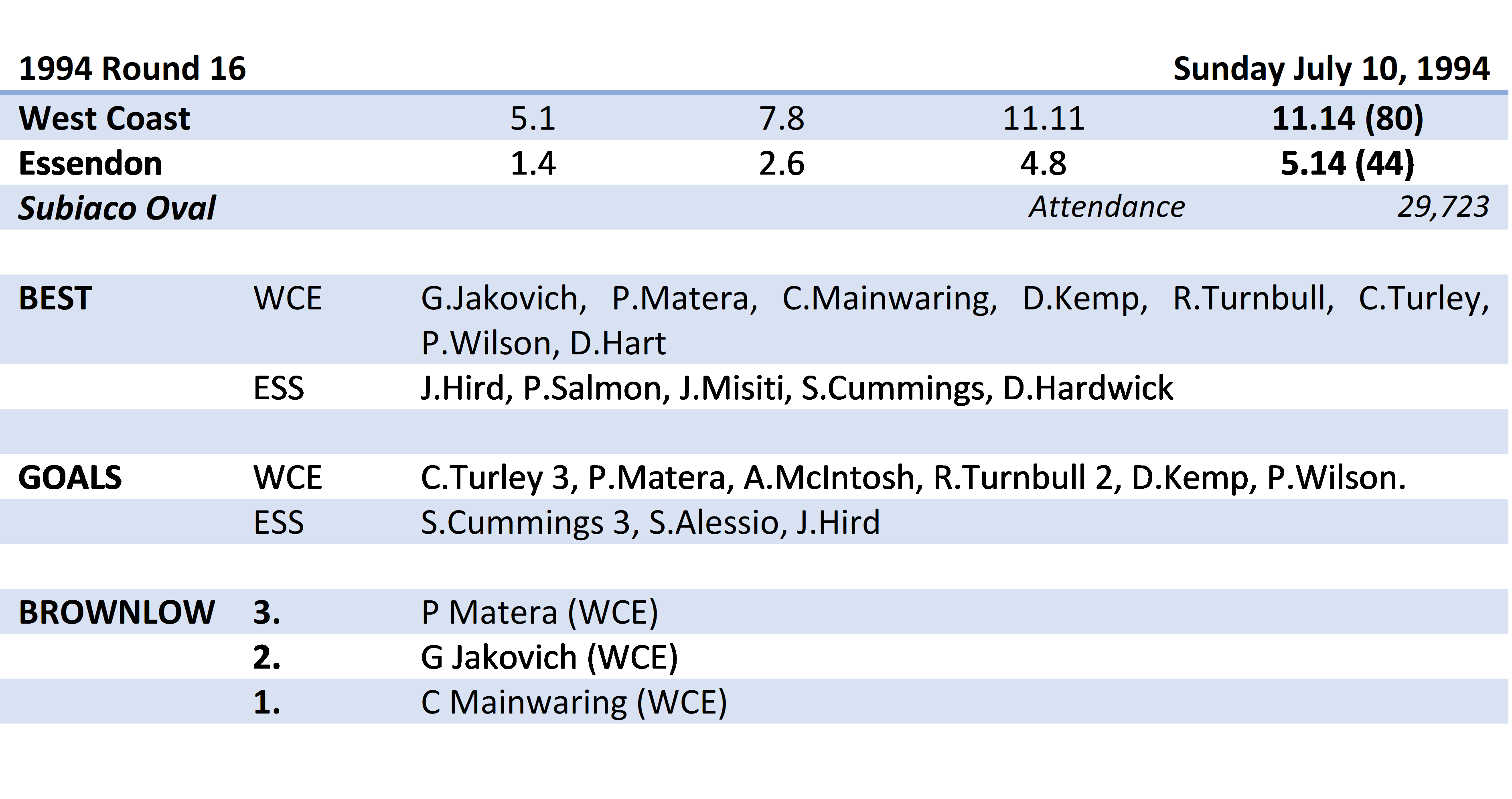
West Coast retained their premiership favouritism and Eagles fans got to exact their revenge but the biggest talking point after West Coast’s 36 point win over Essendon was the dilapidated surface of Subiaco Oval.

With Perth in the midst of an uncharacteristic wet spell, Subiaco Oval resembled more of a muddy swamp than its customary fast-track, drawing the ire of Eagles coach Mick Malthouse.

The Eagles coach seemed more interested in savaging the state of the surface than discussing his side’s committed win over the reigning premiers. With one side of the stadium torn down ahead of the building of the new southern stand, Malthouse was sceptical over whether there had been appropriate care towards maintenance of the playing arena, with drainage around the ground, virtually non-existent.

Malthouse extended his criticism towards the WAFC in the hope that improvements would be made before the end of the season.

And when the Eagles coach did talk about his side’s performance, he remained stoically understated.

The game appeared done at quarter time with the Eagles jumping the Bombers booting five goals to one. Any chance of Essendon staging a comeback was extinguished at the start of the second term when driving rain descended the game into a quagmire.

By three-quarter time, West Coast had extended their lead to 45 points, before the two teams combined for 1.9 in the last quarter, with the two teams out on their legs in the heavy conditions.

The win kept West Coast at the top of the ladder a game ahead of the Blues, with Malthouse acknowledging that a win over the 1993 premiers gave a good indication of where the Eagles sat. “I believed if you want to assess yourself you have to do it against the previous year’s premiership side. Last year everyone wanted to have a crack at us to see where they sat.”

“I think after the halfway mark if you are on top, you should really aspire to stay there. It is tough enough to get there and its going to be tough to stay there”, Malthouse said.

More pleasing for Malthouse was the successful return of Peter Sumich, who made it through four quarters, despite having little impact. Sumich was held scoreless from three kicks but there was relief after the game that the full-forward had managed to get through his first full game in over three months. “Peter did everything we wanted from him today,” Malthouse said.

Sumich was one of two inclusions, with Eagles captain John Worsfold finally making it to his 150th game after missing two of the previous three games. Sumich replaced David Hynes at full forward, while Shane Bond was the other exclusion through injury. Brett Spinks became the third out for the Eagles on game day, after being under an injury cloud all week, with Tony Godden coming in for his first game since Round 10.

The Bombers dropped Glenn Kilpatrick and Robert Stevenson, while their hero from the Round 1 win over West Coast, Che Cockatoo-Collins, couldn’t be considered after he dislocated a finger. Captain Mark Thompson was then a fourth change for the Bombers, when he was withdrawn on the morning of the game through illness.

David Grenvold replaced Thompson, with Anthony Daniher, Lachlan Ross and Russell Williams the other inclusions. The Bombers had been hopeful of bringing back a number of premiership stars for the trip West, but the likes of Mark Mercuri (groin), Dean Wallis (achilles), Rick Olarenshaw (back) and David Flood (hamstring) remained sidelined.

Dustin Fletcher, Michael Long and Mark Harvey were three more premiership players missing from the Essendon line-up, a fact that Malthouse was willing to present. “Essendon had three or four key players out of the side so we don’t want to get carried away with the victory.”

The make-up of the Bombers side would not have mattered to Eagles fans, who got their right of reply to Kevin Sheedy’s antics 12 months earlier. In the corresponding game of 1993, Sheedy emerged from the coaches box waving his jacket above his head after Paul Salmon had snatched a two point win over the Eagles in the final minute of the game.

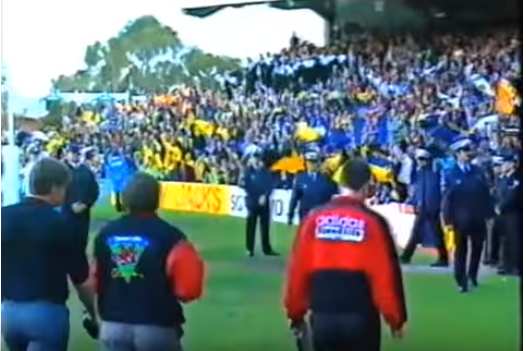
The Eagles had lost the two meetings since that game – the semi final of 1993 and then the opening round of 1994, both of which had been played in Melbourne – but as Kevin Sheedy walked the muddy boundary line towards the Bombers race, he was met with the mass celebration of scarves and jackets twirling above the heads of the jubliant Eagles crowd. The Essendon coach could do no more, than acknowledge the gesture with a wry smile and a nod of the head.

The Essendon coach is met with flying scarves after the Eagles 36 point win

If Sumich lasting 100 minutes was one feel good factor from the day, the other pleasing performance for the Eagles match committee would have been that of Craig Turley. After returning to the club following his retirement during the 1993 season, Turley’s form had been rather indifferent as he struggled to recapture the form that made him one of the premier midfielders of the preceding two seasons.

But against the Bombers, Turley bobbed up with three crucial goals from 12 disposals across half-forward as he appeared to revel in the tough, slippery conditions. Turley was also handed the task of stopping Essendon playmaker Gary O’Donnell, with the stand-in captain restricted to just 11 possessions, and a couple of stints on the bench.

The Eagles wingmen were again the standouts, with Chris Mainwaring leading the way with 27 disposals, while Peter Matera finished with 24 touches and five shots on goal, booting 2.3. Mainwaring benefitted from being matched against Darren Bewick, who had been moved to a wing to avoid the tag of David Hart. Bewick had enough of the ball (finishing with 18 possessions) but was nowhere near as damaging as the blonde Eagle, who continually linked the ball from defence to the forward line.

Glen Jakovich was again the rock in defence, picking up 22 disposals in his absorbing battles with James Hird. Hird often drifted up to the wing, but Jakovich remained in the Eagles defensive 50, often setting up as the Eagles seventh defender. Steven Alessio was sent to centre half forward to create a match-up with Jakovich, but Jason Ball was sent to defence, allowing Jakovich to pick off Essendon’s forward entries, many off Hird himself.

Ryan Turnbull also enjoyed plenty of freedom around the ground and had an important influence on the contest, particularly early in the game. With Paul Salmon often dropping a kick a behind the play after contesting the ruck, Turnbull positioned himself through the middle of the ground, drifting forward twice in the opening term to boot goals.

Peter Wilson picked up 22 disposals around the ground and Dean Kemp had 20 through the centre, although he lowered his colours slightly to Joe Misiti who finished with 25 disposals.

James Hird was the next best for Essendon, after Misiti, with 24 disposals and seven marks, while Sean Denham had 21. Gavin Wanganeed was switched forward after half-time and gathered 19 disposals, but the Bombers lacked few options forward of centre. Third-gamer Scott Cummings was the only winner in the Essendon forward line, booting three of the Bombers’ five goals for the game.

Sheedy was left to lament a poor attitude from his side in the opening quarter, which ultimately decided the game. “We were very undisciplined in the first quarter. It cost us dearly.”

One such incident involved Gary O’Donnell choosing to wrestle with Eagles captain John Worsfold, rather than contest a loose ball, which allowed Turley to stroll in and boot one of his three goals.  

While declaring that ‘the Eagles were looking pretty good’, Sheedy admitted that his side would have a battle to make finals, after they dropped to seventh on the ladder, amongst a strong group of teams vying for the lower spots in the top eight.

Richmond climbed to sixth on the ladder when they recorded a narrow three point win over Footscray, in what was a virtual eight-point clash. The Bulldogs dropped out of the top eight as a result, replaced by Geelong who, off the back of 10 goals from Gary Ablett, defeated Melbourne by 30 points.

At the pointy end of the table, Carlton and Hawthorn both recorded ten goal wins over Adelaide and St Kilda, respectively, to maintain their chase of West Coast. Collingwood moved into the top four after they beat Fitzroy by 49 points at the Western Oval, moving past North Melbourne who had the bye.

1994 Rewind: Lamb Creates History

Dwayne Lamb made club history when he became the first player to play 150 games in the Eagles 26 point win over lowly Sydney at the WACA.

Already the first player to reach 50 and 100 games, Lamb had slowed up in his attempt to notch game 150. Lamb had managed just one appearance in the back end of the 1993 season, and was then overlooked for the opening five games of 1994.

However, the veteran was brought back into the Eagles line-up following the debacle against Hawthorn, stringing together the four games required to earn life membership with the club.

The Eagles were expected to brush aside the 14th placed Swans but Sydney proved to be stronger competition than anticipated. A week after upsetting the Demons at the MCG, Sydney threatened to repeat the dose when they held a 19 point lead closing in on half-time.

David Hynes kicked truly on the half-time siren to reduce the deficit to a goal at the main break before the Eagles clicked into gear in the third term. The home team booted six goals in 10 minutes to separate the two sides, eventually running out 26 point winners.

While happy with the four points, Eagles coach Mick Malthouse was more interested in praising the opposition than discussing his own team. “Four points is four points. It’s so easy to say we were terrible, but the basic thing from football’s point of view is that the Swans were terrific.”

“It’s important to acknowledge that the Swans played football almost as good enough to win the game. We played one good quarter of football”, Malthouse said.

With Dwayne Lamb given the honour of starting on the ground in his milestone game, David Hart spent most of the first half on the bench, but his introduction just before half-time helped get the game on the Eagles’ terms.

Hart booted two goals and had a hand in several others as West Coast went on their third-quarter run, as well as curbing the influence of Jamie Lawson, who had been dynamic for the Swans in the first half. Lawson had 12 first-half possessions and along with Peter Filandia and Dale Lewis, thrived on the ruck dominance of Gavin Rose.

Rose was too strong in the hit-outs opposed to the Eagles trio of Jason Ball, David Hynes and Ryan Turnbull and it was no coincidence that the Eagles six goal run came when he was given a breather on the bench.  

Sydney coach Ron Barrassi was proud of his side’s effort, but expressed disappointment in the third-quarter lapse. “I guess we’ll have a good look at that third quarter and see where we came unstuck.”

“It’s hard to contain a side for four quarters, let alone a top four side.”

Despite the mostly unimpressive performance, the win saw West Coast move a game clear at the top of the ladder, courtesy of Brisbane’s upset win over North Melbourne. The Bears trailed by five goals at quarter time, but steamrolled their way home to record a 27 point win over the Kangaroos at the GABBA.

Melbourne ended their losing run with a comfortable win over the Saints to join North Melbourne on six wins, while six teams – Geelong, Collingwood, Carlton, Hawthorn, Essendon and Adelaide – sat a further game back on five wins, as the top eight started to take shape.

Dwayne Lamb played game 150

While there was plenty to celebrate for West Coast, the win came at a cost. Peter Sumich and Brett Heady both sat out the second half due to hamstring injuries and Chris Lewis was nursing a knee problem at game’s end.

Sumich’s latest injury occurred in his first game after damaging his hamstring in the round six win over North Melbourne. Recalled at the expense of young forward Brett Spinks, the spearhead failed to last a half, limping off late in the second quarter with Heady following him off the ground a minute later.

Malthouse was forced to defend the selection of Sumich, with the full-forward facing another spell on the sidelines. “Any medical people in the country would have allowed him to play – he was half an inch off playing last week.”

“With another week’s training you can’t blame anyone. The simple fact is that he probably has a weakness in that area.”

With Sumich and Heady both sitting on the bench, the Eagles were forced into a re-shuffle of their forward line after half-time. Ashley McIntosh was moved to the Eagles goal square, after failing to get a hold of Simon Minton-Connell in defence at the start of the game. The Sydney full-forward had four shots early in the opening term, kicking 1.3 (including a poster), with Michael Brennan shifted to the last line.

Minton-Connell finished with 3.4 for the match to be the Swans’ most productive forward, but the Eagles defence were again superb, particularly in the first half when Sydney’s midfield had control. Guy McKenna provided plenty of dash off half-back collecting 29 possesions, while Worsfold restricted enigmatic forward Derek Kickett to just three disposals, before he was ultimately benched in the third quarter.

Dermott Brereton was another Swan who spent several stints on the bench, when he was well beaten by Glen Jakovich at centre-half forward. Brereton had made his first Swans appearance the week before, his club debut delayed due to a seven week suspension for stomping on Hawk Raydon Tallis in a pre-season practice match.

However, Brereton struggled in his second game, managing just five disposals while also giving away two 50m penalties on a poor night.

Along with Jamie Lawson, Peter Filandia (22 disposals) and Robert Neill (22) gave the Swans drive out of the middle, with Ed Consadine and Andrew Dunkley holding their ends in defence. However, the Eagles midfield stamped their authority in the third quarter.

Peter Wilson and Don Pyke both lifted after half-time as did Chris Waterman who enjoyed the rare chance to spend four quarters on the ground. Shane Bond was productive, finishing with 22 possessions to be the second highest ball-winner for West Coast, behind McKenna.

Leading up to the game, Barassi had identified the two wingmen as the Eagles’ greatest weapons and duly slapped tags on both of them. Jayson Daniels was given the run-with role on Peter Matera, while Daryn Cresswell was stationed on the other wing to stop Chris Mainwaring.

While Mainwaring was well held by Cresswell, Matera got the early break on his opponent with seven kicks in the first quarter. Matera was one of the few four-quarter performers for West Coast finishing 18 possessions and 1.3.

Post-match, much of the attention was on Mainwaring and his future at the club. The Fremantle Dockers were compiling their priority list of uncontracted players for their inaugural 1995 squad and had made no secret that Mainwaring was their number one priority.

Fremantle were expected to table a substantial offer to the East Fremantle product in excess of what West Coast had presented, as well as offering Mainwaring the opportunity of being the club’s first captain. Mainwaring, to this point, had been non-committal over his future at West Coast with chief executive Brian Cook declaring the ‘ball was in his court’.

The Eagles had been wary of the Dockers poaching their stars, signing the likes of Peter Sumich, Peter Matera and John Worsfold to long-term deals earlier in the season.

As part of the AFL’s establishment rules, the Dockers were entitled to select 12 players who were uncontracted at opposition clubs. As well as Mainwaring, several Eagles were yet to sign contracts for 1995 including Michael Brennan, David Hynes, Brendan Krummel, Jason Ball and Damien Hampson.

While confident that they would be able to hold onto most, if not all, of their uncontracted players, West Coast were adamant that they would keep an eye on Fremantle to ensure they followed the correct protocols in signing new players.

“We did have some misgivings about some of the methods they were using a month or two ago with some part-time staff. Since then we have contracted most of our players… they have got no excuses to talk to our players.”