Eagles Firm For Finals

Second Quarter Burst Delivers Important Away Win

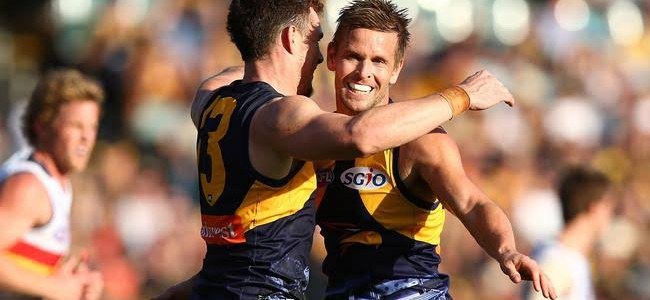
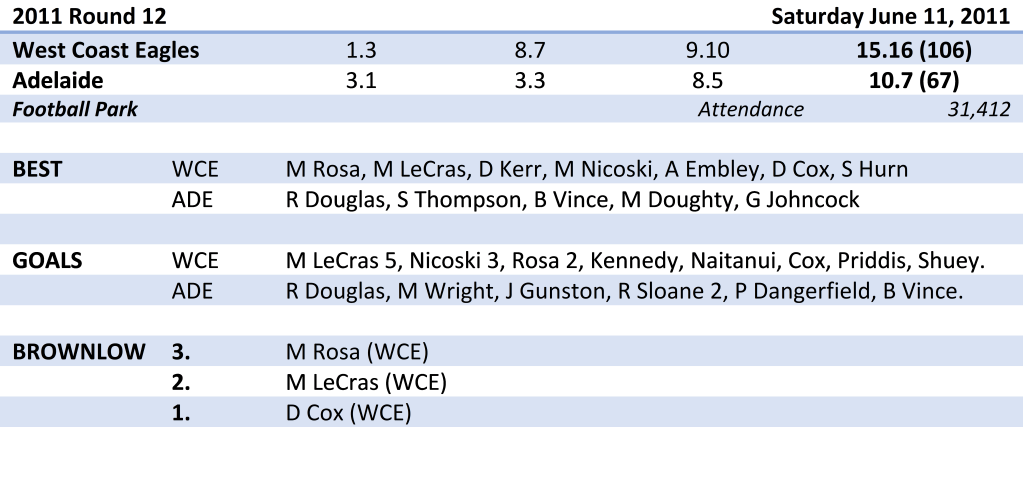
Seven unanswered second-quarter goals and a number of other favourable results all but ensured the Eagles would return to finals action for the first time in four seasons.

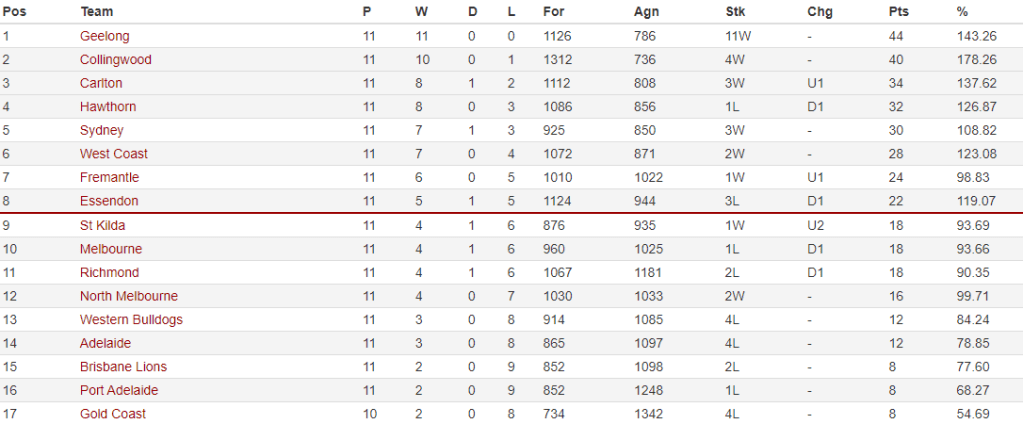
West Coast scored a 39 point win over Adelaide at Football Park and found themselves safely inside the top eight by two and a half games at the halfway mark of the season as several of the outsiders dropped important results.

Melbourne were thrashed by Collingwood to the tune of 88 points in their Queens Birthday clash while Richmond fell to a narrow ten point loss to the Swans in Sydney to harm their chances of reaching finals.

The Eagles sat sixth after 11 matches, just one game out of the top four after Hawthorn lost another narrow match to Geelong. The Hawks led by three goals at three-quarter time, but were held scoreless in the final stanza as the Cats maintained their unbeaten start to the year. Geelong booted three goals to claim the lead nine minutes into the final quarter, before the match became an engrossing battle, with the Cats recording the last four scores of the game (all behinds) to run out five point winners.

That result saw Hawthorn drop to fourth on the ladder, with Carlton leapfrogging the Hawks after the comfortably accounted for the Lions by ten goals. Fremantle reversed recent form to record an impressive 34 point win over Essendon, with the two sides swapping position in 7th and 8th on the ladder. The Dockers win was set up in the first quarter when they opened the match with a six goal to one term.

The Crows and Eagles had built a strong rivalry during the mid-2000’s, with the Eagles twice thwarting Adelaide’s flag hopes with preliminary final wins in 2005 and 2006. As West Coast dropped to the foot of the ladder, the Crows continued to be a finals challenger but in 2011 the roles had reversed.

Adelaide had won just three games for the season and were in rebuild mode, while the Eagles had surged back towards finals contention. Such had been the Crows’ performances this season, that questions had risen over the future of senior coach Neil Craig.

The commentary over Craig’s future led to Worsfold to back in his counterpart ahead of the match, having been the focus of speculation the year before. The Eagles coach questioned why many were quick to dismiss veteran coaches during bad spells, suggesting that Craig and Rodney Eade both had the capability to turn their clubs’ fortunes around in future years.

West Coast made three changes for the trip to South Australia, recalling Brad Ebert after he was banished to the WAFL a week earlier. Ebert responded with a best on ground performance for Peel to earn his spot back, with Daniel Kerr and Sam Butler both overcoming injuries to make the trip.

Brad Sheppard, Tom Swift and Andrew Strijk were the three to lose their place.

The Crows made two changes, dropping Ricky Henderson and Brad Moran in favour of Andy Otten and Shaun McKernan.

Adelaide had first use of a strong breeze, opening up a ten point lead at the first change, before West Coast maximised the wind advantage in the second term.

West Coast slammed on seven goals while the Crows managed just two behinds as the ball lived in the Eagles forward half. Mark LeCras add two majors for the term to go with the Eagles only goal of the first term to have three at the half.

Adelaide made better use of the breeze in the third term as they worked their back on the scoreboard. When Richard Douglas added a brace of goals within 77 seconds, the home side trailed by just nine points.

Mark Nicoski then put the match out of reach with the opening two goals of the final term as the Eagles eased away for their seventh win of the season. LeCras contributed the final two goals of the game to take his match haul to five, with Nicoski (three) and Matt Rosa (two) the other multiple goal scorers for West Coast.

In his 101st game, Rosa was best on ground, with 31 disposals, nine marks and seven inside-50s on the wing to go with his two goals. Andrew Embley (29 disposals) and Daniel Kerr (25) were proficient while Scott Selwood and Patrick McGinnity did the jobs on Scott Thompson and Richard Douglas.

The Eagles ruck pairing of Dean Cox and Nic Naitanui again controlled the tap knocks with the Eagles winning the count by 19 and subsequently the clearances by 10.

For Adelaide, running defender Graham Johncock was their leading ball winner with 26 and ten rebound 50’s, with Scott Thompson also collecting 26 disposals. Michael Doughty nullified the influence of Matt Priddis in the middle while Matthew Wright and Bernie Vince bobbed up throughout the game, but the greater spread of the Eagles ensured they would get the points.
Eagles Fall Short Against Benchmark

Magpie Magic the Difference

After an encouraging start to the season, West Coast tested themselves up against the best of the competition – and found they still had a way to go as Collingwood cruised to a 52 point win.

West Coast matched the reigning premiers at the stoppages and had just two less inside-50s, but the Magpies’ superior class and ability to produce magical moments showed the gulf in the two sides.

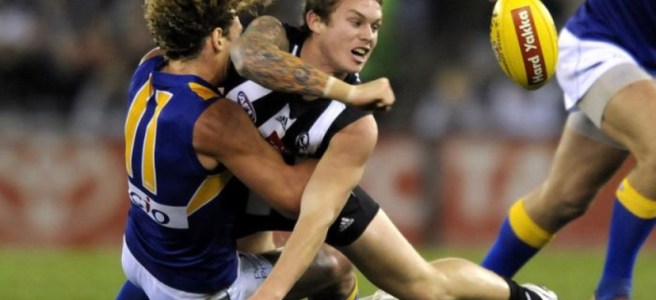
Dale Thomas was the standout on the ground, producing a mark-of-the-year and goal-of-the-year contender to go with 30 disposals and two goals. Thomas worked all over the ground, pushing back in defence with six rebound 50s while also floating forward to hit the scoreboard.

Collingwood coach Mick Malthouse praised the performance of Thomas after the win, as well as Leon Davis who finished with 25 disposals and seven rebounds. Few sides have been able to break the Eagles forward press in 2011, but the Magpies were able to burst through with speed, through the likes of Thomas, Davis, Heritier Lumumba and Heath Shaw.

Malthouse was full of admiration for West Coast in the lead up to the match for their rapid improvement on 2010, but after the win proudly acknowledged his side’s ability to eliminate the strengths of the new Eagles.

“When you analyse their contested ball, they hadn’t been beaten I don’t think this year. Their first quarters (travelling interstate), they’ve always won them.”

“We took both of those away from today, which is good.”

Much had been made about a host of Collingwood players in the lead up to the match with Davis one of a number of Magpies under a cloud. Dane Swan and Leigh Brown were limited to walking laps for much of the week, while Davis and Heath Shaw were both rumoured to miss.

However, all four lined up with the only change for Collingwood being Alan Toovey replacing Tyson Goldsack in defence.

West Coast also made the one change with Brad Sheppard called up to replace Sam Butler who suffered a thigh injury during training.

The Eagles couldn’t have asked for a better start with Josh Kennedy outmarked Chris Tarrant and slotted the opening goal after just 27 seconds. But Collingwood made the most of their chances through some remarkable individual efforts.

Steele Sidebottom rolled Collingwood’s first from the boundary line, Thomas hacked the ball out of mid-air for the Magpies’ second before Alan Didak swivelled through four Eagles for three in a row. Scott Pendlebury added a fourth to have the Magpies out to a 19 point lead at quarter time.

The Eagles had their best period of the match in the second term, but the Magpie defence held firm with Daniel Kerr adding the only goal for West Coast in the quarter. The deficit had been reduced to 10 points midway through the term before a quickfire three-goal burst to the Magpies extended their lead to 27 at the major break.

Adam Selwood was one of the best for West Coast

Collingwood continued to stretch their lead through the second half, taking their advantage out to beyond ten goals during the last term, before West Coast booted three of the final four goals in the match to add some respectability.  

Despite the poor showing against the competition benchmark, Worsfold remained upbeat after the match, keeping to the tune that the season was all about improvement.

“The margin is disappointing but the effort and matching Collingwood in certain areas shows that we are bridging the gap between the absolute best in the competition and where we’re at.”

Worsfold also boldly declared he was keen to coach on beyond this season when his current deal is set to expire. Having survived calls to be sacked over the preceding 18 months, Worsfold said he was as eager as ever to continue coaching, buoyed by the sharp improvement the club had seen across the opening ten rounds of the season.

“If we hadn’t shown any improvement, I would be guiding this team along and getting them as well prepared as I could for someone to take over.”

“Where I’m at is, when this season finishes, I’d love to sit down with our management and our board and find out the direction that, one, the club wants to go and, two, my direction.”

“If they match up and we’re all happy, then I’d expect to push forward with it.”

Matt Priddis was industrious as ever with 32 disposals and eight clearances, with Adam Selwood (27 disposals) and Daniel Kerr (24) the next best for West Coast. Josh Kennedy was the only clear winner up forward with three goals opposed to Chris Tarrant while Dean Cox and Nic Naitanui again were supreme in the ruck.

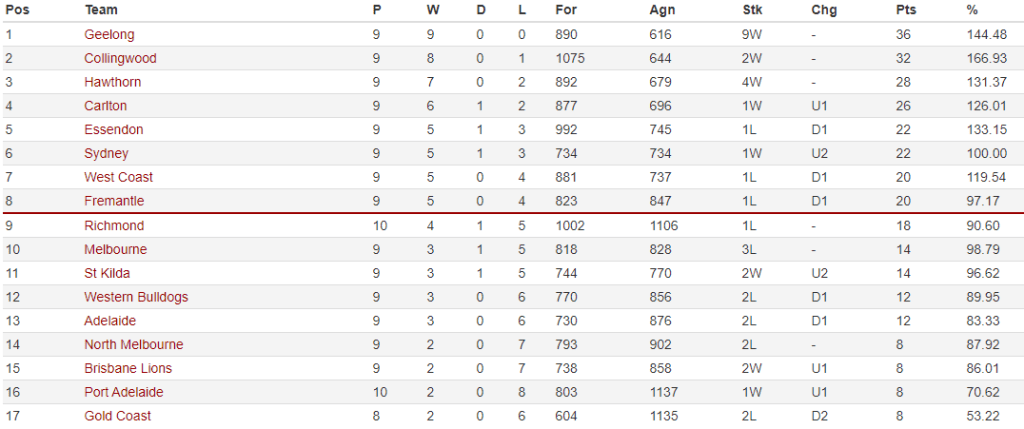
The Magpies held 2nd spot on the ladder with the win, with Geelong remaining undefeated after they easily accounted for former champion Gary Ablett’s Gold Coast side. The Eagles dropped to back to seventh on the ladder, with the Dockers falling to eighth after they lost their third match in four weeks, thrashed by St Kilda.

Sydney moved past both WA sides when they scraped past a horribly inaccurate Kangaroos side by one point. Hawthorn and Carlton both recorded simple wins over the Western Bulldogs and Melbourne to shore up their places in the top four, while Essendon sat fifth with the bye.

Richmond missed out on a chance to move into the top eight past the Eagles and Dockers when they fell to bottom-placed Port Adelaide by 15 points. That saw the Power jump out of last and coupled with Brisbane’s surprise 40 point win over the Crows, the Suns were relegated to the foot of the table.

While West Coast didn’t get the result, there was a noticeable name in the 25-man squad. Jacob Brennan was listed as an emergency, moving one step closer to becoming the first son of a former player to play for the Eagles.

Brennan was the final choice for West Coast at the 2010 National Draft, selected in the footsteps of father Michael who played 179 games with the club. Jacob’s selection in the Eagles squad was interesting timing after Trevor Nisbett earlier in the week professed frustration over the limitations of the current father-son eligibility that had cost the Eagles the chance at selecting several under-18 WA players in recent drafts.

Brandon Matera and Alex Rance had both been selected by other clubs, while promising defender Jordan Lockyer was another who the Eagles wouldn’t have first crack at due to the restrictive father-son rules imposed on the two WA clubs.

Under current rules, former players must have either played 100 AFL games with the Eagles or 150 WAFL games prior to the Eagles formation in 1986, to qualify as father-son selections. Nisbett had lobbied to the AFL that inaugural squad members should automatically be eligible for the father-son rule, claiming that many of the players selected in 1986 were older-aged recruits who would never have been able to meet either of the playing parameters.

As such, West Coast could have had first option at Brandon Matera (son of Wally) and Jordan Lockyer (son of Andrew). Nisbett’s suggestion was subsequently rejected by the AFL, leading the Eagles CEO to lament West Coast had missed out on a generation of father-son players.

JK’s Big Day Out

Kennedy Bags 10 as Eagles Deliver Bulldog Belting

When Chris Judd declared that he would head home to Victoria at the end of the 2007 season, the premiership captain was adamant West Coast would be fairly compensated for his departure.

Following a tender process involving four clubs, the Blues ultimately came up with the package that earned the services of Judd, exchanging the number 3 and 20 draft selections, as well as emerging West Australian forward Josh Kennedy.

Kennedy had booted 11 goals in 22 games across two seasons at the Blues, and while Carlton were reluctant to let the key forward go, the opportunity to bring Judd to the club was too great to refuse.

Judd was instantly instilled as captain, guided the Blues to finals appearances in 2009 and 2010 and claimed the club champion award in his first three years at the club as well as winning the 2010 Brownlow.

For West Coast, Josh Kennedy was always going to be a longer-term project.

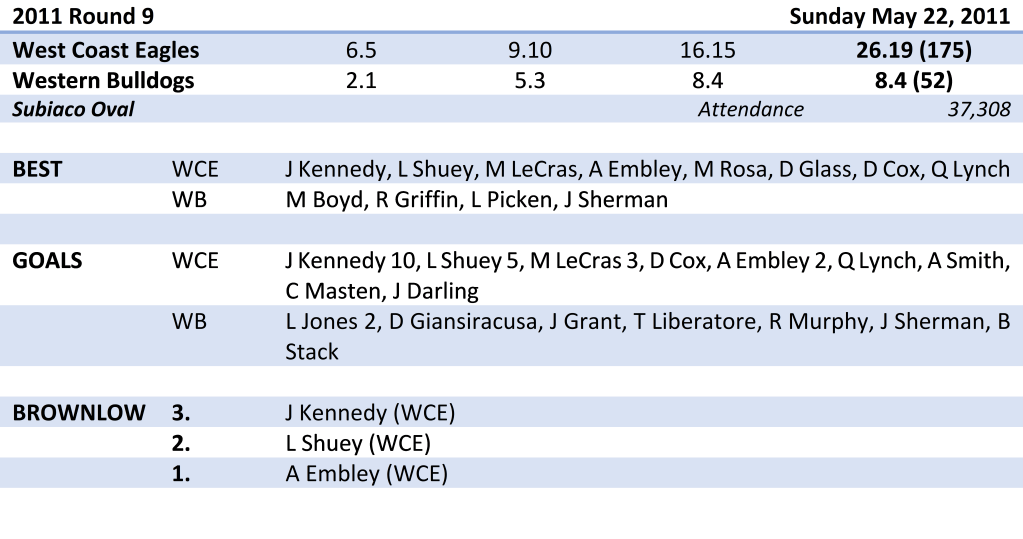
And in his 53rd game with the club, the Eagles saw exactly what Kennedy could produce when he booted a career best 10 goals in a 123 point thumping of the Western Bulldogs.

Kennedy got the better of four opponents on the day, kicking 10.3 from 21 disposals and 15 marks as the Eagles orchestrated a remarkable 183 point turnaround from their last meeting with the Bulldogs. That game, in Round 13 of 2010, saw ‘Dogs come to Perth and claim an easy 60 point win.

However, the side that had reached the penultimate weekend of the season in each of the previous three seasons appeared a shell on this trip to Perth, outplayed from the opening bounce.

The Bulldogs were without several important players, including Brian Lake and Barry Hall (who was named an emergency as he returned from injury), while Adam Cooney was forced out with a knee injury and Dylan Addison injured an ankle at training. However, Shaun Higgins, Easton Wood and Tom Williams could all be recalled.

West Coast made just the two changes, bringing in Andrew Embley and Daniel Kerr who had been late withdrawals the week before. Their two replacements for the Derby in Brad Sheppard and Andrew Gaff made way.

Kennedy’s big day started in the opening minute when Matt Rosa and Scott Selwood combined to win the first stoppage, before sliding the ball to Luke Shuey who found Kennedy. Kennedy would have a further three goals by quarter time and added a fifth, 56 seconds into the second term.

By this point the Eagles had opened up a five goal lead, although the visitors were able to manage the halt the damage to half time. Remarkably, when Jarrad Grant and Daniel Giansiracusa goaled midway through the third term, the margin was just 22 points between the sides, but the Eagles rammed home their clear advantage in the game with the next seven goals.

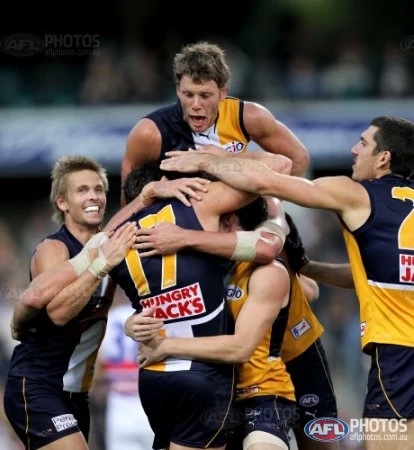
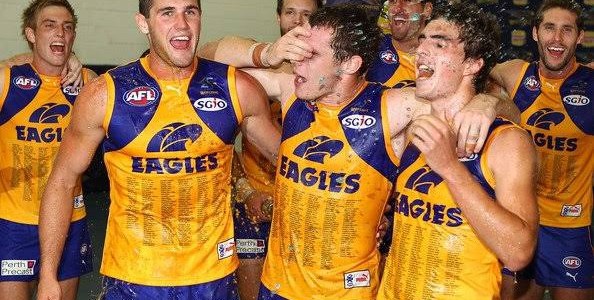
Eagles teammates celebrate with Kennedy after he kicks his tenth goal

The game was as good as done by three-quarter time with West Coast leading by 59 points, before the Eagles went another level.

West Coast stepped into savage mode.

The last term became a procession as the Eagles slammed on 10.4 to nothing to come away with a 20 goal victory, having kicked 17 of the last 18 goals in the match. After four goals in the first quarter, Kennedy added two in each of the 2nd, 3rd and 4th terms, with teammates mobbing the key forward when he became just the fourth Eagle in club history to reach double digits.

Kennedy would be the standout from the result, but there wasn’t a poor Eagle in the house.

Scott Selwood and Daniel Kerr provided the grunt in the middle, Andrew Embley and Matt Rosa gave the outside run and Luke Shuey provided the cream through the centre and the perfect foil up forward, booting five goals from 27 disposals.

With the Eagle talls dominating, Mark LeCras spent more time through the middle, gathering 29 disposals and booting three goals. Darren Glass held the defence, blanketing Jarrad Grant with Ashley Smith and Shannon Hurn proficient in exiting the ball out of the Bulldogs forward 50 on the few times they got that far up the ground.

Nic Naitanui and Dean Cox were superior over Ben Hudson and Will Minson, Quinten Lynch and Jack Darling roamed up and down the ground to send the ball inside 50 on ten occasions and Adam Selwood kept the reins on Daniel Cross.

All aspects of the game pointed to a shellacking.

West Coast finished the game with 121 more disposals, 35 more marks, won the clearances 48-37, recorded 34 more inside-50s and had a staggering 33 more scoring shots (45-12). The Eagles also took 27 marks inside their forward 50, with the combination of Kennedy, Darling, Lynch and Cox proving too much for the undersized Bulldog defence.

The 123 point margin was the third largest win in the clubs history and was also their highest score since 2006.

While teammates and fans were celebrating the massive win, coach John Worsfold was quick to stifle expectations declaring the upcoming round 10 match against Collingwood ‘the real measuring kick’.

“I told them after the game you get four points for the win. You get a lot of pats on the backs – well above what four points deserves.”

“They deserve the accolades that come but it doesn’t give you anything other than one win. I wanted to see them maintain the effort they put in last week and they did that.”

Worsfold was also full of praise for Kennedy following his career-best day. “It reinforces the faith in the ability that we all know he (Kennedy) does have. It is good reward because he works as hard as anyone.”

“It wasn’t ideal losing Chris Judd but… we were more than pleased with the outcome of that trade.”

While Worsfold was playing down the expectations of his side, Bulldogs coach Rodney Eade declared West Coast were premiership contenders, following what he described as the ‘worst loss his career’. The magnitude of the defeat – the fourth worst in the history of the Bulldogs, and their largest defeat since 1996 – followed in the coming days, with president David Smorgon issuing an open letter to members apologising for the performance.

Smorgon was also forced to deny Eade’s tenure as coach was under threat, despite the veteran coach being out of contract at the end of the season. “With 14 rounds to play, I want to reiterate that we will continue to support and encourage Rodney Eade and the match committee to make whatever changes they feel necessary to ensure we again start playing consistent footy every week and every quarter.”

Any other day LeCras’ 29 disposal, three goal game would have been best on ground honours

The big victory saw the Eagles move up one place to sixth on the ladder, with the biggest gain in the percentage column, rising from 112.6 to 131. The Eagles moved past the Swans who were thrashed at home by Hawthorn to the tune of 46 points. That saw the Hawks climb up to third after Essendon and Carlton both suffered defeats in the round.

The Bombers were 16 point losers to the Tigers, with Richmond joining the Swans on four and a half wins on the outskirts of the top eight. Carlton went down to the top of the table Cats by just two points in one of the games of the season.

The Blues jumped out of the blocks early, twice leading by 20 points during the first half, before a late rally before half-time saw the top four aspirants level at the major break. Geelong edged away during the third term, before Carlton strung four of five goals either side of three-quarter time to take back the lead.

The Cats then settled through Steve Johnson and James Podsiadly, but the Blues had chances late in the game to steal the win, with Jarrad Waite and Robert Warnock missing shots on goal. The Bombers and Blues were now just half a game in front of the Eagles.

The Dockers joined the Eagles on five wins when they easily accounted for Port Adelaide, who slumped to the bottom of the ladder after Brisbane broke through for their first win of the season over North Melbourne. The Demons hopes of making finals took a hit when they fell to a 20 point defeat against the Saints, who had started the season horribly after playing in the previous two grand finals. St Kilda had recorded just two wins and a draw in their first eight games.

Next up for West Coast was arguably their biggest challenge of the year – a trip to the MCG to tackle the all-conquering Magpies.

Eagles End Derby Drought

Shock Late Withdrawals Fail to Rock West Coast

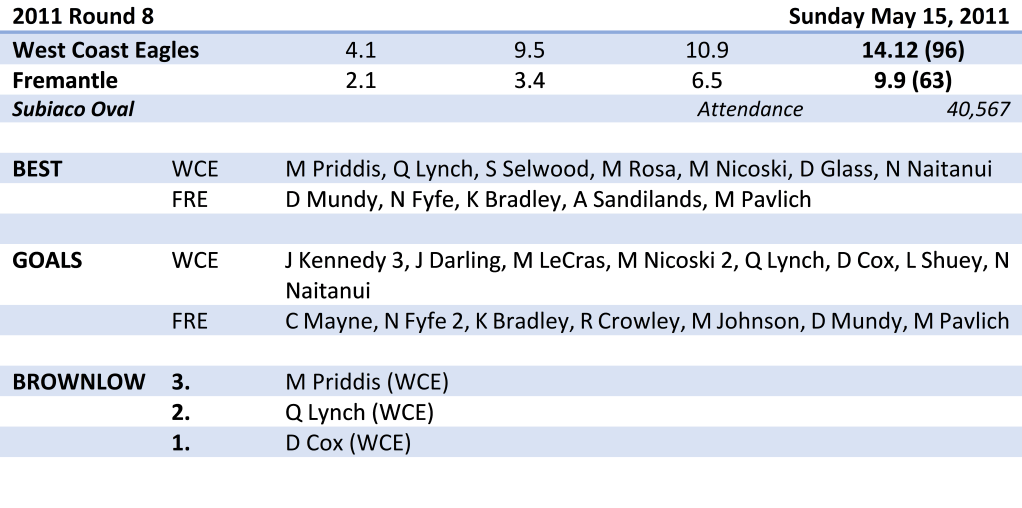
West Coast ended a seven game losing streak against their cross-town rivals when they broke through for a 33 point win over the Dockers.

Despite losing key midfielders Daniel Kerr and Andrew Embley in the hour before bouncedown, West Coast managed to win the battle in the centre and implement their forward press to make it four wins from their first seven matches – equal to the number of wins they managed for the entire 2010 season.

Matt Priddis stepped up in the absence of Kerr and Embley to dominate the stoppages and claim his first Ross Glendinning medal. Priddis was a unanimous choice for the award, with 27 disposals (17 contested), six clearances and five tackles.

Priddis, in particular, was instrumental at winning the ball in the contest and feeding out possession to the outside runners in the likes of Matt Rosa, Chris Masten and Luke Shuey. The Eagles forward line functioned far better than their counterparts, with the three-pronged attack of Kennedy, Darling and Lynch proving too much for the Docker defence.

Lynch also rotated through the ruck as West Coast used the burly forward along with Nic Naitanui and Dean Cox to counter the impact of Fremantle beanpole Aaron Sandilands. Sandilands still got the better in the hit-outs (45-39) and picked up 14 disposals to go with five clearances to be one of Fremantle’s better players on the day, but West Coast would have a better spread of contributors in the match.

The 33rd Western Derby promised to be the most even contest in several seasons with West Coast showing improvement after three seasons at the bottom of the ladder. Certainly, hopes were raised amongst both sets of fans, with the match declared a sell out over a week before the match. However, the Eagles’ chances of ending their losing run against Fremantle took a major hit as the clubs prepared for the start of the match.

First, Andrew Embley pulled out after deciding his questionable hamstring wasn’t worth the risk. Then, with the sides completing their customary warm-up, Daniel Kerr strained an adductor and was deemed unable to take his place. Brad Sheppard and Andrew Gaff were called up as the late replacements, with Gaff donning the substitute vest and Chris Masten, who had already been added to the side for his first game since injuring a knee in the opening round, was elevated into the starting 21.

Fremantle had their own late drama with small forward Hayden Ballentine officially ruled out. Ballantine had not been expected to play due to injury, but was surprisingly named when teams were released during the week with the Dockers refusing to admit there had been an issue. Jayden Pitt was brought in as his replacement, starting as the Fremantle sub.

Despite the disrupted preparations, West Coast showed no signs of being rattled. They started the stronger of the two sides with Josh Kennedy taking a strong pack mark to boot the Eagles’ first goal, with Darling following shortly after.

Quinten Lynch and Mark Nicoski also kicked first-quarter goals as West Coast took a two-goal lead into the second term, where West Coast’s ascendancy around the ground would lead to its biggest impact on the scoreboard.

Fremantle became the latest casualty to the Eagles forward press, as West Coast locked the ball in their forward half. The Docker defence failed to handle the pressure from the Eagles forwards, who capitalised in booting five goals for the term to take a commanding 37-point lead into half time.

The Dockers got the match on a more even keel through the second half, twice closing withing 20 points, but the Eagles were able to hold their advantage to run out 33 point winners.

Josh Kennedy finished with three goals to get the better of Luke McPharlin, with Jack Darling, Mark LeCras and Mark Nicoski each finishing with a brace. Scott Selwood joined Priddis with the in-and-under work, finishing with 21 disposals and nine tackles while Matt Rosa picked up 24 disposals on the wing in a run-with role on Stephen Hill.

John Worsfold was impressed with his side’s ability to focus on the task at hand, despite the late disruptions. “It was a credit the players just got on with business.”

“The way that Gaff prepared, the way that Sheppard prepared. And also Masten who expected to be the sub and having to come on and play longer game time. Those players just got on with the job.”

“They are only young players who showed great maturity.”

While many of the plaudits were for the midfield and forward groups, the Eagles defence were also solid, with Darren Glass leading the way. Glass held Jack Anthony to just five disposals and a behind in his Dockers debut, with Sam Butler and Ashley Smith providing the rebound from the back half.

While Anthony’s first game since crossing over from Collingwood was underwhelming, he wasn’t alone with many of the key Fremantle players struggling. Matthew Pavlich was closely watched by Adam Selwood, and while he still found the ball 22 times, he lacked presence in the match.

Adam McPhee, Paul Duffield, Clancee Pearce and Greg Broughton were all below their best, with Mark Harvey admitting his side couldn’t handle the pressure brought on the Eagles.

“We appear to not have enough class at the moment in our side and we are putting ourselves under pressure with our disposal.”

Matt Priddis was the unanimous choice for the Ross Glendinning Medal

The result saw West Coast move back into the top eight, past the Dockers into 7th spot. The Eagles were able to climb several rungs with Melbourne and Richmond, who sat above them heading into the round, both suffering surprise defeats to lower placed sides.

The Tigers lost to the Bulldogs in a 43-goal shootout, while Melbourne fell to North Melbourne by 41 points after being outscored 12 goals to four in the second half. Many of the remainder games went as expected as the top half of the ladder began to take shape.

Essendon ran away to a six goal win over Brisbane after an even first half, Hawthorn claimed a five goal win over the Saints after also being even at the major break while Sydney thrashed Port Adelaide by ten goals.

The match of the round, however, was the opening game of the weekend that saw the undefeated pair of Collingwood and Geelong meet at the MCG. In a fiercely fought match, the inaccurate Cats came from behind to get over the top of the Magpies by three points.

Geelong registered 11 scoring shots in the opening term but could only manage 2.9, to hold a 14 point lead at the first change. Collingwood then took control with six of the next nine goals to head into the final term with a five point advantage. Andrew Krakouer kicked the first major in the final quarter to stretch the Magpies lead out to 11 and the reigning premiers appeared to have done enough.

However, three goals in seven minutes to the Cats flipped the match, with Geelong holding on due to some late controversy. Scott Pendlebury appeared to have slid home the winner for Collingwood in the final two minutes after taking advantage from a free kick, but the umpires pulled the ball back up the ground and the chance was lost.

For Eagles fans, the win over Fremantle had them dreaming of a return to finals actions after three seasons watching on in September. While Worsfold was happy with the result, bragging rights weren’t high on the agenda.

“It’s not about the derby. It’s where we want to get to as a team. We’re working hard to improve… and we’ve taken some steps. There are a lot of steps still to take. And the derby was another step on the way.”

“The big picture is to develop this side to be the absolute best it can be. It’s going to take a little while longer.”

Eagles Resurgence Takes Next Step

Fast Start Allows Eagles to Coast Home

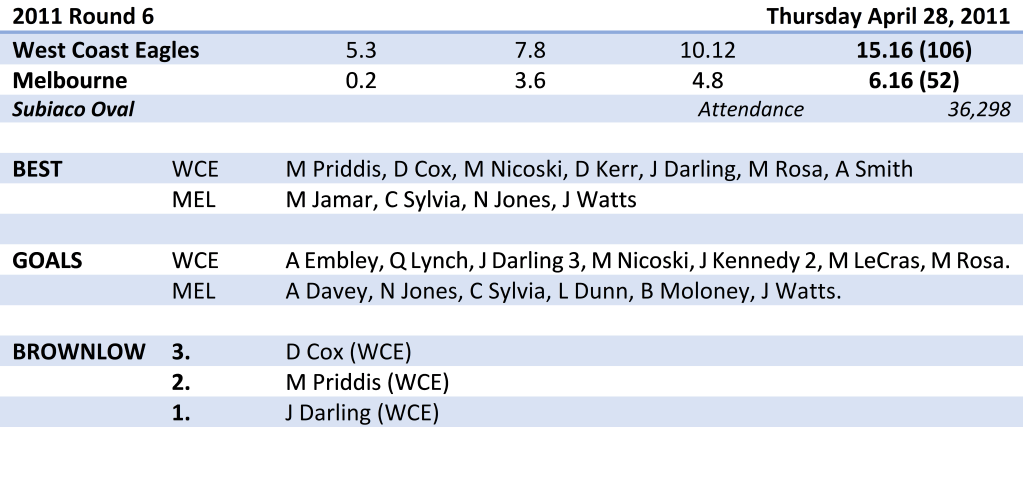
West Coast showed that they would be a significant improver on their 2010 wooden spoon finish with a comprehensive nine goal win over Melbourne at Subiaco Oval.

The Demons had also been expected to rise after a strong finish to the 2010 season and started the season with two wins and a draw from their first four games.

However, they were no match for the Eagles’ famed forward press as West Coast locked the ball in their forward half for much of the night. The Eagles bounced to a five goal quarter time lead off the back of an astonishing 22-3 inside 50 advantage and they never looked like relinquishing the lead.

After their first four matches had been decided by 18 points or less (for two wins and two losses), Eagles coach John Worsfold was pleased to have the match out of the opposition’s reach early.

“We’ve had four pretty tight games leading into this one so to actually get the margin out a little bit is some good reward for the players”, Worsfold said.

Over 36,000 fans attended the rare Thursday night fixture in Perth, with the Eagles and Demons both coming off byes in round 5. West Coast made three changes to the side that lost to Hawthorn a fortnight earlier with Will Schofield and Mitch Brown unavailable due to injury and Bradd Dalziell omitted.

Mark LeCras returned for his first game since damaging a groin in the opening round, with Ashley Smith selected for his first match of the season and Patrick McGinnity also included. The Demons smashed newcomers Gold Coast by 90 points before the bye, with the Demons coaching staff sticking with the same 22 for the trip west.

However, it wouldn’t be long before Dean Bailey would have wished he could have called on more reinforcements.

Nic Naitanui took clean possession from the opening bounce and sent the ball deep into the Eagles’ forward line in what would prove indicative of the rest of the term. The Demons defence were under siege and the Eagles arguably could have led by more at the first break.

Jack Darling kicked the home sides first major shortly after and by the time Andrew Embley waltzed through for his second goal just before quarter time, there had been a distinct difference in level between the two sides.

It was much of the same for the second term before Melbourne briefly brought some life to the contest on the brink of half-time. Two goals in a minute to Colin Sylvia and Aaron Davey reduced the margin at the major break to 26 points but West Coast reasserted themselves in the second half, coasting to their third win of the year.

The tale of the match was told in the stats, with the Eagles well ahead in most areas. The Eagles had 40 more disposals on the night, which translated into a 65-36 inside-50 count, following their opening quarter blitz. The Eagles also out-tackled the Demons 68-57 and claimed a win in the clearances 35-29.

West Coast also made the most of the advantage they had in their forward line, with the likes of Kennedy, Lynch, Darling and the resting ruckmen of Naitanui and Cox proving too strong for the smaller Demon defence. The Eagles took 22 contested marks for the match, and had 14 marks inside 50.

Individually, Matt Priddis was the leading ball winner on the ground with 33 disposals (9 kicks, 24 handballs), while also amassing eight clearances and seven inside 50’s. Daniel Kerr tallied 27 possessions, six clearances and seven inside 50s with Matt Rosa picking up 26.

Dean Cox wasn’t as proficient as previous weeks but still managed 23 disposals and 12 marks to go with 20 hit-outs in an intriguing duel with Demons ruckman Mark Jamar. Jamar was easily the Demons best player and only four-quarter performer with the pair breaking even in their contest.

Ashley Smith gathered 25 disposals in his first senior outing of the year, Sam Butler had 21 and laid nine tackles, while Mark Nicoski was again lively in his new role across half forward. Nicoski kicked two goals and had a hand in several other goals from 15 disposals.

Young forward Jack Darling put in his best performance of his burgeoning career with three goals from 14 disposals and nine marks while Andrew Embley and Quinten Lynch also each booted three goals.

Apart from Jamar, it was slim pickings for the Demons.

With the ball spending much of the night in their defence, Jack Grimes finished with the most disposals (27), while Colin Garland (19) and James Frawley (18) also saw plenty of the pill. Nathan Jones collected 23 possessions, while Colin Sylvia tried hard through the middle and across half forward with 21 disposals, seven tackles and a goal.

Coach Dean Bailey couldn’t hide his disappointment after the match.

“It is a poor performance, it is a poor performance”, Bailey lamented.

“We turned the ball over too much. We’ve got to go back to the fundamentals of the game and get better in those areas.”

“You don’t start well, you get what you deserve really.”

The win catapulted the Eagles back into the top eight, into seventh spot ahead of Melbourne who slipped to eighth. With three wins, the Eagles were equal on points with Hawthorn, but there was already separation at the top of the ladder.

The last two premiers were the trendsetters early in the year, with both sides undefeated at the end of Round 6. The Magpies were a game clear, courtesy of having played an extra game, with Geelong, Hawthorn and Fremantle (who had started the year with four wins from five matches) all having byes this round.

Carlton overcame Sydney in the final quarter to record their fourth win of the season and move up to third behind the Magpies and Cats and in front of the Dockers who rounded out the top four. Essendon pushed up to fifth after they were the latest team to annihilate the Suns. The Bombers kicked a record 15 goals in the first term to lead by an astonishing 93 points at quarter time, ultimately ‘easing’ to a 139 point win. The victory bumped their percentage by almost 27 percentage points.

West Coast sat two points ahead of the Demons, Swans and Tigers who defeated the winless Brisbane by 26 points. The Lions were left last on the ladder after North Melbourne earned their first win of the season with a ten goal triumph over Port Adelaide.

The Eagles had showed in their win over Melbourne that the early season form was sustainable and three wins from five matches had put the team in good stead for a return to finals action ahead of a tough month with matches to come against Essendon, Fremantle, the Bulldogs and reigning premiers Collingwood.

Back In The Pack

Consecutive Losses See Eagles Slip Down Ladder

After a bright start with wins over North Melbourne and Port Adelaide to open the season, the Eagles soon found themselves with a squared ledger after dropping games against Sydney and Hawthorn.

In a throwback to the classic encounters of the mid-2000’s, the Eagles and Swans played out another tight match, with the margin never going beyond three goals for the entire game.

Adam Goodes would be the difference between the two sides in the final term switching to the midfield after spending much of the first three quarters playing forward.

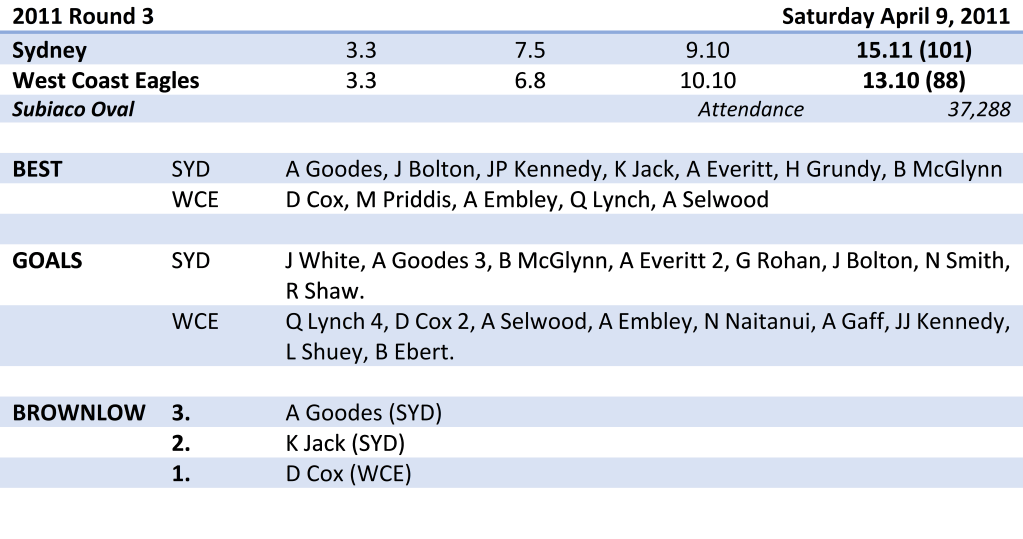
With West Coast holding a 12 point after Luke Shuey goaled inside the first minute of the quarter, Goodes provided the response to draw the Swans within six points, before adding a second major later in the term to level the scores. Goodes would finish with eight disposals for the term, along with three centre clearances and four contested marks as Sydney booted six goals to three to claim a narrow 13 point win.

The match itself was far less a spectacle and more a bruising battle, as the hardened Sydney midfield overwhelmed their younger opponents. The Swans laid 111 tackles (to West Coast’s 69), with Jude Bolton applying a game record 19 tackles himself.

The Swans got the quick jump with Jesse White booting the opening two goals of the match, but Quinten Lynch also managed a brace for the quarter which saw the two teams tied at the first change after Nic Naitanui floated home a goal on the siren.

Again Sydney got out to a two goal lead, with Goodes registering his first goal, but Lynch added two more goals, either side of a Lewis Jetta major, to keep the Eagles within touching distance. Andrew Embley put the Eagles in front, but Rhyce Shaw restored the Swans’ lead with the visitors in front by three points at the main break.

Dean Cox then took a hold of the match in the third quarter, putting in a quarter that matched the efforts of Goodes in the final. The Swans opted to play Shane Mumford as their sole ruckman against the pairing of Cox and Naitanui, with Mark Seaby – who had crossed to the Swans in the off-season – and Canadian Mike Pyke both left out of the side.

Sydney moved to a game high 17 point lead after Ben McGlynn and Jude Bolton both kicked majors when Cox stamped his authority. The Eagles ruckman picked up nine disposals for the term and kicked the final goal of an Eagles four-goal run that saw West Coast head into the final quarter with a six point lead.

Luke Shuey then made it five majors on the trot early in the last before Goodes drove his side to the line. Goodes finished with 21 disposals and three goals, complementing the workhorse Swans midfield group. Kieran Jack was the leading ball winner for the Swans, collecting 23 touches while also restricting Eagles dynamo Daniel Kerr to just 13.

Josh Kennedy also had 23 possessions, 18 of which were contested, while Jesse White joined Goodes in booting three goals.

Matt Priddis was one of the best for West Coast with 27 disposals and six clearances, doing what he could to match the Swans outfit. Cox’ strong start to the season continued, finishing with 20 disposals, two goals and 38 hit-outs. Naitanui tallied 28 himself with the Eagles winning the tap 68-38 but the Swans were still able to claim the clearances 49-34. Crucially their dominance through the middle in the final quarter saw them maintain their unbeaten record, following a draw with Melbourne in the opening round and a five point win over Essendon.

The Eagles on the other hand had been dealt their first loss of the season which saw them drop to ninth on the ladder.

The Eagles then made the long trek to Launceston to tackle the Hawks in what proved to be another narrow defeat. The match featured two of the upcoming forwards in the game, with Lance Franklin kicking six of the Hawks’ 10 goals, while Josh Kennedy booted four of the Eagles’ nine.

For the second week in a row the Eagles led at three-quarter time, but were run over by a more experienced side in the final quarter. Franklin kicked three of his six goals in the final quarter, as he got the better of young defender Mitch Brown.

With two points separating the sides at the final change, the Hawks broke the game open with the first four goals of the term, leading by 26 points as the term ticked into time-on. However West Coast finished with a rush, kicking the final three goals in the match but ultimately falling short by seven points.

The Eagles were made to pay for their early inaccuracy, as they failed to capitalise on their control of the match in the first quarter. The Eagles had twice as many inside-50s but kicked three goals to the Hawks’ two.

Josh Kennedy kicked his second late in the quarter to put the Eagles ten points ahead, but he was one culprit of missed chances, with three other efforts on goal either failing to score or going out on the full.

West Coast continued to hold the ascendancy in field position as the Hawks struggled to break through the Eagles forward press. However, the Hawks were devastating when they got the ball forward. Hawthorn booted the first three goals of the second term before Andrew Embley added one late for West Coast to reduce the Hawks’ lead to a solitary point.

While Franklin was proving a handful forward of centre, Sam Mitchell was racking up disposals in the irregular position of half back. Mitchell had averaged 27 disposals across the opening three rounds, but had matched that effort by half time.

The Eagles booted two goals to one in the third term to grab the lead before Franklin stepped up in the final term.

Mitchell finished with 37 disposals for the match as he was moved onto Kerr in the second half, who was also playing out of the middle, across half forward. Grant Birchall and Matt Suckling gathered 30 and 23 disposals, respectively, in defence while Brad Sewell was the enforcer through the middle with 19 possessions and 12 tackles.

The Eagles were well served once again by Matthew Priddis in the middle of the ground and Matt Rosa was strong on a wing with 25 touches and a goal. Josh Kennedy was the only multiple goal scorer for West Coast, while in defence Darren Glass was supreme in his 200th AFL match.

With Brown tracking Franklin and Eric Mackenzie lining up on Jarryd Roughead at full forward, Glass was released to play on the resting ruckman in either David Hale or Brent Renouf getting the better of both players. Mackenzie held Roughead to just one disposal for the first half to be one of the Eagles best.  

Sam Butler, Jack Darling and Andrew Embley all had 24 touches, with Darling outstanding in the first half with 18 possessions.

The Eagles were now 2-2 for the season and dropped down to 10th on the ladder ahead of their bye in round five. With Gold Coast entering the competition as the 17th team, the competition had an uneven number of teams for the first time since 1994, with each side scheduled for two byes throughout the 24 round season.

2011 Rewind: Eagles Strike Down Power

Eagles Make It Two On The Trot

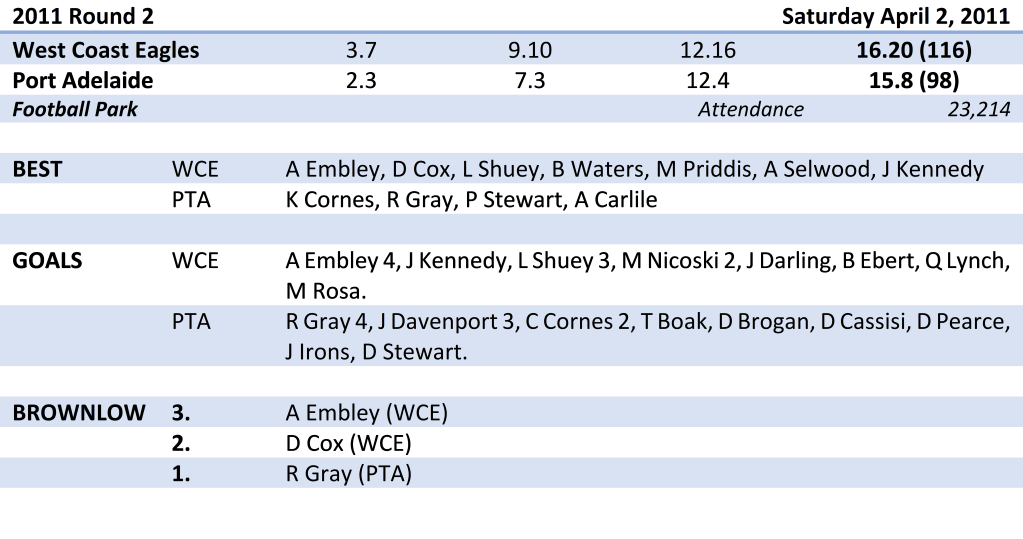
West Coast made it consecutive wins to start the 2011 season when they secured an 18 point win over Port Adelaide at Football Park.

The inaccurate Eagles edged their way to a three goal leading during the first half and maintained their advantage for most of the second half, holding out the home side after they twice closed within a goal during the final term.

Andrew Embley booted four goals to go with 32 disposals in a best afield display, while Josh Kennedy and Luke Shuey each kicked three. Kennedy had the better of Jackson Trengove early to boot his three goals by half time, while Embley and Shuey combined for the Eagles’ last six goals as West Coast became the first team since Collingwood in 2000 to win their first two games after claiming the wooden spoon the year before.

However, it was mixed fortunes for two of the Eagles most injury-prone players.

Daniel Kerr returned for his first game in nearly a year and picked up where he left off, gathering 25 disposals through the middle. Beau Waters, though, was set for a stint on the sidelines after injuring an elbow in one of the plays of the day.

With the Power closing in on the Eagles lead during the third term, and with the run of the play through the middle of the ground, Waters was able to tackle David Rodan, recover to smother a kick off the boot of Jaspar Pittard, before taking possession and finding Andrew Embley free at half forward to roll home a steadying goal.

The Eagles vice-captain missed the entire 2009 campaign after surgery on his left elbow, with the latest injury to his right. While West Coast were optimistic after the match, Waters would remain unavailable to the back end of the season.

Kerr was one of three changes for the Eagles, with Nic Naitanui and Patrick McGinnity both recalled after being late withdrawals the week before. Chris Masten and Mark LeCras were both sidelined with injury, with small forward Ashton Hams dropped.

Port Adelaide made just the one change after they were thrashed by reigning premiers Collingwood in the opening round. Veteran Chad Cornes came into the side in place of injured full forward Jay Schulz.

As they had done the week before, West Coast started strongly, but inaccuracy prevented the visitors from establishing a larger lead. Josh Kennedy and Quinten Lynch kicked truly early in the second term to stretch the Eagles lead to 22 points before Port Adelaide got their foot into the game.

Chad Cornes swung forward to kick the Power’s first for the term, with Robbie Gray kicking a brace to bring the Power back within five points. The Eagles then got on another run with Kennedy booting his third to send the Eagles out to a four goal advantage.

Gray added a third for the term to reduce the Eagles lead to 19 at the main break.

Mark Nicoski kicked from long range inside the opening minute of the second half to stretch the lead to 25, before the Power’s sub stamped his mark on the game. Jason Davenport was injected into the game during the half-time break in place of Dom Cassisi, booting three goals for the quarter as Port Adelaide refused to give up on their chase of the Eagles lead.

Three goals in a row – two to Davenport – had the home side back within nine points, before Waters’ inspirational play through the middle of the ground led to Embley and then Shuey, giving the Eagles breathing space.

Again Port Adelaide came, with Davenport adding his third and Chad Cornes kicking truly.

The Eagles had managed 12 more scoring shots in the first three quarters, but that only equated to a 12 point lead. Travis Boak – who had been well held by Adam Selwood – found the major opening to get the Power within a goal but Luke Shuey was able to answer.

And for each of the Power’s challenges in the final term, the Eagles were able to find the answer with Embley’s fourth in the dying seconds the icing on a fine win.

Daniel Kerr was one of the best for West Coast in his return game

Eagles coach John Worsfold was pleased with the win, but the victory was the least of what West Coast deserved having controlled large periods of the match. The Eagles finished with 60 more disposals, 18 more contested possessions and 13 more scoring shots.

Worsfold was also content with the return of Kerr through the midfield. “…he (Kerr) was always going to be a certain starter when he was fit enough to be in the side.”

“His attitude about getting back to wanting to play his best footy is great.”

Dean Cox again dominated in the ruck, combining with Naitanui to get the better of Port Adelaide ruckman Dean Brogan. The pair notched 53 hit-outs to Brogan’s 13, although the Eagles weren’t able to translate the hit-out advantage in the stoppages, losing the clearances 33-40.

But with Mitch Brown keeping Justin Westhoff quiet, and the other Port talls unable to exert any influence in the forward half, West Coast were able to set up much of their scoring opportunities with transition football from the back half.

Matt Priddis collected 29 disposals through the centre, while Shuey’s 27 disposal, three-goal effort earned a rising star nomination.

The Eagles’ first win over Port Adelaide at the Adelaide Oval in nine attempts, since 1998, left them as one of just five teams with two wins from the opening two games of the season.

For Worsfold, the result was an important step as the Eagles continued to build from the bottom. “Obviously for us they’re all important wins.”

“So to come to Port and beat Port here, which has been pretty tough for us since Port’s existence, for this group specifically it’s a very good win for them, but for the club overall to beat Port here has taken a bit of time.”

“We came over here saying we still wanted to win. Just that belief within the group, I think, is a bit stronger.”

2011 Rewind: West Coast Return to Winning Ways

Veterans and Youngsters Provide Glimpse to Brighter Future

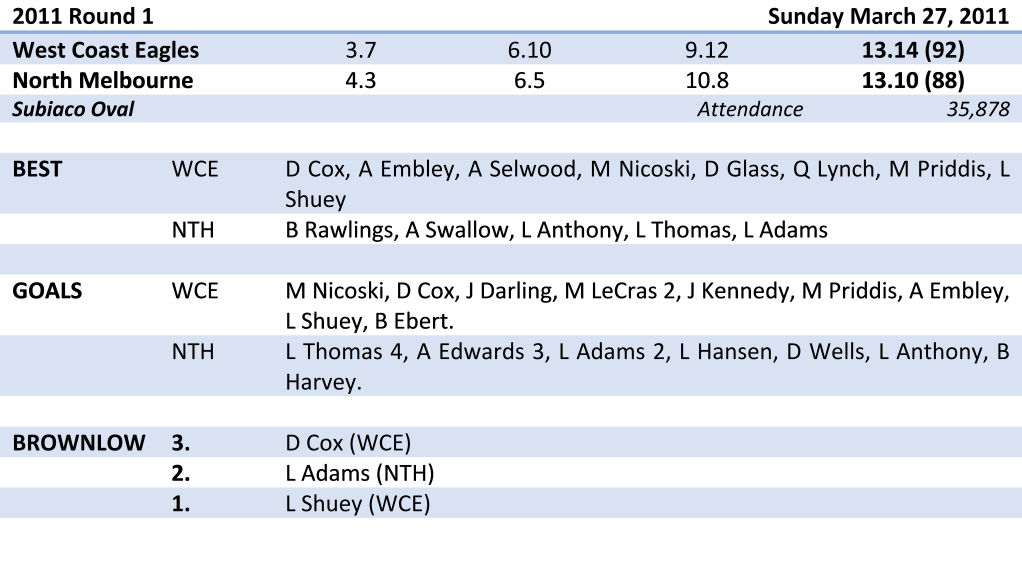
West Coast started the 2011 season in winning fashion with a narrow four point win over North Melbourne at Subiaco Oval.

Wearing a commemorative guernsey to mark 25 years in the AFL competition, the Eagles outlasted the Kangaroos in a match where the margin at the end of each quarter was never more than five points.

Fresh off the club’s first ever wooden spoon, the Eagles approached the new season with a sense of renewal as a host of veterans returned from injury and a several high draftees joined the club.

After a season of speculation, coach John Worsfold was assured that he would see out the season, despite many predicting a bottom four finish for West Coast. However, the Eagles showed they would be an improving team after recording wins against 2010 finalists Fremantle and Hawthorn in the shortened pre-season format.

West Coast followed the round-robin win with a comfortable victory over newcomers Gold Coast, before falling to premiers Collingwood in the pre-season semi-finals.

Encouragingly, the Eagles had enjoyed a drama-free off-season which hadn’t been the case in recent years. And as West Coast approached the start of the 2011 season, they had virtually a full squad to choose from – another rarity of recent times.

Darren Glass and Dean Cox had appeared to shake off ongoing groin problems, while the likes of Beau Waters, Mark Nicoski and Sam Butler were available to start the season. Daniel Kerr was another who was set to return to the senior side after ripping his hamstring from the bone in round 4 of the previous season.

Remarkably, Kerr would make his league debut for junior club East Fremantle the week before the Eagles’ opening match against North Melbourne, 10 years after he was drafted by West Coast. Kerr would ultimately be left out of the Eagles side for the Kangaroos as West Coast opted for a cautious approach with their senior midfielder.

Two players who did make it into the final two were West Coast’s top two draft picks from the 2010 National Draft. By virtue of finishing last, the Eagles would normally secure the first selection, however the inclusion of the Gold Coast Suns had seen the expansion team monopolising many of the early draft choices.

West Coast took running wingman Andrew Gaff with the fourth overall selection and then West Perth forward Jack Darling with a priority selection at the end of the first round which the club had received for winning less than five games in 2010. The pair were named for their AFL debuts – the first time Worsfold had named multiple debutants in a match during his time as coach.

Gaff would earn the honour of being the clubs first interchange substitute, after the controversial rule was introduced by the AFL ahead of the season. Originally not named in the 22, Gaff came in as a late replacement for Patrick McGinnity who was pulled from the side after a hot spot was detected in his foot. Mark Nicoski also earnt a late selection when he replaced Naitanui who had concerns over a shoulder injury from the pre-season.

The Kangaroos were one of the big unknowns heading into 2011 after finishing ninth the year before. Brad Scott – entering his second season as coach – talked up his sides chances heading into the match, believing the Eagles off-season training in the Perth heat would serve as a disadvantage.

With the substitute rule effectively reducing interchange rotations from four players to three, Scott suggested the young Eagles would tire quicker, with the match to be played in mid-30’s heat.

The Kangaroos named four players for their first game, with Cameron Richardson, Cameron Pedersen and Shaun Atley all named for their AFL debut, with former Eagle Ben McKinley included for his first game after switching clubs at the end of the 2010 season.

McKinley and Pedersen were set to take up the key forward roles, with Drew Petrie out suspended and Hamish McIntosh unavailable, while small forward Matthew Campbell was sidelined with injury.

The Kangaroos were then dealt a further blow before the match with ruckman Todd Goldstein withdrawing from the side. Goldstein’s departure effectively balanced out the Eagles’ loss of Naitanui and left makeshift duo Lachie Hansen and Cameron Pedersen to battle it out against Cox.

Cox would be one of the influential players of the day as West Coast won out in a match that ebbed and flowed throughout.

Early on though, it seemed as the Eagles’ 2010 form would continue as the Kangaroos bounced to an early three goal lead. Brent Harvey had the first major inside a minute, with Hansen and Lindsay Thomas adding majors to see the visitors out to a 19 point lead.

Slowly, the Eagles worked their way into the game, with Matthew Priddis opening the Eagles account midway through the term. Brad Ebert and Andrew Embley kicked goals and West Coast hit the front having had all of the momentum as the quarter time loomed.

The Eagles arguably should have hit the lead sooner, but wasted several chances in front of goal, most notably Mark Nicoski who kicked three behinds for the term. Re-cast as a half forward after spending his career in defence, Nicoski was creative without getting reward on the scoreboard.

A late Liam Anthony goal put the Kangaroos back in front at quarter time, before the two teams traded goals through the second term. Jack Darling kicked his first career goal after running down Jack Ziebell as West Coast took a narrow five point lead into the major break.

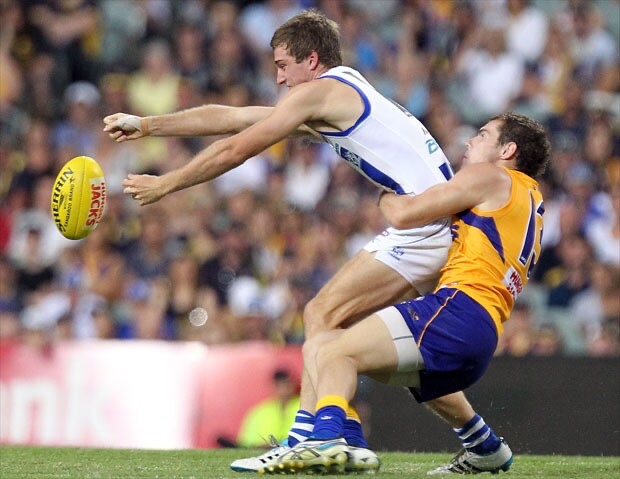
Jack Darling brings down Jack Ziebell to register his first career goal

The Eagles’ other debutant, Gaff, was into the action early after Chris Masten limped off early in the match with a knee injury and West Coast were soon down two on the bench when reigning best and fairest Mark LeCras was stretchered off with a torn adductor as he snapped through his second major.

Jack Darling added a second soon after as the Eagles skipped out to a 19 point advantage. Lindsay Thomas then dragged the Kangaroos back into the match with two goals in a minute.

North Melbourne closed with all of the momentum as Daniel Wells and Leigh Adams hit the scoreboard, to put North Melbourne in front by two points with a term to play.

In oppressive heat and with players down on the bench, West Coast could have been excused for wilting in the final term, but they came out the stronger at the start of the final quarter, with Nicoski finally getting some reward. With four behinds to his name, Nicoski found the major opening after two minutes of play

Dean Cox pushed forward for his second goal, before Nicoski added a second to see the Eagles back out to a 16 point advantage. The Kangaroos kept coming, reducing the margin to four points as the final term ticked into time-on, but a dubious Luke Shuey free kick and resultant goal sealed the match for West Coast.

Another ex-Eagle in Aaron Edwards goaled after the final siren to reduce the margin to four points, as West Coast started their season with a win for the first time since 2008. The victory saw the Eagles sit inside the top eight for just the second time since the opening round of 2008 and restored a winning feeling after West Coast managed just one win in the final 14 games of the 2010 season.

A delighted John Worsfold expressed pride that his side was able to hold and win despite losing numbers on the bench and being clearly fatigued in the final term. “Very proud of the way the players held up in a lot of individual efforts in terms of taking up a lot of the slack so we could keep the rotations going.”

One of those players was Quinten Lynch who rucked for large portions of the final term as Cox battled cramp. Lynch, who had fallen out of favour towards the end of the previous season, appeared to enjoy the freedom of the forward/ruck hybrid, with Kennedy and Darling holding down the key forward posts. The hulking forward collected 20 disposals and nine marks, as well as having 18 hit-outs.

Cox for his part finished as the leading ball winner at West Coast with 29 disposals, eight marks, 29 hit-outs and two goals, as well collecting the three Brownlow votes. Andrew Embley and Matt Priddis finished with 28 each, while Nicoski had 21 to go with eight inside 50s and 2.5.

Luke Shuey stepped up in the midfield in just his 7th game

Brady Rawlings picked up 32 touches to lead the Kangaroos with Andrew Swallow next best with 26. Lindsay Thomas kicked four goals and Edwards three, but too many were down on the day. For McKinley, it was an unhappy homecoming, subbed off during the third term with just five disposals to his name.

Brent Harvey couldn’t shake the tag of Adam Selwood, finishing with just 11 disposals. Harvey had amassed 44 touches the last time the two sides met, but was given no space by the close-checking Selwood.

Darling and Gaff both showed they belonged at AFL level, with Darling’s two goals coming from 11 disposals and three marks, showing an intensity around the forward line as West Coast looked to implement a high press.

Gaff tallied 14 disposals in nearly three quarters of football while Luke Shuey was just as impressive in his seventh game of football, picking up 20 disposals and six clearances, as well as booting the important sealing goal. Brad Sheppard (15th game) and Ashton Hams (12th game) also both had their moments.

“It is fantastic for the young kids that have earned a spot in round one”, a beaming Worsfold declared.