
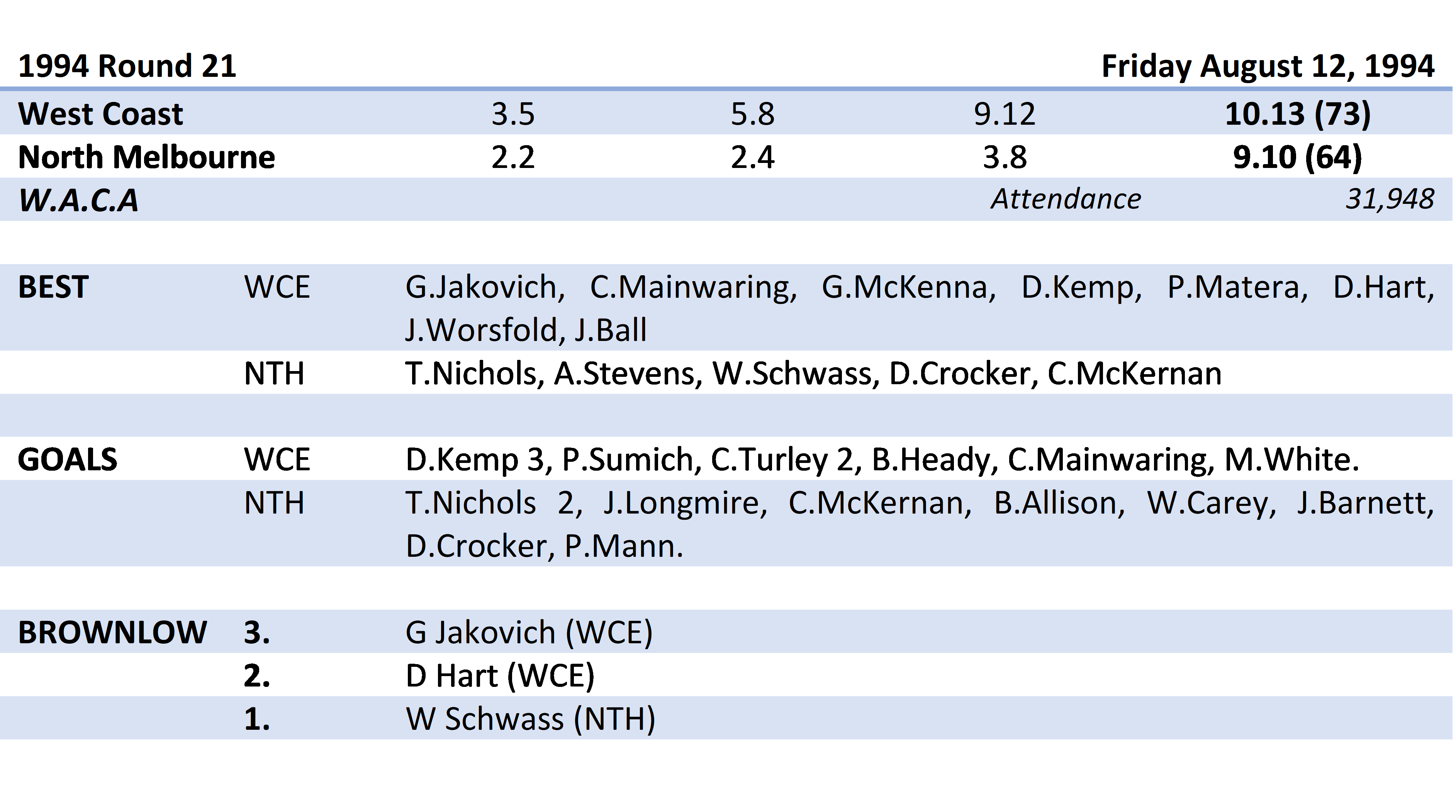
West Coast ensured they would finish in the top two at the close of the home and away season when they held off a rampaging North Melbourne at the WACA, in the opening game of Round 21.
The Eagles put in one of their best defensive efforts of the year when they held the free-flowing Kangaroos to just three goals to three quarter time to lead by 40 points.
But the Kangaroos rallied, kicking the last five goals of the game to have the home side and the home fans nervous, with only some desperate defence in the final minutes putting a halt to a famous comeback.
The win meant that the Eagles sat four games clear of North Melbourne with three matches remaining to confirm a top two finish. However, West Coast were yet to receive confirmation from the AFL that a top two finish would equate to two home finals under the new top eight finals format.
Subiaco Oval was due to start comprehensive construction of the new Southern Stand immediately following the Eagles final round game against Footscray and the WACA had yet to be accepted as an alternative venue due to its smaller capacity.
The AFL were also locked into an agreement with the MCC that stipulated a final at the MCG every week, and while the remaining seven positions on the ladder were filled with Victorian sides, the AFL refused to confirm West Coast would receive a second home final beyond the opening week.
The situation mirrored the scenario that West Coast faced in 1991 when they were forced to travel for a semi-final against Melbourne and a preliminary final against Geelong, despite finishing top.
While that was still to play out between West Coast and the AFL, on the field two of the premiership fancies showed their best and their worst in front of an electric crowd of just under 32,000 people.
Both teams named strong line-ups with the Eagles bringing back three premiership players in captain John Worsfold and half-forwards Tony Evans and Brett Heady. Guy McKenna was able to take his place despite still nursing a broken nose from a Darren Jarman hit the week before, as did Ryan Turnbull who was limited during the week at training with a left wrist complaint.
The Kangaroos made just the one change to the team that narrowly lost to Geelong the week before, with midfielder Alastair Clarkson making way for utility Peter Mann. North Melbourne coach Denis Pagan admitted that the selection of Mann was in response to the 37 point defeat to West Coast earlier in the season, when the Eagles exposed the Kangaroos for lack of height.
Another inclusion to the Kangaroos side from the one that lost in round 6 was Corey McKernan who had been a revelation in his first season. The rookie ruckman/forward had added another dimension to the Kangaroos in 1994 and lined up in the forward half along with Wayne Carey and John Longmire in a three-pronged attack.
Jason Ball was given the task in defence of minding McKernan, with Michael Brennan taking Longmire and Glen Jakovich matching up with Carey in the next instalment of their individual rivalry.
Jakovich would emerge the winner out of their battle with a best on ground display. The Eagles centre half back finished with 29 disposals and seven marks as he often stood in the way of many North Melbourne forward entries.
He was well supported by Guy McKenna (19 disposals) and John Worsfold (20 disposals) as North Melbourne allowed the Eagles half-back line to dictate play.
The Kangaroos used Alex Ishchenko as a spare man in defence, replicating a tactic that had worked successfully against Gary Ablett the week before. With Ishchenko heading into the back 50 after contesting the centre bounce, the Kangaroo half-forwards pushed up the ground to neutralise the Eagle midfield.
That meant McKenna and Worsfold were often allowed to set up without an opponent, feeding off the loose balls created from spilled balls in the North Melbourne forward 50.
The Eagles also had plenty of winners through the middle of the ground as Dean Kemp, Peter Matera and Chris Mainwaring dominated the North Melbourne centreline. Kemp dismissed the tagging effort of Anthony Stevens to pick up 12 first-half possessions and also booted the only two goals of the second quarter as West Coast worked their way to a 22 point half-time lead.
While Kemp was less influential after half-time, Mainwaring got the better of Wayne Schwass with 18 second-half disposals to finish with a match haul of 25 (along with eight marks). Peter Matera tallied 23 disposals on the other wing and Don Pyke was just as effective with 22 touches.
After controlling the first half, the Eagles were dominant in the third term, but it took until late in the quarter when consecutive goals to Craig Turley – who started the game on the bench – gave the Eagles what appeared to be an unassailable lead.
At three-quarter time, Pagan reverted back to a more typical structure holding his half-forwards deeper and the Kangaroos got the rewards on the scoreboard. They opened the scoring in the first minute before Peter Sumich responded shortly after with his second major of the evening to restore the Eagles’ 40 point lead.
That would be the last significant score for West Coast in the game as North Melbourne flew home in a rush. The Kangaroos kicked the final five goals of the game and had their chances in the dying minutes. With the margin just nine points and still three minutes remaining, the Kangaroos butchered several forward 50 entries.
Jakovich twice was able to intercept North Melbourne, including one John Blakey kick when he had Carey 15m free in space. Jakovich had 12 disposals and took four marks in the final term alone as the Eagles defence stood tall in the face of repeat Kangaroo entries.
After the match, the mood of the two coaches could not have been further apart.
Denis Pagan was seething of his side’s performance, with many of his prime movers leaving their imprint on the game until it was too late. Corey McKernan, Wayne Schwass and Darren Crocker all lifted in the final term as North Melbourne rallied, but it mattered little to Pagan.
“We were pretty disappointing for three quarters, and to come back hard in the last quarter proved that there is nothing conclusive about West Coast and North Melbourne.”
On the flipside, Mick Malthouse wasn’t bothered by his team’s last quarter, instead choosing to focus on the earlier effort that won the game.
“I thought the workload of the boys was outstanding for three quarters and there probably wasn’t any reward on the scoreboard.”
“North got their momentum up and they were very hard to stop… we got a couple of running injuries and that put a bit of pressure on us,” Malthouse explained. “We had to leave a couple of players out there when we wouldn’t have normally.”
In the post-script, both sides had setbacks to counter.
The Eagles finished the game without a fit player on the bench after John Worsfold and Tony Evans re-aggravated injuries in their first games back, while Chris Lewis had fresh worries over a thigh.
North Melbourne lost Anthony Rock during the game with a serious ankle injury, that was likely to see the midfielder miss the remainder of the regular season, but their concerns lay more critically with the tribunal.
The Kangaroos had three players reported on the night, with Brett Allison and Corey McKernan both reported for tripping Jason Ball on separate occasions, while Glenn Archer went into the book for disputing an umpires decision. Archer and Allison would escape suspension, but McKernan would not be so lucky, copping a one week ban. Cruelly, the guilty finding would leave McKernan ineligible for the Rising Star award, which he had been favourite to win.
If the nine-point win on a Friday night was a positive way to start the weekend, it only got better for the Eagles when Carlton – who were vying with West Coast for top spot – were humbled by last-placed Sydney at the SCG.
In a result that David Parkin declared would ‘have severe ramifications for the club’, the Swans recorded a famous eight-point win in a low-scoring clash, despite four goals to Carlton captain Stephen Kernahan. The Blues entered the game as $1.05 favourites, but the upset defeat left Carlton two games behind West Coast in second place ahead of their meeting the following week.
An inaccurate Richmond dropped their match against Hawthorn, while a goalless last quarter saw Melbourne fall to the Magpies. The losses to the Tigers and the Demons, on top of defeats to the Blues and Kangaroos meant that the teams placed second through to fifth coming into round 21 all lost, as the race for the top four got tighter.
The six teams behind West Coast and Carlton all had 11 wins for the season, with percentage determining the order.
North Melbourne remained third courtesy of their superior percentage with the Bulldogs moving into the top four after they easily accounted for St Kilda. The Saints got the early jump, but Footscray took control after quarter time, booting 15 goals to 6 on their way to a 45 point victory.
Geelong moved up to fifth when they got over the Lions, although it took until the last quarter to be completely assured of the win. Hawthorn, Collingwood and Richmond rounded out the eight, with the Magpies returning to the top eight after knocking on the door for several weeks.
Richmond suddenly looked vulnerable as they dropped from fourth to eighth, with their poor percentage threatening to undo their run to the finals. Melbourne made way for the Magpies dropping to ninth, as they sat one game behind the teams above them; the loss to Collingwood proving a real eight-point result.

 sportsphrase.blog