1994 Rewind: Eagles, Bulldogs Thrown Into Tribunal Chaos

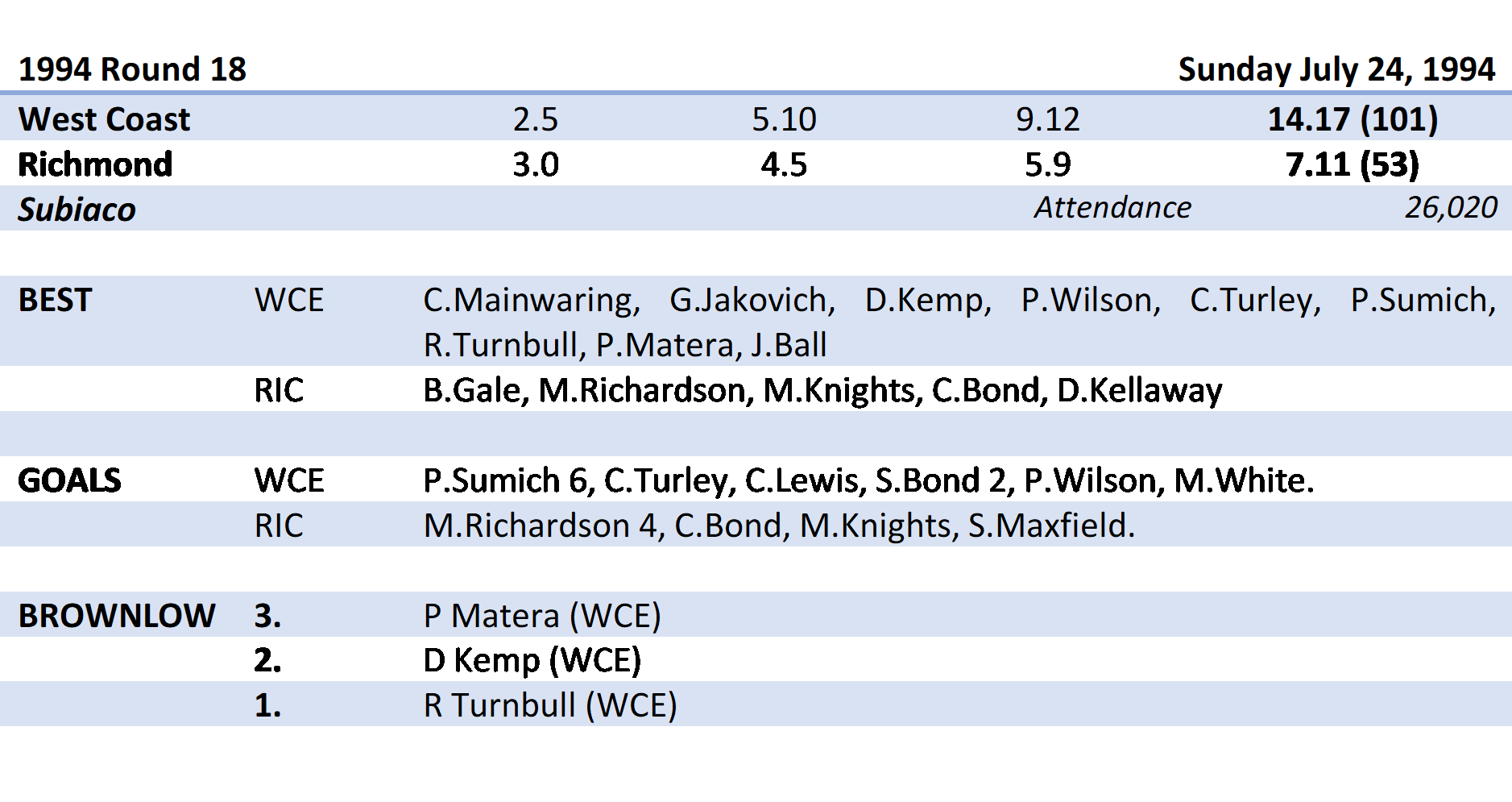
West Coast claimed their second minor premiership with a 71 point thumping of Footscray in the final round, but the win was marred by a half-time brawl that ultimately dragged the club through a farcical AFL investigation.

The Bulldogs arrived in Perth in third position on the ladder on the back of six wins in seven games, but were no match for a West Coast side that had been given a boost by reigning premiers Essendon 24 hours earlier.

The Bombers had already been ruled out of finals action for 1994, but they doubled down on the misery of Carlton’s 1993 Grand Final defeat, with an upset 18 point win over the Blues that opened the door for West Coast to reclaim top spot.  

The bye in round 23 had allowed several Eagles to recover from minor niggles but the break wasn’t enough for John Worsfold who missed with a groin strain. Craig Turley was also out, serving the first game of a two week suspension, allowing Chris Waterman to return after several weeks in the WAFL. Brett Spinks was the other inclusion when teams were first named.

Before the bounce, the Eagles made two further changes. Ashley McIntosh, Chris Mainwaring and Glen Jakovich had all been reported as struggling heading into the game, but it was Ryan Turnbull and Dean Kemp who were given an extra week of recovery. David Hynes and Tony Godden were brought in, with Hynes grasping the late opportunity with both hands.

Hynes put in a best on ground performance, controlling the ruck against Bulldogs counterparts Ilija Grgic and Barry Standfield. Hynes had 24 hit-outs (to the Bulldogs pair of 17), to go with 23 disposals and a goal. Don Pyke proved to be the greatest beneficiary from Hynes’ dominance, picking up 24 touches and capping off a fine game with three second half goals.

Pyke was too good for Simon Atkins early, gathering eight first quarter possessions, before Bulldogs coach Alan Joyce swung seven-gamer Brad Johnson onto the Eagle ruck rover. Chris Mainwaring and David Hart topped the ball-getters for West Coast with 25 each, while there was a strong spread of goal kickers with Pyke, Jason Ball and Chris Lewis leading the way with three each.

Lewis was magical across the half forward line having a hand in several goals from his 17 disposals and eight marks, while the Eagles defence again stood strong, conceding just six goals to the Bulldogs.

The Bulldogs had few winners on the day but Scott West and Tony Liberatore each finished with 18 touches through the middle, while Chris Grant had 11 disposals and seven marks roaming up the ground and also booted two goals.

West Coast jumped to a 20 point lead at quarter time, building their lead to 37 at the main break with only inaccurate kicking preventing the margin from being greater. The Eagles then booted four goals in each of the next two quarters, while the Bulldogs were held goalless in the last term. With the game in their keeping, West Coast turned their attention to the first final, resting a host of players in the final term, which saw them even finish with just 16 players on the ground.

The routine win was soon overshadowed when the focus turned onto the half-time brawl that involved most players on the ground.

The incident first began following a shirtfront on Brett Heady from Steve Wallis along the boundary line moments before the half time siren.

That caused remonstration between players, which quickly escalated as players rushed from all over the ground and even those that were on the bench.

With players tangled up, the brawl took a disturbing turn when Eagles spearhead Peter Sumich was taken into a headlock from rookie Bulldogs defender Danny Southern. Sumich blacked out on the ground and with the teams eventually dispersing and heading into the changerooms, the West Coast medical staff remained on the ground to tend to their full forward.

Eagles coach Mick Malthouse also remained on the field, opting to watch over Sumich until he was stretchered into the changerooms. Sumich would play no further part in the game, with the Eagles doctors eventually reviving the Eagles full-forward following several minutes on an oxygen tank.

Tensions remained high between the two sides through the second half, despite the one-sided scoreline. Southern – who had spent time with West Coast a couple of seasons earlier as he rehabilitated from a knee injury suffered while playing at Claremont – became the target of verbal abuse at the final siren from both Glen Jakovich and Jason Ball.
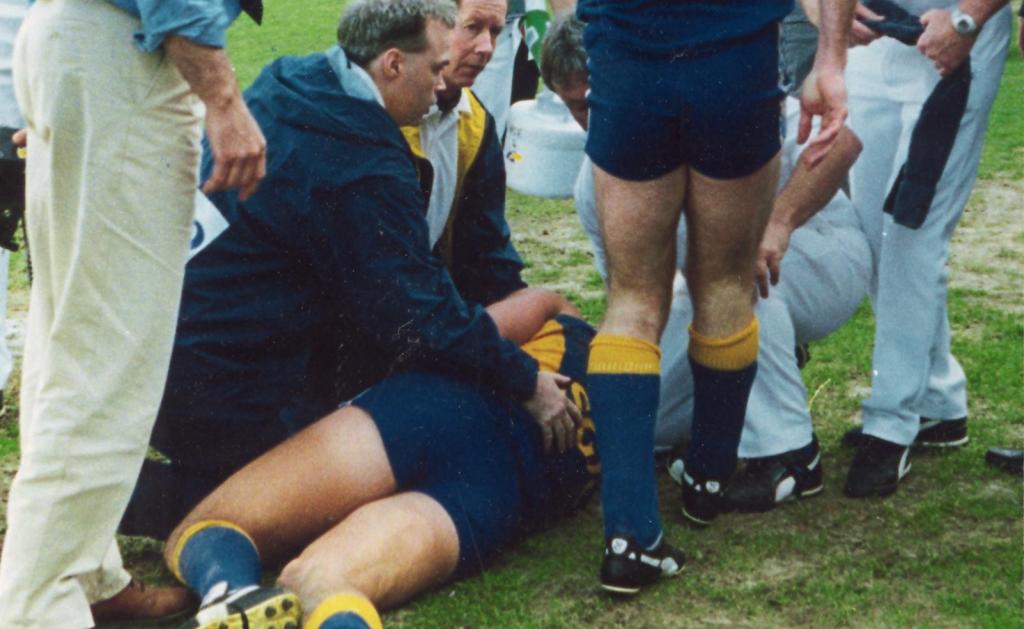
Peter Sumich is attended too after being choked into unconsciousness by Danny Southern

After the game, Malthouse described the brawl as a ‘blight’ on the game. “We come here to play football.”

“We can accept solid bumps and we can accept that footy is a physical game. But there were certain elements of today’s game that have surprised and disappointed us.”

No match-day reports were laid by umpires, with the clubs then the centre of an AFL investigation, led by Max Crawford. After Crawford spoke individually with both clubs, he found that no players should be charged, with AFL general manager Ian Collins supporting the findings and declaring both clubs would be fined $20,000.

However, Eagles officials were left stunned 24 hours later when the AFL overruled both Crawford and Collins to charge five West Coast players for their part in the melee. Glen Jakovich, Jason Ball, Tony Evans, Chris Lewis and Peter Sumich were all summoned to face the AFL judiciary five days after the game took place.

Jakovich copped two charges for striking Richard Osborne and Danny Southern, as did Ball who had two striking charges on Ilija Grgic and Chris Grant. Sumich was also charged for striking Grgic, while Chris Lewis and Tony Evans each received one charge for striking Doug Hawkins, who suffered a torn abdominal muscle during the fracas.

The Bulldogs weren’t spared with three players also called up to face the tribunal. Chris Grant was cited for striking Jakovich and Darcy  MacPherson was cited for striking Lewis, while Danny Southern faced the more serious charge of conduct unbecoming for his headlock on Sumich.

West Coast general manager Brian Cook expressed the thoughts of both clubs, whose finals preparations were now under serious threat. “We are extremely disappointed and somewhat shocked. This has thrown our finals preparations into turmoil.”

The Bulldogs dropped to fifth at the completion of the home and away season, falling behind North Melbourne and Geelong who both recorded large wins in round 24. North Melbourne moved back to third when they comfortably accounted for the Magpies in the opening game of the round. The Kangaroos controlled the game from the outset, with eight goals to John Longmire delivering a 64 point win.

That left the Magpies nervously waiting on other results to stay in the finals hunt, but their place in the top eight was confirmed the following day when Richmond were trounced by Geelong. Despite being without Gary Ablett, the Cats were never troubled, running out 76 point winners as Bill Brownless replicated Longmire’s haul of eight goals.

Having suffered horrid defeats of 113 points to the Blues and 76 points to the Cats in the final two rounds of the season, it would be Richmond who were relegated to ninth position after Melbourne won a high scoring clash against the Swans to move back into the top eight.

The Tigers finished on 12 wins – the same as Melbourne and Collingwood – but had lost nearly 10 percentage points in the previous fortnight to finish well behind the Demons and Magpies. Geelong, on the other hand, found themselves inside the top four for the first time since Round 10 on the back of a late season revival after coach Malcolm Blight was at risk of losing his job midway through the year.

With Melbourne and West Coast recording wins on the Sunday, the first week finals schedule had been set. The Demons rose to seventh to book a first week final against Carlton, with North Melbourne to host Hawthorn and the Cats and the Dogs to square off.

That left eighth-placed Collingwood with the unenviable task of travelling to Perth to tackle the Eagles in a virtual elimination final, although who West Coast would have available for the game still remained up in the air.

With Footscray due to play their qualifying final on the Saturday night, the Bulldogs immediately sought an injunction with the Victorian Supreme Court to delay the tribunal hearings for Grant, MacPherson and Southern until the following Monday.

With the Bulldogs successful, West Coast considered a similar tack.

Ultimately, the Eagles decided to push ahead with the hearings with the five players to face the AFL tribunal less than 48 hours before they were due to play Collingwood.

Eagles Chairman Dwane Buckland denied that West Coast had missed the boat in joining the Bulldogs in submitting a joint injunction, as a war of words broke out between the two clubs.

The Bulldogs had responded in the wake of Malthouse’s post-match comments, calling their former coach’s words as ‘untrue, outrageous and defamatory’.

Footscray coach Alan Joyce was particularly pointed towards his counterpart. “I have been coaching in the AFL for several years now and I just wish other coaches, particularly Malthouse in Perth, would have the same degree of professionalism.”

General manager Dennis Galimberti went even further, defending the actions of Danny Southern  and declaring it was the West Coast players who instigated the whole melee.

“The incident between Steve Wallis and Brett Heady was totally fair and within the rules of the game,” Galimberti said.

“As a result of the collision, several West Coast Eagles players ran a considerable distance to remonstrate with Wallis. That was the single thing that incited the events that followed.”

The Bulldogs were particularly critical of Malthouse speaking about the incident between Southern and Sumich, saying that it was inappropriate for comments to be made before the case was put to the tribunal.

Malthouse had stated that Sumich ‘was grabbed from behind by a bloke who came from their bench and was virtually strangled’

Malthouse retorted, saying he had never named Southern.

“You would have to be blind not to see the Channel 7 replay and determine the player responsible for Sumich’s condition,” Malthouse said. The Eagles coach also rejected suggestions he had confronted Southern at three quarter time. “I did not utter one word to Danny Southern. I can honestly say I did not utter one word to any Footscray player and I would never do that, never.”

Ultimately, West Coast decided to send their players to the tribunal, with the hearing taking place less than 48 hours before their finals match against Collingwood and the night after they had announced their squad for the game.

Buckland said that it was the view of the Board to have the matter dealt with before the clubs first final, to ensure that any potential penalties handed down could be served earlier in the finals campaign.

“If you are going to have a few players out, we’d prefer to have them out in a game we can afford to lose, rather than a game we can’t afford to lose.”

In the end, Buckland and the Eagles had nothing to worry about.

After a marathon four hour hearing, via video link up from Perth, all five West Coast players were cleared of any wrongdoing. The Eagles even called up Crawford as one of their own witnesses, to reiterate his view that no players should be charged over the melee.
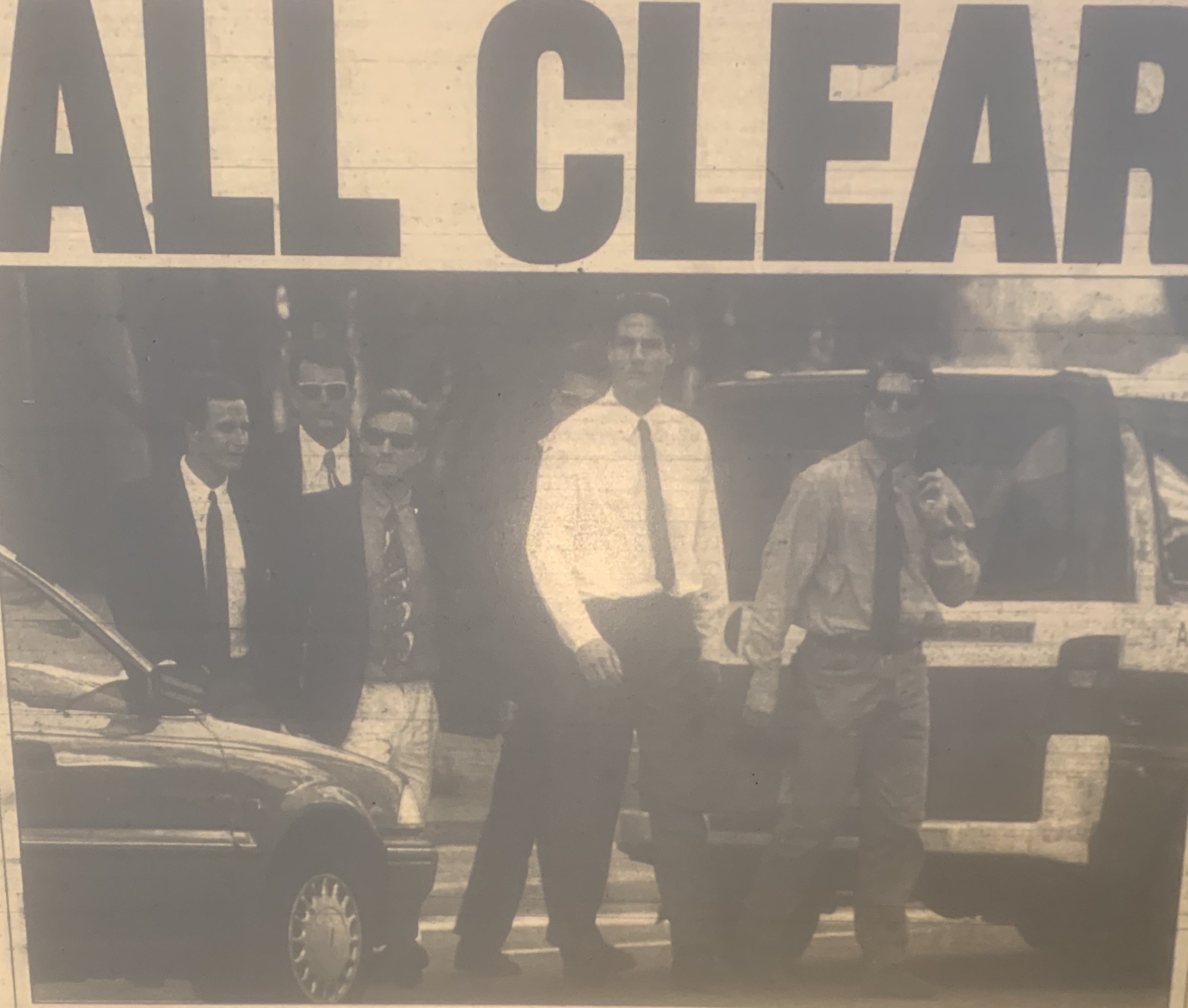
Eagles players leave the tribunal after having their charges thrown out.

The Bulldogs would subsequently front the tribunal after the weekend with Grant and MacPherson equally cleared of any wrongdoing, while Southern was hit with a $10,000 fine.

After a week of disruption, West Coast were happy to move on from the whole situation and turn their attention into their match with Collingwood.

“Where it went off the rails I don’t know. And we are not going to pursue it,” a relieved Buckland declared.

1994 Rewind: Eagles Crash To Blues

Mick Malthouse had just one thought following the Eagles 64 point drubbing to Carlton.

“The bye has come as a blessing in many respects.”

That a week off was the one positive from the top-of-the-table clash against Carlton said plenty about the performance. Jason Ball kicked the opening goal of the game, but it was all the home side from that point on, as Carlton booted 10 of the next 12 goals to storm to a 42 point half-time lead.

It fared little better through the second half as Carlton did as they pleased to move back within a game of West Coast at the top of the ladder and with a game in hand.

The result also produced a crucial 10 percent swing the between the two sides in the tight race for the minor premiership. The Eagles lost seven percent from the heavy defeat, dropping from 135.6 to 128.1, while the Blues improved from 126.4 to 129.3.

Following the defeat, Malthouse implored his players to regroup from the result ahead of their final home and away game of the season in a fortnights time, after their round 23 bye.

“No one likes to lose by 10 or 11 goals. Your confidence goes out the door.”

To compound matters, West Coast lost several key players with injury and had Craig Turley placed on report. Turley would later receive a two week ban for striking Greg Williams.

West Coast could have wrapped up top spot with a win over the Blues, but Carlton – who were desperate to atone for a shock eight point loss to Sydney the week before – were desperate to keep their shot at the minor premiership alive.

The Blues made four changes for the clash with Mil Hanna, Adrian Whitehead, Brett Ratten and young ruckman Matthew Allan all coming into the side. Forward James Cook was forced out with a heel injury, while Troy Bond, Brett Sholl and Stephen Oliver were all omitted.

The Eagles made no changes to the team that defeated North Melbourne the previous Friday night, despite injury concerns during the week over Chris Lewis and Ashley McIntosh.

West Coast lined up as expected, but David Parkin threw his side around in a bid to quell many of the Eagles playmakers. Andrew McKay was moved to half-forward in a tagging role on Guy McKenna, while the Blues also considered their match-ups for the Eagles midfield trio of Peter Matera, Dean Kemp and Chris Mainwaring.

Matthew Hogg was given the run-with role on Kemp, while offensive runners Craig Bradley and Anthony Koutofides lined up on the wing to go head-to-head with Matera and Mainwaring. Carlton coach David Parkin said the Blues had placed a focus on limiting the Eagles midfield drive.

“With both sides having such strong backlines we knew the game would be won in the midfield. We knew we had to harass players like Kemp, Matera and Mainwaring and not let them break away.”

Hogg kept Kemp to just four possessions to three quarter time, with the Eagle midfielder then moved into the forward line when he became hampered with an achilles injury. Koutofides had the better of Mainwaring, while Bradley’s run forced Matera to play defensively, depriving West Coast of attacking flair.

Bradley had 10 first-quarter possessions, and finished the term with one of the goals of the year. Taking possession on the wing, Bradley had several bounces running the outer wing, partaking in a one-two with Andrew McKay, and then curling the ball from 40m with a checkside from the boundary, just out of reach of a sprawling Jakovich on the goal line.

While the Blues perfected their plans for the Eagles midfielders, there was nothing West Coast could do to stop Greg Williams. The Carlton centreman was central to everything early and by quarter time he had made his mark on the game.

Williams had 13 possessions by quarter time and had directly created three of the Blues six first quarter goals. Craig Turley was given the initial assignment on Williams, but was on the bench midway through the term after going into the umpire’s book for striking. Don Pyke and Drew Banfield both spent time during the day on Williams but he proved unstoppable.

Craig Turley copped a two week suspension for striking Greg Williams.

Four goals down at the first break, Malthouse swung the changes in an attempt to get his side back into the game. Jason Ball was sent to full back to mind Stephen Kernahan, who had booted two goals in the first term on Glen Jakovich.

Jakovich was moved to his customary position at centre half back on Earl Spalding, with Michael Brennan coming off the bench in place of Mitchell White. Brett Heady – a surprise starter on the interchange – was also introduced into the game, but the moves did little to stop the Blues as Carlton’s midfield continued to control proceedings.

The Blues booted the first four goals of the quarter to race to a 49 point lead and all but end the contest, with a late Ryan Turnbull long bomb just before half-time breaking the drought for West Coast.

In the second half, West Coast were forced into preservation mode as they regularly lost players to injury. John Worsfold had a recurrence of a groin problem and was joined on the bench soon after by Jakovich who suffered a knee injury from landing awkwardly in a marking contest.

Ryan Turnbull then became the third player consigned to the bench with his own knee concerns, with Pyke (wrist) and Kemp (achilles) stuck on the ground to battle through their ailments. For Malthouse, the game had left plenty to ponder.

Instead of going into the bye in a position of strength, the Eagles now had a fortnight to patch players up before their final game against Footscray and then a finals campaign.

“We are under a lot of pressure because we have a lot of players who have received injuries. [The bye] gives us the chance to get a couple of blokes up. But I don’t know whether we are going to get them all up. That’s the trouble.”

Carlton’s win saw them move up to equal flag favouritism, along with West Coast, as doubts grew over the Eagles late-season form. The defeat was their third in six games and with fresh injury concerns, questions started to grow over the Eagles premiership contention. The shift in percentage meant that the Blues could now take top spot with a win over Richmond the following week, while West Coast had the week off.

David Parkin praised the response of his players, describing the win as one of the best of his career, while also acknowledging the unpredictability of the season.

“I guess to be beaten by the bottom side at its lowest ebb and then to come out and beat the top side, which is in pretty good form, is one of the things that makes Australian football so exciting.”

Greg Williams continued on from his blistering start, doubling his opening quarter tally by half-time and eventually finishing with 45 touches. The Carlton centreman tallied 17 kicks and 28 handballs and was central in many of Carlton’s forward entries.

Williams was the clear best on ground, but there were no shortage of best players amongst his teammates. Craig Bradley finished with 29 touches and two goals and was far too good for Matera, Barry Mitchell had 27 possessions and also booted two goals in his 200th game, while Brett Ratten finished with 26 touches. Up forward, Stephen Kernahan completed the work of the midfielders with six goals and half-forward Tom Alvin chipped in with three.

For West Coast, it was hard to find a winner on the ground. Jason Ball toiled hard in defence against Kernahan and Tony Evans and Don Pyke each finished with 20 disposals, but too many Eagles had no impact on the game.

While West Coast and Carlton’s battle for top spot was set to go the whole way, the rest of the top eight was also still up for grabs with just one win separating third from ninth.

North Melbourne’s third straight loss – a 20 point defeat to Melbourne – saw them drop from third to sixth as Footscray, Collingwood and Richmond moved past them. The Bulldogs climbed to third when they saw off a late Brisbane challenge to beat the Bears by 10 points, the Magpies squeaked past Geelong by three points courtesy of a late Nathan Buckley winner and Richmond easily accounted for Fitzroy by ten goals.

Melbourne’s win over the Kangaroos saw them jump back into the top eight ahead of Geelong who fell from fifth to eighth, and Hawthorn who tumbled out of the top eight after they lost to Essendon by 52 points in a disappointing display.

1994 Rewind: Eagles Secure Top Two

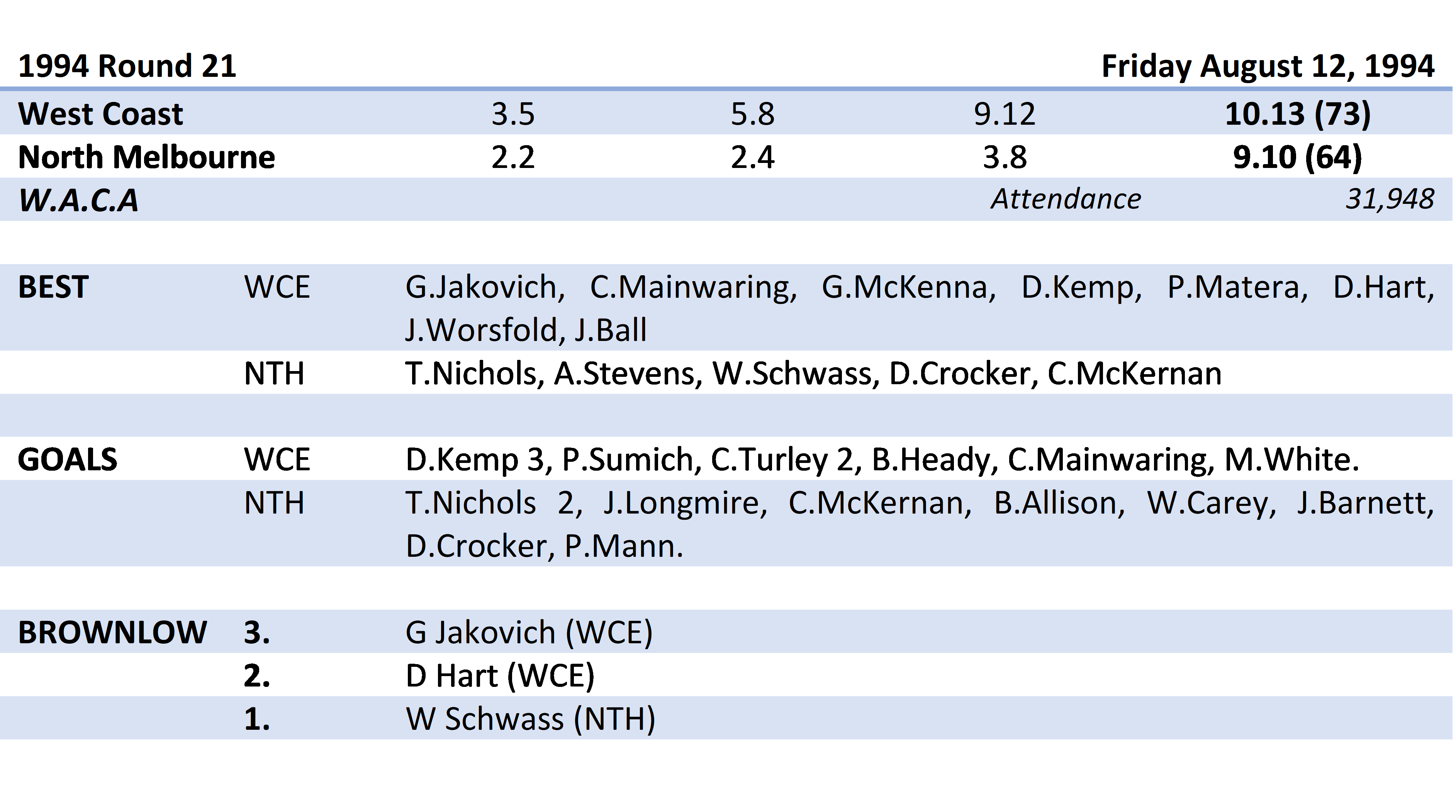
West Coast ensured they would finish in the top two at the close of the home and away season when they held off a rampaging North Melbourne at the WACA, in the opening game of Round 21.

The Eagles put in one of their best defensive efforts of the year when they held the free-flowing Kangaroos to just three goals to three quarter time to lead by 40 points.

But the Kangaroos rallied, kicking the last five goals of the game to have the home side and the home fans nervous, with only some desperate defence in the final minutes putting a halt to a famous comeback.

The win meant that the Eagles sat four games clear of North Melbourne with three matches remaining to confirm a top two finish. However, West Coast were yet to receive confirmation from the AFL that a top two finish would equate to two home finals under the new top eight finals format.

Subiaco Oval was due to start comprehensive construction of the new Southern Stand immediately following the Eagles final round game against Footscray and the WACA had yet to be accepted as an alternative venue due to its smaller capacity.

The AFL were also locked into an agreement with the MCC that stipulated a final at the MCG every week, and while the remaining seven positions on the ladder were filled with Victorian sides, the AFL refused to confirm West Coast would receive a second home final beyond the opening week.

The situation mirrored the scenario that West Coast faced in 1991 when they were forced to travel for a semi-final against Melbourne and a preliminary final against Geelong, despite finishing top.

While that was still to play out between West Coast and the AFL, on the field two of the premiership fancies showed their best and their worst in front of an electric crowd of just under 32,000 people. 

Both teams named strong line-ups with the Eagles bringing back three premiership players in captain John Worsfold and half-forwards Tony Evans and Brett Heady. Guy McKenna was able to take his place despite still nursing a broken nose from a Darren Jarman hit the week before, as did Ryan Turnbull who was limited during the week at training with a left wrist complaint.

The Kangaroos made just the one change to the team that narrowly lost to Geelong the week before, with midfielder Alastair Clarkson making way for utility Peter Mann. North Melbourne coach Denis Pagan admitted that the selection of Mann was in response to the 37 point defeat to West Coast earlier in the season, when the Eagles exposed the Kangaroos for lack of height.

Another inclusion to the Kangaroos side from the one that lost in round 6 was Corey McKernan who had been a revelation in his first season. The rookie ruckman/forward had added another dimension to the Kangaroos in 1994 and lined up in the forward half along with Wayne Carey and John Longmire in a three-pronged attack.

Jason Ball was given the task in defence of minding McKernan, with Michael Brennan taking Longmire and Glen Jakovich matching up with Carey in the next instalment of their individual rivalry.

Jakovich would emerge the winner out of their battle with a best on ground display. The Eagles centre half back finished with 29 disposals and seven marks as he often stood in the way of many North Melbourne forward entries.

He was well supported by Guy McKenna (19 disposals) and John Worsfold (20 disposals) as North Melbourne allowed the Eagles half-back line to dictate play.

The Kangaroos used Alex Ishchenko as a spare man in defence, replicating a tactic that had worked successfully against Gary Ablett the week before. With Ishchenko heading into the back 50 after contesting the centre bounce, the Kangaroo half-forwards pushed up the ground to neutralise the Eagle midfield.

That meant McKenna and Worsfold were often allowed to set up without an opponent, feeding off the loose balls created from spilled balls in the North Melbourne forward 50.

The Eagles also had plenty of winners through the middle of the ground as Dean Kemp, Peter Matera and Chris Mainwaring dominated the North Melbourne centreline. Kemp dismissed the tagging effort of Anthony Stevens to pick up 12 first-half possessions and also booted the only two goals of the second quarter as West Coast worked their way to a 22 point half-time lead.

While Kemp was less influential after half-time, Mainwaring got the better of Wayne Schwass with 18 second-half disposals to finish with a match haul of 25 (along with eight marks). Peter Matera tallied 23 disposals on the other wing and Don Pyke was just as effective with 22 touches.

After controlling the first half, the Eagles were dominant in the third term, but it took until late in the quarter when consecutive goals to Craig Turley – who started the game on the bench – gave the Eagles what appeared to be an unassailable lead.

At three-quarter time, Pagan reverted back to a more typical structure holding his half-forwards deeper and the Kangaroos got the rewards on the scoreboard. They opened the scoring in the first minute before Peter Sumich responded shortly after with his second major of the evening to restore the Eagles’ 40 point lead.

That would be the last significant score for West Coast in the game as North Melbourne flew home in a rush. The Kangaroos kicked the final five goals of the game and had their chances in the dying minutes. With the margin just nine points and still three minutes remaining, the Kangaroos butchered several forward 50 entries.

Jakovich twice was able to intercept North Melbourne, including one John Blakey kick when he had Carey 15m free in space. Jakovich had 12 disposals and took four marks in the final term alone as the Eagles defence stood tall in the face of repeat Kangaroo entries.

After the match, the mood of the two coaches could not have been further apart.

Denis Pagan was seething of his side’s performance, with many of his prime movers leaving their imprint on the game until it was too late. Corey McKernan, Wayne Schwass and Darren Crocker all lifted in the final term as North Melbourne rallied, but it mattered little to Pagan.

“We were pretty disappointing for three quarters, and to come back hard in the last quarter proved that there is nothing conclusive about West Coast and North Melbourne.”

On the flipside, Mick Malthouse wasn’t bothered by his team’s last quarter, instead choosing to focus on the earlier effort that won the game.

“I thought the workload of the boys was outstanding for three quarters and there probably wasn’t any reward on the scoreboard.”

“North got their momentum up and they were very hard to stop… we got a couple of running injuries and that put a bit of pressure on us,” Malthouse explained. “We had to leave a couple of players out there when we wouldn’t have normally.”

In the post-script, both sides had setbacks to counter.

The Eagles finished the game without a fit player on the bench after John Worsfold and Tony Evans re-aggravated injuries in their first games back, while Chris Lewis had fresh worries over a thigh.

North Melbourne lost Anthony Rock during the game with a serious ankle injury, that was likely to see the midfielder miss the remainder of the regular season, but their concerns lay more critically with the tribunal.

The Kangaroos had three players reported on the night, with Brett Allison and Corey McKernan both reported for tripping Jason Ball on separate occasions, while Glenn Archer went into the book for disputing an umpires decision. Archer and Allison would escape suspension, but McKernan would not be so lucky, copping a one week ban. Cruelly, the guilty finding would leave McKernan ineligible for the Rising Star award, which he had been favourite to win.

If the nine-point win on a Friday night was a positive way to start the weekend, it only got better for the Eagles when Carlton – who were vying with West Coast for top spot – were humbled by last-placed Sydney at the SCG.

In a result that David Parkin declared would ‘have severe ramifications for the club’, the Swans recorded a famous eight-point win in a low-scoring clash, despite four goals to Carlton captain Stephen Kernahan. The Blues entered the game as $1.05 favourites, but the upset defeat left Carlton two games behind West Coast in second place ahead of their meeting the following week.

An inaccurate Richmond dropped their match against Hawthorn, while a goalless last quarter saw Melbourne fall to the Magpies. The losses to the Tigers and the Demons, on top of defeats to the Blues and Kangaroos meant that the teams placed second through to fifth coming into round 21 all lost, as the race for the top four got tighter.

The six teams behind West Coast and Carlton all had 11 wins for the season, with percentage determining the order.

North Melbourne remained third courtesy of their superior percentage with the Bulldogs moving into the top four after they easily accounted for St Kilda. The Saints got the early jump, but Footscray took control after quarter time, booting 15 goals to 6 on their way to a 45 point victory.

Geelong moved up to fifth when they got over the Lions, although it took until the last quarter to be completely assured of the win. Hawthorn, Collingwood and Richmond rounded out the eight, with the Magpies returning to the top eight after knocking on the door for several weeks.

Richmond suddenly looked vulnerable as they dropped from fourth to eighth, with their poor percentage threatening to undo their run to the finals. Melbourne made way for the Magpies dropping to ninth, as they sat one game behind the teams above them; the loss to Collingwood proving a real eight-point result.

1994 Rewind: Hawks Humble Eagles

For the second time in season 1994, the Eagles faced a Hawthorn side who were reeling off the back of three consecutive heavy defeats.

And, for the second time in season 1994, the Eagles were well beaten. After thrashing the Eagles by 71 points in their round 5 meeting, the Hawks were able to complete the double with a 46 point triumph that re-invigorated their finals hopes and opened up the race for top spot.

Making the Hawks’ win even more impressive was that they did it without champion full forward Jason Dunstall, after he strained a calf against the Blues the week before.

Paul Hudson stepped up to the plate in Dunstall’s absence, booting five goals and having the better of a handful of Eagle opponents.

Apart from a brief period in the second quarter when they had the advantage of the breeze, the Eagles never looked like threatening the Hawks, in a performance that coach Michael Malthouse labelled ‘absolutely dreadful’.

With Carlton having the bye, the Eagles remained one game clear of the Blues, despite the loss, but their hold of top spot was starting to look shaky. The two teams were set to do battle in a fortnight’s time, with West Coast also due to face top eight sides North Melbourne and Footscray in the final rounds of the regular season.

There was little change in the top eight, with most results going as expected. The one surprise was the Cats thrilling one-point win over North Melbourne, where Gary Ablett notched his 100th goal for the season. However, despite the win, the Cats actually dropped from sixth to eighth. The Hawks stayed seventh with their win over West Coast, while the Bulldogs swapped positions with Geelong after thumped a dispirited Adelaide by 84 points at Western Oval. The defeat all but ended the Crows’ slim finals hopes, with the future of inaugural coach Graham Cornes in question.

Richmond accounted for the Saints to remain in fourth spot, but joined the Kangaroos on eleven wins, while Melbourne scored a vital win over Brisbane at the GABBA to stay fifth. The Demons led a pack of five teams, all on 10 wins, with Collingwood sitting ninth after they defeated the Bombers. Essendon and Brisbane sat one game out of the top eight, but both teams had yet to have to their second bye, meaning they were essentially two games out of finals contention.

Dunstall was one of four changes for the Hawks, with Paul Barnard, Scott Crow and Tim Hargreaves all dropped following the 32 point loss to Carlton. Anthony Condon, Greg Madigan, Alex McDonald and Jason Taylor all came into the side, with Taylor named at centre half forward and Paul Dear starting in the goal square.

Alex McDonald also started forward with Peter Knights throwing his side around in a bid to arrest the three game losing streak. Greg Madigan and Andrew Gowers both spent time through the centre, while Shayne Stevenson often pushed up the ground from half-forward to create an additional number around the ball. Young defender Mark Graham was put to full back to mind Peter Sumich with Chris Langford shifted to centre half back.

West Coast made two changes with Chris Mainwaring and John Worsfold both named at selection but each needing to pass a fitness test before taking their place. Mainwaring made it through, but Worsfold was ruled out for the fifth game in the past eight weeks. His place was taken by veteran Dwayne Lamb. Brendan Krummel and Damien Hampson were both omitted.

After losing his place at West Coast, Krummel’s week got worse when he was suspended by the WAFL tribunal following an investigation into the Fremantle derby a fortnight earlier. Krummel was found guilty of rough conduct when he elbowed South Fremantle youngster Owen Woods while attempting to shepherd, which left Woods with a fractured cheekbone. Krummel was rubbed out for a week.

The writing was on the wall early for West Coast when Michael Brennan dropped a simple chest mark just three minutes into the game, allowing Paul Hudson to swoop on the loose ball and snap through the opening goal. With the aid of the wind, Hawthorn raced to a 28 point quarter time lead, with six goals to one.

Having lost Worsfold before the game, the Eagles half-back line took another hit when Guy McKenna created history to became the first player sent off by the umpires under the AFL’s newly implemented blood rule in the first quarter.

McKenna was on the end of a heavy bump from Darren Jarman that left the defender with a bloodied nose. McKenna returned in the second term, only to be sent off again when the patchwork didn’t hold and his jumper got stained. McKenna wouldn’t appear after half-time due to blurred vision.

The Eagles got the game on their terms in the second quarter, reducing the Hawks lead to 15 at the major break. Peter Wilson led the way for the visitors with 11 possessions in the quarter, but the Hawks wrapped up the contest on the back of a Darren Jarman masterclass.  

The Hawks more than doubled their half-time score in the third term, with Jarman having a hand in nearly all of Hawthorn’s seven goals for the quarter. Drew Banfield, Matt Clape and Peter Wilson were all given the task of stopping Jarman, but there was little any of the Eagles players could do.

Paul Hudson booted three of the Hawks’ seven goals and, likewise, created headaches for the Eagles coaching box who were unable to find a player to curb his influence. Chris Langford proved a wall for Hawthorn across half-back, picking up 21 dipsosals and six marks as he completely shut out Ashley McIntosh.

Shane Crawford picked up 26 disposals in a run with role on Peter Matera on the wing, holding the Eagle to just 11 possessions, while Rayden Tallis blanketed Dean Kemp in the middle. On a day of few winners for West Coast, Peter Wilson and Chris Mainwaring each finished with 20 disposals and a goal.

The Eagles sluggishness could have been attributed to consecutive trips to Melbourne, with the Hawthorn clash six days after taking on Fitzroy at the sodden Western Oval. However, Eagles coach Michael Malthouse refused to use the fixture as an excuse.

Instead, the Eagles coach was left to ponder whether the Hawks now had the psychological edge should the two teams meet in the finals. “They have the edge at the moment. Next week is a different week, but they slaughtered us.”

1994 Rewind: Eagles Class Shines In Wet

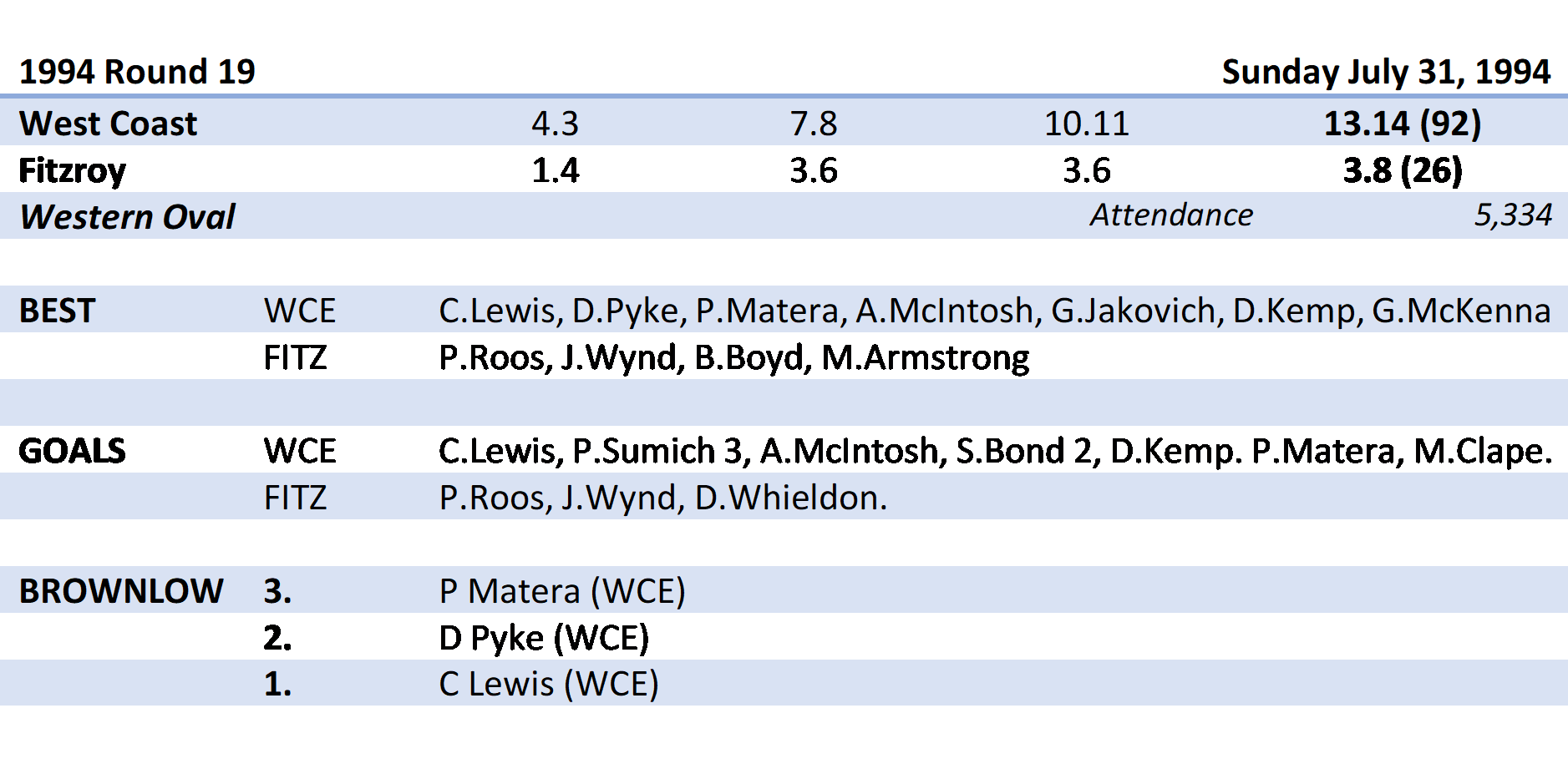
West Coast swept aside the Fitzroy Lions with an easy 66 point win at the Western Oval. Fitzroy were held to just two behinds after half-time, unable to break through the Eagles hardened defence in wet and heavy conditions.

On a cold, wintry afternoon where a crowd of just 5,334 braved the conditions, Chris Lewis provided the shine with 16 disposals and three first half goals, as well as having a hand in several others. Peter Sumich also finished with three goals as he continued to build his match fitness from consecutive hamstring injuries.

The Eagles strong performance came despite missing several key players. Brett Heady was never a chance of lining up after dislocating his shoulder the week before against Richmond, while Chris Mainwaring (hamstring) and Chris Waterman (foot) were ruled out during the week.

John Worsfold was given an extra week to recover from his groin problem, as was Tony Evans who had a back complaint. The Eagles consequently made four changes at the selection table, with Michael Brennan returning from injury, and fringe players Matt Clape, Brendan Krummel and Paul Symmons all earning call-ups.

Damien Hampson was initially dropped, alongside injured trio Heady, Mainwaring and Waterman, but earned a reprieve ahead of the opening bounce when David Hynes pulled out.

Krummel’s selection marked his first Eagles appearance in over a year, but it didn’t come without controversy. After being named in the Eagles squad on Thursday night, Krummel became the centre of an investigation over an incident from the previous weeks WAFL derby between East Fremantle and South Fremantle.

Young Bulldog Owen Woods was collected behind the play, suffering a broken jaw in several places, and South Fremantle officials pointed the finger at Krummel. The Bulldogs lodged an official complaint with the WAFL and demanded that Krummel be charged, with Woods expected to miss the remainder of the season after undergoing surgery.

However, the WAFL tribunal were unable to determine whether there would be a case to answer, leaving Krummel free to play with West Coast. Krummel, for his part, said that he knew nothing of the incident.

The Lions dropped four players in response to their narrow loss to Brisbane the week before, with Tom Kavanagh, Danny Morton, James Manson and Nick Mitchell all losing their place. Rick Lyon, Brett Cook, Trent Cummings and Mark Zanotti were the four inclusions, but Zanotti and Cummings then became late withdrawals ahead of the match. Their spots were in turn taken by David Bain and Marcus Seecamp.

Brendan Krummel returned to the Eagles line-up for the first time in over a year

Despite the wet conditions, Malthouse started three talls in the Eagles forward line, as he looked to expose the depleted Fitzroy defence. Ashley McIntosh and Jason Ball took their spots across half forward, with Peter Sumich taking his regular spot in the goal square.

Fitzroy had first use of the wind, but the Eagles got first blood when Lewis soccered home from the goal square. The Lions held on for much of the quarter, but a three goal burst in time-on put West Coast out to a 17 point lead at the first change and there was never any coming back for the Lions from there.

The Eagles would extend their lead to 26 by the major break, then leading by 47 at three quarter time and finally running out 66 point winners as Fitzroy failed to register a second-half major. In fact, the Lions remained scoreless after half-time until the dying minutes of the last term when they kicked consecutive behinds.

When the game was there to be won, Lewis was a cut above most others on the field, proving a constant danger and giving Fitzroy defender Steven Stretch the run-around. Peter Matera added the flashes of brilliance, getting the better of Michael Dunstan on the wing, while down back the Eagles defence proved impenetrable.

Michael Brennan held Darren Wheildon to just one goal, while Guy McKenna, Glen Jakovich and Mitchell White all shut out their opponents in a complete display.

The win further enhanced this Eagles group with the club not always renowned for their performances in the wet. However, the win over Fitzroy was the fourth win in wet weather after victories over St Kilda, Essendon and Richmond in recent weeks, all of which were played in the rain.

The performance impressed Fitzroy coach Robert Shaw, declaring West Coast as ‘the best team I have seen in those conditions’.

Eagles coach Mick Malthouse acknowledged that the conditions suited the more developed Eagles against a young Fitzroy outfit. “Jarrod Molloy is a good marking player so the conditions didn’t suit him. Chris Johnson has great pace but is still finding his way.”

“We had a lot of experienced players in the midfield.”

Shaw though was far more circumspect over the difference between the two sides. “They played the percentages and followed the basic principles a lot better than us.”

“And they did it for longer and more often.”

While Lewis and Matera were the polish up forward and around the wings, Dean Kemp and Don Pyke provided the grunt through the midfield. Kemp finished with 28 disposals and a goal while Pyke had 30 through the centre. Ashley McIntosh had 18 disposals, four marks and booted 2.2 across half forward, while Glen Jakovich collected 20 touches across half back.

Paul Roos was clearly the best player for Fitzroy, gathering 31 disposals and booting a goal in an intriguing battle with Craig Turley through the middle. Jim Wynd also found plenty of the ball, finishing with 29 disposals and joined Roos as one of the Lions’ three goal kickers.

The win saw West Coast hold their one game advantage over the Blues, who defeated an inaccurate Hawthorn by 32 points at Princes Park. The Blues, in turn, held their position in second ahead of North Melbourne, with the Kangaroos coming from behind to defeat Footscray by 20 points in a Friday night classic.

Richmond became the benefactors of the losses suffered by the Hawks and the Bulldogs, climbing into the top four after their straight forward win over Sydney. Melbourne were the other big movers, storming into the top eight  for the first time since Round 13. The Demons thumped a faltering Essendon by 77 points, lifting them from ninth to fifth on the ladder as they passed a number of clubs – including the Bombers – with a superior percentage.

Melbourne led a group of five teams who all had nine wins as the race for the bottom half of the top eight continued to tighten. The Cats rose to sixth after they thrashed Adelaide, with Hawthorn and Footscray filling out the rest of the finals positions. The Magpies slipped to ninth due to having the bye.

While West Coast were all but guaranteed finals and strengthened their position on a top two finish and two home finals, the fallout for Fitzroy was substantial.

Robert Shaw resigned as coach in the days following the Eagles defeat, although he agreed to coach out the remainder of the season as the Lions continued to be the centrepiece of merger discussions. Speculation suggested that a deal with either Brisbane or Melbourne was imminent, leading Fremantle to claim they should be given first right to Fitzroy players as part of their inaugural 1995 squad.

The comments angered president Dyson Hore-Lacy, who had already been vocal about the Dockers’ attempts to lure Paul Roos west with a ‘substantial’ offer, which included the captaincy. Hore-Lacy remained resolute about Fitzroy’s future, declaring the club wouldn’t hold back from launching legal action against any AFL club who tried to poach their players while under contract.

Hore-Lacy also scoffed at the idea the club would head interstate, saying a merger with the Bears would be ‘like taking the last chair on the Titanic.’

1994 Rewind: Eagles End Tiger Streak

West Coast bounced back from their narrow loss to Adelaide with an eight goal win over Richmond, which ended the Tigers’ six game winning streak.

Richmond arrived in Perth as one of the form teams of the competition, rising to fifth on the ladder on the back of a mid-season revival that had the Tiger faithful dreaming of a first finals appearance since 1982. But they were no match for one of the premiership favourites on their home turf.

However, it was that home turf which once again hit the headlines after Richmond coach John Northey blasted the surface for not being up to scratch. A fortnight after Mick Malthouse was critical over the poor standard of the ground, Northey labelled the surface ‘absolutely pathetic’.

“It’s no good having tremendous facilities and the ground being as poor as it is… to me this is an absolute disgrace.”

Northey’s comments were echoed by Malthouse who reiterated his thoughts after the last Eagles home game. “We’ve been a victim of our home ground in many respects. When it is like it is at the moment… we have modified our training while we wait and see how the ground comes up.”

The ongoing discussion prompted the General Manager at Subiaco Football Club Alan White to reveal they had presented an offer to the WAFC to subsidise the resurfacing costs of the ground, in exchange for an extension of their current lease at Subiaco until 2011. However, White claimed that WAFC Chief Executive Jeff Ovens rejected the offer.

The WAFC said they needed $700,000 to repair the drainage at the ground, but with West Coast not scheduled to play at the ground again until the final round, and with any home finals set to be staged at the WACA due to capacity concerns, the hope was that the ground would recover on its own.

While the deterioration of the ground and who was responsible continued to be debated, what couldn’t be questioned was the gap between the two sides. West Coast controlled the contest from midway through the first quarter and only poor kicking on goal prevented the final margin from being far greater.

The Eagles made four changes to the team that lost to Adelaide, with three players forced out with injury. Michael Brennan damaged a hamstring, John Worsfold was ruled out with a groin and then Tony Evans was pulled on the morning of the game with a back concern. Brett Spinks was dropped after a poor showing against the Crows.

Shane Bond and David Hynes returned from injury, while Mitchell White was selected for his first senior game of the year, after recurring groin problems had kept the premiership forward sidelined since pre-season. Damien Hampson was then selected for his first game in over a year when he came in as the late replacement for Evans.

The Tigers has their own injury concerns entering the game losing Mark Neeld (knee) and Stuart Edwrds (groin) at selection. Paul Bulless and Tony Free were the two inclusions.

After being humbled by Shaun Rehn the week before, Eagles duo Ryan Turnbull and Jason Ball responded in fine fashion. Turnbull was dominant in the ruck against Tiger counterpart Greg Dear, so much so, that David Hynes rarely got off the bench as Turnbull provided the Eagles midfield with first use from the ruck knock.

Turnbull had 23 hit-outs to go with 14 disposals and four marks as he showed his versatility around the ground. After spending parts of the year either in the ruck and in defence, Ball played primarily out of his favoured position at centre-half-forward in the absence of Brett Spinks. Ball produced the best performance of his 10-game career with 23 disposals and ten marks.

Ball’s showing at half-forward also created plenty of opportunities for full-forward Peter Sumich, who had his best return for the year. Sumich finished with 6.5 from 11 kicks and six marks and most pleasingly showed no concerns with his questionable hamstring opposed to Tiger full-back Scott Turner.

The Tigers had the better start with Matthew Richardson proving too much for Ashley McIntosh to boot the opening two goals. Brendan Gale was similarly getting the better of Glen Jakovich picking up five marks in the first 14 minutes of the game.

However, with Turnbull getting the ascendancy at the stoppages, the Eagles soon had the momentum of the game through the likes of Craig Turley, Dean Kemp and Peter Wilson. Turley, in particular, started strongly in his customary ruck-rover position, getting the better of Paul Broderick with seven first-quarter possessions.

Sumich and Peter Wilson got West Coast on the board but wayward kicking allowed Richmond to hold a one point lead at the first change. Shane Bond and Sumich kicked early goals to put West Coast in front, but held only an 11 point lead at the main break following further inaccuracy in front of goal.

After half-time, the Eagles got reward for their dominance with a nine goal to three second half bringing about a 48 point win.

Eagles coach Mick Malthouse was happy enough with the win, although admitted that he felt his side should have been better in front of goal considering their statistical advantage. “By our tally we had 70 or 80 more kicks and 60 more handpasses. I think we really should have done better than win by seven or eight goals.”

The Eagles had 78 more kicks and 26 more handpasses, resulting in 13 more scoring shots.

Chris Mainwaring finished with 31 disposals to lead the Eagles, with Dean Kemp (29), Craig Turley (23) and Peter Wilson (18) all prominent. Stand-in captain Guy McKenna marshalled the Eagles defence with David Hart restricting Nick Daffy to just eight disposals.

Brendan Gale was the Tigers’ best player, clearly getting the better of Glen Jakovich at centre half forward, but the dominance of Turnbull forced Richmond to move Gale into the ruck, depriving them of a key target ahead of the ball. Matthew Richardson booted four goals from limited chances and Duncan Kellaway was defiant in defence, having the better of Brett Heady and then Chris Lewis.

Heady would be the one low point out of the match for West Coast, dislocating a shoulder during the third term.

The win meant West Coast moved back to one game clear at the top of the ladder after Carlton fell to Geelong by 36 points at Waverley Park. The Cats charged to a five goal lead at the first change and held sway for the remainder of the afternoon to record their eighth win of the season and stay in touch with the top eight.

North Melbourne took a hold of third place when they ran away from the fourth-placed Hawks. The Kangaroos led by just four points at three-quarter time after a tight struggle, but six goals to just one point in the last term saw North Melbourne record a comfortable 40 point win. Despite the loss, Hawthorn stayed in fourth spot but they were joined on points by Footscray who were the big movers of the weekend.

The Bulldogs were too good for the Mapgies, recording their fifth win in six games to rise from eighth on the ladder to fifth bypassing the Magpies, Tigers and Bombers, who suffered a shock loss to lowly St Kilda. Tony Lockett booted six goals for the Saints who produced a remarkable display of accuracy to finish with 18.2 in a ten point win.

The other surprising result of the weekend was Adelaide’s defeat at home to Sydney. A week after they toppled the ladder-leading Eagles, the Crows fell to the bottom of the ladder Swans by 12 points, all but ending their finals aspirations. The loss ended a tumultuous week for the Crows who stood down high-flying full forward Tony Modra after he missed a training session during the week. The situation prompted growing rumours that Modra was set to join new club Fremantle for their inaugural season in 1995.

Despite being a game clear of Carlton and three games clear of third-placed North Melbourne, Eagles coach Mick Malthouse refused to entertain the idea that West Coast had secured a top two position which guaranteed two home finals.

“We are not even thinking about that,” a terse Malthouse declared.

1994 Rewind: Eagles Fall Short Against Crows

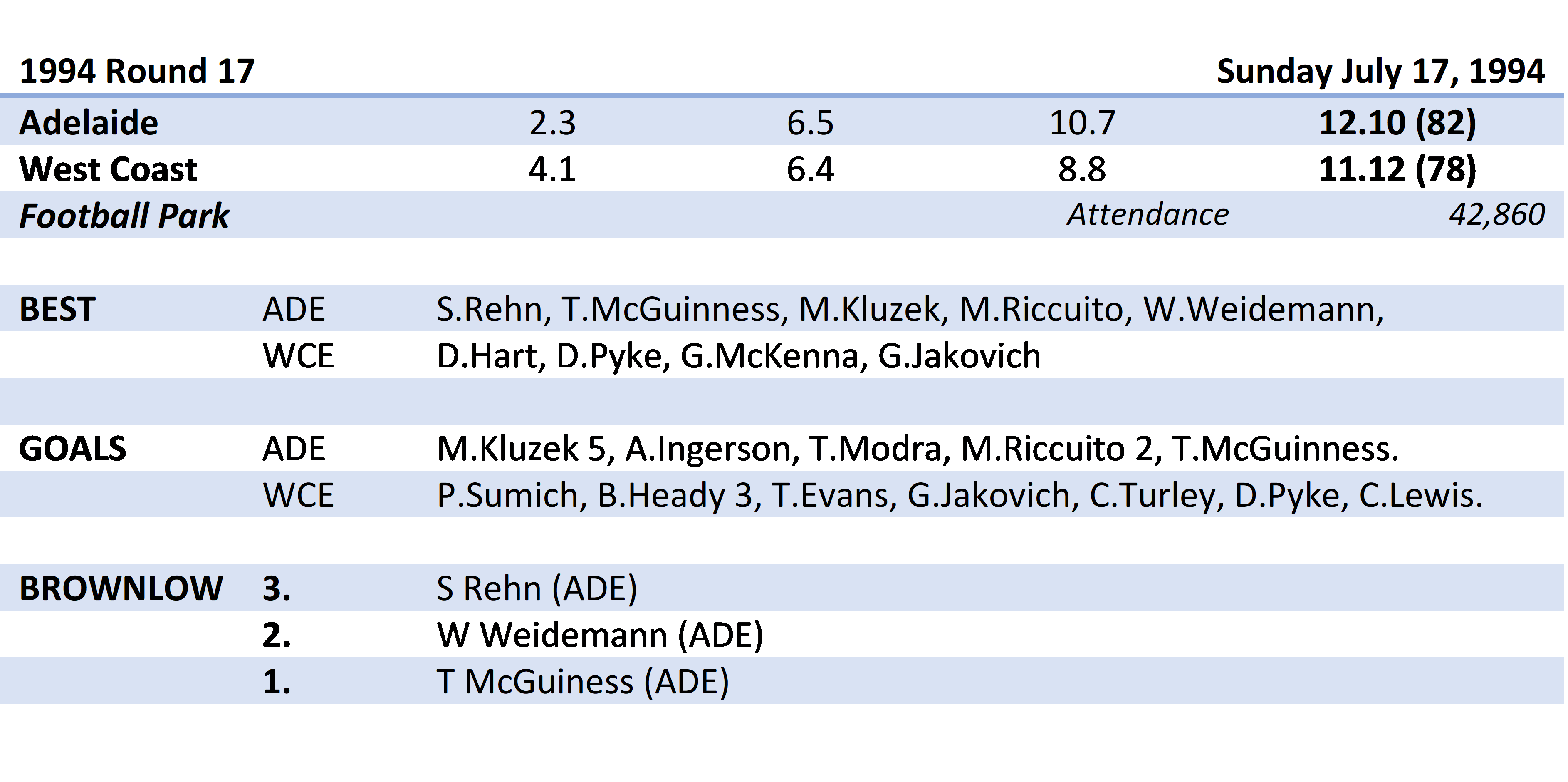
Adelaide kept their flagging finals hopes alive, while the Eagles’ grip on top spot loosened slightly, after the Crows defeated West Coast by four points at Football Park.

Peter Matera had a chance to win the game with only seconds remaining in the game, but his running shot from deep in the pocket missed narrowly, resulting in the Eagles’ fourth defeat of the season.

For the second time in five weeks, a third-gamer proved to be the Eagles undoing. Matthew Kluzek gave Chris Waterman the run-around after coming onto the ground during the second quarter when Nigel Smart limped off with a hamstring strain. The small forward booted five of the Crows 12 goals and proved a constant threat as part of a pacy Adelaide forward line.

The loss saw Carlton join West Coast at the top of the ladder after the Blues beat Collingwood in a blockbuster clash at the MCG. Carlton’s 43 point win saw them jump up to 12 wins from 16 games, level with West Coast, although the Eagles remained top on percentage. 

North Melbourne climbed back up to third when they easily accounted for St Kilda, passing the Hawks who fell to Melbourne. Like Adelaide, the Demons were able to stay in finals contention with the 38 point victory, while Footscray moved back into the top eight – at the expense of Geelong – with a 28 point win over the Cats.

Richmond climbed up to fifth on the ladder, on the back of their sixth straight win, when they defeated the Bears at the GABBA and Essendon moved to sixth on the ladder after they thrashed Fitzroy. The Magpies dropped from fourth to seventh after their loss to Carlton.

Leading into the game, the Eagles were almost unbackable favourites with the two clubs tracking different paths in 1994. While West Coast had sat at the top of the table for much of the year, the Crows had fallen well short of expectation after their preliminary final appearance in 1993.

West Coast made just one change, with Brett Spinks coming back into the line-up after being a late withdrawal the week before. Tony Godden was the player to make way. The Crows though made three changes in response to the ten goal thumping from Carlton the week before.

Andrew Jarman was ruled out with a groin injury, while Rodney Maynard and Martin McKinnon were dropped. However, McKinnon would get a reprieve before the first bounce when Simon Tregenza was ruled out with illness. Wayne Weidemann, Nick Pesch and Jonathan Ross were all brought into the Adelaide line-up.

The Eagles would have their own pre-match drama when Guy McKenna undertook a fitness test ahead of the game, after injuring an ankle at training the day before. The half-back flanker passed and was able to take his place.

The Crows got the early running with the opening two goals in the game, but things started to go awry for the home side.

Jonathan Ross dislocated a kneecap inside the first 30 seconds of the game, with West Coast taking charge of the game, mostly through the efforts of Don Pyke. The midfielder tallied 10 possessions (including a goal) and had strong support from Peter Wilson and Guy McKenna.

The Eagles finished with the final four goals of the quarter to take a 12 point lead into the first break. Tony Modra got the Crows on the board early in the second term, but Peter Sumich quickly responded. Adelaide’s injuries woes only worsened when Nigel Smart was forced out of the game, leaving the Crows with just one player left on the bench halfway through the second term.

With the Eagles holding sway, Adelaide coach Graham Cornes swung the board around and the momentum of the game changed. Chris McDermott was moved to the uncustomary role of half-back while Mark Bickley was moved into the middle onto Pyke.

Tony McGuinness broke free of the tag from Drew Banfield to provide some drive out of the middle, while Kluzek similarly got free to boot two second quarter goals. Adelaide stole a one point lead at the main break and then continued on in the third term on the back of Shaun Rehn’s dominance in the ruck.

Rehn completely outpointed Ryan Turnbull and Jason Ball in the ruck and around the ground as the Eagles struggled to win the ball at the stoppages. With Dean Kemp well held by Wayne Weidemann and Pyke and Mainwaring both having little impact after strong starts, the Eagles forward line were getting no supply.

Matt Kluzek booted a further two goals for the term as Adelaide kicked four goals to two to stretch out their lead to 11 points.

With much of his side ineffective, it was Mick Malthouse’s turn to throw the magnets around. Glen Jakovich went forward, with Ashley McIntosh moved onto Modra after Michael Brennan went off injured. Guy McKenna went to a half forward flank and Peter Matera went into the centre with Malthouse sending Kemp to McGuinness in an attempt to break the Weidemann tag.

When Kluzek slotted his fifth goal at the five minute mark of the final term, Adelaide led by four goals and the game seemed done.

The Eagles, though, roared back into the contest after Jakovich kicked a long bomb. Brett Heady and Tony Evans followed with goals and the Eagles had dragged themselves back within a goal of the home side.

But as West Coast sought a winner, they could find only behinds. Guy McKenna, David Hart and Peter Sumich all missed shots on goal, before Matera’s final chance seconds before the final siren sounded for an Adelaide win.

A relieved Cornes hailed his side’s victory in the face of a growing injury list. Cornes had been under immense pressure in recent weeks, with speculation he was likely to be out of a job if Adelaide failed to make finals, but for the moment the Crows coach was happy to just to get some self-belief back at the club.

“Coaching the Crows is like riding a roller coaster when we win the crowd go overboard and when we lose they can be very unforgiving. The emotional highs and lows are unbelievable,” Cornes said.

The Crows had been well served by veterans Chris McDermott and Tony McGuinness who finished with 33 and 32 disposals respectively, while younger midfidlers Mark Bickley and Mark Riccuito were also influential.

Riccuito chimed in with two goals, along with Modra and Anthony Ingerson as multiple goalscorers behind Kluzek. Shaun Rehn was a clear best on ground with 21 disposals, 10 marks and 31 hit-outs.

David Hart finished as the leading ballwinner for West Coast with 25, while Pyke, Mainwaring and Wilson all tallied 21. Peter Sumich and Brett Heady each booted three goals, but West Coast lacked any genuine winners up forward.

A circumspect Malthouse admitted that it would have been the ‘steal of the season’ if West Coast had gotten over the line, in what was his 250th game as coach across both Footscray and the Eagles.

“We were out-muscled, out-played and beaten badly by a very talented football side. To be undermanned and then lose a couple of players and still win… they’re going to be a real threat.”

“They were terrific, they were far too good for us,” Malthouse declared.

Reflecting on his milestone, Malthouse acknowledged the journey his coaching career had taken.

“… I suppose reaching 250 (games) makes you think you’ve been around a fair while. There have been ups and downs and probably more downs than ups, but it has been great to be involved.”

1994 Rewind: Scarves & Swamps

West Coast retained their premiership favouritism and Eagles fans got to exact their revenge but the biggest talking point after West Coast’s 36 point win over Essendon was the dilapidated surface of Subiaco Oval.

With Perth in the midst of an uncharacteristic wet spell, Subiaco Oval resembled more of a muddy swamp than its customary fast-track, drawing the ire of Eagles coach Mick Malthouse.

The Eagles coach seemed more interested in savaging the state of the surface than discussing his side’s committed win over the reigning premiers. With one side of the stadium torn down ahead of the building of the new southern stand, Malthouse was sceptical over whether there had been appropriate care towards maintenance of the playing arena, with drainage around the ground, virtually non-existent.

Malthouse extended his criticism towards the WAFC in the hope that improvements would be made before the end of the season.

And when the Eagles coach did talk about his side’s performance, he remained stoically understated.

The game appeared done at quarter time with the Eagles jumping the Bombers booting five goals to one. Any chance of Essendon staging a comeback was extinguished at the start of the second term when driving rain descended the game into a quagmire.

By three-quarter time, West Coast had extended their lead to 45 points, before the two teams combined for 1.9 in the last quarter, with the two teams out on their legs in the heavy conditions.

The win kept West Coast at the top of the ladder a game ahead of the Blues, with Malthouse acknowledging that a win over the 1993 premiers gave a good indication of where the Eagles sat. “I believed if you want to assess yourself you have to do it against the previous year’s premiership side. Last year everyone wanted to have a crack at us to see where they sat.”

“I think after the halfway mark if you are on top, you should really aspire to stay there. It is tough enough to get there and its going to be tough to stay there”, Malthouse said.

More pleasing for Malthouse was the successful return of Peter Sumich, who made it through four quarters, despite having little impact. Sumich was held scoreless from three kicks but there was relief after the game that the full-forward had managed to get through his first full game in over three months. “Peter did everything we wanted from him today,” Malthouse said.

Sumich was one of two inclusions, with Eagles captain John Worsfold finally making it to his 150th game after missing two of the previous three games. Sumich replaced David Hynes at full forward, while Shane Bond was the other exclusion through injury. Brett Spinks became the third out for the Eagles on game day, after being under an injury cloud all week, with Tony Godden coming in for his first game since Round 10.

The Bombers dropped Glenn Kilpatrick and Robert Stevenson, while their hero from the Round 1 win over West Coast, Che Cockatoo-Collins, couldn’t be considered after he dislocated a finger. Captain Mark Thompson was then a fourth change for the Bombers, when he was withdrawn on the morning of the game through illness.

David Grenvold replaced Thompson, with Anthony Daniher, Lachlan Ross and Russell Williams the other inclusions. The Bombers had been hopeful of bringing back a number of premiership stars for the trip West, but the likes of Mark Mercuri (groin), Dean Wallis (achilles), Rick Olarenshaw (back) and David Flood (hamstring) remained sidelined.

Dustin Fletcher, Michael Long and Mark Harvey were three more premiership players missing from the Essendon line-up, a fact that Malthouse was willing to present. “Essendon had three or four key players out of the side so we don’t want to get carried away with the victory.”

The make-up of the Bombers side would not have mattered to Eagles fans, who got their right of reply to Kevin Sheedy’s antics 12 months earlier. In the corresponding game of 1993, Sheedy emerged from the coaches box waving his jacket above his head after Paul Salmon had snatched a two point win over the Eagles in the final minute of the game.

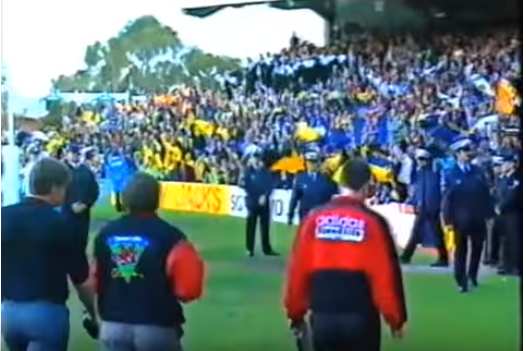
The Eagles had lost the two meetings since that game – the semi final of 1993 and then the opening round of 1994, both of which had been played in Melbourne – but as Kevin Sheedy walked the muddy boundary line towards the Bombers race, he was met with the mass celebration of scarves and jackets twirling above the heads of the jubliant Eagles crowd. The Essendon coach could do no more, than acknowledge the gesture with a wry smile and a nod of the head.

The Essendon coach is met with flying scarves after the Eagles 36 point win

If Sumich lasting 100 minutes was one feel good factor from the day, the other pleasing performance for the Eagles match committee would have been that of Craig Turley. After returning to the club following his retirement during the 1993 season, Turley’s form had been rather indifferent as he struggled to recapture the form that made him one of the premier midfielders of the preceding two seasons.

But against the Bombers, Turley bobbed up with three crucial goals from 12 disposals across half-forward as he appeared to revel in the tough, slippery conditions. Turley was also handed the task of stopping Essendon playmaker Gary O’Donnell, with the stand-in captain restricted to just 11 possessions, and a couple of stints on the bench.

The Eagles wingmen were again the standouts, with Chris Mainwaring leading the way with 27 disposals, while Peter Matera finished with 24 touches and five shots on goal, booting 2.3. Mainwaring benefitted from being matched against Darren Bewick, who had been moved to a wing to avoid the tag of David Hart. Bewick had enough of the ball (finishing with 18 possessions) but was nowhere near as damaging as the blonde Eagle, who continually linked the ball from defence to the forward line.

Glen Jakovich was again the rock in defence, picking up 22 disposals in his absorbing battles with James Hird. Hird often drifted up to the wing, but Jakovich remained in the Eagles defensive 50, often setting up as the Eagles seventh defender. Steven Alessio was sent to centre half forward to create a match-up with Jakovich, but Jason Ball was sent to defence, allowing Jakovich to pick off Essendon’s forward entries, many off Hird himself.

Ryan Turnbull also enjoyed plenty of freedom around the ground and had an important influence on the contest, particularly early in the game. With Paul Salmon often dropping a kick a behind the play after contesting the ruck, Turnbull positioned himself through the middle of the ground, drifting forward twice in the opening term to boot goals.

Peter Wilson picked up 22 disposals around the ground and Dean Kemp had 20 through the centre, although he lowered his colours slightly to Joe Misiti who finished with 25 disposals.

James Hird was the next best for Essendon, after Misiti, with 24 disposals and seven marks, while Sean Denham had 21. Gavin Wanganeed was switched forward after half-time and gathered 19 disposals, but the Bombers lacked few options forward of centre. Third-gamer Scott Cummings was the only winner in the Essendon forward line, booting three of the Bombers’ five goals for the game.

Sheedy was left to lament a poor attitude from his side in the opening quarter, which ultimately decided the game. “We were very undisciplined in the first quarter. It cost us dearly.”

One such incident involved Gary O’Donnell choosing to wrestle with Eagles captain John Worsfold, rather than contest a loose ball, which allowed Turley to stroll in and boot one of his three goals.  

While declaring that ‘the Eagles were looking pretty good’, Sheedy admitted that his side would have a battle to make finals, after they dropped to seventh on the ladder, amongst a strong group of teams vying for the lower spots in the top eight.

Richmond climbed to sixth on the ladder when they recorded a narrow three point win over Footscray, in what was a virtual eight-point clash. The Bulldogs dropped out of the top eight as a result, replaced by Geelong who, off the back of 10 goals from Gary Ablett, defeated Melbourne by 30 points.

At the pointy end of the table, Carlton and Hawthorn both recorded ten goal wins over Adelaide and St Kilda, respectively, to maintain their chase of West Coast. Collingwood moved into the top four after they beat Fitzroy by 49 points at the Western Oval, moving past North Melbourne who had the bye.

1994 Rewind: Wall of Jakovich Halts Cats

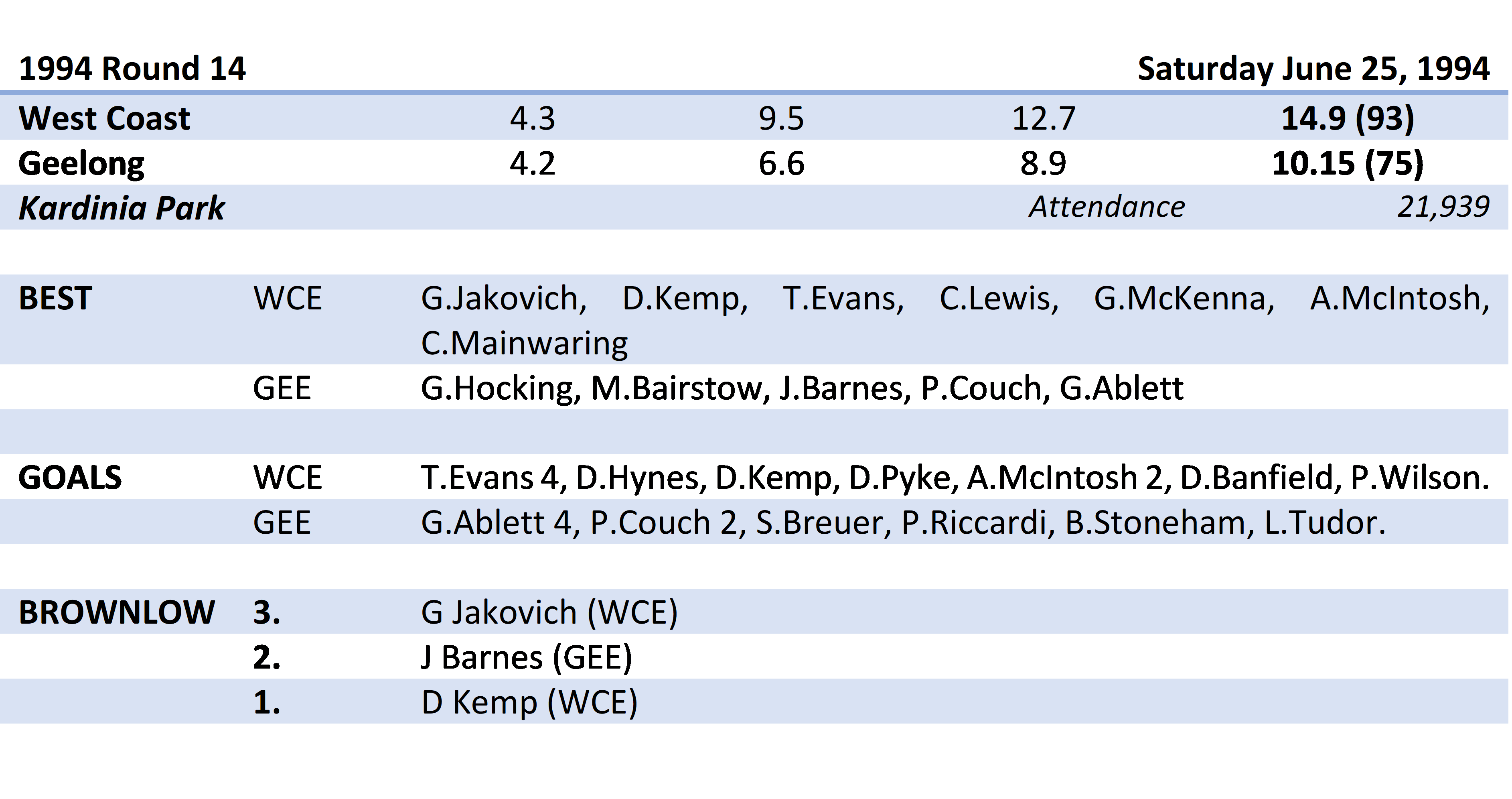
It was a case of the Eagles taking their chances and the Cats ruing theirs when West Coast bounced back from their loss to Collingwood with an 18 point win over Geelong at Kardinia Park.

Glen Jakovich was arguably the difference between the two sides, with the hulking centre half back picking up 28 disposals and 10 marks in a best on ground display. Jakovich had the better of first Barry Stoneham and then Leigh Colbert with Geelong coach Malcolm Blight unable to diffuse the Eagle’s output.

“The biggest problem we had all day was Jakovich. Forget the rest,” an exasperated Blight remarked after the game.

Jakovich had spent much of the week in doubt with a shoulder injury, but he proved to be an integral part in the Eagles win. Jakovich combined well with Guy McKenna who rebounded strongly off the half-back flank, while Tony Evans produced his best performance of an injury-interrupted season with four goals up forward.

Evans was considered lucky to have held his spot after managing just five disposals the week before, but several others weren’t so fortunate as West Coast made a raft of changes. Karl Langdon, Paul Harding and Matt Clape were all dropped, while Brett Spinks was ruled out with concussion.

Coming into the Eagles line-up were Jason Ball, David Hynes, captain John Worsfold and debutant Paul Symmons. Symmons’ inclusion capped a whirlwind week for the skinny redhead, after he was named best afield for Western Australia in their state league match against South Australia the previous week.

The inclusion of Hynes and Ball was with the intention of giving the Eagles forward line greater presence after Mick Malthouse thought too much reliance had been placed on mid-sized forwards Chris Lewis and Brett Heady the week before.

Peter Sumich remained sidelined as the Eagles opted for caution on their full forward. Sumich, along with Worsfold and Shane Bond, had undergone a fitness test before the squad departed for Geelong, but only Worsfold was declared fit.

The Cats were missing their own spearhead in Bill Brownless, who had not made an appearance since being dropped after the round 10 defeat to Essendon. Geelong, though, still brought back three important players in Leigh Colbert, Leigh Tudor and Peter Riccardi, who was set to resume his battle on the wing with Peter Matera. Sean Simpson was then the Cats’ fourth inclusion when he replaced Leigh Pickering ahead of the bounce.

But while there was no consternation when the team was announced, there were plenty of raised eyebrows when the teams lined up at the opening bounce.

Blight – not immune to thinking outside the box – abandoned his traditional attacking nature by starting many of his playmakers in unorthodox positions in a bid to match the Eagles defensive style. Garry Hocking lined up at half-forward, Robert Scott was sent to a back pocket on Evans, while Paul Couch – who had shown form in the previous month that was reminiscent of his 1989 Brownlow win – started on the bench.

Steven Hocking and Sean Simpson were both moved into the middle in tagging roles on Dean Kemp and Don Pyke, while Grant Tanner was given a similar task on the wing opposed to Chris Mainwaring. Ken Hinkley went to half-forward matching up against McKenna, with Andrew Wills sent to defence on Chris Lewis.

The moves worked for the first 30 seconds when Mark Bairstow was able to win the opening clearance and find Gary Ablett, who snapped the opening goal. But that was about as effective as Blight’s changes got.

Dean Kemp had nine first-quarter possessions – trailing only Jakovich on the ground who had 11 – and Tony Evans was proving too elusive for Robert Scott in the forward line. Chris Lewis was proving equally as difficult for Wills and the Cats were lacking drive with Hocking and Couch not involved in the game.

Two late goals put the Eagles in front at quarter time and they continued to dictate play in the second term. The Cats stuck to the task for the majority of the term, but again West Coast were able to nab a pair of goals late in the quarter to head into half-time with a 17 point advantage.

Kemp had tallied 17 disposals in the first half as he shook off the tagging effort of Steven Hocking, as did Jakovich who had restricted Stoneham to just seven disposals and no marks. Mainwaring picked up seven kicks and three handpasses in the second term to take him to 14 for the half, with Matera also recording 14 disposals in the first half on the other wing.

With the Eagles midfield controlling the game, Blight was forced to do away with his defensive tactics and resort back to Plan A, bringing Couch off the bench and putting he and Garry Hocking in the middle. West Coast booted the first two goals after the main break to stretch their lead to a game high 29 points, but Hocking soon dragged the Cats back into the contest.

The Cats midfielder went head to head with Kemp and had the better of the Eagle as Geelong got more ball in their forward half. However, for all their ball, they were continually met with the imposing presence of Jakovich.

Stoneham was moved to centre half back at the start of the third term, switching positions with Leigh Colbert who had struggled to contain Ashley McIntosh. Colbert moved to centre half forward and tried to drag Jakovich out of the play, but it was to no avail.

The Cats though still managed to kick the final two goals of the third term and Mark Bairstow could have made it three in a row after the siren, only to see his set shot hit slam into the post. Trailing by 22 points at the final change, the Cats continued to push, closing within eight points.

But they failed to capitalise on their chances with Gary Ablett and Tim McGrath, in particular both missing gettable shots. West Coast finished with the final two goals of the game to seal the four points in Chris Mainwaring’s 150th game, but Geelong’s 2.6 in the last term blew any chance they had of stealing the win at the death.

“It was a game of chances, I thought. When we had control of the game in the last quarter we didn’t take ours,” Blight said. The Geelong coach refused to accept that his positional changes at the start of the game had played into the Eagles hands, instead saying they were in the game but couldn’t make their shots on goal count.

Garry Hocking ended with 33 possessions, 21 of which came in the second half, while Paul Couch collected 19, despite spending the best part of half the game on the bench. Gary Ablett finished with four goals, but was well held by Michael Brennan and John Barnes had 18 disposals to go with 25 hit-outs through the middle.

Jakovich’s 28 disposals was the second-best effort in his career and he was the leading ball winner for the Eagles, ahead of Kemp who had 27. Guy McKenna had 25 and Mainwaring finished with 22 touches in his milestone game.

Remarkably, the win was the Eagles’ fourth in a row against Geelong at Kardinia Park, stretching back to 1989. In that time, they had also won twice against the Cats at Waverley Park and twice at the MCG, making it eight consecutive wins over Geelong in Victoria. On the flipside, they had lost twice at home in that same period.

Mick Malthouse was confident that his side would bounce back from their disappointing showing against Collingwood. “We have very rarely lost two in a row. The players responded to direct criticism during the week,” Malthouse proclaimed.

“If that’s the character they showed, then Geelong showed it too. It was a tough game from go to whoa. It was only in the last minute that I put my headphones down.”

When asked about Jakovich’s performance, Malthouse was naturally understated. “Good young player.”

The win maintained the Eagles position at the top of the ladder, one game ahead of Carlton who had defeated North Melbourne by 18 points in their Friday night blockbuster. The Blues leapfrogged the Kangaroos into second spot, with North Melbourne dropping to third. The Hawks held onto fourth position despite having the bye.

Footscray were the big winners of the round, rocketing from ninth to fifth when they thrashed Fitzroy by 104 points. The Bombers defeated Sydney by 34 points but fell behind the Bulldogs on percentage, while the Magpies were the latest team to fall victim at the GABBA, losing to the Bears by 44 points.

Richmond’s narrow win over Melbourne had them knocking on the top eight, while Adelaide missed a golden chance to jump back into the finals spots when they were held to a draw by lowly St Kilda. The Cats remained in eighth spot on percentage, with Malcolm Blight under increasing pressure to hold his position as senior coach.

A fortnight earlier, Blight had been booed by his own fans at three-quarter time when Geelong trailed the Saints by 26 points at home, only to have his blushes saved when the Cats stormed home to win by three points. With a 6-6 record after 12 games, Geelong were well short of expectations and reports of tension between players and the coach were surfacing.

However, Geelong president Greg Durham allayed any suggestions that Blight’s position was under threat, confirming the experienced coach wasn’t going anywhere.

1994 Rewind: Rookie Tranquilli Inspires Upset

The Eagles six game winning streak was brought to a surprising end when they were toppled by an undermanned Collingwood at the MCG.

Andrew Tranquilli proved the unlikely star for the Magpies, booting six goals in just his third AFL game as Collingwood held sway for most of the day to record the 37 point victory, in front of a disappointing crowd of only 27,699.

The Magpies entered the match as rank outsiders after a humiliating 66 point defeat to Richmond on the Queens Birthday just six days earlier as well as dealing with a crippling injury list.

Already without Paul Williams (knee), Craig Kelly (hamstring), Gary Pert (knee) and Jon Ballantyne (knee), Collingwood lost a further three players in the loss to the Tigers. Jason McCartney pulled out before the game, with Brad Rowe (dislocated shoulder) and Brad Plain (groin) both out of action before half-time.

In response to the loss, the Magpies made six changes for their clash with West Coast. McCartney returned to the line-up and was joined by veteran midfielder Scott Russell, wingmen Mark Fraser and Todd Curley, and rookies Paul Sharkey and Tranquilli.

Brad Rowe and Bradley Plain were both forced out with their respective injuries, as was defender Damian Houlihan who was suspended for striking Chris Naish. Stephen Ryan, Brenton Sanderson and Glenn Sandford were all dropped.

The Eagles, on the other hand, welcomed back a number of reinforcements. Brett Heady returned to the side after two false starts in the previous two weeks, with Peter Wilson also returning from a week off due to a hamstring strain. The Eagles brought in Paul Harding to partner Ryan Turnbull in the ruck, with West Coast conscious of the threat of Magpie ruckman Damian Monkhorst.

Out for the Eagles were David Hynes and Jarrad Schofield, who were both dropped, while Shane Bond missed out due to a hamstring complaint. Craig Turley was considered unlucky not to be named after a strong month of football with West Perth, but was a late inclusion for his first game since Round 5 when he replaced John Worsfold. The Eagles captain failed to recover from an arm injury suffered against the Bears.

Despite the Magpies’ troubles heading into the game, Eagles coach Mick Malthouse forewarned a response from Collingwood, saying the preparation had worked in the Magpies favour. Malthouse believed that the negative reporting from the Victorian media over the Magpies’ recent performance and injury woes had given Collingwood a psychological edge.

“They will go in as the rank underdogs basically because of a media beat-up on their injuries. The reports don’t say anything about the quality players that are in their side,” Malthouse said.

“The day a side loses a game because of who is sitting in the grandstand, is the day I’ll give the game away.”

Malthouse’s concerns would prove to be right.

The diminutive Tranquilli booted the opening goal of the match as Collingwood opened up a two goal lead at the first change. The Eagles though would rue a host of missed early chances. They had four behinds on the board before Brett Heady kicked their only goal for the quarter.

The Magpies then broke the game open in the second term with three goals in eight minutes, off the back of a courageous act from captain Tony Shaw. Running back with the flight of the ball, Shaw marked in the middle of the ground with Eagles winger Chris Mainwaring bearing down on him from the opposite direction, which led to a goal to Mick McGuane. Saverio Rocca and Nathan Buckley quickly followed with majors and the Magpies were out to a 23 point lead.

The Eagles worked their way back into the game, but could only match Collingwood for the rest of the term as the Magpies headed into the half-time break with an 18 point advantage.

After managing just four goals the week before against Richmond, Matthews’ loaded up his forward line and instructed his side to ‘kick the bloody thing in there and don’t mess around’. The Magpies started with Sav Rocca, Brett James and Jason McCartney in the forward line, with ruckman Damian Monkhorst also drifting inside the Collingwood 50.

This caused a shuffle for West Coast with Ashley McIntosh, who started up forward, moved to defence to counter the Magpie height. The forced move denied the Eagles a marking target of their own up forward, which was soon compounded when Brett Spinks was forced off the ground with concussion in the second quarter.

Matthews had also identified the Eagles half-back line as their main driver and looked to minimise their impact. Matthews put his strongest line at half-forward, with McCartney opposed to Glen Jakovich and Nathan Buckley and Gavin Brown on the two half-forward flanks.

Buckley had yet to make his mark at Collingwood after a high-profile switch from Brisbane ahead of the 1994 season and had managed just 10 disposals against the Tigers the week before. However, he responded with arguably his best performance thus far in the black-and-white stripes, picking up 26 disposals and booting two goals and giving Guy McKenna the run-around.

Buckley and Brown pushed high up the ground and stayed wide of each other to prevent the Eagles half-backs from teaming together. McCartney was operating as a decoy to drag Jakovich out of the play, which left Tranquilli deep in the forward line, often one-out against David Hart.

The other important tactical match-up was the use of Mark Fraser on a wing against Peter Matera. While Chris Mainwaring was having the better of McGuane, Matera struggled to have any influence on the game with Fraser keeping him company.

Matera had just 13 disposals for the game, while Fraser finished with 21 and two goals, including the vital first goal of the second half. Fraser extended the Magpies lead to 24 points just two minutes into the third term, and while West Coast responded, Damian Monkhorst and Andrew Tranquilli made it three of the first four goals to Collingwood.

Trailing by 31 points heading into time-on, the Eagles once again rallied. Brett Heady – who had been the only productive forward for West Coast all day – booted two goals in as many minutes, with Tony Evans and McKenna also kicking truly. The Eagles trailed by just 13 points at the final break, but a six goal to two final term in favour of Collingwood handed West Coast their first defeat in nearly two months.

Brett Heady matched Tranquilli’s haul of six, but the rest of the West Coast forward line struggled. Eagles coach Mick Malthouse was philosophical after the game, saying his team had been good but the Magpies had been the better.

“The game is in flux right through, it shuffles one way and then the other… we struck a very good side in Collingwood and they beat us.”

“Every match is against a different club, at a different ground on a different week,” Malthouse continued. “The competition now is so regulated – weighted draws, drafts and salary caps – that the game is a fluctuating thing that changes every week… every quarter… what worked last week will not necessarily do the trick again.”

While Malthouse accepted the result as one that was par for the tightness of the competition, Matthews praised the win as one of his side’s best. “It’s got to rank as a good win because we’ve beaten the top side by six goals.”

More importantly though, for Matthews, the result restored the Magpies standing within the competition. “Respect and pride. You either gain a bit or lose a bit and we lost some on Monday.”

“But we gained a bit today.”

Tony Shaw and Damian Monkhorst were the best for Collingwood, with Monkhorst too good for both Turnbull and Harding. Monkhorst finished with 16 disposals, 13 hit-outs and two goals while Shaw had 20 with a number of clearances.

Mainwaring had 26 touches for the Eagles and Don Pyke 24 but the Eagles had too few winners. “As honest as our players tried to be, they weren’t good enough.”

“They were beaten by their direct opponents and when shuffled around they were beaten by another opponent,” Malthouse said. “I don’t know how we got that close at three-quarter time. But they rallied, steadied and kicked goals when it counted most.”

“Collingwood did it better than us and won the game.”

Despite the loss, the Eagles remained a game clear at the top of the ladder, courtesy of a number of favourable results. Only two teams who started the round in the top eight – fourth-placed Carlton and the eighth-placed Magpies – won, while the Cats had the bye.

Carlton moved into third spot when they thumped a hapless St Kilda by 80 points, drawing level with the Kangaroos who lost narrowly to Richmond. Both teams sat one win behind the Eagles and one win ahead of Collingwood, who climbed to fifth following their win over West Coast, and Hawthorn, who lost to Fitzroy by 13 points in a low-scoring match at Waverley.

Melbourne’s season continued to freefall with a narrow defeat to Adelaide and Essendon were the latest victim of the giant-killing Bears, going down by 33 points at the GABBA.